Saint John the Baptist
Artist: Leonardo da Vinci · c. 1513–1516
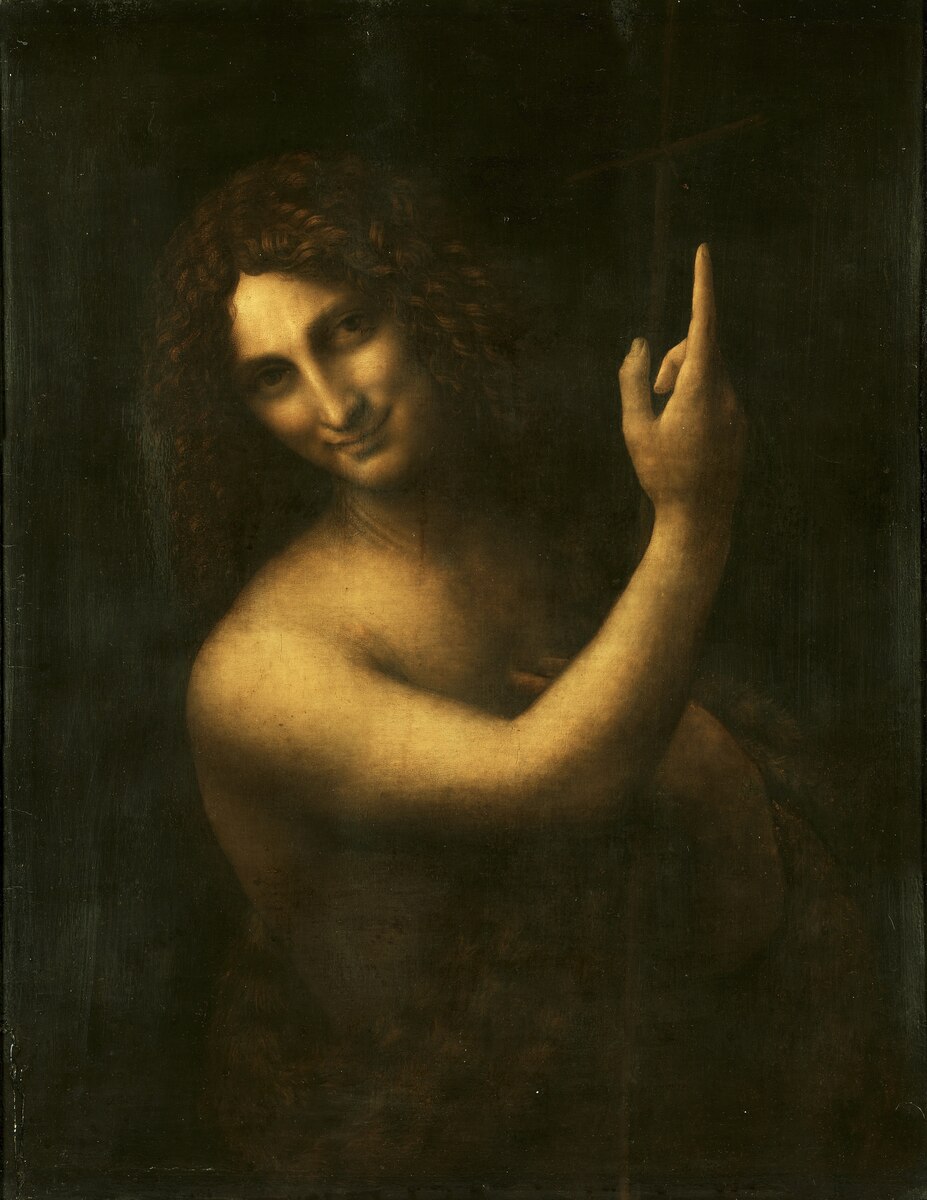
Saint John the Baptist: high-resolution image
The highest-resolution file we hold, available without payment or an account.3,840 × 4,971 pixels.
Download highest-resolution imageThe complete story
The story About 4 minutes to read
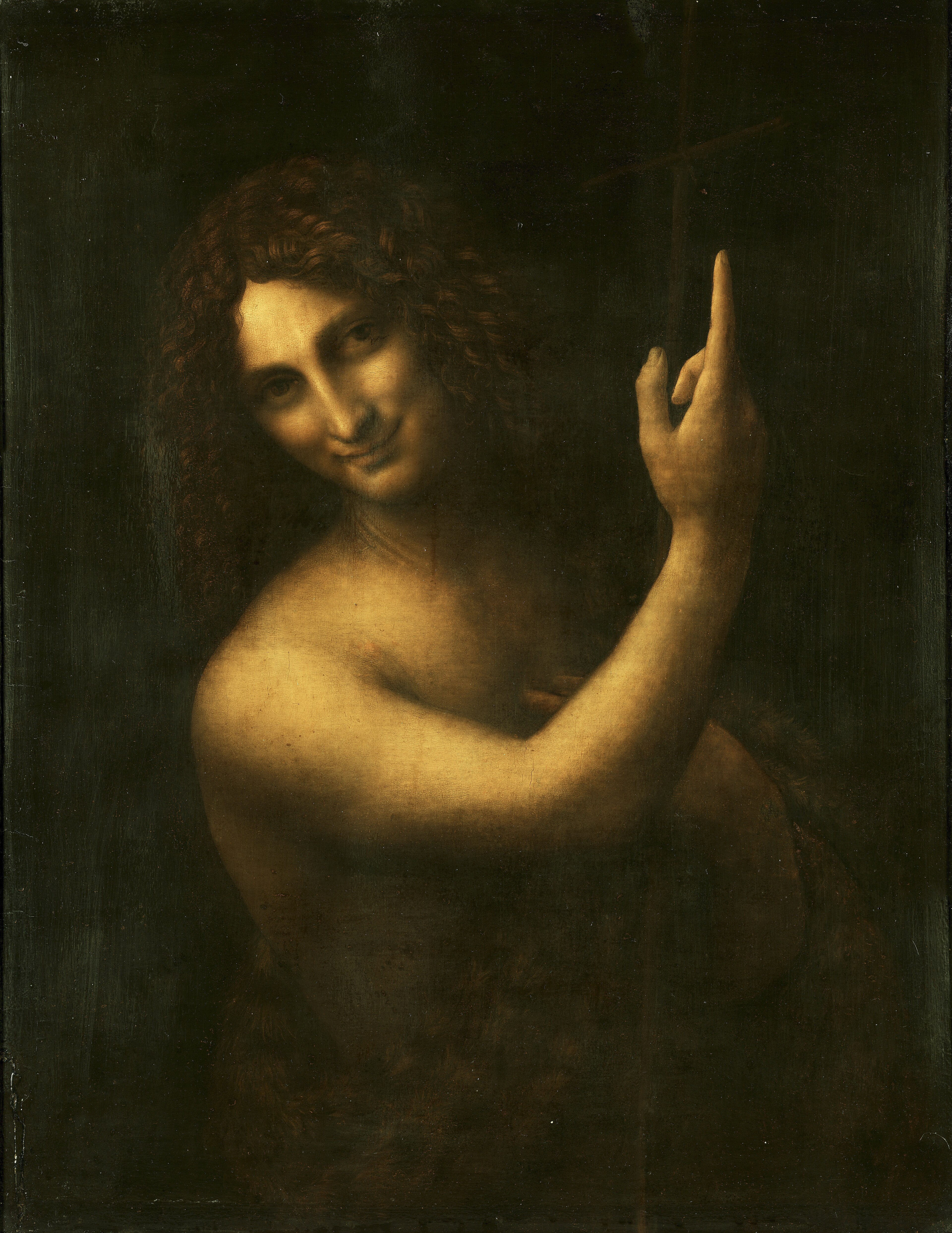
This is Leonardo da Vinci's Saint John the Baptist, painted around 1513 to 1516. The subject is John the Baptist himself, shown as a solitary figure emerging from darkness. In Christian tradition John is the prophet who prepared the way for Christ, and here he appears alone, close to the picture surface.
Look first at the face. It is softly lit, with cascading curls framing it, and the figure is described as androgynous. A Dutch caption on the image calls him smiling, and even without that label the mouth is relaxed rather than severe. Below, a bare shoulder and the fall of hair keep the body quiet and inward, so the face holds most of our attention.
Then follow the right hand. It is raised, pointing upward, and in the other hand he holds a thin reed cross. That upward gesture and the cross are the clearest signs of who he is. The cross refers to Christ, and the pointing hand directs attention beyond the figure himself. The darkness around him makes these small, pale elements stand out with unusual clarity.
The painting is oil on panel, and the supplied record dates it to the years 1513 to 1516, late in Leonardo's career. It is catalogued as a religious work and is attributed to Leonardo da Vinci in the museum record reproduced by the image source. That date belongs to the making of the painting, not to the biblical events associated with John the Baptist, which belong to a much earlier religious narrative.
You may encounter the suggestion that the figure resembles Salai, Leonardo's assistant. A Dutch caption on this image does make that identification. That is a later caption, reported tradition rather than the primary identification of the work. The supplied record presents John the Baptist as the subject, and the Salai reading is not established here. It's worth holding that distinction: a caption can record a tradition without proving the sitter's identity.
So the painting gives us John the Baptist through subtraction. Darkness surrounds him, the face is softly modelled, and the upward-pointing hand and thin reed cross carry the meaning. The figure is not shown preaching or baptising. He is presented as a presence, turned toward us and pointing beyond himself. That is what the work asks you to see: a sacred figure made legible through light, gesture and a single small sign.
The story and its sources
Historical claims are linked to the records below. Close looking and interpretation are identified in the passage notes.
- Passage 1Documented historyInstitutional record for Saint John the Baptist
- Passage 2Close lookingInstitutional record for Saint John the Baptist
- Passage 3Close lookingInstitutional record for Saint John the Baptist
- Passage 4Documented historyInstitutional record for Saint John the Baptist
- Passage 5Reported traditionInstitutional record for Saint John the Baptist
- Passage 6InterpretationInstitutional record for Saint John the Baptist
Details to notice
About 3 minutes to readCascading curls
The mass of long spiralling curls falling on both sides of the head, a signature motif of Leonardo's late style that softens the head against the dark background.
Lit shoulder and bare torso
The bare left shoulder and chest that step out of the black ground into warm light, demonstrating Leonardo's late sfumato and the emergence of the figure from darkness.
Thin reed cross
The slender cross of reeds, virtually swallowed by the darkness, whose faint horizontal and vertical bars rise behind the pointing finger and identify the figure as the Baptist.
Artist portrait Image credit
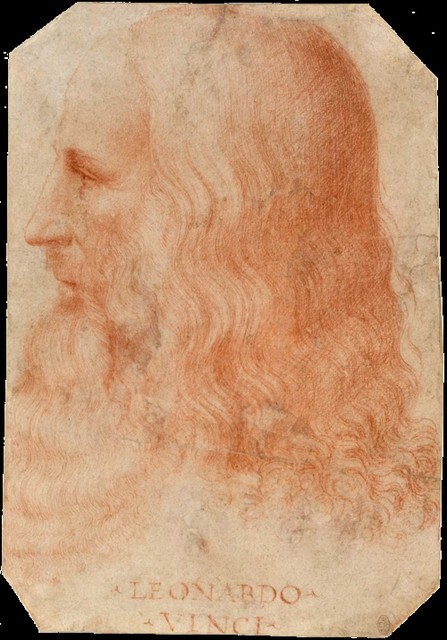
Attributed to Francesco Melzi. Image source · Public domain
About the artist
Leonardo da Vinci
1452 to 1519
Leonardo was an Italian Renaissance painter whose work also encompassed sculpture, architecture, engineering and scientific study. Trained in Andrea del Verrocchio's workshop in Florence, he later worked in Milan, Rome and France. His notebooks connect close observation of anatomy and nature with his interest in how gesture and expression convey thought.
- Born
- 1452
- Died
- 1519
- Nationality
- Italian
- Birthplace
- Near Vinci, Tuscany, Italy
Biography sources
The research & record
Study the work.
Follow the evidence.
Find catalogue details, historical context, technical research and the literature behind this artwork.
The artwork record
Research catalogue
Catalogue information and detailed research, with references that link to the bibliography.
Updated .
Identity and catalogue
Link- Title
- Saint John the Baptist(commons.wikimedia.org, n.d.)
- Artist or attribution
- Leonardo da Vinci
- Object date
- c. 1513–1516(commons.wikimedia.org, n.d.)
- Medium and support
- Oil on panel(commons.wikimedia.org, n.d.)
- Dimensions
- 69 cm × 57 cm (27.1 in × 22.4 in)(commons.wikimedia.org, n.d.)
- Current collection or location
- Musée du Louvre, Paris, France(commons.wikimedia.org, n.d.)
- Movement or period
- Italian Renaissance, High Renaissance
- Country or culture
- Italy, Florentine School
- Depicted subject
- Saint John the Baptist, depicted as a solitary figure emerging from darkness, with a softly lit androgynous face, cascading curls, a bare shoulder, and a raised right hand pointing upward, holding a thin reed cross.
- Title variants
- Saint John the Baptist; St. John the Baptist; San Giovanni Battista
- Accession number
- INV 775(commons.wikimedia.org, n.d.)
- Support
- Panel (poplar, as per generic Leonardo practice; not explicitly stated in this excerpt for this work, but the Commons record says 'oil on panel')
Read valuation records and their limitations
Catalogue data
The object is catalogued as "Saint John the Baptist" and attributed to Leonardo da Vinci, an attribution reproduced in the museum record as presented by the image source rather than argued or tested there. It is classified as a religious art object, and the depicted person is identified as John the Baptist. The supplied record gives its date as 1513 until 1516, its dimensions as 69 cm in height and 57 cm in width, and the medium as oil on panel. These are the core catalogue facts on which the rest of the account depends, and they should be kept distinct from any narrative or devotional claims made about the subject.(commons.wikimedia.org, n.d., Summary, Title; Summary, Date; Summary, Dimensions; Summary, Depicted people; Summary, Genre)
Two kinds of date are involved here and they must not be collapsed. The 1513 to 1516 range belongs to the making of the painting, late in Leonardo's career. It does not refer to the biblical events associated with John the Baptist, which belong to a much earlier religious narrative. The catalogue date therefore locates the object in sixteenth-century production, while the subject it depicts belongs to a separate and much older tradition. Keeping the two apart prevents the object's historical moment from being confused with the chronology of its subject.(commons.wikimedia.org, n.d., Summary, Date; Summary, Depicted people)
Provenance and title variants
Provenance and title variants qualify the bare catalogue entry. The painting was part of the collection of Louis XIV, acquired in 1661, which places it in royal ownership well after its making and before its eventual museum setting. The image source also carries plural captions, including a Dutch caption that identifies the figure as Salai as John the Baptist and another that describes the figure as smiling, referring to the work as "Saint John the Baptist smiling." These captions are recorded on the digital surrogate, not in a demonstrated primary identification, and they show how title and sitter descriptions vary across the record without displacing the catalogued subject, John the Baptist.(commons.wikimedia.org, n.d., Summary, Object history; Summary, Depicted people; Summary, Genre)
The painting is titled 'Saint John the Baptist' and is attributed to Leonardo da Vinci.(commons.wikimedia.org, n.d.)
The painting is dated from 1513 until 1516.(commons.wikimedia.org, n.d.)
The dimensions are height 69 cm and width 57 cm.(commons.wikimedia.org, n.d.)
The depicted person is John the Baptist.(commons.wikimedia.org, n.d.)
The painting is a religious art object.(commons.wikimedia.org, n.d.)
Subject and iconography
LinkRead valuation records and their limitations
The visible figure
Visual observation
The painting shows John the Baptist emerging from darkness. Within that dark setting the record describes a softly lit face of androgynous character, framed by cascading curls. The word 'androgynous' belongs to the record's own description of the figure's appearance and should be retained as such rather than converted into an argument about the sitter's identity or the painter's intention. What the description establishes is a contrast of regimes: a dark surround against which the lit head and hair are set, with the face carrying the greatest tonal delicacy. The figure's emergence from darkness is thus a compositional fact prior to any symbolic reading.(commons.wikimedia.org, n.d., Caption)
The work's expressive character has been recorded in its captions as well as in its appearance. A Dutch caption on the image notes that the figure is smiling and refers to the work as 'Saint John the Baptist smiling'. This caption is a piece of reception attached to the image file, not a statement in the painting's primary catalogue entry, but it registers a long-standing way of describing the face. Read together with the record's account of a softly lit, androgynous face and cascading curls, the caption indicates that the mouth and expression have been treated as salient features of the picture's effect, part of what distinguishes this Baptist from severe or hortatory depictions.(commons.wikimedia.org, n.d., Captions, Nederlands; Caption)
Competing identifications
The frame also carries a competing caption tradition. The record notes that a Dutch caption on the image identifies the figure as Salai as John the Baptist, and the summary of the source lists this alongside the primary identification of the depicted person as John the Baptist. The two statements are not of equal standing in the record: John the Baptist is the subject named in the object metadata, whereas the Salai reading appears in a caption. The Salai identification is therefore best reported as a caption-based tradition attached to the image, not as the painting's established subject; nothing in the supplied evidence documents who first proposed it, on what grounds, or with what scholarly support.(commons.wikimedia.org, n.d., Captions, Nederlands)
Interpretation
Set side by side, the captions show how a single reproduced image can carry divergent descriptions: one Dutch caption emphasizes the smiling expression, another names Salai. The descriptive one concerns what can be seen in the face; the identificatory one concerns who the figure is. Keeping them apart is the methodological point. A caption can register a tradition of viewing without proving an identification, and the presence of the Salai caption in the same file as the Saint John the Baptist title is evidence for the existence of that tradition, not for its correctness. The record itself presents the painting as religious art showing John the Baptist, and that remains the primary identification against which the caption tradition is weighed.(commons.wikimedia.org, n.d., Captions, Nederlands; Caption)
Visual observation
The painting shows John the Baptist, depicted with a softly lit androgynous face and cascading curls, emerging from darkness.(commons.wikimedia.org, n.d.)
A Dutch caption on the image notes the figure is smiling, referring to the work as 'Saint John the Baptist smiling'.(commons.wikimedia.org, n.d.)
Materials and technique
LinkRead valuation records and their limitations
Support and medium
The object is recorded in the institutional metadata as oil on panel, and that single material designation is the documentary anchor for any discussion of its making. The evidence supplied does not itemise the species of wood, the ground or priming, the binding medium, the pigments, or any conservation treatment, so those specifics cannot be asserted here. What the record does establish is the category of support and medium together: a paint layer in oil carried on a rigid wooden panel rather than on canvas or another flexible support. Within the larger history of European panel painting, this is the standard format for a portable devotional or gallery picture, and it conditions how the surface reads, since a panel permits the smooth, blended modelling that the visual record describes while also being vulnerable to the dimensional movement of wood. The date range recorded for the work, 1513 to 1516, belongs to the making of the painting, and the medium statement belongs to the same documented description rather than to any technical analysis reported in the evidence. Any further claim about preparation layers or pigment would exceed what these units support.(commons.wikimedia.org, n.d., Summary, Medium)
Visual effect and its limits
Interpretation
Read together, the material designation and the imaging history explain why this painting matters within a larger history of art and material culture. The oil-on-panel medium, dated 1513 to 1516 in the record, places the work at a moment when panel painting in oil was the vehicle for highly finished, tonally subtle pictures, and the high-resolution photographic record produced through the C2RMF's very-high-definition gallery project makes that subtlety available to remote study. The object's significance in these units is therefore double: it is a documented oil-on-panel religious painting whose surface rewards close looking, and it is a case in which institutional imaging has become part of how the work is known and circulated. That second life as a digital surrogate should not be mistaken for the physical object; the photograph documents appearance under particular conditions of capture, and the evidence supplied here does not describe those conditions in technical detail. Where the account of the making of the painting must remain open, the account of its documentation is comparatively firm, and the distinction between the two is the discipline this section is meant to hold.(commons.wikimedia.org, n.d., Summary, Medium; Structured data, digital representation of; Summary, Source/Photographer)
The digital surrogate and its imaging source
The technical record for this work that is available here describes the digital surrogate as much as the physical painting. The file is characterized as a digital representation of a two-dimensional work of art, which places it in the category of a photographic reproduction rather than a three-dimensional object record. Its imaging lineage is specified: the image is based on a high-resolution photograph made by the C2RMF, the Centre de recherche et de restauration des musées de France, and drawn from the 'Galerie de tableaux en très haute définition'. That attribution of the photography matters for how the image is read, because the resolution, lighting and colour of the surrogate derive from an institutional imaging campaign rather than from an unspecified snapshot. The same source describes the underlying object as oil on panel, so the reproduction stands in for a painted wooden support, and any judgment made from the file about surface, modelling or tonality is a judgment made through that photographic intermediary.(commons.wikimedia.org, n.d., Structured data, digital representation of; Summary, Source/Photographer; Summary, Medium)
Interpretation
Reading the technical evidence alongside the visual evidence suggests a distinction worth keeping explicit. The high-resolution C2RMF photograph is the mechanism by which the softly lit face, the cascading curls and the emergence from darkness become visible and describable at all, yet the photograph is not itself an examination of the panel. The source presents the image as a digital representation of a two-dimensional work and identifies its photographic origin, while the descriptive language about lighting and darkness belongs to the caption and observation record. The most defensible reading is therefore that the surrogate documents how the painting appears in a particular institutional photograph, and that claims about the physical construction of the object would require examination evidence that the supplied units do not contain.(commons.wikimedia.org, n.d., Structured data, digital representation of; Summary, Source/Photographer; Caption; Captions, Nederlands)
The medium is oil on panel.(commons.wikimedia.org, n.d.)
Technical examination
The painting is a digital representation of a two-dimensional work of art.(commons.wikimedia.org, n.d.)
The image is based on a C2RMF high-resolution photograph from the 'Galerie de tableaux en très haute définition'.(commons.wikimedia.org, n.d.)
Provenance and ownership
LinkRead valuation records and their limitations
Documented Ownership
The documented ownership history supplied for this painting begins in 1661, when it was acquired into the collection of Louis XIV. The institutional record that carries this information is the Louvre object record as reproduced on the Wikimedia Commons file page for the C2RMF high-resolution photograph; that same record identifies the work as Saint John the Baptist, attributed to Leonardo da Vinci and dated 1513 to 1516, oil on panel, 69 cm by 57 cm, with accession number INV 775, and places it on the first floor, Denon room 05, Grande Galerie. The 1661 acquisition into the royal collection is the only provenance event the supplied evidence establishes, and it is stated without any preceding owner, intermediary dealer, or earlier location. The interval before 1661 is therefore unrecorded in this evidence rather than documented as a change of ownership.(commons.wikimedia.org, n.d., Summary, Object history)
The current institutional identity of the object is fixed by the Louvre accession number INV 775, and the record locates it physically in Denon room 05, Grande Galerie. This matters for provenance because the accession number is the stable identifier linking the object described in the historical entry of 1661 to the painting now catalogued and displayed, while the room designation is a statement about present installation rather than historical ownership. The supplied evidence does not describe any intermediate transfer, sale, loan, seizure, or reinstallation between the 1661 acquisition and the present collection, so those stages remain gaps in the record rather than proven events.(commons.wikimedia.org, n.d., Summary, Object history)
The digital image through which the painting circulates is itself a documented derivative: it reproduces a two-dimensional work of art and is based on a C2RMF high-resolution photograph made for the 'Galerie de tableaux en très haute définition'. The file page states that the painting is in the public domain in its country of origin and in other countries where the copyright term is the author's life plus 100 years or fewer. This copyright status concerns the reproduction and reuse of the image, and it should not be read as a provenance event for the panel itself; the underlying object record is held by the Louvre, and the file page functions as a discovery aid and digital surrogate rather than as the primary collection record.(commons.wikimedia.org, n.d., Licensing; Summary, Object history)
The painting was part of the collection of Louis XIV, acquired in 1661.(commons.wikimedia.org, n.d.)
Provenance timeline
- 1661
The painting is recorded as having been part of the collection of Louis XIV in an acquisition dated to that year, as stated in the institutional record.(commons.wikimedia.org, n.d., Summary, Object history)
Reception and literature
LinkRead valuation records and their limitations
Layered Evidence of Reception
Visual observation
The reception of Leonardo da Vinci's Saint John the Baptist cannot be reduced to a single dramatic moment or a single documented reading; the surviving evidence instead establishes a layered record in which the object's original sacred subject, its later institutional custody, its naming in multilingual captions, and its modern availability as a reproduction each contribute a distinct kind of meaning. The institutional record reproduced on the file page for the C2RMF high-resolution photograph identifies the work as a religious art object, titled Saint John the Baptist, attributed to Leonardo da Vinci, dated 1513 to 1516, oil on panel, measuring 69 cm by 57 cm, held by the Louvre Museum under accession number INV 775, and currently located on the 1st floor, Denon room 05, Grande Galerie. These particulars describe making and custody rather than reception, but they are the foundation on which any account of subsequent responses rests: the painting's status as a named, dated, measured and accessioned object is what allows later viewers, cataloguers and image users to respond to it as a specific work rather than an anonymous image.(commons.wikimedia.org, n.d., Licensing; Summary, Object history; Caption; Captions, Nederlands)
Reproduction and Digital Circulation
The modern reproduction of the painting through a C2RMF high-resolution photograph from the 'Galerie de tableaux en très haute définition' represents a further stage of reception in which the work becomes available as a digital surrogate. The supplied record states that the image is a digital representation of a two-dimensional work of art and that the file page is a discovery aid, with the underlying object record held by the Louvre. This matters for reception because the captions, identifications and public-domain status that circulate with the image are attached to the reproduction and its file page, not necessarily to the museum's own catalogue entry; the evidence supports the general observation that digital reproduction extends the reach of the work while also carrying along interpretive material that the object itself does not establish.(commons.wikimedia.org, n.d., Licensing; Caption; Summary, Object history)
The public-domain status recorded for the painting, in its country of origin and in other countries and areas where the copyright term is the author's life plus 100 years or fewer, is a legal condition rather than an interpretation, but it has consequences for reception. Public-domain status is what permits the high-resolution photograph and its captions to circulate freely, and it is the condition under which later viewers can encounter the work without institutional mediation. The evidence does not record specific exhibitions, publications, or named later artists who imitated or appropriated the painting, and none should be supplied. What the supplied units do support is a reception history organized around custody, description, captioning and reproduction, each of which adds a layer to the object's meaning without displacing the sacred subject it was made to present.(commons.wikimedia.org, n.d., Licensing; Summary, Object history; Captions, Nederlands)
The painting is in the public domain in its country of origin and other countries and areas where the copyright term is the author's life plus 100 years or fewer.(commons.wikimedia.org, n.d.)
Interpretations and debates
LinkRead valuation records and their limitations
Reported traditions and disputed accounts
Reported tradition
A Dutch caption on the image identifies the figure as Salai as John the Baptist. This is a caption level identification attached to the digital file, and the supplied material presents it as a second layer of naming alongside the work's primary title. Read carefully, the caption does not replace the subject: it names the figure as John the Baptist while adding the further claim that Salai is the one depicted under that identity. The evidence records the caption's content without establishing that identification, and the object record itself presents John the Baptist as the subject. The distinction matters because a caption can transmit a tradition without documenting a sitter, and here the two names coexist on the same page in a way that could easily be mistaken for a single settled attribution.(commons.wikimedia.org, n.d., Captions, Nederlands)
Interpretation
The evidential weight of the Salai identification is therefore limited and specific. It survives as a reported tradition in a Dutch caption on a Wikimedia Commons file page, a source whose own annotation describes it as a discovery aid and digital surrogate for an object record held by the Louvre; the caption is multilingual file metadata, not a Louvre catalogue entry. Against it stands the primary identification of the work as Saint John the Baptist, which the supplied record states as the subject and which the title, the religious classification and the object history all support. The smiling figure described in the same captions can be related to the Salai caption only as a juxtaposition within one file page; nothing in the evidence ties the smile to Salai as a sitter, and nothing establishes who first proposed the identification, when, or on what grounds. The honest position is that the Salai reading is recorded, not proven, and that it does not displace the religious subject of the painting.(commons.wikimedia.org, n.d., Captions, Nederlands)
Reported tradition
A Dutch caption on the image identifies the figure as Salai as John the Baptist.(commons.wikimedia.org, n.d.)
Collection and display
LinkRead valuation records and their limitations
The Louvre record: collection, accession and display
The object's institutional life can be stated with unusual directness. The painting titled Saint John the Baptist and attributed to Leonardo da Vinci is in the collection of the Louvre Museum, and it carries the accession number INV 775. Those two facts together locate the work within a specific public collection and a specific cataloguing system, so that any study of the panel begins from a named, numbered holding rather than a floating attribution. The same institutional record gives its present placement: the painting is currently located on the 1st floor, Denon room 05, Grande Galerie, and the record also states that it is currently on display at the Musée du Louvre. The location and the display statement agree in placing the work before visitors in the Grande Galerie, one of the Louvre's long picture galleries, although the record does not describe the installation, the case, the lighting or the labelling that a visitor would actually encounter.(commons.wikimedia.org, n.d., Summary, Collection; Summary, Accession number; Summary, Current location)
Interpretation
What the supplied evidence establishes is the museum record and the digital surrogate derived from it, not a firsthand examination of the panel in the gallery. The source is a Wikimedia Commons file page for a high-resolution image of the painting, made from a C2RMF photograph from the 'Galerie de tableaux en très haute définition', and the page's own framing describes the file as a digital representation of a two-dimensional work of art. The underlying object record is held by the Louvre. This matters for how the collection facts should be weighed: the accession number, the Denon room 05 placement and the display statement are reported through a source that functions as a discovery aid and digital surrogate, and its description notes that the page is only partially consulted. The painting's presence in the Louvre can therefore be stated as documented, while the finer details of its current installation rest on a secondary reproduction of the museum's information rather than on the museum's own catalogue entry or on inspection.(commons.wikimedia.org, n.d., Summary, Collection; Summary, Accession number; Summary, Current location)
The painting is in the collection of the Louvre Museum.(commons.wikimedia.org, n.d.)
The accession number is INV 775.(commons.wikimedia.org, n.d.)
The painting is currently located on the 1st floor, Denon room 05, Grande Galerie.(commons.wikimedia.org, n.d.)
The painting is currently on display at the Musée du Louvre.(commons.wikimedia.org, n.d.)
Documented values and qualified estimates
LinkRead valuation records and their limitations
Valuation as a recorded figure
Interpretation
The only recorded valuation in the evidence is a calculated working range, generated on 2026-10-16 as an estimate of insurance exposure: US$800 million to US$1.6 billion. Its stated methodology specifies a broad working range prepared for manual review only, based on the identification of the panel as a confirmed Leonardo da Vinci autograph painting of the High Renaissance, c. 1513-1516, oil on panel, 69 x 57 cm, Louvre Museum, accession INV 775, from the French royal collection. The calculation is said to reflect the extreme scarcity of Leonardo panel paintings, the work's museum status, exhibition and loan exposure, and the lack of recent market transactions. The same record explicitly states that no auction, sale or official appraisal data for this specific work was used or is claimed. This is a model-generated figure for manual review, not an official insurance value, appraisal, auction result or sale price, and actual insurance placement would require a qualified fine-art appraiser and specialist underwriter review.(Musée du Louvre, n.d.)(commons.wikimedia.org, n.d.)
The valuation record rests on no public comparable sales, private insurance records or verified market data for this specific work, and its own qualification says so. The range therefore measures scarcity and institutional standing as described in the record, not a price at which the panel has ever changed hands; the documented 1661 acquisition by Louis XIV is a royal provenance event, not a market transaction. What the record contributes is a dated, attributable working estimate whose basis and limits are stated in the same document, together with the object identification on which it depends. Used carefully, the figure is evidence of how the work's rarity and its protected museum status are currently framed in financial terms; it is not evidence of the painting's value in the seventeenth century, nor of any sale, and its dependence on the attribution means that the two records stand or fall together.(Musée du Louvre, n.d.)(commons.wikimedia.org, n.d.)
Working estimate
Calculated working insurance estimate, not a sale price: Estimated insurance range: US$800M to US$1.6B Recorded date: Working calculation, generated 2026-10-16. Methodology: Broad working insurance range calculated for manual review only. Basis: confirmed Leonardo da Vinci autograph painting, High Renaissance, c. 1513-1516, oil on panel, 69 x 57 cm, Louvre Museum, accession INV 775, from the French royal collection. The calculation reflects the extreme scarcity of Leonardo panel paintings, the work's museum status, exhibition and loan exposure, and the lack of recent market transactions. No auction, sale, or official appraisal data for this specific work was used or is claimed. Qualification: This is a model-generated working range for manual review only. It is not an official insurance value, appraisal, auction result, or sale price. No public comparable sales, private insurance records, or verified market data for this specific work were used. Actual insurance placement would require a qualified fine-art appraiser and specialist underwriter review.(Musée du Louvre, n.d.)(commons.wikimedia.org, n.d.)
Bibliography
Sources and further reading
References are arranged by author or organisation, with links to the original publications. Where no publication date is recorded, n.d. means no date.
Source notes updated .
No recorded sources match these filters. Reset the filters to see the full bibliography.
- 02
Official · About this artwork
Wikimedia Commons file page for the C2RMF high-resolution image of Leonardo da Vinci's Saint John the Baptist. The file page provides the primary object metadata: title, artist, date range 1513–1516, medium oil on panel, dimensions 69 cm by 57 cm, collection Louvre Museum, accession number INV 775, current location 1st floor Denon room 05 Grande Galerie, object history from Louis XIV in 1661, and structured data showing the digital representation is of the painting Saint John the Baptist. The page also includes multilingual captions, including a Dutch caption identifying the figure as Salai. This source is a discovery aid and digital surrogate; the underlying object record is held by the Louvre.
Citation text
- 01
Museum · Background reading
Saint John the Baptist, Leonardo da Vinci | Louvre Collections.
Louvre Collections page for a Leonardo da Vinci painting. The supplied excerpt primarily discusses the Mona Lisa (Portrait of Lisa Gherardini), not Saint John the Baptist. It confirms the Louvre's collection practices and references works by Leonardo, but does not provide object-specific information for Saint John the Baptist. It is included here as an official museum source from the same institution, but with limited direct relevance to the Saint John the Baptist entry.
Citation text
Art to live with
Bring this painting
home.
A piece of the archive, made yours. Explore Saint John the Baptist in a size and finish that fits your space.
Your text and annotations appear on these editions. Adding to cart saves that design for printing.
Combine this painting with your favourites01 / Find your edition
Made for you
Suggested from your location. Change it if you're sending elsewhere or using a VPN. Prices and delivery are shown in GBP.
19 products
Choose an edition to make it yours
6 × 8 in · Printed cover · 118 lined pages
6 × 8 in · Printed cover · 118 lined pages
6 × 8 in · Printed cover · 118 lined pages
Notebook
GBP 11.91
Delivery GBP 5.30 / Total GBP 17.21
A 6 × 8 inch spiral notebook with 118 ruled pages (59 sheets), a printed front cover, dark grey back cover and metal spiral binding.
Fit and fill keep the painting’s proportions. Stretch changes them.
Move and zoom the painting on your notebook.
Made to order with your design
Made to order
US delivery only
27.9 × 35.6 cm / 11 × 14 in · Standard
27.9 × 35.6 cm / 11 × 14 in · Standard

11 × 14 in / 27.9 × 35.6 cm · Standard

11 × 14 in / 27.9 × 35.6 cm · Standard

11 × 14 in / 27.9 × 35.6 cm · Standard

11 × 14 in / 27.9 × 35.6 cm · Standard

11 × 14 in / 27.9 × 35.6 cm · Standard
Metal art sign
GBP 28.43
Delivery GBP 17.71 / Total GBP 46.14
A printed aluminium sign with rounded corners and mounting holes.
Fit and fill keep the painting’s proportions. Stretch changes them.
Move and zoom the painting on your metal art sign.
Made to order with your design
Printed aluminium · mounting holes included
US delivery only
iPhone 12 Mini ? Glossy ? back view
iPhone 12 Mini · Glossy

iPhone 12 Mini ? Glossy ? back view

iPhone 12 Mini ? Glossy ? back view

iPhone 12 Mini ? Glossy ? back view
Tough phone case
GBP 16.40
Delivery GBP 4.25 / Total GBP 20.65
A two-layer phone case with a printed polycarbonate shell and a shock-absorbing inner liner.
Two layers with a shock-absorbing TPU liner
Case & print details
- Device
- Apple · iPhone 12 Mini
- Material
- Polycarbonate shell with a TPU inner liner
- Artwork
- Outer back and wrapped edges from one template
- Finish
- Glossy
- Version
- Standard version
- Printing
- Dye sublimation
- Print file
- 1,122 × 1,831 px · 95 × 155 mm · PNG · 300 dpi recommended
Rear outline and camera openings follow this variant's Printify template. Case depth and small hardware remain illustrative.
Supplier product detailsFit and fill keep the painting’s proportions. Stretch changes them.
Move and zoom the painting on your tough phone case.
Made to order with your design
Made to order
US delivery only
20.3 × 25.4 cm / 8 × 10 in · White
20.3 × 25.4 cm / 8 × 10 in · White

8 × 10 in / 20.3 × 25.4 cm · White

8 × 10 in / 20.3 × 25.4 cm · White

8 × 10 in / 20.3 × 25.4 cm · White

8 × 10 in / 20.3 × 25.4 cm · White
Framed art print
GBP 34.16
- 1 framed print
- GBP 34.16
- Delivery to United States
- GBP 9.64
- Total
- GBP 43.80
A ready-to-hang wooden frame with a clear Perspex cover and a semi-gloss printed insert.
Delivery is quoted for all selected copies together.
Fit and fill keep the painting’s proportions. Stretch changes them.
Move and zoom the painting on your framed art print.
Made to order with your design
Wooden frame & protective clear front included
US delivery only
38.1 × 40.6 cm / 15 × 16 in · Natural
38.1 × 40.6 cm / 15 × 16 in · Natural

15 × 16 in / 38.1 × 40.6 cm · Natural

15 × 16 in / 38.1 × 40.6 cm · Natural

15 × 16 in / 38.1 × 40.6 cm · Natural

15 × 16 in / 38.1 × 40.6 cm · Natural

15 × 16 in / 38.1 × 40.6 cm · Natural
Canvas tote bag
GBP 14.25
Delivery GBP 4.33 / Total GBP 18.58
A sturdy cotton canvas tote with reinforced handles and artwork on the front panel.
Fit and fill keep the painting’s proportions. Stretch changes them.
Move and zoom the painting on your canvas tote bag.
Made to order with your design
Front print · reinforced cotton handles
US delivery only
22.9 × 20.3 cm / 9 × 8 in · Standard
22.9 × 20.3 cm / 9 × 8 in · Standard

9 × 8 in / 22.9 × 20.3 cm · Standard

9 × 8 in / 22.9 × 20.3 cm · Standard

9 × 8 in / 22.9 × 20.3 cm · Standard

9 × 8 in / 22.9 × 20.3 cm · Standard
Mouse mat
GBP 7.29
Delivery GBP 4.82 / Total GBP 12.11
A rectangular fabric mouse mat with a rubber backing and rounded corners.
Fit and fill keep the painting’s proportions. Stretch changes them.
Move and zoom the painting on your mouse mat.
Made to order with your design
Made to order
US delivery only
See more13 more products
43.2 × 45.7 cm / 17 × 18 in · Artwork
43.2 × 45.7 cm / 17 × 18 in · Artwork

17 × 18 in / 43.2 × 45.7 cm · Artwork

17 × 18 in / 43.2 × 45.7 cm · Artwork

17 × 18 in / 43.2 × 45.7 cm · Artwork
Woven tote bag
GBP 46.87
Delivery GBP 5.88 / Total GBP 52.75
A woven tote with cotton webbing handles and the painting translated into a woven design.
Fit and fill keep the painting’s proportions. Stretch changes them.
Move and zoom the painting on your woven tote bag.
Made to order with your design
Made to order
US delivery only
25.4 × 33 cm / 10 × 13 in · Standard
25.4 × 33 cm / 10 × 13 in · Standard

10 × 13 in / 25.4 × 33 cm · Standard

10 × 13 in / 25.4 × 33 cm · Standard

10 × 13 in / 25.4 × 33 cm · Standard

10 × 13 in / 25.4 × 33 cm · Standard

10 × 13 in / 25.4 × 33 cm · Standard
Matte art print
GBP 12.84
Delivery GBP 7.22 / Total GBP 20.06
An unframed matte poster with archival inks, ready for a frame of your choice.
Fit and fill keep the painting’s proportions. Stretch changes them.
Move and zoom the painting on your matte art print.
Made to order with your design
Unframed · frame it your way
US delivery only
iPhone 12 Mini ? Standard ? back view
iPhone 12 Mini · Standard

iPhone 12 Mini ? Standard ? back view

iPhone 12 Mini ? Standard ? back view

iPhone 12 Mini ? Standard ? back view
Flexible phone case
GBP 15.62
Delivery GBP 4.25 / Total GBP 19.87
A flexible TPU phone case with a frosted finish, a printed back and precise port openings.
Flexible TPU with a frosted, matte finish
Case & print details
- Device
- Apple · iPhone 12 Mini
- Material
- Semi-transparent thermoplastic polyurethane (TPU)
- Artwork
- Back print; rim stays unprinted
- Finish
- Standard
- Version
- Standard version
- Printing
- Dye sublimation
- Print file
- 791 × 1,586 px · 67 × 134.3 mm · PNG · 300 dpi recommended
Rear outline and camera openings follow this variant's Printify template. Case depth and small hardware remain illustrative.
Supplier product detailsFit and fill keep the painting’s proportions. Stretch changes them.
Move and zoom the painting on your flexible phone case.
Made to order with your design
Made to order
S · Standard
S · Standard

S · Standard

S · Standard

S · Standard

S · Standard

S · Standard
Crew socks
GBP 10.66
Delivery GBP 4.43 / Total GBP 15.09
Crew-length polyester and spandex socks with a ribbed cuff, cushioned sole and sublimated artwork.
Fit and fill keep the painting’s proportions. Stretch changes them.
Move and zoom the painting on your crew socks.
Made to order with your design
One pair · design repeated on both socks
US delivery only
12" · Standard
12" · Standard

12" · Standard

12" · Standard

12" · Standard
Laptop sleeve
GBP 26.12
Delivery GBP 4.92 / Total GBP 31.04
A polyester laptop sleeve with a fleece lining, top zip, printed front and black reverse.
Fit and fill keep the painting’s proportions. Stretch changes them.
Move and zoom the painting on your laptop sleeve.
Made to order with your design
Made to order
US delivery only
11oz · 2 image repeats
11oz · White
11oz · 2 image repeats
Mug
GBP 7.36
Delivery GBP 6.17 / Total GBP 13.53
A glossy white ceramic mug with a C-shaped handle, available in 11oz and 15oz sizes.
repeat layout · choose single, double or a repeating pattern in Customise.
Repeat, fit, fill and position your artwork around the mug.
Made to order with your design
Made to order
iPhone 12 Mini ? Standard ? back view
iPhone 12 Mini · Standard

iPhone 12 Mini ? Standard ? back view

iPhone 12 Mini ? Standard ? back view

iPhone 12 Mini ? Standard ? back view

iPhone 12 Mini ? Standard ? back view

iPhone 12 Mini ? Standard ? back view
Biodegradable phone case
GBP 20.96
Delivery GBP 4.25 / Total GBP 25.21
A matte phone case made from plant polymers and bamboo fibre, with the artwork printed on the back.
Flexible plant-polymer shell with a matte finish
Case & print details
- Device
- Apple · iPhone 12 Mini
- Material
- PLA and PBAT polymers with bamboo fibre
- Artwork
- Back print; rim stays unprinted
- Finish
- Standard
- Version
- Standard version
- Printing
- Dye sublimation
- Print file
- 777 × 1,553 px · 65.8 × 131.5 mm · PNG · 300 dpi recommended
Rear outline and camera openings follow this variant's Printify template. Case depth and small hardware remain illustrative.
Supplier product detailsFit and fill keep the painting’s proportions. Stretch changes them.
Move and zoom the painting on your biodegradable phone case.
Made to order with your design
Made to order
27.9 × 35.6 cm / 11 × 14 in · Standard
27.9 × 35.6 cm / 11 × 14 in · Standard

11 × 14 in / 27.9 × 35.6 cm · Standard

11 × 14 in / 27.9 × 35.6 cm · Standard

11 × 14 in / 27.9 × 35.6 cm · Standard
Fine art poster
GBP 20.66
Delivery GBP 7.61 / Total GBP 28.27
A gallery paper print with a smooth art-paper surface. Choose a size that suits the painting.
Fit and fill keep the painting’s proportions. Stretch changes them.
Move and zoom the painting on your fine art poster.
Made to order with your design
Unframed · frame it your way
iPhone 12 Mini ? Standard ? back view
iPhone 12 Mini · Standard

iPhone 12 Mini ? Standard ? back view

iPhone 12 Mini ? Standard ? back view

iPhone 12 Mini ? Standard ? back view
Clear phone case
GBP 15.11
Delivery GBP 4.25 / Total GBP 19.36
A clear phone case with artwork on the back. Leave areas transparent to show the phone underneath.
Clear shell with shock-absorbing TPU sides
Case & print details
- Device
- Apple · iPhone 12 Mini
- Material
- Polycarbonate back and clear TPU sides
- Artwork
- Back print; clear sides stay unprinted
- Finish
- Standard
- Version
- Standard version
- Printing
- Dye sublimation
- Print file
- 732 × 1,527 px · 62 × 129.3 mm · PNG · 300 dpi recommended
Rear outline and camera openings follow this variant's Printify template. Case depth and small hardware remain illustrative.
Supplier product detailsFit and fill keep the painting’s proportions. Stretch changes them.
Move and zoom the painting on your clear phone case.
Made to order with your design
Made to order
15oz · 3 image repeats
15oz · Standard

15oz · 3 image repeats

15oz · 3 image repeats

15oz · 3 image repeats

15oz · 3 image repeats

15oz · 3 image repeats
Travel mug
GBP 32.00
Delivery GBP 5.68 / Total GBP 37.68
A stainless-steel travel mug with a black lid, a tapered base and a printed white exterior.
repeat layout · choose single, double or a repeating pattern in Customise.
Repeat, fit, fill and position your artwork around the mug.
Made to order with your design
Made to order
US delivery only
2.5 × 3.4 cm / 1 × 1.4 in · Glossy
2.5 × 3.4 cm / 1 × 1.4 in · Glossy

1 × 1.4 in / 2.5 × 3.4 cm · Glossy

1 × 1.4 in / 2.5 × 3.4 cm · Glossy

1 × 1.4 in / 2.5 × 3.4 cm · Glossy

1 × 1.4 in / 2.5 × 3.4 cm · Glossy
Photo keyring
GBP 10.19
Delivery GBP 5.39 / Total GBP 15.58
A rectangular zinc-alloy photo keyring with a glossy insert and a swivel split ring.
Fit and fill keep the painting’s proportions. Stretch changes them.
Move and zoom the painting on your photo keyring.
Made to order with your design
Photo insert · zinc frame & swivel ring
US delivery only
iPhone 15 Pro ? Glossy ? back view
iPhone 15 Pro · Glossy

iPhone 15 Pro ? Glossy ? back view

iPhone 15 Pro ? Glossy ? back view

iPhone 15 Pro ? Glossy ? back view

iPhone 15 Pro ? Glossy ? back view

iPhone 15 Pro ? Glossy ? back view
Slim phone case
GBP 16.37
Delivery GBP 5.79 / Total GBP 22.16
A slim printed phone shell with open ports and a lightweight profile.
Slim, lightweight polycarbonate shell
Case & print details
- Device
- Apple · iPhone 15 Pro
- Material
- Polycarbonate
- Artwork
- Outer back and wrapped edges from one template
- Finish
- Glossy
- Version
- Standard version
- Printing
- Dye sublimation
- Print file
- 1,278 × 1,971 px · 108.2 × 166.9 mm · PNG · 300 dpi recommended
Rear outline and camera openings follow this variant's Printify template. Case depth and small hardware remain illustrative.
Supplier product detailsFit and fill keep the painting’s proportions. Stretch changes them.
Move and zoom the painting on your slim phone case.
Made to order with your design
Made to order
US delivery only
36.6 × 30.7 cm / 14.4 × 12.1 in · Standard
36.6 × 30.7 cm / 14.4 × 12.1 in · Standard

14.4 × 12.1 in / 36.6 × 30.7 cm · Standard

14.4 × 12.1 in / 36.6 × 30.7 cm · Standard

14.4 × 12.1 in / 36.6 × 30.7 cm · Standard
Desk mat
GBP 15.29
Delivery GBP 7.13 / Total GBP 22.42
A smooth polyester desk mat with a natural rubber non-slip base and anti-fray edges, available in three sizes.
Fit and fill keep the painting’s proportions. Stretch changes them.
Move and zoom the painting on your desk mat.
Made to order with your design
Made to order
The 30 cm ruler is scaled alongside your selected print. Keep the painting’s proportions with a black background, or stretch it to fill. Frame width, material texture and screen colours are illustrative.
Keep exploring