Lady with an Ermine
Artist: Leonardo da Vinci · circa 1490 (alternatively 1483-1490)

Lady with an Ermine: high-resolution image
The original file is hosted by Wikimedia Commons, available without payment or an account.
Open high-resolution image on Wikimedia CommonsThe complete story
The story About 4 minutes to read
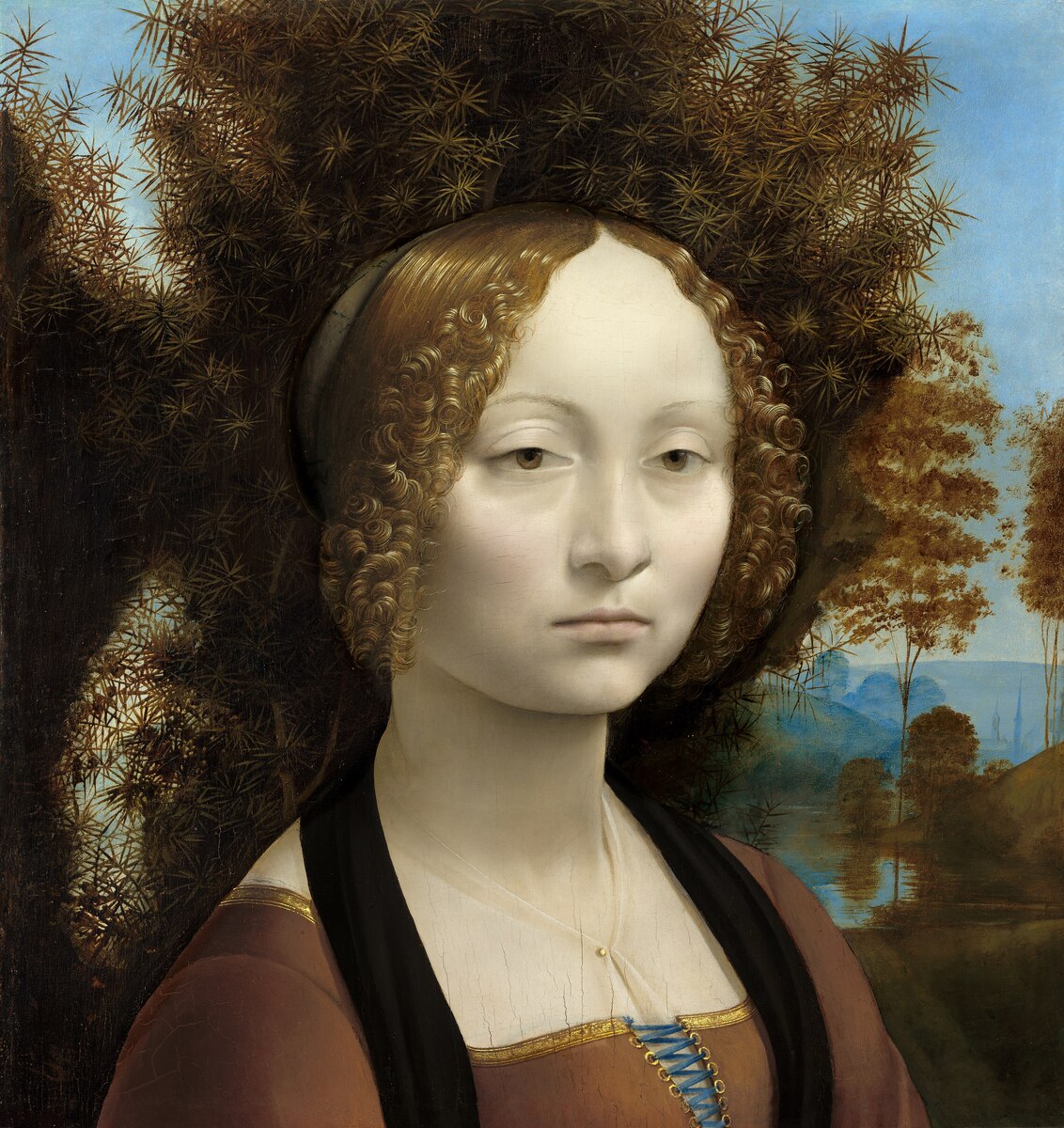
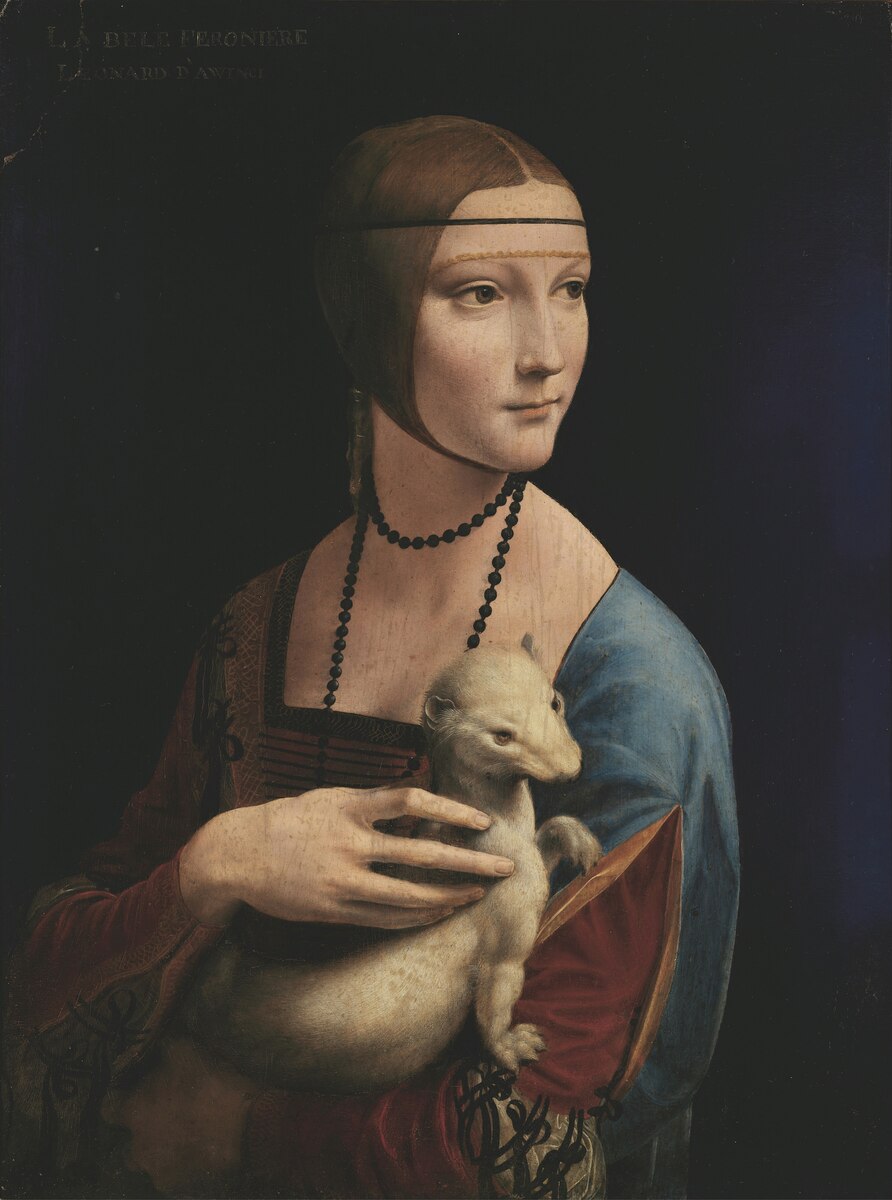
This is Leonardo da Vinci's Lady with an Ermine, a half-length portrait of a young woman holding a white ermine across her chest. The animal turns its head toward her. The sitter is identified as Cecilia Gallerani. That identification is described as reasonably secure, following M. Kemp, though scholars Janice Shell and Grazioso Sironi have traced how the name was first attached to the picture in 1900. The painting is dated to about 1490, with an alternative range of 1483 to 1490. It was commissioned by Ludovico Sforza in Milan.
Look at how she is posed. Her body turns one way while her face turns another, so we see her in three-quarter view rather than flat on. The ermine is held across her chest, and its head twists back toward her face. The two heads answer each other across the centre of the picture. The surface is oil and tempera on panel. That combination allows both fine modelling and crisp detail, which is why the fur and the flesh read so differently.
The commission places the picture in Milan in the orbit of Ludovico Sforza, known as Il Moro, who ruled the city. Cecilia Gallerani was connected to his court. The date is not fixed to a single year. The catalogue gives about 1490, with an alternative span from 1483 to 1490, and that uncertainty should stay attached to the picture rather than being tidied away. A later hand added an inscription at the top left, reading LA BELE FERONIERE and the name of Leonardo. It is not part of the original painted surface.
The ermine is the detail most often discussed, and it rewards a careful look. The animal is not a passive accessory tucked under an arm. Its neck turns, and its gaze meets hers. Because the sitter's identity rests on scholarship rather than a signed document, the picture is best described as a portrait of Cecilia Gallerani on strong but argued grounds. The same care applies to reading the ermine's meaning. What we can say is what we see: a young woman and an animal arranged so that each seems aware of the other.
So the painting is not simply a record of a face. It is a staged encounter between a woman and an ermine, built from opposing turns of body and head. The attribution to Leonardo, the identification of the sitter, and the dating all come to us through catalogue and scholarly argument, not through certainty stamped on the panel. Knowing that, you can look again at the two heads facing each other and see the picture as an argument about a person, made with great skill and a little uncertainty.
The story and its sources
Historical claims are linked to the records below. Close looking and interpretation are identified in the passage notes.
- Passage 1Documented historyWikimedia Commons: Lady with an Ermine
- Passage 2Close lookingWikimedia Commons: Lady with an Ermine
- Passage 3Documented historyWikimedia Commons: Lady with an Ermine
- Passage 4InterpretationWikimedia Commons: Lady with an Ermine
- Passage 5InterpretationWikimedia Commons: Lady with an Ermine
Details to notice
About 3 minutes to readPainted title inscription
The faint lettering in the upper left reading 'LA BELE FERONIERE' over 'LEONARD D'AVINCI', an added inscription documenting the painting's later misidentification and attribution history.
Black beaded necklace
The strand of dark beads crossing the sitter's bare neck and chest, a sharp linear accent against the pale skin and the point where the eye moves from face to garment.
Hand holding the ermine
The sitter's slender right hand with long fingers gripping and steadying the ermine, together with the red sleeve cuff; it shows the gesture of control that links woman and animal.
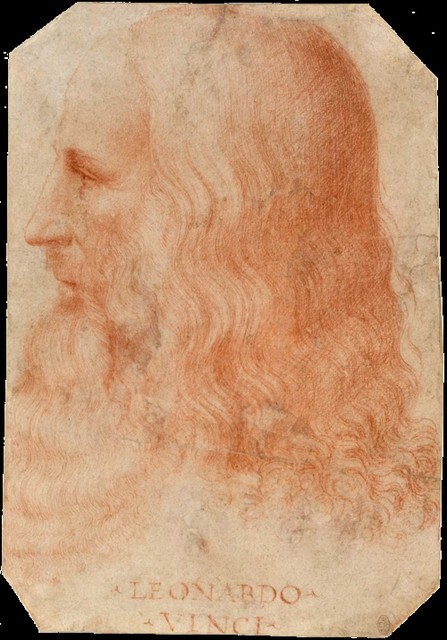
Artist portrait Image credit
Attributed to Francesco Melzi. Image source · Public domain
About the artist
Leonardo da Vinci
1452 to 1519
Leonardo was an Italian Renaissance painter whose work also encompassed sculpture, architecture, engineering and scientific study. Trained in Andrea del Verrocchio's workshop in Florence, he later worked in Milan, Rome and France. His notebooks connect close observation of anatomy and nature with his interest in how gesture and expression convey thought.
- Born
- 1452
- Died
- 1519
- Nationality
- Italian
- Birthplace
- Near Vinci, Tuscany, Italy
Biography sources
The research & record
Study the work.
Follow the evidence.
Find catalogue details, historical context, technical research and the literature behind this artwork.
The artwork record
Research catalogue
Catalogue information and detailed research, with references that link to the bibliography.
Updated .
Identity and catalogue
Link- Title
- Lady with an Ermine(Wikimedia Commons: Lady with an Ermine, n.d.)
- Artist or attribution
- Leonardo da Vinci
- Object date
- circa 1490 (alternatively 1483-1490)(Wikimedia Commons: Lady with an Ermine, n.d.)
- Medium and support
- oil and tempera on panel(Wikimedia Commons: Lady with an Ermine, n.d.)
- Dimensions
- 40.3 cm (width, per Commons structured data; height not supplied in excerpt)
- Current collection or location
- National Museum in Kraków (Muzeum Narodowe w Krakowie), Kraków, Poland(Wikimedia Commons: Lady with an Ermine, n.d.)
- Movement or period
- Italian Renaissance
- Country or culture
- Italy (Milan)
- Depicted subject
- Half-length portrait of a young woman, Cecilia Gallerani, holding a white ermine across her chest; the ermine turns its head toward her.(Wikimedia Commons: Lady with an Ermine, n.d.)
- Title variants
- The Lady with an Ermine (Portrait of Cecilia Gallerani); Portrait of Cecilia Gallerani; Dama z gronostajem
- Accession number
- XII-209(Wikimedia Commons: Lady with an Ermine, n.d.)
- Support
- panel
- Inscriptions
- Caption top left: LA BELE FERONIERE. LEONARD DAWINCI.(Wikimedia Commons: Lady with an Ermine, n.d.)
Read valuation records and their limitations
Catalogue identity
The painting is catalogued as Lady with an Ermine and attributed to Leonardo da Vinci. That title and attribution are catalogue entries rather than inscriptions on the work; the attribution is a scholarly and institutional designation, and the object is recorded under the accession number XII-209. Within the collection documentation the picture is further described as a portrait of Cecilia Gallerani, an identification that should be distinguished from the attribution itself: the title names a subject, while the 'depicted people' record names a specific historical person. Both rest on catalogue and scholarly argument rather than on a signature or documentary statement carried by the panel.(Wikimedia Commons: Lady with an Ermine, n.d., Title field; Accession number field; Depicted people field)
Date, commission and later ownership
Interpretation
Taken together, these records show how the object's identity is built from layered documentation. The title, the Leonardo attribution and the Gallerani identification are catalogued fields; the circa 1490 date with its 1483 to 1490 alternative is likewise a catalogued range; the Sforza commission and the 1800 Czartoryski purchase come from the recorded object history. The identity of the picture as it is studied today therefore depends on institutional cataloguing and on scholarly argument, and the uncertainties in sitter, date and attribution are part of that record rather than defects to be tidied away.(Wikimedia Commons: Lady with an Ermine, n.d., Title field; Accession number field; Depicted people field; Date field; Object history)
The painting is titled Lady with an Ermine and is attributed to Leonardo da Vinci.(Wikimedia Commons: Lady with an Ermine, n.d.)
The painting's accession number is XII-209.(Wikimedia Commons: Lady with an Ermine, n.d.)
The painting is a portrait of Cecilia Gallerani.(Wikimedia Commons: Lady with an Ermine, n.d.)
Subject and iconography
LinkRead valuation records and their limitations
Inscription and the labeled surface
Visual observation
The visible surface carries a later inscription at the upper left that reads 'LA BELE FERONIERE. LEONARD DAWINCI.' Because the source records this specifically as an inscription at that location and names the name of Leonardo within it, the wording belongs to the history of how the panel has been labeled and transmitted rather than to evidence for the original commission or for Leonardo's own hand in lettering the picture. The entry preserves the spelling as it appears in the record, 'DAWINCI', and does not date the inscription or name the person who added it. Any account of the object's appearance should therefore distinguish the painted image from this textual overlay at the top left, and should avoid treating the label as a signature or as a contemporary document of authorship. The inscription tells us what a later stage in the object's life asserted about the picture, not what the painting itself declares.(Wikimedia Commons: Lady with an Ermine, n.d., Inscriptions field)
The inscription's phrase 'LA BELE FERONIERE' is the only element in the supplied record that connects the panel to a named persona, and it does so as an inscribed label rather than as a documented statement by the maker. The record does not establish when or by whom the words were applied, so the inscription cannot be used to date the picture, to confirm the sitter, or to fix the attribution. Its value for research lies in showing that the object has carried an identifying text on its surface, a fact that belongs alongside the catalogue data on medium and date rather than replacing them. Where the label's claims coincide with scholarly positions, that coincidence should be reported as such and not mistaken for independent proof.(Wikimedia Commons: Lady with an Ermine, n.d., Inscriptions field; Date field)
There is an inscription at the top left reading 'LA BELE FERONIERE. LEONARD DAWINCI.'(Wikimedia Commons: Lady with an Ermine, n.d.)
Historical context
LinkRead valuation records and their limitations
Identification and Commission
The catalogue gives the painting's date as circa 1490, with an alternative range of 1483 to 1490. This is a dating offered as a field value, not a fixed year established by a dated document, and the two formulations should be kept with the picture rather than resolved into a single number. The date and the sitter identification together situate the panel in the orbit of the Milanese court, since the object history recorded here states that the painting was commissioned by Ludovico Sforza in Milan. That statement establishes the commission as the catalogue records it; it does not by itself document the terms of the commission, the household setting in which the panel was used, or the patron's purposes.(Wikimedia Commons: Lady with an Ermine, n.d., Date field; Object history)
The painting dates to circa 1490, with an alternate dating of 1483-1490.(Wikimedia Commons: Lady with an Ermine, n.d.)
Materials and technique
LinkRead valuation records and their limitations
The documented medium and support
The one clearly documented material fact about the painting's making is its medium, recorded as oil and tempera on panel. That compound description matters for how the surface is usually read: a tempera component and an oil component are both attested, applied to a wooden support rather than canvas or wall. Beyond this, the evidence supplied does not specify the species of wood, the number or joinery of the planks, the ground or priming layers, the pigments used, any underdrawing, or any conservation treatment. Those gaps should be left open rather than filled from general assumptions about workshop practice.(Wikimedia Commons: Lady with an Ermine, n.d., Medium field)
Visual observation
The record distinguishes sharply between what is painted and what was added later. An inscription at the top left reads "LA BELE FERONIERE. LEONARD DAWINCI." This is catalogued as an inscription rather than as part of the original composition, so the medium and support described for the picture belong to the painted surface, while the lettering belongs to a subsequent stage on or near that surface. Technical examination is not reported in the supplied evidence; the separation of inscription from painting rests on the catalogue's description of the object's inscriptions, not on an account of layer analysis.(Wikimedia Commons: Lady with an Ermine, n.d., Medium field; Inscriptions field)
Interpretation
What the evidence supports about technique is narrower than the transcript's spoken account implies. The medium is documented; the visible result, fur rendered with one kind of crispness and flesh with another, is an observation of the painted image as reproduced. The explanation that the oil and tempera combination produced those different readings is an inference about how the materials were handled that the supplied evidence does not itself demonstrate. It is a reasonable working hypothesis for a materials study, but it should be held as inference and tested against examination of the panel rather than stated as established fact.(Wikimedia Commons: Lady with an Ermine, n.d., Medium field; Inscriptions field)
The medium is oil and tempera on panel.(Wikimedia Commons: Lady with an Ermine, n.d.)
Provenance and ownership
LinkRead valuation records and their limitations
Commission and Early Setting
The provenance of the Lady with an Ermine begins with its commission. The painting was commissioned by Ludovico Sforza in Milan, the city where the picture is placed in the object history supplied by the Wikimedia Commons record. That commission belongs to the same Milanese court context in which the sitter, Cecilia Gallerani, is connected, and it anchors the work's early history in a documented act of patronage rather than in an unrecorded chain of anonymous owners. The record gives the commission as a fact of object history without specifying a contract, payment, or date for the transaction itself; the painting's own dating is treated separately, at circa 1490 with an alternate range of 1483 to 1490, so the commission and the making of the picture should not be collapsed into a single fixed year. What the evidence establishes is the patron and the city; the interval between the commission and the picture's entry into later collections is not recorded in these units and should be described as an unrecorded period rather than as a proven transfer.(Wikimedia Commons: Lady with an Ermine, n.d., Object history; Date field)
The next documented change of ownership in the supplied record is the purchase of the painting in 1800 by Adam Jerzy Czartoryski in Puławy. This is the only sale or acquisition recorded in these units, and it is stated with a year, a named purchaser, and a place. The entry marks a clear break from the Milanese court setting of the commission: by 1800 the picture is documented in a Polish collection context, at Puławy, associated with the Czartoryski name. Because the evidence gives no owners between the Sforza commission and this 1800 purchase, the gap between them must remain an unrecorded interval. Nothing in the units supports filling that gap with named owners, and the 1800 acquisition should not be presented as a continuous, documented line of descent from Ludovico Sforza.(Wikimedia Commons: Lady with an Ermine, n.d., Object history)
Later Custody and Public Record
The object history in the record also places the painting in the collection of the National Museum in Kraków (Muzeum Narodowe w Krakowie), Poland, with the accession number XII-209. This institutional location and identifier are the most concrete administrative facts about the work's present custodianship in the supplied evidence. They sit at the end of the documented sequence that runs from the Milanese commission through the 1800 Czartoryski purchase to the Kraków museum, although the units do not narrate the intermediate steps by which the painting moved from Puławy and the Czartoryski context into the national collection. The accession number matters for research because it is the identifier by which the object is tracked in the museum's records and in the Wikimedia Commons file usage that links the image to 'Paintings in the National Museum in Kraków'.(Wikimedia Commons: Lady with an Ermine, n.d., Object history; File usage on Commons)
Interpretation
The provenance record should be read alongside the debates about the picture's identity and date, because those debates condition how securely the object's history can be stated. The attribution to Leonardo da Vinci is established in the source metadata, and the sitter is identified as Cecilia Gallerani on grounds described as reasonably secure according to M. Kemp, while Janice Shell and Grazioso Sironi discuss the career of that identification since it was first suggested in 1900. The identification therefore rests on scholarly argument rather than on a signed document in the supplied evidence, and the name should be presented as a strongly supported but argued attribution. The same care applies to the dating: circa 1490, with an alternate range of 1483 to 1490, means the commission by Ludovico Sforza should be described within a span rather than pinned to a single year. These qualifications do not overturn the documented ownership events; they define the limits within which the commission and early setting can be described.(Wikimedia Commons: Lady with an Ermine, n.d., Object history; Date field)
The painting was commissioned by Ludovico Sforza in Milan.(Wikimedia Commons: Lady with an Ermine, n.d.)
In 1800 the painting was purchased by Adam Jerzy Czartoryski in Puławy.(Wikimedia Commons: Lady with an Ermine, n.d.)
Provenance timeline
- circa 1490
The painting is dated to approximately this year, with an alternate dating given as 1483 to 1490.(Wikimedia Commons: Lady with an Ermine, n.d., Date field)
- 1800
The painting was purchased by Adam Jerzy Czartoryski in Puławy.(Wikimedia Commons: Lady with an Ermine, n.d., Object history)
Reception and literature
LinkRead valuation records and their limitations
Digital Circulation and Public Recognition
The reception of Leonardo's Lady with an Ermine can be traced, at least in part, through the picture's long life as a reproduced and catalogued image rather than only through painted copies or written praise. Wikimedia Commons records that many of its pages use the file of the painting, naming among them the category pages 'Paintings by Leonardo da Vinci' and 'Paintings in the National Museum in Kraków'. That distribution matters for reception history because it places the picture, in digital form, simultaneously inside a Leonardo corpus and inside a Polish national collection: the same image is used to illustrate an author's oeuvre and an institution's holdings. The Wikimedia record also states that the image is a featured picture on Commons and was a Picture of the Day in 2021, a form of curated public recognition by the platform's own community rather than by an art-historical body. These are documented facts about the digital file and its circulation, not about the fifteenth-century panel, and they should be kept on that footing.(Wikimedia Commons: Lady with an Ermine, n.d., File usage on Commons; Assessment section)
Interpretation
Reproduction never occurs without captions, and this painting's captions carry a contested label. The panel bears an inscription at the top left reading 'LA BELE FERONIERE. LEONARD DAWINCI.', recorded in the catalogue as an observation of the surface. The wording of that inscription, naming the sitter as a beautiful ferronière and the author as Leonardo, is a later addition to the painting's reception rather than a document of its making, and it is a reminder that names and titles attached to such portraits often precede and shape scholarly identification. The identification of the sitter as Cecilia Gallerani is described as reasonably secure according to M. Kemp, while Janice Shell and Grazioso Sironi have discussed the career of that identification since it was first suggested in 1900. Reception of the picture therefore includes the history of a name: a proposal made in 1900, argued over by named scholars, and now treated as strong but argued grounds rather than as a signed certainty. Digital reuse such as the Commons pages inherits that accumulated naming and repeats it to new audiences.(Wikimedia Commons: Lady with an Ermine, n.d., Inscriptions field; File usage on Commons)
Many pages on Wikimedia Commons use this file, including 'Paintings by Leonardo da Vinci' and 'Paintings in the National Museum in Kraków'.(Wikimedia Commons: Lady with an Ermine, n.d.)
The image is a featured picture on Wikimedia Commons and was a Picture of the Day in 2021.(Wikimedia Commons: Lady with an Ermine, n.d.)
Interpretations and debates
LinkRead valuation records and their limitations
The Claims That Frame Interpretation
Interpretation
Interpretation of this panel begins from the claims catalogued around it rather than from the painted surface alone. The work is titled Lady with an Ermine and attributed to Leonardo da Vinci; it is recorded in the collection of the National Museum in Kraków (Muzeum Narodowe w Krakowie), Poland, under accession number XII-209; and it is described as a portrait of Cecilia Gallerani, commissioned by Ludovico Sforza in Milan. Those statements form the frame within which any reading of the picture is argued. The same catalogue records the medium as oil and tempera on panel, dates the painting to circa 1490 with an alternate dating of 1483-1490, and notes an inscription at the top left reading 'LA BELE FERONIERE. LEONARD DAWINCI.'. Interpretation therefore has to work with a set of documentary and catalogued propositions, not with a signed or dated original document, and the inscription is catalogued as something on the picture rather than as part of the original painting act.(Wikimedia Commons: Lady with an Ermine, n.d., References; Date field; Inscriptions field)
The sitter's identity is the point at which the evidence is strongest and still argued. The identification of the sitter as Cecilia Gallerani is described as reasonably secure according to M. Kemp, while Janice Shell and Grazioso Sironi discuss the career of this identification since it was first suggested in 1900. Two things follow. First, the name is not an unexamined tradition but a position held by a named scholar and reported as secure. Second, the identification has a documented history of its own: it was proposed in 1900 and has been traced since by Shell and Sironi. The catalogue's confidence and the catalogue's record of that confidence's making sit side by side, and a responsible reading keeps them together rather than treating the name as if it had always belonged to the panel.(Wikimedia Commons: Lady with an Ermine, n.d., References)
Inscription and the Layering of Names
The inscription at the top left reads 'LA BELE FERONIERE. LEONARD DAWINCI.'. As catalogued, it supplies a later name for the subject and a name for the maker on the same surface. It does not by itself establish the sitter's identity, since the identification rests on scholarly argument rather than on the inscription, and it does not supply a date. Its interest for interpretation lies in what it shows about the picture's life as a named object: the panel carries a title-like designation and an authorial attribution that are separate from the arguments traced by Kemp, Shell and Sironi. The catalogue's own evidence should not be used to convert the inscription into proof of either the name or the attribution.(Wikimedia Commons: Lady with an Ermine, n.d., Inscriptions field; References)
How the Image Circulates
Read together, the catalogued claims and the file's circulation describe two different kinds of authority. The catalogue entries about sitter, commission, date, medium and accession number are arguments and records about the object; the Commons usage and Picture of the Day designation are assessments of a reproduction. Neither kind of evidence settles the other. A reading of the panel gains nothing from treating its featured status as confirmation of the attribution, and a reading of the file gains nothing from ignoring the uncertainties in the catalogue. The useful synthesis is that the picture's importance is carried simultaneously by scholarly argument about a Sforza court portrait and by the wide visual availability of the image in a public repository.(Wikimedia Commons: Lady with an Ermine, n.d., File usage on Commons; Assessment section; References; Date field)
The Interpretive Limits
The interpretive claims in the catalogue are stronger for the identification than for anything else. Kemp's description of the identification as reasonably secure is an attributed scholarly judgment, and Shell and Sironi's discussion of the identification's career since 1900 is a historical account of the argument, not a new proof of the sitter. The commission by Ludovico Sforza, the Milanese setting and the sitter's connection to that court are catalogued facts that frame interpretation, but the evidence supplied does not record the maker's private intentions, the painting's original display, or a contemporary explanation of its subject. Interpretation that goes beyond the named claims would be synthesis by the writer, and it should be marked as such rather than presented as what the catalogue or the cited scholars establish.(Wikimedia Commons: Lady with an Ermine, n.d., References)
The most defensible summary of the evidence is layered. There is a reasonably secure, though argued, identification of the sitter following Kemp, with an account by Shell and Sironi of how that identification was first proposed in 1900. There is a dating of about 1490 with an alternative span of 1483 to 1490, an oil and tempera medium on panel, an accession number at the National Museum in Kraków, a commission attributed to Ludovico Sforza in Milan, and an inscription naming 'LA BELE FERONIERE' and Leonardo. There is also a digital life in which the file is widely used, featured, and was Picture of the Day in 2021. Each of these is supported in its own register; none of them, alone or together, licenses a claim about the maker's private intent. That is the boundary within which further interpretation has to work.(Wikimedia Commons: Lady with an Ermine, n.d., References; Date field; Inscriptions field; File usage on Commons; Assessment section)
The identification of the sitter as Cecilia Gallerani is reasonably secure according to M. Kemp, while Janice Shell and Grazioso Sironi discuss the career of this identification since it was first suggested in 1900.(Wikimedia Commons: Lady with an Ermine, n.d.)
Collection and display
LinkRead valuation records and their limitations
Collection and display
The Lady with an Ermine is held in the collection of the National Museum in Kraków (Muzeum Narodowe w Krakowie), Poland. For a painting whose sitter, author and date all rest on scholarly argument rather than a signed or securely documented commission, this institutional location is one of the few firmly documented anchors in its record. The museum setting also shapes how the picture is encountered: it is a publicly held object within a Polish national collection, catalogued and described under that institution even though the painting is conventionally attributed to Leonardo da Vinci, was made for a Milanese patron, and depicts a woman of the Milanese court. The object's presence in Kraków is therefore a fact of its later collecting history, separable from the circumstances of its creation, and it belongs to the account of how the panel has been cared for and displayed since entering that collection. The title itself, Lady with an Ermine, and the association with Leonardo and with Cecilia Gallerani travel with the object through the museum's descriptive apparatus, where the attribution and sitter identification are presented as catalogued positions rather than as certainties inscribed on the panel.(Wikimedia Commons: Lady with an Ermine, n.d., Collection field)
The painting is in the collection of the National Museum in Kraków (Muzeum Narodowe w Krakowie), Poland.(Wikimedia Commons: Lady with an Ermine, n.d.)
Documented values and qualified estimates
LinkRead valuation records and their limitations
Valuation as a working construct
Interpretation
The only valuation figure supplied for this painting is a model-generated working insurance range of US$100M to US$500M, recorded as generated on 2026-10-16. The methodology states that it was calculated for manual review from the supplied confirmed artwork context, and that it rests on the identification of the painting as Lady with an Ermine by Leonardo da Vinci, its dating to circa 1490 with an alternate range of 1483 to 1490, its medium of oil and tempera on panel, its secure collection status at the National Museum in Kraków under accession number XII-209, its recorded acquisition history involving Adam Jerzy Czartoryski in 1800, and its recognized prominence as a Renaissance portrait of Cecilia Gallerani. The calculation describes itself as applying a conservative high-end fine-art insurance underwriting approach that weighs the extreme scarcity of securely attributed paintings by Leonardo, the work's canonical status in art history, and the typical scale of institutional fine-art insurance coverage for comparable masterworks. The same unit is explicit that no official insurance value, appraisal, auction result, or sale price was provided in the excerpts, and that no comparable sales, private insurance records, or proprietary valuation data were accessed.(Wikimedia Commons: Lady with an Ermine, n.d.)
Because the range is not anchored in a transaction or an appraisal, its evidentiary status differs sharply from the object facts it draws on. The identification of the sitter as Cecilia Gallerani is reported as reasonably secure according to M. Kemp, while Janice Shell and Grazioso Sironi are cited for tracing the career of that identification since it was first suggested in 1900. The commission by Ludovico Sforza in Milan, the circa 1490 date with the alternative 1483 to 1490 span, the oil and tempera on panel medium, the National Museum in Kraków accession number XII-209, and the 1800 purchase by Adam Jerzy Czartoryski in Puławy are the concrete recorded elements on which the working calculation says it depends. Read together, the valuation unit converts a set of attributed and documented object facts into a broad financial bracket, and that bracket inherits both the strength and the contested edges of those underlying attributions rather than adding independent evidence about the painting's worth.(Wikimedia Commons: Lady with an Ermine, n.d.)
Working estimate
Calculated working insurance estimate, not a sale price: Estimated value: US$100M to US$500M Recorded date: Working calculation, generated 2026-10-16. Methodology: A broad, conservative working insurance range was calculated for manual review from the supplied confirmed artwork context. The calculation relies on the identification of the painting as Lady with an Ermine by Leonardo da Vinci, its dating to circa 1490 (alternate 1483-1490), its medium of oil and tempera on panel, its secure collection status at the National Museum in Kraków (accession number XII-209), its recorded acquisition history involving Adam Jerzy Czartoryski in 1800, and its recognized prominence as a Renaissance portrait of Cecilia Gallerani. Because no official insurance value, appraisal, auction result, or sale price was provided in the excerpts, the model applied a conservative high-end fine-art insurance underwriting approach that considers the extreme scarcity of securely attributed paintings by Leonardo da Vinci, the work's canonical status in art history, and the typical scale of institutional fine-art insurance coverage for comparable masterworks. The resulting broad range is intended to support manual review and further expert consultation rather than to serve as a precise value. Qualification: This is a model-generated working range for manual review only. It is not an official insurance value, appraisal, auction result, or sale price. The range is broad and conservative because no confirmed insurance valuation, appraisal, or market transaction was supplied in the available excerpts. It must be verified by a qualified fine-art insurance specialist or appraiser before any coverage decision. No comparable sales, private insurance records, or proprietary valuation data were accessed.(Wikimedia Commons: Lady with an Ermine, n.d.)
Bibliography
Sources and further reading
References are arranged by author or organisation, with links to the original publications. Where no publication date is recorded, n.d. means no date.
Source notes updated .
No recorded sources match these filters. Reset the filters to see the full bibliography.
- 02
Book
Lady with an ermine in the Czartoryski Gallery. Wydawn. Literackie.
Recorded title names the Lady with an Ermine and the Czartoryski Gallery, matching the painting and its documented Czartoryski provenance, so a focused object study.
- ISBN
- 8308002862
Citation text
Title explicitly addresses the Lady with an Ermine by Leonardo da Vinci, and its subject Renaissance portraits matches this portrait of Cecilia Gallerani.
- ISBN
- 9782954825816
Citation text
- 01
Secondary
Wikimedia Commons: Lady with an Ermine (n.d.). Wikimedia Commons.
Citation text
Art to live with
Bring this painting
home.
A piece of the archive, made yours. Explore Lady with an Ermine in a size and finish that fits your space.
Your text and annotations appear on these editions. Adding to cart saves that design for printing.
Combine this painting with your favourites01 / Find your edition
Made for you
Suggested from your location. Change it if you're sending elsewhere or using a VPN. Prices and delivery are shown in GBP.
19 products
Choose an edition to make it yours
6 × 8 in · Printed cover · 118 lined pages
6 × 8 in · Printed cover · 118 lined pages
6 × 8 in · Printed cover · 118 lined pages
Notebook
GBP 11.91
Delivery GBP 5.30 / Total GBP 17.21
A 6 × 8 inch spiral notebook with 118 ruled pages (59 sheets), a printed front cover, dark grey back cover and metal spiral binding.
Fit and fill keep the painting’s proportions. Stretch changes them.
Move and zoom the painting on your notebook.
Made to order with your design
Made to order
US delivery only
12.7 × 17.8 cm / 5 × 7 in · Standard
12.7 × 17.8 cm / 5 × 7 in · Standard

5 × 7 in / 12.7 × 17.8 cm · Standard

5 × 7 in / 12.7 × 17.8 cm · Standard

5 × 7 in / 12.7 × 17.8 cm · Standard

5 × 7 in / 12.7 × 17.8 cm · Standard

5 × 7 in / 12.7 × 17.8 cm · Standard
Metal art sign
GBP 19.63
Delivery GBP 17.71 / Total GBP 37.34
A printed aluminium sign with rounded corners and mounting holes.
Fit and fill keep the painting’s proportions. Stretch changes them.
Move and zoom the painting on your metal art sign.
Made to order with your design
Printed aluminium · mounting holes included
US delivery only
iPhone 12 Mini ? Glossy ? back view
iPhone 12 Mini · Glossy

iPhone 12 Mini ? Glossy ? back view

iPhone 12 Mini ? Glossy ? back view

iPhone 12 Mini ? Glossy ? back view
Tough phone case
GBP 16.40
Delivery GBP 4.25 / Total GBP 20.65
A two-layer phone case with a printed polycarbonate shell and a shock-absorbing inner liner.
Two layers with a shock-absorbing TPU liner
Case & print details
- Device
- Apple · iPhone 12 Mini
- Material
- Polycarbonate shell with a TPU inner liner
- Artwork
- Outer back and wrapped edges from one template
- Finish
- Glossy
- Version
- Standard version
- Printing
- Dye sublimation
- Print file
- 1,122 × 1,831 px · 95 × 155 mm · PNG · 300 dpi recommended
Rear outline and camera openings follow this variant's Printify template. Case depth and small hardware remain illustrative.
Supplier product detailsFit and fill keep the painting’s proportions. Stretch changes them.
Move and zoom the painting on your tough phone case.
Made to order with your design
Made to order
US delivery only
30.4 × 40.6 cm / 12 × 16 in · Black
30.4 × 40.6 cm / 12 × 16 in · Black

12 × 16 in / 30.4 × 40.6 cm · Black

12 × 16 in / 30.4 × 40.6 cm · Black

12 × 16 in / 30.4 × 40.6 cm · Black

12 × 16 in / 30.4 × 40.6 cm · Black
Framed art print
GBP 52.87
- 1 framed print
- GBP 52.87
- Delivery to United States
- GBP 14.16
- Total
- GBP 67.03
A ready-to-hang wooden frame with a clear Perspex cover and a semi-gloss printed insert.
Delivery is quoted for all selected copies together.
Fit and fill keep the painting’s proportions. Stretch changes them.
Move and zoom the painting on your framed art print.
Made to order with your design
Wooden frame & protective clear front included
US delivery only
38.1 × 40.6 cm / 15 × 16 in · Natural
38.1 × 40.6 cm / 15 × 16 in · Natural

15 × 16 in / 38.1 × 40.6 cm · Natural

15 × 16 in / 38.1 × 40.6 cm · Natural

15 × 16 in / 38.1 × 40.6 cm · Natural

15 × 16 in / 38.1 × 40.6 cm · Natural

15 × 16 in / 38.1 × 40.6 cm · Natural
Canvas tote bag
GBP 14.25
Delivery GBP 4.33 / Total GBP 18.58
A sturdy cotton canvas tote with reinforced handles and artwork on the front panel.
Fit and fill keep the painting’s proportions. Stretch changes them.
Move and zoom the painting on your canvas tote bag.
Made to order with your design
Front print · reinforced cotton handles
US delivery only
22.9 × 20.3 cm / 9 × 8 in · Standard
22.9 × 20.3 cm / 9 × 8 in · Standard

9 × 8 in / 22.9 × 20.3 cm · Standard

9 × 8 in / 22.9 × 20.3 cm · Standard

9 × 8 in / 22.9 × 20.3 cm · Standard

9 × 8 in / 22.9 × 20.3 cm · Standard
Mouse mat
GBP 7.29
Delivery GBP 4.82 / Total GBP 12.11
A rectangular fabric mouse mat with a rubber backing and rounded corners.
Fit and fill keep the painting’s proportions. Stretch changes them.
Move and zoom the painting on your mouse mat.
Made to order with your design
Made to order
US delivery only
See more13 more products
43.2 × 45.7 cm / 17 × 18 in · Artwork
43.2 × 45.7 cm / 17 × 18 in · Artwork

17 × 18 in / 43.2 × 45.7 cm · Artwork

17 × 18 in / 43.2 × 45.7 cm · Artwork

17 × 18 in / 43.2 × 45.7 cm · Artwork
Woven tote bag
GBP 46.87
Delivery GBP 5.88 / Total GBP 52.75
A woven tote with cotton webbing handles and the painting translated into a woven design.
Fit and fill keep the painting’s proportions. Stretch changes them.
Move and zoom the painting on your woven tote bag.
Made to order with your design
Made to order
US delivery only
30.5 × 40.6 cm / 12 × 16 in · Standard
30.5 × 40.6 cm / 12 × 16 in · Standard

12 × 16 in / 30.5 × 40.6 cm · Standard

12 × 16 in / 30.5 × 40.6 cm · Standard

12 × 16 in / 30.5 × 40.6 cm · Standard

12 × 16 in / 30.5 × 40.6 cm · Standard

12 × 16 in / 30.5 × 40.6 cm · Standard
Matte art print
GBP 15.85
Delivery GBP 7.22 / Total GBP 23.07
An unframed matte poster with archival inks, ready for a frame of your choice.
Fit and fill keep the painting’s proportions. Stretch changes them.
Move and zoom the painting on your matte art print.
Made to order with your design
Unframed · frame it your way
US delivery only
iPhone 12 Mini ? Standard ? back view
iPhone 12 Mini · Standard

iPhone 12 Mini ? Standard ? back view

iPhone 12 Mini ? Standard ? back view

iPhone 12 Mini ? Standard ? back view
Flexible phone case
GBP 15.62
Delivery GBP 4.25 / Total GBP 19.87
A flexible TPU phone case with a frosted finish, a printed back and precise port openings.
Flexible TPU with a frosted, matte finish
Case & print details
- Device
- Apple · iPhone 12 Mini
- Material
- Semi-transparent thermoplastic polyurethane (TPU)
- Artwork
- Back print; rim stays unprinted
- Finish
- Standard
- Version
- Standard version
- Printing
- Dye sublimation
- Print file
- 791 × 1,586 px · 67 × 134.3 mm · PNG · 300 dpi recommended
Rear outline and camera openings follow this variant's Printify template. Case depth and small hardware remain illustrative.
Supplier product detailsFit and fill keep the painting’s proportions. Stretch changes them.
Move and zoom the painting on your flexible phone case.
Made to order with your design
Made to order
S · Standard
S · Standard

S · Standard

S · Standard

S · Standard

S · Standard

S · Standard
Crew socks
GBP 10.66
Delivery GBP 4.43 / Total GBP 15.09
Crew-length polyester and spandex socks with a ribbed cuff, cushioned sole and sublimated artwork.
Fit and fill keep the painting’s proportions. Stretch changes them.
Move and zoom the painting on your crew socks.
Made to order with your design
One pair · design repeated on both socks
US delivery only
12" · Standard
12" · Standard

12" · Standard

12" · Standard

12" · Standard
Laptop sleeve
GBP 26.12
Delivery GBP 4.92 / Total GBP 31.04
A polyester laptop sleeve with a fleece lining, top zip, printed front and black reverse.
Fit and fill keep the painting’s proportions. Stretch changes them.
Move and zoom the painting on your laptop sleeve.
Made to order with your design
Made to order
US delivery only
11oz · 2 image repeats
11oz · White
11oz · 2 image repeats
Mug
GBP 7.36
Delivery GBP 6.17 / Total GBP 13.53
A glossy white ceramic mug with a C-shaped handle, available in 11oz and 15oz sizes.
repeat layout · choose single, double or a repeating pattern in Customise.
Repeat, fit, fill and position your artwork around the mug.
Made to order with your design
Made to order
iPhone 12 Mini ? Standard ? back view
iPhone 12 Mini · Standard

iPhone 12 Mini ? Standard ? back view

iPhone 12 Mini ? Standard ? back view

iPhone 12 Mini ? Standard ? back view

iPhone 12 Mini ? Standard ? back view

iPhone 12 Mini ? Standard ? back view
Biodegradable phone case
GBP 20.96
Delivery GBP 4.25 / Total GBP 25.21
A matte phone case made from plant polymers and bamboo fibre, with the artwork printed on the back.
Flexible plant-polymer shell with a matte finish
Case & print details
- Device
- Apple · iPhone 12 Mini
- Material
- PLA and PBAT polymers with bamboo fibre
- Artwork
- Back print; rim stays unprinted
- Finish
- Standard
- Version
- Standard version
- Printing
- Dye sublimation
- Print file
- 777 × 1,553 px · 65.8 × 131.5 mm · PNG · 300 dpi recommended
Rear outline and camera openings follow this variant's Printify template. Case depth and small hardware remain illustrative.
Supplier product detailsFit and fill keep the painting’s proportions. Stretch changes them.
Move and zoom the painting on your biodegradable phone case.
Made to order with your design
Made to order
30.5 × 40.6 cm / 12 × 16 in · Standard
30.5 × 40.6 cm / 12 × 16 in · Standard

12 × 16 in / 30.5 × 40.6 cm · Standard

12 × 16 in / 30.5 × 40.6 cm · Standard

12 × 16 in / 30.5 × 40.6 cm · Standard
Fine art poster
GBP 17.36
Delivery GBP 7.61 / Total GBP 24.97
A gallery paper print with a smooth art-paper surface. Choose a size that suits the painting.
Fit and fill keep the painting’s proportions. Stretch changes them.
Move and zoom the painting on your fine art poster.
Made to order with your design
Unframed · frame it your way
iPhone 12 Mini ? Standard ? back view
iPhone 12 Mini · Standard

iPhone 12 Mini ? Standard ? back view

iPhone 12 Mini ? Standard ? back view

iPhone 12 Mini ? Standard ? back view
Clear phone case
GBP 15.11
Delivery GBP 4.25 / Total GBP 19.36
A clear phone case with artwork on the back. Leave areas transparent to show the phone underneath.
Clear shell with shock-absorbing TPU sides
Case & print details
- Device
- Apple · iPhone 12 Mini
- Material
- Polycarbonate back and clear TPU sides
- Artwork
- Back print; clear sides stay unprinted
- Finish
- Standard
- Version
- Standard version
- Printing
- Dye sublimation
- Print file
- 732 × 1,527 px · 62 × 129.3 mm · PNG · 300 dpi recommended
Rear outline and camera openings follow this variant's Printify template. Case depth and small hardware remain illustrative.
Supplier product detailsFit and fill keep the painting’s proportions. Stretch changes them.
Move and zoom the painting on your clear phone case.
Made to order with your design
Made to order
15oz · 3 image repeats
15oz · Standard

15oz · 3 image repeats

15oz · 3 image repeats

15oz · 3 image repeats

15oz · 3 image repeats

15oz · 3 image repeats
Travel mug
GBP 32.00
Delivery GBP 5.68 / Total GBP 37.68
A stainless-steel travel mug with a black lid, a tapered base and a printed white exterior.
repeat layout · choose single, double or a repeating pattern in Customise.
Repeat, fit, fill and position your artwork around the mug.
Made to order with your design
Made to order
US delivery only
2.5 × 3.4 cm / 1 × 1.4 in · Glossy
2.5 × 3.4 cm / 1 × 1.4 in · Glossy

1 × 1.4 in / 2.5 × 3.4 cm · Glossy

1 × 1.4 in / 2.5 × 3.4 cm · Glossy

1 × 1.4 in / 2.5 × 3.4 cm · Glossy

1 × 1.4 in / 2.5 × 3.4 cm · Glossy
Photo keyring
GBP 10.19
Delivery GBP 5.39 / Total GBP 15.58
A rectangular zinc-alloy photo keyring with a glossy insert and a swivel split ring.
Fit and fill keep the painting’s proportions. Stretch changes them.
Move and zoom the painting on your photo keyring.
Made to order with your design
Photo insert · zinc frame & swivel ring
US delivery only
iPhone 15 Pro ? Glossy ? back view
iPhone 15 Pro · Glossy

iPhone 15 Pro ? Glossy ? back view

iPhone 15 Pro ? Glossy ? back view

iPhone 15 Pro ? Glossy ? back view

iPhone 15 Pro ? Glossy ? back view

iPhone 15 Pro ? Glossy ? back view
Slim phone case
GBP 16.37
Delivery GBP 5.79 / Total GBP 22.16
A slim printed phone shell with open ports and a lightweight profile.
Slim, lightweight polycarbonate shell
Case & print details
- Device
- Apple · iPhone 15 Pro
- Material
- Polycarbonate
- Artwork
- Outer back and wrapped edges from one template
- Finish
- Glossy
- Version
- Standard version
- Printing
- Dye sublimation
- Print file
- 1,278 × 1,971 px · 108.2 × 166.9 mm · PNG · 300 dpi recommended
Rear outline and camera openings follow this variant's Printify template. Case depth and small hardware remain illustrative.
Supplier product detailsFit and fill keep the painting’s proportions. Stretch changes them.
Move and zoom the painting on your slim phone case.
Made to order with your design
Made to order
US delivery only
36.6 × 30.7 cm / 14.4 × 12.1 in · Standard
36.6 × 30.7 cm / 14.4 × 12.1 in · Standard

14.4 × 12.1 in / 36.6 × 30.7 cm · Standard

14.4 × 12.1 in / 36.6 × 30.7 cm · Standard

14.4 × 12.1 in / 36.6 × 30.7 cm · Standard
Desk mat
GBP 15.29
Delivery GBP 7.13 / Total GBP 22.42
A smooth polyester desk mat with a natural rubber non-slip base and anti-fray edges, available in three sizes.
Fit and fill keep the painting’s proportions. Stretch changes them.
Move and zoom the painting on your desk mat.
Made to order with your design
Made to order
The 30 cm ruler is scaled alongside your selected print. Keep the painting’s proportions with a black background, or stretch it to fill. Frame width, material texture and screen colours are illustrative.
Keep exploring