Identity and catalogue
Link- Movement or period
- Italian Renaissance
- Country or culture
- Italy
- Depicted subject
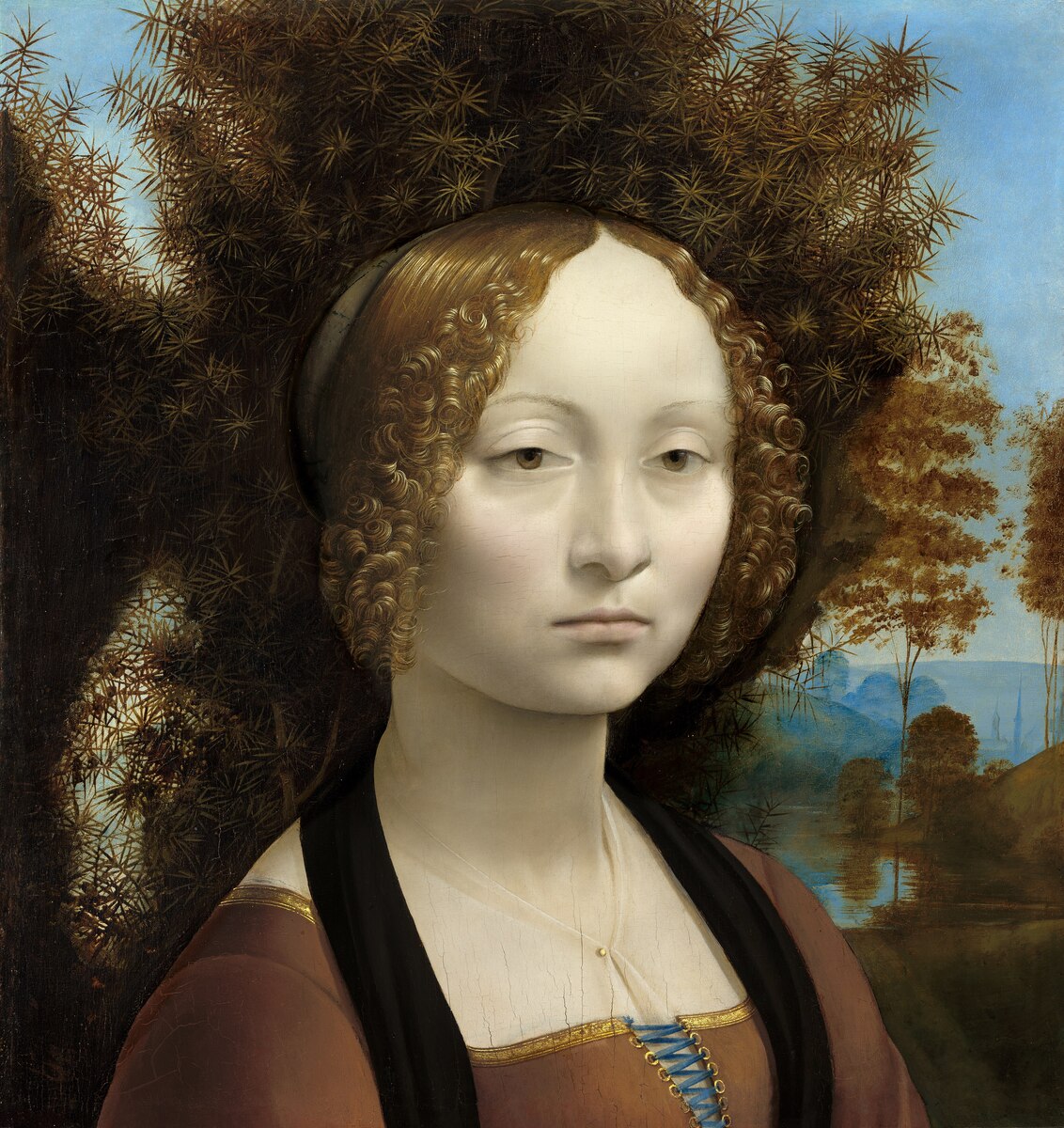
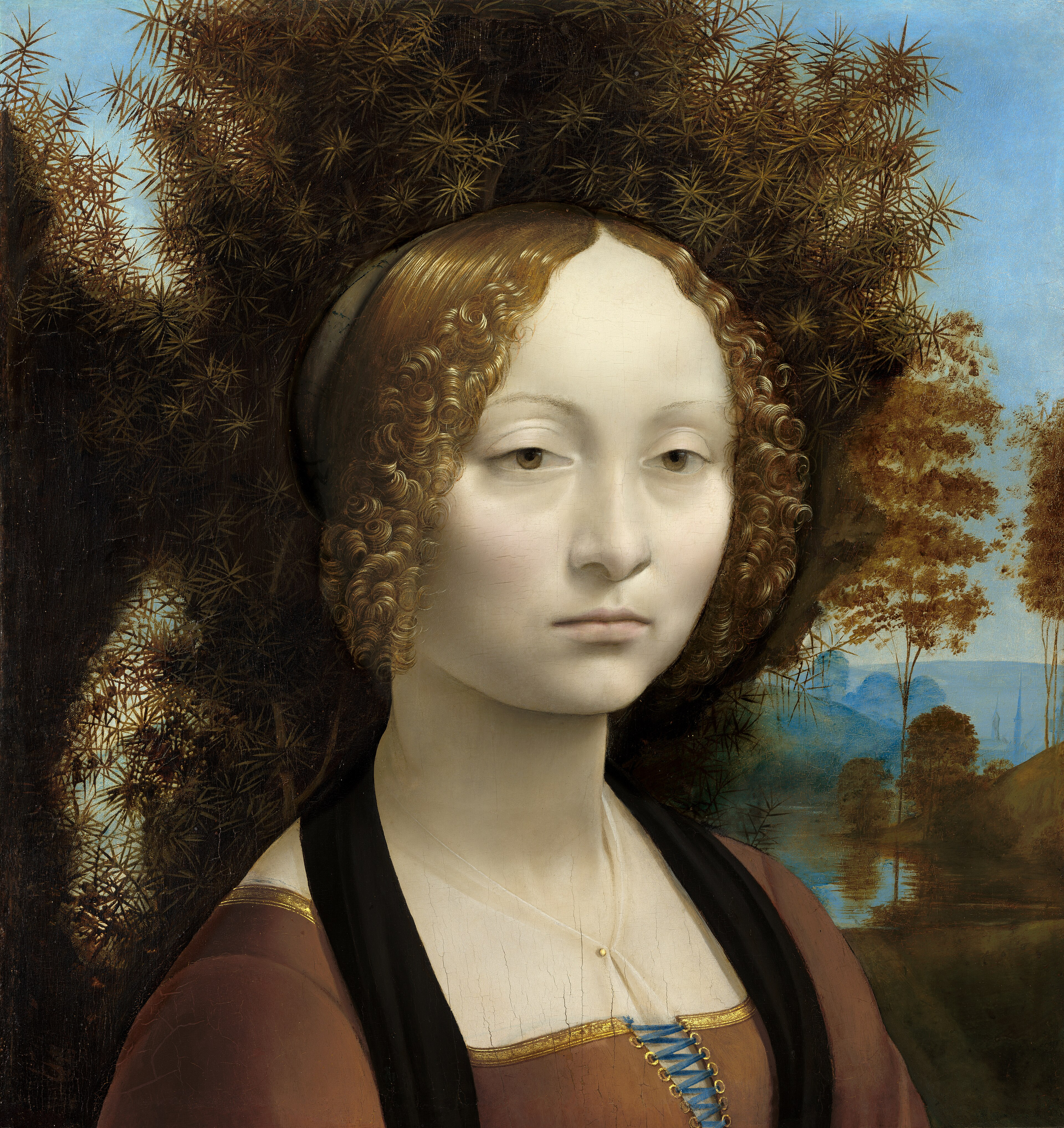
- A portrait of Ginevra de' Benci, a young Florentine woman. She is shown in bust-length, turned slightly, with a juniper bush framing her head. The juniper is a chastity emblem and a pun on her name, Ginevra.(Wikimedia Commons: Ginevra de Benci, n.d.)
- Title variants
- Ginevra de' Benci [obverse]; Portrait of Ginevra de' Benci; Ginevra de' Benci (obverse)
- Accession number
- 1967.6.1.a
- Support
- panel
Catalogue identity
The object is catalogued as Ginevra de' Benci, a title that records both the sitter's given name and her family name rather than the sort of descriptive label often applied to unidentified portraits. The portrait depicts Ginevra de' Benci, and it is attributed to Leonardo da Vinci, whose life dates are given as 1452 to 1519. The attribution and the identification of the sitter together determine how the picture is indexed, published and displayed; they are also the two claims on which most of the subsequent literature about the work depends.(Wikimedia Commons: Ginevra de Benci, n.d., File title; Artist; Depicted people)
The painting is dated between circa 1474 and circa 1478. This span places the work in the 1470s, which is the period in which the portrait is conventionally set, and it is a catalogue date rather than a date recorded on the object itself. Because the range is given with circa on both ends, it is a bracketed estimate: the panel does not carry a documented completion date, and the span should be understood as the interval within which the painting is thought to have been made rather than as a fixed year of execution.(Wikimedia Commons: Ginevra de Benci, n.d., Date)
Interpretation
The dimensions are recorded as height 38.8 cm (15.2 in) and width 36.7 cm (14.4 in), with the original panel given as 38.1 x 37 cm. The two sets of measurements differ, and the distinction is between the picture as it now measures and the original panel as separately recorded, so the smaller panel figure should not simply be substituted for the current dimensions. The dimensions matter for the object's classification: a panel of roughly this size belongs to the category of small, cabinet-scale pictures rather than to the large altarpiece or full-length court portrait, and that scale is relevant to the later history of the collection in which it was kept.(Wikimedia Commons: Ginevra de Benci, n.d., Dimensions)
Subject and iconography
LinkThe object and its frame
Visual observation
The object is a bust-length portrait of a young woman, painted in oil on panel, with dimensions given as 38.8 cm in height and 36.7 cm in width, while the original panel is recorded at 38.1 by 37 cm. The sitter is identified as Ginevra de' Benci, and the work is associated with Leonardo da Vinci (1452-1519) and dated to approximately 1474 to approximately 1478. It is held by the National Gallery of Art, Washington, D.C., under accession number 1967.6.1.a, and is displayed in the West Building, Main Floor, Gallery 06. The panel entered that collection through purchase on 10 February 1967. These basic facts of medium, support, scale, attribution, dating and collection establish the physical and institutional frame within which the visual evidence must be read.(Wikimedia Commons: Ginevra de Benci, n.d., Genre; Medium)
Observed features of the portrait
Within that frame, the visible evidence is the portrait itself: a young woman shown bust-length, her face pale and softly modelled, with downcast or averted eyes and closed lips. The description of a soft modelling and a gaze that does not meet the viewer's is an observation about how the face is painted, not an identification of a psychological state. It is worth separating what can be seen, a pale face, lowered or turned eyes, closed mouth, from what later interpretation may read into those features. The distinction matters because the portrait's quiet effect depends on these specific visual decisions rather than on any documented statement by the sitter or the painter.(Wikimedia Commons: Ginevra de Benci, n.d., Summary; Genre)
The juniper bush that frames the head is described as carrying two overlapping functions: it is a chastity emblem and a visual pun on the name Ginevra. In that reading the plant is not merely background scenery but an element of meaning, signalling a particular kind of virtue while also sounding the sitter's name. This interpretation is attributed within the source rather than being a neutral observation of the paint surface, and it should be weighed as an emblematic reading of the motif. The juniper therefore connects the visible composition to a Renaissance convention in which symbolic plants communicate qualities about the person portrayed.(Wikimedia Commons: Ginevra de Benci, n.d., Summary)
Provenance and changing attribution
The later history of the panel is unusually tangled and bears directly on how securely its sitter can be named. Leonardo's authorship came to be forgotten, and in the Liechtenstein Catalogue of 1780 the panel was attributed to Lucas Cranach. A red wax seal bearing the Liechtenstein arms on the reverse shows that the picture was in the Liechtenstein collection in Vienna and later Vaduz by 1733, and it may well have entered that collection by 1712 or earlier. Prince Karl Eusebius (1611-1684), founder of the picture gallery at Feldsberg, was a distinguished connoisseur who liked small cabinet type paintings, a detail that situates the panel within a collecting taste for intimate works. During World War II the picture was transferred, with the rest of the collection, from the Garden Palace in Vienna to the castle at Vaduz.(Wikimedia Commons: Ginevra de Benci, n.d., Object history, note 1; Genre)
The identification of the sitter is not secure in the way the title might suggest. It is not known whether the painting belonged to the Benci family in the early sixteenth century, and Antonio Billi, who presumably saw the painting, does not give its location. Some scholars, including Jean Adhémar and Fern Rusk Shapley, linked the picture to an inventory made at Amboise in 1500 that lists a portrait of a lady named Ginevra, but the name Ginevra was too common in the Renaissance to assume that this inventory entry refers to Leonardo's painting. The connection between the depicted woman and the Benci family, and the connection between the panel and the 1500 inventory, therefore remain qualified rather than documented.(Wikimedia Commons: Ginevra de Benci, n.d., Genre)
Interpretation
Taken together, the visual evidence and the object history show a portrait whose meaning has been carried by a plant motif and whose identity has been repeatedly reassigned. The juniper links the image to a symbolic vocabulary of chastity and to the name Ginevra, while the 1780 attribution to Lucas Cranach and the uncertain Benci and Amboise connections show how far the work's authorship and sitter were from stable in later records. Reading the pale, softly modelled face, the averted eyes and the closed lips alongside the juniper allows the emblematic and the observed to be kept distinct: the motif is an attributed reading, while the surface description is what can be seen. That separation is what makes the object useful for a larger history of portraiture, where likeness, virtue, naming and later collecting practices intersect.(Wikimedia Commons: Ginevra de Benci, n.d., Summary; Object history, note 1)
The founder of the picture gallery at Feldsberg was Prince Karl Eusebius (1611–1684), a distinguished connoisseur who liked small cabinet type paintings.(Wikimedia Commons: Ginevra de Benci, n.d.)
Materials and technique
LinkDocumented medium and support
The catalogued medium of the painting is oil on panel, the support and paint medium recorded in the object's descriptive metadata. That single statement is the technical baseline for the section: the picture is not on canvas or on a paper or textile support, and the medium is described as oil rather than tempera, even though the object is associated with a period and a workshop practice in which the two media overlapped. The recording supplies no further material detail beyond the medium itself, so no pigment, ground, priming, varnish or treatment can be asserted from it. The evidence unit gives only the medium, and technical questions about layer structure remain open on the supplied record.(Wikimedia Commons: Ginevra de Benci, n.d., Medium)
Beyond the medium, the evidence unit also fixes the object's dimensions: a height of 38.8 cm and a width of 36.7 cm, with the original panel given as 38.1 by 37 cm. The presence of two sets of measurements, one overall and one described as the original panel, is a qualification rather than a contradiction, since an overall dimension may include later additions or framing history while the original panel measurement describes the wooden support itself. The units do not explain why the figures differ, so the relationship between the overall size and the original panel size should be treated as recorded but not technically resolved here. No further information about the panel's wood species, thickness, joins, cradle or condition is supplied.(Wikimedia Commons: Ginevra de Benci, n.d., Medium)
The identity of the object is recorded as a portrait of Ginevra de' Benci, attributed to Leonardo da Vinci (1452 to 1519) and dated between about 1474 and about 1478. These identifications frame the materials evidence but do not themselves describe materials or method: the title, the artist and the date range come from the same descriptive record as the medium, and the medium statement is the only material fact it supplies. The later ownership record notes that Leonardo's authorship came to be forgotten for a time, with the panel attributed to Lucas Cranach in the Liechtenstein Catalogue of 1780. That attribution history concerns authorship rather than physical make-up, but it is a caution against treating later catalogue descriptions as secure evidence about materials or technique. The painting is now in the National Gallery of Art, Washington, D.C., with accession number 1967.6.1.a, and is located in the West Building, Main Floor, Gallery 06; those facts concern custody and display rather than the object's making.(Wikimedia Commons: Ginevra de Benci, n.d., Medium)
Provenance as context for technical claims
Interpretation
The object history recorded around the painting is unusually tangled and bears on what can and cannot be tied to the physical object. A red wax seal bearing the Liechtenstein arms on the reverse, dated 1733, shows the picture was in that collection by then, and the picture may well have entered the collection by 1712 or earlier. The evidence also notes that it is not known whether the painting belonged to the Benci family in the early sixteenth century, that Antonio Billi, who presumably saw the painting, does not give its location, and that Jean Adhémar and Fern Rusk Shapley identified the picture with an inventory made at Amboise in 1500 listing a portrait of a lady named Ginevra, an identification the evidence calls insecure because the name Ginevra was too common in the Renaissance to assume. The founder of the picture gallery at Feldsberg was Prince Karl Eusebius (1611 to 1684), a connoisseur who liked small cabinet type paintings, and during World War II the picture was transferred with the rest of the collection from the Garden Palace in Vienna to the castle at Vaduz. The painting was purchased by the National Gallery of Art on 10 February 1967, and it was in the Liechtenstein collection in Vienna and later Vaduz by 1733. These are provenance and reception facts; they do not establish pigments, preparation or technique, but they explain why attributions and descriptions attached to the panel changed over time.(Wikimedia Commons: Ginevra de Benci, n.d., Medium)
Provenance and ownership
LinkInto the Liechtenstein Collection
The documented ownership history of the painting begins with the Liechtenstein collection, but the earliest firm anchor is physical rather than archival. A red wax seal bearing the Liechtenstein arms on the reverse of the panel establishes that the picture was in the collection in Vienna and later Vaduz, in the principality of Liechtenstein, by 1733, the date of the seal. The seal therefore proves presence in the collection at that date; it does not document the moment of entry, the seller, or the terms of transfer. A separate, more tentative suggestion holds that the picture may well have entered the Liechtenstein collection by 1712 or earlier, a claim framed as possibility rather than record and not tied to a named transaction. Read together, these two units mark the difference between a fixed terminal date and a soft earlier horizon of possible possession.(Wikimedia Commons: Ginevra de Benci, n.d., Object history; Object history, note 1)
The collecting context that might explain the painting's arrival is partly reconstructed from the history of the family gallery rather than from records concerning this panel. The founder of the picture gallery at Feldsberg was Prince Karl Eusebius (1611–1684), described as a distinguished connoisseur who liked small cabinet type paintings. That characterization supplies a plausible frame for a small panel of this kind, but the evidence does not state that Karl Eusebius owned this picture or that Feldsberg was its destination before Vienna or Vaduz. The connection remains an inference about taste and institutional formation, not a documented link in the chain of title.(Wikimedia Commons: Ginevra de Benci, n.d., Object history, note 1)
The Unrecorded Interval
Between the Renaissance and the Liechtenstein connection the record is largely silent, and the evidence is explicit about how little can be said. It is not known whether the painting belonged to the Benci family in the early sixteenth century, the family of the sitter. The writer Antonio Billi, who presumably saw the painting, does not give its location, so even a near-contemporary observer supplies no provenience. This is an unrecorded interval, not a proven change of ownership: the absence of a Benci connection in the surviving evidence cannot be converted into proof that the family never held the picture, and Billi's silence cannot locate it anywhere in particular. The earlier scholarly temptation to fill that gap with an inventory made at Amboise in 1500, which lists a portrait of a lady named Ginevra, was resisted in the evidence itself: the name Ginevra was too common in the Renaissance to assume, with Jean Adhémar and Fern Rusk Shapley, that the Amboise entry refers to Leonardo's panel. Their proposed identification therefore stands as attributed and insecure rather than established provenance.(Wikimedia Commons: Ginevra de Benci, n.d., Object history, note 1)
Wartime Transfer and the Move to Vaduz
The next documented movement is a wartime transfer. During World War II the picture was transferred, with the rest of the collection, from the Garden Palace in Vienna to the castle at Vaduz. This is a relocation of the collection as a whole rather than a sale or a change of owner, and the evidence names no date within the war for the move. It explains why the Liechtenstein holdings, including this panel, came to be associated with Vaduz rather than only with Vienna, and it sets the geographic stage for the eventual dispersal out of the family's hands.(Wikimedia Commons: Ginevra de Benci, n.d., Object history, note 2)
The Liechtenstein chapter closes with a purchase by the National Gallery of Art on 10 February 1967. The evidence gives the date and the acquiring institution but no price, seller, intermediary, or export terms, so the acquisition is documented as an event without a documented negotiation. The object's present institutional identity, including its accession number and gallery location, belongs to that post-1967 life, but the supplied units establish only the purchase date and buyer. Taken as a sequence, the provenance runs from the 1733 wax seal, with the possibility of entry by 1712 or earlier, through the collection's formation under Karl Eusebius at Feldsberg, the 1780 catalogue misattribution to Cranach, the World War II transfer from Vienna to Vaduz, and finally the 1967 purchase in Washington. The gaps, particularly the early sixteenth-century question and the unrecorded route into the Liechtenstein collection, remain gaps rather than hidden episodes.(Wikimedia Commons: Ginevra de Benci, n.d., Object history)
The painting was in the Liechtenstein collection in Vienna and later Vaduz, principality of Liechtenstein, by 1733, the date of a red wax seal bearing the Liechtenstein arms on the reverse.(Wikimedia Commons: Ginevra de Benci, n.d.)
Provenance timeline
- by 1712 or earlier
The picture may have entered the Liechtenstein collection, a possibility qualified in the evidence rather than a settled acquisition.(Wikimedia Commons: Ginevra de Benci, n.d., Object history, note 1)
- by 1733
The painting was in the Liechtenstein collection in Vienna and later Vaduz, indicated by a red wax seal with the Liechtenstein arms on the reverse.(Wikimedia Commons: Ginevra de Benci, n.d., Object history)
- 10 February 1967
The painting was purchased by the National Gallery of Art.(Wikimedia Commons: Ginevra de Benci, n.d., Object history)
Reception and literature
LinkFrom Collection to Museum
Attribution history is the sharpest index of changing reception in the supplied record. Leonardo's authorship came to be forgotten, and the panel was attributed to Lucas Cranach in the Liechtenstein Catalogue of 1780. That attribution is the concrete trace of a period in which the picture was valued and catalogued without reference to Leonardo, which is a different situation from simple neglect: the work remained an identified, catalogued object whose maker was understood to be someone else. Its later purchase by the National Gallery of Art on 10 February 1967 reversed that position institutionally, placing the panel in a public collection and under a curatorial identity tied to Leonardo. The gap between the 1780 catalogue entry and the 1967 acquisition is therefore not empty time but a documented reattribution history, and any account of the picture's fame has to account for both ends of it rather than treating rediscovery as a single dramatic event.(Wikimedia Commons: Ginevra de Benci, n.d., Object history, note 1; Object history)
Iconography and the Limits of Identification
Interpretation
Read together, the units show a picture whose meanings accumulated in layers rather than replacing one another: the juniper and the sitter's averted gaze support an internal programme of chastity and naming, the Liechtenstein seal and catalogue attest a long life as a collected object, the 1780 Cranach attribution marks a period of misidentified authorship, and the 1967 purchase installs the work in a public national collection under Leonardo's name. The uncertainty about the Benci family's early ownership and about Billi's silence on location means the object's earliest documented contexts are only partly recoverable, and the Amboise inventory parallel remains contested. Within a larger history of art and material culture, the supplied evidence places this panel at the intersection of Renaissance emblematic portraiture and the later formation of princely and then public collections, where changing attributions and settings produced new audiences and new names for the same painted face.(Wikimedia Commons: Ginevra de Benci, n.d., Object history, note 1; Object history, note 2; Object history)
Interpretations and debates
LinkReported traditions and disputed accounts
Disputed account
The identification of the sitter in Leonardo's bust-length portrait of a young woman rests on a chain of inference rather than on direct documentation, and the evidence does not close that chain. Jean Adhémar and Fern Rusk Shapley linked the painting to an inventory made at Amboise in 1500 that lists a portrait of a lady named Ginevra, but the supplied account records the objection that the name 'Ginevra' was too common in the Renaissance for that inventory entry to be assumed to refer to Leonardo's panel. The same account states that it is not known whether the painting belonged to the Benci family in the early sixteenth century, and that Antonio Billi, who presumably saw the painting, does not give its location. Read together, these qualifications mean the traditional title Ginevra de' Benci is a scholarly attribution of identity rather than a documented provenience: the inventory naming, the family connection, and the physical panel have not been joined by evidence supplied here. The disagreement is therefore not a matter of correcting a myth but of weighing how much an early sixteenth-century name list can establish about a specific surviving object.(Wikimedia Commons: Ginevra de Benci, n.d., Object history, note 1)
The evidence for the picture's whereabouts begins, on the supplied account, not with the sitter's family but with a much later owner. The painting was in the Liechtenstein collection in Vienna and later Vaduz, principality of Liechtenstein, by 1733, the date of a red wax seal bearing the Liechtenstein arms on the reverse, and the account allows that it may well have entered that collection by 1712 or earlier. The seal therefore supplies a terminus ante quem for Liechtenstein ownership rather than a date of acquisition, and the two suggested years, 1712 and 1733, describe the limits of what the evidence supports rather than a fixed transfer. The founder of the picture gallery at Feldsberg is identified as Prince Karl Eusebius (1611–1684), described as a distinguished connoisseur who liked small cabinet type paintings, which is the context the account offers for how a panel of this scale and character might have been collected. Nothing in the supplied units names the person or transaction by which the painting moved from any earlier owner into that collection, so the interval before the seal remains open.(Wikimedia Commons: Ginevra de Benci, n.d., Object history, note 1)
Authorship, too, was subject to a documented lapse. Leonardo's authorship came to be forgotten, and in the Liechtenstein Catalogue of 1780 the panel was attributed to Lucas Cranach. That attribution is a catalogue position of a particular date and collection, not a competing claim supported by evidence here, and it indicates that at least one eighteenth-century cataloguer working within the Liechtenstein holdings did not connect the panel with Leonardo. The later restoration of Leonardo's name to the picture and the catalogue entry of 1780 belong to the same object history, separated by the disappearance and recovery of that attribution rather than by any change to the panel itself.(Wikimedia Commons: Ginevra de Benci, n.d., Object history, note 1)
The twentieth-century history of the panel includes a wartime movement and a postwar acquisition, both recorded in the source metadata supplied for this object. During World War II the picture was transferred, with the rest of the collection, from the Garden Palace in Vienna to the castle at Vaduz, a displacement that follows the Liechtenstein holdings as a group rather than the painting alone. The painting was then purchased by the National Gallery of Art on 10 February 1967, and it now carries accession number 1967.6.1.a, with its present location given as the West Building, Main Floor, Gallery 06, National Gallery of Art, Washington, D.C. These are the administrative facts that anchor the object in a public collection and make it available for the kind of technical and art-historical examination that the other units describe.(Wikimedia Commons: Ginevra de Benci, n.d., Object history, note 1)
Interpretation
The visual evidence and the material description supplied here constrain how any account of the sitter should be framed. The painting is a bust-length depiction of a young woman, oil on panel, with dimensions given as height 38.8 cm (15.2 in) and width 36.7 cm (14.4 in), the original panel being 38.1 x 37 cm, and it is dated between circa 1474 and circa 1478 and attributed to Leonardo da Vinci (1452–1519). The face is described as pale and softly modelled, with downcast or averted eyes and closed lips, and the juniper bush that frames the head is described as a chastity emblem and a visual pun on the name Ginevra. Taken together, the plant, the name and the sitter's composed demeanour are what the account treats as the picture's meaning-bearing elements, and it is this combination of observed features with the disputed naming that makes the panel central to the early history of the Italian portrait rather than merely an illustration of a documented life. The sex of the sitter, the pose and the emblematic plant are directly described; the equation of that sitter with a specific Florentine woman is what remains attributed rather than established.(Wikimedia Commons: Ginevra de Benci, n.d., Object history, note 1)
The juniper and the attributed reading
Wikimedia Commons describes the painting as a portrait of Ginevra de' Benci, a bust-length depiction of a young woman, and records the juniper bush framing her head as both a chastity emblem and a visual pun on the name Ginevra. The same summary describes her appearance in specific terms: a pale, softly modelled face, downcast or averted eyes, and closed lips (f9, f20). These are the elements on which the attributed reading rests. The emblematic claim is presented as an interpretation rather than a documented statement by the maker, and the evidence does not record any surviving text in which Leonardo or a contemporary explains the plant. What can be established is narrower and still significant: the painting's title, its subject, its bust-length format, and the botanical motif that a later interpretive tradition reads as chastity and as a name pun (f9, f19, f20).(Wikimedia Commons: Ginevra de Benci, n.d., Genre; Summary)
The reading of the juniper as a chastity emblem and as a pun on Ginevra is a scholarly interpretation attributed to the source, not a statement of the sitter's or the painter's private intent. The evidence does not supply a period text, an inscription, or a contract specifying the plant's meaning. It also does not identify who first proposed the pun or when the chastity emblem reading entered the literature. Because the interpretation concerns a symbol rather than a documented motive, it should be described as an attributed reading that fits the visual evidence, not as a fact about what Leonardo meant (f19). The portrait itself, with its pale modelling and averted gaze, provides the ground on which such a reading becomes plausible, but the reading remains an inference from the image rather than a record of intention (f19, f20).(Wikimedia Commons: Ginevra de Benci, n.d., Summary)
The surviving evidence supports a limited synthesis. The painting is a bust-length portrait of a young woman identified as Ginevra de' Benci, with a pale, softly modelled face, downcast or averted eyes, and closed lips, framed by a juniper bush read by the source as a chastity emblem and a pun on her name (f9, f19, f20). Its authorship was at one point forgotten and the panel was attributed to Lucas Cranach in the Liechtenstein Catalogue of 1780 (f17). The interpretation that the juniper carries chastity and a name pun is the source's reading, not a documented statement of intent, and the evidence does not provide the name of the scholar who first proposed it or the date of that proposal (f19). Within these limits, the portrait matters as a case where a visual motif, a name, and a later history of misattribution converge on a single small panel, while the question of what the maker intended remains open on the supplied evidence (f9, f17, f19, f20).(Wikimedia Commons: Ginevra de Benci, n.d., Genre; Object history, note 1; Summary)
Disputed account
The name 'Ginevra' was too common in the Renaissance to assume, with Jean Adhémar and Fern Rusk Shapley, that a portrait of a lady so named in an inventory made at Amboise in 1500 refers to Leonardo's painting.(Wikimedia Commons: Ginevra de Benci, n.d.)
Collection and display
LinkThe painting now known as Ginevra de' Benci, attributed to Leonardo da Vinci (1452-1519), belongs to the National Gallery of Art in Washington, D.C., where it carries the accession number 1967.6.1.a. Its present display location is the West Building, Main Floor, Gallery 06. The same record describes it as an oil on panel measuring 38.8 cm in height by 36.7 cm in width, with the original panel given as 38.1 by 37 cm, and dates it to between circa 1474 and circa 1478. These are the basic registration facts that anchor any discussion of how the work has moved through collections and galleries.(Wikimedia Commons: Ginevra de Benci, n.d., Collection; Current location)
Provenance in the Liechtenstein collection
The painting was purchased by the National Gallery of Art on 10 February 1967, the acquisition that produced the accession number under which it is now held. Before that purchase it had been in the Liechtenstein collection in Vienna and later in Vaduz, in the principality of Liechtenstein. The evidence for its presence there by 1733 is a red wax seal bearing the Liechtenstein arms on the reverse of the panel, and the same source notes that the picture may well have entered the Liechtenstein collection by 1712 or earlier. The founder of the picture gallery at Feldsberg was Prince Karl Eusebius (1611-1684), described as a distinguished connoisseur who liked small cabinet type paintings, a collecting taste that provides a plausible context for a panel of these modest dimensions.(Wikimedia Commons: Ginevra de Benci, n.d., Collection; Current location)
Within the Liechtenstein collection, knowledge of Leonardo's authorship lapsed: in the Liechtenstein catalogue of 1780 the panel was attributed to Lucas Cranach. During World War II the picture was transferred, with the rest of the collection, from the Garden Palace in Vienna to the castle at Vaduz. The attribution history and the wartime transfer belong to the same institutional story, in which the work's identity as a Leonardo was forgotten and later recovered while the collection itself was moved for safekeeping.(Wikimedia Commons: Ginevra de Benci, n.d., Collection; Current location)
The disputed early provenance
The earlier history of the panel is less secure than its Liechtenstein and Washington records. It is not known whether the painting belonged to the Benci family in the early sixteenth century, and Antonio Billi, who presumably saw the painting, does not give its location. Some scholars, including Jean Adhémar and Fern Rusk Shapley, linked the picture to an inventory made at Amboise in 1500 that lists a portrait of a lady named Ginevra, but the source cautions that the name Ginevra was too common in the Renaissance to assume that this inventory entry refers to Leonardo's painting. The identification is therefore an attributed scholarly proposal rather than a documented fact, and the gap between the picture's presumed Florentine origin and its documented Liechtenstein presence remains unfilled by the supplied evidence.(Wikimedia Commons: Ginevra de Benci, n.d., Collection)
The juniper and the sitter's identity
Interpretation
What the picture depicts is described consistently: it is a portrait, a bust-length depiction of a young woman identified as Ginevra de' Benci, shown with a pale, softly modelled face, downcast or averted eyes, and closed lips. The juniper bush framing the head is read as a chastity emblem and as a visual pun on the name Ginevra, so that the plant carries both a moral meaning and a verbal one. The portrait's dependence on that framing device is part of why the work matters in the history of portraiture: the sitter's virtue and her name are presented through the same motif rather than through inscription or attribute alone.(Wikimedia Commons: Ginevra de Benci, n.d., Collection; Current location)
Documented values and qualified estimates
LinkThe Object and Its Documentary Record
Interpretation
Ginevra de' Benci is an oil on panel portrait attributed to Leonardo da Vinci, dated circa 1474 to circa 1478, and measuring approximately 38.8 cm high by 36.7 cm wide, with the original panel given as 38.1 by 37 cm. It is a bust-length depiction of a young woman, held by the National Gallery of Art, Washington, D.C., under accession number 1967.6.1.a, currently in the West Building, Main Floor, Gallery 06. The picture was purchased by the National Gallery of Art on 10 February 1967. Its earlier ownership is documented through the Princely Collections of Liechtenstein: a red wax seal bearing the Liechtenstein arms on the reverse establishes that it was in that collection by 1733, and it may well have entered the collection by 1712 or earlier. The founder of the picture gallery at Feldsberg, Prince Karl Eusebius (1611 to 1684), was a distinguished connoisseur who liked small cabinet type paintings, a context that bears on how a panel of this scale would have been valued and displayed.(Wikimedia Commons: Ginevra de Benci, n.d.)
The provenance before the eighteenth century is not securely connected to the sitter's family. It is not known whether the painting belonged to the Benci family in the early sixteenth century, and Antonio Billi, who presumably saw the painting, does not give its location. The name 'Ginevra' was too common in the Renaissance to assume, with Jean Adhémar and Fern Rusk Shapley, that a portrait of a lady so named in an inventory made at Amboise in 1500 refers to Leonardo's painting. That attribution of the inventory entry to this panel is therefore disputed, and the Amboise document may well refer to someone else. Attribution of the painting's authorship also shifted over time: Leonardo's authorship came to be forgotten, and in the Liechtenstein Catalogue of 1780 the panel was attributed to Lucas Cranach. During World War II the picture was transferred, with the rest of the collection, from the Garden Palace in Vienna to the castle at Vaduz. This combination of an eighteenth-century owner's seal, a mistaken later catalogue attribution, and a wartime movement of the collection explains why the object's documented history is uneven and why its authorship had to be recovered rather than simply transmitted.(Wikimedia Commons: Ginevra de Benci, n.d.)
Visual Conventions and Meaning
The visual conventions of the portrait are integral to how the object has been valued and interpreted. The juniper bush framing the head functions as a chastity emblem and a visual pun on the name Ginevra. The painting shows Ginevra with a pale, softly modelled face, downcast or averted eyes, and closed lips. These features are not incidental: the plant carries symbolic meaning about the sitter's virtue while also sounding her name, so that the emblem and the pun operate through the same motif.(Wikimedia Commons: Ginevra de Benci, n.d.)
The Recorded Valuation Range
A model-generated working insurance estimate has been prepared for manual review, giving a working range of US$600M to US$1.2B, recorded as a working calculation generated 2026-10-16. The methodology states that this is a model-generated broad working insurance range, not an appraisal. It is derived from the confirmed context of an authentic Leonardo da Vinci oil on panel portrait from circa 1474 to circa 1478, held by the National Gallery of Art, Washington, D.C. (accession 1967.6.1.a), with a long documented provenance including the Princely Collections of Liechtenstein by 1733 and acquisition by the NGA in 1967. The range reflects the extreme rarity and market scarcity of fully authenticated paintings by Leonardo da Vinci, the limited number of surviving panel paintings, and the museum-quality Renaissance portrait scale of approximately 38 by 37 cm. Because no public auction records exist for comparable Leonardo panel paintings, the range is intentionally wide and conservative, anchored to the upper tier of Old Master insurance valuations for undisputed masterpieces of this prominence. The supplied source URL was used only to confirm the object's identity, attribution, date, medium, dimensions, collection, and provenance, not as a source of a public appraisal or insurance value.(Wikimedia Commons: Ginevra de Benci, n.d.)
The estimate carries explicit qualifications that must travel with it. It is a model-generated working range for manual review only, and it is not an official insurance value, appraisal, auction result, or sale price. It does not rely on private insurance records, comparable auction sales, or market quotations. The range is broad and conservative because no confirmed open-market transaction exists for an authenticated Leonardo da Vinci painting of this type. Final insurance values must be set by qualified appraisers, insurers, and institutional risk managers using current market conditions, title, condition, and policy terms. Read against the documented record, this figure therefore reflects scarcity and institutional context rather than any recorded transaction, and it should be treated as a provisional working assumption within a larger history of how Leonardo's surviving panel paintings have been described, authenticated, and institutionally secured.(Wikimedia Commons: Ginevra de Benci, n.d.)
Working estimate
Calculated working insurance estimate, not a sale price: Working range for manual review: US$600M to US$1.2B Recorded date: Working calculation, generated 2026-10-16. Methodology: This is a model-generated broad working insurance range, not an appraisal. It is derived from the confirmed context: an authentic Leonardo da Vinci oil on panel portrait from circa 1474 to circa 1478, held by the National Gallery of Art, Washington, D.C. (accession 1967.6.1.a), with a long documented provenance including the Princely Collections of Liechtenstein by 1733 and acquisition by the NGA in 1967. The range reflects the extreme rarity and market scarcity of fully authenticated paintings by Leonardo da Vinci, the limited number of surviving panel paintings, and the museum-quality Renaissance portrait scale of approximately 38 x 37 cm. Because no public auction records exist for comparable Leonardo panel paintings, the range is intentionally wide and conservative, anchored to the upper tier of Old Master insurance valuations for undisputed masterpieces of this prominence. The supplied source URL was used only to confirm the object's identity, attribution, date, medium, dimensions, collection, and provenance, not as a source of a public appraisal or insurance value. Qualification: This is a model-generated working range for manual review only. It is not an official insurance value, appraisal, auction result, or sale price. It does not rely on private insurance records, comparable auction sales, or market quotations. The range is broad and conservative because no confirmed open-market transaction exists for an authenticated Leonardo da Vinci painting of this type. Final insurance values must be set by qualified appraisers, insurers, and institutional risk managers using current market conditions, title, condition, and policy terms.(Wikimedia Commons: Ginevra de Benci, n.d.)