Mona Lisa
Artist: Leonardo da Vinci · 1503–1519 (Louvre dating)
Mona Lisa: high-resolution image, free to copy
The original file is hosted by Wikimedia Commons, available without payment or an account.7,479 × 11,146 pixels.
Open high-resolution image on Wikimedia CommonsLeonardo da Vinci. Cropped and relevelled from File:Mona Lisa, by Leonardo da Vinci, from C2RMF.jpg . Originally C2RMF: Galerie de tableaux en très haute définition : image page
Free to copy. Reuse terms: Public domain. Image source and credits.
The complete story
The story About 3 minutes to read
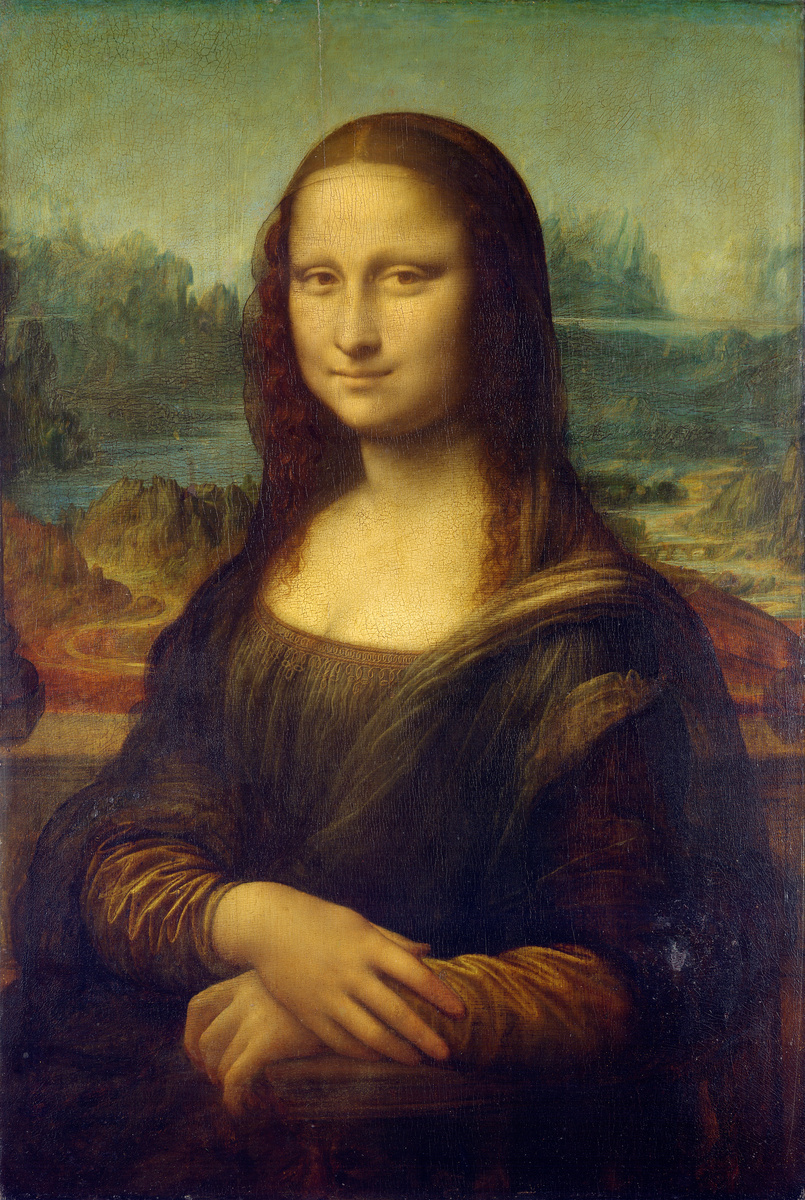
Try looking at her eyes before her mouth. Then move down to the hands, and return to the face. Does the expression feel quite the same? You do not have to solve the smile. Give yourself a little time with the woman who is looking towards us, while the world behind her seems to recede without end.
Behind that famous name is Lisa del Giocondo. A handwritten note in the margin of an old book records Leonardo working on her portrait. Such an ordinary piece of writing gives us a firmer connection to a real sitter than the many ingenious guesses the painting has attracted. Before she became a mystery for strangers, she was a person someone could name.
Her hands lie across one another, calm and close to us. Follow the curve of the arm into the shoulder, then the turn of the head. Her body sits at an angle, but the face meets our attention. That slight difference keeps the pose from becoming rigid. She seems settled in her chair while still being available to this encounter.
Behind her, a path winds away among rocks and water. Colours cool as they retreat. The face, by comparison, is softly modelled: light gives way to shadow without a hard border announcing the change. Look at the corners of the mouth. Their softness leaves room for your eye to keep making small decisions about the expression.
Leonardo kept the portrait with him and continued working on it. The Louvre's account describes a painting he retained until the end of his life, still unfinished at his death. That long attention is a useful companion to our own. A likeness can begin with a named sitter and become an ongoing problem of how paint might suggest living presence.
Come back to the face once more. We know more about who she is than her reputation for mystery might suggest. Yet knowing her name does not tell us what she was thinking. The portrait leaves that encounter open. You can stop trying to extract an answer, and notice how long a small change in shadow can hold your attention.
The story and its sources
Guide sources checked 5 October 2026.
Historical claims are linked to the records below. Close looking and interpretation are identified in the passage notes.
- Passage 1Interpretation
- Passage 2Documented historyMona Lisa’s Identity Established Beyond Doubt
- Passage 3Close looking
- Passage 4Close looking
- Passage 5Documented historyPortrait of Lisa Gherardini: collection record and Vincent Delieuvin’s catalogue commentary
- Passage 6Interpretation
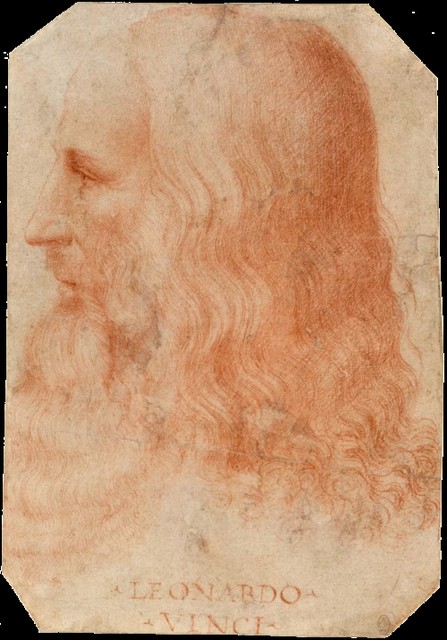
Artist portrait Image credit
Attributed to Francesco Melzi. Image source · Public domain
About the artist
Leonardo da Vinci
1452 to 1519
Leonardo was an Italian Renaissance painter whose work also encompassed sculpture, architecture, engineering and scientific study. Trained in Andrea del Verrocchio's workshop in Florence, he later worked in Milan, Rome and France. His notebooks connect close observation of anatomy and nature with his interest in how gesture and expression convey thought.
- Born
- 1452
- Died
- 1519
- Nationality
- Italian
- Birthplace
- Near Vinci, Tuscany, Italy
Biography sources
The research & record
Study the work.
Follow the evidence.
Find catalogue details, historical context, technical research and the literature behind this artwork.
The artwork record
Research catalogue
Catalogue information and detailed research, with references that link to the bibliography.
Updated .
Identity and catalogue
Link- Title
- Portrait of Lisa Gherardini, wife of Francesco del Giocondo, known as La Joconde or Mona Lisa(Delieuvin, 2021)
- Artist / attribution
- Leonardo da Vinci(Delieuvin, 2021)
- Date
- 1503–1519 (Louvre dating)(Delieuvin, 2021)
- Medium and support
- Oil on poplar panel(Delieuvin, 2021)
- Dimensions
- 79.4 × 53.4 cm(Delieuvin, 2021)
- Current location
- Musée du Louvre, Paris; INV 779; Salle des États, Room 711(Delieuvin, 2021)(Musée du Louvre, n.d.)
- Inventory numbers
- INV 779; MR 316(Delieuvin, 2021)
- Sitter
- Lisa Gherardini, wife of Francesco del Giocondo(Delieuvin, 2021)(Heidelberg University and University Library, 2008)
- Culture / place
- Italy; later worked on and preserved in France
- Period
- High Renaissance
Read valuation records and their limitations
The woman has a name
Lisa Gherardini’s identity has documentary support beyond the later fame of the picture. While cataloguing an early printed book at Heidelberg University Library, Armin Schlechter found a handwritten note by the Florentine official Agostino Vespucci. In the margin of a 1477 edition of Cicero, Vespucci referred in October 1503 to Leonardo painting Lisa del Giocondo. Published in 2005, the discovery supplied near-contemporary support for the identification later given by Giorgio Vasari.(Heidelberg University and University Library, 2008, Paragraphs on Schlechter’s 2005 publication and Vespucci’s October 1503 annotation; shelfmark D 7620 qt. INC)
Subject and iconography
LinkRead valuation records and their limitations
Looking beyond the smile
Interpretation
Look at the hands before the mouth. Their overlap makes a calm foundation for the turning body and head. The dark clothing sets off the face, while roads, water and distant mountains carry attention away into space. In this reading, the portrait’s intimacy depends on the contrast between a person close enough to address us and a landscape whose distances are difficult to measure. This is visual interpretation, not an identification of a secret place.(Musée du Louvre, n.d., Did you know?: Mona Lisa, description of pose and landscape)
What the darkness conceals
Technical examination
Infrared examination reveals a rounded a pozzetto chair before a balustrade, with small columns at either side. The Louvre identifies a large transparent silk veil, gold embroidery, detachable yellow sleeves and a probably dark green dress. Lisa’s hair is gathered behind beneath a cap and transparent head veil. The aged surface obscures a more elaborate costume than its present darkness suggests.(Delieuvin, 2021, Commentaire: L’éclairage des examens de laboratoire; Un grand voile de soie)
The Prado’s restoration gives this comparison a material basis. Its account describes removing oxidised varnish, later black background paint and repainting over part of the veil and hair. The treatment recovered textile modelling and the veil’s transparency, including the landscape visible through it. This belongs to the copy’s treatment history. It helps make a layered costume legible, but does not measure the original colour of every passage in the Louvre panel. The distinction is useful when using the zoom viewer: a dark shape can be a garment, a transparent covering, shadow or the effect of aged coatings. Looking closely should begin a question that technical documentation can refine, rather than convert the present surface into an unquestioned record of its first appearance.(Museo Nacional del Prado, 2012a, Restoration paragraphs: oxidised varnishes, black repaint, veil and hair; findings apply to the Prado copy)
Interpretation
Botticelli’s portrait known as Smeralda Bandinelli provides another Florentine point of comparison. The V&A describes its direct gaze as a challenge to expectations that women lower their eyes, and draws attention to a diaphanous overgown and long-fingered hands. Its account also records a repainted cap and a later, potentially unreliable identifying inscription. The comparison links social codes, fabric and portrait presence, while illustrating why visible details and later labels need separate examination. It does not identify Lisa’s veil as a pregnancy garment or tell us her state of mind. An apparently intimate encounter can still depend on conventions of presentation, and those conventions need to be read alongside the physical history of each painting.(Victoria and Albert Museum, 2024, Opening account of gaze and modesty; cap and inscription; discussion of the diaphanous overgown)
A new language of portraiture
Delieuvin relates the three-quarter figure, joined hands and landscape setting to admired Flemish portrait conventions. He treats Leonardo’s turning body and naturally supported hands as an adaptation of those devices, rather than an isolated invention. This places the portrait within Renaissance exchanges between northern and Italian painting.(Delieuvin, 2021, Commentaire: Une habile synthèse d’inventions flamandes)
Memling’s Portrait of Benedetto Portinari, dated 1487 on its parapet, makes the northern comparison concrete. The Italian national catalogue records a windowed interior and a landscape with a road, fields and trees. The portrait originally belonged to a triptych, with a Virgin and Child at the centre and Saint Benedict on the opposite wing. Its likely patrons had connections with Flemish artists. Such an object joins individual likeness, devotion and exchanges between northern Europe and Florence. Comparing it with Lisa’s portrait asks how familiar arrangements were transformed, rather than assuming that every compositional element began with Leonardo.(Ritratto di Benedetto di Tommaso Portinari, national catalogue 0900286041B, 2006, Description; Notizie storico critiche; inscription 1487; national catalogue 0900286041B)
Interpretation
Sorabella distinguishes the profile format from the three-quarter face, which permits greater engagement with a viewer. This helps explain why Leonardo’s arrangement matters: its impact rests on how body, gaze and hands work together within recognisable conventions. It is the integration of a portrait encounter, rather than the isolated invention of a pose, that comparison allows us to assess.(Sorabella, 2007, Paragraphs comparing profile and three-quarter portrait formats)
Raphael’s Maddalena Doni offers a specific successor. The Uffizi describes the Doni portraits as developments of earlier solutions in Leonardo’s Mona Lisa and Verrocchio’s sculpture, and suggests that Raphael could have studied Leonardo’s portrait in Florence by late 1504. It also identifies a difference: Raphael favours a lower horizon, clear forms and detailed descriptions of fabrics and jewellery. Influence therefore need not mean imitation without change. Lisa’s combination of half-length presence and a landscape became a resource another painter could adapt to a different sitter, household and expressive purpose.(Gallerie degli Uffizi, n.d., Description: relationship to La Gioconda, possible study in 1504 and Raphael’s differences)
Historical context
LinkRead valuation records and their limitations
A Florentine merchant's household
Lisa Gherardini married the Florentine silk merchant Francesco del Giocondo in 1495.(Delieuvin, 2021, Commentaire: Un faux problème d’identité)
Lisa belonged to the Gherardini, an old family with land in the Chianti. She and Francesco had six children. The Louvre documents Francesco’s contact with Leonardo’s notary father, Ser Piero, from at least 1497, and with the Santissima Annunziata, where Leonardo may have stayed after returning to Florence. These connections suggest possible routes to the artist; they do not establish the occasion of the commission.(Delieuvin, 2021, Commentaire: Un faux problème d’identité, household and contacts)
A portrait belonged to a social relationship as well as to an artistic practice. Jean Sorabella’s account of Renaissance portraiture explains how likenesses could mark marriages or changes of status, preserve someone’s presence, and present clothing or possessions as signs of identity. That context makes the choice to paint a merchant’s wife historically meaningful. It does not supply a missing contract for Lisa. Her portrait’s probable domestic origin should therefore be distinguished from the courtly and museum settings through which it later became famous. We can recover something of the visual language available to her household while acknowledging how little survives about the particular purpose of this picture.(Sorabella, 2007, Paragraphs on costume, identity and the social and practical functions of portraits)
A nearby comparison is the household of Agnolo Doni, another prosperous Florentine cloth merchant. The Uffizi relates Raphael’s paired portraits of Doni and Maddalena Strozzi to their 1504 marriage, while qualifying the precise dating. Those pictures remained in the family home. Their pendant format and painted reverses connect likeness with family continuity. They show how portraiture could serve a merchant household at this moment. Lisa’s painting has a different documented history, so the Doni commission offers context rather than proof of an equivalent marriage or childbirth occasion.(Gallerie degli Uffizi, n.d., Description: Doni household, marriage, pendant format, reverses and dating)
Begun by 1503 and retained by Leonardo as he continued work, the portrait entered the French royal collection, probably in 1518.
Materials and technique
LinkRead valuation records and their limitations
How Leonardo softened the edges
Technical examination
Sfumato describes the gradual merging of shadow and light that avoids a hard outline. In 2010, a team working with the Louvre, the French museum research laboratory and the European Synchrotron Radiation Facility used X-ray fluorescence to study faces in seven Leonardo paintings, including this one, without taking samples. Their analysis found that some glazes were built in layers only one or two micrometres thick, accumulating to roughly thirty or forty micrometres. These are results about studied paint passages, not a claim that every part of every Leonardo has an identical recipe.(European Synchrotron Radiation Facility, 2010, Paragraphs on portable X-ray fluorescence and glaze thickness)(de Viguerie et al., 2010, Pages 6125-6128; publisher graphical abstract)
What the ground layer can tell us
A different investigation, published in 2023, examined an exceptional microsample from the Mona Lisa’s ground layer, the preparation beneath the image. Researchers detected the rare lead compound plumbonacrite and interpreted the chemistry as evidence that Leonardo probably treated oil with a substantial amount of lead oxide to prepare a thicker material. The paper explicitly describes ambiguous evidence in his manuscripts. The finding strengthens a hypothesis about a working recipe; it does not reveal a concealed message or fully reconstruct every stage of painting.(Gonzalez et al., 2023, Abstract; publication record, pages 23205-23213)
A workshop copy preserves the decisions
The Prado’s version is valuable because it records more than the finished image’s outward appearance. Infrared comparison found that hidden corrections to the waist, fingers, veil and head in the Louvre painting recur in the Madrid panel. A later copyist looking only at the visible surface would not normally reproduce changes already concealed by paint. The Prado concludes that the two painters worked in parallel and that the pupil followed the developing composition.(Museo Nacional del Prado, 2012b, Comparative analysis; Conclusions)
Interpretation
This evidence changes how the original can be studied. The copy is a witness to a process, rather than simply a substitute souvenir. It also preserves the copyist’s own decisions, so it should not be used as an exact colour key for every part of Leonardo’s picture. The Prado’s later exhibition placed such workshop paintings within a practice that allowed pupils to retain distinct styles under Leonardo’s supervision.(Museo Nacional del Prado, 2021, Exhibition overview: research on studio copies, teaching and production)
Condition and conservation
LinkRead valuation records and their limitations
A fragile panel with a long material history
The protective display also responds to the support’s vulnerability. The Louvre explains that the poplar panel has warped and developed a crack; its case controls temperature and humidity. The conservation problem is therefore partly one of managing wood’s response to its environment, as well as protecting a famous painted surface.(Musée du Louvre, n.d., A home for an icon, paragraph on the temperature and humidity-controlled case)
The Louvre records aged varnishes that yellow and darken the colours. It rejects claims of a cut-down panel, citing unpainted edges and a paint ridge from the working frame. Darkness does not itself establish mourning clothes.(Delieuvin, 2021, Commentaire: Une œuvre très fragile mais bien conservée; Un grand voile de soie)
Provenance and ownership
LinkRead valuation records and their limitations
From Leonardo’s workshop to the Louvre
The note establishes that Lisa’s portrait was under way in 1503, rather than a completion date. Leonardo retained it and continued working. The Louvre treats her husband’s commission as probable and acquisition by François I in 1518 as very likely.(Delieuvin, 2021, Historique de l’œuvre: Provenance; Commentaire: Une acquisition de François Ier)
Bertrand Jestaz’s 1999 study identifies a 1518 payment of 2,604 livres to Salaì for paintings supplied to François I. The payment names paintings collectively, rather than providing an itemised receipt for this portrait. The Louvre interprets the transaction as very likely to include Leonardo’s originals and retains that qualification in its acquisition history. Its catalogue records a separate institutional acquisition date of 1793, from the former royal collection.(Jestaz, 1999, Page 69, discussion of the 1518 état de Milan payment)(Delieuvin, 2021, Une acquisition de François Ier; Mode d’acquisition; Date d’acquisition)
Provenance timeline
- October 1503
Vespucci’s marginal note records Leonardo working on Lisa del Giocondo’s portrait. It establishes work in progress, not delivery to a patron.(Heidelberg University and University Library, 2008, October 1503 annotation; shelfmark D 7620 qt. INC)
- 10 October 1517, probable identification
De Beatis sees a Florentine woman’s portrait with Leonardo at Cloux. Fagnart identifies the work with the Mona Lisa provisionally.(Fagnart, 2020, Pages 176 and 180)
- 1518, probable royal acquisition
A payment to Salaì for paintings is evidence for acquisition by François I. The transaction does not itemise this portrait.(Jestaz, 1999, Page 69: état de Milan payment)(Delieuvin, 2021, Une acquisition de François Ier)
- 1793, institutional acquisition date
The Louvre catalogue records acquisition from the former royal collection. This field does not establish the painting’s first public display date.(Delieuvin, 2021, Mode d’acquisition; Date d’acquisition)
- August 1911
Peruggia steals the painting from the Louvre, interrupting its museum history.(Musée du Louvre, n.d., The theft of the century)
- 1913; 4 January 1914
Recovered in Italy in 1913, the painting returns to Louvre display on 4 January 1914.(Musée du Louvre, n.d., The theft of the century)(Musée du Louvre, Louvre Kids, n.d., Transcript: recovery and return to display)
- 1963
Exceptional loan to Washington and New York. The National Gallery records public dates of 9 January to 3 February, then 7 February to 4 March at the Metropolitan Museum.(National Gallery of Art, n.d., Details: Dates; Other Venues)
- 1974
Exceptional loans to Tokyo (16 April to 11 June) and Moscow (15 June to 28 July).(Delieuvin, 2021, Expositions: Tokyo and Moscow, 1974)
Exhibition history
LinkRead valuation records and their limitations
Rare international journeys
The 1963 United States loan had two museum venues. The National Gallery of Art gives Washington public dates of 9 January to 3 February, following a special presidential viewing on 8 January. Its archive records the Metropolitan Museum of Art venue in New York from 7 February to 4 March. The Louvre catalogue lists 10 January as the Washington start date, so the two institutional records differ by one day.(National Gallery of Art, n.d., Details: Dates; Overview; Other Venues)(Delieuvin, 2021, Expositions: Washington and New York exceptional loans)
The Louvre records exceptional loans to Tokyo from 16 April to 11 June 1974 and to the Pushkin State Museum of Fine Arts in Moscow from 15 June to 28 July 1974. These entries document the original portrait’s itinerary, rather than exhibitions of reproductions or workshop copies.(Delieuvin, 2021, Expositions: Tokyo and Moscow, 1974)
A home for an icon
The Louvre selected the Salle des États for the portrait in 1966. Since 2005 it has occupied a separate protective case in the centre of the room. The painting is displayed opposite Veronese’s Wedding Feast at Cana, within a room otherwise known for Venetian painting.(Musée du Louvre, n.d., A home for an icon; Venetian painting)
Reception and literature
LinkRead valuation records and their limitations
From portrait to global icon
Interpretation
Walter Pater’s essay on Leonardo, dated 1869 in the consulted text, demonstrates a different life for the portrait before the theft. He moves from Lisa as a Florentine individual to an imagined figure carrying the experience of ages. His description invokes antiquity, religious history, the sea and a vampire. These are the critic’s literary associations, not discoveries about the sitter or hidden imagery in the panel. Reading them as reception shows how an interpretation can become part of the object’s fame. The portrait offered Pater a setting for his own account of beauty, memory and accumulated experience. A reader meeting the painting through that prose encounters a culturally charged image before confronting its material details. Keeping Pater’s voice distinct from Leonardo’s intention allows the archive to record the fascination without making its metaphors historical evidence.(Pater, 1869, Leonardo da Vinci chapter, passage beginning with La Gioconda and the subsequent meditation on its presence; essay dated 1869)
Vincenzo Peruggia, a glazier who had worked at the Louvre, stole the painting in August 1911. It was recovered after he tried to sell it to an Italian dealer more than two years later. The episode enlarged its public fame; that effect should not be mistaken for the invention of its artistic importance.(Musée du Louvre, n.d., The theft of the century)
Interpretation
The Louvre’s educational account records its return to display on 4 January 1914. The long absence, investigation and return became another story viewers encountered before they encountered the paint. For a modern audience, that history helps explain why recognition can arrive first and sustained looking only afterward. The theft belongs to the painting’s reception, not to Leonardo’s original intention.(Musée du Louvre, Louvre Kids, n.d., Transcript: final account of the return to display, 4 January 1914)
Duchamp’s L.H.O.O.Q. of 1919 used a reproduction, adding a moustache, goatee and a caption whose spoken French letters form an indecent phrase. MoMA’s curators discuss the work’s humour and irreverence toward an established cultural icon. The gesture depends on an image that can already be recognised and circulated beyond the original panel. As an interpretation of that operation, appropriation makes reproduction part of the meaning: Duchamp alters a familiar copy and the authority attached to it. This belongs to the history of responses to Leonardo’s work. It is neither an intervention on the Louvre painting nor evidence about Lisa herself. It also supplies a different kind of reception from theft publicity, showing an artist using the portrait’s fame as material for another artwork.(Kuo and Temkin, n.d., 1919 work caption and curatorial commentary by Michelle Kuo and Ann Temkin)
Andy Warhol’s 1963 Mona Lisa repeats reproductions of Leonardo’s image through silkscreen printing. The Metropolitan Museum of Art identifies this repetition as a challenge to ideas of artistic genius and authorship. Its collection record, object 65.273, provides a specific example of the portrait becoming material for another artist, beyond the theft story and popular celebrity.(The Metropolitan Museum of Art, n.d., Overview; Artwork Details: object 65.273)
Donald Sassoon's 2001 article offers a historical framework for these different responses. Its published abstract treats the painting's celebrity as cumulative: recognition by contemporaries, royal collecting, the public Louvre in nineteenth-century Paris, literary interpretation, theft publicity during the expansion of the illustrated press, parody and exceptional international journeys. This is an argument about institutions, audiences and circulation as well as the image itself. It makes a useful distinction between artistic importance and mass recognition. The theft enlarged a reputation that already existed, while reproduction made the image available to people who had never seen the original. The abstract supports that outline; the article's full argument is not presented here as having been consulted.(Sassoon, 2001, Publisher abstract, published 1 March 2001)
Interpretation
The comparisons trace several routes to significance. Raphael’s adaptation concerns what other painters could do with a portrait model. Pater’s meditation records a critic’s imaginative encounter. Duchamp’s altered reproduction and Warhol’s repeated image put circulation and recognition to work inside new artworks. These responses do not form a single explanation of Leonardo’s intentions. They show how a private likeness could accumulate different functions as its audience changed. For research, the useful question is therefore not only when the portrait became famous, but what kind of attention each period brought to it.(Gallerie degli Uffizi, n.d., Description: Raphael’s response to La Gioconda)(Pater, 1869, Leonardo da Vinci chapter: literary reception)(Kuo and Temkin, n.d., Curatorial discussion of the altered reproduction)(The Metropolitan Museum of Art, n.d., Overview: duplication, genius and authorship)
Interpretations and debates
LinkRead valuation records and their limitations
A portrait with several historical accounts
The three principal accounts answer different questions. Vespucci’s October 1503 note names Lisa in a record written while Leonardo was working. Vasari’s identification appeared in 1550, decades later, and the Heidelberg account notes his use of anecdote. The marginal note strengthens the sitter’s identification and establishes work in progress; it does not provide a contract, explain why the commission began, or fix a delivery date. Separating those questions lets a strong identification coexist with uncertainty about patronage.(Heidelberg University and University Library, 2008, Paragraphs on Vasari’s 1550 account and Vespucci’s October 1503 note)
Antonio de Beatis’s account of the visit to Leonardo on 10 October 1517 describes a Florentine woman’s portrait associated with the late Giuliano de’ Medici. Laure Fagnart’s 2020 study treats the identification with the Mona Lisa as probable and considers its prolonged execution under changing patronage. She also explains that the surviving travel narrative was rewritten from earlier notes. An eyewitness origin gives the account particular value, without making every later phrase an exact transcript of the meeting.(Fagnart, 2020, Pages 176 and 180: rewriting of the travel account and the Florentine woman’s portrait)
Interpretation
Fagnart argues that the comparison with Isabella Gualanda in the next day’s entry concerns a different portrait at Blois. It should not be transferred automatically to the Florentine sitter seen at Cloux. The dispute demands careful reading of each entry, not replacement of documentary identification with an attractive alternative name.(Fagnart, 2020, Page 181: Blois entry and the comparison with Isabella Gualanda)
Theft and a claim of national belonging
Disputed account
Contradicted story: Peruggia claimed that Napoleon had taken the portrait from Italy and that he was returning it. The Library of Congress discusses this mistaken claim and points to the much earlier royal acquisition. It matters because a story about national belonging helped justify the theft. It should be reported as the thief’s assertion, rather than repeated as the painting’s provenance.(Mazzoli, 2022, Opening paragraphs on Peruggia’s claim and the earlier royal acquisition)
Perception experiments and speculative explanations
Technical examination
A 2004 perception experiment asked observers to judge versions of the face overlaid with visual noise and found that changes around the mouth affected the perceived expression, including the impression of smiling eyes. That research concerns how people read an image. It does not identify Lisa’s private thoughts. The distinction leaves room for an engaging experience of the smile while keeping a laboratory result separate from a historical conclusion.(Kontsevich and Tyler, 2004, Abstract; pages 1493-1498)
Interpretation
Published speculation: a 1992 dental article proposed that the expression reflected missing front teeth. This is an interpretation of a painted face, without an examination of the sitter. Its publication establishes that the proposal was made; it does not establish Lisa’s dental condition. Claims of this kind should retain the author, date and speculative status, rather than become a diagnosis in the article.(Borkowski, 1992, Abstract; pages 1706-1711)
Details to carry with you
- The Louvre identifies the sitter as Lisa Gherardini, wife of Francesco del Giocondo.
- The support is poplar wood, rather than canvas.
- The Louvre inventory number is INV 779.
- An October 1503 marginal note refers to Leonardo working on Lisa’s portrait.
- A Prado workshop copy preserves matching changes beneath the paint.
- The 2023 analysis examined a tiny sample of the ground layer.
Further reading
Books for a closer look
Paid links. As an Amazon Associate I earn from qualifying purchases.

Cover via Open Library / Internet Archive Mona Lisa: The History of the World's Most Famous Painting
HarperCollins Publishers · 2002 paperback catalogue record
Further reading on how the portrait's artistic reception, literary reputation, theft publicity and reproduction contributed to its fame. The linked product was supplied by Sam; catalogue edition details are recorded with the source.
ISBN 9780007106158
Bibliography
Sources and further reading
References are arranged by author or organisation, with links to the original publications. Where no publication date is recorded, n.d. means no date.
Source notes updated .
No recorded sources match these filters. Reset the filters to see the full bibliography.
- 10
Academic · About this artwork
Mona Lisa: the enigma of the smile. Journal of Forensic Sciences, 37(6), pp. 1706-1711. Journal of Forensic Sciences; record hosted by National Library of Medicine.
November 1992 article. The PubMed abstract was consulted. The proposed dental explanation is speculation about a painted image, not an examination or diagnosis of Lisa Gherardini.
- Language
- English
Citation text
- 12
Journal article · About this artwork
Revealing the sfumato Technique of Leonardo da Vinci by X-Ray Fluorescence Spectroscopy. Angewandte Chemie International Edition, 49(35), pp. 6125-6128. Wiley-VCH.DOI: 10.1002/anie.201001116
Peer-reviewed source for the 2010 sfumato study. Publisher metadata, graphical abstract and the research-team summary were consulted; the full paper was not represented as read.
- Language
- English
Citation text
- 01
Museum · About this artwork
Portrait of Lisa Gherardini: collection record and Vincent Delieuvin’s catalogue commentary. Musée du Louvre.
The collection record includes Vincent Delieuvin’s commentary dated July 2021, inventory and acquisition fields, a bibliography and exceptional loans. The record was updated on 25 September 2025; the commentary year is used for author-date citations.
- Language
- French
Citation text
- 04
Official · About this artwork
ESRF research-team announcement dated 15 July 2010. Summarises portable X-ray fluorescence examination and identifies the peer-reviewed study by de Viguerie and colleagues, also listed separately below.
- Language
- English
Citation text
- 26
Book chapter · About this artwork
Luigi d’Aragona’s visit to Leonardo da Vinci (10 October 1517). L’ultimo Leonardo 1510-1519. Leonardo tra Milano, Roma e Amboise: committenze, progetti, studi fra arte, architettura e scienza, pp. 175-185. Nomos Edizioni.
Editorially reviewed chapter. University repository metadata and the relevant postprint passages were consulted.
- Language
- English
- ISBN
- 978-88-94811-94-0
Citation text
- 20
Museum · Background reading
Ritratti di Agnolo e Maddalena Doni (recto); Il Diluvio e Deucalione e Pirra (verso).
Collection commentary consulted for the Doni household and Raphael’s response to Leonardo. No web publication date supplied.
- Language
- Italian
Citation text
- 05
Academic · About this artwork
X-ray and Infrared Microanalyses of Mona Lisa’s Ground Layer and Significance Regarding Leonardo da Vinci’s Palette. Journal of the American Chemical Society, 145(42), pp. 23205-23213. Journal of the American Chemical Society; record hosted by National Library of Medicine.DOI: 10.1021/jacs.3c07000
Publication metadata and abstract were consulted, together with the publisher’s supporting-information description. The ground-layer microsample supports a proposed oil-preparation recipe; this record does not imply a full reconstruction of the painting.
- Language
- English
Citation text
- 03
Official · About this artwork
University press release dated 14 January 2008. Records Armin Schlechter’s discovery of Agostino Vespucci’s October 1503 annotation, shelfmark D 7620 qt. INC, and its publication in the May 2005 incunabula exhibition catalogue.
- Language
- English
Citation text
- 15
Journal article · About this artwork
François Ier, Salaì et les tableaux de Léonard. Revue de l’Art, 126, pp. 68-72. Revue de l’Art.DOI: 10.3406/rvart.1999.348476
Article text and bibliographic record were consulted, particularly the 1518 payment discussed on page 69. Some illustrations are masked by the repository; the text is available.
- Language
- French
Citation text
- 18
Book · About this artwork
Mona Lisa: The People and the Painting. Oxford University Press.
Title, authors, publisher, year and ISBN verified against the Rijksmuseum Research Library record and Oxford University Press’s 2017 publisher catalogue. The link opens the library’s bibliographic record, not the full book. The book is catalogued for further reading and has not supplied factual claims in this article.
- Language
- English
- ISBN
- 9780198749905
Citation text
- 11
Academic · About this artwork
What makes Mona Lisa smile?. Vision Research, 44(13), pp. 1493-1498. Vision Research; record hosted by National Library of Medicine.DOI: 10.1016/j.visres.2003.11.027
PubMed publication record and abstract were consulted. A reverse-correlation experiment on altered reproductions concerns perceived expression, rather than the historical sitter’s intentions.
- Language
- English
Citation text
- 25
Museum · About this artwork
Marcel Duchamp. L.H.O.O.Q. 1919. The Museum of Modern Art.
Curatorial audio transcript and work caption consulted. 1919 dates Duchamp’s work; no publication year assigned to the webpage.
- Language
- English
Citation text
- 09
Official · About this artwork
Historic Thefts: The Mona Lisa and Legal Quests for Repatriation. In Custodia Legis. Law Library of Congress.
Guest post by Casey Mazzoli, published 22 August 2022 and posted by Anna Price. Discusses the thief’s mistaken Napoleon claim in the broader context of repatriation.
- Language
- English
Citation text
- 23
Museum · About this artwork
El Museo del Prado presenta las conclusiones del estudio técnico y restauración de su Gioconda.
Museum restoration report consulted through its indexed text. Treatment findings apply to the workshop copy, not the Louvre original.
- Language
- Spanish
Citation text
- 06
Museum · About this artwork
Published 21 February 2012. Museum technical-study page with separate technical, chemical, materials, comparison and conclusion sections. Credits identify Ana González Mozo for technical study and Almudena Sánchez Martín for restoration. Findings about walnut support and preparation refer to the Prado copy, not the Louvre original.
- Language
- English
Citation text
- 07
Museum · About this artwork
Leonardo and the copy of the Mona Lisa: new approaches to the artist’s studio practices.
Exhibition and research project curated by Ana González Mozo. The exhibition presented studio copies and versions, including the Prado’s painting. This is not a loan record for the Louvre original.
- Language
- English
Citation text
- 02
Museum · About this artwork
From the Mona Lisa to The Wedding Feast at Cana: the Salle des États.
The Louvre’s room guide describes the sitter, sfumato, the controlled display case and the theft. No publication date is supplied on the page.
- Language
- English
Citation text
- 08
Museum · About this artwork
Educational video transcript, including the return to display on 4 January 1914. No publication date is printed in the source record.
- Language
- English
Citation text
- 13
Museum · About this artwork
Institutional exhibition archive gives Washington public dates of 9 January to 3 February 1963 and a special presidential viewing on 8 January. It records the New York venue and dates separately. The year 1963 is the exhibition date, not an asserted publication year for this web page.
- Language
- English
Citation text
- 24
Book chapter · About this artwork
Leonardo da Vinci, in The Renaissance: Studies in Art and Poetry. The Renaissance: Studies in Art and Poetry. Sixth edition, electronic transcription. Project Gutenberg, electronic transcription.
Year refers to the essay’s printed date, 1869. The Leonardo chapter was consulted as evidence of literary reception.
- Language
- English
Citation text
- 16
Journal article · About this artwork
Révéler les choix matériels et techniques de Léonard de Vinci par l’analyse chimique : le cas du pigment blanc de plomb. Technè, issue Hors-série, pp. 162-171. Technè.DOI: 10.4000/11v4a
Bibliographic metadata verified against the Louvre collection record’s bibliography. The article itself has not been consulted and supplies no factual claims in this record.
- Language
- French
Citation text
- 21
Scholarly catalogue · Background reading
Ritratto di Benedetto di Tommaso Portinari, national catalogue 0900286041B (2006). Ministero della Cultura; catalogue record by Le Gallerie degli Uffizi.
Record compiled in 1987, updated in 2002 and 2006. Citation year uses the latest recorded catalogue update; 1487 dates the painting.
- Language
- Italian
Citation text
- 28
Journal article · About this artwork
Mona Lisa: the Best Known Girl in the Whole Wide World. History Workshop Journal, 51(1), pp. 1-18. Oxford University Press.DOI: 10.1093/hwj/2001.51.1
Publisher metadata and abstract consulted. The full article has not been represented as read.
- Language
- English
Citation text
- 27
Book · About this artwork
Mona Lisa: The History of the World's Most Famous Painting. 2002 paperback catalogue record. HarperCollins Publishers.
Metadata verified against Google Books and Open Library edition OL7261161M, ISBN 0007106157. The supplied Amazon listing uses the same ISBN and describes a revised edition dated 2009. This book is catalogued for further reading, not represented as consulted for article claims.
- Language
- English
- ISBN
- 9780007106158
Citation text
- 17
Book · About this artwork
Léonard de Vinci. La Joconde. 2019 edition with addendum. Louvre éditions / El Viso.
Monograph listed in the Louvre collection bibliography. This link opens the Louvre publisher’s catalogue, page 24, which verifies the author, edition and ISBN; it is not the full book. The book has not been consulted for claims in this record.
- Language
- French
- ISBN
- 978-84-120107-1-8
Citation text
- 19
Museum · Background reading
Portraiture in Renaissance and Baroque Europe. Heilbrunn Timeline of Art History. The Metropolitan Museum of Art.
Essay dated August 2007; consulted for portrait conventions and social functions, not as documentation of Lisa’s commission.
- Language
- English
Citation text
- 14
Museum · About this artwork
Collection record for Warhol’s acrylic and silkscreen painting, used here as evidence of Leonardo’s portrait’s later artistic reception. This is a separate work, not the Louvre original.
- Language
- English
Citation text
- 22
Museum · Background reading
Museum article updated 17 April 2024. Its comparison concerns Botticelli’s portrait, not proof of Lisa’s costume or personal circumstances.
- Language
- English
Citation text
Art to live with
Bring this painting
home.
A piece of the archive, made yours. Explore Mona Lisa in a size and finish that fits your space.
Your text and annotations appear on these editions. Adding to cart saves that design for printing.
Combine this painting with your favourites01 / Find your edition
Made for you
Suggested from your location. Change it if you're sending elsewhere or using a VPN. Prices and delivery are shown in GBP.
4 products
Choose an edition to make it yours
50.8 × 76.2 cm / 20 × 30 in · Standard
50.8 × 76.2 cm / 20 × 30 in · Standard

20 × 30 in / 50.8 × 76.2 cm · Standard

20 × 30 in / 50.8 × 76.2 cm · Standard

20 × 30 in / 50.8 × 76.2 cm · Standard

20 × 30 in / 50.8 × 76.2 cm · Standard

20 × 30 in / 50.8 × 76.2 cm · Standard
Metal art sign
GBP 64.37
Delivery GBP 20.91 / Total GBP 85.28
A printed aluminium sign with rounded corners and mounting holes.
Fit and fill keep the painting’s proportions. Stretch changes them.
Move and zoom the painting on your metal art sign.
Made to order with your design
Printed aluminium · mounting holes included
US delivery only
30.4 × 40.6 cm / 12 × 16 in · Black
30.4 × 40.6 cm / 12 × 16 in · Black

12 × 16 in / 30.4 × 40.6 cm · Black

12 × 16 in / 30.4 × 40.6 cm · Black

12 × 16 in / 30.4 × 40.6 cm · Black

12 × 16 in / 30.4 × 40.6 cm · Black
Framed art print
GBP 53.41
- 1 framed print
- GBP 53.41
- Delivery to United States
- GBP 14.31
- Total
- GBP 67.72
A ready-to-hang wooden frame with a clear Perspex cover and a semi-gloss printed insert.
Delivery is quoted for all selected copies together.
Fit and fill keep the painting’s proportions. Stretch changes them.
Move and zoom the painting on your framed art print.
Made to order with your design
Wooden frame & protective clear front included
US delivery only
20.3 × 30.5 cm / 8 × 12 in · Standard
20.3 × 30.5 cm / 8 × 12 in · Standard

8 × 12 in / 20.3 × 30.5 cm · Standard

8 × 12 in / 20.3 × 30.5 cm · Standard

8 × 12 in / 20.3 × 30.5 cm · Standard

8 × 12 in / 20.3 × 30.5 cm · Standard

8 × 12 in / 20.3 × 30.5 cm · Standard
Matte art print
GBP 14.07
Delivery GBP 7.29 / Total GBP 21.36
An unframed matte poster with archival inks, ready for a frame of your choice.
Fit and fill keep the painting’s proportions. Stretch changes them.
Move and zoom the painting on your matte art print.
Made to order with your design
Unframed · frame it your way
US delivery only
20.3 × 30.5 cm / 8 × 12 in · Standard
20.3 × 30.5 cm / 8 × 12 in · Standard

8 × 12 in / 20.3 × 30.5 cm · Standard

8 × 12 in / 20.3 × 30.5 cm · Standard

8 × 12 in / 20.3 × 30.5 cm · Standard
Fine art poster
GBP 13.03
Delivery GBP 7.69 / Total GBP 20.72
A gallery paper print with a smooth art-paper surface. Choose a size that suits the painting.
Fit and fill keep the painting’s proportions. Stretch changes them.
Move and zoom the painting on your fine art poster.
Made to order with your design
Unframed · frame it your way
The 30 cm ruler is scaled alongside your selected print. Keep the painting’s proportions with a black background, or stretch it to fill. Frame width, material texture and screen colours are illustrative.
Keep exploring