Morning, Interior
Artist: Maximilien Luce · 1890
Morning, Interior: high-resolution image, free to copy
The original file is hosted by Wikimedia Commons, available without payment or an account.3,712 × 2,992 pixels.
Open high-resolution image on Wikimedia CommonsMaximilien Luce. Metropolitan Museum of Art
Free to copy. Reuse terms: Public domain. Image source and credits.
The complete story
The story About 3 minutes to read
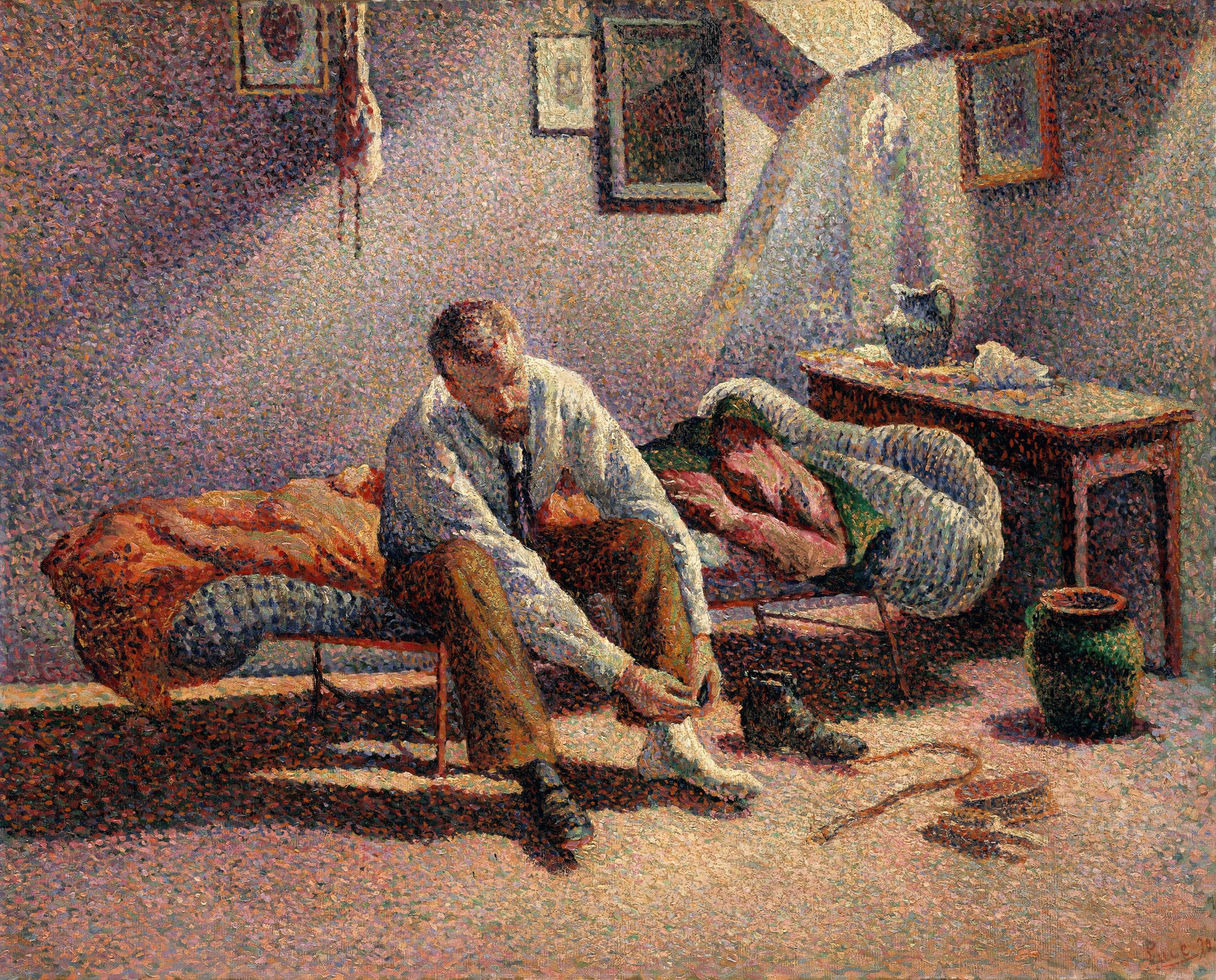
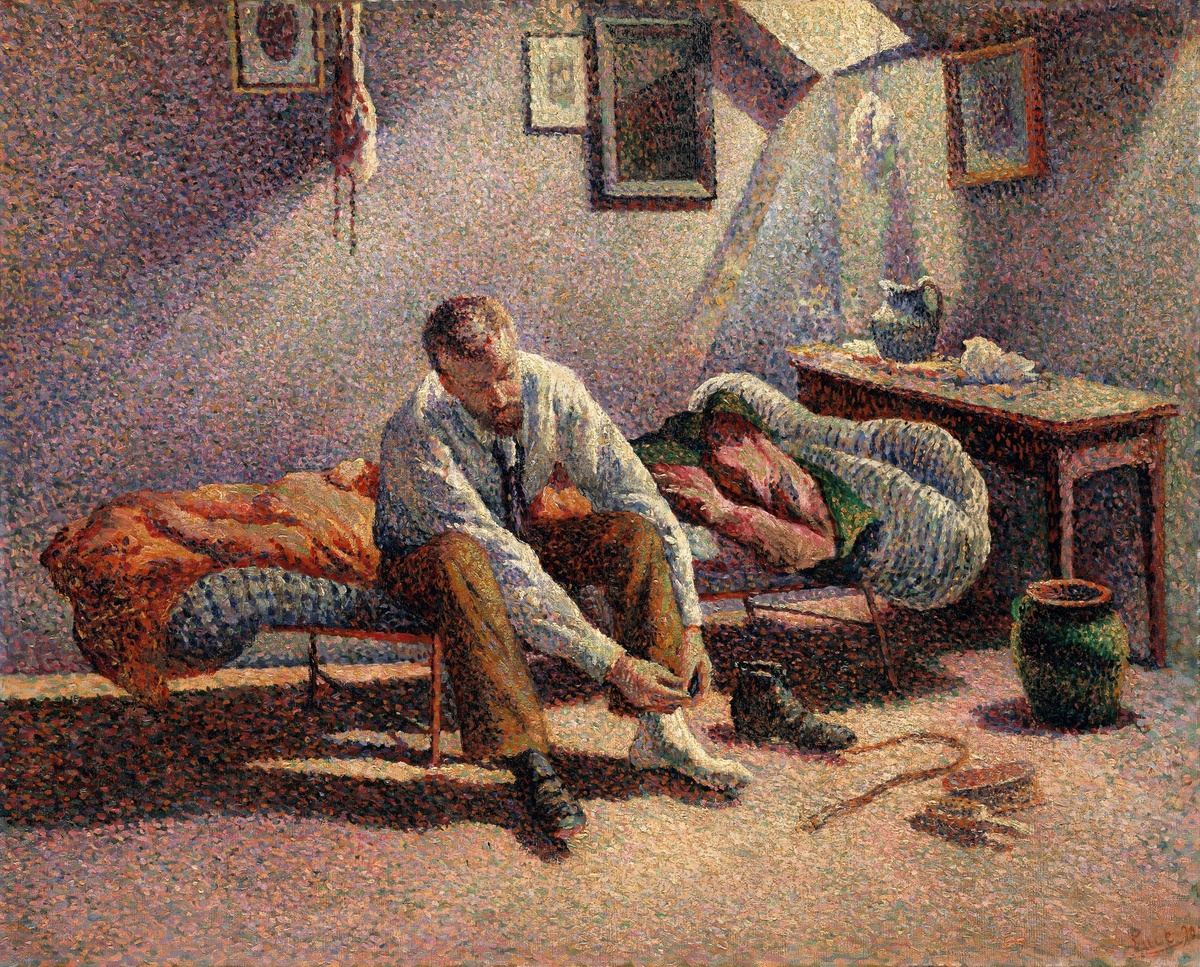
The bed is still rumpled. A man sits nearby, bent towards the ordinary business of getting dressed. Light enters the room and catches the bedding, the wall and his body. There is no ceremony to announce that this moment matters. Luce gives us a morning we might otherwise pass through without remembering.
The man is Gustave Perrot, Luce's close friend and a fellow painter. The Met identifies the scene as Perrot getting up and dressing. That name changes our distance from him. He is someone the artist knew, seen during a quiet part of the day. We meet their friendship through the attention Luce gives to this unguarded routine.
Follow the light across the room. Warm touches of colour sit beside cooler ones, so a wall or a fold of cloth never becomes a single flat patch. Move closer and the surface breaks into little strokes. Step back and they gather into the glow of the room. Looking becomes a small movement between a painted mark and the thing it helps us see.
Luce used the stippled brushwork associated with Pointillism, bringing vivid colours to this modest interior. The technique could have become the main event. Here, it stays attached to a person getting ready for the day. The painted surface is full of activity even while the subject remains familiar and quiet.
Little is known about Perrot's life. The museum records that he died young, and that his work was remembered in a tribute exhibition. We should not invent his thoughts or turn the room into a scene Luce never painted. But that small piece of history makes the survival of this ordinary morning feel especially precious.
Look again at the rumpled bed and the figure beside it. Someone has made room in a painting for a friend's daily life. What stays with us may be the light, or the act of dressing, or simply the feeling of being allowed close enough to notice. An ordinary morning can become a way of remembering a person.
The story and its sources
Guide sources checked 5 October 2026.
Historical claims are linked to the records below. Close looking and interpretation are identified in the passage notes.
- Passage 1Close looking
- Passage 2Documented historyMaximilien Luce, Morning, Interior, 1890; accession 67.187.80
- Passage 3Close looking
- Passage 4Documented historyMaximilien Luce, Morning, Interior, 1890; accession 67.187.80
- Passage 5Documented historyMaximilien Luce, Morning, Interior, 1890; accession 67.187.80
- Passage 6Interpretation
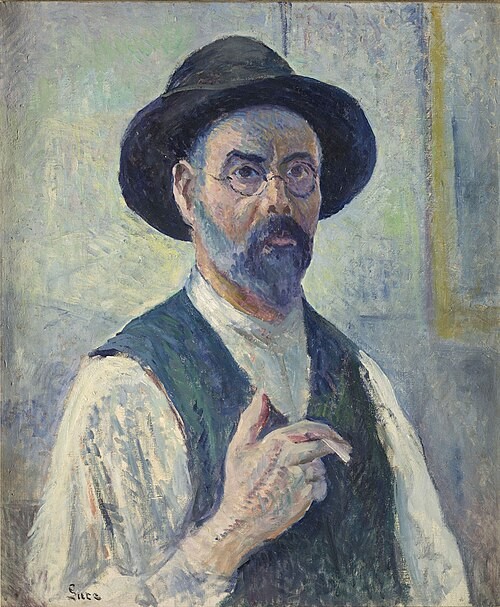
Artist portrait Image credit
Maximilien Luce. Image source · Public domain
About the artist
Maximilien Luce
1858 to 1941
Luce was a French painter, draughtsman and lithographer associated with Neo-Impressionism. Born in Paris, he studied with Carolus-Duran and was influenced by Pissarro and the pointillists. He worked in Paris and Rolleboise, painting landscapes, city views and scenes of construction and labour.
- Born
- 1858
- Died
- 1941
- Nationality
- French
- Birthplace
- Paris, France
- Died in
- Paris, France
The research & record
Study the work.
Follow the evidence.
Find catalogue details, historical context, technical research and the literature behind this artwork.
The artwork record
Research catalogue
Catalogue information and detailed research, with references that link to the bibliography.
Identity and catalogue
Link- Title
- Morning, Interior
- Artist / attribution
- Maximilien Luce
- Date
- 1890
- Medium and support
- Oil on canvas
- Dimensions
- 64.8 × 81 cm (25 1/2 × 31 7/8 in.)
- Culture / place
- France
- Period
- Neo-Impressionism
- Current location
- The Metropolitan Museum of Art, New York; accession 67.187.80
Read valuation records and their limitations
Subject and iconography
LinkRead valuation records and their limitations
Visual observation
In the displayed image, the strongest illumination falls from the upper right, touching the wall, the washstand, and parts of the man's white shirt. The bed stretches behind him, its red cover and blue-striped bedding making a dense band across the room. Framed pictures and hanging objects interrupt the upper wall. This is a visual reading of the reproduction: light gives a modest room a complicated rhythm of bright patches, diagonals, and shadows.(File: Morning, Interior - Luce.jpeg, n.d.)
Small objects reward a slower look: the dark pitcher on the washstand, a container beneath it, footwear near the man's feet, and the pale fabric he handles. His bent posture connects the body to the foreground floor rather than presenting a formal portrait pose. Behind him, a red cover overlaps blue-striped bedding and a crumpled pillow. The Met's account identifies Perrot and supplies no second sitter.(File: Morning, Interior - Luce.jpeg, n.d.)(The Metropolitan Museum of Art, n.d.b)
Luce's paint application belongs to the Neo-Impressionist experiment in separated color. The Met's account of the movement distinguishes Divisionism, the separation of colors into individual strokes, from Pointillism, the use of precise dots. Its artists drew on nineteenth-century theories of optics and color contrast, believing that neighboring pigments could create a livelier impression in the viewer's eye than ordinary mixing on the palette.(The Metropolitan Museum of Art, n.d.a)
The effect can be explored directly in this painting. Up close, warm and cool marks remain conspicuous across the wall and the clothing; at a distance, they begin to organize themselves into light, fabric, and space. The image is a useful demonstration of an artistic theory, rather than proof that every viewer perceives color identically. Its patterned surface stays visible even when the domestic scene is easy to recognize.(File: Morning, Interior - Luce.jpeg, n.d.)(The Metropolitan Museum of Art, n.d.a)
Historical context
LinkRead valuation records and their limitations
Painted in 1890, this domestic scene belongs to Luce's early Neo-Impressionist period. The Met identifies the sitter as Gustave Perrot and acquired the painting through Adelaide Milton de Groot's bequest in 1967.
Interpretations and debates
LinkRead valuation records and their limitations
Reported tradition
The consulted museum records do not supply a dramatic legend about the painting. The strongest unusual story is the real sitter's obscurity: a named artist survives vividly in Luce's image while the Met reports that little is known about his short life. This gap should invite further research into Perrot, not invented dialogue, a romantic relationship, or a second person supposedly hidden beneath the blankets.(The Metropolitan Museum of Art, n.d.b)(File: Morning, Interior - Luce.jpeg, n.d.)
A fuller study could examine the 1892 memorial exhibition and the painting's ownership before de Groot's bequest. Neither a complete early provenance nor an exact room address has been established in this article. The Musée d'Orsay holds an archival collection for Luce that can be consulted by arrangement. That is a concrete research route for correspondence, rather than permission to fill the missing biography with plausible-sounding details.(Musée d'Orsay, n.d.)(The Metropolitan Museum of Art, n.d.b)
An ordinary morning, a named sitter
LinkRead valuation records and their limitations
The seated man is not simply an anonymous figure. The Metropolitan Museum identifies him as Gustave Perrot, a close friend and fellow painter of Luce, dressing in morning light beneath a garret window. The identification gives the room a personal connection, but the museum also acknowledges that little is known about Perrot. He died young; a fifteen-work tribute commemorated his brief career at the Salon des Indépendants in 1892.(The Metropolitan Museum of Art, n.d.b)
The secure object record is unusually useful here: 1890, oil on canvas, 64.8 by 81 centimetres, accession 67.187.80. The Met received the painting through the 1967 bequest of Miss Adelaide Milton de Groot. Wikimedia's file record independently connects the reproduced image to the same accession. These identifiers distinguish this canvas from similarly titled interiors and make it possible to check that an article and its illustration describe the same work.(The Metropolitan Museum of Art, n.d.b)(File: Morning, Interior - Luce.jpeg, n.d.)
Luce's place among the Neo-Impressionists
LinkRead valuation records and their limitations
Luce's route to painting began in skilled manual work. The Musée des impressionnismes Giverny records his apprenticeship to a wood engraver at fourteen and later study at the Académie Suisse and Carolus-Duran's studio. In 1887 he exhibited at the Salon des Indépendants and encountered Pissarro, Seurat, and Signac. Morning, Interior, painted three years later, belongs to the period when he had adopted the division of tones.(Musée des impressionnismes Giverny, n.d.)
That connection is historical context, not a claim that the painting imitates one particular Seurat canvas. The Musée d'Orsay identifies Luce as a painter, draftsman, lithographer, and ceramic painter influenced by Pissarro and the pointillists. His range helps explain why this intimate bedroom should be considered alongside landscapes, city scenes, and images of work. A single familiar reproduction captures only one part of his practice.(Musée d'Orsay, n.d.)
Politics around the picture
LinkRead valuation records and their limitations
Luce's anarchist commitments are documented artist history, but they should not be turned into an invented plot for this bedroom. Giverny describes his arrest and imprisonment after the 1894 assassination of President Sadi Carnot, followed by release when serious evidence against him was lacking. That event occurred four years after Morning, Interior. It establishes the political climate around Luce's later career, rather than the circumstances of this canvas's creation.(Musée des impressionnismes Giverny, n.d.)
The museum distinguishes sympathetic images of labor from the sharper social criticism of Luce's illustrations for anarchist periodicals. Reading dignity or intimacy in Perrot's morning is a reasonable interpretation if labeled as such. The quiet subject does not establish a coded revolutionary message or a political commission.(Musée des impressionnismes Giverny, n.d.)
Details to carry with you
- The Met dates the painting to 1890 and records oil on canvas.
- The painting measures 64.8 × 81 cm.
- The sitter is Gustave Perrot, a close friend of Luce and a fellow painter.
- Perrot's short career was commemorated by a fifteen-work tribute at the Salon des Indépendants in 1892.
- The painting entered the Met through the 1967 bequest of Miss Adelaide Milton de Groot.
- The Met accession number is 67.187.80; its online object identifier is 436923.
Bibliography
Sources and further reading
References are arranged by author or organisation, with links to the original publications. Where no publication date is recorded, n.d. means no date.
Source notes updated .
No recorded sources match these filters. Reset the filters to see the full bibliography.
- 02
Image-record
File: Morning, Interior - Luce.jpeg (n.d.). Wikimedia Commons.
Citation text
Citation text
Citation text
Citation text
Citation text
Art to live with
Bring this painting
home.
A piece of the archive, made yours. Explore Morning, Interior in a size and finish that fits your space.
Your text and annotations appear on these editions. Adding to cart saves that design for printing.
Combine this painting with your favourites01 / Find your edition
Made for you
Suggested from your location. Change it if you're sending elsewhere or using a VPN. Prices and delivery are shown in GBP.
19 products
Choose an edition to make it yours
6 × 8 in · Printed cover · 118 lined pages
6 × 8 in · Printed cover · 118 lined pages
6 × 8 in · Printed cover · 118 lined pages
Notebook
GBP 12.03
Delivery GBP 5.35 / Total GBP 17.38
A 6 × 8 inch spiral notebook with 118 ruled pages (59 sheets), a printed front cover, dark grey back cover and metal spiral binding.
Fit and fill keep the painting’s proportions. Stretch changes them.
Move and zoom the painting on your notebook.
Made to order with your design
Made to order
US delivery only
25.4 × 20.3 cm / 10 × 8 in · Standard
25.4 × 20.3 cm / 10 × 8 in · Standard

10 × 8 in / 25.4 × 20.3 cm · Standard

10 × 8 in / 25.4 × 20.3 cm · Standard

10 × 8 in / 25.4 × 20.3 cm · Standard

10 × 8 in / 25.4 × 20.3 cm · Standard

10 × 8 in / 25.4 × 20.3 cm · Standard
Metal art sign
GBP 24.82
Delivery GBP 17.90 / Total GBP 42.72
A printed aluminium sign with rounded corners and mounting holes.
Fit and fill keep the painting’s proportions. Stretch changes them.
Move and zoom the painting on your metal art sign.
Made to order with your design
Printed aluminium · mounting holes included
US delivery only
iPhone 12 Mini ? Glossy ? back view
iPhone 12 Mini · Glossy

iPhone 12 Mini ? Glossy ? back view

iPhone 12 Mini ? Glossy ? back view

iPhone 12 Mini ? Glossy ? back view
Tough phone case
GBP 16.56
Delivery GBP 4.28 / Total GBP 20.84
A two-layer phone case with a printed polycarbonate shell and a shock-absorbing inner liner.
Two layers with a shock-absorbing TPU liner
Case & print details
- Device
- Apple · iPhone 12 Mini
- Material
- Polycarbonate shell with a TPU inner liner
- Artwork
- Outer back and wrapped edges from one template
- Finish
- Glossy
- Version
- Standard version
- Printing
- Dye sublimation
- Print file
- 1,122 × 1,831 px · 95 × 155 mm · PNG · 300 dpi recommended
Rear outline and camera openings follow this variant's Printify template. Case depth and small hardware remain illustrative.
Supplier product detailsFit and fill keep the painting’s proportions. Stretch changes them.
Move and zoom the painting on your tough phone case.
Made to order with your design
Made to order
US delivery only
25.4 × 20.3 cm / 10 × 8 in · White
25.4 × 20.3 cm / 10 × 8 in · White

10 × 8 in / 25.4 × 20.3 cm · White

10 × 8 in / 25.4 × 20.3 cm · White

10 × 8 in / 25.4 × 20.3 cm · White

10 × 8 in / 25.4 × 20.3 cm · White
Framed art print
GBP 34.51
- 1 framed print
- GBP 34.51
- Delivery to United States
- GBP 9.73
- Total
- GBP 44.24
A ready-to-hang wooden frame with a clear Perspex cover and a semi-gloss printed insert.
Delivery is quoted for all selected copies together.
Fit and fill keep the painting’s proportions. Stretch changes them.
Move and zoom the painting on your framed art print.
Made to order with your design
Wooden frame & protective clear front included
US delivery only
38.1 × 40.6 cm / 15 × 16 in · Natural
38.1 × 40.6 cm / 15 × 16 in · Natural

15 × 16 in / 38.1 × 40.6 cm · Natural

15 × 16 in / 38.1 × 40.6 cm · Natural

15 × 16 in / 38.1 × 40.6 cm · Natural

15 × 16 in / 38.1 × 40.6 cm · Natural

15 × 16 in / 38.1 × 40.6 cm · Natural
Canvas tote bag
GBP 14.40
Delivery GBP 4.38 / Total GBP 18.78
A sturdy cotton canvas tote with reinforced handles and artwork on the front panel.
Fit and fill keep the painting’s proportions. Stretch changes them.
Move and zoom the painting on your canvas tote bag.
Made to order with your design
Front print · reinforced cotton handles
US delivery only
22.9 × 20.3 cm / 9 × 8 in · Standard
22.9 × 20.3 cm / 9 × 8 in · Standard

9 × 8 in / 22.9 × 20.3 cm · Standard

9 × 8 in / 22.9 × 20.3 cm · Standard

9 × 8 in / 22.9 × 20.3 cm · Standard

9 × 8 in / 22.9 × 20.3 cm · Standard
Mouse mat
GBP 7.36
Delivery GBP 4.87 / Total GBP 12.23
A rectangular fabric mouse mat with a rubber backing and rounded corners.
Fit and fill keep the painting’s proportions. Stretch changes them.
Move and zoom the painting on your mouse mat.
Made to order with your design
Made to order
US delivery only
See more13 more products
43.2 × 45.7 cm / 17 × 18 in · Artwork
43.2 × 45.7 cm / 17 × 18 in · Artwork

17 × 18 in / 43.2 × 45.7 cm · Artwork

17 × 18 in / 43.2 × 45.7 cm · Artwork

17 × 18 in / 43.2 × 45.7 cm · Artwork
Woven tote bag
GBP 47.33
Delivery GBP 5.94 / Total GBP 53.27
A woven tote with cotton webbing handles and the painting translated into a woven design.
Fit and fill keep the painting’s proportions. Stretch changes them.
Move and zoom the painting on your woven tote bag.
Made to order with your design
Made to order
US delivery only
25.4 × 25.4 cm / 10 × 10 in · Standard
25.4 × 25.4 cm / 10 × 10 in · Standard

10 × 10 in / 25.4 × 25.4 cm · Standard

10 × 10 in / 25.4 × 25.4 cm · Standard

10 × 10 in / 25.4 × 25.4 cm · Standard

10 × 10 in / 25.4 × 25.4 cm · Standard

10 × 10 in / 25.4 × 25.4 cm · Standard
Matte art print
GBP 11.42
Delivery GBP 7.29 / Total GBP 18.71
An unframed matte poster with archival inks, ready for a frame of your choice.
Fit and fill keep the painting’s proportions. Stretch changes them.
Move and zoom the painting on your matte art print.
Made to order with your design
Unframed · frame it your way
US delivery only
iPhone 12 Mini ? Standard ? back view
iPhone 12 Mini · Standard

iPhone 12 Mini ? Standard ? back view

iPhone 12 Mini ? Standard ? back view

iPhone 12 Mini ? Standard ? back view
Flexible phone case
GBP 15.76
Delivery GBP 4.28 / Total GBP 20.04
A flexible TPU phone case with a frosted finish, a printed back and precise port openings.
Flexible TPU with a frosted, matte finish
Case & print details
- Device
- Apple · iPhone 12 Mini
- Material
- Semi-transparent thermoplastic polyurethane (TPU)
- Artwork
- Back print; rim stays unprinted
- Finish
- Standard
- Version
- Standard version
- Printing
- Dye sublimation
- Print file
- 791 × 1,586 px · 67 × 134.3 mm · PNG · 300 dpi recommended
Rear outline and camera openings follow this variant's Printify template. Case depth and small hardware remain illustrative.
Supplier product detailsFit and fill keep the painting’s proportions. Stretch changes them.
Move and zoom the painting on your flexible phone case.
Made to order with your design
Made to order
S · Standard
S · Standard

S · Standard

S · Standard

S · Standard

S · Standard

S · Standard
Crew socks
GBP 10.78
Delivery GBP 4.49 / Total GBP 15.27
Crew-length polyester and spandex socks with a ribbed cuff, cushioned sole and sublimated artwork.
Fit and fill keep the painting’s proportions. Stretch changes them.
Move and zoom the painting on your crew socks.
Made to order with your design
One pair · design repeated on both socks
US delivery only
12" · Standard
12" · Standard

12" · Standard

12" · Standard

12" · Standard
Laptop sleeve
GBP 26.36
Delivery GBP 4.96 / Total GBP 31.32
A polyester laptop sleeve with a fleece lining, top zip, printed front and black reverse.
Fit and fill keep the painting’s proportions. Stretch changes them.
Move and zoom the painting on your laptop sleeve.
Made to order with your design
Made to order
US delivery only
11oz · single image
11oz · White
11oz · single image
Mug
GBP 7.42
Delivery GBP 6.23 / Total GBP 13.65
A glossy white ceramic mug with a C-shaped handle, available in 11oz and 15oz sizes.
single layout · choose single, double or a repeating pattern in Customise.
Repeat, fit, fill and position your artwork around the mug.
Made to order with your design
Made to order
iPhone 12 Mini ? Standard ? back view
iPhone 12 Mini · Standard

iPhone 12 Mini ? Standard ? back view

iPhone 12 Mini ? Standard ? back view

iPhone 12 Mini ? Standard ? back view

iPhone 12 Mini ? Standard ? back view

iPhone 12 Mini ? Standard ? back view
Biodegradable phone case
GBP 21.19
Delivery GBP 4.28 / Total GBP 25.47
A matte phone case made from plant polymers and bamboo fibre, with the artwork printed on the back.
Flexible plant-polymer shell with a matte finish
Case & print details
- Device
- Apple · iPhone 12 Mini
- Material
- PLA and PBAT polymers with bamboo fibre
- Artwork
- Back print; rim stays unprinted
- Finish
- Standard
- Version
- Standard version
- Printing
- Dye sublimation
- Print file
- 777 × 1,553 px · 65.8 × 131.5 mm · PNG · 300 dpi recommended
Rear outline and camera openings follow this variant's Printify template. Case depth and small hardware remain illustrative.
Supplier product detailsFit and fill keep the painting’s proportions. Stretch changes them.
Move and zoom the painting on your biodegradable phone case.
Made to order with your design
Made to order
25.4 × 20.3 cm / 10 × 8 in · Standard
25.4 × 20.3 cm / 10 × 8 in · Standard

10 × 8 in / 25.4 × 20.3 cm · Standard

10 × 8 in / 25.4 × 20.3 cm · Standard

10 × 8 in / 25.4 × 20.3 cm · Standard
Fine art poster
GBP 12.17
Delivery GBP 7.69 / Total GBP 19.86
A gallery paper print with a smooth art-paper surface. Choose a size that suits the painting.
Fit and fill keep the painting’s proportions. Stretch changes them.
Move and zoom the painting on your fine art poster.
Made to order with your design
Unframed · frame it your way
iPhone 12 Mini ? Standard ? back view
iPhone 12 Mini · Standard

iPhone 12 Mini ? Standard ? back view

iPhone 12 Mini ? Standard ? back view

iPhone 12 Mini ? Standard ? back view
Clear phone case
GBP 15.28
Delivery GBP 4.28 / Total GBP 19.56
A clear phone case with artwork on the back. Leave areas transparent to show the phone underneath.
Clear shell with shock-absorbing TPU sides
Case & print details
- Device
- Apple · iPhone 12 Mini
- Material
- Polycarbonate back and clear TPU sides
- Artwork
- Back print; clear sides stay unprinted
- Finish
- Standard
- Version
- Standard version
- Printing
- Dye sublimation
- Print file
- 732 × 1,527 px · 62 × 129.3 mm · PNG · 300 dpi recommended
Rear outline and camera openings follow this variant's Printify template. Case depth and small hardware remain illustrative.
Supplier product detailsFit and fill keep the painting’s proportions. Stretch changes them.
Move and zoom the painting on your clear phone case.
Made to order with your design
Made to order
15oz · single image
15oz · Standard

15oz · single image

15oz · single image

15oz · single image

15oz · single image

15oz · single image
Travel mug
GBP 32.33
Delivery GBP 5.75 / Total GBP 38.08
A stainless-steel travel mug with a black lid, a tapered base and a printed white exterior.
single layout · choose single, double or a repeating pattern in Customise.
Repeat, fit, fill and position your artwork around the mug.
Made to order with your design
Made to order
US delivery only
2.5 × 3.4 cm / 1 × 1.4 in · Glossy
2.5 × 3.4 cm / 1 × 1.4 in · Glossy

1 × 1.4 in / 2.5 × 3.4 cm · Glossy

1 × 1.4 in / 2.5 × 3.4 cm · Glossy

1 × 1.4 in / 2.5 × 3.4 cm · Glossy

1 × 1.4 in / 2.5 × 3.4 cm · Glossy
Photo keyring
GBP 10.30
Delivery GBP 5.45 / Total GBP 15.75
A rectangular zinc-alloy photo keyring with a glossy insert and a swivel split ring.
Fit and fill keep the painting’s proportions. Stretch changes them.
Move and zoom the painting on your photo keyring.
Made to order with your design
Photo insert · zinc frame & swivel ring
US delivery only
iPhone 15 Pro ? Glossy ? back view
iPhone 15 Pro · Glossy

iPhone 15 Pro ? Glossy ? back view

iPhone 15 Pro ? Glossy ? back view

iPhone 15 Pro ? Glossy ? back view

iPhone 15 Pro ? Glossy ? back view

iPhone 15 Pro ? Glossy ? back view
Slim phone case
GBP 16.53
Delivery GBP 5.85 / Total GBP 22.38
A slim printed phone shell with open ports and a lightweight profile.
Slim, lightweight polycarbonate shell
Case & print details
- Device
- Apple · iPhone 15 Pro
- Material
- Polycarbonate
- Artwork
- Outer back and wrapped edges from one template
- Finish
- Glossy
- Version
- Standard version
- Printing
- Dye sublimation
- Print file
- 1,278 × 1,971 px · 108.2 × 166.9 mm · PNG · 300 dpi recommended
Rear outline and camera openings follow this variant's Printify template. Case depth and small hardware remain illustrative.
Supplier product detailsFit and fill keep the painting’s proportions. Stretch changes them.
Move and zoom the painting on your slim phone case.
Made to order with your design
Made to order
US delivery only
36.6 × 30.7 cm / 14.4 × 12.1 in · Standard
36.6 × 30.7 cm / 14.4 × 12.1 in · Standard

14.4 × 12.1 in / 36.6 × 30.7 cm · Standard

14.4 × 12.1 in / 36.6 × 30.7 cm · Standard

14.4 × 12.1 in / 36.6 × 30.7 cm · Standard
Desk mat
GBP 15.17
Delivery GBP 7.21 / Total GBP 22.38
A smooth polyester desk mat with a natural rubber non-slip base and anti-fray edges, available in three sizes.
Fit and fill keep the painting’s proportions. Stretch changes them.
Move and zoom the painting on your desk mat.
Made to order with your design
Made to order
The 30 cm ruler is scaled alongside your selected print. Keep the painting’s proportions with a black background, or stretch it to fill. Frame width, material texture and screen colours are illustrative.
Keep exploring