Identity and catalogue
Link- Country or culture
- France
- Depicted subject
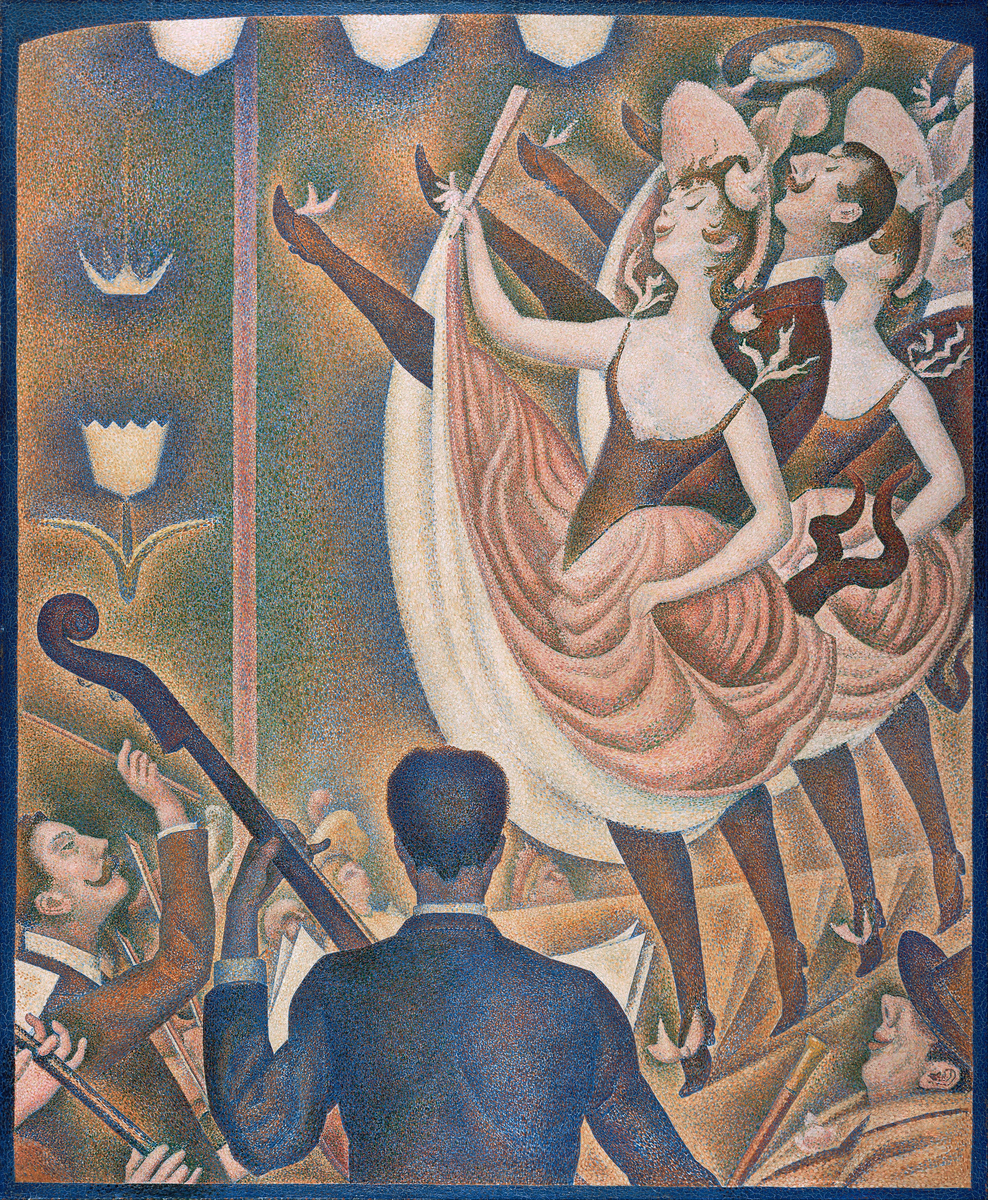
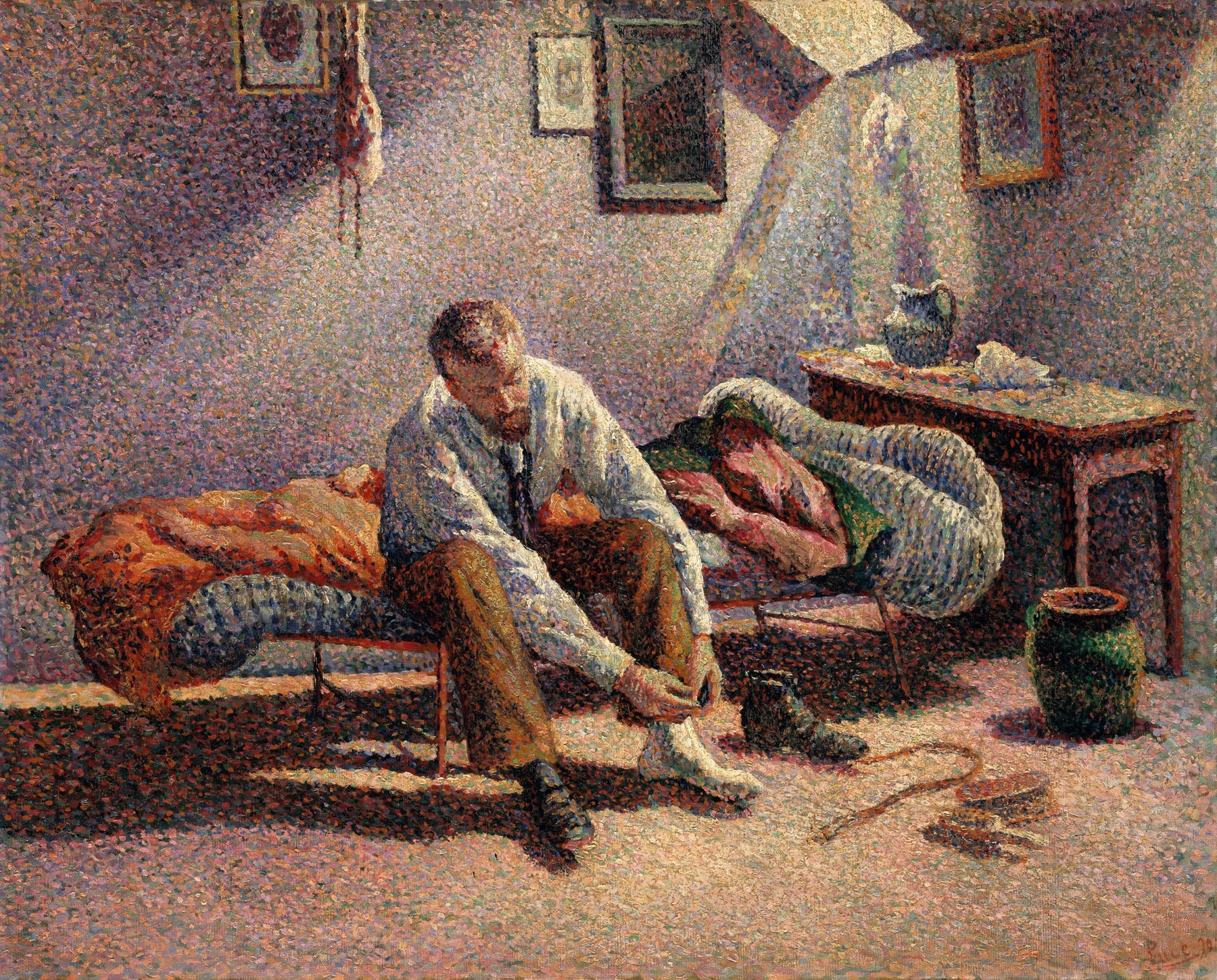
- A music-hall can-can performed by dancers on stage, with musicians in the foreground seen from behind, painted in the divisionist technique of dots and strokes.(Wikimedia Commons contributors, 2015)
- Title variants
- The Can-Can; Le Chahut (Can-can); Lo Chahut; El cancan (Le chahut)
- Support
- canvas
Catalogue identity
The painting carries the French title Le Chahut, known in English as The Can-Can. It is catalogued as the work of Georges Seurat, a French painter, drawer, lithographer and designer whose life span is given as 1859 to 1891. The object record dates the painting to 1889 and classifies it as an oil painting on canvas measuring 170 by 141 centimetres. Its object type is painting, and its genre is genre art, that is, a scene drawn from contemporary everyday or entertainment life rather than from history, religion or myth. These elements together form the core catalogue identity against which the other accounts of the work can be checked.(Wikimedia Commons contributors, 2015, File information, Title; Artist; Date; Medium; Dimensions; Object type, Genre)
The dating of the work is not entirely uniform across its records. The object record dates the painting to 1889, while the image file was formerly titled with the date range 1889-90. The two positions differ in precision rather than in broad period: the catalogue settles on a single year, whereas the earlier file title allowed for work continuing into the following year. Anyone citing the painting should therefore be careful to distinguish the object date recorded in the catalogue from the superseded title date, and should not treat the 1889-90 range as the catalogue's own dating.(Wikimedia Commons contributors, 2015, File title, Date; Date)
Subject and iconography
LinkObject and identification
Visual observation
The object under examination is a painting by Georges Seurat, a French painter, drawer, lithographer and designer who lived from 1859 to 1891. It carries the title Le Chahut, known in English as The Can-Can, and is dated 1889 in the object record. The work is an oil painting on canvas measuring 170 by 141 centimetres. Its object type is a painting and its genre is genre art. The painting belongs to the collection of the Kröller-Müller Museum in Otterlo, Netherlands, where it carries the accession number KM 107.757. These basic identifications frame every subsequent question about what the picture depicts and how it was made.(Wikimedia Commons contributors, 2015, Description)
The painting depicts a can-can, identified as the subject of the work. This identification is recorded as the subject of the artwork and is treated here as the source's stated subject rather than as an independently verified reading of every figure in the scene. The subject is a dance, and the treatment of the dance in paint is what connects the object to the account of its composition and its place in Seurat's practice.(Wikimedia Commons contributors, 2015, Description)
Technique and surface
The painting's technique is described as Pointillism, using dots or strokes of colour, and it is associated with Pointillism in the reference notes of the source record. This is a technical description of method rather than a claim about pigments or supports beyond the stated oil on canvas. The dotted or stroked application is the mechanism by which the surface is built, and the source repeatedly links the work to that technique rather than to smooth blended paint.(Wikimedia Commons contributors, 2015, Description)
Collection context
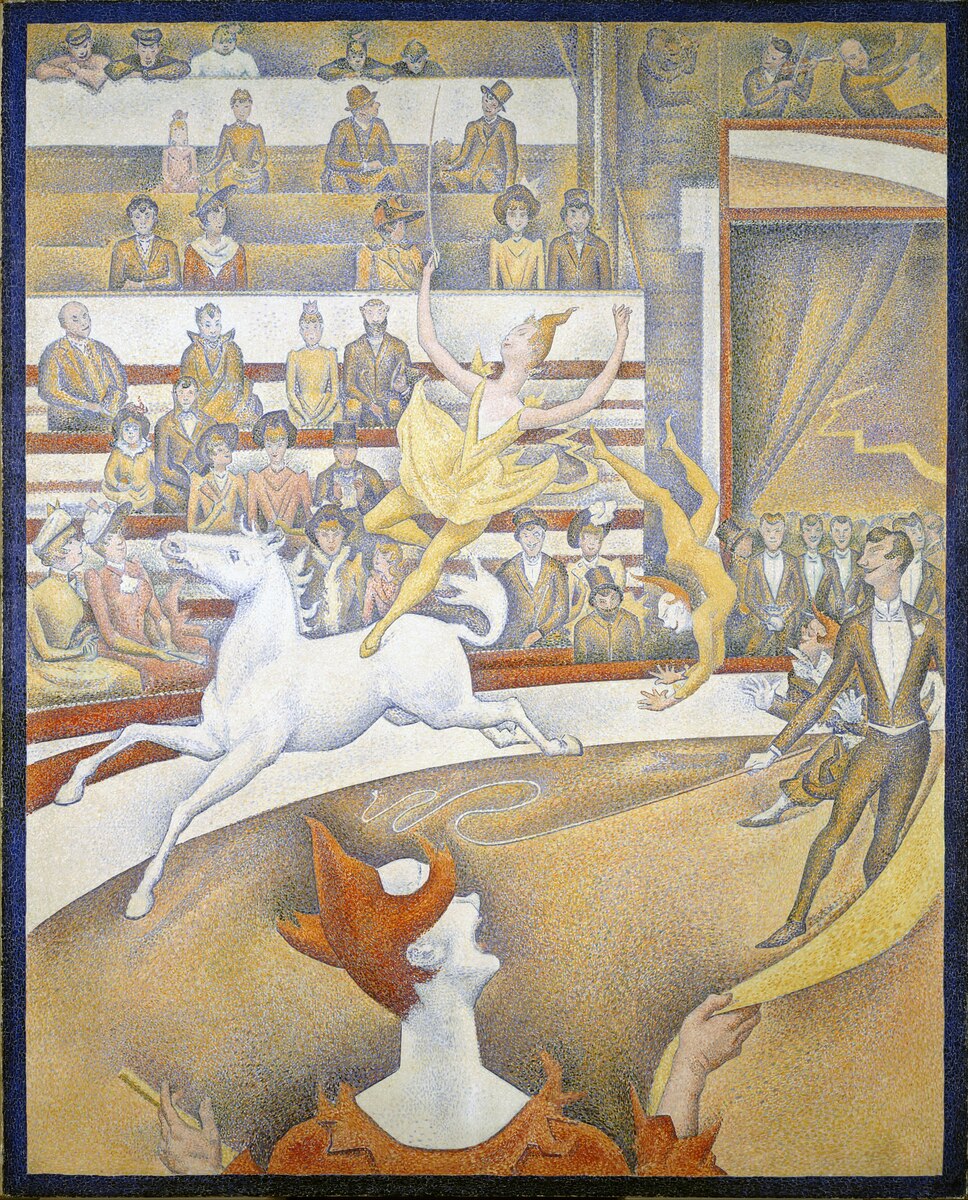
The source groups the painting with other paintings by Georges Seurat in the Kröller-Müller Museum, including The Circus and Young Woman Powdering Herself. This grouping is a collection-level association rather than a claim about stylistic dependence between the three works. It nevertheless places Le Chahut within a holding of Seurat paintings that share a museum context, which is useful for understanding how the object is presented alongside related works by the same hand.(Wikimedia Commons contributors, 2015, Description)
Dates and documentation
The image file was formerly titled with the date range 1889-90, while the object record dates the painting to 1889. This is a disagreement between a file title and the object record, and the object record date is the one stated as the painting's date. The discrepancy is worth retaining because file titles and object records are different kinds of documentation and can preserve older or looser dating conventions. Nothing in the supplied evidence resolves the difference beyond noting that the file title once carried the broader range.(Wikimedia Commons contributors, 2015, Description)
Studies and related files
Study and related files for Le Chahut exist, including an oil study listed as Georges Seurat, Étude pour Le Chahut PC 201. The existence of such study material indicates that the finished painting was preceded by related work in oil, and the study is recorded under its own listing. The evidence does not establish the sequence of execution between the study and the final canvas, nor does it specify how closely the study corresponds to the finished composition. It establishes only that the study and related files are documented alongside the painting.(Wikimedia Commons contributors, 2015, Description)
Circulation and status
The painting is recorded on Wikidata as Le Chahut, with its digital representation and copyright status given as public domain. The painting is in the public domain in its country of origin and other countries where the copyright term is the author's life plus one hundred years or fewer. These are status statements about the work and its reproduction rather than about its making or meaning, but they matter for how the object circulates: they govern whether its image can be reproduced and reused. The public domain determination rests on the term of the author's life plus the stated number of years, applied in the country of origin and in jurisdictions with terms at or below that threshold.(Wikimedia Commons contributors, 2015, Description)
Subject and historical context
Visual observation
Le Chahut, known in English as The Can-Can, is an oil painting on canvas by Georges Seurat, a French painter, drawer, lithographer and designer who lived from 1859 to 1891. The work is dated 1889 and measures 170 by 141 centimetres. Its object type is a painting and its genre is genre art, and the subject depicted is a can-can, identified as the subject of the work. The painting belongs to the collection of the Kröller-Müller Museum in Otterlo, Netherlands, where it carries the accession number KM 107.757. Wikimedia Commons groups the painting with other works by Seurat in the same museum, including The Circus and Young Woman Powdering Herself, and notes that study and related files for Le Chahut exist, among them an oil study listed as Georges Seurat, Étude pour Le Chahut PC 201. The source describes the technique as Pointillism, using dots or strokes of colour, and associates the painting with Neo-Impressionism. Wikidata records the painting as Le Chahut, with its digital representation and copyright status as public domain. The image file was formerly titled with the date range 1889-90, while the object record dates the painting to 1889; that discrepancy between a file title and the object record is itself evidence of how the work's dating has been carried in different documentation layers.(Wikimedia Commons contributors, 2015, File title, Date; Description; Structured data; Public domain)
Interpretation
The painting's historical position rests on its medium and method as much as on its subject. Seurat builds the whole scene from small dots and strokes of colour rather than smooth blended paint, and the source's reference notes explicitly connect the canvas to Pointillism, a technique using dots or strokes of colour. That method is not merely a surface effect: it is the technical fact that links a popular entertainment subject, the can-can, to the Neo-Impressionist programme with which Seurat is associated. The can-can was a dance of display that Paris audiences knew from the music hall, and the painting places dancers on stage while musicians sit in the foreground with their backs turned to the viewer. The dancers lift their legs in a line and their skirts flare with the motion, while the musicians below form a dark horizontal band and the stage above them rises in pale, glowing light. The contrast between the dark foreground and the bright stage separates the performers from the people who make the performance possible, and the repeated legs, flaring skirts and dotted light produce a rhythm that turns a popular entertainment into a carefully constructed pattern of colour and movement.(Wikimedia Commons contributors, 2015, Description; File title, Date)
The image file was formerly titled with the date range 1889-90, while the object record dates the painting to 1889.(Wikimedia Commons contributors, 2015)
Materials and technique
LinkMark-making and attributed technique
Technical description of Le Chahut centres on the painting's method. The source's reference notes associate the work with Pointillism, and the same notes describe the technique as Pointillism using dots or strokes of colour. Taken together, these statements establish the technique as an attributed identification carried in the source's apparatus rather than as a layer-by-layer condition report: they name a method and a characteristic mark, but they do not itemise pigments, media ratios, or preparation layers. The attribution nevertheless matters because it places the canvas within a recognised practice of building a picture from small, discrete marks of colour instead of smoothly blended paint, and it is the single most concrete fact the supplied record offers about how the surface was made. The dating in the record, 1889, situates that practice late in the painter's short career, and the association of the work with Pointillism is repeated in both the general reference note and the technique note, so the two citations reinforce rather than merely duplicate one another.(Wikimedia Commons contributors, 2015, Notes)
The phrase used in the notes, dots or strokes of colour, keeps two kinds of mark in play rather than insisting on one. That wording is a qualification worth preserving: it describes a family of discrete colour applications, and it does not commit the record to a single uniform dotting procedure across the whole canvas. In scholarly terms, the distinction matters because Pointillism is often discussed as a system, while the surviving evidence here supports a description of small separate marks of colour. The evidence does not document the size, density, orientation or distribution of those marks, nor does it distinguish between areas of the composition; any claim that the marks are uniform everywhere would go beyond what the notes state. The notes also do not describe the ground, the canvas weave, or any underdrawing, so the technique is identified but the layered sequence of making remains undocumented in these units.(Wikimedia Commons contributors, 2015, Notes)
The object record specifies an oil painting on canvas measuring 170 by 141 centimetres, an object type of painting within the genre of genre art. These are the support and medium facts the supplied evidence establishes, and they set the scale at which the dotted or stroked colour would have been applied. The dimensions and medium also anchor the technique description to a physical object rather than to a generic style label: the canvas is a large one, and the method attributed to the notes is the method of that canvas. The record does not specify the canvas preparation, the priming, the ground colour, the palette of pigments, or any later treatment or lining, so those aspects of materials and technique remain outside the documented account. Nor do the notes differentiate between the making of the figures, the orchestra, or the background; the medium and support statements apply to the painting as a single object.(Wikimedia Commons contributors, 2015, Notes)
Interpretation
The technique identification and the existence of the study together let the materials account be read against the interpretation of the subject. The painting depicts a can-can, identified as the subject of the work, and the visual account of the composition places dancers on stage with musicians in the foreground, their backs turned. The piling of marks of colour across that composition supports an observation recorded elsewhere: the method keeps the surface active even in quieter areas of the canvas. Read together with the technique notes, that observation links a making procedure to an effect, and it explains why the mark structure is described as continuous rather than confined to the performers. The linkage is interpretive in so far as it connects a technical description to a visual reading of the whole surface, but the underlying components, the pointillist identification and the can-can subject, are each documented or observed in the supplied units. Nothing in the evidence records how the artist planned that distribution of marks, so the connection should be treated as a reading of the surface rather than a statement about intention.(Wikimedia Commons contributors, 2015, Notes; Description)
The written record for the object carries its own dating qualification alongside the material facts. The image file was formerly titled with the date range 1889-90, while the object record dates the painting to 1889. This discrepancy is a documentation matter rather than a materials finding, but it bears directly on any technical account that uses dates to place the picture. The supporting claim list retains both the 1889 dating and the note about the former file title, so the difference between the two is preserved rather than resolved. A materials study that treated the 1889-90 range as fixed, or that treated 1889 as uncontested, would be relying on one side of a documented inconsistency; the safe scholarly position is to record both and to note that they refer to different layers of the record. The same source also records the painting on Wikidata with its digital representation and public domain status, which is provenance of the record rather than of the canvas.(Wikimedia Commons contributors, 2015, Notes)
Collection and display
LinkCollection and display
Le Chahut by Georges Seurat is held in the collection of the Kröller-Müller Museum in Otterlo, Netherlands, where it carries the accession number KM 107.757. This museum record gives the painting a fixed institutional identity, distinguishing the canvas itself from the many reproductions and study images that circulate under the same title. The collection location and number are the most concrete facts in the available documentation: they tie the object to a specific public holding and to the cataloguing practices through which the museum accounts for works in its care. Any account of the painting's form or subject rests on this baseline identification, since the evidence for what the picture shows and how it was made comes from the same record that documents where it now resides.(Wikimedia Commons contributors, 2015, Collection, Current location; Accession number)
The painting is grouped on Wikimedia Commons with other paintings by Georges Seurat in the Kröller-Müller Museum, including The Circus and Young Woman Powdering Herself.(Wikimedia Commons contributors, 2015)
Documented values and qualified estimates
LinkRecorded values
Interpretation
The only supplied valuation evidence for this object is a working insurance estimate generated on 2026-10-16, which places the painting in a range of US$175M to US$400M. The unit states that this is a conservative, model-generated range intended for manual review rather than a figure drawn from the art market or from any institutional record. Its stated inputs are the confirmed context of the object itself: Georges Seurat, Le Chahut, 1889, oil on canvas, 170 by 141 centimetres, Neo-Impressionist, held by the Kröller-Müller Museum under accession KM 107.757. The range is said to reflect Seurat's canonical status, the extreme rarity of major finished canvases, the monumental scale, the museum exhibition history, and the prominence of the image. No official appraisal, private insurance figure, auction result, or comparable sale stands behind the numbers.(Wikimedia Commons contributors, 2015)
The qualification attached to that estimate is as consequential as the estimate itself. The unit states that it is a model-generated working range for manual review only, that it is not an official insurance value, appraisal, auction result, or sale price, and that it rests on neither private insurance records, verified comparable sales, nor a formal valuation. It further warns that actual insurance coverage, museum indemnity, or market value could fall outside the stated range and should be determined by a qualified professional using current market and collection-specific data. The same unit and the Commons record supply the object-level facts that feed the calculation, including the attribution to Seurat, the 1889 dating, the oil-on-canvas medium, the 170 by 141 centimetre dimensions, the Neo-Impressionist association, the Kröller-Müller Museum holding, and the accession number KM 107.757. Those object facts are presented as documented collection data, whereas the monetary range is presented as a derived and provisional construct.(Wikimedia Commons contributors, 2015)
The Commons record documents cultural and institutional standing through material facts: a painting dated 1889, known in English as The Can-Can, by a French painter, drawer, lithographer and designer who lived from 1859 to 1891, depicting the can-can as its subject, and belonging to the genre of genre art. The Commons entry also relates the canvas to other Seurat paintings in the Kröller-Müller Museum, including The Circus and Young Woman Powdering Herself, and notes that study and related files exist, among them an oil study listed as Étude pour Le Chahut PC 201. The painting is recorded on Wikidata as Le Chahut, with its digital representation and copyright status as public domain, and the source states that the painting is in the public domain in its country of origin and other countries where the copyright term is the author's life plus one hundred years or fewer. Copyright status is a recorded value of a different order from insurance or market value, and it is the only one of these value categories that the evidence presents as settled rather than provisional. Read together, the documented value of Le Chahut in this record is a value of position, material identity and legal status, while the money figure is an inference layered on top of that profile and remains formally unverified.(Wikimedia Commons contributors, 2015)
The Commons entry preserves a dating discrepancy that bears on any valuation premise keyed to a confirmed date. The record dates the painting to 1889, and the valuation unit adopts 1889 as part of the confirmed context. At the same time, the Commons entry notes that the image file was formerly titled with the date range 1889-90, while the object record dates the painting to 1889. The Commons record also describes the technique as Pointillism, using dots or strokes of colour, and associates the painting with Pointillism in its reference notes, while calling the work Neo-Impressionist. Because the valuation unit anchors its range in Seurat's canonical status and the painting's prominence, and because those claims rest on the attributed technique and art-historical characterisations recorded by the source, the estimate is only as secure as those attributed status claims beneath it. Within the terms of the supplied evidence, the value of Le Chahut is documented as cultural, material and public-domain status, with a dated, model-generated monetary working range offered solely for manual review.(Wikimedia Commons contributors, 2015)
Working estimate
Calculated working insurance estimate, not a sale price: Working range: US$175M to US$400M Recorded date: Working calculation, generated 2026-10-16. Methodology: This is a conservative, model-generated working range for manual review. It is derived from the confirmed context only: Georges Seurat, Le Chahut, 1889, oil on canvas, 170 x 141 cm, Neo-Impressionist, held by the Kroller-Muller Museum with accession KM 107.757. The range reflects Seurat's canonical status, extreme rarity of major finished canvases, monumental scale, museum exhibition history, and the prominence of the image, without claiming any official appraisal, private insurance figure, auction result, or comparable sale. Qualification: This is a model-generated working range for manual review only. It is not an official insurance value, appraisal, auction result, or sale price. It is not based on private insurance records, verified comparable sales, or a formal valuation. Actual insurance coverage, museum indemnity, or market value could fall outside this range and should be determined by a qualified professional using current market and collection-specific data.(Wikimedia Commons contributors, 2015)