ArchiveThe Circus

Artwork record / 50 of 331

The Circus by Georges Seurat (1891)

Artist: Georges Seurat

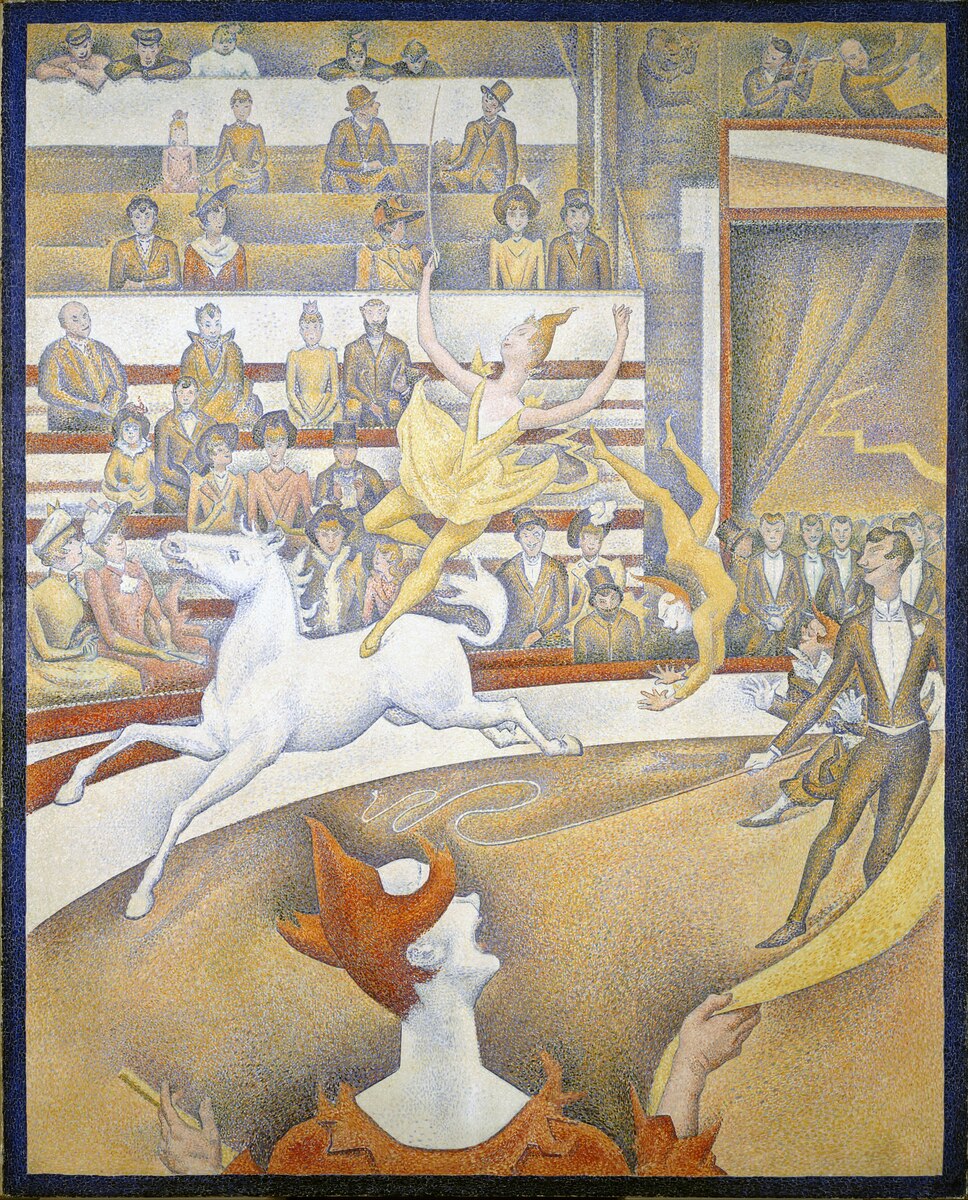
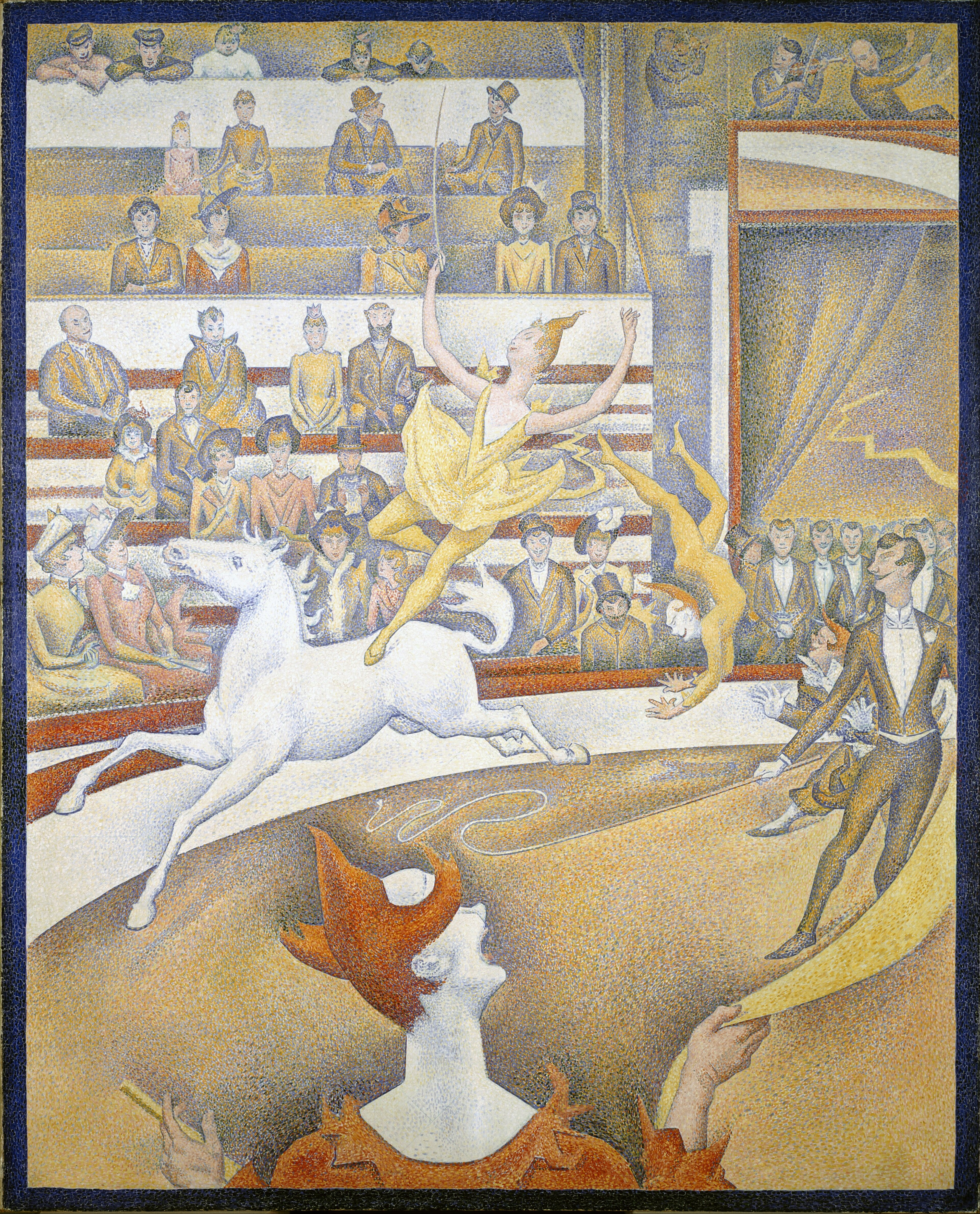
A gallery walk through Georges Seurat's The Circus (1891). The painting shows a female acrobat balanced on a galloping white horse while a ringmaster directs the performance and a clown frames the ring from the foreground. Looking closely at the composition and the dotted surface, we can trace how Seurat turns a live circus act into a demonstration of how the eye assembles a scene.

Read the story ↓ About the artist ↓ Research and record ↓ Literature and sources ↓ Listen to the article ↓
Article text for AI
Shop this artwork ↓ 0 visits
Date1891CultureFrench PeriodNeo-ImpressionismCurrent locationMusée d'Orsay, Paris, France
Listen to the article
100%
The Circus by Georges Seurat (1891)
Loading full-resolution artwork…
Scroll to zoom · drag to pan · double-click to focus Pinch to zoom · drag to explore · double-tap to focus FIELD VIEW / 50
Tools & download
Pixel colour Select a pixel with the eyedropper
No pixel selected

Choose the eyedropper, then click or tap the image. Scroll to zoom for finer selection.

Add text

Hand to pan · Select to move text and drawings · Add as many texts as you like · Scroll to zoom

The Circus: high-resolution image

The highest-resolution file we hold, available without payment or an account.3,840 × 4,758 pixels.

Download highest-resolution image

Details to notice

About 3 minutes to read
01

Musicians' box

The orchestra box at the upper right where two musicians play violins, a small but revealing detail that sets the circus scene within continuous performance and live sound.

02

Tiered audience stands

Rows of seated spectators with top hats, bonnets and bowlers packed into the tiered benches along the left, each face and hat reduced to dotted silhouettes that give the painting its social texture.

03

Ringmaster in evening dress

The ringmaster at the right in black tailcoat, white shirtfront and bow tie, with moustache and outstretched hand, directing the performance and holding a long yellow ribbon or rein that curves across the ring.

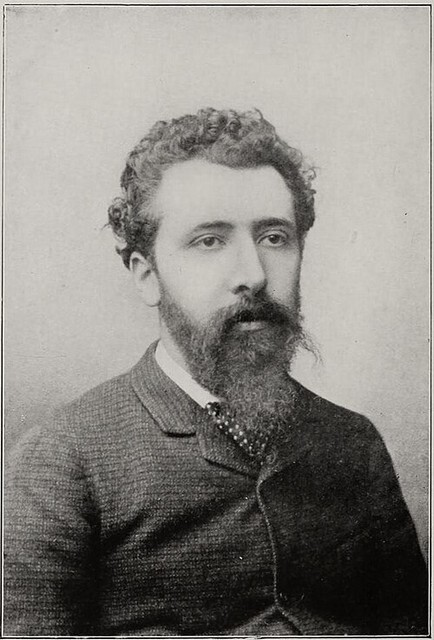
Artist portrait of Georges Seurat
Artist portrait Image credit

Unidentified photographer. Image source · Public domain

About the artist

Georges Seurat

1859 to 1891

Georges Seurat was a French painter (1859-1891). Their work is associated with pointillism; Neo-impressionism; Post-impressionism. Their recorded places of work include Brest; Gravelines; Honfleur; Le Crotoy; Paris; Port-en-Bessin-Huppain.

Born
1859
Died
1891
Nationality
France
Birthplace
Paris; former 5th arrondissement of Paris
Died in
Paris; boulevard de Magenta

The research & record

Study the work.
Follow the evidence.

Find catalogue details, historical context, technical research and the literature behind this artwork.

Article text for AI
Open research text

The artwork record

Research catalogue

Catalogue information and detailed research, with references that link to the bibliography.

Updated .

Identity and catalogue

Link
Title
The Circus
Artist or attribution
Georges Seurat(Wikimedia Commons: The Circus, n.d.)
Object date
1891
Medium and support
oil on canvas(Wikimedia Commons: The Circus, n.d.)
Dimensions
1,850 mm x 1,520 mm(Wikimedia Commons: The Circus, n.d.)
Current collection or location
Musée d'Orsay, Paris, France(Wikimedia Commons: The Circus, n.d.)
Movement or period
Neo-Impressionism(Wikimedia Commons: The Circus, n.d.)
Country or culture
France
Depicted subject
A genre scene of a circus performance. An equestrienne in a yellow tunic balances on a galloping white horse at the centre of the ring, while a ringmaster with a whip directs the act, an acrobat hangs inverted from a trapeze, a clown stands in the foreground with his back to us, and spectators fill the tiered stands. The work is dated 1891 and was left unfinished at the artist's death that year.
Title variants
Cirque; Le Cirque; The Circus
Support
canvas
Catalogue identity

The painting The Circus is attributed to Georges Seurat and is dated 1891, the year of the artist's death. It is an oil on canvas in the collection of the Musée d'Orsay. Seurat is identified in the record as a French painter, drawer, lithographer and designer, born 2 December 1859 and died 29 March 1891. The date 1891 belongs to the object, not to any later catalogue or photographic record: the Wikimedia Commons page used here is a file page for a Google Art Project photograph of the painting, and its role as a discovery aid and institutional record mirror is distinct from the physical object's own date. The object record classifies the work as genre art, and its inclusion in the Wikidata project for sum of all paintings places it within the Neo-Impressionist movement.(Wikimedia Commons: The Circus, n.d., Summary, object type, title, date, medium; Artist; Genre; File usage on other wikis, Wikidata project)

The painting The Circus is by Georges Seurat, dated 1891, oil on canvas, in the collection of the Musée d'Orsay.(Wikimedia Commons: The Circus, n.d.)

The artist Georges Seurat was a French painter, drawer, lithographer and designer, born 2 December 1859 and died 29 March 1891.(Wikimedia Commons: The Circus, n.d.)

Subject and iconography

Link
The recorded composition

Visual observation

The object record for this canvas localises the performance in a series of distinct figures. At the centre is an equestrienne in a flared yellow tunic, balanced on a galloping white horse, her arms curved over her head in a decorative arabesque. The record places a clown at the bottom edge, seen from behind and cropped by the frame, his hand holding a whip at the lower right, so that the viewer is positioned behind him. At the right of the ring stands a moustached man in evening dress and bow tie, gesturing with a long curling lash that sweeps across the sand. A yellow-costumed acrobat hangs head downward at the right, hair loose and arms open toward the ring. Above and around these figures, rows of spectators in top hats, bowlers, bonnets and uniform collars pack the raked seating, their faces reduced to sociable masks. What the record establishes is a composition organised around a ring and framed by figures who face into it from different positions at the edge, rather than a single continuous stage picture.(Wikimedia Commons: The Circus, n.d., Semantic focus candidate, context)

Interpretation

These placements can be described without settling what they mean. The equestrienne and horse occupy the highest and most central point of the described action; the clown occupies the nearest edge and is cropped by the frame; the standing man with the lash is placed at the right of the ring and works the space with a sweeping line; the inverted acrobat at the right is positioned off the ground and outside the centre. The raked seating crowds the described picture with repeating heads and hats. The record does not give the thoroughfare, the architecture of the tent beyond the seating, or a colour for the ring floor, and those are not supplied here. It does establish that the composition is built from a small number of named performers set against an audience that is treated as massed pattern rather than as individual portraiture.(Wikimedia Commons: The Circus, n.d., Semantic focus candidate, context)

Costume, class and the world of the ring

Visual observation

Details of dress and behaviour carry social information. The moustached man is recorded in evening dress and bow tie, and he acts with a long curling lash, which ties him to the direction of the performance as described. The clown's whip at the lower right belongs to the same repertory of handling equipment. The yellow tunic of the equestrienne and the yellow costume of the inverted acrobat are the two recorded items of yellow performance dress, and both performers are placed in relation to the ring rather than inside the seating. The spectators are recorded in top hats, bowlers, bonnets and uniform collars, a mixture of headgear that the record treats as evidence of a packed public rather than of named sitters. Because these are recorded observations from an institutional record mirror rather than a firsthand viewing account, they are reported here as the record's description, not as unmediated fact.(Wikimedia Commons: The Circus, n.d., Semantic focus candidate, context)

Interpretation

Read together, these figures and spectators describe a division between the ring and the stand. The performance is carried by a small number of costumed and equipped bodies; the audience is carried by repetition of hat and collar types. The record treats the faces as reduced to sociable masks, which is a statement about how they are rendered, not a claim about the sitters. This is the level at which the object sits within a larger history of modern urban leisure imagery: it records a commercial spectacle and its paying public together, and it does so through figure types rather than through identifiable individuals. Whether the yellow dress signals a specific troupe, role or convention is not stated in the evidence and is not asserted here.(Wikimedia Commons: The Circus, n.d., Semantic focus candidate, context)

What the visual record establishes and what it leaves open

The object record settles a set of connected claims: that this is an oil on canvas genre picture of the recorded dimensions, associated with Neo-Impressionism, distributed through the catalogues, databases and publications listed above, and imaged at a stated resolution for the Google Art Project. It records the composition as an equestrienne on a galloping white horse, a cropped clown with a whip, a moustached man in evening dress with a curling lash, an inverted acrobat, and packed rows of hatted spectators. It does not establish the identity of the performers, the circus, the spectators or the occasion; it does not describe the architecture of the tent, the ground, the lighting or the palette beyond the recorded yellow costumes; and it does not give an influence, predecessor or successor for any of the recorded motifs. Statements of resemblance between this scene and other circus or leisure imagery would therefore be acts of comparison, not findings of this record. The work matters within a larger history of art and material culture on the evidence actually present here because it is a documented, catalogue-indexed, database-indexed and widely reproduced modern genre painting whose record preserves both the described performance and the institutional apparatus through which that performance has been transmitted.(Wikimedia Commons: The Circus, n.d., Semantic focus candidate, context; Genre; Medium; Dimensions; References; File information; File usage on other wikis, Wikidata project)

Visual observation

The central focus of the painting is an equestrienne in a flared yellow tunic balanced on a galloping white horse, her arms curved over her head in a decorative arabesque.(Wikimedia Commons: The Circus, n.d.)

A clown appears at the bottom edge of the painting, seen from behind, his body cropped by the frame so that the viewer sits behind him, with his hand holding a whip at the lower right.(Wikimedia Commons: The Circus, n.d.)

A moustached man in evening dress and bow tie stands at the right of the ring, gesturing with a long curling lash that sweeps across the sand.(Wikimedia Commons: The Circus, n.d.)

A yellow-costumed acrobat hangs head downward at the right, hair loose, arms open toward the ring.(Wikimedia Commons: The Circus, n.d.)

Rows of spectators in top hats, bowlers, bonnets and uniform collars pack the raked seating, their faces reduced to sociable masks.(Wikimedia Commons: The Circus, n.d.)

Historical context

Link
Object record and classification

The object record classifies The Circus as genre art. The same record associates the work with the Neo-Impressionist movement through its inclusion in the Wikidata project for sum of all paintings, movement Neo-Impressionism. These two classifications belong to the institutional description of the work rather than to the performance it depicts. The genre designation places the painting within a category of scenes of everyday and public life, while the movement association situates it within a documented grouping of works identified as Neo-Impressionist. The object record also carries the painting's identification in the Wikidata item Q2275610, making the work a described entity within structured art-historical data. The classifications are descriptive metadata: they identify what kind of picture this is understood to be and how it has been grouped, and they establish the terms under which the object is researched.(Wikimedia Commons: The Circus, n.d., Genre; File usage on other wikis, Wikidata project; References)

Why the object matters

Interpretation

Taken together, the evidence shows an object whose documentary life and pictorial life are closely entwined. The genre and Neo-Impressionist classifications fix its place in art-historical categories, the catalogue raisonne numbers and database identifiers fix its place in scholarly infrastructure, and the Quinn bequest fixes its place in a specific collecting history that led to the Musee d'Orsay. The picture's own subject is a public amusement whose viewing arrangements it repeats and turns back on the spectator: the crowed stands, the directing ringmaster, the inverted acrobat and the cropped clown all organise attention in the same way a ring organises its audience. The painting thus matters within a larger history of art and material culture because it treats a mass entertainment and its social order as a subject for a highly controlled pictorial construction. That claim is a qualified synthesis drawn from the recorded classifications, provenance, reference literature and described visual arrangements, and it does not depend on undocumented claims about the artist's intention or about any single historical performance.(Wikimedia Commons: The Circus, n.d., Genre; File usage on other wikis, Wikidata project; Object history; References; Semantic focus candidate, context)

The painting is classified as genre art in its object record.(Wikimedia Commons: The Circus, n.d.)

The work is associated with the Neo-Impressionist movement, as evidenced by its inclusion in the Wikidata project for sum of all paintings, movement Neo-Impressionism.(Wikimedia Commons: The Circus, n.d.)

Materials and technique

Link
Support, medium and format

The Circus is executed in oil on canvas. The support is therefore a woven fabric prepared to receive an oil medium, and the picture belongs to the tradition of portable, large-format canvas painting rather than to panel, fresco or paper. Wikimedia Commons records the medium simply as oil on canvas, without specifying the ground, the priming, the weave, the stretcher or any lining, so the material description established by the evidence stops at the identification of oil and canvas. The painting measures 1,850 mm in height and 1,520 mm in width. Those dimensions describe a work of considerable scale, taller than it is wide, and they are object-record facts that define the physical format of the canvas independently of what it depicts. The same record dates the work to 1891 and identifies it as The Circus by Georges Seurat, and it is held in the collection of the Musee d'Orsay in Paris with accession number 542, entering that collection through the John Quinn bequest in 1924. Provenance and accession belong to the history of the object as a museum holding, while medium and dimensions belong to its history as a made thing; the evidence keeps these two orders of fact distinct, and the present account does the same.(Wikimedia Commons: The Circus, n.d., Medium; Dimensions)

Beyond the identification of oil on canvas and the recorded dimensions, the supplied evidence documents no further material or technical particulars. There is no evidence here for the ground or priming, the pigment analysis, the layer structure, the brushes or other tools, any varnish, lining, restoration or conservation treatment, and no examination report, sampling result or imaging study is cited. The available documentation is an institutional record mirrored by Wikimedia Commons and a Google Art Project photograph, not a technical examination. This distinction matters because the surface of the painting is described in visual terms elsewhere in the evidence: the pale body of the white horse is said to be dotted with lilac and blue shadows against the warm ring floor, and the spectators' faces and hats are described as reduced to dotted silhouettes. Those are observations of appearance, and they are not the same as analytical findings about what materials produce that appearance. Whether the dots are separate touches of distinct pigments, how the paint was applied, and how the colours were prepared are questions the present evidence does not answer, and they should not be inferred from the picture's look alone.(Wikimedia Commons: The Circus, n.d., Medium; Dimensions)

The Circus is documented as oil on canvas, dated 1891, measuring 1,850 millimetres high by 1,520 millimetres wide, and held in the collection of the Musée d'Orsay in Paris with accession number 542, where it entered through the John Quinn bequest in 1924. Those object-record facts keep the physical picture distinct from the subject it depicts: a large canvas whose scale matters because the painting asks the viewer to stand before a ring rather than read a small image. The Circus is also the title under which the work circulates in the Wikimedia Commons file page for a Google Art Project photograph, the institutional record mirror through which the present account was assembled. The medium, dimensions, collection and provenance are documented data about the object, not observations inferred from looking at it.(Wikimedia Commons: The Circus, n.d., Medium; Dimensions; File information)

Interpretation

The Google Art Project photograph that supplies the primary technical datum is 3,918 by 4,855 pixels with a file size of 8.39 MB and MIME type image/jpeg. This matters for how the painting has been examined here: the account below works from a high-resolution digital surrogate rather than from physical examination, condition reporting, sampling or imaging. The surrogate records appearance at a single documented resolution and compression, and it cannot by itself establish surface texture, layer structure, pigments, canvas weave or earlier states of the composition. Claims about pattern, placement and visible form can be checked against this file; claims about materials and technique cannot. The file is therefore a resource for looking closely, and its limits should be kept in view wherever a description below begins to sound like an account of the paint itself.(Wikimedia Commons: The Circus, n.d., File information)

Read together, the documented and observed units support a distinction between what is established and what is proposed. The medium, dimensions, collection, accession number and bequest are documented facts about the object. The configurations of figures, gestures, costume colours and audience are observations plus the Commons record's own descriptive elaborations. The claims that the acrobat forms the visual apex and that the clown's placement draws the viewer in are interpretations offered by the Commons record, not findings of examination. The technical datum, the 3,918 by 4,855 pixel jpeg, tells us the resolution at which the visible detail can be inspected but does not confirm any proposal about composition or pictorial intention. Where the account moves from placement and pattern to the work's effect, that step is interpretive, and the evidence does not license a stronger claim.(Wikimedia Commons: The Circus, n.d., File information; Medium; Dimensions; Semantic focus candidate, context)

The evidence supplied for this object does not include dated examination campaigns, imaging methods beyond the Google Art Project photograph, sampling results, pigment analysis, canvas or ground studies, condition reports, conservation treatments, pentimenti or underdrawing. No technical study establishing Seurat's working sequence on this canvas, no cross-section or pigment identification, and no infrared or x-radiographic finding is present in the units. The painting's place within a larger history of art and material culture must therefore rest on what the units actually support: a large oil on canvas of 1891, documented in the Musée d'Orsay and known through a high-resolution digital photograph, showing a circus performance organised around a balancing equestrienne and a surrounding cast of ringmaster, clown, acrobat and dotted audience. Those are the terms on which the object can be described without inventing missing technical findings.(Wikimedia Commons: The Circus, n.d., File information; Medium; Dimensions)

The painting is executed in oil on canvas.(Wikimedia Commons: The Circus, n.d.)

The painting measures 1,850 mm in height and 1,520 mm in width.(Wikimedia Commons: The Circus, n.d.)

Technical examination

The Google Art Project image of the painting is 3,918 by 4,855 pixels, with a file size of 8.39 MB, MIME type image/jpeg.(Wikimedia Commons: The Circus, n.d.)

Provenance and ownership

Link
Documented Transfer and Custody

The provenance record for Georges Seurat's The Circus begins with a single documented event: the painting entered the Musée d'Orsay through the John Quinn bequest of 1924. The same institutional record gives the work its accession number, 542, fixing the object within the museum's holdings under that identifier. These two facts belong together, since the bequest is the means of entry and the accession number is the mark of the museum's custody. What the evidence does not supply is any earlier history. No purchase, commission, dealer, prior owner or intermediate transfer is recorded here, and the interval before 1924 therefore remains unrecorded rather than proven to be a change of ownership. That distinction matters for how the object is described: a documented bequest establishes the route into the public collection, while an unrecorded period simply establishes that the sources consulted do not narrate it.(Wikimedia Commons: The Circus, n.d., Object history)

The date and medium fixed in the object record give the transfer a chronological anchor. The painting is an oil on canvas dated 1891, measuring 1,850 millimetres high by 1,520 millimetres wide, and this identification as The Circus by Georges Seurat is what the provenance statement concerns. Placing the 1891 execution beside the 1924 bequest shows that the documented custody begins after the artist's lifetime and that the museum's acquisition is separated from the work's making by more than three decades. The record does not explain what happened during that separation, and the evidence does not permit the gap to be filled with assumed sales, inheritances or holdings. What can be said is bounded and useful: the object exists as an identified oil painting of 1891, and the earliest documented fact in its ownership history is the Quinn bequest.(Wikimedia Commons: The Circus, n.d., Object history)

The provenance of the painting is bound up with the identity of John Quinn, whose bequest carried the work into the Musée d'Orsay. The source consulted records the Quinn connection not only in the object history but also in a publication on John Quinn, in which the painting is reproduced at page 186. That reproduction places the work within a documented account of Quinn's collecting and legacy, even though the evidence supplied here does not narrate the terms of the bequest, the date of Quinn's death, or the mechanism by which the bequest was administered. The citation is nonetheless relevant to provenance because it shows that the Quinn association is treated as a substantive part of the painting's documented history rather than an incidental detail, and it provides a locator for further research into that association.(Wikimedia Commons: The Circus, n.d., Object history; References)

Object Identity and Provenance

The provenance account and the visual record should be kept distinct even when they concern the same canvas. The scene shows a female acrobat in a yellow tutu and bodice balancing on the back of a galloping white horse, holding a whip in one raised arm while the other arm extends, with a spectator clown in orange ruff seen from behind in the foreground and a ringmaster in black tailcoat, white shirtfront and bow tie holding a long yellow ribbon or rein at the right. The tiered audience stands on the left reduce faces and hats to dotted silhouettes, and an orchestra box at the upper right contains two musicians playing violins. These are the elements the object record describes, and they are the subject the painting depicts. They do not by themselves document ownership. The provenance section matters because it shows that the canvas carrying this image is the same identified object, dated 1891 and held under accession number 542, whose entry into the Musée d'Orsay is documented through the Quinn bequest.(Wikimedia Commons: The Circus, n.d., Object history)

The documentary situation of The Circus is therefore uneven in a way that is typical of late nineteenth-century paintings and worth stating plainly. One transfer is recorded, from the Quinn bequest into the Musée d'Orsay in 1924, and it is recorded with an accession number and a museum collection. Everything before that is absent from the supplied evidence, and the catalogues, databases and publications that identify the work do not fill the gap. The gap should be called an unrecorded interval, not an undocumented change of ownership: the sources establish silence, not an undocumented sale or inheritance. This distinction is consequential because it governs what may be asserted in the object's history. The painting's documented provenance is a single well-attested event attached to a securely identified oil on canvas of 1891, and the rest of its ownership history awaits evidence that the present record does not contain.(Wikimedia Commons: The Circus, n.d., Object history; References)

The painting entered the Musée d'Orsay through the John Quinn bequest of 1924.(Wikimedia Commons: The Circus, n.d.)

Provenance timeline
  1. 1924

    The painting entered the Musee d'Orsay through the John Quinn bequest.(Wikimedia Commons: The Circus, n.d., Object history)

Reception and literature

Link
Catalogues raisonnés and reference status

The Circus has been fixed within the core reference literature on Georges Seurat for well over half a century: it appears in the 1972 and 1959 Seurat catalogue raisonnés, numbered 215 and 211 respectively. The two numbers matter as evidence of a historiographic process rather than a merely bibliographic detail, since a catalogue raisonné is the instrument by which a body of work is delimited, ordered, and made citable, and the renumbering between the 1959 and 1972 volumes shows that even the basic inventory of Seurat's output has been subject to revision as scholarship on the artist has been reassessed. Inclusion in these volumes establishes the painting not only as an authentic Seurat but as a work considered central enough to the corpus to be catalogued and described in each successive authoritative survey.(Wikimedia Commons: The Circus, n.d., References)

Beyond the specialist catalogues, the painting circulates in general and thematic publications. It is reproduced in the 2006 book 1001 Paintings You Must See Before You Die, page 540, and in the publication on John Quinn, page 186. The two occurrences represent different kinds of reception: the first places the work within a popular canon of must-see pictures, a list format that converts art-historical standing into an itinerary for general readers, while the second attaches it to the history of a single collector. The Quinn volume is the more consequential connection for this object, because Quinn is the figure through whom the painting reached its present public home.(Wikimedia Commons: The Circus, n.d., References)

The painting has also been registered in a series of digital and photographic reference systems. It is indexed in the Joconde database, ID 000PE004119, in the RKDimages database, ID 223060, in the Panorama de l'art under the identifier le-cirque, in L'Histoire par l'image under cirque-spectacle-populaire, in Google Arts & Culture with asset ID agFX4peHSDwt_g, and under Bpk-ID 00056179, and it is the subject of the Wikidata item Q2275610. These identifiers carry different institutional weight: Joconde is the French national collections inventory, RKDimages is the Netherlands Institute for Art History's image documentation system, Panorama de l'art and L'Histoire par l'image are French educational and image-history resources, and Google Arts & Culture and the Bpk identifier belong to photography distribution and rights management. Taken together they show reception operating simultaneously through national heritage documentation, scholarly image archives, pedagogical platforms, and commercial photographic circulation, so that the picture is now reachable through several distinct infrastructures rather than through museum display alone.(Wikimedia Commons: The Circus, n.d., References)

Collection, bequest, and the object record

The painting entered the Musée d'Orsay through the John Quinn bequest of 1924. That bequest is the documented moment at which the work passed into a French national collection, and it links the object to a transatlantic history of collecting: Quinn, an American collector, is named in the provenance record as the source of the bequest, and the painting is consequently discussed in a publication devoted to him, suggesting that its life in an American collection and its transfer to Paris are treated as a single episode in his collecting activity.(Wikimedia Commons: The Circus, n.d., Object history; References)

The work's place in the history of art and material culture

Interpretation

Read together, the evidence shows several successive stages of reception layered on one object. First, the painting entered the Seurat literature through the catalogues raisonnés and was assigned changing numbers as that literature was revised. Second, it entered popular and thematic publishing, including a must-see canon and a book on John Quinn. Third, it passed into public ownership through the 1924 Quinn bequest and was registered by the Musée d'Orsay under accession number 542 with a genre classification. Fourth, it was absorbed into movement history as Neo-Impressionist through the sum-of-all-paintings project. Fifth, it acquired digital life through national, scholarly, educational, photographic and linked-data identifiers. Each stage changed what the painting could be used for: a catalogue entry makes it citable, a bequest makes it visitable, a database identifier makes it findable and reproducible at distance. Its importance within a larger history of art and material culture therefore rests on two documented facts that operate at once, its place in Seurat's catalogued output and its physical survival in a public collection where its imagery of live performance continues to be read.(Wikimedia Commons: The Circus, n.d., References; Object history; Genre; File usage on other wikis, Wikidata project)

The painting is included in the 1972 and 1959 Seurat catalogue raisonnés, numbered 215 and 211 respectively.(Wikimedia Commons: The Circus, n.d.)

The painting is reproduced in the 2006 book 1001 Paintings You Must See Before You Die, page 540, and in the publication on John Quinn, page 186.(Wikimedia Commons: The Circus, n.d.)

The painting is indexed in the Joconde database (ID 000PE004119), the RKDimages database (ID 223060), the Panorama de l'art (le-cirque), L'Histoire par l'image (cirque-spectacle-populaire), Google Arts & Culture (asset ID agFX4peHSDwt_g), Bpk-ID 00056179, and is the subject of the Wikidata item Q2275610.(Wikimedia Commons: The Circus, n.d.)

Interpretations and debates

Link
Interpretive Frames for the Ring

Interpretation

The interpretive layer supplied for the painting treats the ring as a composed system of attention rather than a neutral record of an acrobatic act. In this reading the equestrienne on the white horse is the focal point of the ring and the image of grace and equilibrium around which the whole picture is built; the foreground clown, cropped by the frame with his back to the viewer, works as the audience's surrogate and the picture's nearest witness; the ringmaster's command gesture sets the rhythm that the horse and rider obey; and the inverted trapeze artiste introduces a note of risk and suspended movement that counterpoints the poised rider. These are attributed readings, not statements of the maker's private intent, and they sit on top of the observations they depend on: the equestrienne in a flared yellow tunic balanced on a galloping white horse with her arms curved over her head in a decorative arabesque; the clown seen from behind at the bottom edge, his body cropped so that the viewer sits behind him, his hand holding a whip at the lower right; the moustached man in evening dress and bow tie at the right of the ring, gesturing with a long curling lash that sweeps across the sand; and the yellow-costumed acrobat hanging head downward at the right, hair loose, arms open toward the ring. Read together, the readings describe a division of pictorial labour between a still centre of balance and peripheral figures who supply rhythm, risk and a viewing position.(Wikimedia Commons: The Circus, n.d., Semantic focus candidate, context)

A further interpretive claim concerns the audience rather than the performers: the serried crowd of spectators makes the circus a public ritual and presses the ring into a shallow stage band. That reading rests on a specific observed configuration in which rows of spectators in top hats, bowlers, bonnets and uniform collars pack the raked seating, their faces reduced to sociable masks. The compression of the crowd and the reduction of faces to repeated types are what allow the stands to be read as ritual and as a shallow band rather than as deep, individuated space. The claim is a description of pictorial effect, and it remains an interpretation of how the seating functions in the composition, not a documented statement about the painting's reception by any historical audience.(Wikimedia Commons: The Circus, n.d., Semantic focus candidate, context)

Limits of the Interpretive Layer

The interpretive readings collected here share a common evidential basis in the described content of the picture and a common limit. They explain how figures and groupings function compositionally, and they do so in the language of focus, rhythm, counterpoint and framing, but they do not document what the maker intended, what contemporary viewers understood, or how any historical audience responded. The same record that supports the readings also preserves material that the readings do not absorb: the object classification as genre, the movement attribution, the catalogue raisonné numbers, the page-level reproduction data and the database identifiers all describe the painting as a catalogued, classified and widely reproduced work. Any further synthesis would have to keep the attributed scholarly and institutional interpretations distinct from claims about intent, and would have to treat the observational descriptions of the equestrienne, the clown, the ringmaster, the inverted acrobat and the seated crowd as the evidence on which those interpretations rest.(Wikimedia Commons: The Circus, n.d., Semantic focus candidate, context; Genre; References)

The equestrienne on the white horse is the focal point of the ring and the image of grace and equilibrium the whole picture is built around.(Wikimedia Commons: The Circus, n.d.)

The foreground clown, cropped by the frame with his back to us, serves as the audience's surrogate and the picture's nearest witness.(Wikimedia Commons: The Circus, n.d.)

The ringmaster's command gesture sets the rhythm that the horse and rider obey.(Wikimedia Commons: The Circus, n.d.)

The inverted trapeze artiste adds a note of risk and suspended movement that counterpoints the poised rider.(Wikimedia Commons: The Circus, n.d.)

The serried crowd of spectators makes the circus a public ritual and presses the ring into a shallow stage band.(Wikimedia Commons: The Circus, n.d.)

Collection and display

Link
Institutional Record

The Circus by Georges Seurat belongs to the collection of the Musée d'Orsay in Paris, France, where it is registered under accession number 542. Within the museum it is currently located at Level 2, room 69. These three elements of the institutional record, the collecting institution, the registration number, and the gallery location, establish the painting as a catalogued, publicly displayed object rather than an image known only through reproduction, and they give subsequent research a stable point of reference for the work's identity and current whereabouts.(Wikimedia Commons: The Circus, n.d., Collection; Accession number; Current location)

The Circus is in the collection of the Musée d'Orsay, Paris, France.(Wikimedia Commons: The Circus, n.d.)

The painting's accession number is 542.(Wikimedia Commons: The Circus, n.d.)

The painting is currently located at Level 2, room 69 of the Musée d'Orsay.(Wikimedia Commons: The Circus, n.d.)

Documented values and qualified estimates

Link
The Status of the Valuation Record

Interpretation

The single supplied evidence unit for this section is not a sale record, an appraisal, or an archival document of ownership. It is a model-generated working insurance range, explicitly labelled a working calculation and dated 2026-10-16, which places an estimated value of US$500,000 to US$2,000,000 on Georges Seurat's The Circus. The unit therefore belongs to the recorded values of the object only in a qualified sense: it records a provisional figure produced for manual review, not a price achieved, a valuation agreed between parties, or an institutional statement of worth. Any account of what this painting is "worth" on the evidence supplied must begin from that distinction, because the unit itself insists on it.(Wikimedia Commons: The Circus, n.d.)

The range is described as derived from confirmed artwork attributes rather than from market data. Those attributes are named in the unit as the artist's identity as Georges Seurat, the title The Circus, the date 1891, the medium of oil on canvas, dimensions of 1,850 mm by 1,520 mm, current holding at the Musee d'Orsay in Paris under accession number 542, an object history running through the John Quinn bequest of 1924, and identification as a Neo-Impressionist genre painting left unfinished at the artist's death in 1891. The methodology states that the figure rests on these confirmed attributes together with the artist's canonical prominence, the large scale of the canvas, and its institutional collection status. It is therefore a valuation reasoning from curatorial and art-historical facts about the object, not from transactions involving it.(Wikimedia Commons: The Circus, n.d.)

The same unit is explicit about what it did not use. No comparable sales, auction results, official appraisals, or private insurance records were consulted. The consequence, stated in the methodology, is that the range is intentionally broad and conservative for preliminary review. This matters when reading the numbers, because a breadth of US$500,000 to US$2,000,000 reflects the limits of the inputs as much as any property of the painting. The unit also disclaims access to private insurance records and any reliance on comparable sales, so the figure cannot be treated as evidence about what similar works have fetched or about what insurers have previously required for this canvas.(Wikimedia Commons: The Circus, n.d.)

The qualification attached to the record is unusually full and should be preserved in any scholarly use of it. The estimate is described as a model-generated working insurance range for manual review only, and expressly not an official insurance value, appraisal, auction result, or sale price. It further notes that actual insurance requirements may vary significantly with institutional policy, loan agreements, condition, provenance, and professional appraisal, and directs verification through qualified art insurance and appraisal professionals before any decision. Read alongside the object's history, this is a reminder that a painting held in a public collection since the John Quinn bequest of 1924 is not normally valued for the market at all; its insurance figure would be a matter of institutional policy and loan circumstance, which is precisely the domain the unit declines to enter. The most defensible scholarly statement the evidence supports is that a provisional, model-generated insurance range exists for the work, bounded and qualified as above, and that it is not a market price.(Wikimedia Commons: The Circus, n.d.)

Working estimate

Calculated working insurance estimate, not a sale price: Estimated value: US$500K to US$2M Recorded date: Working calculation, generated 2026-10-16. Methodology: Broad working insurance range calculated for manual review only, based on the confirmed artwork context: Georges Seurat, The Circus, 1891, oil on canvas, 1,850 mm x 1,520 mm, held at the Musee d'Orsay, Paris, accession number 542, with an object history of the John Quinn bequest, 1924, and identified as a Neo-Impressionist genre painting left unfinished at the artist's death in 1891. The range is derived from these confirmed attributes, the artist's canonical prominence, the large scale, and the institutional collection status. No comparable sales, auction results, official appraisals, or private insurance records were used, so the range is intentionally broad and conservative for preliminary review. Qualification: This is a model-generated working insurance range for manual review only. It is not an official insurance value, appraisal, auction result, or sale price. It does not claim access to private insurance records and does not rely on comparable sales. Actual insurance requirements may vary significantly based on institutional policy, loan agreements, condition, provenance, and professional appraisal. Verify through qualified art insurance and appraisal professionals before any decision.(Wikimedia Commons: The Circus, n.d.)

Further reading

Books for a closer look

Paid links. As an Amazon Associate I earn from qualifying purchases.

  • Cover of Georges Seurat
    Open Library

    Pierre Courthion, 1988

    Georges Seurat

    H.N. Abrams

    Monograph on Seurat by Pierre Courthion, catalogued with subjects Painting, French; Painting, Modern; and Seurat, Georges, 1859-1891. Its subject matter aligns with a study of Seurat's paintings, offering art-historical comparison, but the record gives no evidence that The Circus itself is examined.

    ISBN 0810915197

    Find book on Amazon.co.uk View reference

Bibliography

Sources and further reading

References are arranged by author or organisation, with links to the original publications. Where no publication date is recorded, n.d. means no date.

Source notes updated .

  1. 02

    Book

    Georges Seurat. H.N. Abrams.

    Monograph on Seurat by Pierre Courthion, catalogued with subjects Painting, French; Painting, Modern; and Seurat, Georges, 1859-1891. Its subject matter aligns with a study of Seurat's paintings, offering art-historical comparison, but the record gives no evidence that The Circus itself is examined.

    ISBN
    0810915197
    Link to reference
    Citation text
  2. 01

    Secondary · About this artwork

    Wikimedia Commons: The Circus (n.d.). Wikimedia Commons: File:Georges Seurat - The Circus - Google Art Project.jpg. Wikimedia Commons.

    Wikimedia Commons file page for a Google Art Project photograph of Georges Seurat's The Circus. Provides object identification, artist dates, title, date, medium, dimensions, collection, accession number, provenance, and references to catalogues raisonnés and databases. Used as a discovery aid and institutional record mirror.

    Language
    English
    Citation text

Article text and sources · Reading and attribution

An unhandled error has occurred. Reload 🗙