Witches' Flight
Artist: Francisco Goya · 1798

Witches' Flight: high-resolution image
The original file is hosted by Wikimedia Commons, available without payment or an account.
Open high-resolution image on Wikimedia CommonsThe complete story
The story About 3 minutes to read
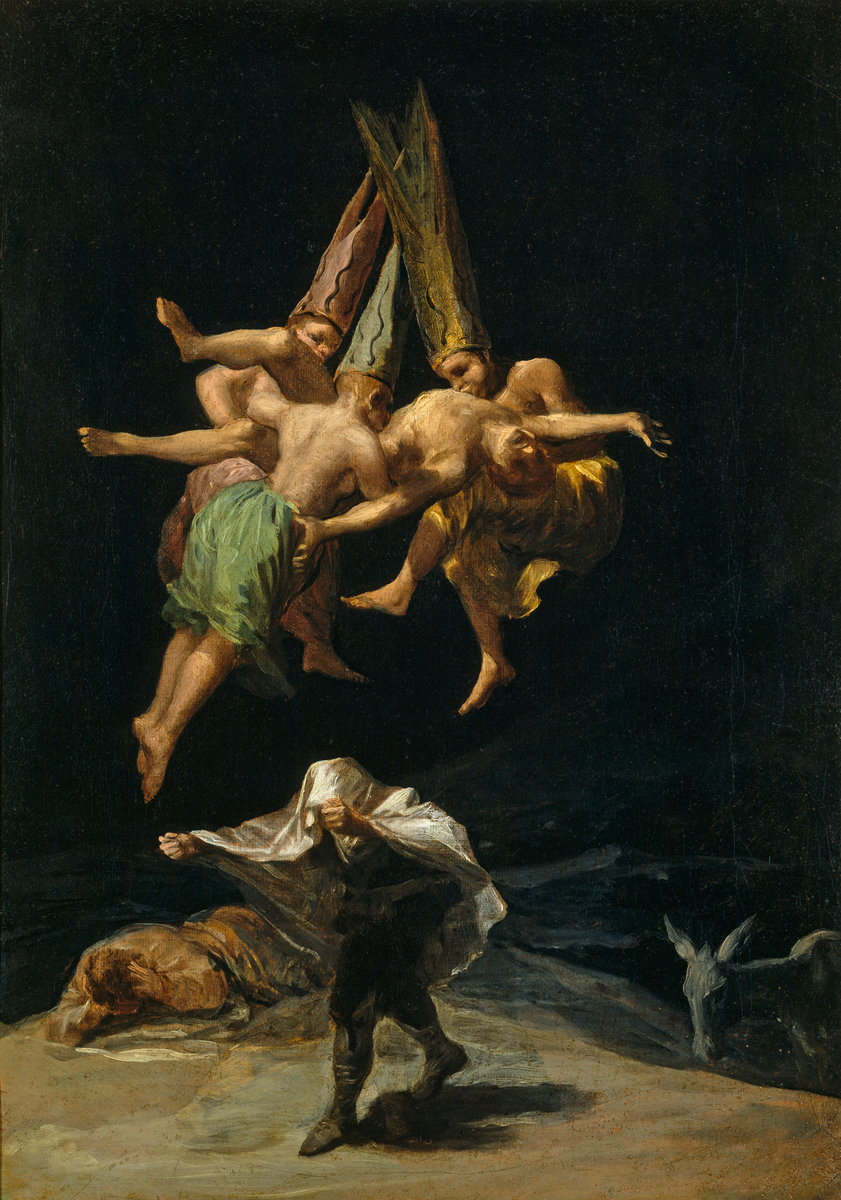
Here, three witches carry a naked man through the air. Their pointed conical hats mark them as the witches in Goya's picture. Below them, two men cover their faces. A donkey emerges from the shadows beside them. Goya painted this scene in 1798.
The floating group occupies the upper part of the canvas. The witches hold the naked man aloft, so the sky becomes the stage for their flight. Down below, the two men turn away and shield themselves. Their covered faces register the sight above them more strongly than any scream would.
The donkey stands in shadow at the lower edge. It does not act. It watches, half hidden, as the witches pass overhead. The painting is small, and the figures are tightly packed. Nothing opens out into a landscape, so the strange action fills almost the whole surface.
The canvas belonged to the Duke of Osuna in 1798, the year it was painted. It stayed with the Osuna collections until the Osuna sale of 1896. After passing through later collections, it was acquired by the Spanish State in 1999 for the Museo del Prado. The work is now part of that museum's collection in Madrid.
What the picture asks you to feel is the flight itself. The witches are airborne, and the men below cannot bear to look. Goya gives the terror a comic, exaggerated form: pointed hats, bare body, shielded faces. The strange encounter is the whole subject, held in a room-sized canvas.
The story and its sources
Historical claims are linked to the records below. Close looking and interpretation are identified in the passage notes.
- Passage 1Documented historyWikimedia Commons: Witches' Flight
- Passage 2Close lookingWikimedia Commons: Witches' Flight
- Passage 3Close lookingWikimedia Commons: Witches' Flight
- Passage 4Documented historyWikimedia Commons: Witches' Flight
- Passage 5InterpretationWikimedia Commons: Witches' Flight
Details to notice
About 2 minutes to readDonkey Emerging from Darkness
A grey donkey's long ears and muzzle emerge at lower right from the black ground, an ambiguous animal witness that adds an ominous folkloric note.
Crouching Man on the Ground
At the lower left, a brown-clad man lies huddled face down with his arms drawn around his head, his compressed pose countering the weightless movement above.
Cloaked Witness Below
The standing man below draws a pale mantle over his head and face, his body recoiling as the white cloth catches the strongest light in the lower half of the composition.
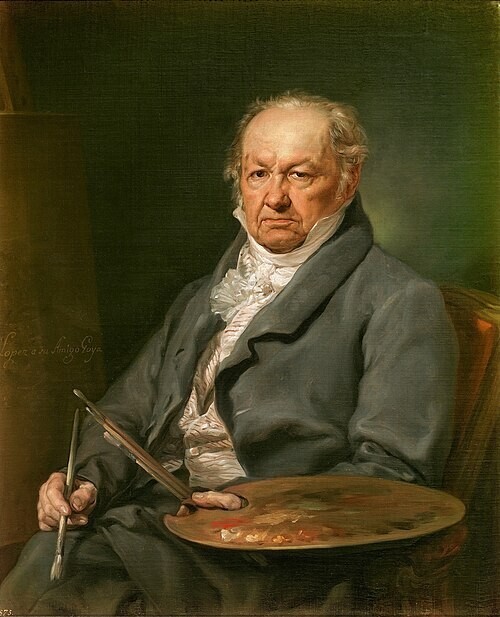
Artist portrait Image credit
Vicente López Portaña. Image source · Public domain
About the artist
Francisco de Goya
30 March 1746 to 16 April 1828
Goya was a Spanish painter and printmaker whose career extended from royal tapestry designs and court portraiture to images of war, repression and unsettling fantasy. Born in Fuendetodos, he trained in Zaragoza and Madrid and became First Painter to Charles IV in 1799. He spent his final years in Bordeaux.
- Born
- 30 March 1746
- Died
- 16 April 1828
- Nationality
- Spanish
- Birthplace
- Fuendetodos, Spain
- Died in
- Bordeaux, France
The research & record
Study the work.
Follow the evidence.
Find catalogue details, historical context, technical research and the literature behind this artwork.
The artwork record
Research catalogue
Catalogue information and detailed research, with references that link to the bibliography.
Updated .
Identity and catalogue
Link- Title
- Witches' Flight
- Artist or attribution
- Francisco Goya
- Object date
- 1798
- Medium and support
- Oil on canvas(Wikimedia Commons contributors, 2025)
- Dimensions
- 43.5 cm x 30.5 cm
- Current collection or location
- Museo del Prado, Madrid, Spain(Wikimedia Commons contributors, 2025)
- Movement or period
- Romanticism
- Country or culture
- Spanish
- Depicted subject
- Three witches in conical hats carry a naked man through the air, while below two men shield themselves and a donkey stands in the shadows.
- Title variants
- Vuelo de brujas; The Witches' Flight; Witches in the Air
- Accession number
- P07748
- Support
- Canvas
Read valuation records and their limitations
Catalogue identity
The painting is catalogued as Witches' Flight by Francisco Goya, dated 1798, the year it was painted. The work is oil on canvas, measuring 43.5 by 30.5 centimetres, and it is held by the Museo del Prado, Madrid, with accession number P07748. The date belongs to the making of the painting itself; it should be kept distinct from the later catalogue and collection dates that record the object's passage into public ownership, since a publication or accession year describes documentation and acquisition, not the moment of creation.(Wikimedia Commons contributors, 2025, Summary; Object history)
Ownership and the museum record
The 1798 date and the earliest recorded ownership converge in the same year: the painting belonged to the Duque de Osuna at the palacete de la Alameda in Madrid in 1798. It remained within the Osuna collections until the Osuna sale of 1896, then passed through later collections before the Spanish State acquired it for the Museo del Prado in 1999. This sequence, which the Commons record reproduces from the Prado record, establishes a documented line from a private aristocratic holding to a national museum collection, with the 1896 sale as a named turning point and 1999 as the date of state acquisition.(Wikimedia Commons contributors, 2025, Object history; Summary)
Subject as recorded
The catalogue description identifies the subject as three witches carrying a naked man through the air, with two men below covering their faces and a donkey emerging from the shadows. These elements belong to the object record rather than to independent technical analysis, so they should be read as the documented description of what the picture shows. The description establishes the composition: an airborne group above, a pair of shielding men below, and an animal at the shadowed lower edge.(Wikimedia Commons contributors, 2025, Summary)
Interpretation
The record assimilates the descriptive, technical and provenance data through the same Prado-derived account: the file page on Wikimedia Commons reproduces the Museo del Prado record, including title, artist, date, medium, dimensions, collection, accession number, provenance and structured data. That provenance of information matters for how the object's identity should be cited. The attribution to Goya, the 1798 date, the oil-on-canvas medium and the dimensions all come to this account through that reproduced museum record rather than through an independent examination described in the evidence, and the source is accordingly the point of reference for the catalogue facts stated here.(Wikimedia Commons contributors, 2025, Summary; Object history)
The painting is Witches' Flight by Francisco Goya, dated 1798.(Wikimedia Commons contributors, 2025)
Subject and iconography
LinkRead valuation records and their limitations
The recorded composition
Visual observation
The composition that the picture record describes is compact and vertically divided. Three witches carry a naked man through the air, and this flying group is set in the upper part of the picture. Below them two men cover their faces, and a donkey emerges from the shadows beside them. Because the canvas is small, 43.5 by 30.5 centimetres, the figures are close together and the strange action fills nearly the whole surface rather than opening into a landscape. The record of the composition therefore identifies four elements by role and placement, not merely by subject: the airborne witches, the naked carried man, the two men who shield themselves, and the donkey at the shadowed lower edge. The surviving evidence for this object establishes these as the described constituents of the scene; it does not document further figures, setting or background.(Wikimedia Commons contributors, 2025, Structured data; Summary)
The only visual identification that the evidence allows is partial. The three airborne figures are described as witches, and in the transcript's account their pointed conical hats are what mark them as witches in this picture. The naked man they carry is described by his state rather than named. The two men below are described by their gesture of covering their faces, and the donkey is described by its emergence from shadow. The evidence does not record the colour of the hats, the direction of flight, the expressions of the men, or the donkey's position relative to them beyond the shadowed lower edge. Any account of the picture's visual conventions beyond these described features would exceed the supplied record, and the scholarly description here is therefore deliberately limited to what the observation unit and the recorded composition establish.(Wikimedia Commons contributors, 2025, Structured data)
Interpretation
Why the object matters within a larger history of art cannot be extrapolated from the visual record alone. The evidence establishes the work as an oil painting on canvas of modest dimensions, and it establishes the scene's subjects and arrangement. It does not supply named predecessors or successors, comparisons with other works, or a documented iconographic tradition from which the pointed hats or the flight derive. The picture's significance therefore rests, on this evidence, on the recorded composition itself: a tightly packed airborne group above men who will not look, with a donkey half hidden in shadow. That is the extent of the historical and technical relationship the record supports.(Wikimedia Commons contributors, 2025, Structured data; Summary)
Visual observation
The painting depicts three witches carrying a naked man through the air, with two men below covering their faces and a donkey emerging from the shadows.(Wikimedia Commons contributors, 2025)
Materials and technique
LinkRead valuation records and their limitations
Documented support and medium
The documented physical description of the painting is brief but firm: it is an oil on canvas measuring 43.5 by 30.5 centimetres. These are the only support, medium and dimension facts recorded in the supplied evidence, and they come from the museum-derived record reproduced by Wikimedia Commons. The small size is worth noting against the pictorial structure, since the composition packs the airborne group, the shielding men and the shadowed animal into a narrow surface rather than opening onto a landscape. Any further statement about the canvas weave, stretcher, ground or priming would go beyond what this evidence establishes and is not asserted here.(Wikimedia Commons contributors, 2025, Summary)
Visual observation
What the work depicts is separable from how it was made. The subject is three witches carrying a naked man through the air, with two men below covering their faces and a donkey emerging from the shadows. The composition places the flight in the upper part of the canvas and the recoiling onlookers and the half-hidden donkey along the lower edge, so that the strange action fills almost the entire surface. This is visual observation of the painted image, not technical analysis of its materials, and the two kinds of evidence should not be conflated: the picture's crowded staging can be described from looking, while the oil medium and canvas support are documented facts about the object.(Wikimedia Commons contributors, 2025, Structured data; Summary)
Interpretation
No pigment, layer, ground, preparation, brushwork, underdrawing or conservation treatment is specified in the supplied units, and the record does not describe examination by X-radiography, infrared reflectography, cross-section or pigment analysis. The section therefore cannot reconstruct Goya's working method from this evidence. What it can do is hold the documented facts of medium and size together with the observed composition and mark the boundary clearly: statements about how the paint was applied or what it contains remain unsupported here, and the museum record's contribution is the identification of oil on canvas at a stated size rather than a technical study of the surface.(Wikimedia Commons contributors, 2025, Summary; Structured data)
The work is oil on canvas, measuring 43.5 by 30.5 centimetres.(Wikimedia Commons contributors, 2025)
Provenance and ownership
LinkRead valuation records and their limitations
Documented Owners and Transfers
The documented history of this painting begins with the Duque de Osuna, at whose palacete de la Alameda in Madrid the work is recorded in 1798, the year Goya painted it. This earliest recorded location places the canvas in an aristocratic Madrid setting from the moment of its creation, rather than in an unknown or commercial context. The work remained associated with the Osuna collections across the nineteenth century.(Wikimedia Commons contributors, 2025, Object history)
The next documented transfer is the Osuna sale of 1896, at which the painting left that collection. After the sale it passed through later collections whose individual owners are not recorded in the available evidence, and it was eventually acquired by the Spanish State for the Museo del Prado in 1999. The sources distinguish the documented Osuna ownership and the 1896 sale from the unspecified sequence of later collections, so the period between 1896 and 1999 should be treated as an incompletely documented interval rather than as a proven chain of named owners.(Wikimedia Commons contributors, 2025, Object history)
The 1999 acquisition by the Spanish State establishes the painting's entry into the Museo del Prado, Madrid, where it is now held. The object record for the Prado collection associates the painting with the accession number P07748, oil on canvas measuring 43.5 by 30.5 centimetres, and titles it Witches' Flight by Francisco Goya, dated 1798. These collection details anchor the work both to the end of its recorded provenance and to its present institutional identity.(Wikimedia Commons contributors, 2025, Object history)
The painting belonged to the Duque de Osuna at the palacete de la Alameda, Madrid, in 1798; it passed through the Osuna sale of 1896 and later collections before being acquired by the Spanish State for the Museo del Prado in 1999.(Wikimedia Commons contributors, 2025)
Provenance timeline
- 1798
The painting is recorded as belonging to the Duque de Osuna at the palacete de la Alameda in Madrid.(Wikimedia Commons contributors, 2025, Object history)
- 1896
The painting passed through the Osuna sale.(Wikimedia Commons contributors, 2025, Object history)
- 1999
The Spanish State acquired the painting for the Museo del Prado, following its passage through later collections.(Wikimedia Commons contributors, 2025, Object history)
Collection and display
LinkRead valuation records and their limitations
Collection and display
The painting discussed here is held by the Museo del Prado, Madrid, where it carries accession number P07748. The same source record identifies the work as Witches' Flight by Francisco Goya, dated 1798, executed in oil on canvas and measuring 43.5 by 30.5 centimetres. The small scale is worth keeping in view alongside the description of the composition, since the recorded dimensions establish that the tightly packed figures and the airborne group occupy a surface of well under half a metre in either direction; the Prado inventory number is the anchor by which the object can be traced in the museum's own records.(Wikimedia Commons contributors, 2025, Summary)
The provenance recorded for the work places it with the Duque de Osuna at the palacete de la Alameda, Madrid, in 1798, the year of painting. It remained within the Osuna collections until the Osuna sale of 1896, after which it passed through later collections before being acquired by the Spanish State for the Museo del Prado in 1999. The record therefore distinguishes two phases of ownership that are chronologically far apart: an early period of Osuna possession beginning in the year of execution, and a dispersal beginning with the 1896 sale whose intermediate steps the supplied evidence does not itemise. The 1999 acquisition by the State is the documented route by which the painting entered the Prado, and the account should be read with that gap in the later provenance in mind rather than as a continuous chain.(Wikimedia Commons contributors, 2025, Summary)
Interpretation
The subject recorded for the painting is three witches carrying a naked man through the air, with two men below covering their faces and a donkey emerging from the shadows. These elements are what the source record establishes about the picture's content, and they correspond to the scene the object presents to a viewer. Descriptions of what the figures express, and of the terror or comedy the scene is said to convey, are responses to that recorded content rather than separate documentary findings about the painting's making or reception. The accession data, the 1798 dating and the Osuna provenance remain the firmly documented frame within which any such reading of the image sits.(Wikimedia Commons contributors, 2025, Summary)
The painting is held by the Museo del Prado, Madrid, with accession number P07748.(Wikimedia Commons contributors, 2025)
Documented values and qualified estimates
LinkRead valuation records and their limitations
The object and its documentation
Interpretation
The object addressed here is Francisco Goya's painting Witches' Flight, an oil on canvas dated to 1798. At a cabinet scale of 43.5 by 30.5 centimetres, it is a small picture in which three witches carry a naked man through the air, with pointed conical hats identifying them as witches, while two men below cover their faces and a donkey emerges from the shadows beside them. The recording of this subject in the source is descriptive rather than iconographically argued: the elements are enumerated, not interpreted doctrinally. The Museo del Prado holds the work in Madrid under accession number P07748, which gives the painting a documented institutional identity independent of its later valuation.(Wikimedia Commons contributors, 2025)
The documented provenance is unusually continuous for a painting of this date. The canvas belonged to the Duque de Osuna at the palacete de la Alameda in Madrid in 1798, the year it was painted, and it remained within the Osuna collections until the Osuna sale of 1896. It then passed through various private collections, including that of Jaime Ortiz Patiño, before being acquired by the Spanish State for the Museo del Prado in 1999. This sequence, from an aristocratic Madrid household through a nineteenth-century auction and twentieth-century private ownership to state acquisition, is the kind of chain that underpins both scholarly standing and institutional valuation, and it is the only provenance the supplied evidence establishes.(Wikimedia Commons contributors, 2025)
A working valuation, not a market record
The only valuation evidence supplied is not an official figure. It is a model-generated working insurance estimate of US$50 million to US$150 million, recorded as a working calculation generated on 2026-11-16. Its stated methodology rests on confirmed context alone: an authenticated 1798 oil on canvas by Francisco Goya, a major Spanish Romantic master, at small cabinet scale, held at the Museo del Prado under accession P07748 with the documented Osuna and later provenance and the 1999 state acquisition. The reasoning is that a museum-held, highly prominent Goya with strong exhibition and scholarly standing would be treated at the upper tier of the artist's market.(Wikimedia Commons contributors, 2025)
That range comes with explicit qualifications that must be retained alongside the number itself. The source provides no transaction price, no official insurance figure and no comparable sale data, and the range is described as deliberately wide and conservative, intended only to frame a manual review rather than to replace expert appraisal or institutional valuation practice. It is not an official insurance value, appraisal, auction estimate, auction result or sale price, and it does not reflect comparables, private insurance records, condition assessment, title verification or current market data. Actual insurance scheduling would require a qualified appraiser and the collection's own valuation policy. The figure therefore documents a procedural hypothesis rather than a market fact, and the authenticating and provenance data, not the dollar amount, are what the evidence substantiates.(Wikimedia Commons contributors, 2025)
Working estimate
Calculated working insurance estimate, not a sale price: Estimated value: US$50M to US$150M Recorded date: Working calculation, generated 2026-11-16. Methodology: Broad working range built from confirmed context only: an authenticated 1798 oil on canvas by Francisco Goya, a major Spanish Romantic master, at a small cabinet scale of 43.5 by 30.5 cm. The work is in the Museo del Prado, accession P07748, with a documented provenance including the Duque de Osuna, various private collections, Jaime Ortiz Patiño, and State acquisition for the Prado in 1999. As a museum-held, highly prominent Goya with strong exhibition and scholarly standing, it would be treated at the upper tier of the artist's market. The range is deliberately wide and conservative because the source provides no transaction price, no official insurance figure, and no comparable sale data. It is intended only to frame a manual review, not to replace expert appraisal or institutional valuation practice. Qualification: This is a model-generated working insurance range for manual review only. It is not an official insurance value, appraisal, auction estimate, auction result, or sale price. It relies solely on the supplied Wikimedia Commons and Prado-derived context and does not reflect comparables, private insurance records, condition assessment, title verification, or current market data. Actual insurance scheduling requires a qualified appraiser and the collection's own valuation policy.(Wikimedia Commons contributors, 2025)
Further reading
Books for a closer look
Paid links. As an Amazon Associate I earn from qualifying purchases.

Open Library Goya
Kodansha International
Catalogue record for a Goya volume whose recorded subjects include catalogues raisonnés, exhibitions, Spanish painting, the Museo del Prado, and Romanticism. Those subjects connect directly to Goya and to the Prado's holding of Witches' Flight, making this the most object-adjacent scholarly candidate among the returned records.
ISBN 0870110837

Open Library Los caprichos
Dover Publications
Goya's Los caprichos is the print series of the 1790s that shares the artist's contemporary preoccupation with witchcraft and popular superstition, the same thematic territory as Witches' Flight (1798). Relevant as a documented comparison within Goya's own work, not as a study of this painting.
ISBN 0486223841
Bibliography
Sources and further reading
References are arranged by author or organisation, with links to the original publications. Where no publication date is recorded, n.d. means no date.
Source notes updated .
No recorded sources match these filters. Reset the filters to see the full bibliography.
- 02
Book
Goya. Kodansha International.
Catalogue record for a Goya volume whose recorded subjects include catalogues raisonnés, exhibitions, Spanish painting, the Museo del Prado, and Romanticism. Those subjects connect directly to Goya and to the Prado's holding of Witches' Flight, making this the most object-adjacent scholarly candidate among the returned records.
- ISBN
- 0870110837
Citation text
- 04
Book
Los caprichos. Dover Publications.
Goya's Los caprichos is the print series of the 1790s that shares the artist's contemporary preoccupation with witchcraft and popular superstition, the same thematic territory as Witches' Flight (1798). Relevant as a documented comparison within Goya's own work, not as a study of this painting.
- ISBN
- 0486223841
Citation text
- 03
Book
Francisco Goya - the Paintings. Independently Published.
Recorded under Goya as the author with the title Francisco Goya - the Paintings. As a paintings-focused Goya candidate it is relevant to the artist of Witches' Flight, an oil on canvas, though the record gives no further descriptive subjects.
- ISBN
- 9781521566466
Citation text
- 01
Secondary · About this artwork
Wikimedia Commons: Witches' Flight. File:Francisco de Goya - Vuelo de brujas (1798).jpg. Wikimedia Commons.
Wikimedia Commons file page reproducing the Museo del Prado record for Witches' Flight, including title, artist, date, medium, dimensions, collection, accession number, provenance, and structured data.
- Language
- en
Citation text
Art to live with
Bring this painting
home.
A piece of the archive, made yours. Explore Witches' Flight in a size and finish that fits your space.
Your text and annotations appear on these editions. Adding to cart saves that design for printing.
Combine this painting with your favourites01 / Find your edition
Made for you
Suggested from your location. Change it if you're sending elsewhere or using a VPN. Prices and delivery are shown in GBP.
19 products
Choose an edition to make it yours
6 × 8 in · Printed cover · 118 lined pages
6 × 8 in · Printed cover · 118 lined pages
6 × 8 in · Printed cover · 118 lined pages
Notebook
GBP 12.03
Delivery GBP 5.35 / Total GBP 17.38
A 6 × 8 inch spiral notebook with 118 ruled pages (59 sheets), a printed front cover, dark grey back cover and metal spiral binding.
Fit and fill keep the painting’s proportions. Stretch changes them.
Move and zoom the painting on your notebook.
Made to order with your design
Made to order
US delivery only
12.7 × 17.8 cm / 5 × 7 in · Standard
12.7 × 17.8 cm / 5 × 7 in · Standard

5 × 7 in / 12.7 × 17.8 cm · Standard

5 × 7 in / 12.7 × 17.8 cm · Standard

5 × 7 in / 12.7 × 17.8 cm · Standard

5 × 7 in / 12.7 × 17.8 cm · Standard

5 × 7 in / 12.7 × 17.8 cm · Standard
Metal art sign
GBP 19.84
Delivery GBP 17.90 / Total GBP 37.74
A printed aluminium sign with rounded corners and mounting holes.
Fit and fill keep the painting’s proportions. Stretch changes them.
Move and zoom the painting on your metal art sign.
Made to order with your design
Printed aluminium · mounting holes included
US delivery only
iPhone 12 Mini ? Glossy ? back view
iPhone 12 Mini · Glossy

iPhone 12 Mini ? Glossy ? back view

iPhone 12 Mini ? Glossy ? back view

iPhone 12 Mini ? Glossy ? back view
Tough phone case
GBP 16.56
Delivery GBP 4.28 / Total GBP 20.84
A two-layer phone case with a printed polycarbonate shell and a shock-absorbing inner liner.
Two layers with a shock-absorbing TPU liner
Case & print details
- Device
- Apple · iPhone 12 Mini
- Material
- Polycarbonate shell with a TPU inner liner
- Artwork
- Outer back and wrapped edges from one template
- Finish
- Glossy
- Version
- Standard version
- Printing
- Dye sublimation
- Print file
- 1,122 × 1,831 px · 95 × 155 mm · PNG · 300 dpi recommended
Rear outline and camera openings follow this variant's Printify template. Case depth and small hardware remain illustrative.
Supplier product detailsFit and fill keep the painting’s proportions. Stretch changes them.
Move and zoom the painting on your tough phone case.
Made to order with your design
Made to order
US delivery only
30.4 × 40.6 cm / 12 × 16 in · Black
30.4 × 40.6 cm / 12 × 16 in · Black

12 × 16 in / 30.4 × 40.6 cm · Black

12 × 16 in / 30.4 × 40.6 cm · Black

12 × 16 in / 30.4 × 40.6 cm · Black

12 × 16 in / 30.4 × 40.6 cm · Black
Framed art print
GBP 53.41
- 1 framed print
- GBP 53.41
- Delivery to United States
- GBP 14.31
- Total
- GBP 67.72
A ready-to-hang wooden frame with a clear Perspex cover and a semi-gloss printed insert.
Delivery is quoted for all selected copies together.
Fit and fill keep the painting’s proportions. Stretch changes them.
Move and zoom the painting on your framed art print.
Made to order with your design
Wooden frame & protective clear front included
US delivery only
38.1 × 40.6 cm / 15 × 16 in · Natural
38.1 × 40.6 cm / 15 × 16 in · Natural

15 × 16 in / 38.1 × 40.6 cm · Natural

15 × 16 in / 38.1 × 40.6 cm · Natural

15 × 16 in / 38.1 × 40.6 cm · Natural

15 × 16 in / 38.1 × 40.6 cm · Natural

15 × 16 in / 38.1 × 40.6 cm · Natural
Canvas tote bag
GBP 14.40
Delivery GBP 4.38 / Total GBP 18.78
A sturdy cotton canvas tote with reinforced handles and artwork on the front panel.
Fit and fill keep the painting’s proportions. Stretch changes them.
Move and zoom the painting on your canvas tote bag.
Made to order with your design
Front print · reinforced cotton handles
US delivery only
22.9 × 20.3 cm / 9 × 8 in · Standard
22.9 × 20.3 cm / 9 × 8 in · Standard

9 × 8 in / 22.9 × 20.3 cm · Standard

9 × 8 in / 22.9 × 20.3 cm · Standard

9 × 8 in / 22.9 × 20.3 cm · Standard

9 × 8 in / 22.9 × 20.3 cm · Standard
Mouse mat
GBP 7.36
Delivery GBP 4.87 / Total GBP 12.23
A rectangular fabric mouse mat with a rubber backing and rounded corners.
Fit and fill keep the painting’s proportions. Stretch changes them.
Move and zoom the painting on your mouse mat.
Made to order with your design
Made to order
US delivery only
See more13 more products
43.2 × 45.7 cm / 17 × 18 in · Artwork
43.2 × 45.7 cm / 17 × 18 in · Artwork

17 × 18 in / 43.2 × 45.7 cm · Artwork

17 × 18 in / 43.2 × 45.7 cm · Artwork

17 × 18 in / 43.2 × 45.7 cm · Artwork
Woven tote bag
GBP 47.33
Delivery GBP 5.94 / Total GBP 53.27
A woven tote with cotton webbing handles and the painting translated into a woven design.
Fit and fill keep the painting’s proportions. Stretch changes them.
Move and zoom the painting on your woven tote bag.
Made to order with your design
Made to order
US delivery only
27.9 × 40.6 cm / 11 × 16 in · Standard
27.9 × 40.6 cm / 11 × 16 in · Standard

11 × 16 in / 27.9 × 40.6 cm · Standard

11 × 16 in / 27.9 × 40.6 cm · Standard

11 × 16 in / 27.9 × 40.6 cm · Standard

11 × 16 in / 27.9 × 40.6 cm · Standard

11 × 16 in / 27.9 × 40.6 cm · Standard
Matte art print
GBP 12.96
Delivery GBP 7.29 / Total GBP 20.25
An unframed matte poster with archival inks, ready for a frame of your choice.
Fit and fill keep the painting’s proportions. Stretch changes them.
Move and zoom the painting on your matte art print.
Made to order with your design
Unframed · frame it your way
US delivery only
iPhone 12 Mini ? Standard ? back view
iPhone 12 Mini · Standard

iPhone 12 Mini ? Standard ? back view

iPhone 12 Mini ? Standard ? back view

iPhone 12 Mini ? Standard ? back view
Flexible phone case
GBP 15.76
Delivery GBP 4.28 / Total GBP 20.04
A flexible TPU phone case with a frosted finish, a printed back and precise port openings.
Flexible TPU with a frosted, matte finish
Case & print details
- Device
- Apple · iPhone 12 Mini
- Material
- Semi-transparent thermoplastic polyurethane (TPU)
- Artwork
- Back print; rim stays unprinted
- Finish
- Standard
- Version
- Standard version
- Printing
- Dye sublimation
- Print file
- 791 × 1,586 px · 67 × 134.3 mm · PNG · 300 dpi recommended
Rear outline and camera openings follow this variant's Printify template. Case depth and small hardware remain illustrative.
Supplier product detailsFit and fill keep the painting’s proportions. Stretch changes them.
Move and zoom the painting on your flexible phone case.
Made to order with your design
Made to order
S · Standard
S · Standard

S · Standard

S · Standard

S · Standard

S · Standard

S · Standard
Crew socks
GBP 10.78
Delivery GBP 4.49 / Total GBP 15.27
Crew-length polyester and spandex socks with a ribbed cuff, cushioned sole and sublimated artwork.
Fit and fill keep the painting’s proportions. Stretch changes them.
Move and zoom the painting on your crew socks.
Made to order with your design
One pair · design repeated on both socks
US delivery only
12" · Standard
12" · Standard

12" · Standard

12" · Standard

12" · Standard
Laptop sleeve
GBP 26.36
Delivery GBP 4.96 / Total GBP 31.32
A polyester laptop sleeve with a fleece lining, top zip, printed front and black reverse.
Fit and fill keep the painting’s proportions. Stretch changes them.
Move and zoom the painting on your laptop sleeve.
Made to order with your design
Made to order
US delivery only
11oz · 2 image repeats
11oz · White
11oz · 2 image repeats
Mug
GBP 7.42
Delivery GBP 6.23 / Total GBP 13.65
A glossy white ceramic mug with a C-shaped handle, available in 11oz and 15oz sizes.
repeat layout · choose single, double or a repeating pattern in Customise.
Repeat, fit, fill and position your artwork around the mug.
Made to order with your design
Made to order
iPhone 12 Mini ? Standard ? back view
iPhone 12 Mini · Standard

iPhone 12 Mini ? Standard ? back view

iPhone 12 Mini ? Standard ? back view

iPhone 12 Mini ? Standard ? back view

iPhone 12 Mini ? Standard ? back view

iPhone 12 Mini ? Standard ? back view
Biodegradable phone case
GBP 21.19
Delivery GBP 4.28 / Total GBP 25.47
A matte phone case made from plant polymers and bamboo fibre, with the artwork printed on the back.
Flexible plant-polymer shell with a matte finish
Case & print details
- Device
- Apple · iPhone 12 Mini
- Material
- PLA and PBAT polymers with bamboo fibre
- Artwork
- Back print; rim stays unprinted
- Finish
- Standard
- Version
- Standard version
- Printing
- Dye sublimation
- Print file
- 777 × 1,553 px · 65.8 × 131.5 mm · PNG · 300 dpi recommended
Rear outline and camera openings follow this variant's Printify template. Case depth and small hardware remain illustrative.
Supplier product detailsFit and fill keep the painting’s proportions. Stretch changes them.
Move and zoom the painting on your biodegradable phone case.
Made to order with your design
Made to order
20.3 × 30.5 cm / 8 × 12 in · Standard
20.3 × 30.5 cm / 8 × 12 in · Standard

8 × 12 in / 20.3 × 30.5 cm · Standard

8 × 12 in / 20.3 × 30.5 cm · Standard

8 × 12 in / 20.3 × 30.5 cm · Standard
Fine art poster
GBP 13.03
Delivery GBP 7.69 / Total GBP 20.72
A gallery paper print with a smooth art-paper surface. Choose a size that suits the painting.
Fit and fill keep the painting’s proportions. Stretch changes them.
Move and zoom the painting on your fine art poster.
Made to order with your design
Unframed · frame it your way
iPhone 12 Mini ? Standard ? back view
iPhone 12 Mini · Standard

iPhone 12 Mini ? Standard ? back view

iPhone 12 Mini ? Standard ? back view

iPhone 12 Mini ? Standard ? back view
Clear phone case
GBP 15.28
Delivery GBP 4.28 / Total GBP 19.56
A clear phone case with artwork on the back. Leave areas transparent to show the phone underneath.
Clear shell with shock-absorbing TPU sides
Case & print details
- Device
- Apple · iPhone 12 Mini
- Material
- Polycarbonate back and clear TPU sides
- Artwork
- Back print; clear sides stay unprinted
- Finish
- Standard
- Version
- Standard version
- Printing
- Dye sublimation
- Print file
- 732 × 1,527 px · 62 × 129.3 mm · PNG · 300 dpi recommended
Rear outline and camera openings follow this variant's Printify template. Case depth and small hardware remain illustrative.
Supplier product detailsFit and fill keep the painting’s proportions. Stretch changes them.
Move and zoom the painting on your clear phone case.
Made to order with your design
Made to order
15oz · 3 image repeats
15oz · Standard

15oz · 3 image repeats

15oz · 3 image repeats

15oz · 3 image repeats

15oz · 3 image repeats

15oz · 3 image repeats
Travel mug
GBP 32.33
Delivery GBP 5.75 / Total GBP 38.08
A stainless-steel travel mug with a black lid, a tapered base and a printed white exterior.
repeat layout · choose single, double or a repeating pattern in Customise.
Repeat, fit, fill and position your artwork around the mug.
Made to order with your design
Made to order
US delivery only
2.5 × 3.4 cm / 1 × 1.4 in · Glossy
2.5 × 3.4 cm / 1 × 1.4 in · Glossy

1 × 1.4 in / 2.5 × 3.4 cm · Glossy

1 × 1.4 in / 2.5 × 3.4 cm · Glossy

1 × 1.4 in / 2.5 × 3.4 cm · Glossy

1 × 1.4 in / 2.5 × 3.4 cm · Glossy
Photo keyring
GBP 10.30
Delivery GBP 5.45 / Total GBP 15.75
A rectangular zinc-alloy photo keyring with a glossy insert and a swivel split ring.
Fit and fill keep the painting’s proportions. Stretch changes them.
Move and zoom the painting on your photo keyring.
Made to order with your design
Photo insert · zinc frame & swivel ring
US delivery only
iPhone 15 Pro ? Glossy ? back view
iPhone 15 Pro · Glossy

iPhone 15 Pro ? Glossy ? back view

iPhone 15 Pro ? Glossy ? back view

iPhone 15 Pro ? Glossy ? back view

iPhone 15 Pro ? Glossy ? back view

iPhone 15 Pro ? Glossy ? back view
Slim phone case
GBP 16.53
Delivery GBP 5.85 / Total GBP 22.38
A slim printed phone shell with open ports and a lightweight profile.
Slim, lightweight polycarbonate shell
Case & print details
- Device
- Apple · iPhone 15 Pro
- Material
- Polycarbonate
- Artwork
- Outer back and wrapped edges from one template
- Finish
- Glossy
- Version
- Standard version
- Printing
- Dye sublimation
- Print file
- 1,278 × 1,971 px · 108.2 × 166.9 mm · PNG · 300 dpi recommended
Rear outline and camera openings follow this variant's Printify template. Case depth and small hardware remain illustrative.
Supplier product detailsFit and fill keep the painting’s proportions. Stretch changes them.
Move and zoom the painting on your slim phone case.
Made to order with your design
Made to order
US delivery only
36.6 × 30.7 cm / 14.4 × 12.1 in · Standard
36.6 × 30.7 cm / 14.4 × 12.1 in · Standard

14.4 × 12.1 in / 36.6 × 30.7 cm · Standard

14.4 × 12.1 in / 36.6 × 30.7 cm · Standard

14.4 × 12.1 in / 36.6 × 30.7 cm · Standard
Desk mat
GBP 15.17
Delivery GBP 7.21 / Total GBP 22.38
A smooth polyester desk mat with a natural rubber non-slip base and anti-fray edges, available in three sizes.
Fit and fill keep the painting’s proportions. Stretch changes them.
Move and zoom the painting on your desk mat.
Made to order with your design
Made to order
The 30 cm ruler is scaled alongside your selected print. Keep the painting’s proportions with a black background, or stretch it to fill. Frame width, material texture and screen colours are illustrative.
Keep exploring