Don Antonio Noriega
Artist: Francisco Goya · 1801
Don Antonio Noriega: high-resolution image
The highest-resolution file we hold, available without payment or an account.3,193 × 4,096 pixels.
Download highest-resolution imageThe complete story
The story About 3 minutes to read
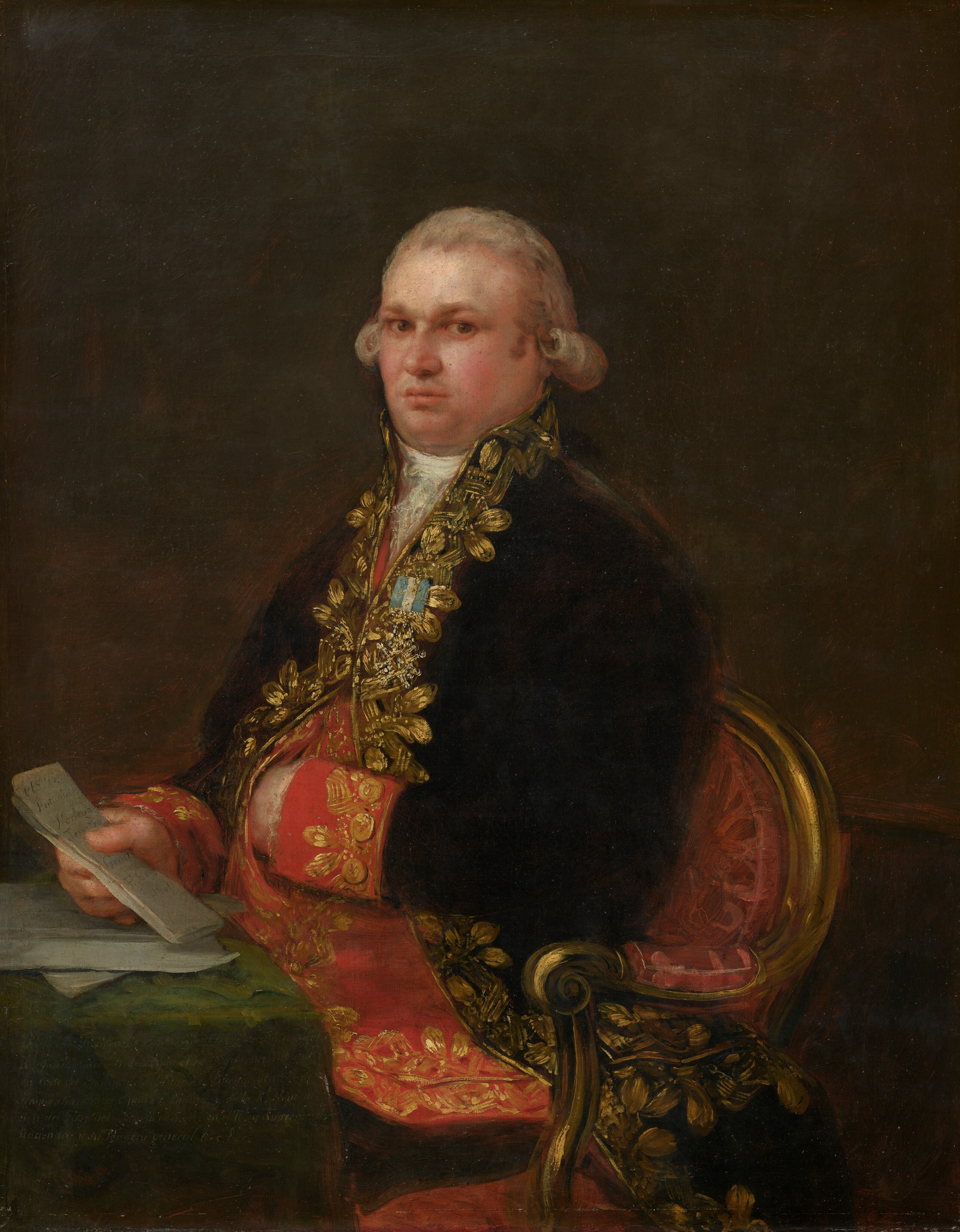
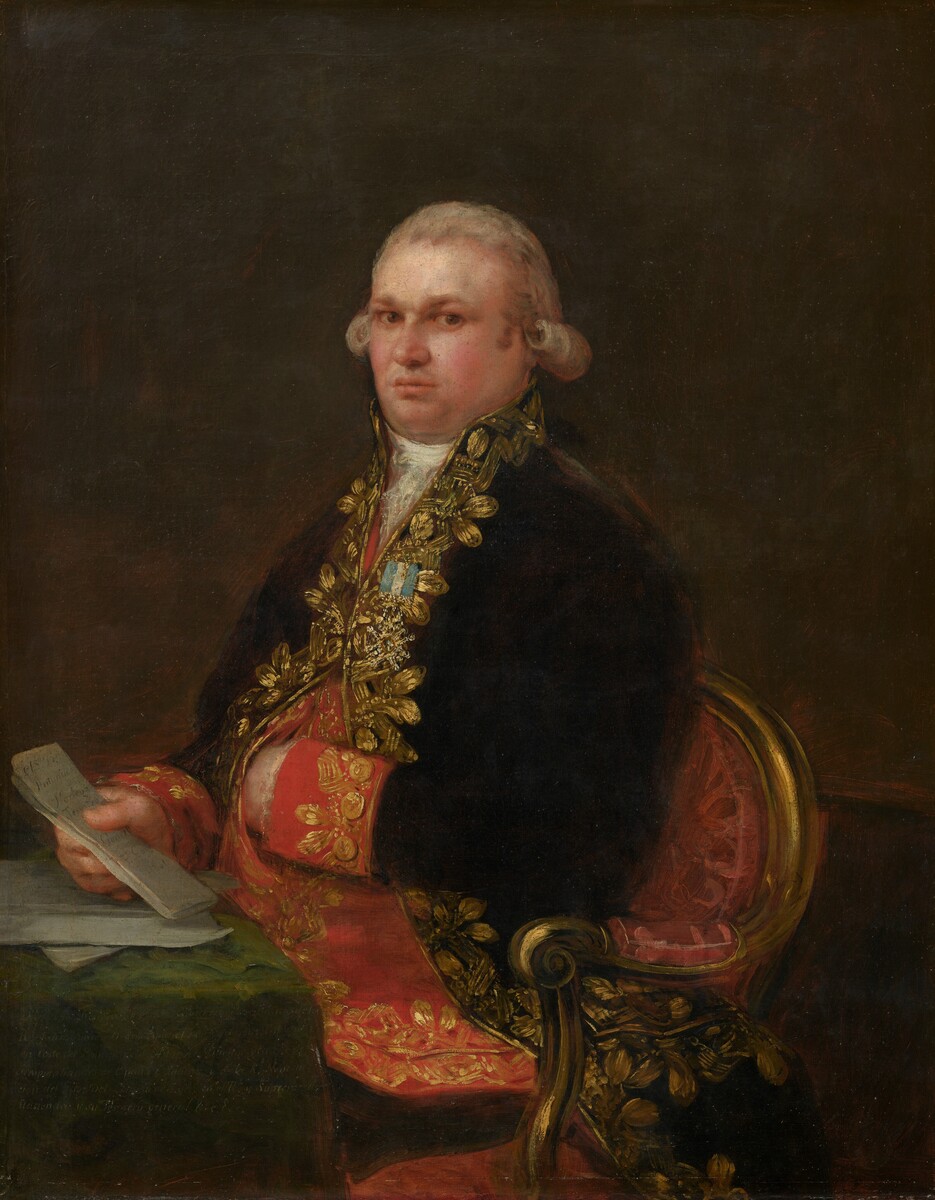
This is Goya's portrait of Don Antonio Noriega, painted in 1801. Noriega sits in a gilded armchair, holding folded papers over a green table, and his coat carries heavy gold embroidery and an order badge. The papers and the chair tell us how to read him. He is presented as an official at work, and as a man of rank.
Start with the hands. Noriega holds the folded papers directly over the green tabletop, so the documents sit at the center of the composition, between his body and ours. That placement gives the portrait its subject. The folded sheets are not a casual accessory. They convey administrative duty and his professional role.
Then follow the chair. The gilded armchair has carved gold armrests and red upholstery, and it frames him on both sides. The setting works with the costume rather than competing with it. Together, the chair and the gold-embroidered coat reinforce an impression of wealth and authority.
His face stays serious. With the powdered wig and neckcloth, that grave expression sets a formal, watchful tone. The costume does more than date him. The gold embroidery and order badge across the chest and lapels display rank and ceremonial status.
So the portrait holds two kinds of authority at once. The badge and embroidery announce public honor, while the papers announce the daily work behind it. Goya painted this in 1801, and the picture presents Noriega as both a decorated figure and a serving official. The grave expression keeps the ceremony from feeling merely decorative.
You might expect a ceremonial portrait to let the gold do all the talking. Here, the plain folded papers hold the middle of the picture. That is where the quiet claim of the portrait sits. Status is displayed, but duty is placed in his hands, in front of us.
Look once more at the hands and the papers above the green table. They explain the whole arrangement: the wig, the badge, and the gilded chair support the man of rank, and the documents show what that rank is for. Goya gives us an official defined by both ceremony and work.
The story and its sources
Historical claims are linked to the records below. Close looking and interpretation are identified in the passage notes.
- Passage 1Documented historyWikimedia Commons: Don Antonio Noriega
- Passage 2Close lookingWikimedia Commons: Don Antonio Noriega
- Passage 3Close lookingWikimedia Commons: Don Antonio Noriega
- Passage 4InterpretationWikimedia Commons: Don Antonio Noriega
- Passage 5InterpretationWikimedia Commons: Don Antonio Noriega
- Passage 6InterpretationWikimedia Commons: Don Antonio Noriega
- Passage 7InterpretationWikimedia Commons: Don Antonio Noriega
Details to notice
About 2 minutes to readGilded armchair
The carved gold armrest and red upholstery frame the seated figure and reinforce the impression of wealth and authority.
Hand holding letters
The visible hand grasps folded papers over a green table, conveying administrative duty and the sitter's active professional role.
Gold-embroidered coat and orders
Heavy gold embroidery and the blue-and-white order badge display rank and ceremonial status across the chest and lapels.
Artist portrait Image credit
Vicente López Portaña. Image source · Public domain
About the artist
Francisco de Goya
30 March 1746 to 16 April 1828
Goya was a Spanish painter and printmaker whose career extended from royal tapestry designs and court portraiture to images of war, repression and unsettling fantasy. Born in Fuendetodos, he trained in Zaragoza and Madrid and became First Painter to Charles IV in 1799. He spent his final years in Bordeaux.
- Born
- 30 March 1746
- Died
- 16 April 1828
- Nationality
- Spanish
- Birthplace
- Fuendetodos, Spain
- Died in
- Bordeaux, France
The research & record
Study the work.
Follow the evidence.
Find catalogue details, historical context, technical research and the literature behind this artwork.
The artwork record
Research catalogue
Catalogue information and detailed research, with references that link to the bibliography.
Updated .
Identity and catalogue
Link- Title
- Don Antonio Noriega(Wikimedia Commons: Don Antonio Noriega, n.d.)
- Artist or attribution
- Francisco Goya
- Object date
- 1801
- Medium and support
- Oil on canvas(Wikimedia Commons: Don Antonio Noriega, n.d.)
- Dimensions
- 102.6 x 80.9 cm (40 3/8 x 31 7/8 in.); framed: 128.3 x 105.4 x 12.7 cm (50 1/2 x 41 1/2 x 5 in.)
- Current collection or location
- National Gallery of Art, Washington, D.C.(Wikimedia Commons: Don Antonio Noriega, n.d.)
- Movement or period
- Romanticism
- Country or culture
- Spanish
- Depicted subject
- Portrait of Don Antonio Noriega, a Spanish official, seated and holding papers, wearing a heavily gold-embroidered coat and an order badge.
- Accession number
- 1961.9.74
Read valuation records and their limitations
Catalogue title, attribution and date
The painting is catalogued as Don Antonio Noriega, attributed to Francisco Goya and dated 1801. This is the core identity entry: a named sitter, an attributed rather than firmly documented authorship, and a date belonging to the object's own historical moment, not to any later catalogue, publication or collection record. Because the title, attribution and date reach the record as a single catalogue statement, the attribution qualification should be kept attached to the artist's name wherever the work is cited. The portrait's subject and its making are thus separated in the record: the sitter is named, the painter is proposed by attribution, and the year 1801 is given as the painting's date.(Wikimedia Commons: Don Antonio Noriega, n.d., Wikimedia Commons file description)
The recorded support and dimensions identify the work as a painting on canvas, oil medium, measuring 102.6 by 80.9 centimeters overall. In its frame the object measures 128.3 by 105.4 by 12.7 centimeters. These figures describe a vertical portrait of moderate cabinet scale rather than a monumental full-length, and they are catalogue measurements of the physical object, distinct from its title, attribution or date. The framed dimensions record the object as it is housed, while the overall dimensions record the painted canvas itself.(Wikimedia Commons: Don Antonio Noriega, n.d., Wikimedia Commons file description)
Collection, accession and credit
The painting belongs to the National Gallery of Art, Washington, D.C., and carries the accession number 1961.9.74 under the credit line Samuel H. Kress Collection. The accession number is the museum's own identifier and should not be conflated with the 1801 date of the painting: the one marks the work's entry into a public collection, the other marks its creation. The Kress credit identifies the collection through which the picture reached the museum and is part of the catalogue record of ownership and support, not a statement about the sitter or the painter.(Wikimedia Commons: Don Antonio Noriega, n.d., Wikimedia Commons file description)
Presentation of the sitter
The sitter is presented with a powdered wig, a neckcloth and a coat carrying heavy gold embroidery and an order badge. His grave expression, together with the wig and neckcloth, sets a formal, watchful tone and identifies him as a figure of authority; the embroidery and badge across the chest and lapels display rank and ceremonial status. These are elements the catalogue description reads as conveying status, and they belong to the portrait's presentation of the man rather than to documentary facts about his career independent of the painting.(Wikimedia Commons: Don Antonio Noriega, n.d., Wikimedia Commons file description)
Seated in a gilded armchair with carved gold armrests and red upholstery, the sitter holds folded papers over a green table. The catalogue reads the chair as reinforcing an impression of wealth and authority, and the papers as conveying administrative duty and his professional role. Taken together with the costume, the setting and the documents give the portrait a double claim: honor announced by the badge and embroidery, and work announced by the papers held before the body of the sitter.(Wikimedia Commons: Don Antonio Noriega, n.d., Wikimedia Commons file description)
The painting is titled Don Antonio Noriega and is attributed to Francisco Goya, dated 1801.(Wikimedia Commons: Don Antonio Noriega, n.d.)
Subject and iconography
LinkRead valuation records and their limitations
Composition, Dress and Setting
Visual observation
The portrait presents its sitter, Don Antonio Noriega, as an official defined by three interlocking registers of visual information: the body and its dress, the objects he handles, and the setting that frames him. Recorded in the file description accompanying the painting, these features are best read together rather than as separate attributes, because each supports the others in constructing authority. The sitter wears a powdered wig, a neckcloth, and a coat with heavy gold embroidery and an order badge that displays rank and ceremonial status. The badge and embroidery locate him within a hierarchy of honors, while the wig and neckcloth signal formal, courtly or administrative dress. The painting is oil on canvas, measuring 102.6 by 80.9 centimeters overall and 128.3 by 105.4 by 12.7 centimeters framed, dimensions that establish a portrait of substantial but not monumental scale, suited to a room rather than a gallery wall of state.(Wikimedia Commons: Don Antonio Noriega, n.d., Wikimedia Commons file description)
The sitter holds folded papers over a green table, conveying administrative duty and his professional role. Placed between the sitter's body and the viewer, the papers make the documents the visual center of the composition: they are the object through which the portrait explains what the rank displayed on his coat is for. The gesture is not idle; the folded sheets are held, presented and legible as papers of business, so that administrative work becomes a defining attribute of the man, on a par with his honors. The green tabletop anchors this action, giving the hands and documents a stable surface and linking the professional role to the furnished interior.(Wikimedia Commons: Don Antonio Noriega, n.d., Wikimedia Commons file description)
The sitter is seated in a gilded armchair with carved gold armrests and red upholstery, reinforcing an impression of wealth and authority. The chair encloses the body on both sides, so that its carved gold arms and red upholstery frame the sitter rather than competing with his costume. Read against the gold-embroidered coat, the chair converts the setting into a statement of status: the same precious metal that marks the dress is repeated in the furniture, and the upholstery introduces a warm, rich note that sets off the figure. The result is a coherent presentation in which wealth, rank and office are staged simultaneously through dress, object and interior.(Wikimedia Commons: Don Antonio Noriega, n.d., Wikimedia Commons file description)
Interpretation
Taken together, the recorded features show a portrait organized around two kinds of authority. The gold embroidery and order badge across the chest and lapels announce public honor and ceremonial status, while the folded papers over the green table announce the daily work behind that honor. The grave expression, powdered wig and neckcloth set a formal, watchful tone and identify him as a figure of authority. Because the papers occupy the middle of the picture, the composition gives duty a visual weight equal to ceremony, so that the portrait presents Noriega as both a decorated figure and a serving official. This reading follows the file description's own account of the sitter's dress, documents and chair; it does not depend on any information about his biography beyond what those recorded visual elements establish.(Wikimedia Commons: Don Antonio Noriega, n.d., Wikimedia Commons file description)
Visual observation
The sitter wears a powdered wig, a neckcloth, and a coat with heavy gold embroidery and an order badge that displays rank and ceremonial status.(Wikimedia Commons: Don Antonio Noriega, n.d.)
The sitter holds folded papers over a green table, conveying administrative duty and his professional role.(Wikimedia Commons: Don Antonio Noriega, n.d.)
The sitter is seated in a gilded armchair with carved gold armrests and red upholstery, reinforcing an impression of wealth and authority.(Wikimedia Commons: Don Antonio Noriega, n.d.)
Materials and technique
LinkRead valuation records and their limitations
Documented support and medium
The only material fact directly documented for Don Antonio Noriega is its support and medium: the work is described as oil on canvas. The same record gives overall dimensions of 102.6 by 80.9 centimeters, together with framed dimensions of 128.3 by 105.4 by 12.7 centimeters. These figures establish the scale of the painted surface and the additional bulk of its frame, but they do not by themselves describe how the canvas was prepared, stretched, or primed, and no ground, pigment, layer structure, tool or treatment is recorded in the available evidence. The technical account of this object therefore remains, on present evidence, a statement of medium and measurement rather than a reconstruction of its making.(Wikimedia Commons: Don Antonio Noriega, n.d., Wikimedia Commons file description)
Interpretation
Where the evidence does allow description of materials, it comes from what can be seen in the image rather than from technical examination, and the two should not be conflated. The visible account records a powdered wig, a neckcloth, and a coat with heavy gold embroidery and an order badge displaying rank and ceremonial status, with the embroidery and badge distributed across the chest and lapels. It also records folded papers held over a green table and a gilded armchair with carved gold armrests and red upholstery. None of these is identified as a pigment or a painting technique; they are described as depicted objects and effects. In the present state of the record, the gold, the green and the red belong to the represented world of the sitter, and only the oil-on-canvas medium is documented as a material of the painting itself. The useful distinction is between the material facts the record supplies, namely medium and dimensions, and the visual inferences it supports about how costume, furniture and papers were rendered.(Wikimedia Commons: Don Antonio Noriega, n.d., Wikimedia Commons file description)
The painting is oil on canvas, with overall dimensions of 102.6 by 80.9 centimeters and framed dimensions of 128.3 by 105.4 by 12.7 centimeters.(Wikimedia Commons: Don Antonio Noriega, n.d.)
Interpretations and debates
LinkRead valuation records and their limitations
Attributed readings of an official portrait
Interpretation
The file description for this painting in Wikimedia Commons identifies it as Don Antonio Noriega, attributed to Francisco Goya and dated 1801, and records it as oil on canvas measuring 102.6 by 80.9 centimeters overall and 128.3 by 105.4 by 12.7 centimeters framed. The same source places the work in the National Gallery of Art, Washington, D.C., under accession number 1961.9.74 with credit to the Samuel H. Kress Collection. Those particulars frame any reading of the portrait: the interpretations below concern a specific documented object with a known medium, date and repository, not a generic type of official likeness. The interpretive statements themselves derive from this single file description, which is the only evidence supplied here, so they are best treated as an attributed reading of the image as that description presents it rather than as conclusions drawn from independent examination.(Wikimedia Commons: Don Antonio Noriega, n.d., Wikimedia Commons file description)
The description reads the sitter's grave expression together with his powdered wig and neckcloth as setting a formal, watchful tone and as identifying him as a figure of authority. This is put forward as an interpretation, not as a record of the sitter's character or of Goya's stated intention. What the account does support is a link between depicted elements and a social impression: the wig and neckcloth belong to a convention of formal dress, and the seriousness of the face is described as reinforcing that convention rather than softening it. Within the account, the face and the wig and neckcloth work together to produce an impression of authority. The account does not supply a documentary source, such as a contract or contemporary commentary, that would establish how the sitter or Goya understood that impression, so the description's language of tone and identity should be kept distinct from any claim about private intent.(Wikimedia Commons: Don Antonio Noriega, n.d., Wikimedia Commons file description)
A second reading in the same description treats the heavy gold embroidery and the order badge as displaying rank and ceremonial status across the chest and lapels. The description locates that display specifically at those parts of the costume, which makes the decorated surface of the coat, rather than the face alone, the carrier of the sitter's public standing. Because the badge and embroidery are read as markers of rank and ceremonial status, the account presents honor as something worn and shown. The description does not name the order to which the badge belongs, nor does it identify the embroidery's pattern or manufacture, so those details remain outside the evidence supplied here. The claim should therefore be retained as the description's interpretation of visible ceremonial insignia and not extended into a documented identification of the honor itself.(Wikimedia Commons: Don Antonio Noriega, n.d., Wikimedia Commons file description)
The interpretive readings in the file description rest on features it records as visible. The sitter wears a powdered wig, a neckcloth, and a coat with heavy gold embroidery and an order badge; he holds folded papers over a green table; and he is seated in a gilded armchair with carved gold armrests and red upholstery. The papers are described as conveying administrative duty and professional role, while the chair is described as reinforcing an impression of wealth and authority. Reading the interpretive units beside these observations shows the account's method: each attributed meaning is tied to an element the description identifies in the picture, so the formal tone is anchored in wig, neckcloth and expression, and the ceremonial standing is anchored in embroidery and badge. The description also treats the papers and the chair as supporting the impression of duty and of wealth and authority respectively, and the interpretive material extends that same descriptive approach rather than introducing facts about the sitter's career, the documents' contents or the chair's ownership.(Wikimedia Commons: Don Antonio Noriega, n.d., Wikimedia Commons file description)
Taken together, the description's interpretations divide the portrait's assertion of authority between what is worn and what is handled: the embroidery and order badge carry rank and ceremonial status, while the face, wig and neckcloth carry a formal and watchful tone. The visual observations add a further layer, since the folded papers are described as conveying administrative duty and professional role, and the gilded armchair as reinforcing wealth and authority. This produces a reading of an official whose standing is shown through ceremonial display and whose role is also indicated through the documents he holds. The synthesis has clear limits. It rests on one partially consulted Wikimedia Commons file description, which is itself interpretive in its wording, and it does not establish the sitter's office, the nature of the papers, the identity of the order or the circumstances of the commission. Within those limits, the object matters as an example of how a portrait can present public honor and administrative occupation together, with costume and setting assigned distinct parts in that presentation.(Wikimedia Commons: Don Antonio Noriega, n.d., Wikimedia Commons file description)
The sitter's grave expression, powdered wig, and neckcloth set a formal, watchful tone and identify him as a figure of authority.(Wikimedia Commons: Don Antonio Noriega, n.d.)
The gold embroidery and order badge display rank and ceremonial status across the chest and lapels.(Wikimedia Commons: Don Antonio Noriega, n.d.)
Collection and display
LinkRead valuation records and their limitations
Collection and display
The portrait known as Don Antonio Noriega is recorded as being held in the National Gallery of Art, Washington, D.C., under accession number 1961.9.74, with credit to the Samuel H. Kress Collection. This registration information situates the work within a major public museum collection whose holdings were substantially shaped by the Kress gift, and it gives the painting a stable institutional identity against which the fuller description of title, attribution, date, medium and dimensions can be checked. The Wikimedia Commons file description from which this collection data is drawn presents the painting as attributed to Francisco Goya and dated 1801, so the museum record and the descriptive record together anchor the object for research purposes.(Wikimedia Commons: Don Antonio Noriega, n.d., Wikimedia Commons file description)
The same source describes the painting as oil on canvas, with overall dimensions of 102.6 by 80.9 centimeters and framed dimensions of 128.3 by 105.4 by 12.7 centimeters. Those measurements establish the work as a relatively modest half-length portrait rather than a large ceremonial canvas, and the separate framed figures document how much of the object's present physical presence belongs to its display housing rather than to the painted surface alone. The recorded medium of oil on canvas is the material basis for the dense description of costume and setting that follows, and the distinction between unframed and framed dimensions is a reminder that the object encountered in a gallery is a composite of painting and frame whose presentation has its own history.(Wikimedia Commons: Don Antonio Noriega, n.d., Wikimedia Commons file description)
Reading the sitter
The descriptive account reads the sitter through a set of coordinated visual cues. Noriega wears a powdered wig, a neckcloth and a coat with heavy gold embroidery and an order badge, and he is seated in a gilded armchair with carved gold armrests and red upholstery. The grave expression, powdered wig and neckcloth are said to set a formal, watchful tone and identify him as a figure of authority, while the gold embroidery and order badge display rank and ceremonial status across the chest and lapels. In this reading the chair and costume work together rather than competing, reinforcing an impression of wealth and authority, and the folded papers he holds over a green table convey administrative duty and his professional role. These are interpretive descriptions of what can be seen rather than independent documentary evidence about Noriega's offices, and they should be weighed as such.(Wikimedia Commons: Don Antonio Noriega, n.d., Wikimedia Commons file description)
Interpretation
Taken together, these observed elements allow the portrait to be described as presenting two kinds of authority at once: the badge and embroidery announce public honor, while the papers announce the daily work behind it. The plain folded papers occupy the middle of the composition, between the sitter's body and the viewer, and in the source's account this placement is what gives the portrait its subject, since the sheets are treated not as a casual accessory but as the marker of administrative duty. That synthesis is an interpretation of pictorial arrangement rather than a documented statement of the sitter's intentions, but it explains why the ceremonial and the professional registers of the picture are legible together, and it keeps the grave expression from reading as merely decorative formality.(Wikimedia Commons: Don Antonio Noriega, n.d., Wikimedia Commons file description)
The painting is in the National Gallery of Art, Washington, D.C., with accession number 1961.9.74, credit Samuel H. Kress Collection.(Wikimedia Commons: Don Antonio Noriega, n.d.)
Documented values and qualified estimates
LinkRead valuation records and their limitations
Working valuation record
Interpretation
The recorded values attached to this object are not sale or appraisal figures but a model-generated working insurance estimate, given as a range of US$8M to US$30M under a recorded working calculation dated 2026-11-16. The method is stated explicitly: it is a broad range produced for manual review only, built from the confirmed context of an oil on canvas portrait by Francisco Goya dated 1801, approximately 102.6 by 80.9 cm, held in the National Gallery of Art, Washington, D.C. under accession 1961.9.74, Samuel H. Kress Collection. The stated factors shaping the bounds are the artist's canonical standing in Romanticism, the early nineteenth-century date, the oil medium, and the substantial scale of a documented single-figure portrait.(Wikimedia Commons: Don Antonio Noriega, n.d.)
The same record supplies its own qualification, and it should be taken at full weight. Because the painting is in a public museum collection with no public sale record in the supplied excerpts, no comparable transactions are cited, and the wide upper and lower bounds are described as deliberately accommodating the rarity of major Goya portraits. The figure is expressly not an official insurance value, appraisal, auction estimate, auction result, or sale price, and is not to be used for binding coverage, tax, or transactional purposes without review by a qualified fine-art appraiser or insurer. No public comparable sales or private insurance records were used or claimed. This means the value has to be read as a prompt for qualified professional review rather than a documented valuation of the object.(Wikimedia Commons: Don Antonio Noriega, n.d.)
The content variables that the estimate draws on can all be traced to the object description itself. The painting is titled Don Antonio Noriega and is attributed to Francisco Goya with a date of 1801; it is oil on canvas, with overall dimensions of 102.6 by 80.9 centimeters and framed dimensions of 128.3 by 105.4 by 12.7 centimeters; it is in the National Gallery of Art, Washington, D.C., with accession number 1961.9.74 and credit to the Samuel H. Kress Collection. The same description identifies the sitter's powdered wig, neckcloth, and coat with heavy gold embroidery and an order badge that display rank and ceremonial status across the chest and lapels, the folded papers he holds over a green table as conveying administrative duty and his professional role, and the gilded armchair with carved gold armrests and red upholstery that reinforces an impression of wealth and authority; his grave expression, powdered wig, and neckcloth are said to set a formal, watchful tone and identify him as a figure of authority.(Wikimedia Commons: Don Antonio Noriega, n.d.)
Read together, the two records describe different orders of evidence. The object description establishes attributions, date, medium, dimensions, collection, attributes and the iconographic reading of the sitter as a decorated official; the valuation record converts exactly those features, artist, date, medium and scale, into a hedged numerical band while conceding its own dependence on them and the absence of any market comparables. The distinction matters for how the object can be used: the portrait's place in early nineteenth-century portraiture and its representation of office and rank rest on the descriptive record, whereas the dollar figures are a provisional administrative artifact generated for review, and no claim about the painting's worth should be detached from that qualification.(Wikimedia Commons: Don Antonio Noriega, n.d.)
Working estimate
Calculated working insurance estimate, not a sale price: Estimated value: US$8M to US$30M Recorded date: Working calculation, generated 2026-11-16. Methodology: Broad working insurance range calculated for manual review only, using the confirmed context: an oil on canvas portrait by Francisco Goya dated 1801, approximately 102.6 x 80.9 cm, held in the National Gallery of Art, Washington, D.C. (accession 1961.9.74, Samuel H. Kress Collection). The range reflects the artist's canonical standing in Romanticism, the early 19th-century date, the oil medium, and the substantial scale of a documented single-figure portrait. Because the artwork is in a public museum collection with no public sale record in the supplied excerpts, no comparable transactions are cited; the upper and lower bounds are deliberately wide to accommodate the rarity of major Goya portraits and are intended to prompt qualified professional review rather than to assert a precise value. Qualification: This is a model-generated working range for manual review. It is not an official insurance value, appraisal, auction estimate, auction result, or sale price, and it should not be used for binding coverage, tax, or transactional purposes without review by a qualified fine-art appraiser or insurer. No public comparable sales or private insurance records were used or claimed.(Wikimedia Commons: Don Antonio Noriega, n.d.)
Further reading
Books for a closer look
Paid links. As an Amazon Associate I earn from qualifying purchases.

Open Library Goya
Kodansha International
A Goya catalogue with subjects including catalogues raisonnés, Spanish painting, and criticism and interpretation. Relevant to the Goya attribution and portrait painting context of Don Antonio Noriega.
ISBN 0870110837

Open Library Francisco Goya
Counterpoint
A study of Francisco Goya with subjects covering biography, criticism and interpretation, and artists in Spain. Relevant to the artist of the portrait and his career context.
ISBN 1582433070
Bibliography
Sources and further reading
References are arranged by author or organisation, with links to the original publications. Where no publication date is recorded, n.d. means no date.
Source notes updated .
No recorded sources match these filters. Reset the filters to see the full bibliography.
- 03
Book
Francisco Goya. Counterpoint.
A study of Francisco Goya with subjects covering biography, criticism and interpretation, and artists in Spain. Relevant to the artist of the portrait and his career context.
- ISBN
- 1582433070
Citation text
- 02
Book
Goya. Kodansha International.
A Goya catalogue with subjects including catalogues raisonnés, Spanish painting, and criticism and interpretation. Relevant to the Goya attribution and portrait painting context of Don Antonio Noriega.
- ISBN
- 0870110837
Citation text
- 04
Book
Francisco Goya - the Paintings. Independently Published.
Titled as a treatment of Goya's paintings, relevant to the artist and medium of this 1801 oil portrait. Its catalogue record lists no subjects, so relevance rests only on the title and attributed author.
- ISBN
- 9781521566466
Citation text
- 01
Secondary · About this artwork
Wikimedia Commons: Don Antonio Noriega (n.d.). Wikimedia Commons: Don Antonio Noriega. Wikimedia Commons.
Wikimedia Commons file description providing title, artist, date, medium, dimensions, collection and accession number.
Citation text
Art to live with
Bring this painting
home.
A piece of the archive, made yours. Explore Don Antonio Noriega in a size and finish that fits your space.
Your text and annotations appear on these editions. Adding to cart saves that design for printing.
Combine this painting with your favourites01 / Find your edition
Made for you
Suggested from your location. Change it if you're sending elsewhere or using a VPN. Prices and delivery are shown in GBP.
19 products
Choose an edition to make it yours
6 × 8 in · Printed cover · 118 lined pages
6 × 8 in · Printed cover · 118 lined pages
6 × 8 in · Printed cover · 118 lined pages
Notebook
GBP 12.03
Delivery GBP 5.35 / Total GBP 17.38
A 6 × 8 inch spiral notebook with 118 ruled pages (59 sheets), a printed front cover, dark grey back cover and metal spiral binding.
Fit and fill keep the painting’s proportions. Stretch changes them.
Move and zoom the painting on your notebook.
Made to order with your design
Made to order
US delivery only
27.9 × 35.6 cm / 11 × 14 in · Standard
27.9 × 35.6 cm / 11 × 14 in · Standard

11 × 14 in / 27.9 × 35.6 cm · Standard

11 × 14 in / 27.9 × 35.6 cm · Standard

11 × 14 in / 27.9 × 35.6 cm · Standard

11 × 14 in / 27.9 × 35.6 cm · Standard

11 × 14 in / 27.9 × 35.6 cm · Standard
Metal art sign
GBP 28.73
Delivery GBP 17.90 / Total GBP 46.63
A printed aluminium sign with rounded corners and mounting holes.
Fit and fill keep the painting’s proportions. Stretch changes them.
Move and zoom the painting on your metal art sign.
Made to order with your design
Printed aluminium · mounting holes included
US delivery only
iPhone 12 Mini ? Glossy ? back view
iPhone 12 Mini · Glossy

iPhone 12 Mini ? Glossy ? back view

iPhone 12 Mini ? Glossy ? back view

iPhone 12 Mini ? Glossy ? back view
Tough phone case
GBP 16.56
Delivery GBP 4.28 / Total GBP 20.84
A two-layer phone case with a printed polycarbonate shell and a shock-absorbing inner liner.
Two layers with a shock-absorbing TPU liner
Case & print details
- Device
- Apple · iPhone 12 Mini
- Material
- Polycarbonate shell with a TPU inner liner
- Artwork
- Outer back and wrapped edges from one template
- Finish
- Glossy
- Version
- Standard version
- Printing
- Dye sublimation
- Print file
- 1,122 × 1,831 px · 95 × 155 mm · PNG · 300 dpi recommended
Rear outline and camera openings follow this variant's Printify template. Case depth and small hardware remain illustrative.
Supplier product detailsFit and fill keep the painting’s proportions. Stretch changes them.
Move and zoom the painting on your tough phone case.
Made to order with your design
Made to order
US delivery only
20.3 × 25.4 cm / 8 × 10 in · White
20.3 × 25.4 cm / 8 × 10 in · White

8 × 10 in / 20.3 × 25.4 cm · White

8 × 10 in / 20.3 × 25.4 cm · White

8 × 10 in / 20.3 × 25.4 cm · White

8 × 10 in / 20.3 × 25.4 cm · White
Framed art print
GBP 34.51
- 1 framed print
- GBP 34.51
- Delivery to United States
- GBP 9.73
- Total
- GBP 44.24
A ready-to-hang wooden frame with a clear Perspex cover and a semi-gloss printed insert.
Delivery is quoted for all selected copies together.
Fit and fill keep the painting’s proportions. Stretch changes them.
Move and zoom the painting on your framed art print.
Made to order with your design
Wooden frame & protective clear front included
US delivery only
38.1 × 40.6 cm / 15 × 16 in · Natural
38.1 × 40.6 cm / 15 × 16 in · Natural

15 × 16 in / 38.1 × 40.6 cm · Natural

15 × 16 in / 38.1 × 40.6 cm · Natural

15 × 16 in / 38.1 × 40.6 cm · Natural

15 × 16 in / 38.1 × 40.6 cm · Natural

15 × 16 in / 38.1 × 40.6 cm · Natural
Canvas tote bag
GBP 14.40
Delivery GBP 4.38 / Total GBP 18.78
A sturdy cotton canvas tote with reinforced handles and artwork on the front panel.
Fit and fill keep the painting’s proportions. Stretch changes them.
Move and zoom the painting on your canvas tote bag.
Made to order with your design
Front print · reinforced cotton handles
US delivery only
22.9 × 20.3 cm / 9 × 8 in · Standard
22.9 × 20.3 cm / 9 × 8 in · Standard

9 × 8 in / 22.9 × 20.3 cm · Standard

9 × 8 in / 22.9 × 20.3 cm · Standard

9 × 8 in / 22.9 × 20.3 cm · Standard

9 × 8 in / 22.9 × 20.3 cm · Standard
Mouse mat
GBP 7.36
Delivery GBP 4.87 / Total GBP 12.23
A rectangular fabric mouse mat with a rubber backing and rounded corners.
Fit and fill keep the painting’s proportions. Stretch changes them.
Move and zoom the painting on your mouse mat.
Made to order with your design
Made to order
US delivery only
See more13 more products
43.2 × 45.7 cm / 17 × 18 in · Artwork
43.2 × 45.7 cm / 17 × 18 in · Artwork

17 × 18 in / 43.2 × 45.7 cm · Artwork

17 × 18 in / 43.2 × 45.7 cm · Artwork

17 × 18 in / 43.2 × 45.7 cm · Artwork
Woven tote bag
GBP 47.33
Delivery GBP 5.94 / Total GBP 53.27
A woven tote with cotton webbing handles and the painting translated into a woven design.
Fit and fill keep the painting’s proportions. Stretch changes them.
Move and zoom the painting on your woven tote bag.
Made to order with your design
Made to order
US delivery only
35.6 × 45.7 cm / 14 × 18 in · Standard
35.6 × 45.7 cm / 14 × 18 in · Standard

14 × 18 in / 35.6 × 45.7 cm · Standard

14 × 18 in / 35.6 × 45.7 cm · Standard

14 × 18 in / 35.6 × 45.7 cm · Standard

14 × 18 in / 35.6 × 45.7 cm · Standard

14 × 18 in / 35.6 × 45.7 cm · Standard
Matte art print
GBP 15.02
Delivery GBP 7.29 / Total GBP 22.31
An unframed matte poster with archival inks, ready for a frame of your choice.
Fit and fill keep the painting’s proportions. Stretch changes them.
Move and zoom the painting on your matte art print.
Made to order with your design
Unframed · frame it your way
US delivery only
iPhone 12 Mini ? Standard ? back view
iPhone 12 Mini · Standard

iPhone 12 Mini ? Standard ? back view

iPhone 12 Mini ? Standard ? back view

iPhone 12 Mini ? Standard ? back view
Flexible phone case
GBP 15.76
Delivery GBP 4.28 / Total GBP 20.04
A flexible TPU phone case with a frosted finish, a printed back and precise port openings.
Flexible TPU with a frosted, matte finish
Case & print details
- Device
- Apple · iPhone 12 Mini
- Material
- Semi-transparent thermoplastic polyurethane (TPU)
- Artwork
- Back print; rim stays unprinted
- Finish
- Standard
- Version
- Standard version
- Printing
- Dye sublimation
- Print file
- 791 × 1,586 px · 67 × 134.3 mm · PNG · 300 dpi recommended
Rear outline and camera openings follow this variant's Printify template. Case depth and small hardware remain illustrative.
Supplier product detailsFit and fill keep the painting’s proportions. Stretch changes them.
Move and zoom the painting on your flexible phone case.
Made to order with your design
Made to order
S · Standard
S · Standard

S · Standard

S · Standard

S · Standard

S · Standard

S · Standard
Crew socks
GBP 10.78
Delivery GBP 4.49 / Total GBP 15.27
Crew-length polyester and spandex socks with a ribbed cuff, cushioned sole and sublimated artwork.
Fit and fill keep the painting’s proportions. Stretch changes them.
Move and zoom the painting on your crew socks.
Made to order with your design
One pair · design repeated on both socks
US delivery only
12" · Standard
12" · Standard

12" · Standard

12" · Standard

12" · Standard
Laptop sleeve
GBP 26.36
Delivery GBP 4.96 / Total GBP 31.32
A polyester laptop sleeve with a fleece lining, top zip, printed front and black reverse.
Fit and fill keep the painting’s proportions. Stretch changes them.
Move and zoom the painting on your laptop sleeve.
Made to order with your design
Made to order
US delivery only
11oz · 2 image repeats
11oz · White
11oz · 2 image repeats
Mug
GBP 7.42
Delivery GBP 6.23 / Total GBP 13.65
A glossy white ceramic mug with a C-shaped handle, available in 11oz and 15oz sizes.
repeat layout · choose single, double or a repeating pattern in Customise.
Repeat, fit, fill and position your artwork around the mug.
Made to order with your design
Made to order
iPhone 12 Mini ? Standard ? back view
iPhone 12 Mini · Standard

iPhone 12 Mini ? Standard ? back view

iPhone 12 Mini ? Standard ? back view

iPhone 12 Mini ? Standard ? back view

iPhone 12 Mini ? Standard ? back view

iPhone 12 Mini ? Standard ? back view
Biodegradable phone case
GBP 21.19
Delivery GBP 4.28 / Total GBP 25.47
A matte phone case made from plant polymers and bamboo fibre, with the artwork printed on the back.
Flexible plant-polymer shell with a matte finish
Case & print details
- Device
- Apple · iPhone 12 Mini
- Material
- PLA and PBAT polymers with bamboo fibre
- Artwork
- Back print; rim stays unprinted
- Finish
- Standard
- Version
- Standard version
- Printing
- Dye sublimation
- Print file
- 777 × 1,553 px · 65.8 × 131.5 mm · PNG · 300 dpi recommended
Rear outline and camera openings follow this variant's Printify template. Case depth and small hardware remain illustrative.
Supplier product detailsFit and fill keep the painting’s proportions. Stretch changes them.
Move and zoom the painting on your biodegradable phone case.
Made to order with your design
Made to order
27.9 × 35.6 cm / 11 × 14 in · Standard
27.9 × 35.6 cm / 11 × 14 in · Standard

11 × 14 in / 27.9 × 35.6 cm · Standard

11 × 14 in / 27.9 × 35.6 cm · Standard

11 × 14 in / 27.9 × 35.6 cm · Standard
Fine art poster
GBP 20.86
Delivery GBP 7.69 / Total GBP 28.55
A gallery paper print with a smooth art-paper surface. Choose a size that suits the painting.
Fit and fill keep the painting’s proportions. Stretch changes them.
Move and zoom the painting on your fine art poster.
Made to order with your design
Unframed · frame it your way
iPhone 12 Mini ? Standard ? back view
iPhone 12 Mini · Standard

iPhone 12 Mini ? Standard ? back view

iPhone 12 Mini ? Standard ? back view

iPhone 12 Mini ? Standard ? back view
Clear phone case
GBP 15.28
Delivery GBP 4.28 / Total GBP 19.56
A clear phone case with artwork on the back. Leave areas transparent to show the phone underneath.
Clear shell with shock-absorbing TPU sides
Case & print details
- Device
- Apple · iPhone 12 Mini
- Material
- Polycarbonate back and clear TPU sides
- Artwork
- Back print; clear sides stay unprinted
- Finish
- Standard
- Version
- Standard version
- Printing
- Dye sublimation
- Print file
- 732 × 1,527 px · 62 × 129.3 mm · PNG · 300 dpi recommended
Rear outline and camera openings follow this variant's Printify template. Case depth and small hardware remain illustrative.
Supplier product detailsFit and fill keep the painting’s proportions. Stretch changes them.
Move and zoom the painting on your clear phone case.
Made to order with your design
Made to order
15oz · 3 image repeats
15oz · Standard

15oz · 3 image repeats

15oz · 3 image repeats

15oz · 3 image repeats

15oz · 3 image repeats

15oz · 3 image repeats
Travel mug
GBP 32.33
Delivery GBP 5.75 / Total GBP 38.08
A stainless-steel travel mug with a black lid, a tapered base and a printed white exterior.
repeat layout · choose single, double or a repeating pattern in Customise.
Repeat, fit, fill and position your artwork around the mug.
Made to order with your design
Made to order
US delivery only
2.5 × 3.4 cm / 1 × 1.4 in · Glossy
2.5 × 3.4 cm / 1 × 1.4 in · Glossy

1 × 1.4 in / 2.5 × 3.4 cm · Glossy

1 × 1.4 in / 2.5 × 3.4 cm · Glossy

1 × 1.4 in / 2.5 × 3.4 cm · Glossy

1 × 1.4 in / 2.5 × 3.4 cm · Glossy
Photo keyring
GBP 10.30
Delivery GBP 5.45 / Total GBP 15.75
A rectangular zinc-alloy photo keyring with a glossy insert and a swivel split ring.
Fit and fill keep the painting’s proportions. Stretch changes them.
Move and zoom the painting on your photo keyring.
Made to order with your design
Photo insert · zinc frame & swivel ring
US delivery only
iPhone 15 Pro ? Glossy ? back view
iPhone 15 Pro · Glossy

iPhone 15 Pro ? Glossy ? back view

iPhone 15 Pro ? Glossy ? back view

iPhone 15 Pro ? Glossy ? back view

iPhone 15 Pro ? Glossy ? back view

iPhone 15 Pro ? Glossy ? back view
Slim phone case
GBP 16.53
Delivery GBP 5.85 / Total GBP 22.38
A slim printed phone shell with open ports and a lightweight profile.
Slim, lightweight polycarbonate shell
Case & print details
- Device
- Apple · iPhone 15 Pro
- Material
- Polycarbonate
- Artwork
- Outer back and wrapped edges from one template
- Finish
- Glossy
- Version
- Standard version
- Printing
- Dye sublimation
- Print file
- 1,278 × 1,971 px · 108.2 × 166.9 mm · PNG · 300 dpi recommended
Rear outline and camera openings follow this variant's Printify template. Case depth and small hardware remain illustrative.
Supplier product detailsFit and fill keep the painting’s proportions. Stretch changes them.
Move and zoom the painting on your slim phone case.
Made to order with your design
Made to order
US delivery only
36.6 × 30.7 cm / 14.4 × 12.1 in · Standard
36.6 × 30.7 cm / 14.4 × 12.1 in · Standard

14.4 × 12.1 in / 36.6 × 30.7 cm · Standard

14.4 × 12.1 in / 36.6 × 30.7 cm · Standard

14.4 × 12.1 in / 36.6 × 30.7 cm · Standard
Desk mat
GBP 15.17
Delivery GBP 7.21 / Total GBP 22.38
A smooth polyester desk mat with a natural rubber non-slip base and anti-fray edges, available in three sizes.
Fit and fill keep the painting’s proportions. Stretch changes them.
Move and zoom the painting on your desk mat.
Made to order with your design
Made to order
The 30 cm ruler is scaled alongside your selected print. Keep the painting’s proportions with a black background, or stretch it to fill. Frame width, material texture and screen colours are illustrative.
Keep exploring