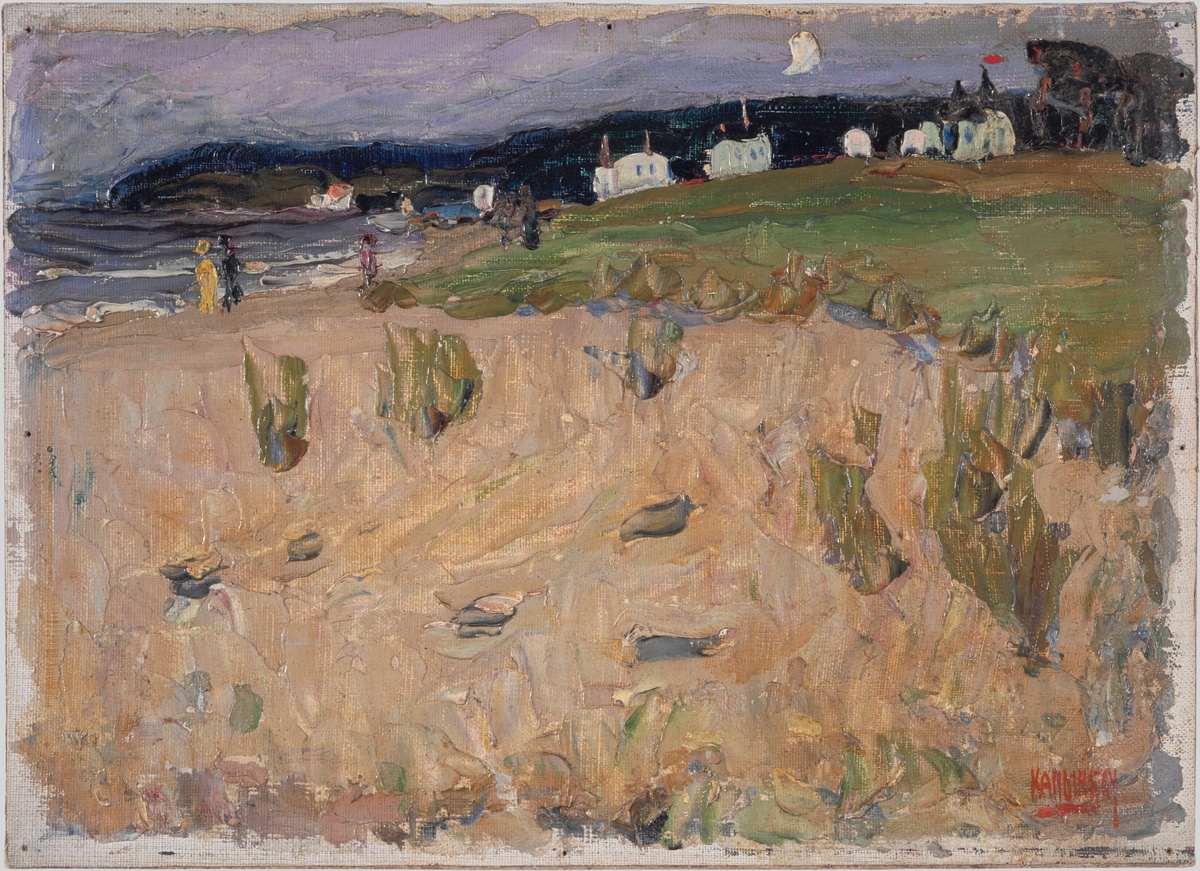
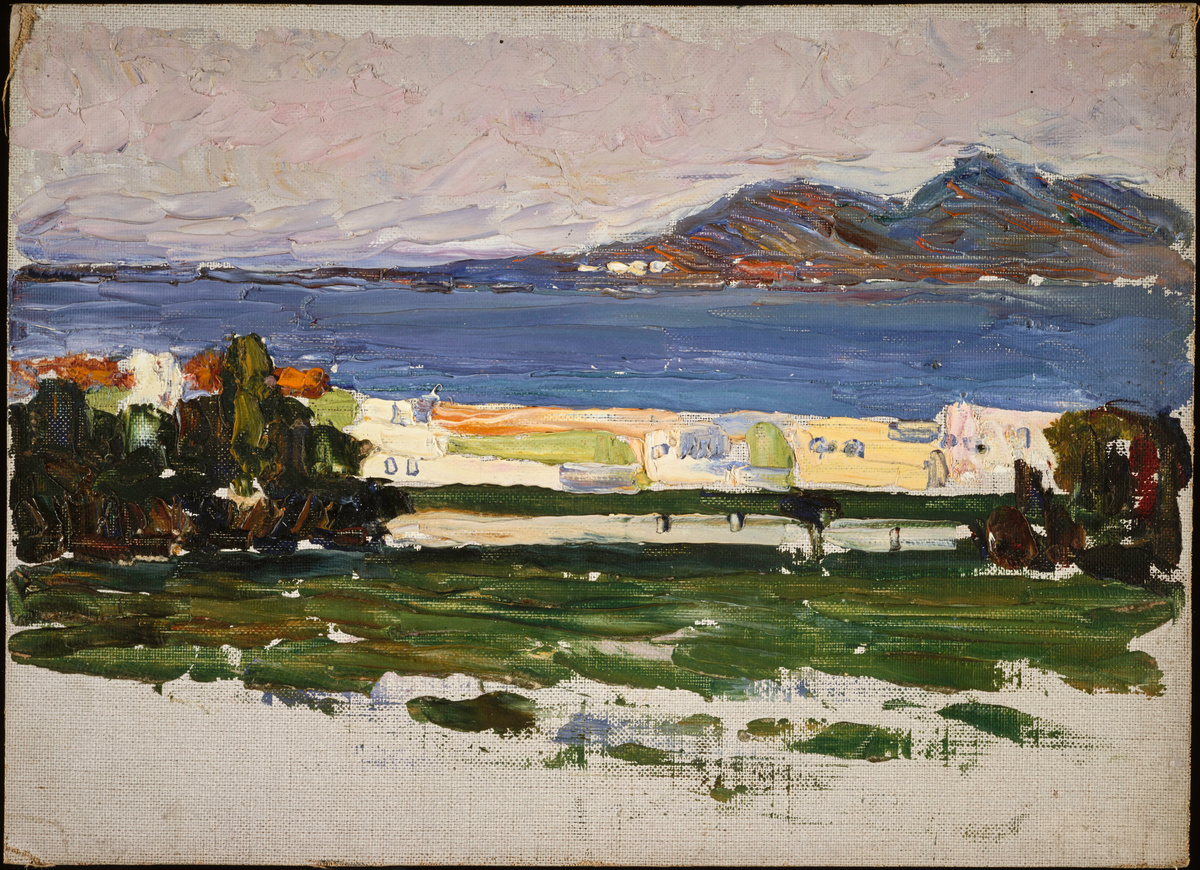
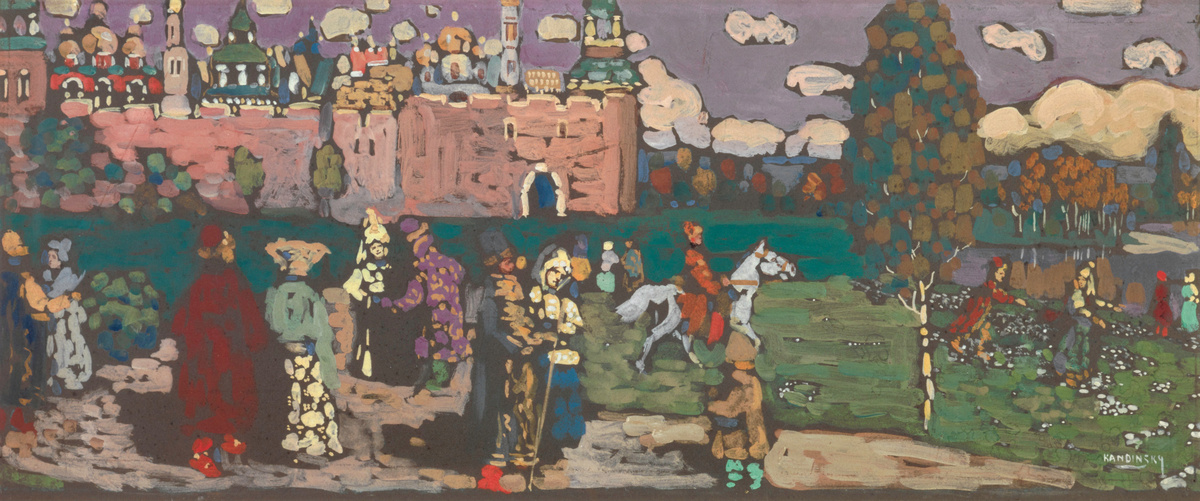
Windmill in Holland
Artist: Wassily Kandinsky · 1904

Windmill in Holland: high-resolution image
The original file is hosted by Wikimedia Commons, available without payment or an account.
Open high-resolution image on Wikimedia CommonsThe complete story
The story About 2 minutes to read
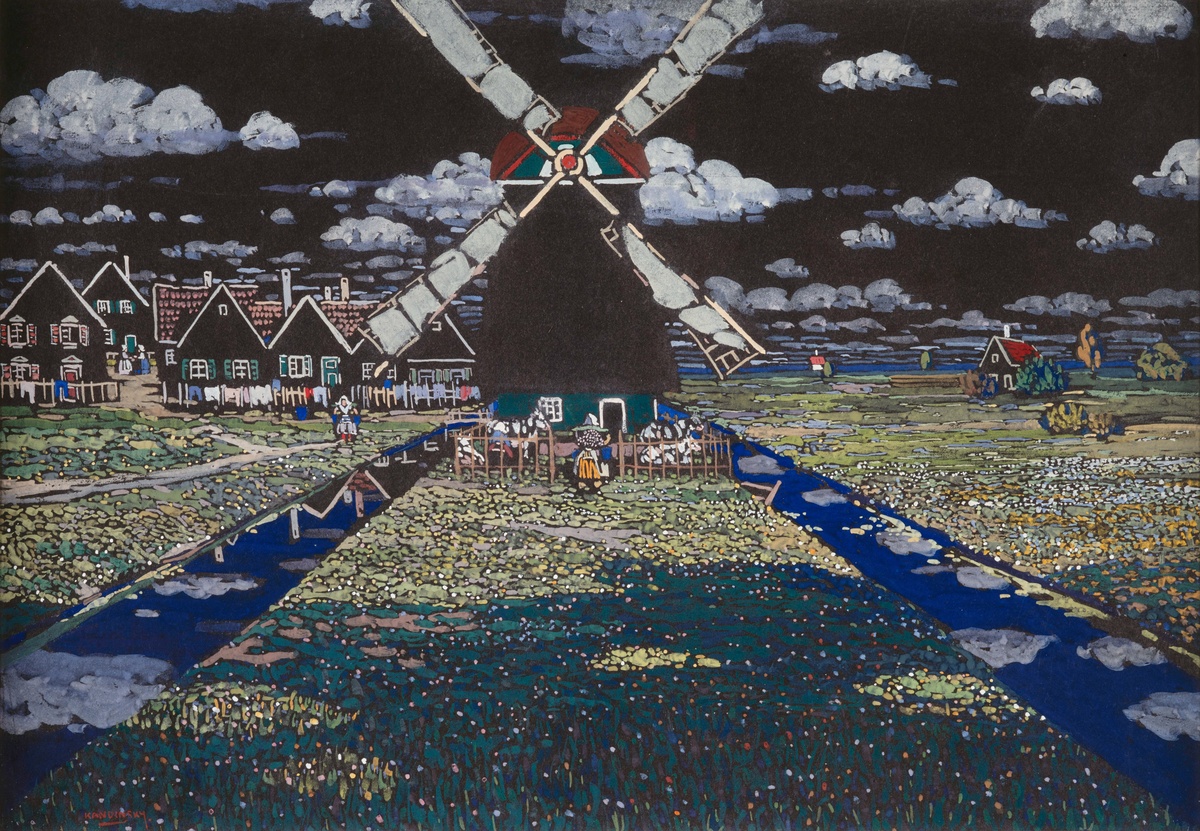
This is Wassily Kandinsky's Windmill in Holland, a landscape from 1904. The title tells you plainly what it shows: a windmill in the Dutch countryside. It's tempera on paper, and it belongs to the Musée National d'Art Moderne in Paris.
The painting gives us a landscape with a windmill as its subject. The title also appears in French as Moulin en hollande and in German as Mühle, Holland. Beyond that, the supplied record describes the scene as a Dutch landscape with village life, a canal and flowers. Those are the elements we can point to.
Kandinsky made this work in 1904, well before the abstract paintings he became famous for. At this point he was still working with recognizable landscape subjects. The Dutch motif of the windmill places the painting in a long tradition of Dutch landscape imagery.
What does the painting ask us to notice? The windmill anchors the scene, and the surrounding village life, canal and flowers build a picture of everyday Dutch surroundings. We can see how the title and the visible elements work together to set a specific place and mood, even though the record doesn't elaborate on Kandinsky's intentions.
So this is an early Kandinsky: a landscape that names its subject directly and invites us to look at how a familiar Dutch scene is painted. The record gives us the facts of title, date and medium. The rest is for your eyes to explore.
The story and its sources
Historical claims are linked to the records below. Close looking and interpretation are identified in the passage notes.
- Passage 1Documented historyWikimedia Commons: Windmill in Holland
- Passage 2Close lookingWikimedia Commons: Windmill in Holland
- Passage 3Documented historyWikimedia Commons: Windmill in Holland
- Passage 4InterpretationWikimedia Commons: Windmill in Holland
- Passage 5InterpretationWikimedia Commons: Windmill in Holland
Details to notice
About 2 minutes to readBlue canal and flower banks
The deep blue canal carries pale cloud reflections and cuts diagonally through densely speckled flower beds, highlighting the painting's contrast between flat pattern and deep space.
Village laundry line
White laundry hung across the fronts of dark-roofed houses shows everyday Dutch domestic life and adds bright rhythmic accents beneath the windmill sails.
Woman and hens at the windmill yard
A woman in a white cap and yellow skirt stands at the wooden fence while white hens gather nearby, supplying human scale and rural activity in the foreground.
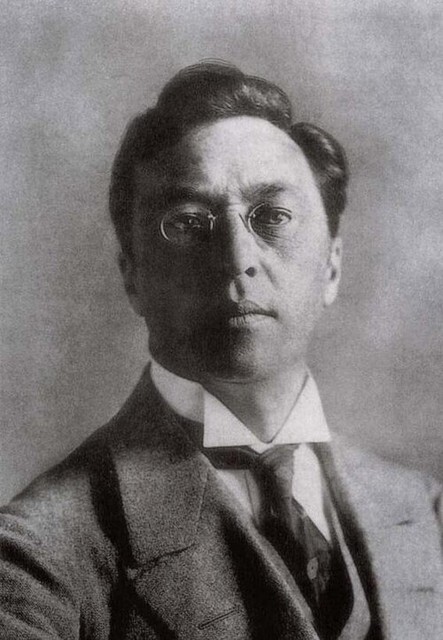
Artist portrait Image credit
未知上傳者. Image source · Public domain
About the artist
Wassily Kandinsky
1866 to 1944
Wassily Kandinsky was an avant-garde painter of Russian origin (1866–1944). Their work is associated with Expressionism; Symbolism; Bauhaus. Their recorded places of work include Paris; Munich; Weimar; Rapallo; The Hague; Russia; Stockholm; Switzerland; Tunis.
- Born
- 1866
- Died
- 1944
- Nationality
- Russian Empire; Russian Soviet Federative Socialist Republic; Soviet Union; France; Germany
- Birthplace
- Moscow
- Died in
- Neuilly-sur-Seine
Biography sources
The research & record
Study the work.
Follow the evidence.
Find catalogue details, historical context, technical research and the literature behind this artwork.
The artwork record
Research catalogue
Catalogue information and detailed research, with references that link to the bibliography.
Updated .
Identity and catalogue
Link- Title
- Windmill in Holland(Wikimedia Commons: Windmill in Holland, 1904)
- Artist or attribution
- Wassily Kandinsky(Wikimedia Commons: Windmill in Holland, 1904)
- Object date
- 1904
- Medium and support
- tempera on paper(Wikimedia Commons: Windmill in Holland, 1904)
- Dimensions
- 34.7 cm × 50.3 cm
- Current collection or location
- Musée National d'Art Moderne, Centre Georges Pompidou, Paris(Wikimedia Commons: Windmill in Holland, 1904)
- Movement or period
- Early twentieth-century landscape painting
- Country or culture
- Russia and the Netherlands
- Depicted subject
- A Dutch landscape with a windmill, village life, a canal and flowers, painted by Kandinsky in 1904.(Wikimedia Commons: Windmill in Holland, 1904)
- Title variants
- Moulin en hollande; Mühle, Holland; Mulini a vento
- Accession number
- AM 81-65-84
- Support
- paper
Read valuation records and their limitations
Catalogue identity
The work catalogued here is a landscape painting titled Windmill in Holland, a title that also circulates in French as Moulin en hollande and in German as Mühle, Holland. These three forms, English, French and German, belong to the single record for the object; they are title variants rather than separate works, and the alternation between them reflects the bilingual and international description practices of the cataloguing institution and the languages of the artist's career. The painting is attributed to Wassily Kandinsky and dated 1904. The attribution is recorded as an attribution in the source record, and the date is given as 1904 in the artist and date fields of that record. Both the attribution and the date belong to the catalogue entry for the object, not to a signature, inscription or document transcribed in the supplied evidence.(Wikimedia Commons: Windmill in Holland, 1904, File title and labels; Artist and Date fields)
The 1904 date is the date assigned to the painting in its catalogue record. It is not the date of the catalogue entry, of the reference photograph, or of the digital surrogate through which the image is now circulated. Keeping these dates distinct matters because the object record, the image file and the reproductions derived from it each have their own histories, and only the first of these is the object date of 1904. The evidence supplied here establishes the object as a 1904 work under the title Windmill in Holland, with the alternative titles Moulin en hollande and Mühle, Holland, and does not attribute that date to the making of any of the later records. The distinction is small but consequential for how the object is cited: the work is a 1904 painting, while the catalogue descriptions of it are modern instruments of documentation.(Wikimedia Commons: Windmill in Holland, 1904, File title and labels; Artist and Date fields; Source/Photographer and License fields)
The work is a landscape painting titled Windmill in Holland, also known as Moulin en hollande and Mühle, Holland.(Wikimedia Commons: Windmill in Holland, 1904)
The painting is attributed to Wassily Kandinsky and dated 1904.(Wikimedia Commons: Windmill in Holland, 1904)
Subject and iconography
LinkRead valuation records and their limitations
What the record establishes about the scene
Visual observation
The supplied record describes the painting as a landscape showing a windmill in Holland, and the object carries the title Windmill in Holland, appearing in French as Moulin en hollande and in German as Mühle, Holland. Those titles and the recorded genre are the firm ground for any visual account. The evidence establishes the subject category, a landscape with a windmill, and the geographic association implied by the title. It does not establish the number of windmills, their placement, the presence or absence of figures, water, buildings, flowers or weather, nor does it record a palette, a horizon line or a compositional structure. Descriptions of village life, a canal and flowers therefore cannot be presented here as documented observations of this painting. The visual analysis has to begin from the windmill landscape as a titled subject and acknowledge that the detailed look of the sheet is not captured in the available documentation.(Wikimedia Commons: Windmill in Holland, 1904, Title and Genre fields)
The painting is a landscape showing a windmill in Holland.(Wikimedia Commons: Windmill in Holland, 1904)
Materials and technique
LinkRead valuation records and their limitations
Documented support and dimensions
The supplied record describes Windmill in Holland as tempera on paper, measuring 34.7 by 50.3 centimetres. Both the medium and the dimensions are catalogued facts, recorded in the same registration that attributes the landscape to Wassily Kandinsky and dates it 1904. No technical examination report is among the evidence: nothing here records the paper's weight, texture, chain lines or watermark, and nothing records pigment analysis, binder sampling, surface microscopy or conservation treatment. The account of materials therefore rests on the catalogue entry alone, and any further statement about how the sheet was prepared or what specific colourants were used would go beyond what is documented. The one physical consequence the measurements do support is one of format: at roughly thirty-five by fifty centimetres the work is a modest sheet, the scale of a study or small independent composition on paper rather than a large canvas.(Wikimedia Commons: Windmill in Holland, 1904, Medium and Dimensions fields)
Visual observation
Tempera on paper situates the work within the graphic and small-format side of early twentieth-century practice, where paper served as a support for works carried out in media other than oil, including the opaque water-based paints that catalogue language often groups under tempera. Because the entry specifies paper rather than canvas or board, the sheet itself is the primary support, and the painted image sits directly upon it; the evidence does not say whether the exposed paper remains visible at the edges, whether the sheet was mounted, or whether any sizing or ground intervenes between paper and paint. These are exactly the questions that a technical study would answer, and their absence is a qualification on the material account rather than a gap to be filled by assumption. The distinction matters because the visual impression of the painting, a Dutch landscape with a windmill, cannot by itself establish how many layers, if any, lie between the paper and the visible surface.(Wikimedia Commons: Windmill in Holland, 1904, Medium and Dimensions fields; Title and Genre fields)
Materials and the visible subject
Interpretation
What can be seen and what is documented meet at the subject: the entry describes the work as a landscape showing a windmill in Holland, and the title fields in French and German, Moulin en hollande and Mühle, Holland, name the same motif. The visible elements of a canal, village life and flowers belong to the catalogue description of the scene, not to technical analysis of the paint. A materials-based reading therefore has to keep two registers separate: the composition is known from description of the image, while the physical making is known only from the medium and dimension fields. Within that limit, the pairing of a landscape subject with tempera on paper is coherent with the period before Kandinsky's abstract work, when he was still working with recognizable landscape motifs, as the 1904 date indicates. The choice of paper and a water-based medium does not in itself determine the appearance of the Dutch scene, but it does place the object in the world of portable, quickly worked sheets rather than in the tradition of large oil landscapes.(Wikimedia Commons: Windmill in Holland, 1904, Medium and Dimensions fields; Title and Genre fields)
The work is tempera on paper, measuring 34.7 by 50.3 centimetres.(Wikimedia Commons: Windmill in Holland, 1904)
Provenance and ownership
LinkRead valuation records and their limitations
The Documented Record
The documented record for Windmill in Holland, also titled Moulin en hollande and Mühle, Holland, fixes the work as a landscape by Wassily Kandinsky dated 1904, executed in tempera on paper at 34.7 by 50.3 centimetres. The painting is held by the Musée National d'Art Moderne, part of the Centre national d'art et de culture Georges-Pompidou in Paris, under accession number AM 81-65-84. For a provenance account, these identifiers are the anchor points: the accession number is the object's stable administrative identity within the Paris collection, while the three language variants of the title record how the work has been named across French and German publication contexts as well as English.(Wikimedia Commons: Windmill in Holland, 1904, Source/Photographer and License fields)
Chronology can be stated only at its two secure ends. The work carries a date of 1904, the year of its making as recorded for the painting, and it is now documented in the collection of the Musée National d'Art Moderne in Paris under accession number AM 81-65-84. The supplied evidence does not set out any intermediate owner, dealer, sale, gift, bequest or transfer between those points. That absence must be read as an unrecorded interval, not as a proven continuity of ownership: nothing in the record establishes that the painting passed directly from the artist to the Paris museum, and nothing establishes that it changed hands at all. The provenance history of this object, as far as the supplied evidence goes, is a making date, a present repository and an accession identifier, with the intervening decades left open.(Wikimedia Commons: Windmill in Holland, 1904, Source/Photographer and License fields)
Interpretation
The accession number AM 81-65-84 is the most precise provenance datum available. Its form encodes the museum's own registration practice rather than any narrative of ownership: it identifies the object within the holdings of the Musée National d'Art Moderne and would be the reference used for any inquiry into acquisition files, gallery records or loan history held by the Centre Pompidou. The evidence does not supply the date or mechanism behind that number, so it should not be read as evidence of an acquisition in any particular year. What it does establish is that the painting's documented institutional life belongs to the Paris museum, and that any future reconstruction of the missing interval must be built outward from that registration record.(Wikimedia Commons: Windmill in Holland, 1904, Source/Photographer and License fields)
Reproduction and Rights
A separate strand of the record concerns the image rather than the object. The reproduction is credited to Google Arts & Culture and released as public domain. This is a rights statement about the photograph and its distribution, not a claim about the legal status of the painting itself, and it should not be conflated with ownership. Its practical effect for research is that the work can be studied and reproduced from that digital surrogate without permission barriers, which is why the visual evidence of the Dutch landscape, with its windmill, village life, canal and flowers, circulates so widely even though the documentary trail of the physical object remains thin.(Wikimedia Commons: Windmill in Holland, 1904, Source/Photographer and License fields)
The image is credited to Google Arts & Culture and released as public domain.(Wikimedia Commons: Windmill in Holland, 1904)
Collection and display
LinkRead valuation records and their limitations
Collection and accession
Windmill in Holland is recorded as belonging to the Musée National d'Art Moderne, part of the Centre national d'art et de culture Georges-Pompidou in Paris, where it carries the accession number AM 81-65-84. This single institutional fact is the strongest documented element in the collection record supplied for the work: the accession number fixes the painting to a specific public collection, and the museum identity places it within the national modern art museum of France rather than in a private holding or an unidentified location. Because the supplied record gives no acquisition date, donor, purchase history or earlier provenance, the object's route into the museum and its whereabouts before accession remain undocumented here and should not be inferred from the accession number alone, even though such numbers are sometimes read as encoding a year of entry.(Wikimedia Commons: Windmill in Holland, 1904, Collection and Accession number fields)
The painting belongs to the Musée National d'Art Moderne, part of the Centre national d'art et de culture Georges-Pompidou in Paris, with accession number AM 81-65-84.(Wikimedia Commons: Windmill in Holland, 1904)
Documented values and qualified estimates
LinkRead valuation records and their limitations
Valuation status
Interpretation
The only valuation evidence supplied for Wassily Kandinsky's Windmill in Holland, also recorded under the French title Moulin en hollande and the German Mühle, Holland, is a model-generated working insurance range of US$3M to US$9M, recorded as a working calculation generated 2026-10-30. The document is explicit about its own limits: it is a broad, conservative working range derived only from the confirmed context in the supplied source excerpt, not from any official museum object record, appraisal, comparable sale, auction result, or private insurance data. The record states plainly that no such material was supplied or used, and that the range depends on unverified identification details and must be replaced by a professional valuation before any insurance or financial use. The range is also described as intentionally wide in order to support manual review. Within the accumulating account of this object, then, the figure is best treated as a documented artifact of a valuation exercise and its stated method, not as a market price or an institutional estimate.(Wikimedia Commons: Windmill in Holland, 1904)
The calculation's own methodology explains how the range was assembled from identifying facts: attribution to Kandinsky, a date of 1904, tempera on paper, dimensions of 34.7 by 50.3 centimetres, and collection at the Musée National d'Art Moderne, Centre Georges Pompidou, Paris, under accession number AM 81-65-84. In the document's stated reasoning, the artist's prominence, the early date within a formative period before his mature abstraction, and museum collection status indicating a documented acquisition path support the estimate, while the modest scale and the works-on-paper medium discount it. This is the calculation's own methodological account rather than an attributed scholarly judgment about the picture, and it carries the explicit qualification that the range is a working estimate for manual review only. The same identification facts, including the title variants, medium, dimensions and accession number, are independently recorded on the Wikimedia Commons file page for the work, whose image is credited to Google Arts & Culture and released as public domain. The valuation document and the object record therefore rest on the same identification, so doubt about that identification would propagate into both.(Wikimedia Commons: Windmill in Holland, 1904)
What the record supports
What the object record establishes is narrower and firmer than a value: a landscape showing a windmill in Holland, attributed to Wassily Kandinsky and dated 1904, executed in tempera on paper at 34.7 by 50.3 centimetres, and held by the Musée National d'Art Moderne, part of the Centre national d'art et de culture Georges-Pompidou in Paris, accession AM 81-65-84. The Wikimedia Commons page records the title variants Windmill in Holland, Moulin en hollande and Mühle, Holland, and describes the scene as a Dutch landscape with village life, a canal and flowers. No official valuation, appraisal, sale result or comparable appears among the supplied evidence, and the model-generated range explicitly disclaims being any of these. Keeping those categories apart matters for the material history of such a work: an accession number documents custodial status within a public collection, and a 2026 working insurance figure documents a planning exercise, but neither substitutes for a provenance record or a professional appraisal. The account should preserve that gap rather than fill it with a number treated as established fact.(Wikimedia Commons: Windmill in Holland, 1904)
Working estimate
Calculated working insurance estimate, not a sale price: Working insurance range: US$3M to US$9M Recorded date: Working calculation, generated 2026-10-30. Methodology: This is a broad, conservative working range derived only from the confirmed context in the supplied source excerpt. The work is attributed to Wassily Kandinsky, dated 1904, and described as tempera on paper measuring 34.7 cm by 50.3 cm, an early landscape from a formative period before his mature abstraction. It is recorded as held by the Musée National d'Art Moderne, Centre Georges Pompidou, Paris, with accession number AM 81-65-84, indicating museum collection status and a documented acquisition path. Because the excerpt supplies no official valuation, appraisal, sale result, or comparables, the range is a cautious order-of-magnitude benchmark reflecting the artist's prominence and the work's early date and museum context, while discounting for the modest scale and works-on-paper medium. The range is intentionally wide to support manual review and should be replaced by a professional valuation before any insurance decision. Qualification: This is a model-generated working range for manual review only. It is not an official insurance value, appraisal, auction estimate, auction result, or sale price. No official museum object record, appraisal, comparable sale, or private insurance data was supplied or used. The range depends on unverified identification details and must be confirmed by a qualified professional before any insurance or financial use.(Wikimedia Commons: Windmill in Holland, 1904)
Further reading
Books for a closer look
Paid links. As an Amazon Associate I earn from qualifying purchases.

Open Library Kandinsky: Russian and Bauhaus years, 1915-1933.
Solomon R. Guggenheim Museum
Kandinsky catalogue with subjects including Catalogues, Musée national d'art moderne (Paris) and Centre Georges Pompidou, matching the documented holding of Windmill in Holland at the Musée National d'Art Moderne, Centre Pompidou. Recorded as a catalogue, so possibly useful for object documentation, though the specific painting is not confirmed in the record.
ISBN 0892070447
Bibliography
Sources and further reading
References are arranged by author or organisation, with links to the original publications. Where no publication date is recorded, n.d. means no date.
Source notes updated .
No recorded sources match these filters. Reset the filters to see the full bibliography.
- 03
Covers windmills in Germany, Holland and Belgium, matching the painting's Dutch windmill subject as documented. Useful as background on the depicted motif, not as a study of Kandinsky's work.
- ISBN
- 3770112229
Citation text
- 02
Book
Kandinsky: Russian and Bauhaus years, 1915-1933. Solomon R. Guggenheim Museum.
Kandinsky catalogue with subjects including Catalogues, Musée national d'art moderne (Paris) and Centre Georges Pompidou, matching the documented holding of Windmill in Holland at the Musée National d'Art Moderne, Centre Pompidou. Recorded as a catalogue, so possibly useful for object documentation, though the specific painting is not confirmed in the record.
- ISBN
- 0892070447
Citation text
- 01
Secondary · About this artwork
Wikimedia Commons: Windmill in Holland (1904). Wassily Kandinsky, Mühle, Holland (Mill in Holland). Wikimedia Commons.
Wikimedia Commons file page providing title variants, artist, date, medium, dimensions, collection and accession number for this painting.
- Language
- en
Citation text
Art to live with
Bring this painting
home.
A piece of the archive, made yours. Explore Windmill in Holland in a size and finish that fits your space.
Your text and annotations appear on these editions. Adding to cart saves that design for printing.
Combine this painting with your favourites01 / Find your edition
Made for you
Suggested from your location. Change it if you're sending elsewhere or using a VPN. Prices and delivery are shown in GBP.
19 products
Choose an edition to make it yours
6 × 8 in · Printed cover · 118 lined pages
6 × 8 in · Printed cover · 118 lined pages
6 × 8 in · Printed cover · 118 lined pages
Notebook
GBP 11.87
Delivery GBP 5.27 / Total GBP 17.14
A 6 × 8 inch spiral notebook with 118 ruled pages (59 sheets), a printed front cover, dark grey back cover and metal spiral binding.
Fit and fill keep the painting’s proportions. Stretch changes them.
Move and zoom the painting on your notebook.
Made to order with your design
Made to order
US delivery only
76.2 × 50.8 cm / 30 × 20 in · Standard
76.2 × 50.8 cm / 30 × 20 in · Standard

30 × 20 in / 76.2 × 50.8 cm · Standard

30 × 20 in / 76.2 × 50.8 cm · Standard

30 × 20 in / 76.2 × 50.8 cm · Standard

30 × 20 in / 76.2 × 50.8 cm · Standard

30 × 20 in / 76.2 × 50.8 cm · Standard
Metal art sign
GBP 63.49
Delivery GBP 20.62 / Total GBP 84.11
A printed aluminium sign with rounded corners and mounting holes.
Fit and fill keep the painting’s proportions. Stretch changes them.
Move and zoom the painting on your metal art sign.
Made to order with your design
Printed aluminium · mounting holes included
US delivery only
iPhone 12 Mini ? Glossy ? back view
iPhone 12 Mini · Glossy

iPhone 12 Mini ? Glossy ? back view

iPhone 12 Mini ? Glossy ? back view

iPhone 12 Mini ? Glossy ? back view
Tough phone case
GBP 16.34
Delivery GBP 4.22 / Total GBP 20.56
A two-layer phone case with a printed polycarbonate shell and a shock-absorbing inner liner.
Two layers with a shock-absorbing TPU liner
Case & print details
- Device
- Apple · iPhone 12 Mini
- Material
- Polycarbonate shell with a TPU inner liner
- Artwork
- Outer back and wrapped edges from one template
- Finish
- Glossy
- Version
- Standard version
- Printing
- Dye sublimation
- Print file
- 1,122 × 1,831 px · 95 × 155 mm · PNG · 300 dpi recommended
Rear outline and camera openings follow this variant's Printify template. Case depth and small hardware remain illustrative.
Supplier product detailsFit and fill keep the painting’s proportions. Stretch changes them.
Move and zoom the painting on your tough phone case.
Made to order with your design
Made to order
US delivery only
40.6 × 30.4 cm / 16 × 12 in · Black
40.6 × 30.4 cm / 16 × 12 in · Black

16 × 12 in / 40.6 × 30.4 cm · Black

16 × 12 in / 40.6 × 30.4 cm · Black

16 × 12 in / 40.6 × 30.4 cm · Black

16 × 12 in / 40.6 × 30.4 cm · Black
Framed art print
GBP 53.10
- 1 framed print
- GBP 53.10
- Delivery to United States
- GBP 14.11
- Total
- GBP 67.21
A ready-to-hang wooden frame with a clear Perspex cover and a semi-gloss printed insert.
Delivery is quoted for all selected copies together.
Fit and fill keep the painting’s proportions. Stretch changes them.
Move and zoom the painting on your framed art print.
Made to order with your design
Wooden frame & protective clear front included
US delivery only
38.1 × 40.6 cm / 15 × 16 in · Natural
38.1 × 40.6 cm / 15 × 16 in · Natural

15 × 16 in / 38.1 × 40.6 cm · Natural

15 × 16 in / 38.1 × 40.6 cm · Natural

15 × 16 in / 38.1 × 40.6 cm · Natural

15 × 16 in / 38.1 × 40.6 cm · Natural

15 × 16 in / 38.1 × 40.6 cm · Natural
Canvas tote bag
GBP 14.20
Delivery GBP 4.32 / Total GBP 18.52
A sturdy cotton canvas tote with reinforced handles and artwork on the front panel.
Fit and fill keep the painting’s proportions. Stretch changes them.
Move and zoom the painting on your canvas tote bag.
Made to order with your design
Front print · reinforced cotton handles
US delivery only
22.9 × 20.3 cm / 9 × 8 in · Standard
22.9 × 20.3 cm / 9 × 8 in · Standard

9 × 8 in / 22.9 × 20.3 cm · Standard

9 × 8 in / 22.9 × 20.3 cm · Standard

9 × 8 in / 22.9 × 20.3 cm · Standard

9 × 8 in / 22.9 × 20.3 cm · Standard
Mouse mat
GBP 7.28
Delivery GBP 4.81 / Total GBP 12.09
A rectangular fabric mouse mat with a rubber backing and rounded corners.
Fit and fill keep the painting’s proportions. Stretch changes them.
Move and zoom the painting on your mouse mat.
Made to order with your design
Made to order
US delivery only
See more13 more products
43.2 × 45.7 cm / 17 × 18 in · Artwork
43.2 × 45.7 cm / 17 × 18 in · Artwork

17 × 18 in / 43.2 × 45.7 cm · Artwork

17 × 18 in / 43.2 × 45.7 cm · Artwork

17 × 18 in / 43.2 × 45.7 cm · Artwork
Woven tote bag
GBP 46.69
Delivery GBP 5.86 / Total GBP 52.55
A woven tote with cotton webbing handles and the painting translated into a woven design.
Fit and fill keep the painting’s proportions. Stretch changes them.
Move and zoom the painting on your woven tote bag.
Made to order with your design
Made to order
US delivery only
25.4 × 25.4 cm / 10 × 10 in · Standard
25.4 × 25.4 cm / 10 × 10 in · Standard

10 × 10 in / 25.4 × 25.4 cm · Standard

10 × 10 in / 25.4 × 25.4 cm · Standard

10 × 10 in / 25.4 × 25.4 cm · Standard

10 × 10 in / 25.4 × 25.4 cm · Standard

10 × 10 in / 25.4 × 25.4 cm · Standard
Matte art print
GBP 11.27
Delivery GBP 7.19 / Total GBP 18.46
An unframed matte poster with archival inks, ready for a frame of your choice.
Fit and fill keep the painting’s proportions. Stretch changes them.
Move and zoom the painting on your matte art print.
Made to order with your design
Unframed · frame it your way
US delivery only
iPhone 12 Mini ? Standard ? back view
iPhone 12 Mini · Standard

iPhone 12 Mini ? Standard ? back view

iPhone 12 Mini ? Standard ? back view

iPhone 12 Mini ? Standard ? back view
Flexible phone case
GBP 15.55
Delivery GBP 4.22 / Total GBP 19.77
A flexible TPU phone case with a frosted finish, a printed back and precise port openings.
Flexible TPU with a frosted, matte finish
Case & print details
- Device
- Apple · iPhone 12 Mini
- Material
- Semi-transparent thermoplastic polyurethane (TPU)
- Artwork
- Back print; rim stays unprinted
- Finish
- Standard
- Version
- Standard version
- Printing
- Dye sublimation
- Print file
- 791 × 1,586 px · 67 × 134.3 mm · PNG · 300 dpi recommended
Rear outline and camera openings follow this variant's Printify template. Case depth and small hardware remain illustrative.
Supplier product detailsFit and fill keep the painting’s proportions. Stretch changes them.
Move and zoom the painting on your flexible phone case.
Made to order with your design
Made to order
S · Standard
S · Standard

S · Standard

S · Standard

S · Standard

S · Standard

S · Standard
Crew socks
GBP 10.63
Delivery GBP 4.42 / Total GBP 15.05
Crew-length polyester and spandex socks with a ribbed cuff, cushioned sole and sublimated artwork.
Fit and fill keep the painting’s proportions. Stretch changes them.
Move and zoom the painting on your crew socks.
Made to order with your design
One pair · design repeated on both socks
US delivery only
12" · Standard
12" · Standard

12" · Standard

12" · Standard

12" · Standard
Laptop sleeve
GBP 26.00
Delivery GBP 4.89 / Total GBP 30.89
A polyester laptop sleeve with a fleece lining, top zip, printed front and black reverse.
Fit and fill keep the painting’s proportions. Stretch changes them.
Move and zoom the painting on your laptop sleeve.
Made to order with your design
Made to order
US delivery only
11oz · single image
11oz · White
11oz · single image
Mug
GBP 7.32
Delivery GBP 6.14 / Total GBP 13.46
A glossy white ceramic mug with a C-shaped handle, available in 11oz and 15oz sizes.
single layout · choose single, double or a repeating pattern in Customise.
Repeat, fit, fill and position your artwork around the mug.
Made to order with your design
Made to order
iPhone 12 Mini ? Standard ? back view
iPhone 12 Mini · Standard

iPhone 12 Mini ? Standard ? back view

iPhone 12 Mini ? Standard ? back view

iPhone 12 Mini ? Standard ? back view

iPhone 12 Mini ? Standard ? back view

iPhone 12 Mini ? Standard ? back view
Biodegradable phone case
GBP 20.89
Delivery GBP 4.22 / Total GBP 25.11
A matte phone case made from plant polymers and bamboo fibre, with the artwork printed on the back.
Flexible plant-polymer shell with a matte finish
Case & print details
- Device
- Apple · iPhone 12 Mini
- Material
- PLA and PBAT polymers with bamboo fibre
- Artwork
- Back print; rim stays unprinted
- Finish
- Standard
- Version
- Standard version
- Printing
- Dye sublimation
- Print file
- 777 × 1,553 px · 65.8 × 131.5 mm · PNG · 300 dpi recommended
Rear outline and camera openings follow this variant's Printify template. Case depth and small hardware remain illustrative.
Supplier product detailsFit and fill keep the painting’s proportions. Stretch changes them.
Move and zoom the painting on your biodegradable phone case.
Made to order with your design
Made to order
30.5 × 20.3 cm / 12 × 8 in · Standard
30.5 × 20.3 cm / 12 × 8 in · Standard

12 × 8 in / 30.5 × 20.3 cm · Standard

12 × 8 in / 30.5 × 20.3 cm · Standard

12 × 8 in / 30.5 × 20.3 cm · Standard
Fine art poster
GBP 12.85
Delivery GBP 7.58 / Total GBP 20.43
A gallery paper print with a smooth art-paper surface. Choose a size that suits the painting.
Fit and fill keep the painting’s proportions. Stretch changes them.
Move and zoom the painting on your fine art poster.
Made to order with your design
Unframed · frame it your way
iPhone 12 Mini ? Standard ? back view
iPhone 12 Mini · Standard

iPhone 12 Mini ? Standard ? back view

iPhone 12 Mini ? Standard ? back view

iPhone 12 Mini ? Standard ? back view
Clear phone case
GBP 15.05
Delivery GBP 4.22 / Total GBP 19.27
A clear phone case with artwork on the back. Leave areas transparent to show the phone underneath.
Clear shell with shock-absorbing TPU sides
Case & print details
- Device
- Apple · iPhone 12 Mini
- Material
- Polycarbonate back and clear TPU sides
- Artwork
- Back print; clear sides stay unprinted
- Finish
- Standard
- Version
- Standard version
- Printing
- Dye sublimation
- Print file
- 732 × 1,527 px · 62 × 129.3 mm · PNG · 300 dpi recommended
Rear outline and camera openings follow this variant's Printify template. Case depth and small hardware remain illustrative.
Supplier product detailsFit and fill keep the painting’s proportions. Stretch changes them.
Move and zoom the painting on your clear phone case.
Made to order with your design
Made to order
15oz · single image
15oz · Standard

15oz · single image

15oz · single image

15oz · single image

15oz · single image

15oz · single image
Travel mug
GBP 31.88
Delivery GBP 5.66 / Total GBP 37.54
A stainless-steel travel mug with a black lid, a tapered base and a printed white exterior.
single layout · choose single, double or a repeating pattern in Customise.
Repeat, fit, fill and position your artwork around the mug.
Made to order with your design
Made to order
US delivery only
2.5 × 3.4 cm / 1 × 1.4 in · Glossy
2.5 × 3.4 cm / 1 × 1.4 in · Glossy

1 × 1.4 in / 2.5 × 3.4 cm · Glossy

1 × 1.4 in / 2.5 × 3.4 cm · Glossy

1 × 1.4 in / 2.5 × 3.4 cm · Glossy

1 × 1.4 in / 2.5 × 3.4 cm · Glossy
Photo keyring
GBP 10.16
Delivery GBP 5.37 / Total GBP 15.53
A rectangular zinc-alloy photo keyring with a glossy insert and a swivel split ring.
Fit and fill keep the painting’s proportions. Stretch changes them.
Move and zoom the painting on your photo keyring.
Made to order with your design
Photo insert · zinc frame & swivel ring
US delivery only
iPhone 15 Pro ? Glossy ? back view
iPhone 15 Pro · Glossy

iPhone 15 Pro ? Glossy ? back view

iPhone 15 Pro ? Glossy ? back view

iPhone 15 Pro ? Glossy ? back view

iPhone 15 Pro ? Glossy ? back view

iPhone 15 Pro ? Glossy ? back view
Slim phone case
GBP 16.31
Delivery GBP 5.76 / Total GBP 22.07
A slim printed phone shell with open ports and a lightweight profile.
Slim, lightweight polycarbonate shell
Case & print details
- Device
- Apple · iPhone 15 Pro
- Material
- Polycarbonate
- Artwork
- Outer back and wrapped edges from one template
- Finish
- Glossy
- Version
- Standard version
- Printing
- Dye sublimation
- Print file
- 1,278 × 1,971 px · 108.2 × 166.9 mm · PNG · 300 dpi recommended
Rear outline and camera openings follow this variant's Printify template. Case depth and small hardware remain illustrative.
Supplier product detailsFit and fill keep the painting’s proportions. Stretch changes them.
Move and zoom the painting on your slim phone case.
Made to order with your design
Made to order
US delivery only
36.6 × 30.7 cm / 14.4 × 12.1 in · Standard
36.6 × 30.7 cm / 14.4 × 12.1 in · Standard

14.4 × 12.1 in / 36.6 × 30.7 cm · Standard

14.4 × 12.1 in / 36.6 × 30.7 cm · Standard

14.4 × 12.1 in / 36.6 × 30.7 cm · Standard
Desk mat
GBP 15.23
Delivery GBP 7.11 / Total GBP 22.34
A smooth polyester desk mat with a natural rubber non-slip base and anti-fray edges, available in three sizes.
Fit and fill keep the painting’s proportions. Stretch changes them.
Move and zoom the painting on your desk mat.
Made to order with your design
Made to order
The 30 cm ruler is scaled alongside your selected print. Keep the painting’s proportions with a black background, or stretch it to fill. Frame width, material texture and screen colours are illustrative.
Keep exploring