A Russian Scene
Artist: Wassily Kandinsky · 1904

A Russian Scene: high-resolution image
The original file is hosted by Wikimedia Commons, available without payment or an account.
Open high-resolution image on Wikimedia CommonsThe complete story
The story About 4 minutes to read
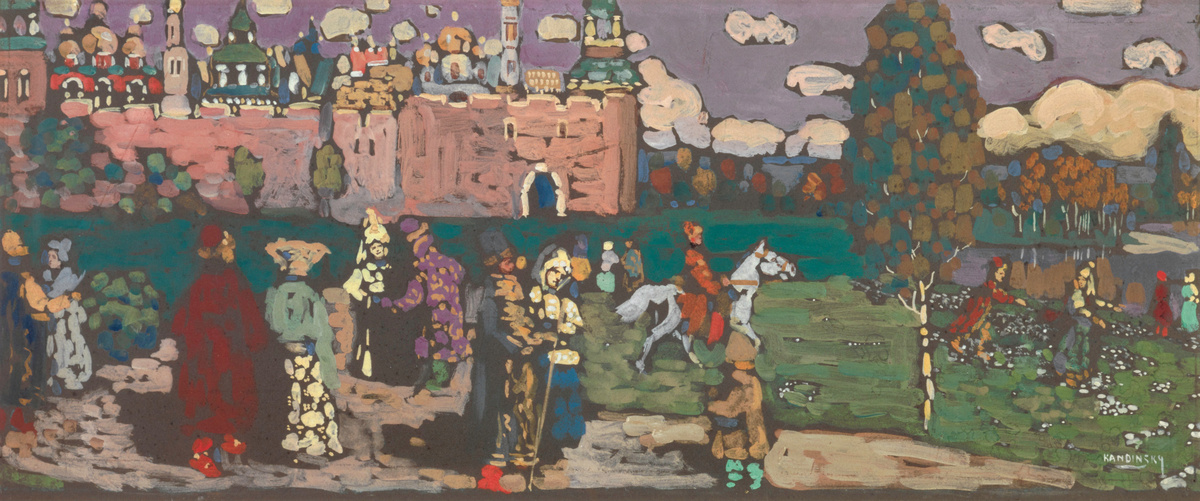
Kandinsky painted A Russian Scene in 1904. It shows a Russian folk subject: costumed figures gathered in the foreground, a rider on a white horse in the middle ground, and a walled town with onion-domed churches behind them. It's a very wide, shallow picture, closer to a strip than a window. That long format lets the scene spread sideways, like a frieze or a panorama passing in front of you.
Start on the left, where the crowd is thickest. A figure in red is seen from behind, a woman wears a pale green jacket and patterned skirt, and a dark bearded man stands out in a gold-trimmed coat. Their varied dress and gestures do real work here. Together they read as a staged assembly of Russian folk types, and they anchor the near end of the panorama.
Near the lower centre stands a small boy in a brown coat and cap, with his back to us. He faces toward the horseman. You might notice that he is modest in scale and slightly apart from the others. That isolation gives a quiet entry point into a crowded scene, an easy place for a newcomer's eye to settle.
The rider crosses the middle ground on a white horse, wearing a red-orange coat and a pale hat. That bright moving silhouette sits at the centre of the composition. Look at how the painting balances either side. The dense procession on the left is answered by small figures in red, yellow and dark clothing scattered across the grassy meadow on the right.
Above the people rises a pink-walled fortress with an arched gate. A cluster of onion-domed churches gathers behind the wall. That architecture sets the Russian scene and holds the upper edge of the panorama. It's the backdrop that turns the costumed figures below into a recognisable place rather than a generic crowd.
Put those parts together and the painting's method becomes clear. The fortress and churches establish where we are, while the costumed figures and the horseman stage the folk subject itself. The long horizontal shape, the crowded left and the open right all serve that staging. This is the record's reading of the work, and it rests on what the picture visibly contains.
So this is less a portrait of named individuals than a panoramic picture of Russian folk life. The rider pivots the scene, the crowd gives it its characters, and the walled churches give it its home. Once you've taken that in, try following the boy's gaze toward the white horse. It's a small device, but it carries you from the edge of the crowd into the heart of the picture.
The story and its sources
Historical claims are linked to the records below. Close looking and interpretation are identified in the passage notes.
- Passage 1Documented historyWikimedia Commons: A Russian Scene
- Passage 2Close lookingWikimedia Commons: A Russian Scene
- Passage 3Close lookingWikimedia Commons: A Russian Scene
- Passage 4Close lookingWikimedia Commons: A Russian Scene
- Passage 5Close lookingWikimedia Commons: A Russian Scene
- Passage 6InterpretationWikimedia Commons: A Russian Scene
- Passage 7InterpretationWikimedia Commons: A Russian Scene
Details to notice
About 3 minutes to readFigures on the Right Meadow
Small figures in red, yellow, and dark clothing are dispersed across the grassy right side, balancing the dense left-hand procession and extending the social life of the scene across the panorama.
Boy in Brown Cap
A small back-turned boy in a brown coat and cap stands near the lower center, facing toward the horseman. His modest scale and isolated stance give the viewer a quiet entry point into the crowded scene.
Kremlin Wall and Churches
A pink-walled fortress with an arched gate and a cluster of onion-domed churches rises behind the figures. The architecture establishes the Russian setting and anchors the panorama's upper edge.
Artist portrait Image credit
未知上傳者. Image source · Public domain
About the artist
Wassily Kandinsky
1866 to 1944
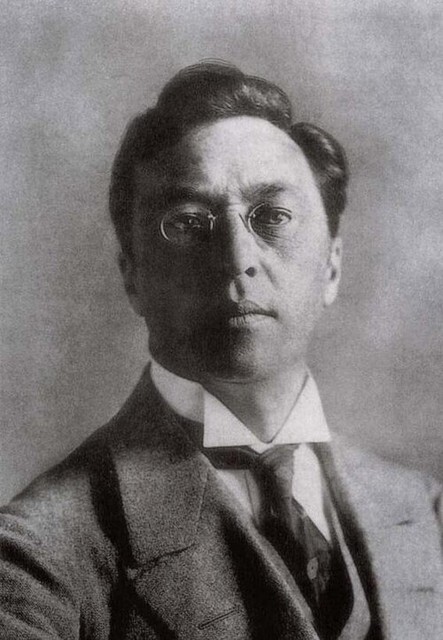
Wassily Kandinsky was an avant-garde painter of Russian origin (1866–1944). Their work is associated with Expressionism; Symbolism; Bauhaus. Their recorded places of work include Paris; Munich; Weimar; Rapallo; The Hague; Russia; Stockholm; Switzerland; Tunis.
- Born
- 1866
- Died
- 1944
- Nationality
- Russian Empire; Russian Soviet Federative Socialist Republic; Soviet Union; France; Germany
- Birthplace
- Moscow
- Died in
- Neuilly-sur-Seine
Biography sources
The research & record
Study the work.
Follow the evidence.
Find catalogue details, historical context, technical research and the literature behind this artwork.
The artwork record
Research catalogue
Catalogue information and detailed research, with references that link to the bibliography.
Updated .
Identity and catalogue
Link- Title
- A Russian Scene(Wikimedia Commons: A Russian Scene, n.d.)
- Artist or attribution
- Wassily Kandinsky(Wikimedia Commons: A Russian Scene, n.d.)
- Object date
- 1904(Wikimedia Commons: A Russian Scene, n.d.)
- Medium and support
- tempera on board(Wikimedia Commons: A Russian Scene, n.d.)
- Dimensions
- height: 23 cm (9 in); width: 54.7 cm (21.5 in)(Wikimedia Commons: A Russian Scene, n.d.)
- Current collection or location
- Musée National d'Art Moderne, Centre Georges Pompidou, Paris(Wikimedia Commons: A Russian Scene, n.d.)
- Movement or period
- Early twentieth-century Russian modernism; Kandinsky's pre-abstract folkloric period
- Country or culture
- Russia
- Depicted subject
- A panoramic view of Russian folk life: a costumed procession and a rider on a white horse, set before a kremlin wall and onion-domed churches, with scattered figures across an open meadow.(Wikimedia Commons: A Russian Scene, n.d.)
- Title variants
- Old Russia; Altrussisches; Scène russe
- Accession number
- AM 81-65-83 (R)(Wikimedia Commons: A Russian Scene, n.d.)
- Support
- board
Read valuation records and their limitations
Titles, attribution and date
The painting is catalogued as A Russian Scene, a title that circulates in the record alongside the variants Old Russia, Altrussisches and Scène russe. The coexistence of English, German and French labels is itself part of the object's documentary identity, since it reflects the several linguistic contexts through which the work has been described; the record does not state which of these titles is the earliest or which was used at the time of creation. The attribution given is to Wassily Kandinsky, and the work carries the date 1904. This date belongs to the painting, not to any later catalogue, file or database entry that records it.(Wikimedia Commons: A Russian Scene, n.d., file title and multilingual title labels; Artist or creator field; Date field)
The recorded dimensions are 23 centimetres in height by 54.7 centimetres in width, so the work is more than twice as wide as it is high. That long horizontal proportion is the format within which the composition's frieze-like arrangement of figures and architecture unfolds, and it is a documented property of the object rather than a description of its effect.(Wikimedia Commons: A Russian Scene, n.d., Dimensions field)
This exact painting is titled A Russian Scene, with title variants Old Russia, Altrussisches and Scène russe.(Wikimedia Commons: A Russian Scene, n.d.)
The painting is by Wassily Kandinsky.(Wikimedia Commons: A Russian Scene, n.d.)
The painting is dated 1904.(Wikimedia Commons: A Russian Scene, n.d.)
The recorded dimensions of this work are 23 centimetres in height by 54.7 centimetres in width, a long horizontal format.(Wikimedia Commons: A Russian Scene, n.d.)
Subject and iconography
LinkRead valuation records and their limitations
The Composition Described
Visual observation
The visible organisation of A Russian Scene can be described through five linked zones: the pink-walled fortress and onion-domed churches above, the rider on the white horse in the middle ground, the frieze of costumed figures at the left, the back-turned boy near the lower centre, and the scattered small figures on the grassy right. The record characterises the painting as presenting a Russian folk subject and treats the costumed figures and fortress architecture together as staging that subject. That reading is a description of what the picture visibly contains rather than a documentary identification of place, event or person, and the sections below follow that distinction.(Wikimedia Commons: A Russian Scene, n.d., Vision-derived semantic focus, Kremlin Wall and Churches; Vision-derived semantic focus, Rider on a White Horse; Vision-derived semantic focus, Costumed Foreground Group; Vision-derived semantic focus, Boy in Brown Cap; Vision-derived semantic focus, Figures on the Right Meadow)
Across the upper zone rises a pink-walled fortress with an arched gate, and behind the wall a cluster of onion-domed churches gathers. The record treats this architecture as establishing the Russian setting and as anchoring the upper edge of the panorama, so that the costumed figures below read as belonging to a recognisable place rather than as a generic crowd. The identification is visual and thematic: the domes and wall mark a Russian townscape, but the record does not name a specific city, monument or site.(Wikimedia Commons: A Russian Scene, n.d., Vision-derived semantic focus, Kremlin Wall and Churches)
At the centre of the middle ground a rider crosses on a white horse, wearing a red-orange coat and a pale hat. The record describes this bright moving silhouette as the composition's central pivot between the costumed crowd and the open meadow. The rider is thus a compositional hinge, connecting the dense activity on one side to the open ground on the other, and its brightness against the surrounding scene is what makes that hinge legible.(Wikimedia Commons: A Russian Scene, n.d., Vision-derived semantic focus, Rider on a White Horse)
The left foreground is filled by a frieze of stylized figures: a red-robed person seen from behind, a woman in a pale green jacket and patterned skirt, and a dark bearded man in a gold-trimmed coat. The record states that their varied dress and gestures stage the Russian folk subject. This is close observation of colour, costume and pose; the record does not identify the individuals, assign a region or period to the dress, or claim that the costumes document actual garments. The figures are described as stylized, which keeps the account at the level of pictorial convention rather than ethnographic record.(Wikimedia Commons: A Russian Scene, n.d., Vision-derived semantic focus, Costumed Foreground Group)
Near the lower centre stands a small back-turned boy in a brown coat and cap, facing toward the horseman. The record notes his modest scale and isolated stance, which give a quiet entry point into the crowded scene. This is an observation about how the picture can be entered by a viewer rather than a claim about the boy's role in any narrative; his back-turned pose makes him a stand-in for the spectator looking into the scene.(Wikimedia Commons: A Russian Scene, n.d., Vision-derived semantic focus, Boy in Brown Cap)
On the grassy right side, small figures in red, yellow and dark clothing are dispersed rather than massed. The record describes them as balancing the dense left-hand procession and extending the social life of the scene across the panorama. The distinction matters: the left is a compact frieze of larger, more detailed figures, while the right is open meadow punctuated by small accents of colour. The two halves are thus described as different in density and in scale of attention, not merely as a repetition of the same crowd.(Wikimedia Commons: A Russian Scene, n.d., Vision-derived semantic focus, Figures on the Right Meadow)
Interpretation
Taken together, the record's reading is an integrated staging: the fortress and churches establish where the scene is set, while the costumed figures and the horseman carry the folk subject itself. The long horizontal format reported for the work, 23 by 54.7 centimetres in tempera on board, is a support that lets this panorama spread sideways, and the medium is recorded separately from the board support. The evidence available here is the visual record and the basic object data; it does not include preparatory studies, inscriptions, or the artist's own statements, so the staging described should be understood as an interpretation of the visible arrangement rather than as a documented programme.(Wikimedia Commons: A Russian Scene, n.d., Vision-derived semantic focus, Kremlin Wall and Churches; Vision-derived semantic focus, Rider on a White Horse; Vision-derived semantic focus, Costumed Foreground Group; Vision-derived semantic focus, Figures on the Right Meadow; Medium field)
Visual observation
A pink-walled fortress with an arched gate and a cluster of onion-domed churches rises behind the figures; the architecture establishes the Russian setting and anchors the panorama's upper edge.(Wikimedia Commons: A Russian Scene, n.d.)
A rider in a red-orange coat and pale hat crosses the middle ground on a white horse, and this bright moving silhouette acts as the composition's central pivot between the costumed crowd and the open meadow.(Wikimedia Commons: A Russian Scene, n.d.)
The left foreground is filled by a frieze of stylized figures: a red-robed person seen from behind, a woman in a pale green jacket and patterned skirt, and a dark bearded man in a gold-trimmed coat; their varied dress and gestures stage the Russian folk subject.(Wikimedia Commons: A Russian Scene, n.d.)
A small back-turned boy in a brown coat and cap stands near the lower centre, facing toward the horseman; his modest scale and isolated stance give a quiet entry point into the crowded scene.(Wikimedia Commons: A Russian Scene, n.d.)
Small figures in red, yellow and dark clothing are dispersed across the grassy right side, balancing the dense left-hand procession and extending the social life of the scene across the panorama.(Wikimedia Commons: A Russian Scene, n.d.)
Materials and technique
LinkRead valuation records and their limitations
The documented support and medium
The record for this work describes it as tempera on board, a formulation that keeps two technical facts distinct: the paint medium is tempera, and the support is board rather than canvas or panel described in any other terms. The same record supplies the physical scale, 23 centimetres in height by 54.7 centimetres in width, and the attribution to Wassily Kandinsky with a date of 1904. The work is titled A Russian Scene, with the variants Old Russia, Altrussisches and Scène russe, and it belongs to the Musée National d'Art Moderne within the Centre national d'art et de culture Georges-Pompidou in Paris under accession number AM 81-65-83 (R). That documentary apparatus matters for any discussion of making, because it fixes the support, medium, dimensions and date as catalogued information rather than as inference from reproduction, while the record itself is a Wikimedia Commons file entry credited to Google Art and Culture and is presented as a discovery aid.(Wikimedia Commons: A Russian Scene, n.d., Medium field)
Visual observation
Within the section on materials and technique, the only documented technical statement supplied is the tempera-on-board formula; the source record does not describe a ground, preparation layer, pigment identification, brushwork, underdrawing or conservation treatment, and none should be supplied from outside the evidence. What the evidence does establish about the use of the medium is indirect but substantial: the same record describes a scene built from many small, distinctly coloured elements. A rider in a red-orange coat and pale hat crosses the middle ground on a white horse and is described as the composition's central pivot between the costumed crowd and the open meadow. On the left, a frieze of stylized figures includes a red-robed person seen from behind, a woman in a pale green jacket and patterned skirt, and a dark bearded man in a gold-trimmed coat. These are observations of what the picture visibly contains, recorded as vision-derived semantic focus points, not the results of pigment analysis, and they should be cited as such.(Wikimedia Commons: A Russian Scene, n.d., Medium field; Vision-derived semantic focus, Rider on a White Horse; Vision-derived semantic focus, Costumed Foreground Group)
Interpretation
Read alongside each other, the documented medium and the observed colour structure become a question for technical study rather than a settled finding. The record attributes the reds, the pale green jacket, the gold trim and the red-orange coat to what is seen in the image, while the only documented material fact remains tempera on board. The evidence therefore supports saying that the picture depends on sharply differentiated, saturated accents distributed across a wide field, and that these accents were realised in tempera on a board support, but it does not permit naming any pigment, binder additive or layer sequence. This distinction between catalogued material and visual inference is the honest boundary of the present account.(Wikimedia Commons: A Russian Scene, n.d., Medium field; Vision-derived semantic focus, Rider on a White Horse; Vision-derived semantic focus, Costumed Foreground Group)
Visual observation
The format established by the record, 23 by 54.7 centimetres, is a long horizontal field more than twice as wide as it is high, and the composition observed in the same source is organised to exploit exactly that proportion. The crowd mass on the left, the central horseman and the small figures dispersed across the grassy right side together produce a lateral, processional arrangement. Small figures in red, yellow and dark clothing on the right meadow balance the dense left-hand procession and extend the social life of the scene across the panorama. The small back-turned boy in a brown coat and cap near the lower centre, facing toward the horseman, adds a further low, close element within the shallow band of the picture. These observations describe how the painted surface is laid out; they do not describe how the paint was applied.(Wikimedia Commons: A Russian Scene, n.d., Medium field; Vision-derived semantic focus, Rider on a White Horse; Vision-derived semantic focus, Costumed Foreground Group; Vision-derived semantic focus, Boy in Brown Cap; Vision-derived semantic focus, Figures on the Right Meadow)
The medium is tempera on board; the record separates the tempera medium from the board support.(Wikimedia Commons: A Russian Scene, n.d.)
Interpretations and debates
LinkRead valuation records and their limitations
The Recorded Reading of the Subject
Interpretation
The Commons record describes A Russian Scene as presenting a Russian folk subject, and it treats the costumed figures and the fortress architecture as the two components that together stage that subject. This reading is explicitly identified in the supplied evidence as an interpretation drawn from the record itself, supported by description and vision-derived focus descriptions rather than by a documented statement from the artist. It should therefore be kept distinct from any claim about Kandinsky's private intention: the evidence establishes what the picture is said to contain and how those contents are read, not what he meant by them or what he expected viewers to feel. Within that limit, the reading is a compositional one. The setting is architectural and the actors are dressed figures, so the subject emerges from the relation between place and costume rather than from portraiture of named people or from a written program.(Wikimedia Commons: A Russian Scene, n.d., Commons description and vision-derived focus descriptions)
The architectural evidence behind that reading is specific. A pink-walled fortress with an arched gate rises behind the figures, and a cluster of onion-domed churches gathers behind the wall; the evidence says this architecture establishes the Russian setting and anchors the panorama's upper edge. The costumed foreground group supplies the other half of the staging. On the left, a red-robed person seen from behind, a woman in a pale green jacket and patterned skirt, and a dark bearded man in a gold-trimmed coat form a frieze of stylized figures whose varied dress and gestures are described as staging the Russian folk subject. Reading the two units together is what makes the attributed interpretation intelligible: the wall locates the scene, and the dress and gestures populate it with recognisable social types rather than individuals, so the panorama reads as a picture of folk life in a particular place.(Wikimedia Commons: A Russian Scene, n.d., Vision-derived semantic focus, Kremlin Wall and Churches; Vision-derived semantic focus, Costumed Foreground Group; Commons description and vision-derived focus descriptions)
Limits of the Reading
What the evidence does not supply is equally important for an accumulating account. The record supports a title with variants (Old Russia, Altrussisches and Scène russe), the attribution to Wassily Kandinsky, the date 1904, tempera on board, dimensions of 23 by 54.7 centimetres, and a holding at the Musée National d'Art Moderne within the Centre national d'art et de culture Georges-Pompidou in Paris under accession number AM 81-65-83 (R). The evaluation of the folk subject rests on that same record and on vision-derived descriptions, so the interpretation is bounded by what the picture visibly contains and by the terms the record uses for it. No source in the evidence states the artist's intention for the work, and the interpretive reading of staged folk life should not be restated as his stated aim. The long horizontal format, the crowded left and the open right can be described as serving the staging, but that is the record's reading of the composition, not a documented program.(Wikimedia Commons: A Russian Scene, n.d., Commons description and vision-derived focus descriptions)
The painting is described as presenting a Russian folk subject; the costumed figures and the fortress architecture together stage that subject.(Wikimedia Commons: A Russian Scene, n.d.)
Collection and display
LinkRead valuation records and their limitations
Institutional home
The painting is recorded as belonging to the Musée National d'Art Moderne, the modern art museum within the Centre national d'art et de culture Georges-Pompidou in Paris. The same collection record assigns it the accession number AM 81-65-83 (R), so the work can be identified within the holding by that inventory designation as well as by its titles and by the artist's name. These two data points are the collection information the available record establishes; they locate the object institutionally without supplying any further history of how, when or from whom it entered the museum.(Wikimedia Commons: A Russian Scene, n.d., Collection field; Accession number field)
The collection record should be read together with what the same source says about the object itself, since it is the record that ties the Paris holding to a specific, described panel. According to that source, the work is by Wassily Kandinsky, is titled A Russian Scene with the variants Old Russia, Altrussisches and Scène russe, and is dated 1904. Its medium is given as tempera on board, with the tempera distinguished from the board support, and its recorded dimensions are 23 centimetres in height by 54.7 centimetres in width, a long horizontal format. The same entry describes a pink-walled fortress with an arched gate and a cluster of onion-domed churches behind the figures, a rider in a red-orange coat and pale hat on a white horse in the middle ground, a left-hand frieze of stylized figures including a red-robed person seen from behind, a woman in a pale green jacket and patterned skirt and a dark bearded man in a gold-trimmed coat, a small back-turned boy in a brown coat and cap near the lower centre, and small figures in red, yellow and dark clothing dispersed across the grassy right side. The record characterizes the whole as presenting a Russian folk subject. Because the accession number and the collection name attach to this described panel, the institutional facts and the visual description refer to one and the same object rather than to loosely related works under similar titles.(Wikimedia Commons: A Russian Scene, n.d., Collection field; Accession number field)
Interpretation
The evidentiary status of these collection facts needs to be stated plainly. The record used here is a Wikimedia Commons file page, which the annotation describes as a discovery aid and which credits Google Art and Culture; the annotation also notes that the record itself identifies it as a Commons file. The collection attribution and accession number therefore rest on that secondary record rather than on a museum catalogue entry quoted in the supplied evidence, and the record is marked as only partially consulted. Nothing in the evidence documents acquisition date, donor, dealer, prior owner or the circumstances of entry into the Musée National d'Art Moderne, and no exhibition history is supplied. The collection information should accordingly be treated as the record's report, reliable enough to place the work institutionally but not a substitute for the museum's own registration file.(Wikimedia Commons: A Russian Scene, n.d., Collection field; Accession number field)
The painting belongs to the Musée National d'Art Moderne, within the Centre national d'art et de culture Georges-Pompidou, in Paris.(Wikimedia Commons: A Russian Scene, n.d.)
The accession number for this painting at the Musée National d'Art Moderne is AM 81-65-83 (R).(Wikimedia Commons: A Russian Scene, n.d.)
Documented values and qualified estimates
LinkRead valuation records and their limitations
The insurance working range and its limits
Interpretation
The only valuation unit supplied for this painting is a model-generated working insurance estimate, recorded as generated on 2026-10-30, that places a broad, conservative range of US$8M to US$20M on the work. The record is explicit about its method: the figure was calculated for manual insurance review and is anchored to the confirmed attribution to Wassily Kandinsky, the 1904 date placing the painting in his early pre-abstract folkloric period, the tempera-on-board medium, and the modest scale of 23 by 54.7 cm. The range was adjusted downward for that small size and horizontal format. The same record states plainly that it is a placeholder for reviewers to use as a conservative starting bracket and not a defensible appraised amount; it is not an official insurance value, appraisal, auction result, or sale price, and it rests on no market comparables, documented acquisition price, published auction estimate, or actual insurance schedule.(Wikimedia Commons: A Russian Scene, n.d.)
The institutional facts in the valuation unit also carry weight independent of any number. The painting is held by the Musée National d'Art Moderne, Centre Georges Pompidou, Paris, under accession number AM 81-65-83 (R), and the estimate's methodology cites that museum ownership as support for treating the object as a museum-held work rather than a free-market item. The title variants and the identification data the estimate relies on, including the title A Russian Scene with the variants Old Russia, Altrussisches and Scène russe, the 1904 date, the separation of the tempera medium from the board support, and the 23 by 54.7 cm dimensions, come from the same Wikimedia Commons record, which the estimate describes as supplying source material used only for identification context. That record credits Google Art and Culture and notes that it is a Commons file, so the present account treats it as a discovery aid rather than as a catalogue raisonné entry.(Wikimedia Commons: A Russian Scene, n.d.)
Read together, these statements make clear why the range belongs in this research account at all and why it should not be repeated as a market figure. The estimate's own qualification is that actual insurance values require a qualified appraiser and the collection's own documentation, and the record states that no private insurance records were accessed. The account therefore records the range as a dated working calculation, preserving what it says about attribution, period, medium, scale, and collection status while keeping the number itself subordinate to those documented facts. In this framing the object matters less as a priced asset than as a museum-owned early Kandinsky whose identification has been established well enough to support a provisional, review-oriented valuation exercise.(Wikimedia Commons: A Russian Scene, n.d.)
Working estimate
Calculated working insurance estimate, not a sale price: Estimated value: US$8M to US$20M Recorded date: Working calculation, generated 2026-10-30. Methodology: This is a broad, conservative working range calculated for manual insurance review. It is anchored to the confirmed attribution to Wassily Kandinsky, the 1904 date placing the work in his early pre-abstract folkloric period, the tempera-on-board medium, and the modest scale of 23 by 54.7 cm. The work is held by the Musee National d'Art Moderne, Centre Georges Pompidou, Paris, under accession number AM 81-65-83 (R), which supports its status as a museum-owned object rather than a free-market item. No public auction estimate, last sale, documented acquisition price, or official insurance figure was supplied. No comparable sales were researched or invented, and no private insurance records were accessed. The range is therefore a model-generated placeholder reflecting the artist's major historical significance and the work's early period, adjusted downward for its small size and horizontal format. It is intended only to give reviewers a conservative starting bracket, not a defensible appraised amount. Qualification: This is a model-generated working insurance range for manual review only. It is not an official insurance value, appraisal, auction result, or sale price, and should not be used as any of those. It is not based on market comparables, documented acquisition data, or any actual insurance schedule. The supplying source is a Wikimedia Commons record used only for identification context. Actual insurance values require a qualified appraiser and the collection's own documentation.(Wikimedia Commons: A Russian Scene, n.d.)
Further reading
Books for a closer look
Paid links. As an Amazon Associate I earn from qualifying purchases.

Open Library Kandinsky: Russian and Bauhaus years, 1915-1933.
Solomon R. Guggenheim Museum
Catalogue record for a Kandinsky volume whose subjects include Catalogues, Centre Georges Pompidou, and Musée national d'art moderne (Paris), the exact collection holding A Russian Scene (AM 81-65-83). As a Kandinsky catalogue linked to the owning institution, it is the closest object-adjacent candidate for this 1904 tempera.
ISBN 0892070447

Open Library Kandinsky, complete writings on art
G.K. Hall
Recorded as Kandinsky's complete writings on art, a documentary primary-source compilation by the named artist, useful for the painter's own statements around works such as this 1904 Russian scene, without implying any specific passage covers the painting.
ISBN 0805799508
Bibliography
Sources and further reading
References are arranged by author or organisation, with links to the original publications. Where no publication date is recorded, n.d. means no date.
Source notes updated .
No recorded sources match these filters. Reset the filters to see the full bibliography.
- 03
Book
Kandinsky, complete writings on art. G.K. Hall.
Recorded as Kandinsky's complete writings on art, a documentary primary-source compilation by the named artist, useful for the painter's own statements around works such as this 1904 Russian scene, without implying any specific passage covers the painting.
- ISBN
- 0805799508
Citation text
- 02
Book
Kandinsky: Russian and Bauhaus years, 1915-1933. Solomon R. Guggenheim Museum.
Catalogue record for a Kandinsky volume whose subjects include Catalogues, Centre Georges Pompidou, and Musée national d'art moderne (Paris), the exact collection holding A Russian Scene (AM 81-65-83). As a Kandinsky catalogue linked to the owning institution, it is the closest object-adjacent candidate for this 1904 tempera.
- ISBN
- 0892070447
Citation text
- 01
Secondary · About this artwork
Wikimedia Commons: A Russian Scene (n.d.). Wikimedia Commons.
Wikimedia Commons file record for this exact painting, giving title variants, artist, date, medium, dimensions, collection, accession number and a source credit to Google Art and Culture. Used as a discovery aid; the record itself notes that it is a Commons file.
Citation text
Art to live with
Bring this painting
home.
A piece of the archive, made yours. Explore A Russian Scene in a size and finish that fits your space.
Your text and annotations appear on these editions. Adding to cart saves that design for printing.
Combine this painting with your favourites01 / Find your edition
Made for you
Suggested from your location. Change it if you're sending elsewhere or using a VPN. Prices and delivery are shown in GBP.
19 products
Choose an edition to make it yours
6 × 8 in · Printed cover · 118 lined pages
6 × 8 in · Printed cover · 118 lined pages
6 × 8 in · Printed cover · 118 lined pages
Notebook
GBP 11.87
Delivery GBP 5.27 / Total GBP 17.14
A 6 × 8 inch spiral notebook with 118 ruled pages (59 sheets), a printed front cover, dark grey back cover and metal spiral binding.
Fit and fill keep the painting’s proportions. Stretch changes them.
Move and zoom the painting on your notebook.
Made to order with your design
Made to order
US delivery only
91.4 × 30.5 cm / 36 × 12 in · Standard
91.4 × 30.5 cm / 36 × 12 in · Standard

36 × 12 in / 91.4 × 30.5 cm · Standard

36 × 12 in / 91.4 × 30.5 cm · Standard

36 × 12 in / 91.4 × 30.5 cm · Standard

36 × 12 in / 91.4 × 30.5 cm · Standard

36 × 12 in / 91.4 × 30.5 cm · Standard
Metal art sign
GBP 53.11
Delivery GBP 20.62 / Total GBP 73.73
A printed aluminium sign with rounded corners and mounting holes.
Fit and fill keep the painting’s proportions. Stretch changes them.
Move and zoom the painting on your metal art sign.
Made to order with your design
Printed aluminium · mounting holes included
US delivery only
iPhone 12 Mini ? Glossy ? back view
iPhone 12 Mini · Glossy

iPhone 12 Mini ? Glossy ? back view

iPhone 12 Mini ? Glossy ? back view

iPhone 12 Mini ? Glossy ? back view
Tough phone case
GBP 16.34
Delivery GBP 4.22 / Total GBP 20.56
A two-layer phone case with a printed polycarbonate shell and a shock-absorbing inner liner.
Two layers with a shock-absorbing TPU liner
Case & print details
- Device
- Apple · iPhone 12 Mini
- Material
- Polycarbonate shell with a TPU inner liner
- Artwork
- Outer back and wrapped edges from one template
- Finish
- Glossy
- Version
- Standard version
- Printing
- Dye sublimation
- Print file
- 1,122 × 1,831 px · 95 × 155 mm · PNG · 300 dpi recommended
Rear outline and camera openings follow this variant's Printify template. Case depth and small hardware remain illustrative.
Supplier product detailsFit and fill keep the painting’s proportions. Stretch changes them.
Move and zoom the painting on your tough phone case.
Made to order with your design
Made to order
US delivery only
40.6 × 30.4 cm / 16 × 12 in · Black
40.6 × 30.4 cm / 16 × 12 in · Black

16 × 12 in / 40.6 × 30.4 cm · Black

16 × 12 in / 40.6 × 30.4 cm · Black

16 × 12 in / 40.6 × 30.4 cm · Black

16 × 12 in / 40.6 × 30.4 cm · Black
Framed art print
GBP 53.10
- 1 framed print
- GBP 53.10
- Delivery to United States
- GBP 14.11
- Total
- GBP 67.21
A ready-to-hang wooden frame with a clear Perspex cover and a semi-gloss printed insert.
Delivery is quoted for all selected copies together.
Fit and fill keep the painting’s proportions. Stretch changes them.
Move and zoom the painting on your framed art print.
Made to order with your design
Wooden frame & protective clear front included
US delivery only
38.1 × 40.6 cm / 15 × 16 in · Natural
38.1 × 40.6 cm / 15 × 16 in · Natural

15 × 16 in / 38.1 × 40.6 cm · Natural

15 × 16 in / 38.1 × 40.6 cm · Natural

15 × 16 in / 38.1 × 40.6 cm · Natural

15 × 16 in / 38.1 × 40.6 cm · Natural

15 × 16 in / 38.1 × 40.6 cm · Natural
Canvas tote bag
GBP 14.20
Delivery GBP 4.32 / Total GBP 18.52
A sturdy cotton canvas tote with reinforced handles and artwork on the front panel.
Fit and fill keep the painting’s proportions. Stretch changes them.
Move and zoom the painting on your canvas tote bag.
Made to order with your design
Front print · reinforced cotton handles
US delivery only
22.9 × 20.3 cm / 9 × 8 in · Standard
22.9 × 20.3 cm / 9 × 8 in · Standard

9 × 8 in / 22.9 × 20.3 cm · Standard

9 × 8 in / 22.9 × 20.3 cm · Standard

9 × 8 in / 22.9 × 20.3 cm · Standard

9 × 8 in / 22.9 × 20.3 cm · Standard
Mouse mat
GBP 7.28
Delivery GBP 4.81 / Total GBP 12.09
A rectangular fabric mouse mat with a rubber backing and rounded corners.
Fit and fill keep the painting’s proportions. Stretch changes them.
Move and zoom the painting on your mouse mat.
Made to order with your design
Made to order
US delivery only
See more13 more products
43.2 × 45.7 cm / 17 × 18 in · Artwork
43.2 × 45.7 cm / 17 × 18 in · Artwork

17 × 18 in / 43.2 × 45.7 cm · Artwork

17 × 18 in / 43.2 × 45.7 cm · Artwork

17 × 18 in / 43.2 × 45.7 cm · Artwork
Woven tote bag
GBP 46.69
Delivery GBP 5.86 / Total GBP 52.55
A woven tote with cotton webbing handles and the painting translated into a woven design.
Fit and fill keep the painting’s proportions. Stretch changes them.
Move and zoom the painting on your woven tote bag.
Made to order with your design
Made to order
US delivery only
25.4 × 25.4 cm / 10 × 10 in · Standard
25.4 × 25.4 cm / 10 × 10 in · Standard

10 × 10 in / 25.4 × 25.4 cm · Standard

10 × 10 in / 25.4 × 25.4 cm · Standard

10 × 10 in / 25.4 × 25.4 cm · Standard

10 × 10 in / 25.4 × 25.4 cm · Standard

10 × 10 in / 25.4 × 25.4 cm · Standard
Matte art print
GBP 11.27
Delivery GBP 7.19 / Total GBP 18.46
An unframed matte poster with archival inks, ready for a frame of your choice.
Fit and fill keep the painting’s proportions. Stretch changes them.
Move and zoom the painting on your matte art print.
Made to order with your design
Unframed · frame it your way
US delivery only
iPhone 12 Mini ? Standard ? back view
iPhone 12 Mini · Standard

iPhone 12 Mini ? Standard ? back view

iPhone 12 Mini ? Standard ? back view

iPhone 12 Mini ? Standard ? back view
Flexible phone case
GBP 15.55
Delivery GBP 4.22 / Total GBP 19.77
A flexible TPU phone case with a frosted finish, a printed back and precise port openings.
Flexible TPU with a frosted, matte finish
Case & print details
- Device
- Apple · iPhone 12 Mini
- Material
- Semi-transparent thermoplastic polyurethane (TPU)
- Artwork
- Back print; rim stays unprinted
- Finish
- Standard
- Version
- Standard version
- Printing
- Dye sublimation
- Print file
- 791 × 1,586 px · 67 × 134.3 mm · PNG · 300 dpi recommended
Rear outline and camera openings follow this variant's Printify template. Case depth and small hardware remain illustrative.
Supplier product detailsFit and fill keep the painting’s proportions. Stretch changes them.
Move and zoom the painting on your flexible phone case.
Made to order with your design
Made to order
S · Standard
S · Standard

S · Standard

S · Standard

S · Standard

S · Standard

S · Standard
Crew socks
GBP 10.63
Delivery GBP 4.42 / Total GBP 15.05
Crew-length polyester and spandex socks with a ribbed cuff, cushioned sole and sublimated artwork.
Fit and fill keep the painting’s proportions. Stretch changes them.
Move and zoom the painting on your crew socks.
Made to order with your design
One pair · design repeated on both socks
US delivery only
12" · Standard
12" · Standard

12" · Standard

12" · Standard

12" · Standard
Laptop sleeve
GBP 26.00
Delivery GBP 4.89 / Total GBP 30.89
A polyester laptop sleeve with a fleece lining, top zip, printed front and black reverse.
Fit and fill keep the painting’s proportions. Stretch changes them.
Move and zoom the painting on your laptop sleeve.
Made to order with your design
Made to order
US delivery only
11oz · single image
11oz · White
11oz · single image
Mug
GBP 7.32
Delivery GBP 6.14 / Total GBP 13.46
A glossy white ceramic mug with a C-shaped handle, available in 11oz and 15oz sizes.
single layout · choose single, double or a repeating pattern in Customise.
Repeat, fit, fill and position your artwork around the mug.
Made to order with your design
Made to order
iPhone 12 Mini ? Standard ? back view
iPhone 12 Mini · Standard

iPhone 12 Mini ? Standard ? back view

iPhone 12 Mini ? Standard ? back view

iPhone 12 Mini ? Standard ? back view

iPhone 12 Mini ? Standard ? back view

iPhone 12 Mini ? Standard ? back view
Biodegradable phone case
GBP 20.89
Delivery GBP 4.22 / Total GBP 25.11
A matte phone case made from plant polymers and bamboo fibre, with the artwork printed on the back.
Flexible plant-polymer shell with a matte finish
Case & print details
- Device
- Apple · iPhone 12 Mini
- Material
- PLA and PBAT polymers with bamboo fibre
- Artwork
- Back print; rim stays unprinted
- Finish
- Standard
- Version
- Standard version
- Printing
- Dye sublimation
- Print file
- 777 × 1,553 px · 65.8 × 131.5 mm · PNG · 300 dpi recommended
Rear outline and camera openings follow this variant's Printify template. Case depth and small hardware remain illustrative.
Supplier product detailsFit and fill keep the painting’s proportions. Stretch changes them.
Move and zoom the painting on your biodegradable phone case.
Made to order with your design
Made to order
43.2 × 27.9 cm / 17 × 11 in · Standard
43.2 × 27.9 cm / 17 × 11 in · Standard

17 × 11 in / 43.2 × 27.9 cm · Standard

17 × 11 in / 43.2 × 27.9 cm · Standard

17 × 11 in / 43.2 × 27.9 cm · Standard
Fine art poster
GBP 23.76
Delivery GBP 7.58 / Total GBP 31.34
A gallery paper print with a smooth art-paper surface. Choose a size that suits the painting.
Fit and fill keep the painting’s proportions. Stretch changes them.
Move and zoom the painting on your fine art poster.
Made to order with your design
Unframed · frame it your way
iPhone 12 Mini ? Standard ? back view
iPhone 12 Mini · Standard

iPhone 12 Mini ? Standard ? back view

iPhone 12 Mini ? Standard ? back view

iPhone 12 Mini ? Standard ? back view
Clear phone case
GBP 15.05
Delivery GBP 4.22 / Total GBP 19.27
A clear phone case with artwork on the back. Leave areas transparent to show the phone underneath.
Clear shell with shock-absorbing TPU sides
Case & print details
- Device
- Apple · iPhone 12 Mini
- Material
- Polycarbonate back and clear TPU sides
- Artwork
- Back print; clear sides stay unprinted
- Finish
- Standard
- Version
- Standard version
- Printing
- Dye sublimation
- Print file
- 732 × 1,527 px · 62 × 129.3 mm · PNG · 300 dpi recommended
Rear outline and camera openings follow this variant's Printify template. Case depth and small hardware remain illustrative.
Supplier product detailsFit and fill keep the painting’s proportions. Stretch changes them.
Move and zoom the painting on your clear phone case.
Made to order with your design
Made to order
15oz · single image
15oz · Standard

15oz · single image

15oz · single image

15oz · single image

15oz · single image

15oz · single image
Travel mug
GBP 31.88
Delivery GBP 5.66 / Total GBP 37.54
A stainless-steel travel mug with a black lid, a tapered base and a printed white exterior.
single layout · choose single, double or a repeating pattern in Customise.
Repeat, fit, fill and position your artwork around the mug.
Made to order with your design
Made to order
US delivery only
2.5 × 3.4 cm / 1 × 1.4 in · Glossy
2.5 × 3.4 cm / 1 × 1.4 in · Glossy

1 × 1.4 in / 2.5 × 3.4 cm · Glossy

1 × 1.4 in / 2.5 × 3.4 cm · Glossy

1 × 1.4 in / 2.5 × 3.4 cm · Glossy

1 × 1.4 in / 2.5 × 3.4 cm · Glossy
Photo keyring
GBP 10.16
Delivery GBP 5.37 / Total GBP 15.53
A rectangular zinc-alloy photo keyring with a glossy insert and a swivel split ring.
Fit and fill keep the painting’s proportions. Stretch changes them.
Move and zoom the painting on your photo keyring.
Made to order with your design
Photo insert · zinc frame & swivel ring
US delivery only
iPhone 15 Pro ? Glossy ? back view
iPhone 15 Pro · Glossy

iPhone 15 Pro ? Glossy ? back view

iPhone 15 Pro ? Glossy ? back view

iPhone 15 Pro ? Glossy ? back view

iPhone 15 Pro ? Glossy ? back view

iPhone 15 Pro ? Glossy ? back view
Slim phone case
GBP 16.31
Delivery GBP 5.76 / Total GBP 22.07
A slim printed phone shell with open ports and a lightweight profile.
Slim, lightweight polycarbonate shell
Case & print details
- Device
- Apple · iPhone 15 Pro
- Material
- Polycarbonate
- Artwork
- Outer back and wrapped edges from one template
- Finish
- Glossy
- Version
- Standard version
- Printing
- Dye sublimation
- Print file
- 1,278 × 1,971 px · 108.2 × 166.9 mm · PNG · 300 dpi recommended
Rear outline and camera openings follow this variant's Printify template. Case depth and small hardware remain illustrative.
Supplier product detailsFit and fill keep the painting’s proportions. Stretch changes them.
Move and zoom the painting on your slim phone case.
Made to order with your design
Made to order
US delivery only
36.6 × 30.7 cm / 14.4 × 12.1 in · Standard
36.6 × 30.7 cm / 14.4 × 12.1 in · Standard

14.4 × 12.1 in / 36.6 × 30.7 cm · Standard

14.4 × 12.1 in / 36.6 × 30.7 cm · Standard

14.4 × 12.1 in / 36.6 × 30.7 cm · Standard
Desk mat
GBP 15.23
Delivery GBP 7.11 / Total GBP 22.34
A smooth polyester desk mat with a natural rubber non-slip base and anti-fray edges, available in three sizes.
Fit and fill keep the painting’s proportions. Stretch changes them.
Move and zoom the painting on your desk mat.
Made to order with your design
Made to order
The 30 cm ruler is scaled alongside your selected print. Keep the painting’s proportions with a black background, or stretch it to fill. Frame width, material texture and screen colours are illustrative.
Keep exploring