Wanderer above the Sea of Fog
Artist: Caspar David Friedrich · circa 1818

Wanderer above the Sea of Fog: high-resolution image
The original file is hosted by Wikimedia Commons, available without payment or an account.
Open high-resolution image on Wikimedia CommonsThe complete story
The story About 3 minutes to read
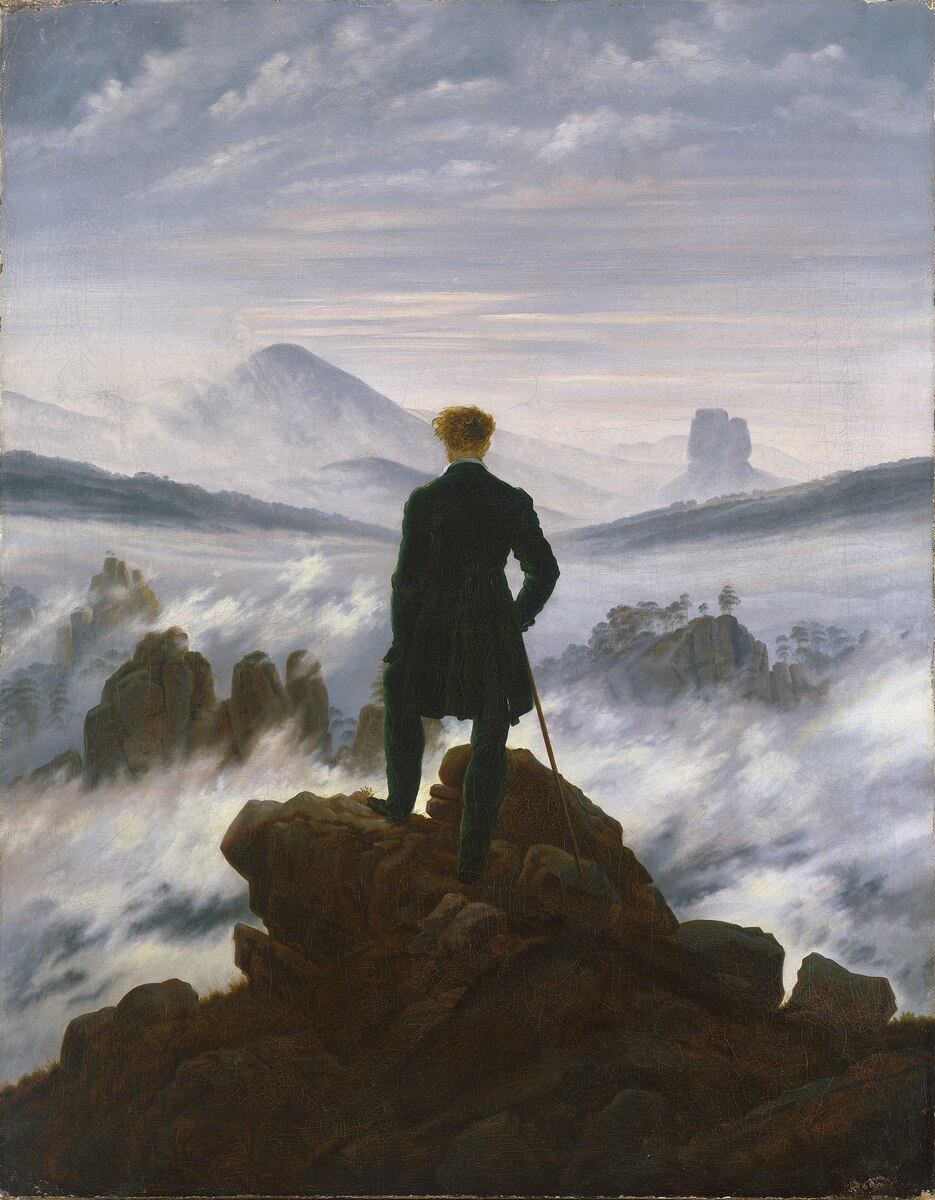
A hiker in dark clothing stands on rocky ground, near the middle of the picture, and we see him from behind. He faces away from us, looking down across a landscape of fog. That back view is the heart of Caspar David Friedrich's painting, made around 1818. The supplied record describes the figure looking down on an almost impenetrable sea of fog, surrounded by rocks.
The fog fills the space below and beyond him, so the ground he stands on reads as an elevated vantage point. We are placed behind the figure rather than in front of him. The supplied description also calls the sea of fog almost impenetrable. Its density is what makes the land below hard to read, and it shapes how we experience the scene.
Friedrich painted the work around 1818, and the supplied record identifies it as oil on canvas. The Hamburger Kunsthalle holds it in its collection. Details of making and custody help place the object, but the subject itself asks us to look at the figure and the landscape together.
The supplied source reads the scene as a metaphor for life as an ominous journey into the unknown. That reading depends on the figure's position at the edge of the visible world. He looks outward while we look with him, and the fog blocks any clear view ahead. So the landscape becomes a way of picturing uncertainty rather than a simple scenic prospect.
The supplied record reports a tradition that Friedrich himself hiked in the Saxon Switzerland and presumably realized the impression of nature in the picture. This is a reported account, not an established fact about the making of this canvas. It is offered as a likely background to the image, and it should be heard with that qualification intact.
Back at the centre, the hiker stays fixed on the rocks while the fog spreads out beyond him. The painting gives us his viewpoint and his blocked horizon at once. That is what the supplied interpretation makes clear: this is not a portrait of a place but an image of a person facing the unknown, with the fog doing the work of uncertainty.
The story and its sources
Historical claims are linked to the records below. Close looking and interpretation are identified in the passage notes.
- Passage 1Close lookingWikimedia Commons: Wanderer above the Sea of Fog
- Passage 2Close lookingWikimedia Commons: Wanderer above the Sea of Fog
- Passage 3Documented historyWikimedia Commons: Wanderer above the Sea of Fog
- Passage 4InterpretationWikimedia Commons: Wanderer above the Sea of Fog
- Passage 5Reported traditionWikimedia Commons: Wanderer above the Sea of Fog
- Passage 6InterpretationWikimedia Commons: Wanderer above the Sea of Fog
Details to notice
About 2 minutes to readDistant Hazy Peak
The softened conical mountain at the upper left, dissolved by atmosphere; it measures the depth of the fog sea and the vast scale of the view beyond the wanderer.
Pinnacles and Pines in Fog
Rock towers with a few wind-bent pines rising out of the white mist on the right, evidence of how the fog hides the ground and isolates the summit in empty air.
Walking Cane
The thin cane gripped in the figure's right hand and planted on the rock below, the only prop in the painting and a sign of the climb and of precarious balance at the summit edge.
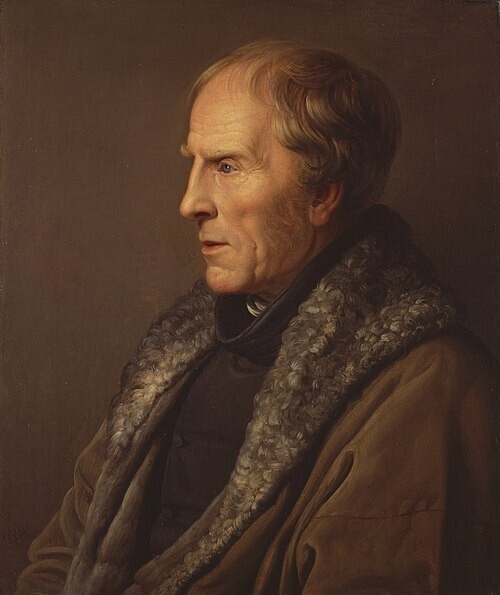
Artist portrait Image credit
Johann Karl Bähr. Image source · Public domain
About the artist
Caspar David Friedrich
1774 to 1840
Caspar David Friedrich was a German Romantic landscape painter (1774–1840). Their work is associated with German Romanticism. Their recorded places of work include Dresden; Greifswald; Copenhagen; Neubrandenburg; Loschwitz; Vienna.
- Born
- 1774
- Died
- 1840
- Nationality
- Kingdom of Prussia; Sweden
- Birthplace
- Greifswald
- Died in
- Dresden
Biography sources
The research & record
Study the work.
Follow the evidence.
Find catalogue details, historical context, technical research and the literature behind this artwork.
The artwork record
Research catalogue
Catalogue information and detailed research, with references that link to the bibliography.
Updated .
Identity and catalogue
Link- Title
- Wanderer above the Sea of Fog
- Artist or attribution
- Caspar David Friedrich
- Object date
- circa 1818
- Medium and support
- oil on canvas(Wikimedia Commons: Wanderer above the Sea of Fog, n.d.)
- Dimensions
- 67 cm high, 74.8 cm wide
- Current collection or location
- Hamburger Kunsthalle, Hamburg, Germany(Wikimedia Commons: Wanderer above the Sea of Fog, n.d.)
- Movement or period
- Romanticism
- Country or culture
- Germany
- Depicted subject
- A solitary hiker stands as a back figure in the centre of the composition, looking down on an almost impenetrable sea of fog in the midst of a rocky landscape.
- Title variants
- Wanderer über dem Nebelmeer; The Wanderer above the Sea of Fog; Le Voyageur contemplant une mer de nuages; El caminante sobre el mar de nubes
- Accession number
- HK-5161
- Support
- canvas
Read valuation records and their limitations
Catalogue data and custody
The object is catalogued as "Wanderer above the Sea of Fog," attributed to Caspar David Friedrich and dated to around 1818. The supplied record gives that title and that approximate date as its basic identifying information; the circumlocution "around" is part of the catalogue entry as transmitted, so the object date should be understood as an approximate one rather than a fixed day or month. The same record links the painting to the Hamburger Kunsthalle, whose collection it now belongs to, with accession number HK-5161. Before that, in 1970, the painting entered the collection of Stiftung Hamburger Kunstsammlungen, a separate corporate holder whose relationship to the Kunsthalle is recorded only as the point of entry into that collection. These are the minimum facts a catalogue entry needs: title, author, approximate date, current collection, accession identifier and the most recent change of holding.(Wikimedia Commons: Wanderer above the Sea of Fog, n.d., File metadata; Object history)
Physically, the record describes the work as oil on canvas, approximately 67 cm high and 74.8 cm wide. The two measurements sit close enough that the picture is nearly square, and the medium tells us that the visible surface is paint on a woven support rather than panel or paper. No inscriptions, signatures, dates written on the canvas, or alternate titles are recorded in the supplied material, and none should be supplied by inference. The precision of the width figure against the rounded height figure is a feature of the source as given.(Wikimedia Commons: Wanderer above the Sea of Fog, n.d., File metadata)
The object date around 1818 and the catalogue dates attached to the record are different orders of fact. The 1818 date belongs to the making of the painting and is offered approximately. The 1970 entry into Stiftung Hamburger Kunstsammlungen belongs to the object's later custody, and 2018 belongs to its exhibition history: the painting was shown in "Wanderlust. From Caspar David Friedrich to Auguste Renoir" at the Alte Nationalgalerie from 10 May 2018 to 16 September 2018. The inclusion of the work in a survey framed by Friedrich and Renoir places it within a longer narrative of landscape and travel imagery rather than as an isolated German Romantic curiosity.(Wikimedia Commons: Wanderer above the Sea of Fog, n.d., File metadata; Object history)
The painting is titled 'Wanderer above the Sea of Fog' and was created by Caspar David Friedrich around 1818.(Wikimedia Commons: Wanderer above the Sea of Fog, n.d.)
Subject and iconography
LinkRead valuation records and their limitations
The figure and the fog
Visual observation
The composition is organised around a single figure seen from behind. The hiker stands as a back figure in the centre of the picture, and the supplied description places him looking down on an almost impenetrable sea of fog set within a rocky landscape. These two observations establish the painting's basic structure: a vertical, cloaked body occupying the middle of the field, a rocky eminence beneath and around him, and a dense, low-lying fog that fills the space below and beyond. Because the figure is shown from the rear, his face and the direction of his gaze are withheld; the viewer is positioned behind him, sharing his elevated vantage point rather than meeting his eyes. The fog is described as almost impenetrable, which means the land below and ahead is hard to read, and that opacity is itself a compositional element rather than incidental weather.(Wikimedia Commons: Wanderer above the Sea of Fog, n.d., Description)
Reading the scene
Interpretation
The supplied source reads the scene as a metaphor for life as an ominous journey into the unknown. This is an attributed interpretation rather than a documented intention of the artist, and it depends on the visual structure already described: the figure at the edge of the visible world, looking outward while the fog blocks any clear view ahead. The viewer looks with him, and the density of the fog converts the landscape into a picture of uncertainty rather than a simple scenic prospect. The same source also reports a tradition that Friedrich himself undertook a hike in the Saxon Switzerland and presumably realised the impression of nature in the picture. That is a reported account, offered as a likely background to the image, and it should not be promoted into an established fact about the making of this canvas. The metaphorical reading and the hiking tradition are both scholarly or editorial attributions in the record, and they carry that status here.(Wikimedia Commons: Wanderer above the Sea of Fog, n.d., Description)
Visual observation
The hiker stands as a back figure in the centre of the composition.(Wikimedia Commons: Wanderer above the Sea of Fog, n.d.)
The figure looks down on an almost impenetrable sea of fog in the midst of a rocky landscape.(Wikimedia Commons: Wanderer above the Sea of Fog, n.d.)
Materials and technique
LinkRead valuation records and their limitations
Support, medium and format
The technical record for this painting is narrow but precise: the supplied documentation describes it as executed in oil on canvas, measuring approximately 67 cm in height and 74.8 cm in width. These are the only material facts the available evidence establishes. The support and medium are stated as documented data rather than inferred from appearance, so they can be relied on as the physical basis for everything else the picture does. The dimensions, given to the nearest tenth of a centimetre in width and as approximate in height, describe a canvas that is slightly wider than it is tall, a format that accommodates the lateral spread of the landscape and the centred placement of the figure within it.(Wikimedia Commons: Wanderer above the Sea of Fog, n.d., File metadata)
Visual structure and its material basis
Interpretation
Read together, the documented medium and the observed composition describe two different kinds of knowledge about the same object. The oil-on-canvas record establishes the physical class of the work and its scale, which is what a collections record can assert with confidence. The observation of the central back figure and the fog-filled rocky landscape establishes the visual structure the medium carries: a single figure set against a deep, obscuring field. The fog is characterised as almost impenetrable, which in pictorial terms means the paint is used to build a dense, hard-to-read expanse below and beyond the standing figure. That density is visible in the image, but the evidence does not specify the pigments or layering that produce it, so the effect can be described while its recipe cannot.(Wikimedia Commons: Wanderer above the Sea of Fog, n.d., File metadata; Description)
The painting is executed in oil on canvas, with dimensions of approximately 67 cm in height and 74.8 cm in width.(Wikimedia Commons: Wanderer above the Sea of Fog, n.d.)
Provenance and ownership
LinkRead valuation records and their limitations
Documented Custody and the Unrecorded Interval
The documented provenance of Caspar David Friedrich's painting, known in the supplied record as 'Wanderer above the Sea of Fog' and dated to around 1818, contains only one firmly dated transfer of custody: in 1970 the painting entered the collection of Stiftung Hamburger Kunstsammlungen. The same source states that the work is part of the collection of the Hamburger Kunsthalle, with accession number HK-5161. The record does not document any owners, sales, gifts or transfers before 1970, nor does it specify the terms or immediate circumstances of the 1970 entry beyond the institution involved. The period between the painting's creation around 1818 and its entry into the Stiftung in 1970 is therefore an unrecorded interval in the supplied evidence, not a proven continuity of ownership by any party.(Wikimedia Commons: Wanderer above the Sea of Fog, n.d., Object history)
Interpretation
The relationship between the two institutional names in the record requires care. The source places the painting in the collection of the Hamburger Kunsthalle and assigns it accession number HK-5161, while separately dating its entry into Stiftung Hamburger Kunstsammlungen to 1970. The evidence does not state whether the Stiftung and the Kunsthalle are to be understood as the same holding for provenance purposes, whether the Stiftung holds the work on behalf of or in association with the Kunsthalle, or how the accession number relates in time to the 1970 entry. These are open questions in the supplied units rather than settled facts, and the two identifiers should be retained together without being collapsed into a single unqualified ownership statement.(Wikimedia Commons: Wanderer above the Sea of Fog, n.d., Object history)
Exhibition After 1970
Later documented activity in the object's institutional life is exhibitionary rather than proprietary. The painting was shown in 'Wanderlust. From Caspar David Friedrich to Auguste Renoir' at the Alte Nationalgalerie from 10 May 2018 to 16 September 2018. This loan exhibition confirms that the work was available for display in Berlin in 2018, but the supplied source does not record a change of ownership in connection with it. It should be treated as evidence of public presentation and institutional circulation after 1970, not as a transfer of title.(Wikimedia Commons: Wanderer above the Sea of Fog, n.d., Exhibition history; Object history)
In 1970 the painting entered the collection of Stiftung Hamburger Kunstsammlungen.(Wikimedia Commons: Wanderer above the Sea of Fog, n.d.)
Provenance timeline
- 1970
The painting entered the collection of Stiftung Hamburger Kunstsammlungen.(Wikimedia Commons: Wanderer above the Sea of Fog, n.d., Object history)
Exhibition history
LinkRead valuation records and their limitations
The painting was exhibited in 'Wanderlust. From Caspar David Friedrich to Auguste Renoir' at the Alte Nationalgalerie from 10 May 2018 to 16 September 2018.(Wikimedia Commons: Wanderer above the Sea of Fog, n.d.)
Reception and literature
LinkRead valuation records and their limitations
Institutional Display and Cross-National Framing
The documented later life of Caspar David Friedrich's painting of the back-turned hiker can be anchored in a specific institutional event: the work was shown in the exhibition 'Wanderlust. From Caspar David Friedrich to Auguste Renoir' at the Alte Nationalgalerie, Berlin, between 10 May 2018 and 16 September 2018. The exhibition title places the painting within a narrative that begins with Friedrich and extends into French painting of the later nineteenth century, so the loan positioned the canvas not as an isolated German masterpiece but as a point of departure within a longer European genealogy of landscape and wanderer imagery. That framing is itself a stage of reception: it shows curators and institutions using the painting to establish lineage and continuity across national schools, and it makes the object legible to a twenty-first-century public through a comparative, cross-border rubric rather than through biography alone.(Wikimedia Commons: Wanderer above the Sea of Fog, n.d., Exhibition history)
Interpretation
The 2018 exhibition should be read alongside the painting's custodial history as supplied: in 1970 it entered the collection of Stiftung Hamburger Kunstsammlungen. The gap between that 1970 transfer and the 2018 Berlin display is not documented in the supplied evidence beyond those two dates, so no continuous exhibition record or acquisition chronology can be asserted here. What the evidence does establish is that the painting's public accessibility has been mediated by a collecting institution whose holdings made loans possible, and that the meaning of the work for audiences has been shaped by decisions to place it in themed, comparative exhibitions. This is a modest but concrete instance of how an object's cultural role is produced not only by its creation but by the institutional choices that circulate it.(Wikimedia Commons: Wanderer above the Sea of Fog, n.d., Object history; Exhibition history)
Interpretations and debates
LinkRead valuation records and their limitations
The Attributed Reading and Its Visual Basis
Interpretation
The supplied source describes the scene as a metaphor for life as an ominous journey into the unknown. Because that formulation is attributed to the source rather than to Caspar David Friedrich, it belongs in the record as a documented reading of the picture, not as evidence of what the painter privately intended. The reading is built from features the source also records: the hiker stands as a back figure in the centre of the composition, and the figure looks down on an almost impenetrable sea of fog in the midst of a rocky landscape. The back view keeps the figure's face and thoughts unavailable, while the fog removes any clear destination ahead. The source's interpretation draws its force from that combination, so the metaphor is best understood as an account the source offers for the visible arrangement, one that depends on how the figure and the landscape are placed in relation to each other and to the viewer.(Wikimedia Commons: Wanderer above the Sea of Fog, n.d., Description)
The source also reports a tradition that the artist himself undertook a hike in the Saxon Switzerland and presumably realised the impression of nature in the picture. The wording of the unit matters: this is a reported account, hedged by the source with presumably, and it concerns the background to the image rather than a documented step in the making of this specific canvas. It should not be promoted into an established fact about the painting's creation. What the unit does establish, and all that it establishes, is that the supplied record presents the hike as a likely context for the image while leaving the connection between the hike and this canvas unproven. The metaphorical reading described by the same source and the hike tradition thus rest on different footing, one an interpretation of visible form and the other a reported, qualified background account, and neither should be exchanged for the other.(Wikimedia Commons: Wanderer above the Sea of Fog, n.d., Description)
Reported traditions and disputed accounts
Reported tradition
The supplied record for Caspar David Friedrich's "Wanderer above the Sea of Fog," painted around 1818 in oil on canvas and held by the Hamburger Kunsthalle, carries a reported tradition alongside its descriptive and interpretive content: that the artist himself undertook a hike in the Saxon Switzerland and presumably realized the impression of nature in the picture. This is recorded as a reported account, offered as a likely background to the image rather than as an established fact about the making of this canvas. It should remain attached to that qualification whenever it is repeated, since nothing in the supplied evidence documents a specific walking route, a date for such a hike, or a direct link between any excursion and the composition.(Wikimedia Commons: Wanderer above the Sea of Fog, n.d., Notes)
Interpretation
The evidentiary status of that tradition matters because of how it functions in accounts of the painting. It is a claim about the artist's experience of landscape, offered as a plausible origin for the natural impression the picture conveys, and it sits among other supplied readings of the work, including the description of the scene as a metaphor for life as an ominous journey into the unknown. The biography of the hike and the interpretation of the fog as uncertainty are both interpretive framings, but they are not the same kind of claim: the first concerns circumstances of making that the record explicitly marks as reported, while the second concerns meaning attributed within the supplied description. Keeping the two distinct prevents a story about Friedrich walking in the hills from being absorbed into the visual evidence of the canvas as though the painting confirmed it.(Wikimedia Commons: Wanderer above the Sea of Fog, n.d., Notes)
The supplied source describes the scene as a metaphor for life as an ominous journey into the unknown.(Wikimedia Commons: Wanderer above the Sea of Fog, n.d.)
Reported tradition
The artist himself undertook a hike in the Saxon Switzerland and presumably realized the impression of nature in the picture.(Wikimedia Commons: Wanderer above the Sea of Fog, n.d.)
Collection and display
LinkRead valuation records and their limitations
Institutional custody
The Wanderer above the Sea of Fog, made by Caspar David Friedrich around 1818, is held in the collection of the Hamburger Kunsthalle under accession number HK-5161, and the supplied record also notes that in 1970 the painting entered the collection of Stiftung Hamburger Kunstsammlungen. Both facts concern the object's custody, but they describe different layers of that custody: the accession number identifies the work within the Kunsthalle's holdings, while the 1970 entry into the Stiftung Hamburger Kunstsammlungen records the foundation's acquisition of it. The supplied account does not state where the painting was before 1970 or whether the foundation's acquisition coincided with its transfer to the museum. Those gaps matter for a full provenance, and they remain unfilled in the sources available here. What the record does establish is that the work is documented as an oil on canvas of approximately 67 cm in height and 74.8 cm in width, dimensions that frame it as a relatively compact picture despite the vastness of the landscape it depicts.(Wikimedia Commons: Wanderer above the Sea of Fog, n.d., File metadata)
The painting's public life includes its inclusion in the exhibition "Wanderlust. From Caspar David Friedrich to Auguste Renoir" at the Alte Nationalgalerie, held from 10 May 2018 to 16 September 2018. The placement of this work in a show spanning Friedrich to Renoir indicates that the supplied record treats the painting as a point of departure for a longer narrative of landscape and open-air themes across the nineteenth century, though the evidence does not detail the argument of the exhibition or the specific role this canvas played within it. Together, the accession record and the exhibition history show an object that has moved between foundation custody, museum collection and loan display, and these tracks are the documented remnants of how it has been cared for and shown.(Wikimedia Commons: Wanderer above the Sea of Fog, n.d., File metadata)
The painting is part of the collection of the Hamburger Kunsthalle, with accession number HK-5161.(Wikimedia Commons: Wanderer above the Sea of Fog, n.d.)
Documented values and qualified estimates
LinkRead valuation records and their limitations
The object and its recorded particulars
Interpretation
The record for Caspar David Friedrich's painting, known in English as Wanderer above the Sea of Fog, fixes the object in a small set of verifiable particulars that everything else in this account depends on. According to the supplied Wikimedia Commons file page, the work was made around 1818, is oil on canvas, measures 67 by 74.8 cm, and is held by the Hamburger Kunsthalle under accession number HK-5161. That combination of date, medium, support, dimensions and accession identifies the painting precisely enough for any later statement about value, display or interpretation to be attached to one object rather than to the wider body of Friedrich's work. The same source records two institutional facts whose significance is easy to overlook: in 1970 the painting entered the collection of Stiftung Hamburger Kunstsammlungen, and it was shown in the exhibition Wanderlust. From Caspar David Friedrich to Auguste Renoir at the Alte Nationalgalerie from 10 May to 16 September 2018. Custody and exhibition history place the canvas within a collecting institution and a public display tradition, not solely within an artist's biography.(Wikimedia Commons: Wanderer above the Sea of Fog, n.d.)
Recorded values
Only one value figure appears in the supplied evidence, and it is a working instrument rather than a market fact. The calculated working insurance estimate gives a range of US$50M to US$200M, recorded as a working calculation generated on 16 October 2026. The methodology described is explicit about its basis: it was produced as a conservative working insurance-scheduling range for manual review, because no official insurance value, appraisal or comparable sale was supplied with the material. The calculation takes the confirmed identification of the work, a Caspar David Friedrich oil on canvas of circa 1818, 67 by 74.8 cm, held by the Hamburger Kunsthalle as HK-5161 and described as among the most prominent icons of German Romanticism, and benchmarks it against the upper market tier for museum-quality Old Master and 19th-century paintings of this stature. The band was then widened and deliberately held below the highest speculative figures in order to keep it conservative.(Wikimedia Commons: Wanderer above the Sea of Fog, n.d.)
The two ends of that range are constructed differently, and the difference matters for anyone reading the figure. The lower bound is described as reflecting a cautious institutional-schedule benchmark, while the upper bound is described as reflecting rarity, canonical status, and the practical cost to replace or indemnify a unique masterpiece of this prominence. The calculation therefore does not represent a single observed price translated into a band; it combines an institutional reference point at the bottom with considerations of uniqueness and indemnity at the top. The accompanying qualifications are equally specific and should travel with the numbers: the range is model-generated, intended for manual review only, and is not an official insurance value, appraisal, auction result or sale price. It is stated not to be based on comparable sales data, private insurance records or any public statement of value, and actual insurance scheduling, indemnity or loan valuation is said to require review by a qualified appraiser or underwriter.(Wikimedia Commons: Wanderer above the Sea of Fog, n.d.)
Read together, the object record and the value calculation describe two different kinds of authority. The date, medium, dimensions, collection and accession number come from the supplied institutional and encyclopedic record of the painting itself. The monetary band comes from a model-generated working document that is explicit that its purpose is scheduling for manual review and that it stands outside appraisal practice. The calculation leans on the same identifying facts, that the work is a confirmed Friedrich oil on canvas of circa 1818 held by the Hamburger Kunsthalle, and on a qualitative characterization of the painting as among the most prominent icons of German Romanticism. The characterisation is interpretive in nature, and in the value document it functions as one input among others rather than as an established finding. In a research account, the range is best treated as a documented proposal about value, dated and methodologically described, while the painting's physical particulars remain the stable factual base.(Wikimedia Commons: Wanderer above the Sea of Fog, n.d.)
Working estimate
Calculated working insurance estimate, not a sale price: Estimated value: US$50M to US$200M Recorded date: Working calculation, generated 2026-10-16. Methodology: Calculated as a conservative working insurance-scheduling range for manual review. The work is a confirmed Caspar David Friedrich oil on canvas of circa 1818, 67 by 74.8 cm, held by the Hamburger Kunsthalle (accession HK-5161), and is among the most prominent icons of German Romanticism. Because no official insurance value, appraisal, or comparable sale was supplied, the range is benchmarked against the upper market tier for museum-quality Old Master and 19th-century paintings of this stature, then widened and held below the highest speculative figures to keep the band conservative. The lower bound reflects a cautious institutional-schedule benchmark; the upper bound reflects rarity, canonical status, and the practical cost to replace or indemnify a unique masterpiece of this prominence. This is not a market valuation and should be reviewed by a qualified fine-art insurance specialist before use. Qualification: This is a model-generated working insurance range for manual review only. It is not an official insurance value, appraisal, auction result, or sale price. It is not based on comparable sales data, private insurance records, or any public statement of value. Actual insurance scheduling, indemnity, or loan valuation requires review by a qualified appraiser or underwriter.(Wikimedia Commons: Wanderer above the Sea of Fog, n.d.)
Further reading
Books for a closer look
Paid links. As an Amazon Associate I earn from qualifying purchases.

Open Library Caspar David Friedrich and the Subject of Landscape
Yale University Press
Joseph Leo Koerner's study of Friedrich and the subject of landscape is recorded under subjects including landscape in art, Romanticism in art, and criticism and interpretation of Friedrich. It directly addresses the artist and the landscape/back-figure tradition that the documented evidence describes for this painting.
ISBN 9780300065473

Open Library Caspar David Friedrich
G. Braziller
Boersch-Supan's monograph is recorded under subjects covering Friedrich, Romanticism in art, landscapes in art, and criticism and interpretation, making it a documented scholarly source on the artist and the Romantic landscape themes present in this composition.
ISBN 0807607479
Bibliography
Sources and further reading
References are arranged by author or organisation, with links to the original publications. Where no publication date is recorded, n.d. means no date.
Source notes updated .
No recorded sources match these filters. Reset the filters to see the full bibliography.
- 03
Book
Caspar David Friedrich. Rizzoli; Rizzoli International Publications, Incorporated.
This catalogue record lists subjects including Friedrich, Romanticism in art, themes and motives, exhibitions, and notably the Hamburger Kunsthalle, the documented holder of this painting. An object-adjacent exhibition catalogue tied to that collection is relevant to the work and its context.
- ISBN
- 0847800334
Citation text
- 04
Book
Caspar David Friedrich. G. Braziller.
Boersch-Supan's monograph is recorded under subjects covering Friedrich, Romanticism in art, landscapes in art, and criticism and interpretation, making it a documented scholarly source on the artist and the Romantic landscape themes present in this composition.
- ISBN
- 0807607479
Citation text
- 02
Book
Caspar David Friedrich and the Subject of Landscape. Yale University Press.
Joseph Leo Koerner's study of Friedrich and the subject of landscape is recorded under subjects including landscape in art, Romanticism in art, and criticism and interpretation of Friedrich. It directly addresses the artist and the landscape/back-figure tradition that the documented evidence describes for this painting.
- ISBN
- 9780300065473
Citation text
- 01
Secondary · About this artwork
Wikimedia Commons: Wanderer above the Sea of Fog (n.d.). Wikimedia Commons: Wanderer above the Sea of Fog. Wikimedia Commons.
Wikimedia Commons file page providing the artwork title, artist, date, medium, dimensions, collection, accession number, object history and exhibition history for this exact painting.
Citation text
Art to live with
Bring this painting
home.
A piece of the archive, made yours. Explore Wanderer above the Sea of Fog in a size and finish that fits your space.
Your text and annotations appear on these editions. Adding to cart saves that design for printing.
Combine this painting with your favourites01 / Find your edition
Made for you
Suggested from your location. Change it if you're sending elsewhere or using a VPN. Prices and delivery are shown in GBP.
19 products
Choose an edition to make it yours
6 × 8 in · Printed cover · 118 lined pages
6 × 8 in · Printed cover · 118 lined pages
6 × 8 in · Printed cover · 118 lined pages
Notebook
GBP 11.91
Delivery GBP 5.30 / Total GBP 17.21
A 6 × 8 inch spiral notebook with 118 ruled pages (59 sheets), a printed front cover, dark grey back cover and metal spiral binding.
Fit and fill keep the painting’s proportions. Stretch changes them.
Move and zoom the painting on your notebook.
Made to order with your design
Made to order
US delivery only
27.9 × 35.6 cm / 11 × 14 in · Standard
27.9 × 35.6 cm / 11 × 14 in · Standard

11 × 14 in / 27.9 × 35.6 cm · Standard

11 × 14 in / 27.9 × 35.6 cm · Standard

11 × 14 in / 27.9 × 35.6 cm · Standard

11 × 14 in / 27.9 × 35.6 cm · Standard

11 × 14 in / 27.9 × 35.6 cm · Standard
Metal art sign
GBP 28.43
Delivery GBP 17.71 / Total GBP 46.14
A printed aluminium sign with rounded corners and mounting holes.
Fit and fill keep the painting’s proportions. Stretch changes them.
Move and zoom the painting on your metal art sign.
Made to order with your design
Printed aluminium · mounting holes included
US delivery only
iPhone 12 Mini ? Glossy ? back view
iPhone 12 Mini · Glossy

iPhone 12 Mini ? Glossy ? back view

iPhone 12 Mini ? Glossy ? back view

iPhone 12 Mini ? Glossy ? back view
Tough phone case
GBP 16.40
Delivery GBP 4.25 / Total GBP 20.65
A two-layer phone case with a printed polycarbonate shell and a shock-absorbing inner liner.
Two layers with a shock-absorbing TPU liner
Case & print details
- Device
- Apple · iPhone 12 Mini
- Material
- Polycarbonate shell with a TPU inner liner
- Artwork
- Outer back and wrapped edges from one template
- Finish
- Glossy
- Version
- Standard version
- Printing
- Dye sublimation
- Print file
- 1,122 × 1,831 px · 95 × 155 mm · PNG · 300 dpi recommended
Rear outline and camera openings follow this variant's Printify template. Case depth and small hardware remain illustrative.
Supplier product detailsFit and fill keep the painting’s proportions. Stretch changes them.
Move and zoom the painting on your tough phone case.
Made to order with your design
Made to order
US delivery only
20.3 × 25.4 cm / 8 × 10 in · White
20.3 × 25.4 cm / 8 × 10 in · White

8 × 10 in / 20.3 × 25.4 cm · White

8 × 10 in / 20.3 × 25.4 cm · White

8 × 10 in / 20.3 × 25.4 cm · White

8 × 10 in / 20.3 × 25.4 cm · White
Framed art print
GBP 34.16
- 1 framed print
- GBP 34.16
- Delivery to United States
- GBP 9.64
- Total
- GBP 43.80
A ready-to-hang wooden frame with a clear Perspex cover and a semi-gloss printed insert.
Delivery is quoted for all selected copies together.
Fit and fill keep the painting’s proportions. Stretch changes them.
Move and zoom the painting on your framed art print.
Made to order with your design
Wooden frame & protective clear front included
US delivery only
38.1 × 40.6 cm / 15 × 16 in · Natural
38.1 × 40.6 cm / 15 × 16 in · Natural

15 × 16 in / 38.1 × 40.6 cm · Natural

15 × 16 in / 38.1 × 40.6 cm · Natural

15 × 16 in / 38.1 × 40.6 cm · Natural

15 × 16 in / 38.1 × 40.6 cm · Natural

15 × 16 in / 38.1 × 40.6 cm · Natural
Canvas tote bag
GBP 14.25
Delivery GBP 4.33 / Total GBP 18.58
A sturdy cotton canvas tote with reinforced handles and artwork on the front panel.
Fit and fill keep the painting’s proportions. Stretch changes them.
Move and zoom the painting on your canvas tote bag.
Made to order with your design
Front print · reinforced cotton handles
US delivery only
22.9 × 20.3 cm / 9 × 8 in · Standard
22.9 × 20.3 cm / 9 × 8 in · Standard

9 × 8 in / 22.9 × 20.3 cm · Standard

9 × 8 in / 22.9 × 20.3 cm · Standard

9 × 8 in / 22.9 × 20.3 cm · Standard

9 × 8 in / 22.9 × 20.3 cm · Standard
Mouse mat
GBP 7.29
Delivery GBP 4.82 / Total GBP 12.11
A rectangular fabric mouse mat with a rubber backing and rounded corners.
Fit and fill keep the painting’s proportions. Stretch changes them.
Move and zoom the painting on your mouse mat.
Made to order with your design
Made to order
US delivery only
See more13 more products
43.2 × 45.7 cm / 17 × 18 in · Artwork
43.2 × 45.7 cm / 17 × 18 in · Artwork

17 × 18 in / 43.2 × 45.7 cm · Artwork

17 × 18 in / 43.2 × 45.7 cm · Artwork

17 × 18 in / 43.2 × 45.7 cm · Artwork
Woven tote bag
GBP 46.87
Delivery GBP 5.88 / Total GBP 52.75
A woven tote with cotton webbing handles and the painting translated into a woven design.
Fit and fill keep the painting’s proportions. Stretch changes them.
Move and zoom the painting on your woven tote bag.
Made to order with your design
Made to order
US delivery only
35.6 × 45.7 cm / 14 × 18 in · Standard
35.6 × 45.7 cm / 14 × 18 in · Standard

14 × 18 in / 35.6 × 45.7 cm · Standard

14 × 18 in / 35.6 × 45.7 cm · Standard

14 × 18 in / 35.6 × 45.7 cm · Standard

14 × 18 in / 35.6 × 45.7 cm · Standard

14 × 18 in / 35.6 × 45.7 cm · Standard
Matte art print
GBP 14.87
Delivery GBP 7.22 / Total GBP 22.09
An unframed matte poster with archival inks, ready for a frame of your choice.
Fit and fill keep the painting’s proportions. Stretch changes them.
Move and zoom the painting on your matte art print.
Made to order with your design
Unframed · frame it your way
US delivery only
iPhone 12 Mini ? Standard ? back view
iPhone 12 Mini · Standard

iPhone 12 Mini ? Standard ? back view

iPhone 12 Mini ? Standard ? back view

iPhone 12 Mini ? Standard ? back view
Flexible phone case
GBP 15.62
Delivery GBP 4.25 / Total GBP 19.87
A flexible TPU phone case with a frosted finish, a printed back and precise port openings.
Flexible TPU with a frosted, matte finish
Case & print details
- Device
- Apple · iPhone 12 Mini
- Material
- Semi-transparent thermoplastic polyurethane (TPU)
- Artwork
- Back print; rim stays unprinted
- Finish
- Standard
- Version
- Standard version
- Printing
- Dye sublimation
- Print file
- 791 × 1,586 px · 67 × 134.3 mm · PNG · 300 dpi recommended
Rear outline and camera openings follow this variant's Printify template. Case depth and small hardware remain illustrative.
Supplier product detailsFit and fill keep the painting’s proportions. Stretch changes them.
Move and zoom the painting on your flexible phone case.
Made to order with your design
Made to order
S · Standard
S · Standard

S · Standard

S · Standard

S · Standard

S · Standard

S · Standard
Crew socks
GBP 10.66
Delivery GBP 4.43 / Total GBP 15.09
Crew-length polyester and spandex socks with a ribbed cuff, cushioned sole and sublimated artwork.
Fit and fill keep the painting’s proportions. Stretch changes them.
Move and zoom the painting on your crew socks.
Made to order with your design
One pair · design repeated on both socks
US delivery only
12" · Standard
12" · Standard

12" · Standard

12" · Standard

12" · Standard
Laptop sleeve
GBP 26.12
Delivery GBP 4.92 / Total GBP 31.04
A polyester laptop sleeve with a fleece lining, top zip, printed front and black reverse.
Fit and fill keep the painting’s proportions. Stretch changes them.
Move and zoom the painting on your laptop sleeve.
Made to order with your design
Made to order
US delivery only
11oz · 2 image repeats
11oz · White
11oz · 2 image repeats
Mug
GBP 7.36
Delivery GBP 6.17 / Total GBP 13.53
A glossy white ceramic mug with a C-shaped handle, available in 11oz and 15oz sizes.
repeat layout · choose single, double or a repeating pattern in Customise.
Repeat, fit, fill and position your artwork around the mug.
Made to order with your design
Made to order
iPhone 12 Mini ? Standard ? back view
iPhone 12 Mini · Standard

iPhone 12 Mini ? Standard ? back view

iPhone 12 Mini ? Standard ? back view

iPhone 12 Mini ? Standard ? back view

iPhone 12 Mini ? Standard ? back view

iPhone 12 Mini ? Standard ? back view
Biodegradable phone case
GBP 20.96
Delivery GBP 4.25 / Total GBP 25.21
A matte phone case made from plant polymers and bamboo fibre, with the artwork printed on the back.
Flexible plant-polymer shell with a matte finish
Case & print details
- Device
- Apple · iPhone 12 Mini
- Material
- PLA and PBAT polymers with bamboo fibre
- Artwork
- Back print; rim stays unprinted
- Finish
- Standard
- Version
- Standard version
- Printing
- Dye sublimation
- Print file
- 777 × 1,553 px · 65.8 × 131.5 mm · PNG · 300 dpi recommended
Rear outline and camera openings follow this variant's Printify template. Case depth and small hardware remain illustrative.
Supplier product detailsFit and fill keep the painting’s proportions. Stretch changes them.
Move and zoom the painting on your biodegradable phone case.
Made to order with your design
Made to order
27.9 × 35.6 cm / 11 × 14 in · Standard
27.9 × 35.6 cm / 11 × 14 in · Standard

11 × 14 in / 27.9 × 35.6 cm · Standard

11 × 14 in / 27.9 × 35.6 cm · Standard

11 × 14 in / 27.9 × 35.6 cm · Standard
Fine art poster
GBP 20.66
Delivery GBP 7.61 / Total GBP 28.27
A gallery paper print with a smooth art-paper surface. Choose a size that suits the painting.
Fit and fill keep the painting’s proportions. Stretch changes them.
Move and zoom the painting on your fine art poster.
Made to order with your design
Unframed · frame it your way
iPhone 12 Mini ? Standard ? back view
iPhone 12 Mini · Standard

iPhone 12 Mini ? Standard ? back view

iPhone 12 Mini ? Standard ? back view

iPhone 12 Mini ? Standard ? back view
Clear phone case
GBP 15.11
Delivery GBP 4.25 / Total GBP 19.36
A clear phone case with artwork on the back. Leave areas transparent to show the phone underneath.
Clear shell with shock-absorbing TPU sides
Case & print details
- Device
- Apple · iPhone 12 Mini
- Material
- Polycarbonate back and clear TPU sides
- Artwork
- Back print; clear sides stay unprinted
- Finish
- Standard
- Version
- Standard version
- Printing
- Dye sublimation
- Print file
- 732 × 1,527 px · 62 × 129.3 mm · PNG · 300 dpi recommended
Rear outline and camera openings follow this variant's Printify template. Case depth and small hardware remain illustrative.
Supplier product detailsFit and fill keep the painting’s proportions. Stretch changes them.
Move and zoom the painting on your clear phone case.
Made to order with your design
Made to order
15oz · 3 image repeats
15oz · Standard

15oz · 3 image repeats

15oz · 3 image repeats

15oz · 3 image repeats

15oz · 3 image repeats

15oz · 3 image repeats
Travel mug
GBP 32.00
Delivery GBP 5.68 / Total GBP 37.68
A stainless-steel travel mug with a black lid, a tapered base and a printed white exterior.
repeat layout · choose single, double or a repeating pattern in Customise.
Repeat, fit, fill and position your artwork around the mug.
Made to order with your design
Made to order
US delivery only
2.5 × 3.4 cm / 1 × 1.4 in · Glossy
2.5 × 3.4 cm / 1 × 1.4 in · Glossy

1 × 1.4 in / 2.5 × 3.4 cm · Glossy

1 × 1.4 in / 2.5 × 3.4 cm · Glossy

1 × 1.4 in / 2.5 × 3.4 cm · Glossy

1 × 1.4 in / 2.5 × 3.4 cm · Glossy
Photo keyring
GBP 10.19
Delivery GBP 5.39 / Total GBP 15.58
A rectangular zinc-alloy photo keyring with a glossy insert and a swivel split ring.
Fit and fill keep the painting’s proportions. Stretch changes them.
Move and zoom the painting on your photo keyring.
Made to order with your design
Photo insert · zinc frame & swivel ring
US delivery only
iPhone 15 Pro ? Glossy ? back view
iPhone 15 Pro · Glossy

iPhone 15 Pro ? Glossy ? back view

iPhone 15 Pro ? Glossy ? back view

iPhone 15 Pro ? Glossy ? back view

iPhone 15 Pro ? Glossy ? back view

iPhone 15 Pro ? Glossy ? back view
Slim phone case
GBP 16.37
Delivery GBP 5.79 / Total GBP 22.16
A slim printed phone shell with open ports and a lightweight profile.
Slim, lightweight polycarbonate shell
Case & print details
- Device
- Apple · iPhone 15 Pro
- Material
- Polycarbonate
- Artwork
- Outer back and wrapped edges from one template
- Finish
- Glossy
- Version
- Standard version
- Printing
- Dye sublimation
- Print file
- 1,278 × 1,971 px · 108.2 × 166.9 mm · PNG · 300 dpi recommended
Rear outline and camera openings follow this variant's Printify template. Case depth and small hardware remain illustrative.
Supplier product detailsFit and fill keep the painting’s proportions. Stretch changes them.
Move and zoom the painting on your slim phone case.
Made to order with your design
Made to order
US delivery only
36.6 × 30.7 cm / 14.4 × 12.1 in · Standard
36.6 × 30.7 cm / 14.4 × 12.1 in · Standard

14.4 × 12.1 in / 36.6 × 30.7 cm · Standard

14.4 × 12.1 in / 36.6 × 30.7 cm · Standard

14.4 × 12.1 in / 36.6 × 30.7 cm · Standard
Desk mat
GBP 15.29
Delivery GBP 7.13 / Total GBP 22.42
A smooth polyester desk mat with a natural rubber non-slip base and anti-fray edges, available in three sizes.
Fit and fill keep the painting’s proportions. Stretch changes them.
Move and zoom the painting on your desk mat.
Made to order with your design
Made to order
The 30 cm ruler is scaled alongside your selected print. Keep the painting’s proportions with a black background, or stretch it to fill. Frame width, material texture and screen colours are illustrative.
Keep exploring