The story About 4 minutes to read
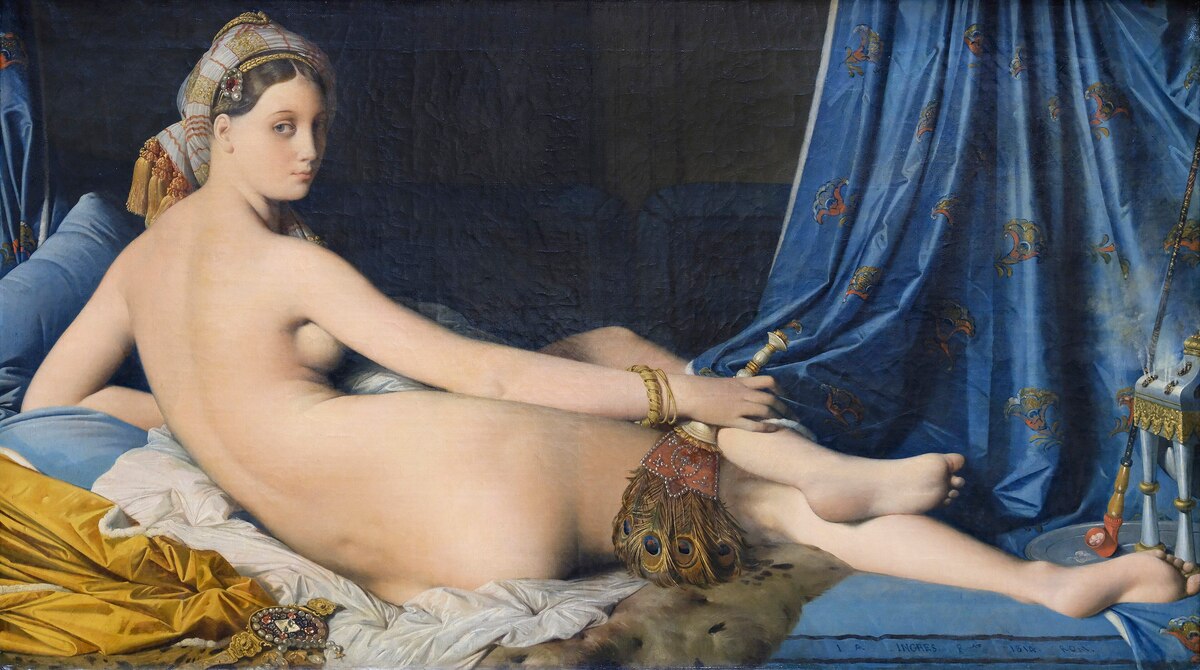
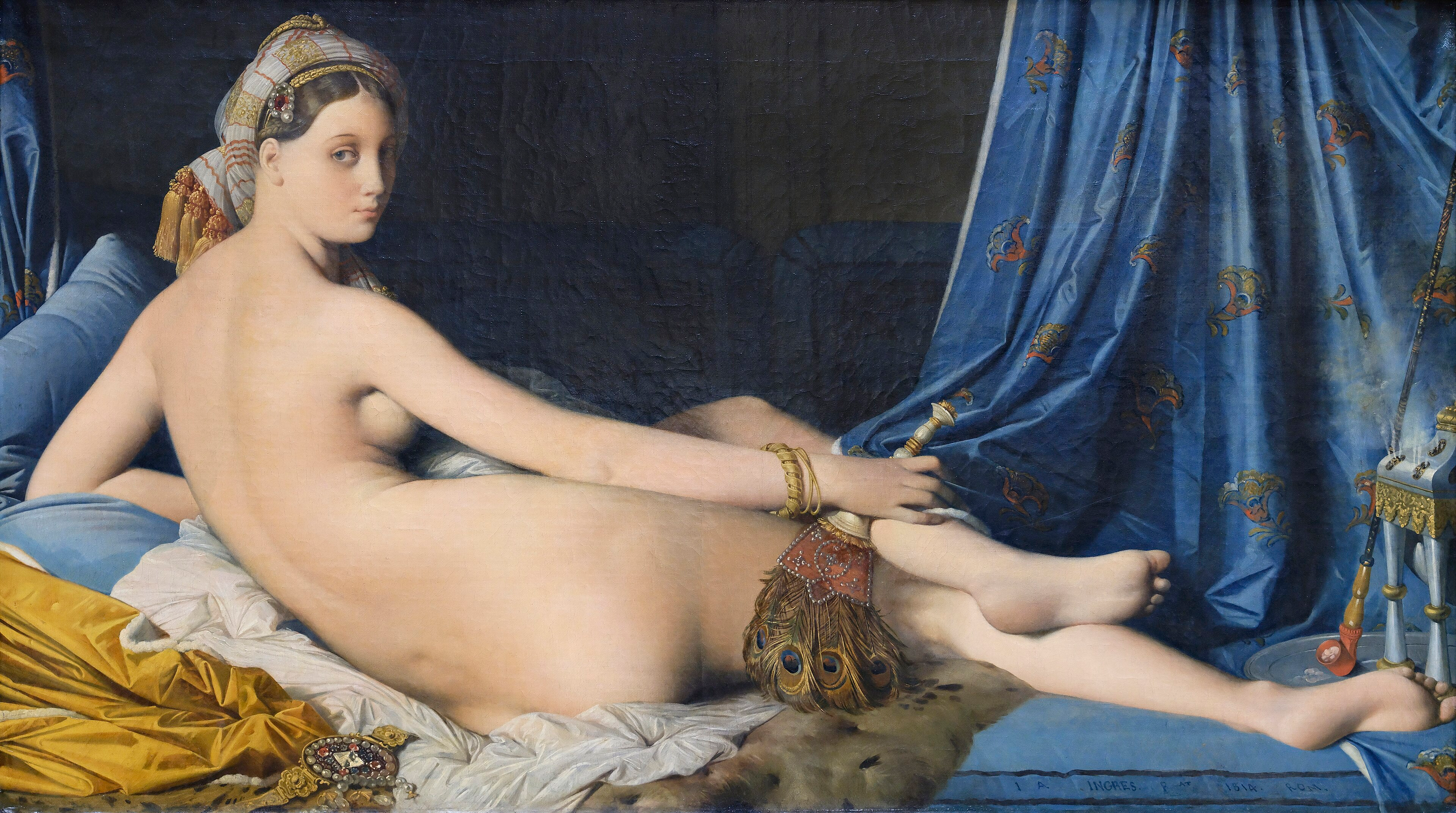
Here is a woman reclining on a divan. She is described as an odalisque, a woman in a harem, and she is the whole subject of the picture.
Her body is turned away from us, but her head turns back over her shoulder to look outward. She is painted as a nude, oil on canvas, made in France in 1814.
Follow the line of her body. It runs nearly the full width of the canvas, from the pale soles of her feet at one side to her face at the other.
Her back arches, her hip curves, and her elbow rests on the cushion. Across the far side hangs a curtain, and beneath her is the low divan.
The work is by Jean-Auguste-Dominique Ingres, and it is dated 1814. It belongs to a body of work associated with Romanticism, the period in which it was made.
Romantic painting often looked to distant or imagined places for its subjects. An odalisque belongs to that kind of imagining, a figure of a harem rather than a named person.
Notice the cool, even light. It falls across her skin without deep shadow, so the shapes stay smooth and clear.
Her head is turned at an angle to her body. That turn is what the picture is built around: the body faces one way, the gaze another.
The depicted person is an unidentified woman. She is not a portrait of someone we can name.
That matters, because it tells us the picture is about a type of figure rather than a particular sitter. The word odalisque does that work of naming a role, not a person.
So the painting sets up a small contradiction. Her body is presented as an object to be looked at, but her head turns back toward the viewer.
The sources identify the figure as an odalisque, a harem woman, and the painting places her in that role. They do not tell us what Ingres intended by the turn of the head, so we are left to read the effect for ourselves.
The painting was shown publicly twice: at the Salon of 1819 and at the Exposition Universelle of 1855.
That means audiences saw it both shortly after it was made and again decades later. What the sources establish is the subject and the showing; what we make of her glance is still ours to weigh.