The story About 5 minutes to read
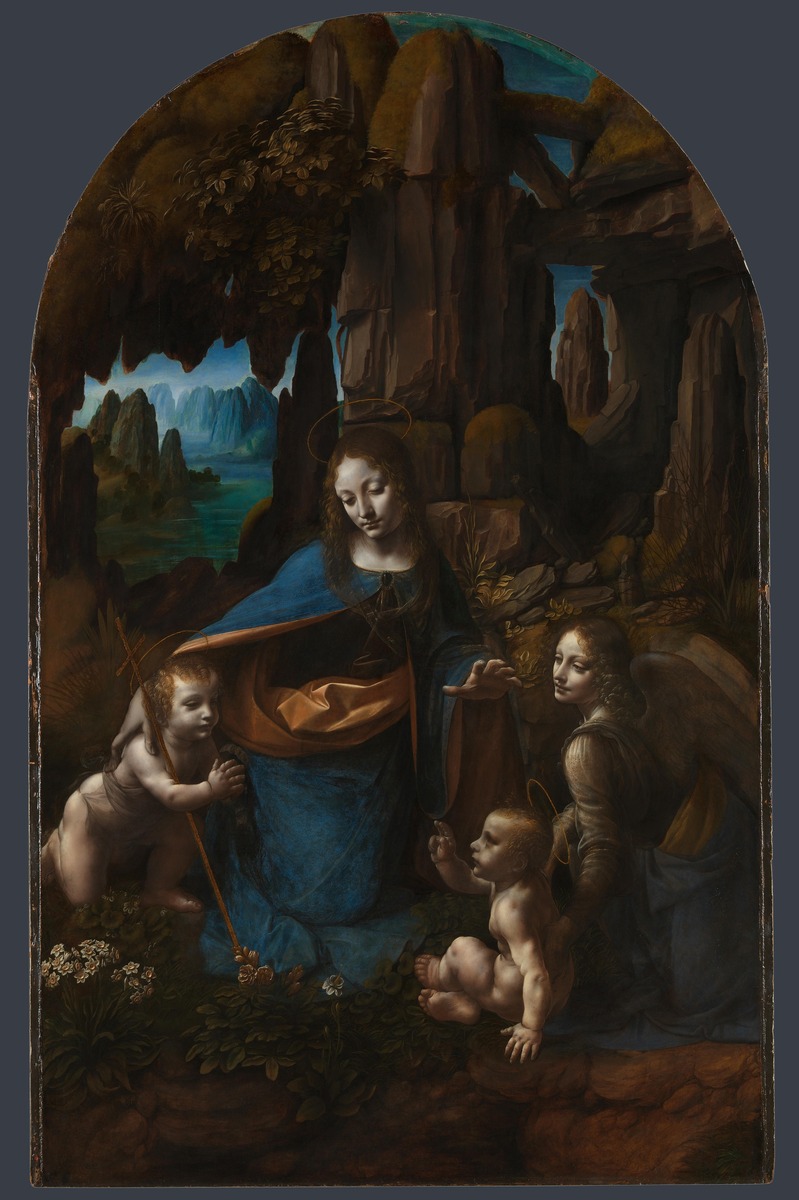
Here is a painting made for a Milanese church, an altarpiece panel showing the Virgin Mary with two children and an angel in a rocky cave.
The children are the infant Christ and the infant Saint John the Baptist, and all the figures kneel to adore Christ, who raises his hand to bless them.
Mary is the tallest figure, kneeling at the centre. Her right arm wraps around the shoulders of the toddler John, who kneels beside her on the left, and she turns her head down to look at him.
Her left arm reaches out palm down above the infant Christ on the right, a protective gesture that also directs our attention toward him.
Christ sits in profile with his legs crossed, his right hand raised in blessing toward John, his left arm down for balance.
Behind him an angel kneels to the right, one hand steadying Christ's back, eyes downcast, facing into the group.
The panel belonged to a large, elaborate altarpiece made for the church of San Francesco Grande in Milan. Its purpose was to celebrate the Immaculate Conception of the Virgin Mary.
Mary was understood by the Franciscans to have been free of sin and conceived by God before creation itself, a controversial idea that had emerged in the twelfth century.
The National Gallery suggests that this event before the dawn of time is hard to picture. That may be why Leonardo sets the figures in a primitive, almost hostile landscape.
The grotto is overhung with rocks and thick vegetation, and beyond it lie a distant lake and blue hills. The place feels older than any garden.
A shaft of light enters from the top left. It moulds the figures so they seem to glow against the darker rock. Mary, John and Christ have thin gold rings shown as oval halos; the angel does not.
In the low light, Mary's ultramarine blue dress and cloak look deep and rich, with flashes of gold lining an orange ochre.
Leonardo blurred the edges where forms curve into shadow. That blurring is called sfumato, from the Italian verb meaning to turn to smoke, and it makes the figures seem to emerge from the darkness.
Instead of linear perspective, he built distance through colour, focus and the contrast of light and dark, an effect known as chiaroscuro.
The underdrawing shows that Leonardo tried a different design before changing his mind. The finished composition is almost identical to the earlier version now in the Louvre.
That earlier picture was replaced by this one for the Milanese altarpiece, which places this panel within a longer commission history.
Put the setting and the doctrine together, and the cave stops being mere scenery. Its raw, pre-human darkness gives visual form to a grace said to precede creation.
The National Gallery notes that the picture still holds a quiet power after five hundred years, drawing viewers into something singular and hard to explain. The light, the gestures and the deep blue carry that meaning.