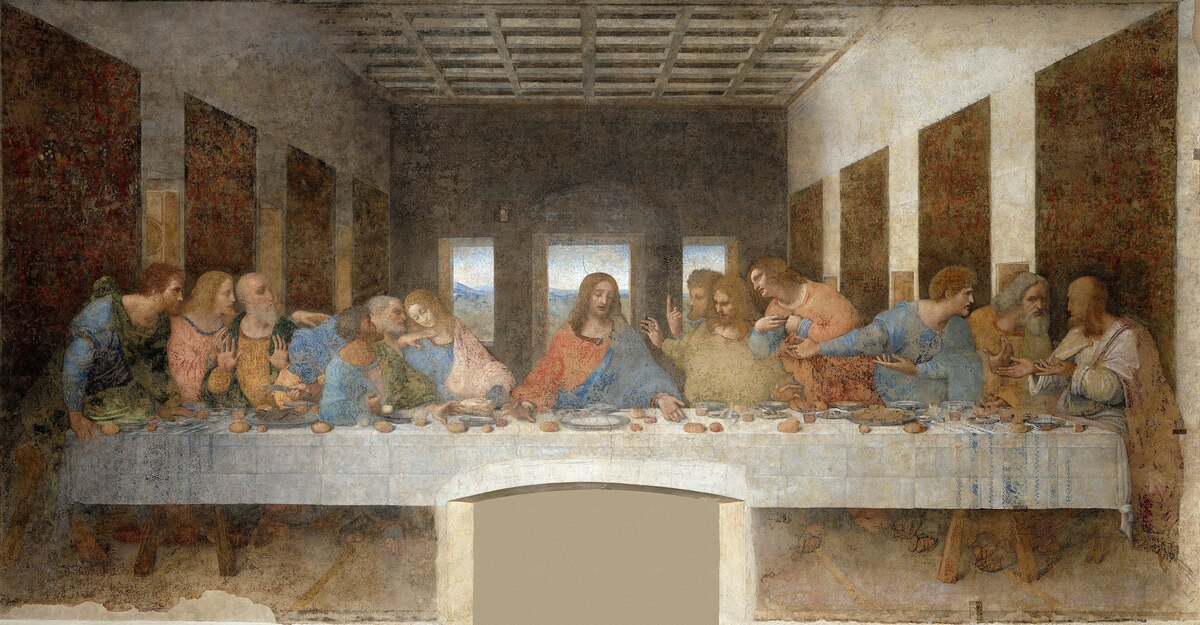
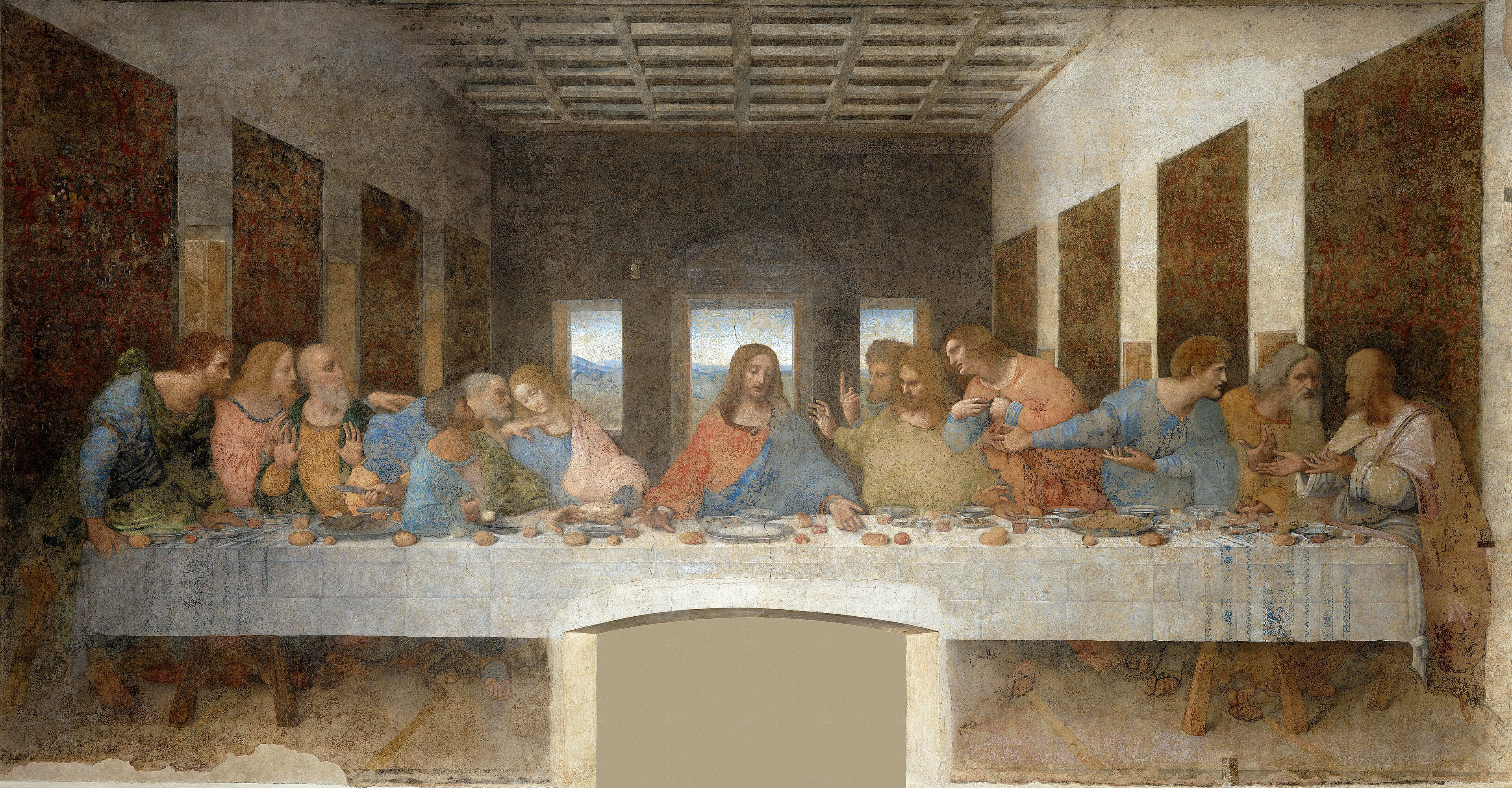
Leonardo da Vinci painted The Last Supper in Milan between 1495 and 1498, and the official Museo del Cenacolo Vinciano identifies it as his work. This short tour sets the biblical subject and then follows the museum's own evidence about the painting's making and its present fragility, keeping the limits of the record in view.
Rolls of bread, wine glasses, plates, and a carafe arranged along the white tablecloth in front of the figures; several disciples reach toward or rest hands beside these objects, tying the meal itself to the sacramental meaning of the scene.
02
Matthew, Jude, and Simon
The three rightmost disciples turned toward each other in heated discussion, hands pointing and open in argument, with Simon the eldest at the far right gesturing with spread fingers; the debate mirrors and answers the left group.
03
Bartholomew, James the Less, and Andrew
The three leftmost disciples: Bartholomew rising from his seat at the table edge, James the Less touching Andrew's shoulder, and Andrew with both palms raised in protest or shock, forming the first wave of reaction along the left bench.
Your gallery guide
The Last Supper by Leonardo da Vinci (1495-1498)
Leonardo da Vinci painted The Last Supper in Milan between 1495 and 1498, and the official Museo del Cenacolo Vinciano identifies it as his work. This short tour sets the biblical subject and then follows the museum's own evidence about the painting's making and its present fragility, keeping the limits of the record in view.
Editorial review by Artifact Archive automated publishing
The Last Supper shows Jesus Christ and his twelve disciples at the moment he tells them that one of them will betray him.
Leonardo da Vinci painted it between 1495 and 1498 for the refectory of the convent of Santa Maria delle Grazie in Milan.
That is the subject the museum record gives for this exact work, so the action is not a riddle to solve first.
The scene gathers thirteen figures along one table, with Christ seated among the twelve disciples.
Within that grouping, the disciples respond to the announcement, and Christ remains part of the same shared table rather than set apart from it.
The painting belongs to the wall of the refectory, so the room itself is the setting for this image, not merely a place that stores it.
The official museum calls the work a masterpiece and says every visitor to the museum is part of an extraordinary experience.
That is the museum's own reception language, and it belongs to the institution's presentation of the painting rather than to a neutral description of the wall.
I am keeping that distinction because a praise statement from a museum is evidence of its interpretation, not proof about how the picture once looked to Leonardo or his first viewers.
The museum also reports that the technique Leonardo used, together with unfavourable environmental conditions and historical vicissitudes, has left the painting vulnerable and fragile.
Because of that condition, the museum says staff care for it daily with preventive conservation measures, and preservation depends on controlled air treatment and controlled visitor access.
The museum therefore limits visits to fifteen minutes for no more than forty people at a time, with booking required for every ticket type.
The museum states that visits are short and strictly managed for conservation, so that limit is part of the painting's present history rather than a scheduling quirk.
What we can say on this record is narrow and firm: this is Leonardo's Last Supper, showing Christ and the twelve at the announcement of the betrayal, made between 1495 and 1498 in Milan.
Its making, the conditions it has survived, and the museum's current care for it are how the museum describes this exact object today.
The story and its sources
Editorial review by Artifact Archive automated publishing.
Historical claims are linked to the records below. Close looking and interpretation are identified in the passage notes.
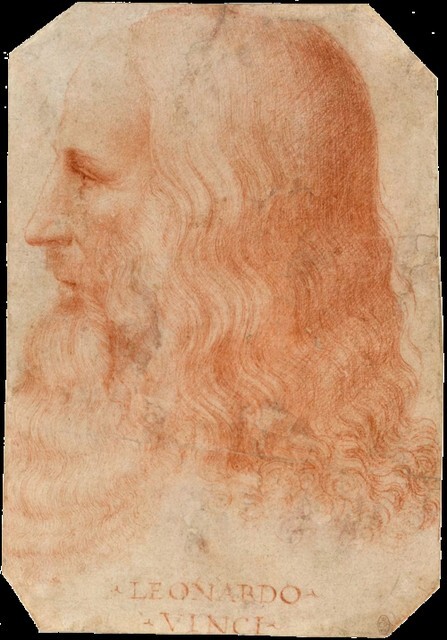
Leonardo was an Italian Renaissance painter whose work also encompassed sculpture, architecture, engineering and scientific study. Trained in Andrea del Verrocchio's workshop in Florence, he later worked in Milan, Rome and France. His notebooks connect close observation of anatomy and nature with his interest in how gesture and expression convey thought.
The Last Supper depicts the biblical scene of Jesus Christ and his twelve disciples at the moment he announces that one of them will betray him. The work is a site-specific mural painting created by Leonardo da Vinci between 1495 and 1498 for the refectory of the convent of Santa Maria delle Grazie in Milan.
Title variants
Last Supper; Il Cenacolo
Dimensions
Unknown
Catalogue identity and date
The object catalogued here is Leonardo da Vinci's Last Supper, a painting identified as such by the official Museo del Cenacolo Vinciano. The museum record and the Wikimedia Commons file record agree on the attribution to Leonardo da Vinci. The Commons file record, which serves as a discovery aid rather than an authority overriding institutional evidence, dates the work 1495-1498. That date range is attached to the artwork in the catalogue record; it is distinct from the dates of the sources that record it, and distinct from the later administrative date discussed below. The subject the museum record gives for this exact work is Jesus Christ with his twelve disciples at the moment he tells them that one of them will betray him, painted for the refectory of the convent of Santa Maria delle Grazie in Milan.(Cenacolo Vinciano (Museo del Cenacolo Vinciano, Milan), n.d.)(Wikimedia Commons: The Last Supper, n.d.)
The object is identified by the Museo del Cenacolo Vinciano, the museum that holds it in Milan, as Leonardo da Vinci's Last Supper, and its subject is given as Jesus Christ with his twelve disciples at the moment he tells them that one of them will betray him. The museum record dates the making of the work to between 1495 and 1498, and places its creation in the refectory of the convent of Santa Maria delle Grazie in Milan. Those are the coordinates the institution itself supplies for this exact work, and they establish the subject, the authorial attribution, the chronological span and the original architectural setting without requiring any reconstruction from later commentary.(Cenacolo Vinciano (Museo del Cenacolo Vinciano, Milan), n.d., The Last Supper Museum Transferred to the Management of the Pinacoteca di Brera)
Interpretation
The identification of the painting should not be confused with the history of its commissioning. The evidence supplied here establishes that the work is Leonardo's Last Supper, made between 1495 and 1498 for the refectory of Santa Maria delle Grazie, and that the museum lists Ludovico il Moro Duke of Milano among the works related to it. Ludovico Sforza, Duke of Milan, was the ruling patron in Milan in the years in which the painting was made, and his appearance in the museum's own list of related works makes him the documented figure closest to the commission within this evidence. The record does not, however, contain a contract, payment, letter or other instrument that spells out the terms of the commission, so the exact form of the arrangement remains outside what these units establish. Secure identification of the artist, the date range and the location need not by itself settle who commissioned the work, under what conditions, or with what stated intention.(Cenacolo Vinciano (Museo del Cenacolo Vinciano, Milan), n.d., The Last Supper Museum Transferred to the Management of the Pinacoteca di Brera; You may be also interested in)
Related works and the museum's framing
The museum places Donato Montorfano's Crucifixion among the works related to the Last Supper. Montorfano's Crucifixion is a wall painting in the same convent complex of Santa Maria delle Grazie, and the museum's grouping of it with the Last Supper indicates how the institution frames the two works in relation to one another for its audience. That framing is a statement of the institution's presentation of related material rather than an independent document about either painting's making. The same list of related works also includes copies and derivations of the Supper, which shows that the museum treats the wider body of reproduction and adaptation as part of the object's documentary neighbourhood. Taken together, these related works connect the painting to a specific Milanese religious house and to the later history of its copying, and they indicate that the object's significance is understood by the museum within a network of works rather than in isolation.(Cenacolo Vinciano (Museo del Cenacolo Vinciano, Milan), n.d., You may be also interested in)
Modern institutional management
On 3 December 2024 the Last Supper Museum was transferred from the Direzione regionale Musei nazionali Lombardia to the management of the Pinacoteca di Brera, as part of a Milanese museum centre that also includes the Biblioteca Braidense and Citterio Palace. This transfer is part of the object's present institutional history: it changes which body is responsible for the museum that holds the painting and situates the Last Supper within a larger grouping of Milanese cultural institutions. The evidence does not record the reasons for the transfer, nor does it describe any effect on the fabric of the painting or on how it is displayed. What it does establish is that the administrative identity of the museum is a recent and changing fact, distinct from the sixteenth-century circumstances of the painting's making.(Cenacolo Vinciano (Museo del Cenacolo Vinciano, Milan), n.d., The Last Supper Museum Transferred to the Management of the Pinacoteca di Brera)
The Last Supper Museum was transferred from the Direzione regionale Musei nazionali Lombardia to the management of the Pinacoteca di Brera on 3 December 2024, as part of a Milanese museum centre also including the Biblioteca Braidense and Citterio Palace.(Cenacolo Vinciano (Museo del Cenacolo Vinciano, Milan), n.d.)
Condition and conservation at the Museo del Cenacolo Vinciano begin with the making of the painting, not merely with its later misfortunes. The museum states that the technique Leonardo used to paint the Last Supper, combined with unfavourable environmental conditions and historical vicissitudes, has made the work vulnerable and fragile. Those three factors are presented together and are not separable in the museum's account: the method of execution is named as the first underlying cause, with climate and the passage of events compounding it. The result, as the institution describes this exact object, is a painting whose fragility is intrinsic to how it was made and how it has survived.(Cenacolo Vinciano (Museo del Cenacolo Vinciano, Milan), n.d., Behind the scenes)
Against that fragility the museum describes an ongoing, daily programme rather than a completed campaign. Staff care for the Last Supper every day through a wide range of preventive conservation actions, and preservation is said to require optimal environmental conditions ensured by air treatment and controlled visitor access. Two distinct domains are therefore named: the continuous daily work of staff, and the engineered environment of treated air. Visitor access appears as a third variable that must be controlled, so the public encounter with the painting is treated as part of its conservation regime, not as separate from it.(Cenacolo Vinciano (Museo del Cenacolo Vinciano, Milan), n.d., Behind the scenes)
The visitor rules are the visible edge of that regime. For conservation reasons, visits to the Last Supper last 15 minutes for a maximum of 40 people at a time, and reservations are compulsory for all ticket types. Because the stated reason is conservation, the time limit and group cap function as protective measures rather than crowd management alone. The compulsory booking applies across ticket categories, so no class of visitor is exempt from the reservation requirement as described.(Cenacolo Vinciano (Museo del Cenacolo Vinciano, Milan), n.d., Hours / Bookings)
Interpretation
The access limit is better read as a threshold under active calibration than as a fixed constant. The museum reports that in 2024 it experimented with gradually increasing visitor numbers to 40 per time slot, with an additional 105 daily tickets available from 1 March 2024. Read alongside the standing rule of a maximum of 40 people per 15 minute visit, this indicates that the 40 person figure was itself the object of experiment and phased adjustment, and that daily capacity, not only the size of a single group, is a variable the institution manages. The evidence supports the arrangement as a controlled trial of increased admission; it does not establish how long the added tickets remained in place or what monitoring accompanied them.(Cenacolo Vinciano (Museo del Cenacolo Vinciano, Milan), n.d., Increase in the number of visitors admitted to the museum; Hours / Bookings)
Museum staff care for the Last Supper daily with a wide range of preventive conservation actions, and preservation requires optimal environmental conditions ensured by air treatment and controlled visitor access.(Cenacolo Vinciano (Museo del Cenacolo Vinciano, Milan), n.d.)
The museum's own account of access to the Last Supper in 2024 is a record of an experiment in capacity, not only a ticketing rule. According to the Museo del Cenacolo Vinciano, the museum tested a gradual increase in the number of visitors admitted to each time slot, bringing the figure to 40 per slot, and from 1 March 2024 an additional 105 tickets per day became available. Reporting this as an experiment matters for the exhibition history of the work: it shows that the ceiling on attendance was being treated as a variable that could be tested against conservation requirements rather than as a fixed, inherited number. The change described in the evidence operates at the level of the daily admission regime, and the evidence does not state which rooms, routes or ticketing channels the additional tickets used, nor the outcome of the experiment beyond the increase itself.(Cenacolo Vinciano (Museo del Cenacolo Vinciano, Milan), n.d., Increase in the number of visitors admitted to the museum)
Exhibition History and Current Display Distinguished
Interpretation
Taken together, the supplied units describe exhibition history and current display as two related but distinct things. The 2024 experiment with gradually increasing visitor numbers and the additional 105 daily tickets from 1 March 2024 belong to the recent history of how the museum tested its capacity; the fifteen-minute visit, the 40-person limit and compulsory reservation describe the standing display regime attributed to conservation; and the daily preventive care and air treatment describe the operational conditions that regime assumes. Placing these side by side makes clear why the Last Supper matters differently from a work whose display is governed mainly by curatorial narrative: here the object's material vulnerability, documented in the evidence as the product of Leonardo's technique together with environmental and historical circumstances, actively shapes how many people may see it, for how long, and under what conditions. The evidence supports that relationship between condition and access without supplying dates for the conservation actions, names of conservators, or a chronology of past exhibitions.(Cenacolo Vinciano (Museo del Cenacolo Vinciano, Milan), n.d., Increase in the number of visitors admitted to the museum; Hours / Bookings; Behind the scenes)
The official museum presents Leonardo da Vinci's Last Supper as a masterpiece and describes every visitor to the museum as part of an extraordinary experience. This is the institution's own reception language, and it belongs to the museum's presentation of the painting rather than to a neutral description of the refectory wall. Museum praise of this kind is evidence of an institutional interpretation, not proof of how the picture once appeared to Leonardo or to its first viewers, and the account keeps that distinction explicit while recording the museum's claim in its own terms.(Cenacolo Vinciano (Museo del Cenacolo Vinciano, Milan), n.d.)
The Last Supper is held at the Museo del Cenacolo Vinciano in Milan, which has been managed since 3 December 2024 by the Pinacoteca di Brera. The museum's own record identifies the work as Leonardo da Vinci's Last Supper, and its subject as Jesus Christ with his twelve disciples at the moment he tells them that one of them will betray him. The museum also records that Leonardo painted it between 1495 and 1498 for the refectory of the convent of Santa Maria delle Grazie in Milan. These are the basic coordinates of the object as the institution that holds it describes them: an identified painting, a named author, a dated campaign of execution, and a site of original installation. The scene gathers thirteen figures along one table, with Christ seated among the twelve disciples and remaining part of the same shared table rather than set apart from it; because the painting belongs to the wall of the refectory, the room itself is the setting for the image and not merely a place that stores it.(Cenacolo Vinciano (Museo del Cenacolo Vinciano, Milan), n.d.)
Management and institutional framing
The transfer of the Last Supper Museum from the Direzione regionale Musei nazionali Lombardia to the management of the Pinacoteca di Brera on 3 December 2024 is part of a larger Milanese museum centre that also includes the Biblioteca Braidense and Citterio Palace. The management change therefore did not concern the painting alone but reorganized the institutional framework through which it is administered, placing it within a group of Milanese cultural institutions under a single direction. Within this setting the museum presents the Last Supper as a masterpiece and describes every visitor to the museum as part of an extraordinary experience. That language is the institution's own reception framing; it belongs to the museum's presentation of the painting rather than to a neutral description of the wall, and it is evidence of how the institution positions the work for its public rather than proof of how the picture appeared to Leonardo or to its first viewers.(Cenacolo Vinciano (Museo del Cenacolo Vinciano, Milan), n.d.)
Conservation and access
The museum attributes the painting's vulnerability and fragility to the combination of the technique Leonardo used, unfavourable environmental conditions, and historical vicissitudes. On that account, staff care for the work daily through a wide range of preventive conservation actions, and its preservation requires optimal environmental conditions ensured by air treatment and controlled visitor access. This is why visits to the Last Supper last 15 minutes for a maximum of 40 people at a time, and why reservations are compulsory for all ticket types. The short, strictly managed visit is thus part of the painting's present history rather than a scheduling quirk: it is the visible edge of a continuous conservation regime. In 2024 the museum experimented with gradually increasing visitor numbers to 40 per time slot, with an additional 105 daily tickets available from 1 March 2024, an expansion that proceeded within, rather than against, the same controlled-access framework.(Cenacolo Vinciano (Museo del Cenacolo Vinciano, Milan), n.d.)
Related works and wider context
Interpretation
The museum website lists among related works Ludovico il Moro Duke of Milano, Donato Montorfano's Crucifixion, and copies and derivations of the Supper. These associations extend the object's documented context beyond the painted figure group: the Crucifixion places it alongside another wall painting in the same monumental complex, the reference to Ludovico il Moro points to the Milanese court under which the work was made, and the copies and derivations acknowledge the painting's long life in reproduction rather than only as an in situ mural. Taken together with the work's holding at the Museo del Cenacolo Vinciano, its management by the Pinacoteca di Brera since 3 December 2024, and the conservation-driven terms of access, these related works show an object whose significance is sustained at once by its original architectural setting, its political and devotional milieu, its material fragility, and the institutional apparatus that now governs how it is seen.(Cenacolo Vinciano (Museo del Cenacolo Vinciano, Milan), n.d.)
The working insurance estimate supplied for Leonardo da Vinci's Last Supper is a model-generated range of US$500 million to US$2 billion, recorded as a working calculation generated on 2026-10-16. Its stated methodology treats the asset as Leonardo's original site-specific mural painting of The Last Supper, 1495-1498, permanently held in the Museo del Cenacolo Vinciano in Milan, an identification the calculation says is confirmed by the museum's official website and a Wikimedia Commons file record. The same sources establish the attribution and dating that the calculation relies on: the official Museo del Cenacolo Vinciano identifies the work as Leonardo's Last Supper, and the Commons file record attributes the painting to Leonardo and dates it 1495-1498. That Commons record is used in the calculation only as a discovery aid whose descriptions do not override institutional evidence. Because the calculation's figure rests on that identification, the range is answerable to the same attribution the museum gives for this exact object rather than to an independent market determination.(Cenacolo Vinciano (Museo del Cenacolo Vinciano, Milan), n.d.)(Wikimedia Commons: The Last Supper, n.d.)
The estimate's methodology explains why it is not derived from sales: it describes the work as an irreplaceable, universally recognized Italian Renaissance masterpiece, physically fixed in a fragile refectory environment, and not privately owned or traded, so that conventional market comparables are unavailable and inappropriate. The range is therefore described as a conservative, model-generated placeholder anchored to the work's superlative art-historical status, extreme rarity, unique monumentality and global significance, rather than to any actual sale, appraisal or insurance schedule, and is said to be intentionally wide and offered solely as an order-of-magnitude prompt for human review. The qualification attached to the calculation is explicit: it is a model-generated working range for manual review only, and is not an official insurance value, appraisal, auction result or sale price; no comparable sales, private insurance records or market data were used or claimed. The calculation further states that actual insurance arrangements for an in situ national treasure of this nature are not established through ordinary market valuation and fall outside the scope of the output, which bounds what the figure can legitimately be taken to show about the object.(Cenacolo Vinciano (Museo del Cenacolo Vinciano, Milan), n.d.)(Wikimedia Commons: The Last Supper, n.d.)
The fragility and fixity the calculation cites are not abstract assumptions; they correspond to the museum's own account of the work's condition. The official museum reports that the technique Leonardo used to paint the Last Supper, combined with unfavourable environmental conditions and historical vicissitudes, has made the work vulnerable and fragile. The museum states that staff care for the painting daily with a wide range of preventive conservation actions, and that its preservation requires optimal environmental conditions ensured by air treatment and controlled visitor access. This is the physical situation that makes the object non-transferable and that the valuation methodology describes as unsuitable for conventional comparables: the same evidence that establishes the painting's status as a fixed, fragile mural also explains why any figure attached to it is a working model rather than a transaction.(Cenacolo Vinciano (Museo del Cenacolo Vinciano, Milan), n.d.)(Wikimedia Commons: The Last Supper, n.d.)
The institutional record also shows the object embedded in an administrative and access regime that bears on how it is valued and cared for. The Last Supper Museum was transferred from the Direzione regionale Musei nazionali Lombardia to the management of the Pinacoteca di Brera on 3 December 2024, as part of a Milanese museum centre that also includes the Biblioteca Braidense and Citterio Palace. For conservation reasons the museum limits visits to 15 minutes for a maximum of 40 people at a time, and reservations are compulsory for all ticket types; in 2024 the museum experimented with gradually increasing visitor numbers to 40 per time slot, with an additional 105 daily tickets available from 1 March 2024. The museum website also lists among related works Ludovico il Moro Duke of Milano, Donato Montorfano's Crucifixion, and copies and derivations of the Supper. These details situate the painting within an ongoing conservation and visitation programme rather than a static asset, and they are the institutional context against which the working estimate's caution about private ownership and market valuation should be read.(Cenacolo Vinciano (Museo del Cenacolo Vinciano, Milan), n.d.)(Wikimedia Commons: The Last Supper, n.d.)
Attribution, status and the limits of the record
The official museum describes the Last Supper as a masterpiece and says every visitor to the museum is part of an extraordinary experience. That language is the institution's own reception framing, and it is worth distinguishing from a neutral description of the wall: it is evidence of how the museum presents the painting, not proof of how the picture appeared to Leonardo or his first viewers. The museum's presentation and the working estimate's reliance on the work's superlative art-historical status and global significance therefore draw on the same institutional authority, and both should be attributed to that source rather than treated as independent corroboration of the painting's reputation.(Cenacolo Vinciano (Museo del Cenacolo Vinciano, Milan), n.d.)(Wikimedia Commons: The Last Supper, n.d.)
Working estimate
Calculated working insurance estimate, not a sale price: Estimated value: US$500M to US$2B Recorded date: Working calculation, generated 2026-10-16. Methodology: This broad working range is calculated for manual insurance review only. It treats the asset as Leonardo da Vinci's original site-specific mural painting of The Last Supper, 1495-1498, permanently held in the Museo del Cenacolo Vinciano in Milan and confirmed by the museum's official website and a Wikimedia Commons file record. Because the work is an irreplaceable, universally recognized Italian Renaissance masterpiece, physically fixed in a fragile refectory environment, and not privately owned or traded, conventional market comparables are unavailable and inappropriate. The range is therefore a conservative model-generated placeholder anchored to the work's superlative art-historical status, extreme rarity, unique monumentality, and global significance rather than to any actual sale, appraisal, or insurance schedule. It is intentionally wide and is offered solely as an order-of-magnitude prompt for human review. Qualification: Model-generated working range for manual review only. This is not an official insurance value, appraisal, auction result, or sale price. No comparable sales, private insurance records, or market data were used or claimed. Actual insurance arrangements for an in situ national treasure of this nature are not established through ordinary market valuation and fall outside the scope of this output.(Cenacolo Vinciano (Museo del Cenacolo Vinciano, Milan), n.d.)(Wikimedia Commons: The Last Supper, n.d.)
Further reading
Books for a closer look
Paid links. As an Amazon Associate I earn from qualifying purchases.
Titled The last supper with subjects including Renaissance Art, art, renaissance, and art, italian, alongside travel in Italy and English women novelists. The recorded art-historical subjects suggest documented cultural reception and reflection connected to viewing the work in Italy, not an accidental title match.
References are arranged by author or organisation, with links to the original publications. Where no publication date is recorded, n.d. means no date.
Source notes updated .
No recorded sources match these filters. Reset the filters to see the full bibliography.
01
Museum · About this artwork
Cenacolo Vinciano (Museo del Cenacolo Vinciano, Milan) (n.d.).Il Cenacolo Vinciano.
Official website of the Museo del Cenacolo Vinciano, providing the authoritative museum record for Leonardo da Vinci's Last Supper, its conservation, management, and visitor information.
Titled The last supper with subjects including Renaissance Art, art, renaissance, and art, italian, alongside travel in Italy and English women novelists. The recorded art-historical subjects suggest documented cultural reception and reflection connected to viewing the work in Italy, not an accidental title match.
Recorded title, Leonardo and the Last Supper, and subjects on Leonardo da Vinci and art criticism indicate this is a book-length study focused specifically on the mural rather than a broad artist survey, making it the most directly object-specific candidate.
Wikimedia Commons file record for the Last Supper, providing title, artist, date range, and public domain license. Used as a discovery aid only; its descriptions do not override institutional evidence.
Advertising supports the archive. These preferences control aggregate page counting, reading activity and ad-delivery diagnostics. They use no visitor tracking cookie.