Identity and catalogue
Link- Artist or attribution
- Leonardo da Vinci
- Object date
- c. 1474/1478
- Medium and support
- oil on panel
- Dimensions
- overall (original panel only): 38.1 x 37 cm (15 x 14 9/16 in.); overall (thickness of original panel): 1.1 cm (7/16 in.); overall (with addition at bottom edge): 4 [...](www.nga.gov, n.d.)
- Movement or period
- Italian Renaissance
- Country or culture
- Florence, Italy
- Depicted subject
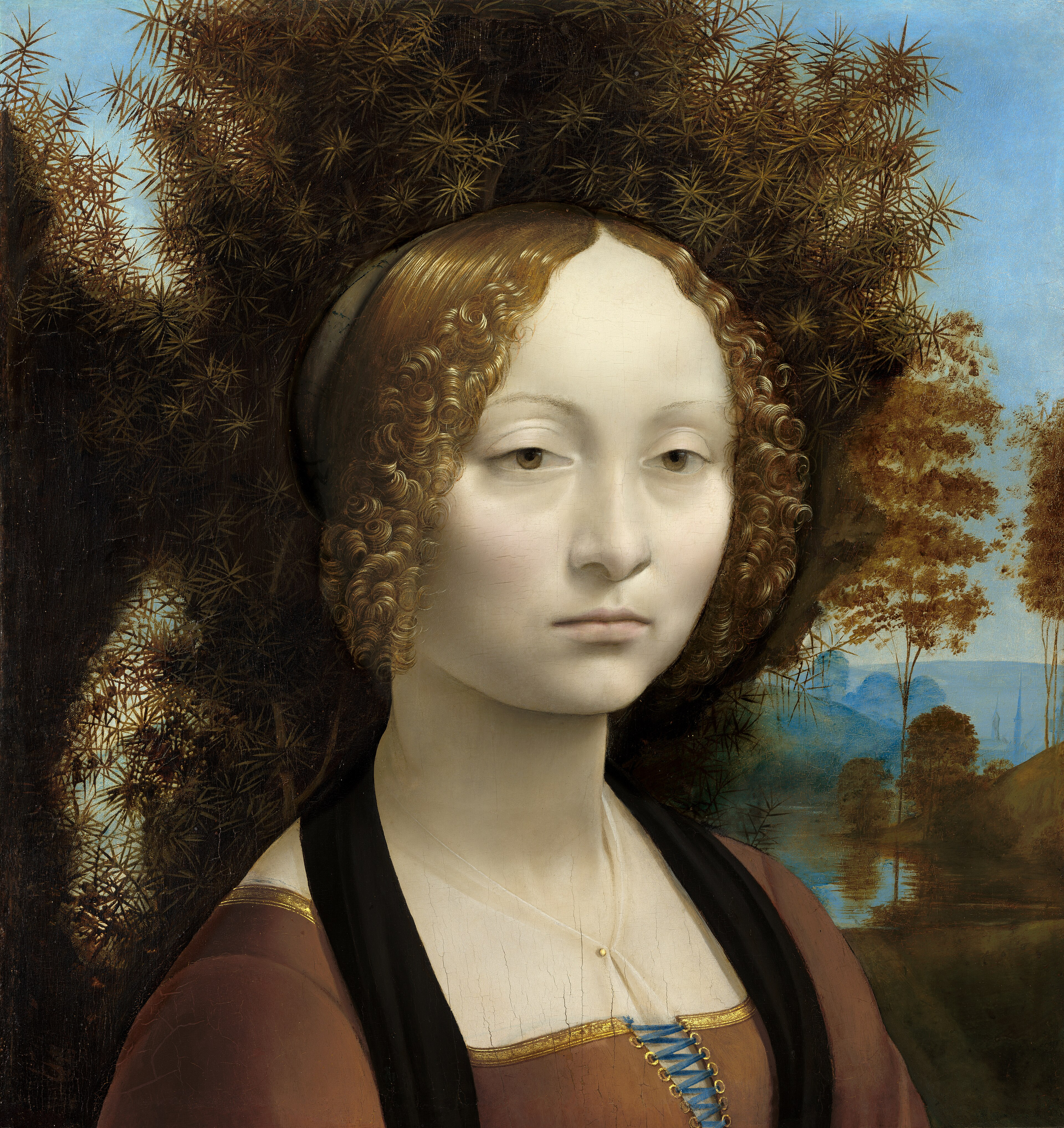
- Portrait of the young Florentine woman Ginevra de' Benci, likely made around the time of her betrothal to Luigi di Bernardo Niccolini. She is shown facing right against a juniper bush, a pun on her name and a symbol of female virtue. The reverse of the panel carries a juniper sprig, laurel and palm wreath, and the motto Virtvtem Forma Decorat.
- Title variants
- Ginevra de' Benci; Portrait of Ginevra de' Benci
- Support
- panel
- Inscriptions
- Virtvtem Forma Decorat (on reverse, per Wikipedia)
Catalogue identification
The work catalogued by the National Gallery of Art as Ginevra de' Benci [obverse] is attributed to Leonardo da Vinci and dated by the museum to c. 1474/1478. The subject is identified as Ginevra de' Benci, a fifteenth-century Florentine aristocrat born around 1458. Those two identifications, of painter and of sitter, are the framing facts on which the rest of the object's documentation depends, and they carry different kinds of qualification: the date is given by the holding institution as an approximate range rather than a fixed year, and the attribution is stated in the catalogue record as a scholarly attribution to Leonardo rather than as a signature or a contemporary document. Nothing in the supplied record names a commissioner, a notary, a payment, or a contract, so the circumstances that produced the panel are reconstructed from the object itself, from its later history, and from the poetry and emblems connected with its sitter.(Wikipedia fallback: Ginevra de' Benci, n.d., Subject section)(www.nga.gov, n.d., Artwork overview)
Support and dimensions
The National Gallery of Art records the medium as oil on panel, with overall dimensions of the original panel only at 38.1 x 37 cm (15 x 14 9/16 in.). The original panel has an overall thickness of 1.1 cm (7/16 in.), and there is an addition at the bottom edge. That addition matters for how the object is measured and understood: the dimensions the museum quotes apply to the original panel alone, which implies that the surviving painted surface is not the whole physical support as it now exists. The same source notes that at some point the bottom of the painting was removed, presumably owing to damage, and that Ginevra's arms and hands are thought to have been lost. The removal and the later addition are reported as consequences of damage and of subsequent intervention rather than as documented events with dates attached, so the original extent of the composition can only be inferred from the surviving panel, its thickness, and the physical seam at the lower edge.(www.nga.gov, n.d., Artwork overview)
Date and occasion
The portrait is dated by the museum to about 1474 to 1478, a range that places its making in Florence during Leonardo's early activity there. A separate account states that Leonardo painted the portrait in Florence between 1474 and 1478, possibly to commemorate Ginevra's marriage to Luigi di Bernardo Niccolini when she was sixteen, or more likely to commemorate the engagement. The two explanations are not equivalent in the record: the marriage commemoration is offered as a possibility and the engagement commemoration as the more probable reading. The same account observes that the portrait faces right, which suggests it more likely represents a betrothal, since wedding portraits traditionally were created in pairs with the woman on the right facing left. The pose is therefore used as an internal formal argument about occasion, not as external proof, and the object's own date range and the proposed life event remain connected by inference rather than by documentation.(www.nga.gov, n.d., Artwork overview)(Wikipedia fallback: Ginevra de' Benci, n.d., Subject section)
Front and reverse
The object carries two painted faces of meaning, and both are described in the catalogue and subject literature. On the front, the young Florentine woman has a distant gaze, and Ginevra's flawless skin and shining curls are offset by a halo of juniper leaves; the work reveals Leonardo's mastery of the paint medium, with subtle shading of Ginevra's face. The portrait is one of the highlights of the National Gallery of Art and is admired by many for its portrayal of Ginevra's temperament: she is beautiful but austere, has no hint of a smile, and her gaze, although forward, seems indifferent to the viewer. On the reverse of the panel a juniper sprig is encircled by a wreath of laurel and palm, with the Latin motto Virtvtem Forma Decorat (Beauty adorns virtue), symbolizing the relationship between Ginevra's intellectual and moral virtue and her physical beauty. The juniper bush that surrounds Ginevra's head and fills much of the background is read as a symbol of female virtue in Renaissance Italy, and the Italian word for juniper, ginepro, makes a play on Ginevra's name. Front and back therefore work as a single emblematic program: a named plant, a name, and a motto that equates beauty with virtue.(www.nga.gov, n.d., Artwork overview; Artwork History)
Interpretive claims
Interpretation
The panel has also attracted interpretive claims that go beyond the documented record. In 2017, researcher and cryptographer Carla Glori anagrammatized fifty Latin sentences signed VINCI, formed with the letters of the motto VIRTVTEM FORMA DECORAT supplemented with the Latin word iuniperus, arguing that they form a coherent text referring to the portrait and to the biography of Ginevra Benci. This is an attributed argument by a named researcher, not a finding of the museum or of the technical examination, and its method differs from the infrared evidence: it works on the letters of the motto rather than on the paint layers. It should be recorded because it is part of the object's reception, but it does not alter the catalogue identification, the date, the medium, or the provenance of the painting.(Wikipedia fallback: Ginevra de' Benci, n.d., Subject section)
The National Gallery of Art identifies the work as Ginevra de' Benci [obverse] by Leonardo da Vinci, dated c. 1474/1478.(www.nga.gov, n.d.)
Subject and iconography
LinkThe surviving surface and its framing
Visual observation
The primary visual record of the panel, as described by the National Gallery of Art, is of a young Florentine woman whose gaze is distant rather than engaged with the viewer, and whose flawless skin and shining curls are set off by a halo of juniper leaves. The same institutional account emphasizes Leonardo's mastery of the paint medium, expressed above all in the subtle shading of Ginevra's face, which gives the features a soft, modelled presence rather than a hard outline. The juniper is not incidental scenery: it surrounds the head and fills much of the background, so that the sitter is framed by a botanical canopy that also functions as a name and a moral statement. The size of what survives is modest. The painting is oil on panel, and the dimensions given for the original panel only are 38.1 by 37 cm (15 by 14 9/16 in.), with an overall thickness of 1.1 cm (7/16 in.) and an addition at the bottom edge. The surviving image is therefore close to square and relatively intimate in scale, which is consistent with a portrait meant for close viewing rather than public display.(www.nga.gov, n.d., Object overview; Artwork overview)
Emblem and inscription
The juniper bush that surrounds Ginevra's head is read in the secondary account as a symbol of female virtue in Renaissance Italy, and the Italian word for juniper, ginepro, is said to make a play on Ginevra's name. On that reading the plant performs two jobs at once: it identifies the sitter through a pun on her name and it characterizes her through a conventional moral meaning attached to the plant. The reverse of the panel carries a further emblematic programme: a juniper sprig encircled by a wreath of laurel and palm, accompanied by the Latin motto Virtvtem Forma Decorat, rendered as Beauty adorns virtue, and understood to symbolize the relationship between Ginevra's intellectual and moral virtue and her physical beauty. The laurel and palm in that reverse emblem are identified as part of the personal emblem of Bernardo Bembo, a Venetian ambassador to Florence whose platonic relationship with Ginevra is revealed in poems exchanged between them. These are attributed interpretations rather than neutral descriptions: the floral meanings, the wordplay and the reading of the reverse as an emblem of virtue and beauty belong to the secondary account.(www.nga.gov, n.d., Object overview)(Wikipedia fallback: Ginevra de' Benci, n.d., Subject section)
What is seen, what is established, what is inferred
Interpretation
The visual evidence and the documentary evidence do not simply confirm one another; they operate at different levels. What can be seen is a young woman with a distant gaze, flawless skin, shining curls and a juniper halo, painted in oil on a panel of about 38.1 by 37 cm. What the historical and technical evidence establishes includes a date range of 1474 to 1478 in Florence, an infrared trace of Bembo's motto beneath the surface pointing to his likely involvement in the commission, a reverse emblem combining juniper, laurel and palm with the motto Virtvtem Forma Decorat, and an occasion that is probably a betrothal though possibly a marriage. What remains attributed rather than settled includes the reading of the juniper as a symbol of female virtue and a pun on Ginevra's name, the identification of the laurel and palm as Bembo's personal emblem, the betrothal inference drawn from the right-facing pose, the Vasari attribution to Ghirlandaio's fresco, and the possibility that the original panel once included arms and hands that are now lost. The portrait matters within a larger history of art and material culture because it joins a named sitter, a documented poetic reputation, an emblematic reverse and a hidden inscription in a single small panel, and because its technical examination and its losses show how much of a Renaissance portrait's meaning can reside in layers that the finished surface does not display.(www.nga.gov, n.d., Object overview; Artwork overview)(Wikipedia fallback: Ginevra de' Benci, n.d., Subject section; Trivia section; Lead section)
Ginevra's flawless skin and shining curls are offset by a halo of juniper leaves.(www.nga.gov, n.d.)
Commission and Florentine Context
The National Gallery of Art identifies this painting as Leonardo da Vinci's Ginevra de' Benci, dated about 1474/1478, when the artist was working in Florence. Leonardo painted the portrait in Florence between 1474 and 1478, possibly to commemorate Ginevra's marriage to Luigi di Bernardo Niccolini at the age of 16, or more likely to commemorate the engagement. The two possibilities carried by the evidence differ in what occasion the picture marked, and the evidence itself leans toward the betrothal rather than the wedding. Ginevra de' Benci is described as a portrait painting by Leonardo of the 15th-century Florentine aristocrat Ginevra de' Benci, born around 1458. Working from a birth around 1458, a marriage or betrothal in the middle 1470s would place her in her mid to late teens, consistent with the stated age of 16.(Wikipedia fallback: Ginevra de' Benci, n.d., Subject section)
Participants and Patrons
Interpretation
The reverse of the panel carries an emblem and a motto that extend the portrait beyond the single face. The reverse features a juniper sprig encircled by a wreath of laurel and palm, with the Latin motto Virtvtem Forma Decorat, rendered as Beauty adorns virtue, symbolizing the relationship between Ginevra's intellectual and moral virtue and her physical beauty. The laurel and palm in that reverse emblem are identified as part of the personal emblem of Bernardo Bembo, a Venetian ambassador to Florence whose platonic relationship with Ginevra is revealed in poems exchanged between them. Because the emblem belongs to Bembo's device, the reverse links the object to a second named participant in Ginevra's social world alongside the Niccolini marriage connection, and it does so through an image rather than a document.(Wikipedia fallback: Ginevra de' Benci, n.d., Subject section)
Other members of Ginevra's family connect the picture to Leonardo's working life in Florence. Ginevra's brother Giovanni, 1456 to 1523, was a friend of Leonardo, and when Vasari wrote his Lives, Leonardo's unfinished Adoration of the Magi was in the house of Amerigo Benci, Giovanni's son. The evidence places an unfinished Leonardo in a Benci household at the time Vasari was compiling his accounts, which shows the family's continuing possession of Leonardo material rather than ownership of this portrait. That distinction matters for the commissioning history, because the documented Benci connection to a Leonardo work concerns the Adoration, not the Ginevra panel, and it should not be stretched into proof about who first owned the portrait.(Wikipedia fallback: Ginevra de' Benci, n.d., Trivia section)
Leonardo painted the portrait in Florence between 1474 and 1478, possibly to commemorate Ginevra's marriage to Luigi di Bernardo Niccolini at the age of 16, or more likely to commemorate the engagement.(Wikipedia fallback: Ginevra de' Benci, n.d.)
The laurel and palm in the reverse emblem are part of the personal emblem of Bernardo Bembo, a Venetian ambassador to Florence whose platonic relationship with Ginevra is revealed in poems exchanged between them.(Wikipedia fallback: Ginevra de' Benci, n.d.)
Ginevra's brother Giovanni (1456-1523) was a friend of Leonardo. When Vasari wrote his Lives, Leonardo's unfinished Adoration of the Magi was in the house of Amerigo Benci, Giovanni's son.(Wikipedia fallback: Ginevra de' Benci, n.d.)
Materials and technique
LinkInfrared examination and the hidden motto
Visual observation
The technical literature on this panel centers on a single, narrowly evidenced finding: infrared examination has revealed Bernardo Bembo's motto, rendered in the source as "Virtue and Honor," beneath the surface of the painted image of Ginevra. The reported inference drawn from that finding is that Bembo was likely involved in the commission of the portrait. It is important to keep the two parts of this account distinct. The infrared result is reported as an examination finding; Bembo's participation in the commission is a likelihood proposed on the strength of that finding, not a documented transaction. The wording of the report does not specify the imaging equipment, the date of the examination, the studio or laboratory in which it was carried out, or whether the motto lies in the underdrawing layer or in some other preparatory material, so the technical claim cannot be refined beyond what the report states. Read together with the visual record of the object, in which Ginevra's flawless skin and shining curls are offset by a halo of juniper leaves and her gaze is described as distant, the hidden inscription provides a second, independently described instance of emblematic content in the same object, which is precisely why the attribution of a role to Bembo has been proposed. The reverse emblem's laurel and palm are described as part of Bembo's personal device, and he is described as a Venetian ambassador to Florence whose platonic relationship with Ginevra is recorded in poems exchanged between them; those documentary associations are what give the infrared report its interpretive weight.(Wikipedia fallback: Ginevra de' Benci, n.d., Subject section)(www.nga.gov, n.d., Object overview)
The limits of the documentary record
Technical examination
What the technical record does not settle is the portrait's documentary history and the purpose for which it was made. The infrared finding is the one item in the technical record that bears on agency in the commission. It revealed Bembo's motto "Virtue and Honor" beneath the surface of Ginevra's image, and on that basis the source proposes that Bembo was likely involved in commissioning the portrait. Even this finding, however, supports a likelihood rather than a certainty about who initiated the work, and it does not by itself establish the purpose the commission served. A separate and later proposal, advanced in 2017 by the researcher and cryptographer Carla Glori, anagrammatized fifty Latin sentences signed VINCI from the letters of the motto VIRTVTEM FORMA DECORAT supplemented with the Latin word iuniperus, and argued that they form a coherent text referring to the portrait and to the biography of Ginevra Benci. Because this is a proposal attributed to a named researcher rather than an examination result, it should not be given the same evidential weight as the reported infrared finding, and it does not establish anything about the physical construction of the panel.(Wikipedia fallback: Ginevra de' Benci, n.d., Subject section)
Why the object matters
Interpretation
The technical and documentary strands converge on the question of why this panel matters in a larger history of art. Its documented afterlife is unusually well attested for a fifteenth-century portrait: it was presumably purchased in Florence by Prince Johann Adam Andreas I von Liechtenstein (1657-1712) before 1712, and was certainly in the collection of the Princes of Liechtenstein by 1733 in Vienna, whence it descended to Prince Franz Josef II von und zu Liechtenstein (1906-1989), Vienna and later Vaduz, and was purchased by the National Gallery of Art on 10 February 1967, an acquisition in February 1967 from Franz Joseph II, Prince of Liechtenstein, made for a record price for a painting of between five and six million dollars. The movement of the object from Florence to a princely Viennese collection and then to an American national collection is the documented frame within which all technical study has taken place. Within that frame, the hidden motto under the surface and the emblem reported on the reverse together make the panel a rare case in which the physical object is said to carry evidence of the intellectual and social network surrounding its making, and the survival of Ginevra as a subject of poetry by members of the Medici circle, Cristoforo Landino and Alessandro Braccesi, and of two sonnets by Lorenzo de' Medici himself, situates the picture within a culture that memorialized her beauty both in verse and in paint. The reception of the work at the National Gallery of Art, where it is described as one of the highlights of the collection and admired for its portrayal of Ginevra's temperament, means that later technical examination has been conducted on an object already carrying a heavy interpretive load.(Wikipedia fallback: Ginevra de' Benci, n.d., Subject section)
Support, medium and dimensions
The National Gallery of Art records Ginevra de' Benci [obverse] as oil on panel, with the overall dimensions of the original panel alone given as 38.1 x 37 cm (15 x 14 9/16 in.). The same catalogue entry documents the original panel's overall thickness as 1.1 cm (7/16 in.) and notes that there is an addition at the bottom edge. Taken together, the support is a wooden panel of approximately square format, roughly a centimetre thick, whose present lower edge is not entirely original wood: the recorded addition is a distinct physical component from the surviving painted panel, and the dimensions supplied describe the original panel rather than the composite object. This is documentation of support and measurement, not a visual inference, and it establishes the material basis on which the painted image was built.(www.nga.gov, n.d., Artwork overview)
Visual observation
The medium is described by the National Gallery of Art as oil, and the entry states that the work reveals Leonardo's mastery of the paint medium, with subtle shading of Ginevra's face. That phrasing attributes to the painter a command of oil technique visible in the modelling of the face, while the description of the flawless skin and shining curls set against a halo of juniper leaves records surface effects rather than construction. What the evidence establishes is medium and a documented assessment of handling; it does not supply pigments, ground composition, layer structure or specific instruments of application, so any account of Leonardo's preparation or of individual materials beyond oil and panel would go past these units.(www.nga.gov, n.d., Artwork overview; Object overview)
The reverse and its emblem
Interpretation
The standing of the work within Leonardo's output and within the history of the portrait rests on the convergence of support, medium and examination rather than on any single datum. The panel's oil medium and its documented dimensions and thickness define a portable wooden picture made in Florence in the later 1470s; the under-surface motto, the designed reverse with its juniper, laurel and palm, and the cut and addition at the lower edge show an object whose making, meaning and survival have each left physical traces. The National Gallery of Art's assessment that the painting reveals Leonardo's mastery of the paint medium situates the technical achievement in the handling of oil, while the reported readings of the juniper, the reverse emblem and the betrothal pose situate the same object in the conventions of Florentine portraiture and its emblematic culture. My synthesis is that the material evidence and the interpretive traditions should be kept in explicit relation: the medium, the panel and the hidden inscription are documented, the emblematic and biographical readings are attributed, and the lost lower section marks the limit of what the surviving surface can show.(www.nga.gov, n.d., Artwork overview; Object overview)(Wikipedia fallback: Ginevra de' Benci, n.d., Subject section)
The painting is oil on panel, with overall dimensions of the original panel only at 38.1 x 37 cm (15 x 14 9/16 in.).(www.nga.gov, n.d.)
Technical examination
Infrared examination has revealed Bembo's motto 'Virtue and Honor' beneath Ginevra's [surface], making it likely that Bembo was involved in the commission of the portrait.(Wikipedia fallback: Ginevra de' Benci, n.d.)
Condition and conservation
LinkPhysical State and the Loss at the Bottom
The physical integrity of Leonardo da Vinci's Ginevra de' Benci has been compromised by an early loss at the bottom of the composition. At some point, the bottom of the painting was removed, presumably owing to damage, and Ginevra's arms and hands are thought to have been lost. This removal is the single most consequential recorded change to the object. The surviving support is not, however, simply the trimmed original. The original panel has an overall thickness of 1.1 cm (7/16 in.), and there is an addition at the bottom edge. Condition and support are therefore two distinct matters here: the loss describes what was cut away from the image, while the addition describes a later material element at the lower edge of the panel. The National Gallery of Art's account does not date the removal or specify the damage that prompted it, so the event remains undated; and because the interpretation of what was lost is expressed as what is thought to have occurred, the absence of the arms and hands should be treated as a reasoned inference rather than a directly documented fact. What can be seen today is accordingly the surviving panel with its lower addition, not the painting in its original full extent. In practical terms, later measurements of the work describe only what survived, which is why the dimensions in current records are explicitly given as those of the original panel only.(Wikipedia fallback: Ginevra de' Benci, n.d., Subject section)(www.nga.gov, n.d., Artwork overview)
Interpretation
The same early loss also removed evidence that might otherwise have settled the portrait's place in social ritual. The pose of the surviving figure, facing right, has been read as an argument that the portrait more likely represents a betrothal, on the reasoning that wedding portraits traditionally were created in pairs with the woman on the right facing left. Any such paired or complementary figure, and any hands that might have held an attribute or clasped another hand, would have occupied precisely the part of the composition now gone. The truncation therefore limits what formal and contextual analysis can reasonably do. It is not that the surviving evidence is neutral between betrothal and marriage; it is that the loss constrains how far the surviving composition can be used either to support the betrothal reading or to test it. The object's condition and its interpretation are bound together: a change made before its modern documentation has narrowed the evidence base for the very question the pose is used to answer.(Wikipedia fallback: Ginevra de' Benci, n.d., Subject section)
What Lies Beneath the Surface
Condition matters further because some of the best evidence for the portrait's patronage lies inside the paint layers and remains accessible despite the damage. Infrared examination has revealed Bembo's motto 'Virtue and Honor' beneath Ginevra's [surface], making it likely that Bembo was involved in the commission of the portrait. This reading of what lies under the visible paint coexists with the documented upper surface of the painting, and it is precisely because the object survives in this layered state that the anomaly can be examined at all. Beneath is not a prior or discarded condition of the painting but an element of its making, for the evidence refers to the motto lying beneath the painted surface of the face. The infrared finding is an interpretation drawn from technical investigation rather than a direct record of a commission, and its force lies in the qualifier: it makes Bembo's involvement likely rather than certain. The technical examination thus stands alongside the strictly material condition record of panel, thickness, addition and loss, and it shows that the physical state of the work is not only a history of attrition but also an archive of its own construction.(Wikipedia fallback: Ginevra de' Benci, n.d., Subject section)(www.nga.gov, n.d., Artwork overview)
Provenance and the Custodial Record
The condition record enters the object's modern custody through its documented provenance. The painting was presumably purchased in Florence by Prince Johann Adam Andreas I von Liechtenstein (1657-1712) before 1712, and was certainly in the collection of the Princes of Liechtenstein by 1733, Vienna. It then descended to Prince Franz Josef II von und zu Liechtenstein (1906-1989), Vienna and later Vaduz, Liechtenstein, and was purchased by the National Gallery of Art on 10 February 1967. These transitions are the intervals during which the panel could have been measured, described and, if it was not lost even earlier, trimmed before the addition was made at the bottom edge. The evidence does not assign the removal to any of these collections or dates, so the timing of the loss remains open; what the provenance establishes is a chain of possession, not a history of intervention. A separate point of uncertainty concerns the earlier period: it is not known whether the painting belonged to the Benci family in the early sixteenth century, so the conditions in which it was first kept are not documented. The condition record is therefore firmly anchored in institutional custody only from the twentieth century onward, while its earlier material history rests on inference.(Wikipedia fallback: Ginevra de' Benci, n.d., Subject section)(www.nga.gov, n.d., Artwork overview; Artwork History; Artwork History footnote 1)
The original panel has an overall thickness of 1.1 cm (7/16 in.), and there is an addition at the bottom edge.(www.nga.gov, n.d.)
Provenance and ownership
LinkFrom Florence to the Liechtenstein Collection
The provenance of Leonardo's portrait of Ginevra de' Benci begins, in the record published by the National Gallery of Art, in Florence, where the painting was presumably purchased by Prince Johann Adam Andreas I von Liechtenstein (1657-1712) before 1712. The Gallery presents this as a presumption rather than a documented transaction, so the earliest phase of ownership rests on inference; what is stated with certainty is that the painting was in the collection of the Princes of Liechtenstein by 1733, when that collection was in Vienna. Between the presumed Florentine purchase and the 1733 Liechtenstein holding the record establishes no intervening owner or transfer. A separate question, raised in the Gallery's own account, is whether the painting belonged to the Benci family in the early sixteenth century; the Gallery states that this is not known. That unrecorded interval should not be read as a proven change of ownership, and it also should not be collapsed into the later Liechtenstein history, since the evidence establishes only that the Benci connection is undocumented.(www.nga.gov, n.d., Artwork History; Artwork History footnote 1)
The painting remained with the Princes of Liechtenstein across the centuries that followed, descending to Prince Franz Josef II von und zu Liechtenstein (1906-1989), whose residences are given as Vienna and later Vaduz, Liechtenstein. The National Gallery of Art purchased the work from him on 10 February 1967. A separate account of the acquisition states that the Gallery acquired the painting in February 1967 for a record price for a painting of between $5 and $6 million, a figure that contextualizes the transfer without altering its documented date and parties. The Liechtenstein descent is thus the one continuous line of ownership that the evidence traces from the eighteenth century to the twentieth, with the 1967 sale marking its end and the Gallery's acquisition marking the beginning of the painting's American institutional history. This chain matters for the object's study because it explains how a Florentine portrait of the 1470s entered a Washington collection and became one of that collection's highlights, rather than remaining in a European princely collection.(www.nga.gov, n.d., Artwork History)
Interpretation
The Benci family's possible early ownership is worth stating precisely because the evidence does not resolve it. Ginevra's brother Giovanni de' Benci (1456-1523) was a friend of Leonardo, and when Giorgio Vasari wrote his Lives, Leonardo's unfinished Adoration of the Magi was in the house of Amerigo Benci, Giovanni's son. That later Benci household connection to a different Leonardo work is documented, but it does not establish that the Ginevra portrait itself passed to the Benci family in the early sixteenth century, and the Gallery explicitly leaves that question open. The distinction is methodologically important: a family's documented association with one Leonardo painting and with the artist himself cannot be promoted into a documented ownership of the portrait in question. The provenance record therefore preserves an acknowledged gap between the painting's creation in Florence and its documented presence in the Liechtenstein collection, and the Benci possibility remains an open question rather than a settled link.(www.nga.gov, n.d., Artwork History footnote 1)(Wikipedia fallback: Ginevra de' Benci, n.d., Trivia section)
The painting was presumably purchased in Florence by Prince Johann Adam Andreas I von Liechtenstein (1657-1712) before 1712, and was certainly in the collection of the Princes of Liechtenstein by 1733, Vienna.(www.nga.gov, n.d.)
The painting descended to Prince Franz Josef II von und zu Liechtenstein (1906-1989), Vienna and later Vaduz, Liechtenstein, and was purchased by the National Gallery of Art on 10 February 1967.(www.nga.gov, n.d.)
It is not known whether the painting belonged to the Benci family in the early sixteenth century.(www.nga.gov, n.d.)
Provenance timeline
- between 1474 and 1478
Leonardo painted the portrait in Florence, possibly to commemorate Ginevra de' Benci's marriage at the age of 16 or more likely her engagement.(Wikipedia fallback: Ginevra de' Benci, n.d., Subject section)
- before 1712
The painting was presumably purchased in Florence by Prince Johann Adam Andreas I von Liechtenstein, a purchase recorded only as probable.(www.nga.gov, n.d., Artwork History)
- by 1733
The painting was certainly in the collection of the Princes of Liechtenstein in Vienna.(www.nga.gov, n.d., Artwork History)
- 10 February 1967
The painting, which had descended to Prince Franz Josef II von und zu Liechtenstein, was purchased by the National Gallery of Art.(www.nga.gov, n.d., Artwork History)
Reception and literature
LinkPoetic Reputation before and around the Portrait
Long before the panel entered a modern museum, Ginevra de' Benci's reputation as a sitter rested on verse. She was a woman of renowned beauty and the subject of ten poems written by members of the Medici circle, Cristoforo Landino and Alessandro Braccesi, together with two sonnets by Lorenzo de' Medici himself. This body of poetry is separate from the portrait and belongs to an earlier layer of her cultural presence in Florence; it establishes that her beauty had a literary audience among the Medici circle, but the evidence does not establish that the painting was known to those poets or that the verses were composed about the painting rather than about the woman.(Wikipedia fallback: Ginevra de' Benci, n.d., Trivia section)
The poetry also intersects with the making of the portrait through Bernardto Bembo. The laurel and palm on the reverse emblem are part of the personal emblem of Bernardo Bembo, a Venetian ambassador to Florence whose platonic relationship with Ginevra is revealed in poems exchanged between them. Taken together with the ten Medici-circle poems and the Lorenzo sonnets, this confirms that verse was a primary medium through which Ginevra was praised, and that the laurel-and-palm device on the panel participates in a Milanese ambassador's emblem tradition rather than standing alone as an unexplained ornament. The evidence does not say whether the exchanged poems preceded, accompanied, or followed the painting.(Wikipedia fallback: Ginevra de' Benci, n.d., Subject section; Trivia section)
The Museum Canon and Modern Admiration
Visual observation
The most fully documented stage of reception is modern and institutional. The portrait is one of the highlights of the National Gallery of Art and is admired by many for its portrayal of Ginevra's temperament. The same account describes the terms of that admiration closely: Ginevra is beautiful, but austere; she has no hint of a smile and her gaze, although forward, seems indifferent to the viewer. This reading of temperament, austere beauty and unreturned gaze, is the frame through which the picture is now most commonly presented, and it is the same quality that the museum's own object description singles out when it observes that the young Florentine woman has a distant gaze. The reception of the work has therefore consolidated around the character of the sitter as much as around its authorship and date.(Wikipedia fallback: Ginevra de' Benci, n.d., Lead section)(www.nga.gov, n.d., Object overview)
Later Technical and Textual Readings
The portrait has continued to attract new interpretive propositions in the present. In 2017, researcher and cryptographer Carla Glori anagrammatized fifty Latin sentences signed VINCI, formed with the letters of the motto VIRTVTEM FORMA DECORAT supplemented with the Latin word iuniperus, arguing that they form a coherent text referring to the portrait and to the biography of Ginevra Benci. This is attributed to Glori as her argument, not an established finding, and it should be weighed as one among several later readings generated by the same motto and juniper symbolism that the panel itself supplies. Its presence in the record shows how the object's encoded devices keep inviting decoding, and it is a recent, individual claim rather than a documented creation account.(Wikipedia fallback: Ginevra de' Benci, n.d., Trivia section)
What the Object Still Withholds
Interpretation
The limits of reception are as informative as its successes. At some point, the bottom of the painting was removed, presumably owing to damage, and Ginevra's arms and hands are thought to have been lost. That loss, reported through later art-historical discussion of the object, means that viewers since the truncation have responded to a composition whose lower register is not the one Leonardo made; the austere, unsmiling character described in modern appreciation is the character of a panel that has been reduced at the bottom edge. Nothing in the evidence says when the removal occurred, so the change cannot be dated to any particular exhibition, owner or moment of reception, and it should be kept distinct from the documented record of purchase and display.(www.nga.gov, n.d., Artwork History footnote 1)(Wikipedia fallback: Ginevra de' Benci, n.d., Lead section)
Ginevra de' Benci was a woman of renowned beauty and was the subject of ten poems written by members of the Medici circle, Cristoforo Landino and Alessandro Braccesi, and of two sonnets by Lorenzo de' Medici himself.(Wikipedia fallback: Ginevra de' Benci, n.d.)
The portrait is one of the highlights of the National Gallery of Art and is admired by many for its portrayal of Ginevra's temperament. Ginevra is beautiful, but austere; she has no hint of a smile and her gaze, although forward, seems indifferent to the viewer.(Wikipedia fallback: Ginevra de' Benci, n.d.)
Interpretations and debates
LinkThe Visible Panel and Its Interpretive Stakes
Interpretation
The obverse of the panel shows a young Florentine woman turned to face right, her head enclosed by a dense bush of juniper leaves that fills much of the background. The National Gallery of Art records the work as oil on panel, with overall dimensions of the original panel alone at 38.1 by 37 cm (15 by 14 9/16 in.), a thickness of 1.1 cm (7/16 in.) and an addition at the bottom edge. Ginevra's flawless skin and shining curls are set against the juniper as a kind of green halo, and the same source observes a distant gaze in the sitter. These are the visible constants on which the interpretive literature rests: the direction of the pose, the framing vegetation and the reserved expression of the face.(www.nga.gov, n.d., Object overview)
The National Gallery of Art describes the work as revealing Leonardo's mastery of the paint medium, expressed in the subtle shading of Ginevra's face. This is an evaluative statement about handling rather than a technical analysis of pigments or layer structure, and it should be read as such. What it establishes is that the modelling of the face was considered by the holding institution to be the salient demonstration of the painter's control of the medium, and the observation of the distant gaze and of the softly rendered skin and curls gives that judgment its visible basis.(www.nga.gov, n.d., Object overview)
Occasion, Occasion, and the Framing of Meaning
Leonardo painted the portrait in Florence between 1474 and 1478, possibly to commemorate Ginevra's marriage to Luigi di Bernardo Niccolini at the age of 16, or more likely to commemorate the engagement. The right-facing pose is offered as a reason for favouring the betrothal rather than the marriage occasion: wedding portraits were traditionally created in pairs, with the woman on the right facing left, so a woman facing right is taken to belong to the earlier moment. The two occasions are not mutually exclusive in the wording of the account, and the dating range itself covers several years, so the commemorative function remains a proposal rather than a settled fact.(Wikipedia fallback: Ginevra de' Benci, n.d., Subject section)
The juniper that surrounds Ginevra's head is read as a symbol of female virtue in Renaissance Italy, and the Italian word for juniper, ginepro, is heard as a play on her name. The reading therefore operates on two registers at once, an emblematic one in which the plant stands for chastity and a verbal one in which the plant's name echoes the sitter's. Both parts of the argument come from the same attributed account, and neither should be converted into a statement about what the painter privately intended. What the account claims is that the framing vegetation was legible to its audience as a moral and onomastic device, which is a claim about contemporary conventions of signification.(Wikipedia fallback: Ginevra de' Benci, n.d., Subject section)
The Emblem on the Reverse and the Bembo Connection
The reverse of the panel carries a further programme: a juniper sprig encircled by a wreath of laurel and palm, with the Latin motto Virtvtem Forma Decorat, rendered as Beauty adorns virtue. The account reads the emblem as symbolizing the relationship between Ginevra's intellectual and moral virtue and her physical beauty, which is to say that the two sides of the panel address one another, the obverse supplying the living face and the reverse supplying the proposition that beauty and virtue are joined. The laurel and palm are separately identified as part of the personal emblem of Bernardo Bembo, a Venetian ambassador to Florence whose platonic relationship with Ginevra is disclosed in poems exchanged between them. The emblem on the back is thus not anonymous: it carries an identifiable owner's device into a portrait of a woman, and that transfer is the factual core of the Bembo connection.(Wikipedia fallback: Ginevra de' Benci, n.d., Subject section)
The Benci Household and the Limits of the Record
Taken together, the units support a reading of the panel as a deliberately two-sided construction in which a living sitter and a proposition about her worth are presented simultaneously. The obverse supplies the face, the pose, the juniper and the modelling of the skin; the reverse supplies the wreath, the motto and an emblem associated with a named Florentine resident, Bembo. Infrared evidence of a motto beneath the surface makes Bembo's participation likely, the poetry of the Medici circle and the exchanged poems with Bembo indicate that Ginevra's beauty and virtue were already public themes, and the betrothal hypothesis supplies a plausible occasion without excluding the marriage. What the evidence does not permit is an account of the maker's private intention, an inventory of pigments or treatments, or a secure early provenance before the Liechtenstein holdings; those remain outside the record. The object matters within a larger history of art and material culture because it joins a documented tradition of verse honouring a Florentine woman to a surviving painted and emblematized artefact, allowing the conventions of virtue, naming and commemoration to be examined in a single physical thing whose reverse is as informative as its front.(Wikipedia fallback: Ginevra de' Benci, n.d., Subject section; Trivia section; Lead section)(www.nga.gov, n.d., Object overview)
Reported traditions and disputed accounts
Reported tradition
Not every early account of Ginevra de' Benci's appearance in Florentine art has held up. According to Giorgio Vasari, Ginevra de' Benci was included in Domenico Ghirlandaio's fresco of the Visitation of Mary and Elizabeth in Santa Maria Novella, Florence, but it is believed that Vasari was mistaken and that Ghirlandaio painted Giovanna Tornabuoni. The correction is presented as a belief rather than as a certainty, with Vasari's original claim retained for the record. A related point of contact between Vasari's Lives and the Benci family is documentary rather than visual: Ginevra's brother Giovanni (1456-1523) was a friend of Leonardo, and when Vasari wrote his Lives, Leonardo's unfinished Adoration of the Magi was in the house of Amerigo Benci, Giovanni's son. The two notices do different work. Vasari's report about the Ghirlandaio fresco concerns a figure he identified as Ginevra, while the Adoration of the Magi notice concerns the Benci family's possession of an unfinished Leonardo picture in the period when Vasari was gathering material for the Lives. Together they indicate that Ginevra's name and her family's collection circulated in early writing on Leonardo, but they do not establish that the fresco figure is Ginevra or that Vasari's identification was correct.(Wikipedia fallback: Ginevra de' Benci, n.d., Trivia section)
Disputed account
A more recent and far more speculative account of the portrait comes from the researcher and cryptographer Carla Glori. In 2017, Glori anagrammatized fifty Latin sentences signed VINCI, formed with the letters of the motto VIRTVTEM FORMA DECORAT supplemented with the Latin word iuniperus, arguing that they form a coherent text referring to the portrait and to the biography of Ginevra Benci. Glori's argument is associated with her catalogued Italian-language publication on the mental motions and biography of Ginevra de' Benci, which offers a psychoanalytic interpretation and is credited to her as author; that source is recorded as only partially consulted. The claim is a disputed account rather than a documented finding. It depends on the anagrammatic rearrangement of the motto on the reverse of the panel together with the juniper word, and it asks the reader to accept the resulting Latin sentences as a coherent text that speaks to Ginevra's life. This should be distinguished from the infrared evidence of Bembo's motto beneath the paint surface, which is a physical examination result, whereas Glori's construction is a textual and interpretive argument built on the letters of the motto itself.(Wikipedia fallback: Ginevra de' Benci, n.d., Subject section)(Glori, 2020, Abstract)
Interpretation
The portrait faces right, which suggests it more likely represents a betrothal, since wedding portraits traditionally were created in pairs with the woman on the right facing left.(Wikipedia fallback: Ginevra de' Benci, n.d.)
The juniper bush that surrounds Ginevra's head and fills much of the background is a symbol of female virtue in Renaissance Italy, and the Italian word for juniper, ginepro, makes a play on Ginevra's name.(Wikipedia fallback: Ginevra de' Benci, n.d.)
The reverse of the panel features a juniper sprig encircled by a wreath of laurel and palm, with the Latin motto Virtvtem Forma Decorat (Beauty adorns virtue), symbolizing the relationship between Ginevra's intellectual and moral virtue and her physical beauty.(Wikipedia fallback: Ginevra de' Benci, n.d.)
The work reveals Leonardo's mastery of the paint medium, with subtle shading of Ginevra's face.(www.nga.gov, n.d.)
Reported tradition
According to Giorgio Vasari, Ginevra de' Benci was included in Domenico Ghirlandaio's fresco of the Visitation of Mary and Elizabeth in Santa Maria Novella, Florence, but it is believed that Vasari was mistaken and that Ghirlandaio painted Giovanna Tornabuoni.(Wikipedia fallback: Ginevra de' Benci, n.d.)
Disputed account
In 2017, researcher and cryptographer Carla Glori anagrammatized fifty Latin sentences signed VINCI, formed with the letters of the motto VIRTVTEM FORMA DECORAT supplemented with the Latin word iuniperus, arguing that they form a coherent text referring to the portrait and to the biography of Ginevra Benci.(Wikipedia fallback: Ginevra de' Benci, n.d.)(Glori, 2020)
Collection and display
LinkAcquisition and Identification
The National Gallery of Art in Washington, D.C. identifies the work as Ginevra de' Benci [obverse] by Leonardo da Vinci, dated around 1474 to 1478, when Leonardo was working in Florence. The Gallery acquired the painting in February 1967 from Franz Joseph II, Prince of Liechtenstein, with the purchase completed on 10 February 1967; the same acquisition is reported as having commanded a record price for a painting of between $5 and $6 million. Ginevra de' Benci, the sitter, was a fifteenth-century Florentine aristocrat born around 1458, so the portrait depicts a young woman at a turning point in her life, and the Gallery's own account emphasizes the young Florentine woman's distant gaze and the subtle shading of her face.(Wikipedia fallback: Ginevra de' Benci, n.d., Lead section)(www.nga.gov, n.d., Artwork history)
Treatments of the object's earlier history differ in how much they assert. The National Gallery of Art states that the painting was presumably purchased in Florence by Prince Johann Adam Andreas I von Liechtenstein (1657-1712) before 1712, and was certainly in the collection of the Princes of Liechtenstein in Vienna by 1733. From there it descended to Prince Franz Josef II von und zu Liechtenstein (1906-1989), in Vienna and later Vaduz, Liechtenstein, before the National Gallery's purchase. The Gallery also notes that it is not known whether the painting belonged to the Benci family in the early sixteenth century, a qualification that matters because it means the documented princely provenance and any earlier Benci ownership are not equivalent as evidence. The work is oil on panel, with the original panel measuring 38.1 by 37 centimeters (15 by 14 9/16 inches) overall and 1.1 centimeters (7/16 inch) thick, and there is an addition at the bottom edge.(Wikipedia fallback: Ginevra de' Benci, n.d., Lead section)(www.nga.gov, n.d., Artwork history)

![Ginevra de' Benci [obverse] by Leonardo da Vinci (c. 1474/1478)](/print-assets/a3b407ac2339ec19054a94046182beb154bb14a85dc2a43c4fb752e09b41e6c6-preview.jpg "Ginevra de' Benci [obverse] by Leonardo da Vinci (c. 1474/1478) | High-resolution image")

![Ginevra de' Benci [obverse] on 10″ x 8″ (Horizontal), front](/product-photos/printify-804-72-75299/22299.png?v=10&p=eyJpbWFnZVBhdGgiOiIvcHJpbnQtYXNzZXRzL2EzYjQwN2FjMjMzOWVjMTkwNTRhOTQwNDYxODJiZWIxNTRiYjE0YTg1ZGMyYTQzYzRmYjc1MmUwOWI0MWU2YzYtcHJldmlldy5qcGciLCJhcnR3b3JrQXNwZWN0UmF0aW8iOjAuOTQzNDg4OTQzNDg4OTQzNSwiZml0IjpudWxsLCJjdXN0b21pemF0aW9uIjp7ImJhY2tncm91bmQiOiJ3aGl0ZSIsImJhY2tncm91bmRDb2xvciI6IiNmZmZmZmYiLCJpbWFnZVNjYWxlIjoxMDAsImZpdE1vZGUiOiJzdHJldGNoIiwiaG9yaXpvbnRhbEFsaWdubWVudCI6ImNlbnRlciIsInZlcnRpY2FsQWxpZ25tZW50IjoiY2VudGVyIiwicGxhY2VtZW50TW9kZSI6ImZyZWUiLCJvZmZzZXRYIjowLCJvZmZzZXRZIjowLCJhbm5vdGF0aW9uQXNzZXRJZCI6bnVsbCwibXVnTGF5b3V0Ijoic2luZ2xlIiwicmVwZWF0Q29sdW1ucyI6MywicmVwZWF0Um93cyI6MSwicmVwZWF0R2FwIjo4LCJtdWdMYXlvdXRMYWJlbCI6IlNpbmdsZSBcdTAwQjcgY2VudHJlZCBpbWFnZSIsImlzRGVmYXVsdCI6ZmFsc2UsImhvcml6b250YWxGcmFjdGlvbiI6MC41LCJ2ZXJ0aWNhbEZyYWN0aW9uIjowLjV9LCJyZWZlcmVuY2VJbmNoZXMiOjMwLCJzaG93QW5ub3RhdGlvbnMiOmZhbHNlfQ)
![Ginevra de' Benci [obverse] on 10″ x 8″ (Horizontal), context-1](/product-photos/printify-804-72-75299/22619.png?v=10&p=eyJpbWFnZVBhdGgiOiIvcHJpbnQtYXNzZXRzL2EzYjQwN2FjMjMzOWVjMTkwNTRhOTQwNDYxODJiZWIxNTRiYjE0YTg1ZGMyYTQzYzRmYjc1MmUwOWI0MWU2YzYtcHJldmlldy5qcGciLCJhcnR3b3JrQXNwZWN0UmF0aW8iOjAuOTQzNDg4OTQzNDg4OTQzNSwiZml0IjpudWxsLCJjdXN0b21pemF0aW9uIjp7ImJhY2tncm91bmQiOiJ3aGl0ZSIsImJhY2tncm91bmRDb2xvciI6IiNmZmZmZmYiLCJpbWFnZVNjYWxlIjoxMDAsImZpdE1vZGUiOiJzdHJldGNoIiwiaG9yaXpvbnRhbEFsaWdubWVudCI6ImNlbnRlciIsInZlcnRpY2FsQWxpZ25tZW50IjoiY2VudGVyIiwicGxhY2VtZW50TW9kZSI6ImZyZWUiLCJvZmZzZXRYIjowLCJvZmZzZXRZIjowLCJhbm5vdGF0aW9uQXNzZXRJZCI6bnVsbCwibXVnTGF5b3V0Ijoic2luZ2xlIiwicmVwZWF0Q29sdW1ucyI6MywicmVwZWF0Um93cyI6MSwicmVwZWF0R2FwIjo4LCJtdWdMYXlvdXRMYWJlbCI6IlNpbmdsZSBcdTAwQjcgY2VudHJlZCBpbWFnZSIsImlzRGVmYXVsdCI6ZmFsc2UsImhvcml6b250YWxGcmFjdGlvbiI6MC41LCJ2ZXJ0aWNhbEZyYWN0aW9uIjowLjV9LCJyZWZlcmVuY2VJbmNoZXMiOjMwLCJzaG93QW5ub3RhdGlvbnMiOmZhbHNlfQ)
![Ginevra de' Benci [obverse] on 10″ x 8″ (Horizontal), context-2](/product-photos/printify-804-72-75299/22646.png?v=10&p=eyJpbWFnZVBhdGgiOiIvcHJpbnQtYXNzZXRzL2EzYjQwN2FjMjMzOWVjMTkwNTRhOTQwNDYxODJiZWIxNTRiYjE0YTg1ZGMyYTQzYzRmYjc1MmUwOWI0MWU2YzYtcHJldmlldy5qcGciLCJhcnR3b3JrQXNwZWN0UmF0aW8iOjAuOTQzNDg4OTQzNDg4OTQzNSwiZml0IjpudWxsLCJjdXN0b21pemF0aW9uIjp7ImJhY2tncm91bmQiOiJ3aGl0ZSIsImJhY2tncm91bmRDb2xvciI6IiNmZmZmZmYiLCJpbWFnZVNjYWxlIjoxMDAsImZpdE1vZGUiOiJzdHJldGNoIiwiaG9yaXpvbnRhbEFsaWdubWVudCI6ImNlbnRlciIsInZlcnRpY2FsQWxpZ25tZW50IjoiY2VudGVyIiwicGxhY2VtZW50TW9kZSI6ImZyZWUiLCJvZmZzZXRYIjowLCJvZmZzZXRZIjowLCJhbm5vdGF0aW9uQXNzZXRJZCI6bnVsbCwibXVnTGF5b3V0Ijoic2luZ2xlIiwicmVwZWF0Q29sdW1ucyI6MywicmVwZWF0Um93cyI6MSwicmVwZWF0R2FwIjo4LCJtdWdMYXlvdXRMYWJlbCI6IlNpbmdsZSBcdTAwQjcgY2VudHJlZCBpbWFnZSIsImlzRGVmYXVsdCI6ZmFsc2UsImhvcml6b250YWxGcmFjdGlvbiI6MC41LCJ2ZXJ0aWNhbEZyYWN0aW9uIjowLjV9LCJyZWZlcmVuY2VJbmNoZXMiOjMwLCJzaG93QW5ub3RhdGlvbnMiOmZhbHNlfQ)
![Ginevra de' Benci [obverse] on 10″ x 8″ (Horizontal), front](/product-photos/printify-764-72-75338/89538.png?v=10&p=eyJpbWFnZVBhdGgiOiIvcHJpbnQtYXNzZXRzL2EzYjQwN2FjMjMzOWVjMTkwNTRhOTQwNDYxODJiZWIxNTRiYjE0YTg1ZGMyYTQzYzRmYjc1MmUwOWI0MWU2YzYtcHJldmlldy5qcGciLCJhcnR3b3JrQXNwZWN0UmF0aW8iOjAuOTQzNDg4OTQzNDg4OTQzNSwiZml0IjpudWxsLCJjdXN0b21pemF0aW9uIjp7ImJhY2tncm91bmQiOiJ3aGl0ZSIsImJhY2tncm91bmRDb2xvciI6IiNmZmZmZmYiLCJpbWFnZVNjYWxlIjoxMDAsImZpdE1vZGUiOiJzdHJldGNoIiwiaG9yaXpvbnRhbEFsaWdubWVudCI6ImNlbnRlciIsInZlcnRpY2FsQWxpZ25tZW50IjoiY2VudGVyIiwicGxhY2VtZW50TW9kZSI6ImZyZWUiLCJvZmZzZXRYIjowLCJvZmZzZXRZIjowLCJhbm5vdGF0aW9uQXNzZXRJZCI6bnVsbCwibXVnTGF5b3V0Ijoic2luZ2xlIiwicmVwZWF0Q29sdW1ucyI6MywicmVwZWF0Um93cyI6MSwicmVwZWF0R2FwIjo4LCJtdWdMYXlvdXRMYWJlbCI6IlNpbmdsZSBcdTAwQjcgY2VudHJlZCBpbWFnZSIsImlzRGVmYXVsdCI6ZmFsc2UsImhvcml6b250YWxGcmFjdGlvbiI6MC41LCJ2ZXJ0aWNhbEZyYWN0aW9uIjowLjV9LCJyZWZlcmVuY2VJbmNoZXMiOjMwLCJzaG93QW5ub3RhdGlvbnMiOmZhbHNlfQ)
![Ginevra de' Benci [obverse] on 10″ x 8″ (Horizontal), side](/product-photos/printify-764-72-75338/89571.png?v=10&p=eyJpbWFnZVBhdGgiOiIvcHJpbnQtYXNzZXRzL2EzYjQwN2FjMjMzOWVjMTkwNTRhOTQwNDYxODJiZWIxNTRiYjE0YTg1ZGMyYTQzYzRmYjc1MmUwOWI0MWU2YzYtcHJldmlldy5qcGciLCJhcnR3b3JrQXNwZWN0UmF0aW8iOjAuOTQzNDg4OTQzNDg4OTQzNSwiZml0IjpudWxsLCJjdXN0b21pemF0aW9uIjp7ImJhY2tncm91bmQiOiJ3aGl0ZSIsImJhY2tncm91bmRDb2xvciI6IiNmZmZmZmYiLCJpbWFnZVNjYWxlIjoxMDAsImZpdE1vZGUiOiJzdHJldGNoIiwiaG9yaXpvbnRhbEFsaWdubWVudCI6ImNlbnRlciIsInZlcnRpY2FsQWxpZ25tZW50IjoiY2VudGVyIiwicGxhY2VtZW50TW9kZSI6ImZyZWUiLCJvZmZzZXRYIjowLCJvZmZzZXRZIjowLCJhbm5vdGF0aW9uQXNzZXRJZCI6bnVsbCwibXVnTGF5b3V0Ijoic2luZ2xlIiwicmVwZWF0Q29sdW1ucyI6MywicmVwZWF0Um93cyI6MSwicmVwZWF0R2FwIjo4LCJtdWdMYXlvdXRMYWJlbCI6IlNpbmdsZSBcdTAwQjcgY2VudHJlZCBpbWFnZSIsImlzRGVmYXVsdCI6ZmFsc2UsImhvcml6b250YWxGcmFjdGlvbiI6MC41LCJ2ZXJ0aWNhbEZyYWN0aW9uIjowLjV9LCJyZWZlcmVuY2VJbmNoZXMiOjMwLCJzaG93QW5ub3RhdGlvbnMiOmZhbHNlfQ)
![Ginevra de' Benci [obverse] on 10″ x 8″ (Horizontal), context-1](/product-photos/printify-764-72-75338/89604.png?v=10&p=eyJpbWFnZVBhdGgiOiIvcHJpbnQtYXNzZXRzL2EzYjQwN2FjMjMzOWVjMTkwNTRhOTQwNDYxODJiZWIxNTRiYjE0YTg1ZGMyYTQzYzRmYjc1MmUwOWI0MWU2YzYtcHJldmlldy5qcGciLCJhcnR3b3JrQXNwZWN0UmF0aW8iOjAuOTQzNDg4OTQzNDg4OTQzNSwiZml0IjpudWxsLCJjdXN0b21pemF0aW9uIjp7ImJhY2tncm91bmQiOiJ3aGl0ZSIsImJhY2tncm91bmRDb2xvciI6IiNmZmZmZmYiLCJpbWFnZVNjYWxlIjoxMDAsImZpdE1vZGUiOiJzdHJldGNoIiwiaG9yaXpvbnRhbEFsaWdubWVudCI6ImNlbnRlciIsInZlcnRpY2FsQWxpZ25tZW50IjoiY2VudGVyIiwicGxhY2VtZW50TW9kZSI6ImZyZWUiLCJvZmZzZXRYIjowLCJvZmZzZXRZIjowLCJhbm5vdGF0aW9uQXNzZXRJZCI6bnVsbCwibXVnTGF5b3V0Ijoic2luZ2xlIiwicmVwZWF0Q29sdW1ucyI6MywicmVwZWF0Um93cyI6MSwicmVwZWF0R2FwIjo4LCJtdWdMYXlvdXRMYWJlbCI6IlNpbmdsZSBcdTAwQjcgY2VudHJlZCBpbWFnZSIsImlzRGVmYXVsdCI6ZmFsc2UsImhvcml6b250YWxGcmFjdGlvbiI6MC41LCJ2ZXJ0aWNhbEZyYWN0aW9uIjowLjV9LCJyZWZlcmVuY2VJbmNoZXMiOjMwLCJzaG93QW5ub3RhdGlvbnMiOmZhbHNlfQ)
![Ginevra de' Benci [obverse] on 10″ x 8″ (Horizontal), context-2](/product-photos/printify-764-72-75338/89637.png?v=10&p=eyJpbWFnZVBhdGgiOiIvcHJpbnQtYXNzZXRzL2EzYjQwN2FjMjMzOWVjMTkwNTRhOTQwNDYxODJiZWIxNTRiYjE0YTg1ZGMyYTQzYzRmYjc1MmUwOWI0MWU2YzYtcHJldmlldy5qcGciLCJhcnR3b3JrQXNwZWN0UmF0aW8iOjAuOTQzNDg4OTQzNDg4OTQzNSwiZml0IjpudWxsLCJjdXN0b21pemF0aW9uIjp7ImJhY2tncm91bmQiOiJ3aGl0ZSIsImJhY2tncm91bmRDb2xvciI6IiNmZmZmZmYiLCJpbWFnZVNjYWxlIjoxMDAsImZpdE1vZGUiOiJzdHJldGNoIiwiaG9yaXpvbnRhbEFsaWdubWVudCI6ImNlbnRlciIsInZlcnRpY2FsQWxpZ25tZW50IjoiY2VudGVyIiwicGxhY2VtZW50TW9kZSI6ImZyZWUiLCJvZmZzZXRYIjowLCJvZmZzZXRZIjowLCJhbm5vdGF0aW9uQXNzZXRJZCI6bnVsbCwibXVnTGF5b3V0Ijoic2luZ2xlIiwicmVwZWF0Q29sdW1ucyI6MywicmVwZWF0Um93cyI6MSwicmVwZWF0R2FwIjo4LCJtdWdMYXlvdXRMYWJlbCI6IlNpbmdsZSBcdTAwQjcgY2VudHJlZCBpbWFnZSIsImlzRGVmYXVsdCI6ZmFsc2UsImhvcml6b250YWxGcmFjdGlvbiI6MC41LCJ2ZXJ0aWNhbEZyYWN0aW9uIjowLjV9LCJyZWZlcmVuY2VJbmNoZXMiOjMwLCJzaG93QW5ub3RhdGlvbnMiOmZhbHNlfQ)
![Ginevra de' Benci [obverse] on 11oz, front](/product-photos/printify-535-6-69010/8348.png?v=10&p=eyJpbWFnZVBhdGgiOiIvcHJpbnQtYXNzZXRzL2EzYjQwN2FjMjMzOWVjMTkwNTRhOTQwNDYxODJiZWIxNTRiYjE0YTg1ZGMyYTQzYzRmYjc1MmUwOWI0MWU2YzYtcHJldmlldy5qcGciLCJhcnR3b3JrQXNwZWN0UmF0aW8iOjAuOTQzNDg4OTQzNDg4OTQzNSwiZml0IjpudWxsLCJjdXN0b21pemF0aW9uIjp7ImJhY2tncm91bmQiOiJ3aGl0ZSIsImJhY2tncm91bmRDb2xvciI6IiNmZmZmZmYiLCJpbWFnZVNjYWxlIjoxMDAsImZpdE1vZGUiOiJjb3ZlciIsImhvcml6b250YWxBbGlnbm1lbnQiOiJjZW50ZXIiLCJ2ZXJ0aWNhbEFsaWdubWVudCI6ImNlbnRlciIsInBsYWNlbWVudE1vZGUiOiJmcmVlIiwib2Zmc2V0WCI6MCwib2Zmc2V0WSI6MCwiYW5ub3RhdGlvbkFzc2V0SWQiOm51bGwsIm11Z0xheW91dCI6InJlcGVhdCIsInJlcGVhdENvbHVtbnMiOjIsInJlcGVhdFJvd3MiOjEsInJlcGVhdEdhcCI6MCwibXVnTGF5b3V0TGFiZWwiOiJSZXBlYXQgXHUwMEI3IDIgYWNyb3NzIFx1MDBENyAxIHJvd3MiLCJpc0RlZmF1bHQiOmZhbHNlLCJob3Jpem9udGFsRnJhY3Rpb24iOjAuNSwidmVydGljYWxGcmFjdGlvbiI6MC41fSwicmVmZXJlbmNlSW5jaGVzIjozMCwic2hvd0Fubm90YXRpb25zIjpmYWxzZX0)
![Ginevra de' Benci [obverse] on 11oz, left](/product-photos/printify-535-6-69010/8349.png?v=10&p=eyJpbWFnZVBhdGgiOiIvcHJpbnQtYXNzZXRzL2EzYjQwN2FjMjMzOWVjMTkwNTRhOTQwNDYxODJiZWIxNTRiYjE0YTg1ZGMyYTQzYzRmYjc1MmUwOWI0MWU2YzYtcHJldmlldy5qcGciLCJhcnR3b3JrQXNwZWN0UmF0aW8iOjAuOTQzNDg4OTQzNDg4OTQzNSwiZml0IjpudWxsLCJjdXN0b21pemF0aW9uIjp7ImJhY2tncm91bmQiOiJ3aGl0ZSIsImJhY2tncm91bmRDb2xvciI6IiNmZmZmZmYiLCJpbWFnZVNjYWxlIjoxMDAsImZpdE1vZGUiOiJjb3ZlciIsImhvcml6b250YWxBbGlnbm1lbnQiOiJjZW50ZXIiLCJ2ZXJ0aWNhbEFsaWdubWVudCI6ImNlbnRlciIsInBsYWNlbWVudE1vZGUiOiJmcmVlIiwib2Zmc2V0WCI6MCwib2Zmc2V0WSI6MCwiYW5ub3RhdGlvbkFzc2V0SWQiOm51bGwsIm11Z0xheW91dCI6InJlcGVhdCIsInJlcGVhdENvbHVtbnMiOjIsInJlcGVhdFJvd3MiOjEsInJlcGVhdEdhcCI6MCwibXVnTGF5b3V0TGFiZWwiOiJSZXBlYXQgXHUwMEI3IDIgYWNyb3NzIFx1MDBENyAxIHJvd3MiLCJpc0RlZmF1bHQiOmZhbHNlLCJob3Jpem9udGFsRnJhY3Rpb24iOjAuNSwidmVydGljYWxGcmFjdGlvbiI6MC41fSwicmVmZXJlbmNlSW5jaGVzIjozMCwic2hvd0Fubm90YXRpb25zIjpmYWxzZX0)
![Ginevra de' Benci [obverse] on 11oz, right](/product-photos/printify-535-6-69010/8350.png?v=10&p=eyJpbWFnZVBhdGgiOiIvcHJpbnQtYXNzZXRzL2EzYjQwN2FjMjMzOWVjMTkwNTRhOTQwNDYxODJiZWIxNTRiYjE0YTg1ZGMyYTQzYzRmYjc1MmUwOWI0MWU2YzYtcHJldmlldy5qcGciLCJhcnR3b3JrQXNwZWN0UmF0aW8iOjAuOTQzNDg4OTQzNDg4OTQzNSwiZml0IjpudWxsLCJjdXN0b21pemF0aW9uIjp7ImJhY2tncm91bmQiOiJ3aGl0ZSIsImJhY2tncm91bmRDb2xvciI6IiNmZmZmZmYiLCJpbWFnZVNjYWxlIjoxMDAsImZpdE1vZGUiOiJjb3ZlciIsImhvcml6b250YWxBbGlnbm1lbnQiOiJjZW50ZXIiLCJ2ZXJ0aWNhbEFsaWdubWVudCI6ImNlbnRlciIsInBsYWNlbWVudE1vZGUiOiJmcmVlIiwib2Zmc2V0WCI6MCwib2Zmc2V0WSI6MCwiYW5ub3RhdGlvbkFzc2V0SWQiOm51bGwsIm11Z0xheW91dCI6InJlcGVhdCIsInJlcGVhdENvbHVtbnMiOjIsInJlcGVhdFJvd3MiOjEsInJlcGVhdEdhcCI6MCwibXVnTGF5b3V0TGFiZWwiOiJSZXBlYXQgXHUwMEI3IDIgYWNyb3NzIFx1MDBENyAxIHJvd3MiLCJpc0RlZmF1bHQiOmZhbHNlLCJob3Jpem9udGFsRnJhY3Rpb24iOjAuNSwidmVydGljYWxGcmFjdGlvbiI6MC41fSwicmVmZXJlbmNlSW5jaGVzIjozMCwic2hvd0Fubm90YXRpb25zIjpmYWxzZX0)
![Ginevra de' Benci [obverse] on 11oz, context-1](/product-photos/printify-535-6-69010/8408.png?v=10&p=eyJpbWFnZVBhdGgiOiIvcHJpbnQtYXNzZXRzL2EzYjQwN2FjMjMzOWVjMTkwNTRhOTQwNDYxODJiZWIxNTRiYjE0YTg1ZGMyYTQzYzRmYjc1MmUwOWI0MWU2YzYtcHJldmlldy5qcGciLCJhcnR3b3JrQXNwZWN0UmF0aW8iOjAuOTQzNDg4OTQzNDg4OTQzNSwiZml0IjpudWxsLCJjdXN0b21pemF0aW9uIjp7ImJhY2tncm91bmQiOiJ3aGl0ZSIsImJhY2tncm91bmRDb2xvciI6IiNmZmZmZmYiLCJpbWFnZVNjYWxlIjoxMDAsImZpdE1vZGUiOiJjb3ZlciIsImhvcml6b250YWxBbGlnbm1lbnQiOiJjZW50ZXIiLCJ2ZXJ0aWNhbEFsaWdubWVudCI6ImNlbnRlciIsInBsYWNlbWVudE1vZGUiOiJmcmVlIiwib2Zmc2V0WCI6MCwib2Zmc2V0WSI6MCwiYW5ub3RhdGlvbkFzc2V0SWQiOm51bGwsIm11Z0xheW91dCI6InJlcGVhdCIsInJlcGVhdENvbHVtbnMiOjIsInJlcGVhdFJvd3MiOjEsInJlcGVhdEdhcCI6MCwibXVnTGF5b3V0TGFiZWwiOiJSZXBlYXQgXHUwMEI3IDIgYWNyb3NzIFx1MDBENyAxIHJvd3MiLCJpc0RlZmF1bHQiOmZhbHNlLCJob3Jpem9udGFsRnJhY3Rpb24iOjAuNSwidmVydGljYWxGcmFjdGlvbiI6MC41fSwicmVmZXJlbmNlSW5jaGVzIjozMCwic2hvd0Fubm90YXRpb25zIjpmYWxzZX0)
![Ginevra de' Benci [obverse] on 11oz, context-2](/product-photos/printify-535-6-69010/8846.png?v=10&p=eyJpbWFnZVBhdGgiOiIvcHJpbnQtYXNzZXRzL2EzYjQwN2FjMjMzOWVjMTkwNTRhOTQwNDYxODJiZWIxNTRiYjE0YTg1ZGMyYTQzYzRmYjc1MmUwOWI0MWU2YzYtcHJldmlldy5qcGciLCJhcnR3b3JrQXNwZWN0UmF0aW8iOjAuOTQzNDg4OTQzNDg4OTQzNSwiZml0IjpudWxsLCJjdXN0b21pemF0aW9uIjp7ImJhY2tncm91bmQiOiJ3aGl0ZSIsImJhY2tncm91bmRDb2xvciI6IiNmZmZmZmYiLCJpbWFnZVNjYWxlIjoxMDAsImZpdE1vZGUiOiJjb3ZlciIsImhvcml6b250YWxBbGlnbm1lbnQiOiJjZW50ZXIiLCJ2ZXJ0aWNhbEFsaWdubWVudCI6ImNlbnRlciIsInBsYWNlbWVudE1vZGUiOiJmcmVlIiwib2Zmc2V0WCI6MCwib2Zmc2V0WSI6MCwiYW5ub3RhdGlvbkFzc2V0SWQiOm51bGwsIm11Z0xheW91dCI6InJlcGVhdCIsInJlcGVhdENvbHVtbnMiOjIsInJlcGVhdFJvd3MiOjEsInJlcGVhdEdhcCI6MCwibXVnTGF5b3V0TGFiZWwiOiJSZXBlYXQgXHUwMEI3IDIgYWNyb3NzIFx1MDBENyAxIHJvd3MiLCJpc0RlZmF1bHQiOmZhbHNlLCJob3Jpem9udGFsRnJhY3Rpb24iOjAuNSwidmVydGljYWxGcmFjdGlvbiI6MC41fSwicmVmZXJlbmNlSW5jaGVzIjozMCwic2hvd0Fubm90YXRpb25zIjpmYWxzZX0)
![Ginevra de' Benci [obverse] on One size, front](/product-photos/printify-720-6-73428/18631.png?v=10&p=eyJpbWFnZVBhdGgiOiIvcHJpbnQtYXNzZXRzL2EzYjQwN2FjMjMzOWVjMTkwNTRhOTQwNDYxODJiZWIxNTRiYjE0YTg1ZGMyYTQzYzRmYjc1MmUwOWI0MWU2YzYtcHJldmlldy5qcGciLCJhcnR3b3JrQXNwZWN0UmF0aW8iOjAuOTQzNDg4OTQzNDg4OTQzNSwiZml0IjpudWxsLCJjdXN0b21pemF0aW9uIjp7ImJhY2tncm91bmQiOiJ3aGl0ZSIsImJhY2tncm91bmRDb2xvciI6IiNmZmZmZmYiLCJpbWFnZVNjYWxlIjoxMDAsImZpdE1vZGUiOiJzdHJldGNoIiwiaG9yaXpvbnRhbEFsaWdubWVudCI6ImNlbnRlciIsInZlcnRpY2FsQWxpZ25tZW50IjoiY2VudGVyIiwicGxhY2VtZW50TW9kZSI6ImZyZWUiLCJvZmZzZXRYIjowLCJvZmZzZXRZIjowLCJhbm5vdGF0aW9uQXNzZXRJZCI6bnVsbCwibXVnTGF5b3V0Ijoic2luZ2xlIiwicmVwZWF0Q29sdW1ucyI6MywicmVwZWF0Um93cyI6MSwicmVwZWF0R2FwIjo4LCJtdWdMYXlvdXRMYWJlbCI6IlNpbmdsZSBcdTAwQjcgY2VudHJlZCBpbWFnZSIsImlzRGVmYXVsdCI6ZmFsc2UsImhvcml6b250YWxGcmFjdGlvbiI6MC41LCJ2ZXJ0aWNhbEZyYWN0aW9uIjowLjV9LCJyZWZlcmVuY2VJbmNoZXMiOjMwLCJzaG93QW5ub3RhdGlvbnMiOmZhbHNlfQ)
![Ginevra de' Benci [obverse] on One size, back](/product-photos/printify-720-6-73428/18641.png?v=10&p=eyJpbWFnZVBhdGgiOiIvcHJpbnQtYXNzZXRzL2EzYjQwN2FjMjMzOWVjMTkwNTRhOTQwNDYxODJiZWIxNTRiYjE0YTg1ZGMyYTQzYzRmYjc1MmUwOWI0MWU2YzYtcHJldmlldy5qcGciLCJhcnR3b3JrQXNwZWN0UmF0aW8iOjAuOTQzNDg4OTQzNDg4OTQzNSwiZml0IjpudWxsLCJjdXN0b21pemF0aW9uIjp7ImJhY2tncm91bmQiOiJ3aGl0ZSIsImJhY2tncm91bmRDb2xvciI6IiNmZmZmZmYiLCJpbWFnZVNjYWxlIjoxMDAsImZpdE1vZGUiOiJzdHJldGNoIiwiaG9yaXpvbnRhbEFsaWdubWVudCI6ImNlbnRlciIsInZlcnRpY2FsQWxpZ25tZW50IjoiY2VudGVyIiwicGxhY2VtZW50TW9kZSI6ImZyZWUiLCJvZmZzZXRYIjowLCJvZmZzZXRZIjowLCJhbm5vdGF0aW9uQXNzZXRJZCI6bnVsbCwibXVnTGF5b3V0Ijoic2luZ2xlIiwicmVwZWF0Q29sdW1ucyI6MywicmVwZWF0Um93cyI6MSwicmVwZWF0R2FwIjo4LCJtdWdMYXlvdXRMYWJlbCI6IlNpbmdsZSBcdTAwQjcgY2VudHJlZCBpbWFnZSIsImlzRGVmYXVsdCI6ZmFsc2UsImhvcml6b250YWxGcmFjdGlvbiI6MC41LCJ2ZXJ0aWNhbEZyYWN0aW9uIjowLjV9LCJyZWZlcmVuY2VJbmNoZXMiOjMwLCJzaG93QW5ub3RhdGlvbnMiOmZhbHNlfQ)
![Ginevra de' Benci [obverse] on One size, context-1](/product-photos/printify-720-6-73428/18916.png?v=10&p=eyJpbWFnZVBhdGgiOiIvcHJpbnQtYXNzZXRzL2EzYjQwN2FjMjMzOWVjMTkwNTRhOTQwNDYxODJiZWIxNTRiYjE0YTg1ZGMyYTQzYzRmYjc1MmUwOWI0MWU2YzYtcHJldmlldy5qcGciLCJhcnR3b3JrQXNwZWN0UmF0aW8iOjAuOTQzNDg4OTQzNDg4OTQzNSwiZml0IjpudWxsLCJjdXN0b21pemF0aW9uIjp7ImJhY2tncm91bmQiOiJ3aGl0ZSIsImJhY2tncm91bmRDb2xvciI6IiNmZmZmZmYiLCJpbWFnZVNjYWxlIjoxMDAsImZpdE1vZGUiOiJzdHJldGNoIiwiaG9yaXpvbnRhbEFsaWdubWVudCI6ImNlbnRlciIsInZlcnRpY2FsQWxpZ25tZW50IjoiY2VudGVyIiwicGxhY2VtZW50TW9kZSI6ImZyZWUiLCJvZmZzZXRYIjowLCJvZmZzZXRZIjowLCJhbm5vdGF0aW9uQXNzZXRJZCI6bnVsbCwibXVnTGF5b3V0Ijoic2luZ2xlIiwicmVwZWF0Q29sdW1ucyI6MywicmVwZWF0Um93cyI6MSwicmVwZWF0R2FwIjo4LCJtdWdMYXlvdXRMYWJlbCI6IlNpbmdsZSBcdTAwQjcgY2VudHJlZCBpbWFnZSIsImlzRGVmYXVsdCI6ZmFsc2UsImhvcml6b250YWxGcmFjdGlvbiI6MC41LCJ2ZXJ0aWNhbEZyYWN0aW9uIjowLjV9LCJyZWZlcmVuY2VJbmNoZXMiOjMwLCJzaG93QW5ub3RhdGlvbnMiOmZhbHNlfQ)
![Ginevra de' Benci [obverse] on One size, context-2](/product-photos/printify-720-6-73428/18942.png?v=10&p=eyJpbWFnZVBhdGgiOiIvcHJpbnQtYXNzZXRzL2EzYjQwN2FjMjMzOWVjMTkwNTRhOTQwNDYxODJiZWIxNTRiYjE0YTg1ZGMyYTQzYzRmYjc1MmUwOWI0MWU2YzYtcHJldmlldy5qcGciLCJhcnR3b3JrQXNwZWN0UmF0aW8iOjAuOTQzNDg4OTQzNDg4OTQzNSwiZml0IjpudWxsLCJjdXN0b21pemF0aW9uIjp7ImJhY2tncm91bmQiOiJ3aGl0ZSIsImJhY2tncm91bmRDb2xvciI6IiNmZmZmZmYiLCJpbWFnZVNjYWxlIjoxMDAsImZpdE1vZGUiOiJzdHJldGNoIiwiaG9yaXpvbnRhbEFsaWdubWVudCI6ImNlbnRlciIsInZlcnRpY2FsQWxpZ25tZW50IjoiY2VudGVyIiwicGxhY2VtZW50TW9kZSI6ImZyZWUiLCJvZmZzZXRYIjowLCJvZmZzZXRZIjowLCJhbm5vdGF0aW9uQXNzZXRJZCI6bnVsbCwibXVnTGF5b3V0Ijoic2luZ2xlIiwicmVwZWF0Q29sdW1ucyI6MywicmVwZWF0Um93cyI6MSwicmVwZWF0R2FwIjo4LCJtdWdMYXlvdXRMYWJlbCI6IlNpbmdsZSBcdTAwQjcgY2VudHJlZCBpbWFnZSIsImlzRGVmYXVsdCI6ZmFsc2UsImhvcml6b250YWxGcmFjdGlvbiI6MC41LCJ2ZXJ0aWNhbEZyYWN0aW9uIjowLjV9LCJyZWZlcmVuY2VJbmNoZXMiOjMwLCJzaG93QW5ub3RhdGlvbnMiOmZhbHNlfQ)
![Ginevra de' Benci [obverse] on One size, flat-lay](/product-photos/printify-720-6-73428/19004.png?v=10&p=eyJpbWFnZVBhdGgiOiIvcHJpbnQtYXNzZXRzL2EzYjQwN2FjMjMzOWVjMTkwNTRhOTQwNDYxODJiZWIxNTRiYjE0YTg1ZGMyYTQzYzRmYjc1MmUwOWI0MWU2YzYtcHJldmlldy5qcGciLCJhcnR3b3JrQXNwZWN0UmF0aW8iOjAuOTQzNDg4OTQzNDg4OTQzNSwiZml0IjpudWxsLCJjdXN0b21pemF0aW9uIjp7ImJhY2tncm91bmQiOiJ3aGl0ZSIsImJhY2tncm91bmRDb2xvciI6IiNmZmZmZmYiLCJpbWFnZVNjYWxlIjoxMDAsImZpdE1vZGUiOiJzdHJldGNoIiwiaG9yaXpvbnRhbEFsaWdubWVudCI6ImNlbnRlciIsInZlcnRpY2FsQWxpZ25tZW50IjoiY2VudGVyIiwicGxhY2VtZW50TW9kZSI6ImZyZWUiLCJvZmZzZXRYIjowLCJvZmZzZXRZIjowLCJhbm5vdGF0aW9uQXNzZXRJZCI6bnVsbCwibXVnTGF5b3V0Ijoic2luZ2xlIiwicmVwZWF0Q29sdW1ucyI6MywicmVwZWF0Um93cyI6MSwicmVwZWF0R2FwIjo4LCJtdWdMYXlvdXRMYWJlbCI6IlNpbmdsZSBcdTAwQjcgY2VudHJlZCBpbWFnZSIsImlzRGVmYXVsdCI6ZmFsc2UsImhvcml6b250YWxGcmFjdGlvbiI6MC41LCJ2ZXJ0aWNhbEZyYWN0aW9uIjowLjV9LCJyZWZlcmVuY2VJbmNoZXMiOjMwLCJzaG93QW5ub3RhdGlvbnMiOmZhbHNlfQ)
![Ginevra de' Benci [obverse] on 8.7" × 8.7" (Round), front](/product-photos/printify-1532-23-109709/112584.png?v=10&p=eyJpbWFnZVBhdGgiOiIvcHJpbnQtYXNzZXRzL2EzYjQwN2FjMjMzOWVjMTkwNTRhOTQwNDYxODJiZWIxNTRiYjE0YTg1ZGMyYTQzYzRmYjc1MmUwOWI0MWU2YzYtcHJldmlldy5qcGciLCJhcnR3b3JrQXNwZWN0UmF0aW8iOjAuOTQzNDg4OTQzNDg4OTQzNSwiZml0IjpudWxsLCJjdXN0b21pemF0aW9uIjp7ImJhY2tncm91bmQiOiJ3aGl0ZSIsImJhY2tncm91bmRDb2xvciI6IiNmZmZmZmYiLCJpbWFnZVNjYWxlIjoxMDAsImZpdE1vZGUiOiJjb3ZlciIsImhvcml6b250YWxBbGlnbm1lbnQiOiJjZW50ZXIiLCJ2ZXJ0aWNhbEFsaWdubWVudCI6ImNlbnRlciIsInBsYWNlbWVudE1vZGUiOiJmcmVlIiwib2Zmc2V0WCI6MCwib2Zmc2V0WSI6MCwiYW5ub3RhdGlvbkFzc2V0SWQiOm51bGwsIm11Z0xheW91dCI6InNpbmdsZSIsInJlcGVhdENvbHVtbnMiOjMsInJlcGVhdFJvd3MiOjEsInJlcGVhdEdhcCI6OCwibXVnTGF5b3V0TGFiZWwiOiJTaW5nbGUgXHUwMEI3IGNlbnRyZWQgaW1hZ2UiLCJpc0RlZmF1bHQiOmZhbHNlLCJob3Jpem9udGFsRnJhY3Rpb24iOjAuNSwidmVydGljYWxGcmFjdGlvbiI6MC41fSwicmVmZXJlbmNlSW5jaGVzIjozMCwic2hvd0Fubm90YXRpb25zIjpmYWxzZX0)
![Ginevra de' Benci [obverse] on 8.7" × 8.7" (Round), print detail](/product-photos/printify-1532-23-109709/112584-close.png?v=10&p=eyJpbWFnZVBhdGgiOiIvcHJpbnQtYXNzZXRzL2EzYjQwN2FjMjMzOWVjMTkwNTRhOTQwNDYxODJiZWIxNTRiYjE0YTg1ZGMyYTQzYzRmYjc1MmUwOWI0MWU2YzYtcHJldmlldy5qcGciLCJhcnR3b3JrQXNwZWN0UmF0aW8iOjAuOTQzNDg4OTQzNDg4OTQzNSwiZml0IjpudWxsLCJjdXN0b21pemF0aW9uIjp7ImJhY2tncm91bmQiOiJ3aGl0ZSIsImJhY2tncm91bmRDb2xvciI6IiNmZmZmZmYiLCJpbWFnZVNjYWxlIjoxMDAsImZpdE1vZGUiOiJjb3ZlciIsImhvcml6b250YWxBbGlnbm1lbnQiOiJjZW50ZXIiLCJ2ZXJ0aWNhbEFsaWdubWVudCI6ImNlbnRlciIsInBsYWNlbWVudE1vZGUiOiJmcmVlIiwib2Zmc2V0WCI6MCwib2Zmc2V0WSI6MCwiYW5ub3RhdGlvbkFzc2V0SWQiOm51bGwsIm11Z0xheW91dCI6InNpbmdsZSIsInJlcGVhdENvbHVtbnMiOjMsInJlcGVhdFJvd3MiOjEsInJlcGVhdEdhcCI6OCwibXVnTGF5b3V0TGFiZWwiOiJTaW5nbGUgXHUwMEI3IGNlbnRyZWQgaW1hZ2UiLCJpc0RlZmF1bHQiOmZhbHNlLCJob3Jpem9udGFsRnJhY3Rpb24iOjAuNSwidmVydGljYWxGcmFjdGlvbiI6MC41fSwicmVmZXJlbmNlSW5jaGVzIjozMCwic2hvd0Fubm90YXRpb25zIjpmYWxzZX0)
![Ginevra de' Benci [obverse] on A5, front](/product-photos/printify-1193-94-91848/60875.png?v=10&p=eyJpbWFnZVBhdGgiOiIvcHJpbnQtYXNzZXRzL2EzYjQwN2FjMjMzOWVjMTkwNTRhOTQwNDYxODJiZWIxNTRiYjE0YTg1ZGMyYTQzYzRmYjc1MmUwOWI0MWU2YzYtcHJldmlldy5qcGciLCJhcnR3b3JrQXNwZWN0UmF0aW8iOjAuOTQzNDg4OTQzNDg4OTQzNSwiZml0IjpudWxsLCJjdXN0b21pemF0aW9uIjp7ImJhY2tncm91bmQiOiJ3aGl0ZSIsImJhY2tncm91bmRDb2xvciI6IiNmZmZmZmYiLCJpbWFnZVNjYWxlIjoxMDAsImZpdE1vZGUiOiJjb3ZlciIsImhvcml6b250YWxBbGlnbm1lbnQiOiJjZW50ZXIiLCJ2ZXJ0aWNhbEFsaWdubWVudCI6ImNlbnRlciIsInBsYWNlbWVudE1vZGUiOiJmcmVlIiwib2Zmc2V0WCI6MCwib2Zmc2V0WSI6MCwiYW5ub3RhdGlvbkFzc2V0SWQiOm51bGwsIm11Z0xheW91dCI6InNpbmdsZSIsInJlcGVhdENvbHVtbnMiOjMsInJlcGVhdFJvd3MiOjEsInJlcGVhdEdhcCI6OCwibXVnTGF5b3V0TGFiZWwiOiJTaW5nbGUgXHUwMEI3IGNlbnRyZWQgaW1hZ2UiLCJpc0RlZmF1bHQiOmZhbHNlLCJob3Jpem9udGFsRnJhY3Rpb24iOjAuNSwidmVydGljYWxGcmFjdGlvbiI6MC41fSwicmVmZXJlbmNlSW5jaGVzIjozMCwic2hvd0Fubm90YXRpb25zIjpmYWxzZX0)
![Ginevra de' Benci [obverse] on A5, inside](/product-photos/printify-1193-94-91848/60886.png?v=10&p=eyJpbWFnZVBhdGgiOiIvcHJpbnQtYXNzZXRzL2EzYjQwN2FjMjMzOWVjMTkwNTRhOTQwNDYxODJiZWIxNTRiYjE0YTg1ZGMyYTQzYzRmYjc1MmUwOWI0MWU2YzYtcHJldmlldy5qcGciLCJhcnR3b3JrQXNwZWN0UmF0aW8iOjAuOTQzNDg4OTQzNDg4OTQzNSwiZml0IjpudWxsLCJjdXN0b21pemF0aW9uIjp7ImJhY2tncm91bmQiOiJ3aGl0ZSIsImJhY2tncm91bmRDb2xvciI6IiNmZmZmZmYiLCJpbWFnZVNjYWxlIjoxMDAsImZpdE1vZGUiOiJjb3ZlciIsImhvcml6b250YWxBbGlnbm1lbnQiOiJjZW50ZXIiLCJ2ZXJ0aWNhbEFsaWdubWVudCI6ImNlbnRlciIsInBsYWNlbWVudE1vZGUiOiJmcmVlIiwib2Zmc2V0WCI6MCwib2Zmc2V0WSI6MCwiYW5ub3RhdGlvbkFzc2V0SWQiOm51bGwsIm11Z0xheW91dCI6InNpbmdsZSIsInJlcGVhdENvbHVtbnMiOjMsInJlcGVhdFJvd3MiOjEsInJlcGVhdEdhcCI6OCwibXVnTGF5b3V0TGFiZWwiOiJTaW5nbGUgXHUwMEI3IGNlbnRyZWQgaW1hZ2UiLCJpc0RlZmF1bHQiOmZhbHNlLCJob3Jpem9udGFsRnJhY3Rpb24iOjAuNSwidmVydGljYWxGcmFjdGlvbiI6MC41fSwicmVmZXJlbmNlSW5jaGVzIjozMCwic2hvd0Fubm90YXRpb25zIjpmYWxzZX0)
![Ginevra de' Benci [obverse] on A5, opened](/product-photos/printify-1193-94-91848/60890.png?v=10&p=eyJpbWFnZVBhdGgiOiIvcHJpbnQtYXNzZXRzL2EzYjQwN2FjMjMzOWVjMTkwNTRhOTQwNDYxODJiZWIxNTRiYjE0YTg1ZGMyYTQzYzRmYjc1MmUwOWI0MWU2YzYtcHJldmlldy5qcGciLCJhcnR3b3JrQXNwZWN0UmF0aW8iOjAuOTQzNDg4OTQzNDg4OTQzNSwiZml0IjpudWxsLCJjdXN0b21pemF0aW9uIjp7ImJhY2tncm91bmQiOiJ3aGl0ZSIsImJhY2tncm91bmRDb2xvciI6IiNmZmZmZmYiLCJpbWFnZVNjYWxlIjoxMDAsImZpdE1vZGUiOiJjb3ZlciIsImhvcml6b250YWxBbGlnbm1lbnQiOiJjZW50ZXIiLCJ2ZXJ0aWNhbEFsaWdubWVudCI6ImNlbnRlciIsInBsYWNlbWVudE1vZGUiOiJmcmVlIiwib2Zmc2V0WCI6MCwib2Zmc2V0WSI6MCwiYW5ub3RhdGlvbkFzc2V0SWQiOm51bGwsIm11Z0xheW91dCI6InNpbmdsZSIsInJlcGVhdENvbHVtbnMiOjMsInJlcGVhdFJvd3MiOjEsInJlcGVhdEdhcCI6OCwibXVnTGF5b3V0TGFiZWwiOiJTaW5nbGUgXHUwMEI3IGNlbnRyZWQgaW1hZ2UiLCJpc0RlZmF1bHQiOmZhbHNlLCJob3Jpem9udGFsRnJhY3Rpb24iOjAuNSwidmVydGljYWxGcmFjdGlvbiI6MC41fSwicmVmZXJlbmNlSW5jaGVzIjozMCwic2hvd0Fubm90YXRpb25zIjpmYWxzZX0)
![Ginevra de' Benci [obverse] on A5, perspective](/product-photos/printify-1193-94-91848/60897.png?v=10&p=eyJpbWFnZVBhdGgiOiIvcHJpbnQtYXNzZXRzL2EzYjQwN2FjMjMzOWVjMTkwNTRhOTQwNDYxODJiZWIxNTRiYjE0YTg1ZGMyYTQzYzRmYjc1MmUwOWI0MWU2YzYtcHJldmlldy5qcGciLCJhcnR3b3JrQXNwZWN0UmF0aW8iOjAuOTQzNDg4OTQzNDg4OTQzNSwiZml0IjpudWxsLCJjdXN0b21pemF0aW9uIjp7ImJhY2tncm91bmQiOiJ3aGl0ZSIsImJhY2tncm91bmRDb2xvciI6IiNmZmZmZmYiLCJpbWFnZVNjYWxlIjoxMDAsImZpdE1vZGUiOiJjb3ZlciIsImhvcml6b250YWxBbGlnbm1lbnQiOiJjZW50ZXIiLCJ2ZXJ0aWNhbEFsaWdubWVudCI6ImNlbnRlciIsInBsYWNlbWVudE1vZGUiOiJmcmVlIiwib2Zmc2V0WCI6MCwib2Zmc2V0WSI6MCwiYW5ub3RhdGlvbkFzc2V0SWQiOm51bGwsIm11Z0xheW91dCI6InNpbmdsZSIsInJlcGVhdENvbHVtbnMiOjMsInJlcGVhdFJvd3MiOjEsInJlcGVhdEdhcCI6OCwibXVnTGF5b3V0TGFiZWwiOiJTaW5nbGUgXHUwMEI3IGNlbnRyZWQgaW1hZ2UiLCJpc0RlZmF1bHQiOmZhbHNlLCJob3Jpem9udGFsRnJhY3Rpb24iOjAuNSwidmVydGljYWxGcmFjdGlvbiI6MC41fSwicmVmZXJlbmNlSW5jaGVzIjozMCwic2hvd0Fubm90YXRpb25zIjpmYWxzZX0)
![Ginevra de' Benci [obverse] on A5, context-3](/product-photos/printify-1193-94-91848/61415.png?v=10&p=eyJpbWFnZVBhdGgiOiIvcHJpbnQtYXNzZXRzL2EzYjQwN2FjMjMzOWVjMTkwNTRhOTQwNDYxODJiZWIxNTRiYjE0YTg1ZGMyYTQzYzRmYjc1MmUwOWI0MWU2YzYtcHJldmlldy5qcGciLCJhcnR3b3JrQXNwZWN0UmF0aW8iOjAuOTQzNDg4OTQzNDg4OTQzNSwiZml0IjpudWxsLCJjdXN0b21pemF0aW9uIjp7ImJhY2tncm91bmQiOiJ3aGl0ZSIsImJhY2tncm91bmRDb2xvciI6IiNmZmZmZmYiLCJpbWFnZVNjYWxlIjoxMDAsImZpdE1vZGUiOiJjb3ZlciIsImhvcml6b250YWxBbGlnbm1lbnQiOiJjZW50ZXIiLCJ2ZXJ0aWNhbEFsaWdubWVudCI6ImNlbnRlciIsInBsYWNlbWVudE1vZGUiOiJmcmVlIiwib2Zmc2V0WCI6MCwib2Zmc2V0WSI6MCwiYW5ub3RhdGlvbkFzc2V0SWQiOm51bGwsIm11Z0xheW91dCI6InNpbmdsZSIsInJlcGVhdENvbHVtbnMiOjMsInJlcGVhdFJvd3MiOjEsInJlcGVhdEdhcCI6OCwibXVnTGF5b3V0TGFiZWwiOiJTaW5nbGUgXHUwMEI3IGNlbnRyZWQgaW1hZ2UiLCJpc0RlZmF1bHQiOmZhbHNlLCJob3Jpem9udGFsRnJhY3Rpb24iOjAuNSwidmVydGljYWxGcmFjdGlvbiI6MC41fSwicmVmZXJlbmNlSW5jaGVzIjozMCwic2hvd0Fubm90YXRpb25zIjpmYWxzZX0)