Identity and catalogue
Link- Artist or attribution
- Pieter Bruegel the Elder
- Movement or period
- Early Netherlandish Painting, Northern Renaissance
- Country or culture
- Flemish
- Depicted subject
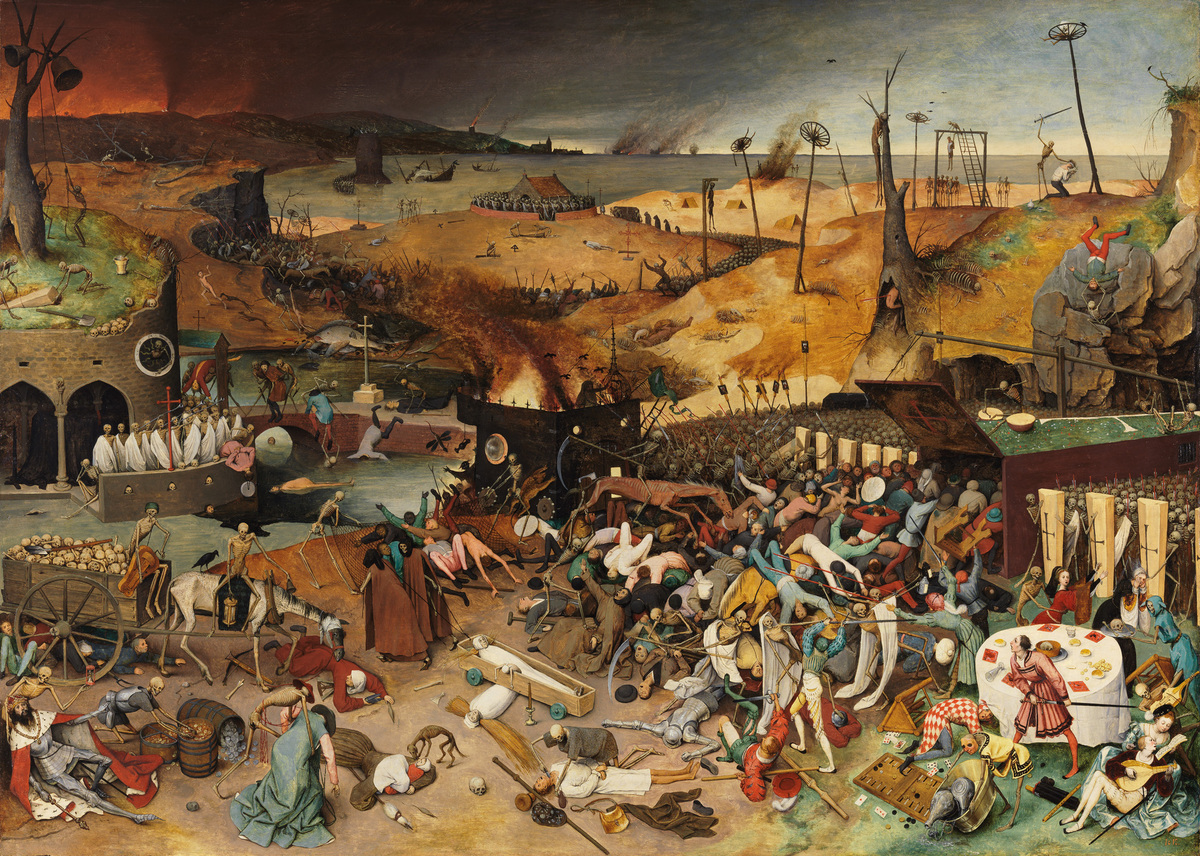
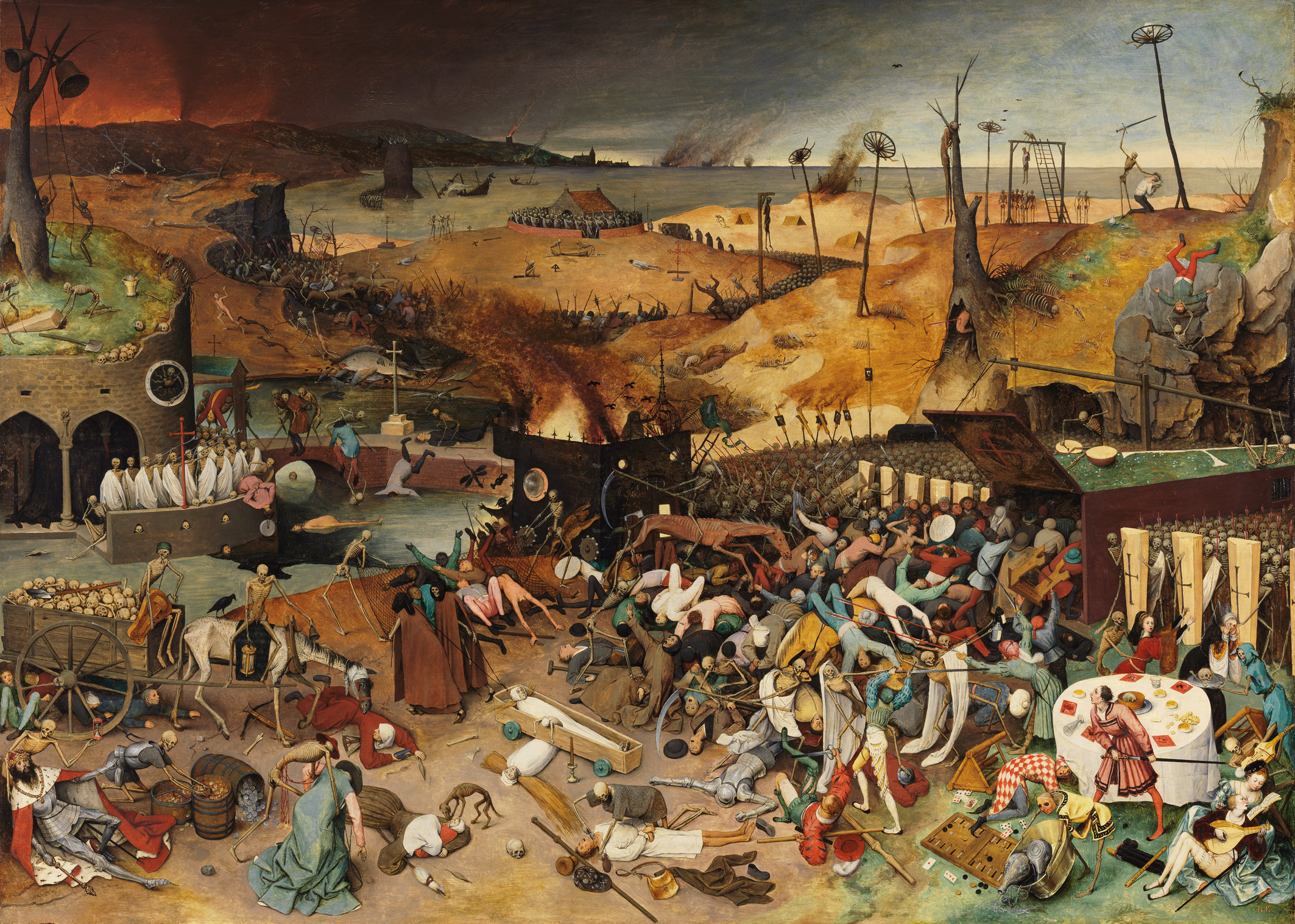
- A moralising scene showing the triumph of Death over worldly things, symbolised by a great army of skeletons laying waste to the earth. In the foreground Death leads its armies on a reddish horse, destroying the world of the living, who are driven toward a huge coffin with no hope of salvation. All social classes are included, and neither power nor devotion can save them.(Wikimedia Commons contributors, n.d.)
- Title variants
- De triomf van de Doods; The Triumph of Death
- Accession number
- P01393
- Support
- panel
The painting is catalogued as The Triumph of Death (De triomf van de Doods) and is attributed to Pieter Brueghel the Elder. The file record dates the work to circa 1562, and the qualifier matters: this is an approximate date of execution for the painting itself, established in the catalogue record, and it should not be conflated with the much later dates attached to the object's documentation, such as the 1774 inventory, the 1857 Real Museo inventory, or the 1873 to 1907 Prado catalogue. The work is oil on panel and the panel measures 117 cm in height by 162 cm in width, dimensions that establish it as a substantial, horizontally oriented support rather than a small devotional panel. The file record classifies the object type as painting and the genre as genre art, a classification that sits in tension with the moralising, universal subject the description records. The record also cites WGA work ID values and a Museo del Prado artwork ID, the identifiers by which the image is located across cataloguing systems.(Wikimedia Commons contributors, n.d., File information, Title and Artist; Date; Medium; Dimensions; Object type, Genre; References)
The attribution to Pieter Brueghel the Elder is the frame within which the date circa 1562 makes sense. The artist is recorded as a Flemish painter, drawer and printmaker who lived from between 1526 and 1530 until 9 September 1569, working in Antwerp from 1551 to 1563, in Italy in 1553, and in Brussels from 1563 to 1569. A work of about 1562 therefore falls at the end of his Antwerp years and immediately before his move to Brussels, which is to say at the point in his career when he was producing the crowded, moralising panel pictures with which the record associates him. The record's artist data is supplied as context for the object's attribution rather than as evidence of the painting's own history, but it does clarify why the catalogue qualifies the attribution and the date as it does.(Wikimedia Commons contributors, n.d., File information, Title and Artist; Date; Artist data)
Subject and iconography
LinkThe recorded composition
Visual observation
The record's description identifies a moral subject: the triumph of Death over worldly things, symbolised by a great army of skeletons laying waste to the earth. In the foreground Death leads its armies on a reddish horse, destroying the world of the living, who are driven toward a huge coffin with no hope of salvation. In the background a barren landscape still contains scenes of destruction, so destruction remains visible even where the foreground crowd recedes. The description further states that all social classes are included in the composition and that neither power nor devotion can save them. Read together, these elements give the picture a levelling argument: the same advance overtakes every rank and every form of piety, and the composition supplies no rescue.(Wikimedia Commons contributors, n.d., Description)
Competing readings in the file record
Beyond the general identification of a moral triumph, the file record preserves further description that should be weighed for what it is. The Commons caption records a description of the painting as depicting the results of a pandemic. A Czech-language description in the file record states that the painting was painted as a reaction to the plague outbreaks in Europe. A Polish-language description characterises the painting as showing the pacification of the Netherlands. The file is additionally categorised on Commons under 1540 European drought. These are attributed readings and associations carried in the record, not settled statements about Brueghel's motive, and they differ from one another in the historical occasion they attach to the scene. Their presence shows how the picture has been recruited to several different historical frameworks at once, which is itself part of its documentary history.(Wikimedia Commons contributors, n.d., Description)
Evidence and limits
Interpretation
The most defensible layer of the account is the narrow one: a documented Flemish artist working between Antwerp, Italy and Brussels; an oil panel dated around 1562, large in format, held in Madrid with a Royal Collection provenance behind it; a recorded scene of Death on a reddish horse driving the living toward a huge coffin against a barren, still destructive landscape; and a file record that also carries pandemic, plague, pacification and drought associations from several languages and contexts. The gap between the described moral subject and the various historical occasions attached to it is where the evidence currently rests. The painting matters within that gap, because it is a picture whose recorded design and whose reception history have been read as commentary on worldly levelling in general and on particular disasters in particular, and the available record supports the former much more firmly than the latter.(Wikimedia Commons contributors, n.d., Description)
In the foreground Death leads its armies on a reddish horse, destroying the world of the living, who are driven toward a huge coffin with no hope of salvation.(Wikimedia Commons contributors, n.d.)
The Object and Its Maker
The painting discussed here is The Triumph of Death (De triomf van de Doods), attributed to Pieter Brueghel the Elder and dated circa 1562. It is oil on panel, measuring 117 cm in height by 162 cm in width, and it belongs to the Museo del Prado, Madrid, with accession number P01393. At the time of the record it was located on the ground floor, room 56A of the Museo del Prado. The file record classifies the object as a painting and its genre as genre art. Brueghel himself is recorded as a Flemish painter, drawer and printmaker who lived from between 1526 and 1530 until 9 September 1569; he worked in Antwerp from 1551 to 1563, in Italy in 1553, and in Brussels from 1563 to 1569. The date of circa 1562 therefore places the panel in the Brussels period of the artist's career, after his Antwerp years and his Italian journey, though the record does not state what commission, patron or immediate circumstance produced it.(Wikimedia Commons contributors, n.d., Artist data)
Pieter Brueghel the Elder is recorded as a Flemish painter, drawer and printmaker who lived from between 1526 and 1530 until 9 September 1569, working in Antwerp from 1551 to 1563, in Italy in 1553, and in Brussels from 1563 to 1569.(Wikimedia Commons contributors, n.d.)
Materials and technique
LinkDocumentation of the reproduction
The file record supplies one piece of explicitly technical, object-level documentation about this painting: the digital reproduction is a photograph by Baztan Lacasa Jose, copyright Museo Nacional del Prado, made with a Hasselblad H3D-39. That unit establishes only the authorship, rights holder and camera used for the image file, not the materials or making of the panel itself. It matters for the section because it separates two distinct classes of evidence that are easily conflated: the painting as a physical artefact and the photographic surrogate through which it is now most often examined. Any material description that depends on studying surface, texture or layer structure is therefore mediated here by a museum-authorised, high-resolution capture, and the Commons file also records that this reproduction is a featured picture on the Hebrew-language Wikipedia, an indication of its circulation as an image rather than of its technical quality.(Wikimedia Commons contributors, n.d., Camera manufacturer and Copyright holder)
Support, medium and format
The support and medium are recorded in the Commons file: the work is oil on panel, measuring 117 cm in height and 162 cm in width, classified as a painting in the genre of genre art. These are the material and dimensional facts that anchor any discussion of technique. The evidence does not describe the species of wood, the number of panels or joins, the ground or preparation layers, the pigments, the brushwork or the varnish, and no technical imaging such as radiography or infrared reflectography is cited. A distinction must therefore be maintained between what the record establishes about medium, format and support and what it leaves unstated. The horizontal proportions of the panel are consistent with a crowded, panoramic composition, but the record does not itself connect dimensions to composition, and no such inference is offered as documented fact.(Wikimedia Commons contributors, n.d., Camera manufacturer and Copyright holder)
Identification, collection and archival trace
The same file record supplies the painting's identification as The Triumph of Death (De triomf van de Doods), attributed to Pieter Brueghel the Elder and dated circa 1562, held by the Museo del Prado, Madrid, under accession number P01393 and currently located on the ground floor in room 56A. Its object history places it in the Colección Real (Royal Collection), and cites an inventory of Carlos III at La Granja of 1774, an inventory of the Real Museo of 1857 under number 1012, and a catalogue of the Museo del Prado of 1873 to 1907 under number 1221. Further references are given to early Netherlandish Painting Volume XIV Pieter Bruegel, number 18; The complete paintings of Bruegel, number 40; and Bruegel: The Complete Paintings, Drawings and Prints, number 115. These locators matter to a materials account because they mark the documentary chain through which the physical object has been tracked across collections and publications; they record custody and cataloguing, and the record does not describe conservation treatments, condition reports, transfers or restorations at any point in that chain.(Wikimedia Commons contributors, n.d., Camera manufacturer and Copyright holder)
Composition and imagery as recorded
Visual observation
What the evidence establishes about the picture's content is descriptive and thematic rather than technical. The record characterises the work as a moral piece showing the triumph of Death over worldly things, symbolised by a great army of skeletons laying waste to the earth; in the foreground Death leads its armies on a reddish horse, destroying the world of the living, who are driven toward a huge coffin with no hope of salvation; in the background a barren landscape still contains scenes of destruction; and all social classes are included in the composition, so that neither power nor devotion can save them. Death's mount is described as reddish, and the army as skeletal, but no pigments, colour measurements or paint analysis are cited, so the colour term remains a description of appearance rather than a finding about materials. The crowding, the direction of movement toward the coffin and the persistence of destruction into the distance are observations of the composition as recorded, not deductions from examination of the panel.(Wikimedia Commons contributors, n.d., Camera manufacturer and Copyright holder; Description)
Interpretive associations in the record
Interpretation
The Commons record preserves several contextual readings attached to the scene: a caption describing the painting as depicting the results of a pandemic; a Czech-language description stating that it was painted as a reaction to the plague outbreaks in Europe; a Polish-language description characterising it as showing the pacification of the Netherlands; and a category on Commons under '1540 European drought'. These are reported associations rather than settled facts about Brueghel's motive, and none of them is supported in the record by technical or documentary evidence about the painting's making. They are noted here because they illustrate how an object accrues interpretive labels around it, including labels whose dates and premises sit awkwardly with a work dated circa 1562. The evidence does not establish that any of these circumstances shaped the picture, and the record offers no pigment, layer or underdrawing evidence that could connect the imagery to a specific event.(Wikimedia Commons contributors, n.d., Camera manufacturer and Copyright holder)
Artist, dating and identification systems
Placing the object within Brueghel's working life helps date and situate the materials. The record gives Pieter Brueghel the Elder as a Flemish painter, drawer and printmaker who lived from between 1526 and 1530 until 9 September 1569, working in Antwerp from 1551 to 1563, in Italy in 1553, and in Brussels from 1563 to 1569. A date of circa 1562 therefore falls at the end of the Antwerp period and immediately before the move to Brussels, a transition the record documents as biography rather than as a fact about this panel's execution. The painting is further identified by a WGA work ID and a Museo del Prado artwork ID, which are identifiers rather than physical evidence, but they indicate that the object is indexed in both general and institutional art-historical resources. Nothing in the evidence specifies where the panel was made, for whom, or in what workshop conditions, so those questions remain open.(Wikimedia Commons contributors, n.d., Camera manufacturer and Copyright holder)
Provenance and ownership
LinkDocumented Custody
The painting now in the Museo del Prado, Madrid, carries an object history that places it within the Colección Real, the Spanish royal collection. That institutional attribution of ownership is the baseline from which the documented record begins. It is also the only custody the supplied object history states directly, so the picture's movement before its entry into royal hands is not evidenced here and should not be reconstructed from the absence of records. The same source records the work's current repository, the Museo del Prado, together with the accession number P01393.(Wikimedia Commons contributors, n.d., Object history)
The chronological markers supplied for the object are inventory and catalogue entries rather than deeds of transfer. An inventory of Carlos III at La Granja is dated 1774, locating the painting at that royal site in that year. A later inventory of the Real Museo, dated 1857, records the work under number 1012. A catalogue of the Museo del Prado covering 1873 to 1907 records it under number 1221. Read in sequence, these references document the painting's presence within royal and then museum collections across the eighteenth and nineteenth centuries and into the early twentieth, and they show the numbering systems under which it was tracked as the collecting institution changed.(Wikimedia Commons contributors, n.d., References; Object history)
The object history assembled in the file record cites further scholarly apparatus alongside the inventory entries: early Netherlandish Painting Volume XIV Pieter Bruegel, number 18; The complete paintings of Bruegel, number 40; and Bruegel: The Complete Paintings, Drawings and Prints, number 115. These are catalogue references attached to the record rather than ownership events, and they matter for provenance in a different way: they show the painting entering the numbered literature of Bruegel scholarship, where it is catalogued and counted among the artist's works. The same file record supplies a WGA work ID and a Museo del Prado artwork ID, identifiers of the modern documentation layer rather than of historical custody.(Wikimedia Commons contributors, n.d., References)
Uncertainty and Gaps
Interpretation
What the provenance record establishes and what it leaves open should be kept apart. Ownership by the Colección Real is stated, and the 1774, 1857 and 1873 to 1907 references place the object at La Granja, then in the Real Museo inventory, then in the Prado catalogue. No acquisition date, vendor, gift, bequest or intermediate owner is supplied, and no interval between these entries is described as a change of ownership. The record therefore supports an unbroken documented connection to the Spanish royal and national collections from at least 1774, but it does not supply the chain by which the painting reached that collection. Distinguishing an unrecorded interval from a documented transfer is essential here, since the evidence gives the latter only at the level of collection membership, not of transaction.(Wikimedia Commons contributors, n.d., Object history; References)
The Object and Its Identifiers
Provenance in this case is inseparable from the object's identification, because the entries that track the painting also fix what it is. The file record titles it The Triumph of Death (De triomf van de Doods), attributes it to Pieter Brueghel the Elder, dates it circa 1562, and describes it as oil on panel measuring 117 cm in height and 162 cm in width, classified as a painting in the genre of genre art. It is currently located on the ground floor, room 56A of the Museo del Prado. The artist is separately recorded as a Flemish painter, drawer and printmaker who lived from between 1526 and 1530 until 9 September 1569, working in Antwerp from 1551 to 1563, in Italy in 1553, and in Brussels from 1563 to 1569. Those dates situate the making of the panel within his Brussels period, while the attribution itself remains a scholarly ascription carried in the catalogues cited above.(Wikimedia Commons contributors, n.d., References; Artist data)
The picture's subject as described is a moral triumph: Death over worldly things, figured by a great army of skeletons laying waste to the earth, with Death leading its armies on a reddish horse in the foreground and the living driven toward a huge coffin with no hope of salvation. All social classes are included in the composition, and neither power nor devotion can save them. In the background a barren landscape still contains scenes of destruction. These descriptions concern iconography rather than custody, but they are relevant to provenance because they underpin the cataloguing by which the object was repeatedly inventoried and numbered.(Wikimedia Commons contributors, n.d., References)
Reported Contexts Beyond Provenance
The file record also carries contextual associations that do not form part of the documented ownership history. A Commons caption records a description of the painting as depicting the results of a pandemic; a Czech-language description states that it was painted as a reaction to the plague outbreaks in Europe; and a Polish-language description characterises it as showing the pacification of the Netherlands. The file is additionally categorised under the 1540 European drought. These are reported readings and categorisations rather than settled facts about the artist's motive or about the circumstances of the commission, and none of them is attached to an owner, sale or transfer.(Wikimedia Commons contributors, n.d., References; Object history)
The object history cites an inventory of Carlos III at La Granja, 1774; an inventory of the Real Museo, 1857, number 1012; and a catalogue of the Museo del Prado, 1873-1907, number 1221.(Wikimedia Commons contributors, n.d.)
Provenance timeline
- 1774
The work is recorded in an inventory of Carlos III at La Granja.(Wikimedia Commons contributors, n.d., References)
- 1857
The work is entered in an inventory of the Real Museo, number 1012.(Wikimedia Commons contributors, n.d., References)
- 1873-1907
The work appears in a catalogue of the Museo del Prado, number 1221.(Wikimedia Commons contributors, n.d., References)
Reception and literature
LinkContested Historical Occasions
Interpretation
Later reception of the painting has attached several historical occasions to it, and the evidence distinguishes those attachments from any documented statement of the artist's motive. A Czech-language description in the file record states that the painting was painted as a reaction to plague outbreaks in Europe, while a Polish-language description characterises it as showing the pacification of the Netherlands. The file is also categorised on Commons under '1540 European drought'. These are contextual associations and reported readings rather than settled facts about why Brueghel made the picture; the Commons caption's description of the painting as depicting the results of a pandemic belongs to the same layer of interpretation. The chronological gap matters for weighing them: the reported readings propose occasions separated from one another, and none is presented in the record as documented cause. What the evidence supports is that successive audiences have found in the image a vehicle for naming catastrophe and political violence, each description selecting a different historical frame for the same composition.(Wikimedia Commons contributors, n.d., Other versions; Artist data)
Reproduction and the Scholarly Apparatus
Reproduction has been a further stage of the work's reception, and it operates through specific, credited technical means rather than as an anonymous circulation. The digital reproduction in the file record is a photograph by Baztan Lacasa Jose, copyright Museo Nacional del Prado, made with a Hasselblad H3D-39; that reproduction is a featured picture on the Hebrew-language Wikipedia. The same file record cites reference literature on the painting through early Netherlandish Painting Volume XIV Pieter Bruegel number 18, The complete paintings of Bruegel number 40, and Bruegel: The Complete Paintings, Drawings and Prints number 115, and it also cites WGA work ID values and a Museo del Prado artwork ID. Reception here is therefore layered: a museum-authorised photograph, an encyclopedic platform that elevates selected images, and a scholarly apparatus of catalogue numbers and databases each fix the work in a different system of reference. The object type is classified in the file record as painting, with genre art as its genre, and these classifications are themselves part of how the work is received, since they determine which histories and which comparisons the image is placed alongside.(Wikimedia Commons contributors, n.d., Other versions; Artist data)
The object history cites early Netherlandish Painting Volume XIV Pieter Bruegel, number 18; The complete paintings of Bruegel, number 40; and Bruegel: The Complete Paintings, Drawings and Prints, number 115.(Wikimedia Commons contributors, n.d.)
Interpretations and debates
LinkAttributed Readings in the File Record
Interpretation
Interpretation of this panel turns on a set of readings supplied by the same Wikimedia Commons file record that carries the work's identification data. That description states the work is a moral piece showing the triumph of Death over worldly things, symbolised by a great army of skeletons laying waste to the earth. The same account holds that all social classes are included in the composition, and that neither power nor devotion can save them, so that the levelling of rank and piety is presented as the argument the imagery makes visible. These are attributed readings of the picture rather than statements about what the maker privately intended, and the file record does not document Brueghel's motive. Their interpretive weight rests on features the record separately describes: in the foreground Death leads its armies on a reddish horse, destroying the world of the living, and the living are conducted toward a huge coffin, without hope of salvation.(Wikimedia Commons contributors, n.d., Description)
The description's components are closely aligned with one another. Death's mounted leadership in the foreground and the removal of any hope of salvation belong to the same narrative, and the claim that no class or devotion can save the victims presupposes exactly the kind of forced movement toward the coffin that the foreground describes. Because all four statements come from a single source whose locator is the file's description, they are best treated as one coherent interpretive apparatus rather than as four independently corroborated findings. Nothing in the evidence establishes that the maker wrote, dictated or endorsed this programme, so the moral reading should be cited as the record's interpretation and not as the painter's stated purpose.(Wikimedia Commons contributors, n.d., Description)
The same foreground detail appears both as interpretation and as observation in the evidence. Where the interpretive unit presents Death as leading its armies on a reddish horse in the foreground, a parallel observation unit states that in the foreground Death leads its armies on a reddish horse, destroying the world of the living, who are driven toward a huge coffin with no hope of salvation. This overlap matters methodologically: the visible element, a mounted figure leading the dead, is what the moral reading is built upon, and the language of destruction and hopelessness has been folded into the description of what is seen. A related observation records that in the background a barren landscape still contains scenes of destruction, extending the destructive action beyond the crowded foreground. Taken together, these units show that the interpretation is anchored in describable features of the composition while also colouring the way those features are verbalised.(Wikimedia Commons contributors, n.d., Description)
Competing Explanatory Frames in the Record
The file record also preserves contextual associations that go well beyond a moral reading, and they are not mutually consistent. A Commons caption records a description of the painting as depicting the results of a pandemic. A Czech-language description in the file record states that the painting was painted as a reaction to the plague outbreaks in Europe. A Polish-language description characterises the painting as showing the pacification of the Netherlands. The file is additionally categorised on Commons under "1540 European drought". These are reported readings and associations attached to the file, not settled facts about Brueghel's motive; they propose different historical occasions, from epidemic to political pacification to climate, and the record supplies no documentation that would adjudicate between them or establish any of them as the cause of the painting. Their presence in the same file that carries the moral description illustrates how a single object can accumulate competing explanatory frames in an open, collaboratively edited record.(Wikimedia Commons contributors, n.d., Description)
Placing the moral reading beside the documented facts about the maker does not resolve the question of intent. Pieter Brueghel the Elder is recorded as a Flemish painter, drawer and printmaker who lived from between 1526 and 1530 until 9 September 1569, working in Antwerp from 1551 to 1563, in Italy in 1553, and in Brussels from 1563 to 1569. The painting itself is dated circa 1562, which places its making in the artist's Brussels years, after the Antwerp period and the Italian journey. That chronology is compatible with the plague, political and climatic associations proposed in the file, but it does not connect the panel to any one of them, and the evidence contains no statement by the artist, contract or contemporary commentary that would establish his intent. The biographical frame therefore situates the work without explaining its programme.(Wikimedia Commons contributors, n.d., Description; Artist data)
The afterlife of the image in digital circulation is part of the evidence for how it is received. The reproduction in the file record is a photograph by Baztan Lacasa Jose, copyright Museo Nacional del Prado, made with a Hasselblad H3D-39, and it is a featured picture on the Hebrew-language Wikipedia. That designation indicates the file has been judged among the best available images on that project, and it explains why this particular reproduction, rather than any other, is the one through which the composition is encountered by many readers. The interpretive claims discussed here are attached to that reproduction and to the descriptions that accompany it, so the moral reading and the competing pandemic, pacification and drought associations circulate together with the Prado photograph as a single documentary package.(Wikimedia Commons contributors, n.d., Description; Other versions)
Reported tradition
The Wikimedia Commons file record for The Triumph of Death by Pieter Bruegel the Elder does not present a single, settled account of what historical occasion the painting addresses. Several descriptions coexist in the same record, and each attaches the image to a different referent. One caption describes the painting as depicting the results of a pandemic. A Czech-language description states that the painting was painted as a reaction to the plague outbreaks in Europe. A Polish-language description characterises the painting as showing the pacification of the Netherlands. Separately, the file is categorised under '1540 European drought'. These four readings are recorded side by side rather than reconciled, and each is a reported tradition rather than a documented statement of the artist's motive. Their range is itself the useful finding: the same composition has been connected both to epidemic disease and to political pacification, two quite different kinds of historical event, and to a climate episode dated well before the painting's own period.(Wikimedia Commons contributors, n.d., Captions, Simple English; Description, Čeština; Description, Polski; Categories)
Competing historical attachments in the file record
Interpretation
The internal relationships among these accounts deserve care. The pandemic caption is the least specific: it does not name a disease, a region or a date, and it describes the painting as depicting results rather than responding to an event. The Czech description is more specific in claiming a reaction to plague outbreaks in Europe, which converts the image from an illustration of consequences into a response to a calamity. The Polish description shifts the subject entirely, from disease to the pacification of the Netherlands, so it is not a variant of the plague reading but a rival one. The '1540 European drought' category introduces a third frame, a climatic rather than epidemic or political context, and its date sits decades before the painting's own documented period. Taken together, the record shows a painting whose captioning has accommodated plague, war and drought, which indicates that the historical attachment is supplied by later description rather than fixed by the object's own documentation. Reported traditions of this kind may preserve genuine period associations, but they do not establish the painter's intention, and the evidence here does not adjudicate between them.(Wikimedia Commons contributors, n.d., Captions, Simple English; Description, Čeština; Description, Polski; Categories)
Object-specific literature
The recorded object-specific literature on this painting is cited in the object history through numbered entries in three reference works: early Netherlandish Painting Volume XIV Pieter Bruegel, number 18; The complete paintings of Bruegel, number 40; and Bruegel: The Complete Paintings, Drawings and Prints, number 115. These citations are catalogue-style locations within larger corpora rather than statements of argument, so they establish that the painting has a place in the standard reference literature on Bruegel and that the object history was compiled with those works at hand. Because the citations are given only as work-plus-number, they do not by themselves show what any of the three works says about the picture, nor whether their treatments agree. The listing is therefore best read as a bibliographic footprint: it tells us which scholars' or editors' compilations the object record depends on, and it marks the painting as an item catalogued across the twentieth- and twenty-first-century Bruegel literature rather than as a marginal or unattributed work.(Wikimedia Commons contributors, n.d., References)
That footprint matters for how the rest of the record should be weighed. The same object history that carries these catalogue numbers also anchors the painting in an institutional sequence, citing an inventory of Carlos III at La Granja, 1774; an inventory of the Real Museo, 1857, number 1012; and a catalogue of the Museo del Prado, 1873-1907, number 1221. Read together, the catalogue citations and the inventory citations show two different kinds of literature converging on one object: the Bruegel monographic and catalogue-raisonne tradition on one side, and the Spanish royal and museum documentation on the other. The object history places the work in the Colección Real (Royal Collection) before its museum life. This convergence is the reason the literature coverage is not merely a list. It is the mechanism by which a panel painting moves from private royal property into the numbered, catalogued, publicly accountable holdings of a national museum, and the numbered entries in the Bruegel literature are the counterpart, in art-historical writing, to the inventory numbers in the palace and museum records.(Wikimedia Commons contributors, n.d., References; Object history)
The larger Bruegel literature named here can be connected to the artist's documented career, which the same source records: Pieter Brueghel the Elder was a Flemish painter, drawer and printmaker who lived from between 1526 and 1530 until 9 September 1569, working in Antwerp from 1551 to 1563, in Italy in 1553, and in Brussels from 1563 to 1569. The painting is dated circa 1562, so the moment of its making falls in the Antwerp years just before the move to Brussels, a placement that gives the monographic literature cited in the object history a specific period to argue about. It also means the reference works cited are dealing with a painter whose printmaking and drawing output was substantial, which is why one of the catalogue titles cited covers paintings, drawings and prints together rather than paintings alone. That breadth is a fact about the literature's scope, not a claim about this panel's own status within it.(Wikimedia Commons contributors, n.d., References; Artist data)
Documented values and qualified estimates
LinkThe object and its documented record
Interpretation
The object at the centre of this record is a painting on panel in oil, measuring approximately 117 by 162 centimetres, attributed to Pieter Bruegel the Elder and dated circa 1562. It belongs to the Museo del Prado, Madrid, under accession number P01393, and is recorded there on the ground floor, room 56A. The object history places it in the Colección Real, the Royal Collection, and cites a 1774 inventory of Carlos III at La Granja, an 1857 inventory of the Real Museo numbered 1012, and a Museo del Prado catalogue of 1873 to 1907 numbered 1221. Those locators matter because they establish a documented institutional life for the panel reaching back into the eighteenth-century Spanish royal collections, well before its modern museum display. The Commons file record classifies the object type as painting and the genre as genre art, and the supporting literature is indexed there to early Netherlandish Painting Volume XIV Pieter Bruegel number 18, The complete paintings of Bruegel number 40, and Bruegel: The Complete Paintings, Drawings and Prints number 115, alongside WGA work ID values and a Museo del Prado artwork ID.(Wikimedia Commons contributors, n.d.)
Both this record and the institutional context set out a single artist biography: Pieter Brueghel the Elder is recorded as a Flemish painter, drawer and printmaker who lived from between 1526 and 1530 until 9 September 1569. He worked in Antwerp from 1551 to 1563, in Italy in 1553, and in Brussels from 1563 to 1569. The Italian journey and the Brussels decade bracket the circa 1562 date given for this panel, and the span of activity between Antwerp and Brussels is the frame in which the painting's making is conventionally placed. The record supplies no workshop, commission, patron or payment document for the picture itself, so the biography locates the artist's career without establishing the circumstances of this specific commission.(Wikimedia Commons contributors, n.d.)
The composition is described in the source as a moral piece showing the triumph of Death over worldly things, symbolised by a great army of skeletons laying waste to the earth. In the foreground Death leads its armies on a reddish horse, destroying the world of the living, who are driven toward a huge coffin with no hope of salvation. All social classes are included in the composition, and neither power nor devotion can save them. In the background a barren landscape still contains scenes of destruction. These are the elements the record establishes for the panel: the mounted figure of Death, the coffin as destination, the levelling of ranks and of piety alike, and destruction persisting in the far distance even where the crowd thins.(Wikimedia Commons contributors, n.d.)
Competing contextual readings
The record preserves several interpretive readings rather than a single settled account. The Commons caption itself records a description of the painting as depicting the results of a pandemic. A Czech-language description in the file record states that the painting was painted as a reaction to the plague outbreaks in Europe, and a Polish-language description characterises it as showing the pacification of the Netherlands. The file is additionally categorised on Commons under 1540 European drought. These attachments come from a collaborative file record rather than from Brueghel's own documentation, and they propose different historical occasions, a plague, a political pacification and a climatic event, for the same imagery. They should be handled as reported readings and contextual associations, not as documented causes of the painting. The categorisation under the 1540 drought sits awkwardly beside the circa 1562 date and the plague reading, which is itself a reason to treat the file's contextual labels as accretions rather than findings.(Wikimedia Commons contributors, n.d.)
Surrogates and circulation
The digital reproduction through which the work circulates is separately documented. The file record identifies the photograph as by Baztan Lacasa Jose, copyrighted to the Museo Nacional del Prado, and made with a Hasselblad H3D-39. The reproduction is a featured picture on the Hebrew-language Wikipedia. This is evidence about the image file and the museum's photographic documentation of the panel, not about the panel's own making; it shows how an institution controls and disseminates a high-resolution record of a museum-held work and how that record acquires recognition across language communities.(Wikimedia Commons contributors, n.d.)
Valuation as a qualified working figure
No public sale or official insurance value for the painting is provided in the supplied sources. The calculated working insurance estimate is a model-generated range of US$50M to US$250M, recorded as a working calculation generated on 2026-10-16 for manual review. Its stated methodology takes the confirmed artwork context, meaning the very large oil on panel by a highly prominent Northern Renaissance painter, together with the supplied Wikimedia Commons and institutional record excerpts that confirm title, artist, date, medium, dimensions, accession number P01393 and current location at the Museo del Prado. Because no directly comparable market transaction or official insurance figure appears in those sources, the calculation uses conservative qualitative anchor tiers rather than fabricated comparables, and the range is deliberately broad. The accompanying qualification is explicit: it is not an official insurance value, appraisal, auction result or sale price; it does not draw on private insurance records and is not based on comparable sales; the supplied URLs provide object context only; and actual insurance values must be determined by qualified appraisers, insurers and institutional specialists using physical inspection, provenance, condition and applicable policy terms. Read alongside the object record, this valuation unit documents only that a manual-review figure was generated and how it was bounded, not a market fact about the painting.(Wikimedia Commons contributors, n.d.)
Working estimate
Calculated working insurance estimate, not a sale price: Estimated value: US$50M to US$250M Recorded date: Working calculation, generated 2026-10-16. Methodology: This broad working insurance range was calculated for manual review from the confirmed artwork context and the supplied Wikimedia Commons and institutional record excerpts. The artwork is a very large oil on panel, approximately 117 by 162 cm, by Pieter Bruegel the Elder, dated circa 1562, a highly prominent Northern Renaissance painter. The excerpts confirm the title, artist, date, medium, dimensions, accession number P01393, and current location at the Museo del Prado. The work is an internationally famous, museum-held masterpiece, and no public sale or official insurance value was provided. Because no directly comparable market transaction or official insurance figure is available in the supplied sources, the model uses conservative qualitative anchor tiers rather than fabricated comparables. The range is intentionally broad and should be treated only as an indicative working figure for further manual review. Qualification: This is a model-generated working range for manual review only. It is not an official insurance value, appraisal, auction result, or sale price. It does not reflect access to private insurance records, and it is not based on comparable sales. The supplied URLs provide object context only. Actual insurance values must be determined by qualified appraisers, insurers, and institutional specialists using physical inspection, provenance, condition, and applicable policy terms.(Wikimedia Commons contributors, n.d.)