The story About 5 minutes to read
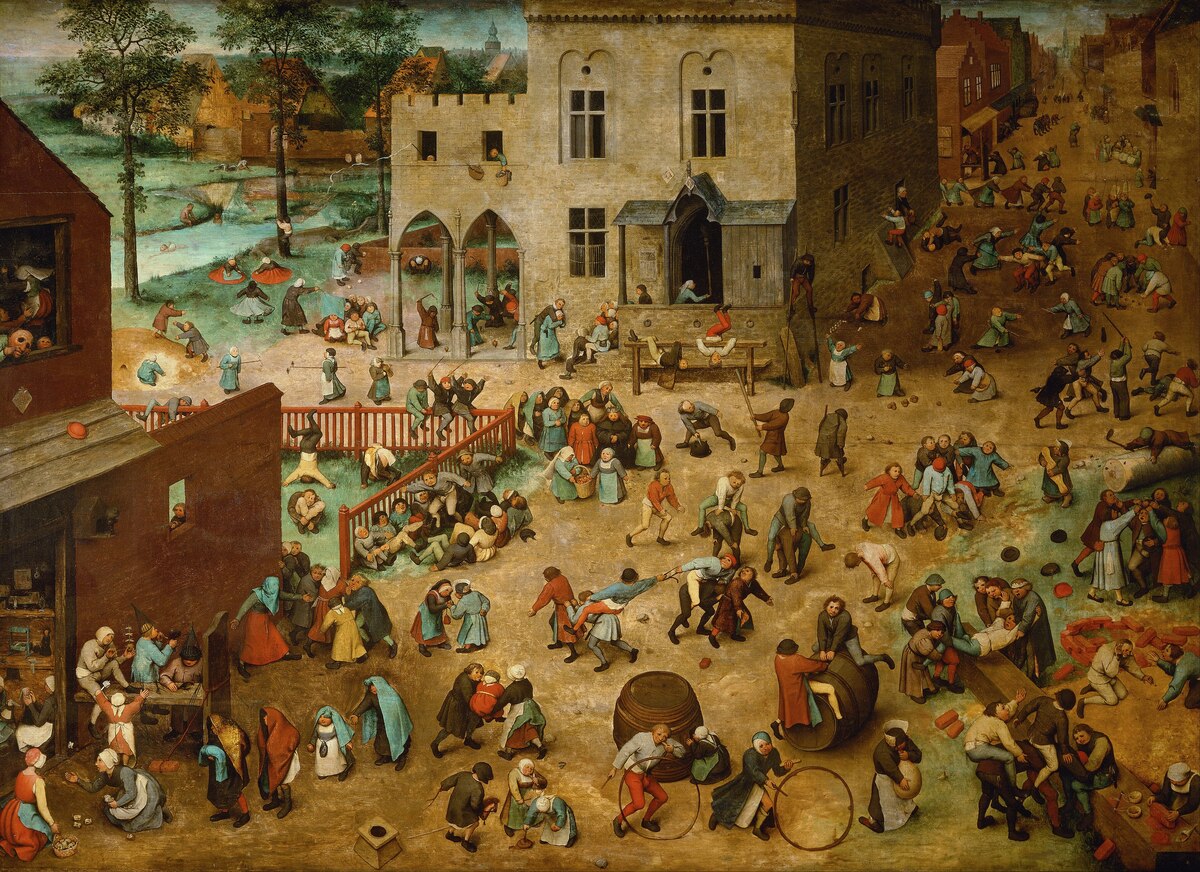
What is this painting about? It is a painting called Children's Games, painted in 1560 by Pieter Bruegel the Elder.
The source describes a scene of children playing in a street or square. If you look at the full surface, you see children at play, not a single dramatic moment.
The work is held in the Kunsthistorisches Museum in Vienna, according to the Commons record, but what draws us in is the subject itself.
The painting does not give you one central episode. Instead, it presents children playing in a street or square, spread across the picture.
The source calls the main subject Children's Games. That tells you the painting is about play as a general activity, not one particular game or one particular child.
Even without a close look at every figure, the overall arrangement asks you to scan and compare, not to follow a story.
Bruegel was a Flemish painter, drawer and printmaker. He lived from about 1526 or 1530 to 1569.
He worked in Antwerp from 1551 to 1563, and then in Brussels from 1563 to 1569. So when he painted Children's Games, he was working in the Southern Netherlands.
The painting is associated with the Northern Renaissance through Bruegel's period and the date of 1560.
The painting is dated 1560 according to the French caption on the Commons file record. That date comes from the source, not from an inscription inspected here.
The painting is oil on panel, as the supplied medium states. That is a common support for Northern Renaissance paintings of this period.
Knowing the date and the medium helps place the work in Bruegel's career, but it does not yet tell us what each group of children is doing.
The source's subject summary is that the painting organizes play as an encyclopedia of childhood behaviour rather than a single episode.
That reading fits the overall look of the scene: many children, many activities, no one focal event that resolves them into a story. The work asks you to look across, not just at one spot.
The painting is not a narrative in the usual sense. Its interest lies in variety and accumulation, not in suspense or resolution. The source supports this as an interpretation of the work's organizing idea.
So the painting is not simply a charming picture of children. It is a structured view of play, arranged as a wide survey of games and activities.
The source's phrase encyclopedia of childhood behaviour is important. It suggests that what matters is the range of play, not one moral lesson or one exemplar.
That reading changes how you might look. Instead of asking what happens next, you ask what kinds of activity are being shown and how they are distributed.
What should you take away? Bruegel's Children's Games is a painting about the many forms of children's play, presented across a street or square. Its subject is play itself as a broad human activity.
The source supports that the work is called Children's Games, that it is dated 1560, and that it is held in the Kunsthistorisches Museum in Vienna. Those are the solid facts we have here.
Beyond that, the source offers the interpretation that the painting works like an encyclopedia of childhood behaviour. That is the argument this tour can honestly make, and it is enough to explain why the painting still holds our attention.