ArchiveThe Fall of the Rebel Angels

Artwork record / 202 of 331

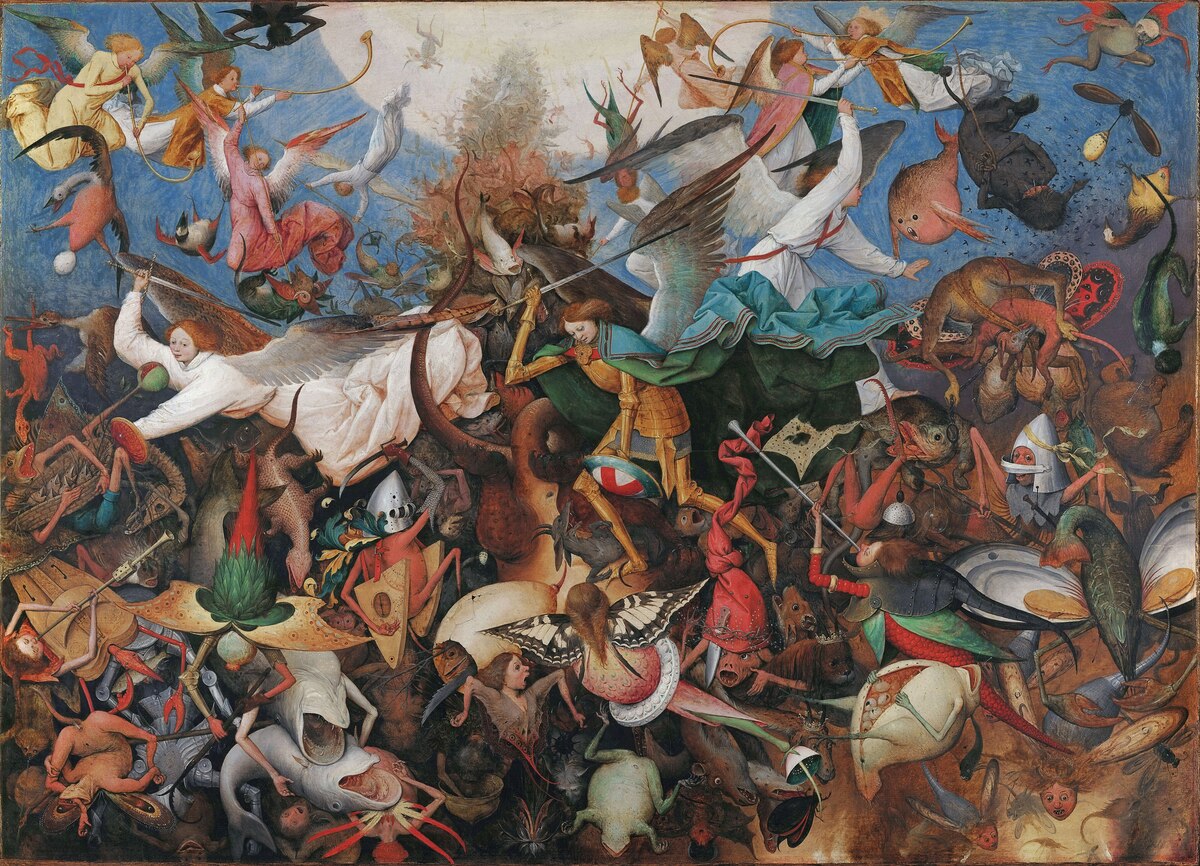
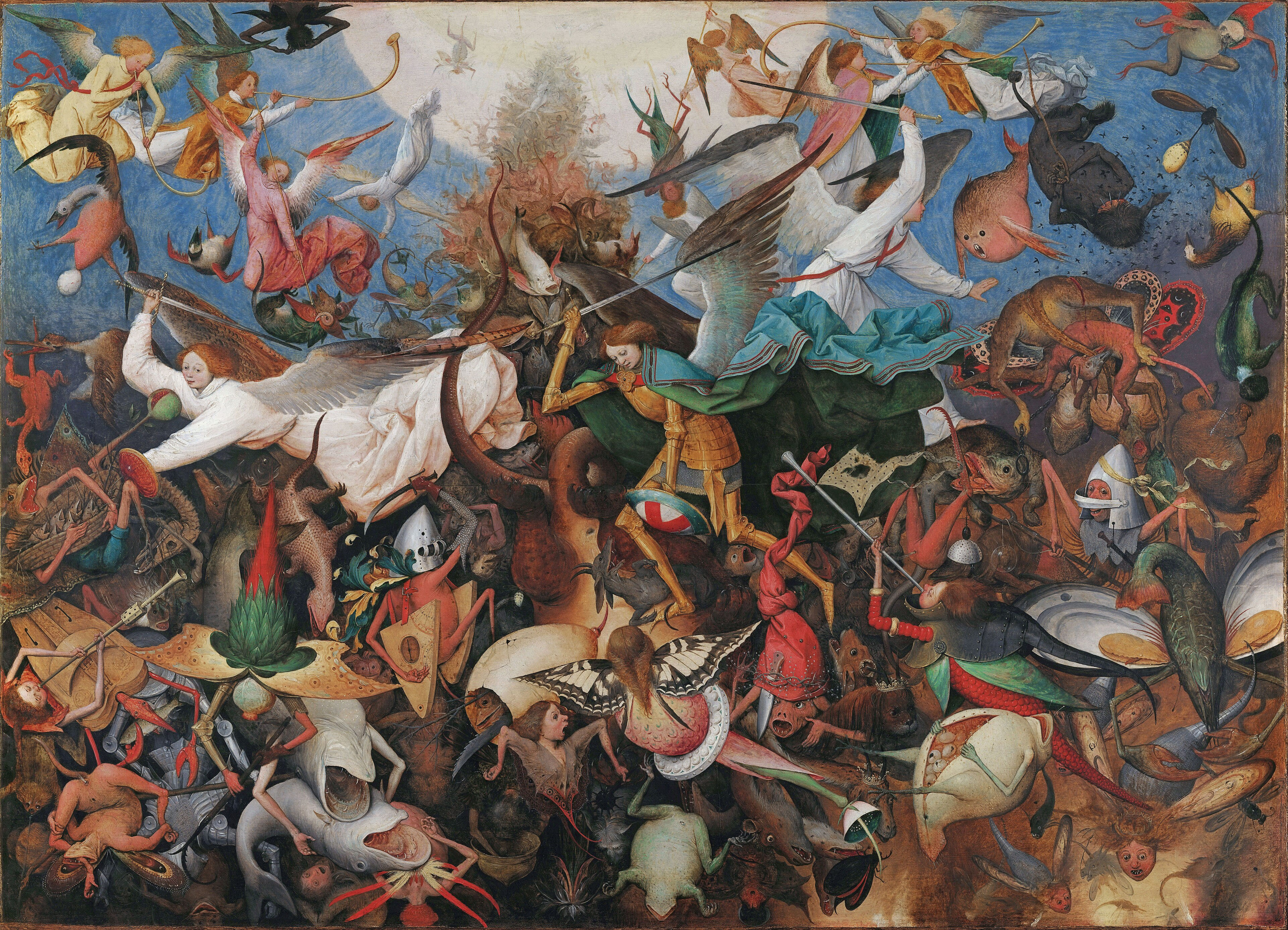
The Fall of the Rebel Angels by Pieter Bruegel the Elder (1562)

Artist: Pieter Bruegel the Elder

A docent-led reading of Pieter Bruegel the Elder's 1562 panel in Brussels, in which the archangel Michael and the faithful angels drive a grotesque, metamorphosing host of rebel angels out of heaven. The account follows the battle downward through the painting's crowded sky, distinguishing what the panel shows from the scriptural tradition behind it.

Read the story ↓ About the artist ↓ Research and record ↓ Literature and sources ↓ Listen to the article ↓
Article text for AI
Shop this artwork ↓ 0 visits
Date1562CultureFlemish PeriodNorthern RenaissanceCurrent locationRoyal Museums of Fine Arts of Belgium, Brussels, Belgium
Listen to the article
100%
The Fall of the Rebel Angels by Pieter Bruegel the Elder (1562)
Loading full-resolution artwork…
Scroll to zoom · drag to pan · double-click to focus Pinch to zoom · drag to explore · double-tap to focus FIELD VIEW / 202
Tools & download
Pixel colour Select a pixel with the eyedropper
No pixel selected

Choose the eyedropper, then click or tap the image. Scroll to zoom for finer selection.

Add text

Hand to pan · Select to move text and drawings · Add as many texts as you like · Scroll to zoom

The Fall of the Rebel Angels: high-resolution image

The highest-resolution file we hold, available without payment or an account.3,840 × 2,772 pixels.

Download highest-resolution image

Details to notice

About 4 minutes to read
01

Hybrid demons with shell shields

The dense knot of monsters at the lower left, including a demon using a mussel shell as a shield and bulbous egg-bodied creatures, showing how bodies, armour and everyday objects merge into grotesque forms.

02

Fish-headed demon with a lance

In the lower right, a demon whose head and body mutate into fish forms, brandishing a long lance amid other grotesque hybrid creatures, a prime example of Bruegel's metamorphosing rebels.

03

Angel plunging in a blue skirt

A winged figure in white and a vivid teal-blue skirt tumbling headlong downward on the right of centre, its billowing drapery marking the downward motion of the defeated host.

Portrait unrecorded

About the makers

Pieter Bruegel the Elder

Individual life dates unrecorded

Biographical details and a verified portrait have not yet been recorded for this attribution.

The research & record

Study the work.
Follow the evidence.

Find catalogue details, historical context, technical research and the literature behind this artwork.

Article text for AI
Open research text

The artwork record

Research catalogue

Catalogue information and detailed research, with references that link to the bibliography.

Updated .

Identity and catalogue

Link
Artist or attribution
Pieter Bruegel the Elder
Object date
1562
Dimensions
height: 1,170 mm (46.06 in); width: 1,620 mm (63.77 in)(Wikimedia Commons: The Fall of the Rebel Angels, n.d.)
Current collection or location
Royal Museums of Fine Arts of Belgium, Brussels, Belgium(Wikimedia Commons: The Fall of the Rebel Angels, n.d.)
Movement or period
Northern Renaissance
Country or culture
Flemish
Depicted subject
The archangel Michael and the faithful angels drive the rebel angels, shown as grotesque hybrid creatures, out of heaven.(Wikimedia Commons: The Fall of the Rebel Angels, n.d.)
Title variants
De aartsengel Michaël doodt de apocalyptische draak; De val der opstandige engelen; The Fall of the Rebel Angels; Падение мятежных ангелов
Accession number
584
Support
oak wood
Catalogue Identity

The object is catalogued under the title The Fall of the Rebel Angels and attributed to Pieter Bruegel the Elder, also recorded as Pieter Brueghel the Elder (1526/1530-1569). In the object record the work is classified as religious art, and the same record identifies its depicted subject as the archangel Michael defeating the apocalyptic dragon, with the rebel angels cast out of heaven. The subject is described as coming from the tradition of the Book of Revelation in Christian scripture, as reported in the record's title and description; that is an attribution of narrative source, not eyewitness testimony about the event depicted.(Wikimedia Commons: The Fall of the Rebel Angels, n.d., File information; Summary; Summary (Genre); Description; Depicted people: Michael)

The painting is titled The Fall of the Rebel Angels and is attributed to Pieter Bruegel the Elder, also recorded as Pieter Brueghel the Elder (1526/1530-1569).(Wikimedia Commons: The Fall of the Rebel Angels, n.d.)

The painting depicts the archangel Michael defeating the apocalyptic dragon, with the rebel angels cast out of heaven.(Wikimedia Commons: The Fall of the Rebel Angels, n.d.)

The work is classified in the object record as religious art.(Wikimedia Commons: The Fall of the Rebel Angels, n.d.)

Subject and iconography

Link
The panel and its making

Visual observation

The painted surface is a large oak panel, 1,170 millimetres high by 1,620 millimetres wide, or roughly 117 by 162 centimetres. That landscape format matters for how the picture is read: it gives the composition width to spread a crowd across, but far less height than a tall altarpiece panel would, so the fall is compressed into a broad field rather than a long vertical drop. The work is dated 1562 and executed in oil on oak, placing it within sixteenth-century Netherlandish panel painting practice, where a rigid wooden support carried oil paint built up in layers. The evidence supplied here records the dimensions, date, medium and support, but it does not include a condition report, conservation treatment history or technical analysis such as dendrochronology, so questions about the age of the tree, later intervention or present physical condition cannot be answered from these units.(Wikimedia Commons: The Fall of the Rebel Angels, n.d., Summary; Summary; Structured data (inception 1562))

Reading the picture: the centre and its inhabitants

At the centre of the composition stands the archangel Michael, and the account of him is unusually specific about equipment and colour. He wears gilded plate armour over a green-blue cloak, a plumed helmet, and carries a raised sword in his right hand and a red-and-white patterned shield on his left arm. He is described as pressing forward as the pivot of the battle. Viewed as a piece of visual organisation, this combination of gilding, saturated blue-green cloak and patterned shield makes him the most legible single figure in the panel, and the raised sword establishes the direction of his movement. The gilt surface also separates him tonally from the surrounding crowd. The subject overall is the archangel Michael defeating the apocalyptic dragon, with the rebel angels cast out of heaven, a narrative the record traces to the tradition of the Book of Revelation in Christian scripture. The panel is classified in the object record as religious art, which is consistent with that scriptural subject rather than with a secular or genre scene.(Wikimedia Commons: The Fall of the Rebel Angels, n.d., Vision-derived semantic focus candidate, priority 1; Summary)

Around Michael the record identifies a set of distinct figures whose positions and gestures organise the action. On the left side a large angel in a sweeping white gown leans out of the sky holding a long sword, described as one of the clearest expressions of divine force driving the demons down. In the upper left, within a blue zone of the painting, angels with long trumpets appear with wings spread and garments flying above the mass of creatures below. To the right of centre, a winged figure in white with a vivid teal-blue skirt tumbles headlong downward, with billowing drapery marking the downward motion of the defeated host. Taken together, these three figures pull in different directions: the left angel and the trumpeters hold the upper and leftward zones, while the falling figure right of centre drives the eye downward. That distribution supports a reading in which the upper regions remain ordered while the lower portion is given over to descent, although this is a description of visual arrangement rather than a statement of the painter's intention.(Wikimedia Commons: The Fall of the Rebel Angels, n.d., Vision-derived semantic focus candidate, priority 2; Vision-derived semantic focus candidate, priority 3; Vision-derived semantic focus candidate, priority 4)

The lower panel and the change of form

In the lower portion of the panel the record describes a marked change in the kinds of bodies depicted. In the lower right, a demon whose head and body mutate into fish forms brandishes a long lance among other grotesque hybrid creatures. At the lower left, a dense knot of monsters includes a demon using a mussel shell as a shield, together with bulbous egg-bodied creatures. The record characterises this as bodies, armour and everyday objects merging into grotesque forms, and describes the grotesque hybrids in the lower portions as a prime example of Bruegel's metamorphosing rebels. The identification here is important to keep precise: the mussel shell, the fish-headed demon and the egg-bodied creatures are reported as visible features of the panel, while the phrase about metamorphosing rebels is the object record's interpretive characterisation of them. What the description establishes is that recognisable objects and animal parts are substituted for the expected anatomy of the defeated angels, so that the figures become composite rather than simply damaged or defeated.(Wikimedia Commons: The Fall of the Rebel Angels, n.d., Vision-derived semantic focus candidate, priority 5; Vision-derived semantic focus candidate, priority 6)

Interpretation

The composition can be understood as organised along an axis from top to bottom. Michael occupies the centre in gilded armour, standing above and against the downward movement; the trumpeting angels in the upper blue zone mark the heaven that the rebels are losing; the white-robed angel on the left supplies a second point of divine force; and the falling bodies carry the eye down until, in the lower areas, human, animal and object forms are no longer cleanly separable. The record presents this as a visual reading of the panel, and that qualification should be retained: the arrangement is described from the painted surface, not from any document in which the painter set out a programme. What the description supports is a shift in the picture's density and legibility, from clearly distinguished celestial figures in the upper zones to hybrid, harder-to-parse creatures below. This makes the lower half carry a substantial part of the painting's visual argument, since the defeat of the rebels is expressed through alteration of their bodies rather than only through their removal from the sky.(Wikimedia Commons: The Fall of the Rebel Angels, n.d., Vision-derived semantic focus candidate, priority 1; Vision-derived semantic focus candidate, priority 3; Vision-derived semantic focus candidate, priority 2; Vision-derived semantic focus candidate, priority 4; Vision-derived semantic focus candidate, priority 6)

Visual observation

Several matters that would normally accompany a full account of a sixteenth-century panel are absent from the supplied units. The evidence records the dimensions, the 1562 date, the oil-on-oak medium, the scriptural subject and the visual details described above, but it does not contain a condition report, a conservation treatment history, dendrochronological analysis or any other technical study of the support and paint layers. The units also do not state the current display location or room within the Royal Museums of Fine Arts of Belgium. The practical consequence for this section is that claims about changes in the panel's appearance over time, about pigment analysis, or about previous restorations would go beyond the evidence and are therefore not made here. The visual descriptions supplied are recorded as visual evidence derived from the image, and they should be treated as such rather than as the findings of instrumental examination.(Wikimedia Commons: The Fall of the Rebel Angels, n.d., Summary; Structured data (inception 1562); Vision-derived semantic focus candidate, priority 6)

The painting is in the public domain, and the photographic reproduction supplied by Google is treated as a public domain reproduction of a two-dimensional work. That licensing status is the reason the image can circulate freely as a research and teaching resource, and it also bears on the nature of the visual evidence used here: the descriptions of Michael's gilded plate, the white-robed angel, the trumpeters, the plunging figure and the hybrid creatures in the lower zones are all derived from a photographic reproduction rather than from direct examination of the panel. Scale, colour balance, surface texture and any later change in the paint are mediated by that photograph. The evidence does not include a record of the photograph's colour management or of any comparison with the object, so the descriptions should be understood as descriptions of the documented image and of the panel as recorded, not as a substitute for examination of the work itself.(Wikimedia Commons: The Fall of the Rebel Angels, n.d., Licensing; Vision-derived semantic focus candidate, priority 4)

The panel measures 1,170 millimetres high by 1,620 millimetres wide (approximately 117 by 162 centimetres).(Wikimedia Commons: The Fall of the Rebel Angels, n.d.)

The central armoured archangel appears in gilded plate with a green-blue cloak, a plumed helmet, a raised sword in his right hand and a red-and-white patterned shield on his left arm, pressing forward as the pivot of the battle.(Wikimedia Commons: The Fall of the Rebel Angels, n.d.)

On the left side a large angel in a sweeping white gown leans out of the sky with a long sword, described as one of the clearest expressions of divine force driving the demons down.(Wikimedia Commons: The Fall of the Rebel Angels, n.d.)

In the upper left blue zone of the painting, angels with long trumpets are shown with wings spread and garments flying above the mass of creatures below.(Wikimedia Commons: The Fall of the Rebel Angels, n.d.)

A winged figure in white with a vivid teal-blue skirt tumbles headlong downward on the right of centre, with billowing drapery marking the downward motion of the defeated host.(Wikimedia Commons: The Fall of the Rebel Angels, n.d.)

In the lower right a demon whose head and body mutate into fish forms brandishes a long lance among other grotesque hybrid creatures.(Wikimedia Commons: The Fall of the Rebel Angels, n.d.)

At the lower left, a dense knot of monsters includes a demon using a mussel shell as a shield and bulbous egg-bodied creatures, showing bodies, armour and everyday objects merging into grotesque forms.(Wikimedia Commons: The Fall of the Rebel Angels, n.d.)

Materials and technique

Link
Support and medium

The one material fact the object record states directly about how this panel was made is its medium: it is painted in oil on oak wood, and it carries the date 1562 on the work itself. Oil on a wooden panel was the established support for painting in the sixteenth-century Low Countries, so the record places the object within a well-populated technical category rather than describing anything anomalous. It is worth separating what that phrasing establishes from what it does not. The medium entry is a documented catalogue statement about support and paint, not a report of a technical examination. Nothing in the supplied record describes how the oak was prepared, whether the panel is a single board or a joined one, what ground or priming lies beneath the paint, whether the paint was built in translucent glazes or opaque layers, or what tools and brushes were used. The distinction matters for a materials account: "oil on oak wood" tells us the physical class of the object, whereas layer structure, pigment identification and panel construction would have to come from examination under magnification, sampling, imaging or dendrochronology, none of which the excerpts record.(Wikimedia Commons: The Fall of the Rebel Angels, n.d., Summary; Structured data (inception 1562))

What the materials evidence establishes

Interpretation

Read together, the evidence supports a materials account of a specific but narrow shape. The work is oil on oak, dated 1562, and it is documented in the object record and cited in standard reference works on Bruegel, with the record also carrying external identifiers such as RKDimages ID 260962, BALaT object ID 20021719 and a Google Arts and Culture asset ID. Those identifiers and citations establish the object's identity and scholarly footprint, not its layer structure. The record's colour vocabulary, its gilding, its blues and whites and reds, is best treated as a description of the designed surface, and the grotesque hybrid creatures in the lower portions are best treated as evidence of invention in design and drawing. Claims about pigments, panel construction, preparation, tools and later intervention would require the technical documentation that the supplied excerpts explicitly do not record. The object matters within a larger history of art and material culture precisely because paintings of this class were made as joined wooden supports painted in oil, and because the survival and study of such panels depends on exactly the condition, treatment and dendrochronological records that are missing here. Where the evidence is silent, the account should stay silent rather than borrow the authority of a technical result that was never cited.(Wikimedia Commons: The Fall of the Rebel Angels, n.d., Summary; Structured data (inception 1562); Whole record; Summary)

The work is dated 1562 and is painted in oil on oak wood.(Wikimedia Commons: The Fall of the Rebel Angels, n.d.)

Condition and conservation

Link
The Limits of the Supplied Record

The evidence supplied for this panel does not include a dated condition report, a conservation treatment history, or technical analysis such as dendrochronology. The record that accompanies the work documents its title, attribution to Pieter Bruegel the Elder (also recorded as Pieter Brueghel the Elder, 1526/1530-1569), its date of 1562, its medium of oil on oak wood, its dimensions of 1,170 millimetres high by 1,620 millimetres wide, its accession number 584, and its home at the Royal Museums of Fine Arts of Belgium in Brussels. It also documents that the museum records a purchase in 1846. Against that background of documented object data, the absence of any condition or treatment documentation is itself a finding about the state of the evidence, not a claim about the state of the panel. Nothing in the supplied units describes losses, restorations, retouching, cradling, panel joins, varnish campaigns, environmental controls, loan history or display conditions, so no statement can be made here about the physical stability of the oak support, the condition of the paint layer, or whether any intervention has ever been carried out.(Wikimedia Commons: The Fall of the Rebel Angels, n.d., Whole record; Summary; Structured data (inception 1562); Object history)

Because the evidence contains no condition account, the panel's painted appearance as described in the record cannot be used as a proxy for its physical condition. The record describes the central armoured archangel in gilded plate with a green-blue cloak, a plumed helmet, a raised sword in his right hand and a red-and-white patterned shield on his left arm, pressing forward as the pivot of the battle; on the left, a large angel in a sweeping white gown leaning out of the sky with a long sword; in the upper left blue zone, angels with long trumpets, wings spread and garments flying above the mass of creatures below; a winged figure in white with a vivid teal-blue skirt tumbling headlong on the right of centre, with billowing drapery marking the downward motion of the defeated host; a demon in the lower right whose head and body mutate into fish forms, brandishing a long lance among other grotesque hybrids; and, at the lower left, a dense knot of monsters including a demon using a mussel shell as a shield, with bulbous egg-bodied creatures, showing bodies, armour and everyday objects merging into grotesque forms. These are descriptions of the painting's imagery and of what is visible in the reproduction, not reports of surface condition, pigment analysis, or the survival of original paint. The supplied photographic reproduction comes from Google and is treated as a public domain reproduction of a two-dimensional work, which establishes the licensing status of the image but says nothing about the physical care of the object it depicts.(Wikimedia Commons: The Fall of the Rebel Angels, n.d., Summary; Structured data (inception 1562); Whole record)

Institutional Custody and the Absence of Treatment Data

The only documented event in the object's institutional life that the evidence records is the museum's purchase of the painting in 1846. That date bears on condition research because a work entering a public collection in the mid nineteenth century would have passed into institutional custody at that point, but the supplied units do not state where the panel was before 1846, how it was stored or displayed after acquisition, or whether it received any treatment on entry. The record also does not state the current display location or room within the Royal Museums of Fine Arts of Belgium, so the environmental conditions under which the panel is now kept cannot be described. It further cites The complete paintings of Bruegel (page 39), Early Netherlandish Painting Vol. XIV Pieter Bruegel (page 14), and Bruegel: The Complete Paintings, Drawings and Prints (page 114) as references for this exact work, and records external identifiers including RKDimages ID 260962, BALaT object ID 20021719, and Google Arts & Culture asset ID ewEs_8lOXkz7tQ. Those references and identifiers establish the documented identity and research footing of the panel; they are not conservation records, and the supplied excerpts do not indicate that any of them contains condition information.(Wikimedia Commons: The Fall of the Rebel Angels, n.d., Object history; Whole record; Summary; Structured data (inception 1562))

Interpretation

The object is classified in the record as religious art, and its subject derives from the tradition of the Book of Revelation in Christian scripture, in which the archangel Michael defeats the apocalyptic dragon and the rebel angels are cast out of heaven. That classification and narrative frame explain why the work's later condition history would matter to more than one audience, but the supplied units establish only the classification and the scriptural source, not any conservation consequence. The record describes the grotesque hybrid creatures in the lower portions of the painting as a prime example of Bruegel's metamorphosing rebels, and it is precisely this lower zone of densely interlocking forms that a future condition survey would need to examine closely. Whether the small-scale detail, the thin glazes that such metamorphosing imagery often implies, or the panel joins have been altered over time is not something the available evidence can affirm or deny, and no inference about current condition should be drawn from the fact that the imagery can still be described in detail from a reproduction.(Wikimedia Commons: The Fall of the Rebel Angels, n.d., Summary; Structured data (inception 1562); Whole record)

Read together, the units support a clear methodological conclusion for this accumulating account: the condition and conservation section of the record is an open research gap rather than a settled file. The work is documented as a 1562 oil on oak panel, measuring 1,170 by 1,620 millimetres, held under accession number 584 at the Royal Museums of Fine Arts of Belgium, purchased by the museum in 1846, and cited in standard reference literature on Bruegel. What cannot be supplied from these units is a condition report, a conservation treatment history, technical analysis such as dendrochronology, a record of environmental measures, or a statement of current display location. Any later addition to this section would need to come from museum conservation files, technical imaging, or dendrochronological study of the oak support, none of which the supplied evidence contains. Until such evidence is available, the honest account of condition and conservation for this panel is that the object is well documented as an artwork and undocumented as a physical artifact.(Wikimedia Commons: The Fall of the Rebel Angels, n.d., Whole record; Summary; Structured data (inception 1562); Object history)

The supplied excerpts do not record a condition report, conservation treatment history, or technical analysis such as dendrochronology for this panel.(Wikimedia Commons: The Fall of the Rebel Angels, n.d.)

Provenance and ownership

Link
Institutional Acquisition and Recorded Provenance

Interpretation

The documented provenance of The Fall of the Rebel Angels rests on a single recorded event: the Royal Museums of Fine Arts of Belgium states that the painting was purchased in 1846. That purchase is the earliest and only acquisition the supplied evidence establishes, and it places the panel in the institution's holdings from that year. The accession number recorded for the work is 584, which ties the object to its current repository and provides the reference by which the museum's own files identify it. No seller, intermediary, price, auction, or prior owner is named in the supplied record, so the identity of the party from whom the 1846 purchase was made remains unknown. Everything before that transaction is, on the present evidence, an unrecorded interval rather than a documented sequence of transfers; the gap should not be filled with owners who are not attested.(Wikimedia Commons: The Fall of the Rebel Angels, n.d., Object history)

The object is also tracked through several external identifiers, which function as cross-references between cataloguing systems rather than as evidence of ownership: RKDimages ID 260962, BALaT object ID 20021719, and Google Arts & Culture asset ID ewEs_8lOXkz7tQ. These identifiers allow the same panel to be located consistently across different databases and reproduce the museum's accession record under distinct indexing schemes. For provenance research they matter because they make the object retrievable and comparable, but they do not themselves document a sale, gift, or change of hands. Their presence therefore supports the identification of the work rather than extending its ownership history.(Wikimedia Commons: The Fall of the Rebel Angels, n.d., Summary; Object history)

Physical and technical particulars bracket the provenance record. The painting is oil on oak wood, dated 1562, and measures 1,170 millimetres high by 1,620 millimetres wide, roughly 117 by 162 centimetres. It is attributed to Pieter Bruegel the Elder, also recorded as Pieter Brueghel the Elder (1526/1530-1569), and it belongs to the Royal Museums of Fine Arts of Belgium in Brussels. The medium and support establish that this is a sixteenth-century panel painting, but the supplied record does not connect the panel's material history to its ownership history. In particular, the excerpts do not record a condition report, a conservation treatment history, or technical analysis such as dendrochronology, so no felling date, workshop practice, or later intervention can be used to narrow the undocumented period before 1846. The distinction matters for provenance: without such technical or documentary evidence, the interval from the panel's making to the 1846 purchase cannot be reconstructed from the supplied material.(Wikimedia Commons: The Fall of the Rebel Angels, n.d., Object history)

Identification, Documentation and Rights Status

Interpretation

Taken together, the evidence supports a narrow but clear provenance account: the panel was made in 1562 and purchased by the Royal Museums of Fine Arts of Belgium in 1846, where it remains under accession number 584, retrievable through its museum record. What it does not support is a claim that ownership is continuous or fully documented between those poles. The period before the 1846 purchase is unrecorded in the supplied evidence, and an unrecorded interval must be distinguished from a proven change of ownership; only the 1846 purchase is documented as a transfer. The supplied excerpts also do not state the current display location or room within the museum, so the physical whereabouts of the panel beyond its institutional home are not established. For the larger history of collecting, the object is a case of a sixteenth-century devotional or narrative panel entering a nineteenth-century public collection, but the evidence identifies that entry without describing the circumstances, actors, or prior hands involved.(Wikimedia Commons: The Fall of the Rebel Angels, n.d., Object history)

The Royal Museums of Fine Arts of Belgium records that the painting was purchased in 1846.(Wikimedia Commons: The Fall of the Rebel Angels, n.d.)

Provenance timeline
  1. 1846

    The Royal Museums of Fine Arts of Belgium records that the painting was purchased.(Wikimedia Commons: The Fall of the Rebel Angels, n.d., Object history)

Reception and literature

Link
Documentation and Reference Status

The panel's standing in the literature rests on its repeated appearance in standard reference works on the artist. The object record cites The complete paintings of Bruegel at page 39, Early Netherlandish Painting Vol. XIV Pieter Bruegel at page 14, and Bruegel: The Complete Paintings, Drawings and Prints at page 114 as references for this exact work. Taken together, these citations show that the painting is not a marginal or disputed attribution but a catalogued item treated in survey volumes and in the specialized Early Netherlandish Painting series. The record also registers the work under several external identifiers, including RKDimages ID 260962, BALaT object ID 20021719, and Google Arts & Culture asset ID ewEs_8lOXkz7tQ, so its identity can be followed across the Dutch art-historical documentation system, the Belgian cultural heritage database, and a digital image platform respectively. This apparatus of catalogues and identifiers is itself a stage of reception: it is how the painting is made findable, comparable with other Bruegel works, and available to later description and reproduction.(Wikimedia Commons: The Fall of the Rebel Angels, n.d., References; Summary)

The painting's availability as an image is bound up with its copyright status. It is in the public domain, and the photographic reproduction supplied by Google is treated as a public domain reproduction of a two-dimensional work. This matters for reception because it separates two histories that are sometimes conflated: the sixteenth-century painted panel, and the photographic surrogate through which most viewers now encounter it. Because both the painting and the two-dimensional reproduction are free of restrictions, the composition can circulate in encyclopedic image collections, teaching materials, and digital art projects without licensing barriers. The Google Arts & Culture asset identifier recorded for the work belongs to that same circulation, and the reference volumes cited in the object record represent the older, print-based form of the same function, fixing the image and its identification in a durable citable form.(Wikimedia Commons: The Fall of the Rebel Angels, n.d., Licensing; Summary; References)

Public access to the physical object runs through the Royal Museums of Fine Arts of Belgium in Brussels, whose records state that the painting was purchased in 1846 and which holds it under accession number 584. That acquisition date marks a documented moment when the panel entered an institutional collection, a different kind of reception from its earlier life as a devotional or collector's object. The supplied excerpts do not state the current display location or room within the museum, so the exact conditions under which visitors see it today cannot be described from this evidence. What is established is the institutional fact of purchase and accession, and the classification of the work in the object record as religious art, a category that shapes how it is grouped, labelled and explained to audiences.(Wikimedia Commons: The Fall of the Rebel Angels, n.d., Object history; References)

Scriptural Subject and Material Identity

Visual observation

The subject that viewers and cataloguers respond to comes from the tradition of the Book of Revelation in Christian scripture, as reported in the object record's title and description: the archangel Michael defeating the apocalyptic dragon, with the rebel angels cast out of heaven. The panel itself is dated 1562 and painted in oil on oak wood, measuring 1,170 millimetres high by 1,620 millimetres wide. These are the material and textual anchors that every later reading has to work with. The painting is a sixteenth-century Flemish imagining of a scriptural battle, so the scriptural source explains the iconography while the date and medium place it within the Northern Renaissance production of religious panel paintings. Later commentary, including the vision-derived descriptions of figures supplied with the record, is interpretation layered onto that scriptural subject rather than part of the scriptural text itself.(Wikimedia Commons: The Fall of the Rebel Angels, n.d., Summary; References)

Qualifications and Limits of the Record

A significant qualification limits what reception history can claim about this panel from the present record. The supplied excerpts do not record a condition report, conservation treatment history, or technical analysis such as dendrochronology for this panel. Consequently, questions about the age of the oak support, past restorations, or changes in appearance over time cannot be answered here. The documentation establishes attribution, title, date, medium, dimensions, collection, accession number and purchase date, and it establishes an extensive visual description, but the material history of the object after 1562 remains outside this evidence. Later reception accounts should therefore distinguish between what catalogues and visual readings establish and what only technical examination could confirm.(Wikimedia Commons: The Fall of the Rebel Angels, n.d., References; Summary; Licensing)

The object record cites The complete paintings of Bruegel (page 39), Early Netherlandish Painting Vol. XIV Pieter Bruegel (page 14), and Bruegel: The Complete Paintings, Drawings and Prints (page 114) as references for this exact work.(Wikimedia Commons: The Fall of the Rebel Angels, n.d.)

The object is recorded under several external identifiers, including RKDimages ID 260962, BALaT object ID 20021719, and Google Arts & Culture asset ID ewEs_8lOXkz7tQ.(Wikimedia Commons: The Fall of the Rebel Angels, n.d.)

The painting is in the public domain, and the photographic reproduction supplied by Google is treated as a public domain reproduction of a two-dimensional work.(Wikimedia Commons: The Fall of the Rebel Angels, n.d.)

Interpretations and debates

Link
The metamorphosing rebels reading and its visual basis

Interpretation

The record describes the grotesque hybrid creatures in the lower portions of the panel as a prime example of Bruegel's metamorphosing rebels, a formulation that attributes the reading to the supplied source rather than to the maker. That description sits at the interpretive end of a chain of evidence that begins with the observable disposition of figures. The lower right is occupied by a demon whose head and body mutate into fish forms and who brandishes a long lance among other grotesque hybrids; at the lower left a dense knot of monsters includes a demon using a mussel shell as a shield alongside bulbous, egg-bodied creatures, so that bodies, armour and everyday objects merge into grotesque forms. The metamorphosing rebels reading therefore rests on identifiable morphological features, the substitution of fish, shell and egg for parts of a once-angelic body, rather than on an inference about what Bruegel privately intended.(Wikimedia Commons: The Fall of the Rebel Angels, n.d., Vision-derived semantic focus candidate, priority 5; Vision-derived semantic focus candidate, priority 6)

Limits of the evidence

What the record supports as interpretation should be distinguished from what it presents as observation. The description of the hybrids as a prime example of Bruegel's metamorphosing rebels is attributed to the supplied record, and the observable details of the fish-formed, shell-shielded and egg-bodied creatures are likewise drawn from that record's vision-derived descriptions of key figures. The supplied excerpts do not record a condition report, conservation treatment history, or technical analysis such as dendrochronology for this panel, and they do not state the current display location or room within the Royal Museums of Fine Arts of Belgium. The metamorphosis reading therefore cannot be tested here against physical evidence about the panel or its making, and the record supplies no basis for a claim about the maker's private intent.(Wikimedia Commons: The Fall of the Rebel Angels, n.d., Vision-derived semantic focus candidate, priority 5; Vision-derived semantic focus candidate, priority 6; Summary)

Why the object matters

The larger point of interest is how the panel turns a scriptural victory into a study of changing form. The upper registers hold legible celestial agents, and the fall carries the eye downward into bodies that no longer resolve into a single creature. The metamorphosing rebels reading is the record's way of naming that downward dissolution, and it is worth taking seriously because it is anchored in described features of the lower portions rather than in a general claim about the artist's temperament. At the same time, the record's own qualifications, its silence on technique, condition and current display, and its attribution of the reading to a source mean that the interpretive weight should remain on what the composition visibly does, not on an asserted intention behind it.(Wikimedia Commons: The Fall of the Rebel Angels, n.d., Vision-derived semantic focus candidate, priority 5; Vision-derived semantic focus candidate, priority 4; References)

Scriptural Source and Reported Subject

Reported tradition

The subject of the archangel Michael defeating the apocalyptic dragon derives from the tradition of the Book of Revelation in Christian scripture, as reported in the object record's title and description. The record classifies the panel as religious art, and the Russian caption attached to the description refers explicitly to the apocalyptic dragon, tying the imagery to that scriptural source. This framing matters for how the object is understood: it presents the panel as a sixteenth-century Flemish rendering of a scriptural battle rather than a depiction of any observed event. The account of the subject is a reported tradition carried by the record, not an independent documentary finding, and it should be weighed as such. The scriptural narrative sequence, with Michael and his angels fighting the dragon and the defeated host cast out of heaven, is the story the image is said to illustrate.(Wikimedia Commons: The Fall of the Rebel Angels, n.d., Description (Russian caption referring to the apocalyptic dragon))

The classification of the panel as religious art and its identification with the Book of Revelation narrative are the terms on which the wider documentation rests. The object record cites three standard references for this exact work: The complete paintings of Bruegel (page 39), Early Netherlandish Painting Vol. XIV Pieter Bruegel (page 14), and Bruegel: The Complete Paintings, Drawings and Prints (page 114). Taken together, these citations indicate that the identification and subject are well documented in the catalogue literature rather than resting on a single caption. The presence of multiple external identifiers, including RKDimages ID 260962, BALaT object ID 20021719, and Google Arts & Culture asset ID ewEs_8lOXkz7tQ, further shows the work is indexed across several distinct documentation systems. These locators establish the object's documented identity and its place in the reference literature; they do not by themselves adjudicate interpretive claims about the imagery.(Wikimedia Commons: The Fall of the Rebel Angels, n.d., Description (Russian caption referring to the apocalyptic dragon))

Interpretation

The grotesque hybrid creatures in the lower portions of the painting are described in the supplied record as a prime example of Bruegel's metamorphosing rebels.(Wikimedia Commons: The Fall of the Rebel Angels, n.d.)

Reported tradition

The subject of the archangel Michael defeating the apocalyptic dragon comes from the tradition of the Book of Revelation in Christian scripture, as reported in the object record's title and description.(Wikimedia Commons: The Fall of the Rebel Angels, n.d.)

Collection and display

Link
The object and its documentation

The panel known as The Fall of the Rebel Angels is attributed to Pieter Bruegel the Elder, also recorded as Pieter Brueghel the Elder (1526/1530-1569). The work is dated 1562 and is painted in oil on oak wood, and the panel measures 1,170 millimetres high by 1,620 millimetres wide, approximately 117 by 162 centimetres. It is classified in the object record as religious art. The subject derives from the tradition of the Book of Revelation in Christian scripture, in which the archangel Michael defeats the apocalyptic dragon and the rebel angels are cast out of heaven. That scriptural basis is reported in the object record's title and description rather than established by technical examination of the panel itself.(Wikimedia Commons: The Fall of the Rebel Angels, n.d., Summary)

The painting belongs to the Royal Museums of Fine Arts of Belgium in Brussels and carries the accession number 584. The museum records that the painting was purchased in 1846, which places its entry into a public Belgian collection in the middle of the nineteenth century, several centuries after its making. The supplied excerpts do not state the current display location or room within the Royal Museums of Fine Arts of Belgium, so the account can establish institutional ownership and the purchase date but not how or where the panel is presently shown. Equally, the excerpts do not record a condition report, conservation treatment history, or technical analysis such as dendrochronology for this panel, which means questions about the oak support's date, the panel's structural history and any later intervention remain open on the present evidence.(Wikimedia Commons: The Fall of the Rebel Angels, n.d., Summary; Whole record)

The object is recorded under several external identifiers, including RKDimages ID 260962, BALaT object ID 20021719, and Google Arts & Culture asset ID ewEs_8lOXkz7tQ. These identifiers link the same panel across research and museum documentation systems, which is what allows the various descriptions, references and reproductions to be treated as records of one work rather than of related but distinct compositions. The reproduction supplied through Google is treated as a public domain reproduction of a two-dimensional work, and the painting itself is in the public domain; the photographic record therefore circulates without the copyright constraints that would attach to a three-dimensional object or to an authored photograph of one.(Wikimedia Commons: The Fall of the Rebel Angels, n.d., Summary)

The object record cites three standard references to this exact work: The complete paintings of Bruegel (page 39), Early Netherlandish Painting Vol. XIV Pieter Bruegel (page 14), and Bruegel: The Complete Paintings, Drawings and Prints (page 114). The presence of these citations is what supports treating the identification and subject of the panel as well documented: the attribution, the 1562 date and the apocalyptic subject are corroborated across catalogue literature rather than resting on a single description. The record also supplies vision-derived descriptions of key figures in the composition, and those descriptions should be read as observations of the image rather than as independent documentary testimony about the physical panel.(Wikimedia Commons: The Fall of the Rebel Angels, n.d., Summary)

Figures and visual conventions

The composition is organised around the archangel Michael, who appears in gilded plate with a green-blue cloak and a plumed helmet, a raised sword in his right hand and a red-and-white patterned shield on his left arm, pressing forward as the pivot of the battle. On the left side a large angel in a sweeping white gown leans out of the sky with a long sword, described as one of the clearest expressions of divine force driving the demons down. In the upper left blue zone of the painting, angels with long trumpets are shown with wings spread and garments flying above the mass of creatures below. Read together, these figures occupy the upper and central registers and hold their positions, so that the side of divine force is presented through armour, drapery and directed movement rather than through the mutating bodies that dominate the lower field.(Wikimedia Commons: The Fall of the Rebel Angels, n.d., Summary)

The falling host is described through several distinct figures. A winged figure in white with a vivid teal-blue skirt tumbles headlong downward on the right of centre, with billowing drapery marking the downward motion of the defeated host. In the lower right a demon whose head and body mutate into fish forms brandishes a long lance among other grotesque hybrid creatures. At the lower left, a dense knot of monsters includes a demon using a mussel shell as a shield and bulbous egg-bodied creatures, showing bodies, armour and everyday objects merging into grotesque forms. The object record describes the grotesque hybrid creatures in the lower portions of the painting as a prime example of Bruegel's metamorphosing rebels, which is the record's own characterisation of the motif and should be attributed to it as such.(Wikimedia Commons: The Fall of the Rebel Angels, n.d., Summary)

Interpretation

Taken as a whole, the described arrangement sets a centred, armoured archangel and a trumpeting heavenly zone against a lower field in which once-angelic bodies are displaced by fish, shell and egg forms. Because the record treats the grotesque hybrids as a prime example of Bruegel's metamorphosing rebels, the lower portions carry the weight of the subject: the expulsion from heaven is rendered as a change of bodily form as much as a change of place. This is an interpretive reading of the composition rather than a statement about the artist's intention; the evidence documents what is depicted and how the record characterises it, not why Bruegel chose those forms. It nevertheless explains why the panel matters for a history of sixteenth-century Flemish art: it applies the visual language of grotesque hybridity, and of bodies merging with armour and everyday objects, to a scriptural subject in which the punishment of the rebels is made visible on their own bodies.(Wikimedia Commons: The Fall of the Rebel Angels, n.d., Summary)

The painting belongs to the Royal Museums of Fine Arts of Belgium in Brussels, and carries the accession number 584.(Wikimedia Commons: The Fall of the Rebel Angels, n.d.)

The supplied excerpts do not state the current display location or room within the Royal Museums of Fine Arts of Belgium.(Wikimedia Commons: The Fall of the Rebel Angels, n.d.)

Documented values and qualified estimates

Link
Object and collection record

Interpretation

The object under discussion is recorded as The Fall of the Rebel Angels, attributed to Pieter Bruegel the Elder, also recorded as Pieter Brueghel the Elder (1526/1530-1569). It is dated 1562 and painted in oil on oak wood, a panel measuring 1,170 millimetres high by 1,620 millimetres wide, approximately 117 by 162 centimetres. It belongs to the Royal Museums of Fine Arts of Belgium in Brussels and carries the accession number 584; the Royal Museums record that the painting was purchased in 1846. The work is classified in the object record as religious art. These are the foundational facts against which every valuation statement about the panel has to be read, because they fix both the artist's scarcity and the work's long-standing institutional setting.(Wikimedia Commons: The Fall of the Rebel Angels, n.d.)

The subject depicted is the archangel Michael defeating the apocalyptic dragon, with the rebel angels cast out of heaven. The object record reports that this subject derives from the tradition of the Book of Revelation in Christian scripture. The panel therefore belongs to a sixteenth-century Flemish tradition of scriptural narrative painting rather than to eyewitness documentation, and the object record's reference apparatus confirms the identification: it cites The complete paintings of Bruegel (page 39), Early Netherlandish Painting Vol. XIV Pieter Bruegel (page 14), and Bruegel: The Complete Paintings, Drawings and Prints (page 114) as references for this exact work. The object is further recorded under several external identifiers, including RKDimages ID 260962, BALaT object ID 20021719, and Google Arts & Culture asset ID ewEs_8lOXkz7tQ, so its identification, subject and location are unusually well documented across catalogues and databases. The painting is in the public domain, and the photographic reproduction supplied by Google is treated as a public domain reproduction of a two-dimensional work.(Wikimedia Commons: The Fall of the Rebel Angels, n.d.)

Visual conventions and composition

The visual organisation of the panel is described figure by figure in the supplied record. The central armoured archangel appears in gilded plate with a green-blue cloak, a plumed helmet, a raised sword in his right hand and a red-and-white patterned shield on his left arm, pressing forward as the pivot of the battle. On the left a large angel in a sweeping white gown leans out of the sky with a long sword, described as one of the clearest expressions of divine force driving the demons down. In the upper left blue zone, angels with long trumpets are shown with wings spread and garments flying above the mass of creatures below. Right of centre, a winged figure in white with a vivid teal-blue skirt tumbles headlong downward, with billowing drapery marking the downward motion of the defeated host. These figures together establish the composition's direction: pressure at the centre, expulsion on the left, and a long fall through blue sky.(Wikimedia Commons: The Fall of the Rebel Angels, n.d.)

The lower portions of the panel carry the most distinctive imagery. In the lower right a demon whose head and body mutate into fish forms brandishes a long lance among other grotesque hybrid creatures. At the lower left, a dense knot of monsters includes a demon using a mussel shell as a shield and bulbous egg-bodied creatures, showing bodies, armour and everyday objects merging into grotesque forms. The supplied record describes the grotesque hybrid creatures in the lower portions as a prime example of Bruegel's metamorphosing rebels. The significance of this lies in the emphasis of the metamorphosis: the defeated are not only expelled from a place but visibly dissolved and recombined, with fish, shell and egg displacing once-angelic bodies. That reading of the lower half is the record's own visual interpretation of the panel; the record does not state Bruegel's private intention, and no such intention should be treated as documented.(Wikimedia Commons: The Fall of the Rebel Angels, n.d.)

Recorded valuation

A calculated working insurance estimate places the value at US$60 million to US$120 million, recorded as a working calculation generated 2026-10-16. The methodology behind the range is a calculated insurance range prepared for manual review from confirmed artwork context. That context is precisely the catalogue information: the work is an authenticated Pieter Bruegel the Elder oil on oak panel of 1562, large scale at 1170 by 1620 mm, held by the Royal Museums of Fine Arts of Belgium, Brussels, accession number 584, with acquisition history of purchase in 1846. The range is said to reflect the extreme scarcity and prominence of Bruegel the Elder panel paintings, the museum collection status, the absence of comparable public auction records, and the high insurance interest that would attach to such a work. A conservative working range of US$60 million to US$120 million is provided for manual review only, without reliance on private insurance records or invented comparable sales.(Wikimedia Commons: The Fall of the Rebel Angels, n.d.)

The estimate carries explicit qualifications that matter as much as the figure. It is a model-generated working insurance range for manual review. It is not an official insurance value, appraisal, auction result, or sale price. It is not based on access to private insurance records or verified comparable sales. The work is in a public museum collection with acquisition context noted in the record, and any actual insurance placement would require independent professional appraisal and policy-specific terms. The range should accordingly be understood as an inference from the object's documented position in a major public collection and the scarcity of comparable Bruegel the Elder panels, not as market evidence, and it should not be cited as a price or an official valuation.(Wikimedia Commons: The Fall of the Rebel Angels, n.d.)

Documentary limits and open questions

Several limits in the supplied record are consequential for how far any valuation or material-culture argument can be pushed. The supplied excerpts do not record a condition report, conservation treatment history, or technical analysis such as dendrochronology for this panel, and they do not state the current display location or room within the Royal Museums of Fine Arts of Belgium. Because the oak support and the 1562 date are recorded as object data rather than as results of published technical study, questions about panel construction, aging and past intervention remain open in this evidence. The absence of condition and technical documentation also means that the insurance range's reference to confirmed artwork context rests on identification, attribution, scale, date, medium, accession and acquisition history alone, and not on physical examination.(Wikimedia Commons: The Fall of the Rebel Angels, n.d.)

Working estimate

Calculated working insurance estimate, not a sale price: Estimated value: US$60M to US$120M Recorded date: Working calculation, generated 2026-10-16. Methodology: Calculated insurance range prepared for manual review from confirmed artwork context. The work is an authenticated Pieter Bruegel the Elder oil on oak panel of 1562, large scale at 1170 by 1620 mm, held by the Royal Museums of Fine Arts of Belgium, Brussels, accession number 584, with acquisition history of purchase in 1846. The range reflects the extreme scarcity and prominence of Bruegel the Elder panel paintings, the museum collection status, the absence of comparable public auction records, and the high insurance interest that would attach to such a work. A conservative working range of US$60 million to US$120 million is provided for manual review only, without reliance on private insurance records or invented comparable sales. Qualification: This is a model-generated working insurance range for manual review. It is not an official insurance value, appraisal, auction result, or sale price. It is not based on access to private insurance records or verified comparable sales. The work is in a public museum collection with acquisition context noted in the record, and any actual insurance placement would require independent professional appraisal and policy-specific terms.(Wikimedia Commons: The Fall of the Rebel Angels, n.d.)

Further reading

Books for a closer look

Paid links. As an Amazon Associate I earn from qualifying purchases.

  • Cover of Pieter Bruegel the Elder: Prints and Drawings
    Open Library

    Nadine M. Orenstein, 2001

    Pieter Bruegel the Elder: Prints and Drawings

    Metropolitan Museum of Art

    Scholarly catalogue by Nadine M. Orenstein, recorded under subjects including Bruegel and Art, exhibitions. Bruegel's The Fall of the Rebel Angels is a large panel painting connected to his print and drawing production, so an exhibition catalogue centred on Bruegel and his graphic and painted work is a plausible object-specific source for its study and display context.

    ISBN 9780300090147

    Find book on Amazon.co.uk View reference
  • Cover of Pieter Bruegel the Elder: drawings and prints
    Open Library

    Pieter Bruegel, 2001

    Pieter Bruegel the Elder: drawings and prints

    Metropolitan Museum of Art; Yale University Press

    Catalogue record with Bruegel and Jacques Lavalleye, listing subjects such as Exhibitions, Flemish Engraving, Prints, Flemish Art and Renaissance Art. These subjects align with scholarly cataloguing of Bruegel's oeuvre, which includes The Fall of the Rebel Angels, and with the print and drawing traditions surrounding his painted compositions.

    ISBN 0300090145

    Find book on Amazon.co.uk View reference

Bibliography

Sources and further reading

References are arranged by author or organisation, with links to the original publications. Where no publication date is recorded, n.d. means no date.

Source notes updated .

  1. 02

    Book

    Pieter Bruegel the Elder: Prints and Drawings. Metropolitan Museum of Art.

    Scholarly catalogue by Nadine M. Orenstein, recorded under subjects including Bruegel and Art, exhibitions. Bruegel's The Fall of the Rebel Angels is a large panel painting connected to his print and drawing production, so an exhibition catalogue centred on Bruegel and his graphic and painted work is a plausible object-specific source for its study and display context.

    ISBN
    9780300090147
    Link to reference
    Citation text
  2. 03

    Book

    Pieter Bruegel the Elder: drawings and prints. Metropolitan Museum of Art; Yale University Press.

    Catalogue record with Bruegel and Jacques Lavalleye, listing subjects such as Exhibitions, Flemish Engraving, Prints, Flemish Art and Renaissance Art. These subjects align with scholarly cataloguing of Bruegel's oeuvre, which includes The Fall of the Rebel Angels, and with the print and drawing traditions surrounding his painted compositions.

    ISBN
    0300090145
    Link to reference
    Citation text
  3. 04

    Book

    Pieter Bruegel the Elder: Art Discourse in the Sixteenth-Century Netherlands. Taylor & Francis Group.

    Monographic study by Todd M. Richardson recorded with subjects including Narrative painting, Painting, Flemish, Art and society and Bruegel criticism and interpretation. The Fall of the Rebel Angels is a narrative religious painting, so a scholarly treatment of Bruegel's narrative painting offers art-historical context relevant to the work.

    ISBN
    9781315089744
    Link to reference
    Citation text
  4. 01

    Secondary · About this artwork

    Wikimedia Commons: The Fall of the Rebel Angels (n.d.). Wikimedia Commons.

    Wikimedia Commons file page recording the painting's title, artist, date, medium, dimensions, collection, accession number, provenance and licensing. Also the source of the supplied vision-derived descriptions of key figures.

    Language
    en
    Link to reference
    Citation text

Article text and sources · Reading and attribution

An unhandled error has occurred. Reload 🗙