Identity and catalogue
Link- Title
- Descent from the Cross
- Artist or attribution
- Peter Paul Rubens
- Object date
- 1600–1602
- Medium and support
- oil on canvas
- Movement or period
- Baroque
- Country or culture
- Flemish
- Depicted subject
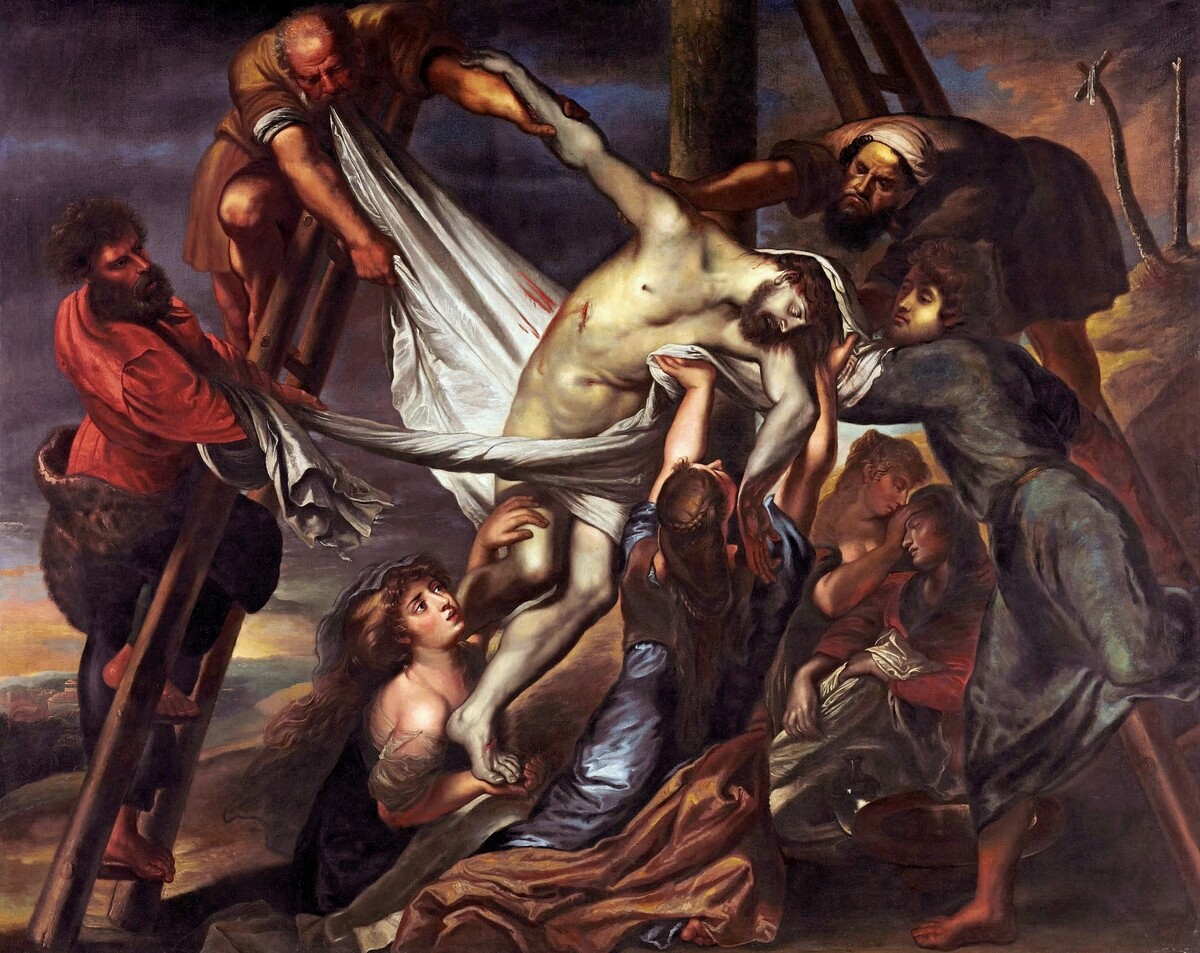
- The painting depicts the Descent from the Cross: the dead Christ is lowered from the cross, received by attendants, with a kneeling woman in the foreground who symbolically embodies the duchess Eleonora de' Medici Gonzaga receiving the Body of Christ in the Eucharist.
- Support
- canvas
- Dimensions
- Unknown
Catalogue identity
The painting treated in this archive is catalogued as The Descent from the Cross, an oil-on-canvas work of 1600–1602 by the Flemish artist Peter Paul Rubens. The date belongs to the making of the object, not to the later archival and scholarly events that surround it, and the support is specified as canvas rather than the panel that might be expected of an early northern work. The attribution is recorded in the catalogue as Rubens, and the evidence preserves both the attribution and the boundaries of what supports it: the published account cited for this identification is a reference work that draws on scholarly literature, including Logan (2007), Müller Hofstede (2012), and Braet (2005, 2009), but those studies were not themselves consulted for this catalogue entry. The identification therefore stands on an attributed scholarly literature that has been relayed rather than independently re-verified here.(Wikipedia fallback: The Descent from the Cross (Rubens, 1600–1602), n.d.)
Place in Rubens's career
The sources also place the Mantuan canvas within a longer sequence of Rubens's treatments of the subject. After early drafts now in the Hermitage Museum, Saint Petersburg, he devoted himself in later periods to the idea of the Descent from the Cross, among them the famous triptych in Antwerp and works on the subject in Lille, St Petersburg and Arras (1610). The Arras work is dated by the evidence to 1610, which is close enough to the Mantuan commission to show that the theme occupied Rubens across the first decade of the seventeenth century rather than in a single episode. The catalogue entry for this canvas should therefore note both its early date and its position at the beginning of a series, without implying that the later works depend on the Mantuan picture in any documented way. It is significant that recognition of this canvas as part of that series came late: the painting remained somewhat obscure until 2001, when the German art historian Justus Müller-Hofstede, a specialist in Rubens's early work, identified it. The attribution supplied in the catalogue title thus rests on a twentieth-century scholarly identification that the earlier archival copy supports, while the object's visibility in the literature is a much more recent phenomenon.(Wikipedia fallback: The Descent from the Cross (Rubens, 1600–1602), n.d.)
The composition itself can be described in terms the evidence records. The dead Christ sinks diagonally through the centre, pale flesh against the long white linen; the wound in his side, blood streaks on the cloth, and the slack fall of his arms show the weight being taken by the bearers and make this the still centre of the whole action. Two bearers carry that load at the edges: a bearded man in a red robe and fur-lined mantle stands on the ladder at the left edge, one hand clamped on the falling shroud and his head turned toward Christ, his warm red mass anchoring the left side of the composition and embodying the effort of the descent; and a dark-bearded man in a turban leans in from the upper right, both hands seizing Christ's outstretched arm, his clamped grip and downward stare registering the strain of holding the body and the care with which it is lowered.(Wikipedia fallback: The Descent from the Cross (Rubens, 1600–1602), n.d.)
Subject and iconography
LinkComposition and the work of lowering
Visual observation
The composition is organised around a single downward diagonal. The dead Christ sinks through the centre of the canvas, pale flesh set against a long white linen, and the visible signs of violence and of collapse, the wound in his side, the blood streaks on the cloth and the slack fall of his arms, are what make the weight being taken by the bearers legible to a viewer. The diagonal fall is also what keeps the body as the still centre of the whole action even while the surrounding figures are in motion, so that the physical fact of the descent and the stillness of the corpse are carried by the same pictorial device rather than by two separate effects.(Wikipedia fallback: The Descent from the Cross (Rubens, 1600–1602), n.d.)
Two figures are described as doing the work of holding and lowering the body, and they occupy opposite corners of the action. At the left edge a bearded man in a red robe and fur-lined mantle stands on the ladder; one hand is clamped on the falling shroud and his head is turned toward Christ. His warm red mass anchors the left side of the composition and, in the description given, embodies the effort of the descent. From the upper right a dark-bearded man in a turban leans in and seizes Christ's outstretched arm with both hands; the clamped grip and the downward stare register both the strain of holding the body and the care with which it is lowered. Together the two figures frame the central diagonal with opposed directions of effort, one from the ladder at the side and one from above, and the observation that the bearers carry the weight is what the still centre of the composition depends on.(Wikipedia fallback: The Descent from the Cross (Rubens, 1600–1602), n.d.)
Commission and Patronage at the Mantuan Court
The subject of this archive is an oil-on-canvas Descent from the Cross painted between 1600 and 1602 by the Flemish artist Peter Paul Rubens, today in the Siegerlandmuseum in the Oberes Schloss in Siegen. Among Rubens's early achievements it holds a distinct position: the sources describe it as his first major commissioned work, and they tie it directly to the private chapel of Eleonora de' Medici Gonzaga (1567–1611), duchess of Mantua. That combination of an early date, a named patron and a documented destination in a court chapel is what makes the object historically consequential rather than merely an early attribution. It belongs to the moment before the Antwerp triptych on the same subject, and the archival record places it under the duchess's patronage at the outset of Rubens's career as a maker of large-scale religious pictures.(Wikipedia fallback: The Descent from the Cross (Rubens, 1600–1602), n.d.)
The commission had a specific architectural condition attached to it. Rubens adjusted the commissioned work for the duchess Eleonora de' Medici in Mantua exactly to the dimensions of the reredos, the structure behind the altar. That detail matters because it converts the painting from an independent devotional image into a component fitted to a particular chapel installation, and it implies that measurements, not merely iconographic preference, governed the final format. The evidence does not record the dimensions themselves, nor the negotiations behind them, so the exact fit remains documented as a stated fact about the commission rather than a measurable one. Set against the later reputation of Rubens as a painter of enormous altarpieces, the Mantuan commission shows him accepting the physical constraints of a private chapel as the frame within which his first major commission was conceived.(Wikipedia fallback: The Descent from the Cross (Rubens, 1600–1602), n.d.)
Engaged by the duchess of Mantua, Eleonora Gonzaga, Rubens joined a competition described in the sources as a paragone with a sculptor and created a new composition. The evidence does not name the sculptor, does not specify the terms or judging of the contest, and does not say what the competing sculptural work was. What it does establish is the intellectual setting: the painter entered a comparative contest of the arts, the kind of rivalry between painting and sculpture that structured early modern courtly debate, and the outcome attributed to him is a newly invented composition rather than a variation on an existing model. This is the social world in which the painting must be read, a court where artistic competition functioned as a form of display and where a young painter could stake a claim by out-inventing a rival in another medium. The sources do not report the duchess's motive for staging the contest, so any reading of her intentions beyond engagement of the participants would go past the evidence.(Wikipedia fallback: The Descent from the Cross (Rubens, 1600–1602), n.d.)
Formal Choices and Their Sources
The commission can also be dated against Rubens's other early work. Stylistically the painting is comparable to another early work created approximately at the same time, The Elevation of the Cross for the chapel of the church Santa Croce in Gerusalemme, which offers the same perspective to the mourning group of women. The comparison is a formal one: it links the two compositions through the way the mourning women are positioned and viewed, and it gives the Mantuan canvas a place within a short span of related experiments. The sources present this as stylistic comparability rather than as a documented sequence, so the relation is best understood as a shared moment in Rubens's development rather than as proof that one work followed the other by a fixed interval. For the history of the object, the comparison supplies a network of reference against which its composition can be judged.(Wikipedia fallback: The Descent from the Cross (Rubens, 1600–1602), n.d.)
A further source for the composition is identified in Michelangelo's Descent from the Cross, the Pietà Bandini, which Rubens knew. The evidence leaves open how he knew it, stating that he may have seen it in Rome or else knew it by an engraving by Cherubino Alberti. This qualification is important: it distinguishes knowledge of the image from direct encounter with the marble, and it introduces print as a possible channel of transmission. The two possibilities carry different implications for how closely Rubens could have studied the work and for the role of reproductive engraving in the circulation of Italian models north of the Alps, but the evidence does not choose between them. What the unit supports is the fact of familiarity, not the route by which it was acquired, and the attribution of the engraving to Cherubino Alberti is recorded as part of the possible rather than the confirmed account.(Wikipedia fallback: The Descent from the Cross (Rubens, 1600–1602), n.d.)
Archival Proof and Modern Rediscovery
Against the late date of the modern rediscovery stands a much earlier archival proof of authorship. Rubens as the creator of the painting is proven archivally since it was copied by the court painter Francesco Marcoleoni in 1611, after the duchess's death, for the church Santa Maria Assunta in Susano. A historic text describes Marcoleoni's copy and Rubens's original reference as follows: Un Christo che togliono di croce, che coppiò messer Francesco Marco Leone che viene da Pietro Paolo Fiamingo, et è originale nella capella di Santa Croce di sopra in Corte. The document thus does three things at once: it names the copyist, it identifies the copy as deriving from Pietro Paolo Fiamingo, the Italian form of Rubens's name, and it locates the original in the chapel of Santa Croce di sopra in Corte. The archival proof is therefore indirect, resting on the copy and its description rather than on a contract for the original, and the evidence does not supply the document's author, its full date or its place of preservation.(Wikipedia fallback: The Descent from the Cross (Rubens, 1600–1602), n.d.)
It was Rubens's first major commissioned work, made for the private chapel of Eleonora de' Medici Gonzaga (1567–1611), duchess of Mantua.(Wikipedia fallback: The Descent from the Cross (Rubens, 1600–1602), n.d.)
The painting remained somewhat obscure until 2001, when it was discovered by German art historian Justus Müller-Hofstede, a specialist on Rubens's early work.(Wikipedia fallback: The Descent from the Cross (Rubens, 1600–1602), n.d.)
Stylistically, the painting is comparable to another early work created approximately at the same time: The Elevation of the Cross for the chapel of the church Santa Croce in Gerusalemme, which offers the same perspective to the mourning group of women.(Wikipedia fallback: The Descent from the Cross (Rubens, 1600–1602), n.d.)
Rubens knew the Descent from the Cross (Pietà Bandini) by Michelangelo, which he may have seen in Rome or else knew by an engraving by Cherubino Alberti.(Wikipedia fallback: The Descent from the Cross (Rubens, 1600–1602), n.d.)
Engaged by the duchess of Mantua, Eleonora Gonzaga, Rubens joined a competition (paragone) with the sculptor and created a new composition.(Wikipedia fallback: The Descent from the Cross (Rubens, 1600–1602), n.d.)
Rubens adjusted the commissioned work for the duchess Eleonora de' Medici in Mantua exactly to the dimensions of the reredos.(Wikipedia fallback: The Descent from the Cross (Rubens, 1600–1602), n.d.)
The historic text describes Marcoleoni's copy and Rubens's original reference as follows: [...] Un Christo che togliono di croce, che coppiò messer Francesco Marco Leone che viene da Pietro Paolo Fiamingo, et è originale nella capella di Santa Croce di sopra in Corte [...].(Wikipedia fallback: The Descent from the Cross (Rubens, 1600–1602), n.d.)
After early drafts (Hermitage Museum, Saint Petersburg), Rubens devoted himself also in later periods to the idea of the Descent from the Cross, among them the famous triptych The Descent from the Cross in Antwerp and works on the subject in Lille, St Petersburg and Arras (1610).(Wikipedia fallback: The Descent from the Cross (Rubens, 1600–1602), n.d.)
Reception and literature
LinkObscurity and Identification
The Mantuan canvas did not enter modern scholarship through an unbroken chain of attribution. According to the supplied account, the painting remained somewhat obscure until 2001, when it was discovered by the German art historian Justus Müller-Hofstede, a specialist on Rubens's early work. This is a documented claim about the modern scholarly reception of the object rather than about its original creation or function: for an extended period, the picture's existence was not integrated into the standard narrative of Rubens's development, and the recognition of it in 2001 belongs to the historiography of Rubens studies. The date 2001 therefore marks a decisive change in the painting's cultural status, from a work outside the usual literature to one that could be discussed as Rubens's first major commissioned work. That the source presents Müller-Hofstede specifically as a specialist in the early Rubens matters: the identification depended on expertise in the chronology and style of Rubens's formative years, not on a signature or an uninterrupted documentary record.(Wikipedia fallback: The Descent from the Cross (Rubens, 1600–1602), n.d.)
From Chapel Commission to Art-Historical Place
When the painting entered modern art-historical discussion, it was placed within a sequence of Rubens's own repeated engagement with the subject. According to the evidence, after early drafts now in the Hermitage Museum in Saint Petersburg, Rubens devoted himself also in later periods to the idea of the Descent from the Cross, among them the famous triptych The Descent from the Cross in Antwerp and works on the subject in Lille, St Petersburg and Arras (1610). This later reception is scholarly rather than popular: the Mantuan canvas is understood as belonging at the start of a chain that culminates in the famous triptych, and the evidence dates one of the related works to 1610. The materials supplied do not establish which later work preceded or followed which in exact order beyond the stated periods and the 1610 date, and they do not describe the Antwerp triptych's own reception in detail. What they do establish is that the early Mantuan commission was retrospectively integrated into a body of repeated treatments, and that this grouping in later scholarship is what makes the painting consequential for Rubens's development.(Wikipedia fallback: The Descent from the Cross (Rubens, 1600–1602), n.d.)
Meanings Accumulated Around the Work
Interpretation
Across the evidence, the painting carries several layers of meaning that belong to different stages and different kinds of testimony. The documented account presents it as Rubens's first major commissioned work for the private chapel of Eleonora de' Medici Gonzaga, adjusted to the dimensions of the reredos, and made within a paragone with a sculptor; the archival account records the Marcoleoni copy of 1611 and the historic description of the original in the chapel of Santa Croce di sopra in Corte; the visual description identifies the diagonal fall of Christ and the two bearers as the physical facts around which the devotional reading turns. The scholarly reception after 2001 adds the identification by Müller-Hofstede, the placement among Rubens's later treatments of the subject, and the comparison with the Elevation of the Cross. These are not competing versions of a single event but layered historical roles: the object's original function in the chapel, its documentary afterlife through a copy, its relative obscurity in later literature, and its modern reinsertion into the history of Rubens's early work. The evidence attributes each of these positions to its source rather than presenting them as settled facts about the painting's meaning.(Wikipedia fallback: The Descent from the Cross (Rubens, 1600–1602), n.d.)
Collection and display
LinkObject and present location
The Descent from the Cross is an oil-on-canvas painting of 1600–1602 by the Flemish artist Peter Paul Rubens. The painting is now in the Siegerlandmuseum in the Oberes Schloss in Siegen, so its present location is a museum housed in a castle rather than the sacred interior for which it was made. The object therefore has two distinct settings in the record: a northern European museum of the present, and the chapel context of its creation, and the evidence supports both without collapsing one into the other.(Wikipedia fallback: The Descent from the Cross (Rubens, 1600–1602), n.d.)
The commission is attributed to Eleonora de' Medici Gonzaga (1567–1611), duchess of Mantua, who ordered the work for her private chapel. The sources describe it as Rubens's first major commissioned work, and they state that Rubens adjusted the painting exactly to the dimensions of the reredos, the structure behind the altar. That detail is more than a technical footnote: the physical size of the canvas was set by the architectural frame it was meant to occupy, which ties the composition to a specific liturgical setting rather than to a free-standing picture intended for a gallery.(Wikipedia fallback: The Descent from the Cross (Rubens, 1600–1602), n.d.)
Commission and devotional program
According to the sources, Rubens was engaged by the duchess and entered a competition, a paragone, with a sculptor, devising a new composition rather than following an established model. This framing matters because it presents the commission as a contest of media as well as a devotional project, with Rubens working against a sculptural rival on the same subject. The kneeling woman in the foreground is interpreted in the sources as a symbolic embodiment of the duchess herself, receiving the Body of Christ; the reading connects the scene to John 6:54–59 and turns the altarpiece into a picture of the Eucharist, the sacramental reception of Christ's body, placed in the duchess's own chapel. Because this reading is attributed to the sources rather than presented as an unmediated observation, it should be described as an interpretation of the figure's role within the chapel's devotional program.(Wikipedia fallback: The Descent from the Cross (Rubens, 1600–1602), n.d.)
Visual sources and stylistic relations
The sources describe the large altarpiece as overturning the usual Cinquecento illustrations of the Descent from the Cross and as folding in the idea of the holy Eucharist. They also record that Rubens knew Michelangelo's Descent from the Cross, the Pietà Bandini, which he may have seen in Rome or else known through an engraving by Cherubino Alberti, and that stylistically the painting is comparable to another early work made at approximately the same time, The Elevation of the Cross for the chapel of the church of Santa Croce in Gerusalemme, which offers the same perspective to the mourning group of women. The comparison with the Santa Croce commission is a stylistic and compositional link, and the Michelangelo reference is qualified by the sources' own uncertainty about whether Rubens saw the work directly or through a print.(Wikipedia fallback: The Descent from the Cross (Rubens, 1600–1602), n.d.)
The composition centers on the dead Christ, who sinks diagonally through the middle, his pale flesh set against the long white linen. The wound in his side, the blood streaks on the cloth, and the slack fall of his arms show the weight being taken by the bearers and make the body the still center of the whole action. Two figures carry that action: a bearded man in a red robe and fur-lined mantle stands on the ladder at the left edge, one hand clamped on the falling shroud and his head turned toward Christ, the warm red mass of his clothing anchoring the left side of the composition and embodying the effort of the descent; and a dark-bearded man in a turban leans in from the upper right, both hands seizing Christ's outstretched arm, his clamped grip and downward stare registering the strain of holding the body and the care with which it is lowered. These are the terms in which the sources describe the visible action, and they ground the devotional reading in the physical facts of the descent.(Wikipedia fallback: The Descent from the Cross (Rubens, 1600–1602), n.d.)
Authorship, the 1611 copy, and the archival record
Rubens's authorship is reported as proven archivally because the court painter Francesco Marcoleoni copied the painting in 1611, after the duchess's death, for the church of Santa Maria Assunta in Susano. A historic text describes Marcoleoni's copy and the original it derives from in the following terms: Un Christo che togliono di croce, che coppiò messer Francesco Marco Leone che viene da Pietro Paolo Fiamingo, et è originale nella capella di Santa Croce di sopra in Corte. The document therefore attests both the copy and the location of the original in the chapel of Santa Croce di sopra in Corte, and it is this archival chain, rather than a signature or a contract, that the sources cite as the proof of Rubens's hand.(Wikipedia fallback: The Descent from the Cross (Rubens, 1600–1602), n.d.)
The painting is reported to have remained somewhat obscure until 2001, when it was discovered by the German art historian Justus Müller-Hofstede, a specialist on Rubens's early work. This modern identification phase belongs to the object's history alongside its seventeenth-century commission and its present museum setting. The evidence does not describe the route by which the canvas reached the Siegerlandmuseum, so the interval between the Mantuan chapel and the Siegen collection is not established here and should not be reconstructed from these units.(Wikipedia fallback: The Descent from the Cross (Rubens, 1600–1602), n.d.)
Place in Rubens's later treatments
The Mantuan canvas belongs at the start of a longer sequence of treatments of the subject by Rubens. After early drafts now in the Hermitage Museum in Saint Petersburg, he devoted himself in later periods to the idea of the Descent from the Cross, among them the famous triptych The Descent from the Cross in Antwerp and works on the subject in Lille, St Petersburg and Arras dated 1610 in the evidence. Within that sequence, the 1600–1602 painting is an early commission executed under the duchess's patronage, and the archival record places it there; the later versions are not variants of the same commission but separate returns to the theme.(Wikipedia fallback: The Descent from the Cross (Rubens, 1600–1602), n.d.)
Interpretation
Read together, the evidence supports a double account of the painting: it is a Gospel event, the deposition of Christ, and it is a sacramental image made for a specific chapel and a specific duchess at prayer. The bearers' strain and the diagonal fall of Christ's body hold the physical fact of the descent, while the kneeling woman turns that fact toward the Eucharist she is interpreted as receiving. The object's importance in a larger history of art lies in this conjunction: an early Rubens altarpiece, dimensioned to its reredos, composed in competition with a sculptor, and later reworked by its author on the same theme, whose identification in 2001 restored to scholarship a painting that had been little known. That synthesis rests on the attributed readings of the sources and on the archival proof of authorship they cite, and it remains qualified by the questions they leave open about how the work traveled from Mantua to Siegen.(Wikipedia fallback: The Descent from the Cross (Rubens, 1600–1602), n.d.)
Documented values and qualified estimates
LinkValuation as process
Interpretation
The single valuation record attached to this object is not a market result but a model-generated working calculation, dated 2026-10-16, offering an estimated value of US$10M to US$30M. Its stated methodology is explicitly inferential: the range was derived conservatively from confirmed context rather than from comparable sales, auction records or private insurance data, and the record states that only the supplied source URL was used. Because no dimensions and no accession number were supplied, the originators of the figure describe the range as intentionally broad. The record further qualifies its own status at length: it is a working range for manual review only, not an official insurance value, an appraisal, an auction result or a sale price, and no appraisal date, insurance date or market date is to be inferred from it. Verification by a qualified professional appraiser or conservator is stated to be required before any insurance or financial use. In the research account this unit matters as a documented process artefact: it records that a valuation exercise was undertaken, what contextual facts it rested on, and where its limits were declared by its own authors, but it establishes no monetary fact about the painting.(Wikipedia fallback: The Descent from the Cross (Rubens, 1600–1602), n.d.)
The context the valuation was built from is the object's documented identity and history. The painting is an oil on canvas of 1600-1602 by the Flemish artist Peter Paul Rubens, described in the source as his first major commissioned work, made for the private chapel of Eleonora de' Medici Gonzaga (1567-1611), duchess of Mantua. It is now held at the Siegerlandmuseum in the Oberes Schloss in Siegen, Germany. It remained somewhat obscure until 2001, when the German art historian Justus Müller-Hofstede, a specialist in Rubens's early work, discovered it. Attribution is proved archivally by the 1611 copy made by the court painter Francesco Marcoleoni for the church Santa Maria Assunta in Susano. These are the facts the valuation logic treats as confirmed context, and they are the same facts that anchor the art-historical account; separating them here shows that the financial figure depends entirely on them and adds no independent evidence about the work.(Wikipedia fallback: The Descent from the Cross (Rubens, 1600–1602), n.d.)
The commission itself is documented through its patron and its setting. Eleonora de' Medici Gonzaga, duchess of Mantua, commissioned the painting for her private chapel, and Rubens adjusted the work exactly to the dimensions of the reredos, the structure behind the altar; the source states this of the commission for the duchess in Mantua. Engaged by the duchess, Rubens entered a competition, a paragone, with a sculptor and created a new composition rather than following an established model. Within the larger history of his career the source places this as his first major commissioned work, which is why the object matters beyond its own chapel: it is the point at which a young artist took on public-scale, site-specific devotional painting under court patronage. The adjustment to the reredos matters technically as well, since it shows a commission shaped by an existing architectural frame rather than by a free-standing format.(Wikipedia fallback: The Descent from the Cross (Rubens, 1600–1602), n.d.)
The source's account of what the altarpiece does compositionally is specific. It describes the large-size altarpiece as revolutionising the usual illustrations of Jesus' Descent from the Cross of the Cinquecento and as engrossing the idea of the holy Eucharist. The body of the dead Christ sinks diagonally through the centre, pale flesh against the long white linen; the wound in his side, blood streaks on the cloth and the slack fall of his arms show the weight being taken by the bearers, which the source calls the still centre of the whole action. On the left edge a bearded man in a red robe and fur-lined mantle stands on the ladder, one hand clamped on the falling shroud and his head turned toward Christ, his warm red mass anchoring the left side of the composition and embodying the effort of the descent. From the upper right a dark-bearded man in a turban leans in, both hands seizing Christ's outstretched arm, his clamped grip and downward stare registering the strain of holding the body and the care with which it is lowered. These are attributed descriptions within the source rather than the archive's own observations, and they matter because they connect a devotional interpretation to a legible mechanics of weight and support.(Wikipedia fallback: The Descent from the Cross (Rubens, 1600–1602), n.d.)
The eucharistic reading depends on one figure. The source interprets the kneeling lady in the foreground as a symbolic embodiment of the duchess, who receives the Body of Christ like a lover for supper, referencing John 6:54-59. That attributed interpretation is what turns the scene from a deposition into an image of sacramental reception, placed in the duchess's own chapel and tied to a scriptural passage about eating the flesh and drinking the blood of the Son of Man. Because the reading is presented as an interpretation rather than as a documented intention, it should be carried in the archive as such: the visual evidence of a kneeling woman receiving the body supports the reading, but the identification of that woman with Eleonora is the source's symbolic claim. The distinction matters for how the object is used in a history of art, since it determines whether the painting is primarily a narrative of the Passion or a portrait of patronage at prayer.(Wikipedia fallback: The Descent from the Cross (Rubens, 1600–1602), n.d.)
Two artistic relationships are recorded. Stylistically the source compares the painting to another early work made approximately at the same time, The Elevation of the Cross for the chapel of the church Santa Croce in Gerusalemme, which offers the same perspective to the mourning group of women. Separately, the source states that Rubens knew Michelangelo's Descent from the Cross, the Pietà Bandini, which he may have seen in Rome or else knew by an engraving by Cherubino Alberti. The second of these is doubly qualified, first by the modal may and then by an alternative route of knowledge, and should not be flattened into a claim of direct study from the sculpture. Taken together the two comparisons place the Mantuan canvas both in Rubens's own emerging early manner and in the wider circulation of Italian models available to him, which is precisely the kind of evidence that gives an early commission historical weight.(Wikipedia fallback: The Descent from the Cross (Rubens, 1600–1602), n.d.)
Authorship and original location rest on archival evidence. Rubens as the creator of the painting is proved archivally since it was copied by the court painter Francesco Marcoleoni in 1611, after the duchess's death, for the church Santa Maria Assunta in Susano. The historic text describes Marcoleoni's copy and Rubens's original reference as follows: a Christ taken down from the cross, which was copied by messer Francesco Marco Leone and which comes from Pietro Paolo Fiamingo, and is the original in the chapel of Santa Croce di sopra in Corte. Two things follow that the archive should keep distinct. First, the documentary chain runs through a copy, so the proof of authorship is a record of derivation rather than a signature or contract on the original. Second, the document locates the original in a named chapel, Santa Croce di sopra in Corte, which is the institutional setting behind the phrase private chapel of the duchess. The source also records that Rubens devoted himself to the idea of the Descent from the Cross in later periods, including early drafts now in the Hermitage Museum, Saint Petersburg, and the famous triptych The Descent from the Cross in Antwerp, with works on the subject in Lille, St Petersburg and Arras dated by the source to 1610. The Mantuan canvas therefore opens a sequence rather than standing alone, and its archival documentation is what allows that sequence to be traced.(Wikipedia fallback: The Descent from the Cross (Rubens, 1600–1602), n.d.)
Read together, the units describe an object whose value is documented at several different levels, and the levels are not interchangeable. Its devotional and art-historical importance rests on a commission for a named duchess, an adaptation to the dimensions of a specific reredos, a eucharistic interpretation attributed to the source, and a documented afterlife in copies and later versions of the subject. Its attribution rests on an archival chain through Marcoleoni's 1611 copy and on the rediscovery attributed to Müller-Hofstede in 2001. Its monetary standing rests only on a model-generated working range whose own authors declare it provisional, undated in market terms and unsupported by sales data, dimensions or accession details. The larger history of art gains something from keeping these layers visible at once, because the painting shows how a court commission could be integrated into an altar setting, how a scriptural subject could be turned toward the Eucharist for a patron's private chapel, and how the survival of derivative copies and later treatments can be the very means by which an original is identified and proved. The qualification that the monetary figure is not an appraisal and requires professional verification is part of the same picture: the object's documented significance and its financial estimate are of different kinds, and only the former is established by the evidence at hand.(Wikipedia fallback: The Descent from the Cross (Rubens, 1600–1602), n.d.)
Working estimate
Calculated working insurance estimate, not a sale price: Estimated value: US$10M to US$30M Recorded date: Working calculation, generated 2026-10-16. Methodology: Model-generated working insurance range for manual review. Broad working range derived conservatively from confirmed context: an early Rubens (Peter Paul Rubens, 1600-1602) oil on canvas, large-scale altarpiece, Baroque Flemish, his first major commissioned work, created for the private chapel of Eleonora de' Medici Gonzaga, duchess of Mantua. The painting was rediscovered in 2001 by Justus Müller-Hofstede and is now held at the Siegerlandmuseum, Oberes Schloss, Siegen, Germany. Attribution is proved archivally by the 1611 copy by Francesco Marcoleoni. No dimensions or accession number were supplied, so the range is intentionally broad. Only the supplied source URL was used for context; no comparable sales, auction records, or private insurance data were accessed. The range is not an appraisal and is intended only to support manual review. Qualification: This is a model-generated working range for manual review only. It is not an official insurance value, appraisal, auction result, or sale price. No appraisal date, insurance date, or market date is inferred. The range is broad and conservative because confirmed dimensions and accession details were not available. Verification by a qualified professional appraiser or conservator is required before any insurance or financial use.(Wikipedia fallback: The Descent from the Cross (Rubens, 1600–1602), n.d.)