01
Secondary · About this artwork
Wikimedia Commons: The Tower of Babel (n.d.). Wikimedia Commons.
Wikimedia Commons file page providing cataloguing information and a high-resolution image of the painting.
Artwork record / 176 of 331
Artist: Pieter Brueghel the Elder
A docent-led reading of Pieter Brueghel the Elder's Tower of Babel in Vienna, following the unfinished tower, King Nimrod's retinue, and the stonemasons at work. The account distinguishes what is visible from what the supplied source documents, and leaves unsupported interpretation aside.
Read the story ↓ About the artist ↓ Research and record ↓ Literature and sources ↓ Listen to the article ↓Your browser could not copy automatically. Select the research text below, then copy it.
Open the complete research text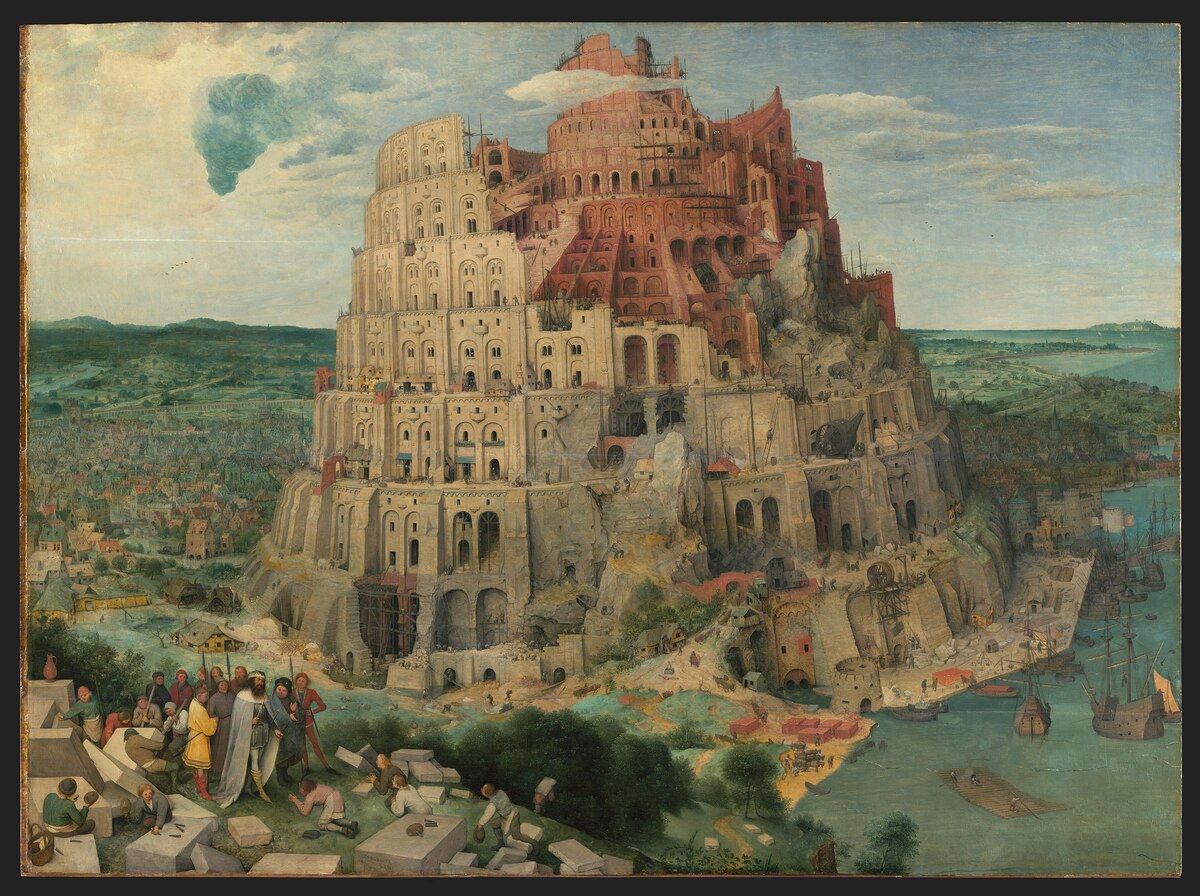
The highest-resolution file we hold, available without payment or an account.3,840 × 2,866 pixels.
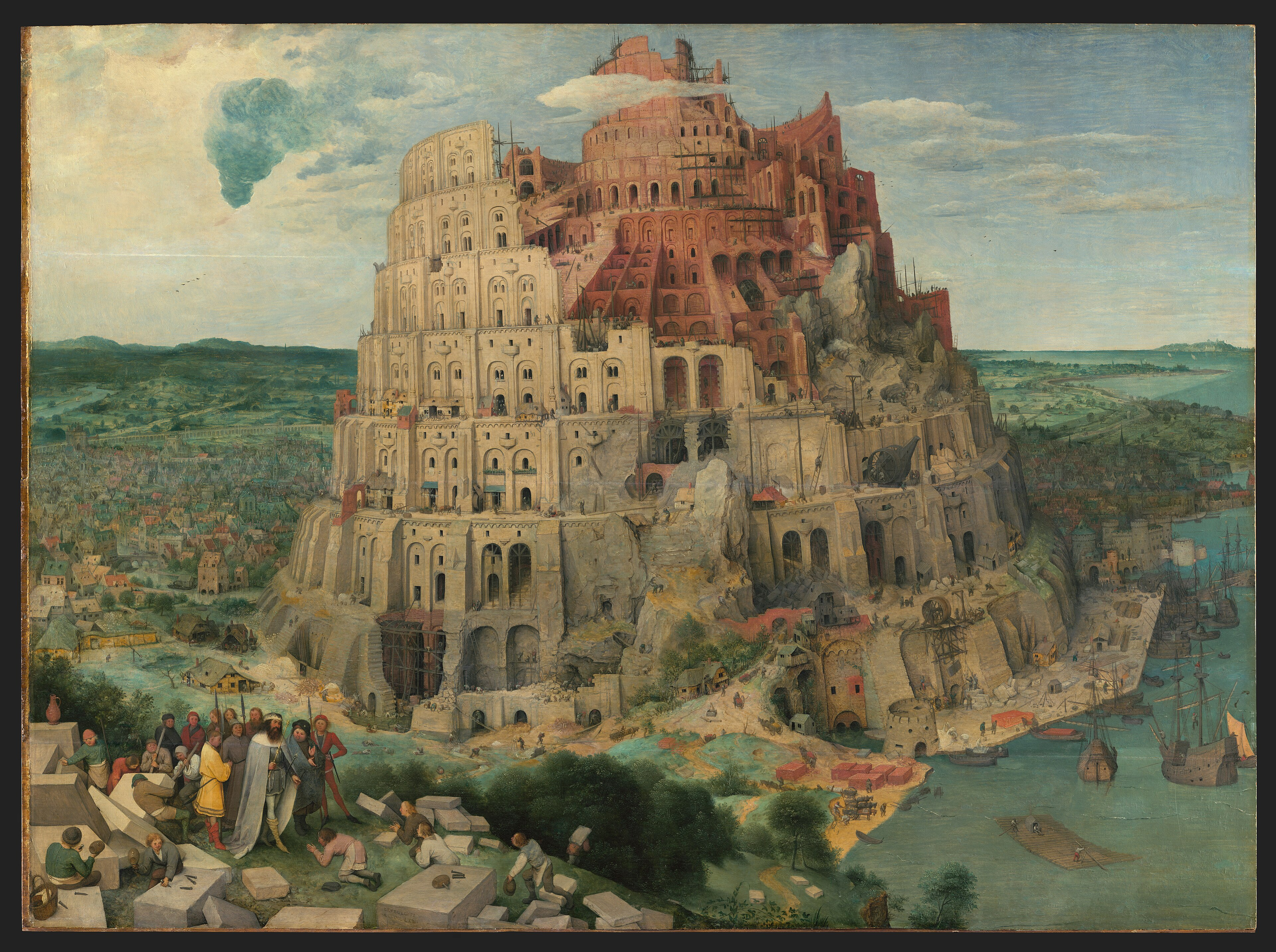
Download highest-resolution imageThe densely packed town of gabled houses, walls, and waterways spread at the tower's base on the left, extending into green fields and distant hills. It roots the biblical scene in Bruegel's own Netherlandish world and shows the ordinary city that the giant structure dwarfs.
At the right, a busy port with masted sailing ships, barges, and a raft of timber on the water, backed by the shore where goods are stacked and carted. The shipping shows the commercial reach and wealth of the kingdom that the tower is meant to glorify.
On the tower's right flank, a great horseshoe arch is going up with wooden centering while a treadwheel crane with radiating spokes hoists blocks, and tiny figures swarm over the ramps and vaults. This exposes Bruegel's precise observation of real sixteenth-century building technology.
Your gallery guide
A docent-led reading of Pieter Brueghel the Elder's Tower of Babel in Vienna, following the unfinished tower, King Nimrod's retinue, and the stonemasons at work. The account distinguishes what is visible from what the supplied source documents, and leaves unsupported interpretation aside.
Editorial review by Artifact Archive automated publishing
Explore the researchThe story About 4 minutes to read
This is Pieter Brueghel the Elder's Tower of Babel, painted in 1563. It shows the biblical story of the tower, with King Nimrod and his retinue in the lower left and stonemasons cutting blocks in the bottom centre. The tower itself rises unfinished, its upper tiers still under scaffolding, its summit breaking into a dense cloud. Brueghel sets that vast structure against the small figures who are building it.
Follow the curve of the tower from its wide base upward. Each tier is ringed with ramps and arches, and near the top the scaffolding is still open, so the building never closes into a finished silhouette. At the summit the stonework disappears into cloud. You cannot see whether the tower ends there or continues, and that gap is part of what you are looking at.
In the lower left, Nimrod and his retinue are shown as a small court group, standing apart from the work. In the bottom centre, stonemasons cut blocks, and the stone they handle feeds the structure above them. So the painting gives you two scales at once: the ruler and his party, and the labourers whose cutting and hauling make the tower possible.
The subject is the biblical Tower of Babel, and the source identifies King Nimrod among the depicted people. That places the painting in a religious narrative rather than a modern city view. The exact setting and date of the biblical episode are not fixed by the source. What is documented is the story, the named figure and the working scene Brueghel depicts.
One way to read the composition is through that contrast between scale and labour. The tower is enormous, yet the painting keeps returning your attention to the small, repeated actions of cutting and carrying. That reading is an interpretation of what is visible, not a statement about Brueghel's private intention. The source establishes the subject and the figures; the emphasis on labour is something the picture itself supports.
What stays with you is the unfinished upper tier and the cloud that swallows it. Brueghel shows the project at the moment it is still being built, with the scaffolding still up and the outcome withheld. So the painting is about the tower as a work in progress, and about the people, from ruler to mason, whose labour keeps it rising.
Editorial review by Artifact Archive automated publishing.
Historical claims are linked to the records below. Close looking and interpretation are identified in the passage notes.
Portrait unrecorded
About the artist
Died 1569
Pieter Brueghel the Elder was a Flemish painter (1526–1569). Their work is associated with Dutch and Flemish Renaissance painting; Northern Renaissance. Their recorded places of work include Antwerp; Italy; Brussels; Mechelen; Rome.
The research & record
Find catalogue details, historical context, technical research and the literature behind this artwork.
Your browser could not copy automatically. Select the research text below, then copy it.
Open the complete research textThe artwork record
Catalogue information and detailed research, with references that link to the bibliography.
Updated .
The catalogue identifies The Tower of Babel as a painting by Pieter Brueghel the Elder, dated 1563. The recorded medium is oil on oak panel, and the recorded dimensions are 114 cm by 155 cm. These are the object's core identity data: author, year of execution, support, paint medium and size. The same catalogue entry places the painting within the series The Tower of Babel and assigns it to the genre of religious art, so the object belongs simultaneously to a named series and to a devotional or scriptural category rather than to landscape or city view alone.(Wikimedia Commons: The Tower of Babel, n.d., File information; Series title, Genre)
The catalogue also names the figures depicted. King Nimrod appears among the depicted people, a figure the source associates with the biblical tower narrative. His presence anchors the subject in scripture rather than in a contemporary civic or architectural scene. The same source records the composition in which Nimrod and his retinue occupy the lower left foreground, while stonemasons cut blocks in the bottom centre foreground, and the tower rises unfinished with its upper tiers still under scaffolding and its summit piercing a dense cloud. The accession number GG_1026 and the holding at the Kunsthistorisches Museum in Vienna are documented for the painting, giving the object a stable institutional identity alongside its authorial and biblical ones.(Wikimedia Commons: The Tower of Babel, n.d., Depicted people)
Interpretation
The evidence establishes the subject and the named participants, but it does not fix the exact setting or date of the biblical episode represented. What can be documented is the story, the named figure and the working scene: ruler and retinue on one side, masons cutting stone on the other, and a structure that never closes into a finished silhouette because its summit disappears into cloud. The catalogue data and the described scene together define what the object is, while leaving the narrative's time and place open in the source. This distinction matters for the object's identity: the painting is catalogued as a religious narrative with a known author and date of execution, not as a view of a real city that can be located or dated independently of the biblical text.(Wikimedia Commons: The Tower of Babel, n.d., File information; Depicted people)
The Tower of Babel is a painting by Pieter Brueghel the Elder, dated 1563, oil on oak panel, measuring 114 cm by 155 cm.(Wikimedia Commons: The Tower of Babel, n.d.)
The painting is part of the series The Tower of Babel, and its genre is religious art.(Wikimedia Commons: The Tower of Babel, n.d.)
The source identifies King Nimrod among the depicted people, a figure associated with the biblical tower narrative.(Wikimedia Commons: The Tower of Babel, n.d.)
Visual observation
The painting depicts the biblical story of the Tower of Babel, and its composition divides the scene into distinct zones of narrative action. King Nimrod and his retinue appear in the lower left foreground, a small court group positioned apart from the construction activity. In the bottom center foreground, stonemasons are shown cutting blocks. The tower itself is depicted unfinished, with its upper tiers still under scaffolding and its summit piercing a dense cloud. These are the observable features the source records: the named figures, the labouring masons, the scaffolded upper stages and the cloud at the summit.(Wikimedia Commons: The Tower of Babel, n.d., Depicted people; Description)
The source identifies King Nimrod among the depicted people, a figure associated with the biblical tower narrative. That identification places the scene within a religious narrative rather than a modern city view. What the evidence establishes is the story, the named figure and the working scene. The exact setting and date of the biblical episode are not fixed by the source, and the evidence does not establish any private intention behind the choice of subject or the arrangement of figures.(Wikimedia Commons: The Tower of Babel, n.d., Depicted people)
The tower is shown unfinished, with its upper tiers still under scaffolding and its summit piercing a dense cloud. The scaffolding remains open near the top, so the building never closes into a finished silhouette. At the summit the stonework disappears into cloud, and it is not possible to see whether the tower ends there or continues. This visual withholding of the summit is part of the recorded depiction, not an inference about the artist's purpose.(Wikimedia Commons: The Tower of Babel, n.d., Description)
Interpretation
The composition presents a contrast in scale between the vast structure and the small figures who are building it. Nimrod and his retinue stand apart from the work, while the stonemasons in the bottom center foreground cut blocks that feed the structure above them. The painting thus gives two scales at once: the ruler and his party, and the labourers whose cutting and hauling make the tower possible. The source establishes the subject and the figures; the emphasis on labour is something the picture itself supports, and reading the composition through that contrast is an interpretation of what is visible rather than a statement about the artist's private intention.(Wikimedia Commons: The Tower of Babel, n.d., Depicted people; Description)
Visual observation
The painting depicts the biblical story of the Tower of Babel, showing King Nimrod and his retinue in the lower left foreground and stonemasons cutting blocks in the bottom center foreground.(Wikimedia Commons: The Tower of Babel, n.d.)
The tower is shown unfinished, with its upper tiers still under scaffolding and its summit piercing a dense cloud.(Wikimedia Commons: The Tower of Babel, n.d.)
The Tower of Babel by Pieter Brueghel the Elder is dated 1563 and is executed in oil on an oak panel measuring 114 cm by 155 cm. It is held at the Kunsthistorisches Museum, Vienna, under accession number GG_1026, the cataloguing information through which the work is identified in the museum's collections. The painting's genre is religious art, and it belongs to the series The Tower of Babel, a grouping that situates the Vienna panel alongside related treatments of the same subject rather than as an isolated image. These details of date, medium, support, dimensions, repository and classification are the documented framework within which any account of the picture's content and history has to be set.(Wikimedia Commons: The Tower of Babel, n.d., Collection)
The painting depicts the biblical story of the Tower of Babel. King Nimrod appears among the depicted people, a figure associated with the biblical tower narrative, and he is shown in the lower left foreground with his retinue. In the bottom centre foreground, stonemasons are cutting blocks. The tower itself is shown unfinished: its upper tiers are still under scaffolding, and its summit pierces a dense cloud. The source identifies King Nimrod among the depicted people but does not fix the exact setting or date of the biblical episode within the picture, so what is documented is the story, the named figure and the working scene Brueghel depicts, not a specific historical or geographic location for the event.(Wikimedia Commons: The Tower of Babel, n.d., Collection)
Interpretation
Reading the composition through the contrast between the tower's immense scale and the small, repeated actions of cutting and carrying is a way of responding to what is visible, not a statement about Brueghel's private intention. The source establishes the subject and the identity of the figures; the emphasis on labour is something the picture itself supports through the placement of the stonemasons and the ruler's party. The unfinished upper tier and the cloud that swallows the summit hold the project at the moment it is still being built, with the scaffolding still up and the outcome withheld, so the painting presents the tower as a work in progress and the people, from ruler to mason, as the labour that keeps it rising.(Wikimedia Commons: The Tower of Babel, n.d., Collection)
The painting is held at the Kunsthistorisches Museum, Vienna, with accession number GG_1026.(Wikimedia Commons: The Tower of Babel, n.d.)
Interpretation
The object documented in the supplied record is The Tower of Babel by Pieter Brueghel the Elder, dated 1563, executed in oil on oak panel and measuring 114 by 155 centimetres. It is held in institutional custody at the Kunsthistorisches Museum, Vienna, under accession number GG_1026, and the source identifies its genre as religious art, describing it as part of the series The Tower of Babel. The same record establishes the subject as the biblical story of the tower, with King Nimrod and his retinue shown in the lower left foreground and stonemasons cutting blocks in the bottom centre foreground. Because the panel's identification, medium, support, dimensions, date and repository are all established by this source, they are the fixed points from which any account of the work's value must proceed; the source does not fix the exact setting or date of the biblical episode itself, which remain unspecified there.(Wikimedia Commons: The Tower of Babel, n.d.)
The record also establishes the tower's visible condition: it is shown unfinished, with its upper tiers still under scaffolding and its summit piercing a dense cloud. On the account given, the building is displayed as a work in progress rather than as a completed silhouette, and the stone the masons cut in the foreground feeds the structure rising above them. This connects the depicted labour to the depicted architecture at the level of what the image itself shows, so that the small repeated actions of cutting, hauling and building are continuous with the enormous tiered mass they serve.(Wikimedia Commons: The Tower of Babel, n.d.)
The working insurance estimate records a calculated range of US$500,000 to US$2,000,000, generated on 16 October 2026 as a working calculation. Its stated methodology derives a conservative range from confirmed contextual factors: the painting's status as an exceptional Northern Renaissance master by Pieter Brueghel the Elder, the documented 1563 oil on oak panel at monumental scale of 114 by 155 centimetres, secure identification, institutional custody at the Kunsthistorisches Museum, Vienna under accession GG_1026, and high public prominence supported by the supplied institutional and Wikimedia records. The record states explicitly that no comparable sales or private insurance records were used, and that the range reflects a broad insurance scheduling band before formal appraisal review.(Wikimedia Commons: The Tower of Babel, n.d.)
That calculation carries a qualification of its own making: it is described as a model-generated working range for manual review only, and expressly not an official insurance value, appraisal, auction result or sale price. The record repeats that no comparable sales or private insurance records were used, and holds that actual insurance scheduling requires a qualified appraiser and formal documentation. The figure therefore stands as an attributed working calculation rather than as a documented market transaction, and its evidential weight should be read accordingly: the inputs it names are the documented art-historical facts about the object, while the monetary band is a scheduling estimate derived from those facts by a stated method and offered for manual review.(Wikimedia Commons: The Tower of Babel, n.d.)
Read together, the two strands of evidence describe different kinds of recorded value. The cataloguing strand records what the object is, what it depicts and where it is held, while the valuation strand records a date, a method and a monetary band that are explicitly bounded by their own qualifications. The relationship between them is one of dependence rather than equivalence: the valuation states that it was derived from the confirmed contextual factors about Brueghel, the 1563 panel, the identification, the Vienna custody and the public prominence, and it does not claim to rest on any sale, auction or private insurance record. A scholarly account therefore treats the monetary range as an attributed working estimate standing on documented descriptive facts, and treats the descriptive facts as independently supported by the source that supplies the object's cataloguing information.(Wikimedia Commons: The Tower of Babel, n.d.)
Within a larger history of art and material culture, the object's recorded prominence and its secure institutional custody are the factors the valuation itself identifies as grounding its working range, alongside the painter's standing in the Northern Renaissance and the panel's monumental scale. The evidence does not supply gallery history, provenance intervals, exhibition records or treatment history, and none should be inferred from the valuation's mention of public prominence. What the supplied units do establish is a documented 1563 oil on oak panel, securely identified, held under a named accession number, depicting the biblical tower with Nimrod and his retinue and with masons cutting blocks below an unfinished, scaffolded summit disappearing into cloud. Any further claims about the object's status, reception or monetary worth beyond those points await evidence not present here.(Wikimedia Commons: The Tower of Babel, n.d.)
Working estimate
Calculated working insurance estimate, not a sale price: Estimated value: US$500K to US$2M Recorded date: Working calculation, generated 2026-10-16. Methodology: Conservative working range derived from confirmed contextual factors: exceptional Northern Renaissance master Pieter Brueghel the Elder, documented 1563 oil on oak panel of monumental scale (114 x 155 cm), secure identification and institutional custody at the Kunsthistorisches Museum, Vienna (accession GG_1026), and high public prominence supported by the supplied institutional and Wikimedia records. No comparable sales or private insurance records were used. The range reflects a broad insurance scheduling band before formal appraisal review. Qualification: This is a model-generated working range for manual review only. It is not an official insurance value, appraisal, auction result, or sale price. No comparable sales or private insurance records were used. Actual insurance scheduling requires a qualified appraiser and formal documentation.(Wikimedia Commons: The Tower of Babel, n.d.)
Bibliography
References are arranged by author or organisation, with links to the original publications. Where no publication date is recorded, n.d. means no date.
Source notes updated .
No recorded sources match these filters. Reset the filters to see the full bibliography.
Secondary · About this artwork
Wikimedia Commons: The Tower of Babel (n.d.). Wikimedia Commons.
Wikimedia Commons file page providing cataloguing information and a high-resolution image of the painting.
Art to live with
A piece of the archive, made yours. Explore The Tower of Babel in a size and finish that fits your space.
Choose your edition Combine this painting with your favourites10 × 8 in / 25.4 × 20.3 cm · Standard
10 × 8 in / 25.4 × 20.3 cm · Standard

10 × 8 in / 25.4 × 20.3 cm · Standard

10 × 8 in / 25.4 × 20.3 cm · Standard

10 × 8 in / 25.4 × 20.3 cm · Standard
A gallery paper print with a smooth art-paper surface. Choose a size that suits the painting.
Choose size and finish10 × 8 in / 25.4 × 20.3 cm · Black frame
10 × 8 in / 25.4 × 20.3 cm · Black frame

10 × 8 in / 25.4 × 20.3 cm · Black frame

10 × 8 in / 25.4 × 20.3 cm · Black frame

10 × 8 in / 25.4 × 20.3 cm · Black frame

10 × 8 in / 25.4 × 20.3 cm · Black frame
A ready-to-hang wooden frame with a clear Perspex cover and a semi-gloss printed insert, made in the UK.
Choose size and finish11oz · 2 image repeats
11oz · Standard

11oz · 2 image repeats

11oz · 2 image repeats

11oz · 2 image repeats

11oz · 2 image repeats

11oz · 2 image repeats
An 11oz white ceramic mug with AAA+ ORCA coating and a C-shaped handle. Dishwasher and microwave safe, printed and dispatched in the UK.
Choose size and finish15 × 16.5 in / 38 × 42 cm · Black
15 × 16.5 in / 38 × 42 cm · Black

15 × 16.5 in / 38 × 42 cm · Black

15 × 16.5 in / 38 × 42 cm · Black

15 × 16.5 in / 38 × 42 cm · Black

15 × 16.5 in / 38 × 42 cm · Black

15 × 16.5 in / 38 × 42 cm · Black
A cotton tote with reinforced handles and artwork on the front, printed and dispatched in the UK.
Choose size and finish8.7 × 8.7 in / 22 × 22 cm · Standard
8.7 × 8.7 in / 22 × 22 cm · Standard

8.7 × 8.7 in / 22 × 22 cm · Standard

8.7 × 8.7 in / 22 × 22 cm · Standard
A rectangular PU leather mouse mat with a non-slip base, printed locally for your delivery country.
Choose size and finishA5 · Glossy cover · Lined pages
A5 · Glossy cover · Lined pages

A5 · Glossy cover · Lined pages

A5 · Glossy cover · Lined pages

A5 · Glossy cover · Lined pages

A5 · Glossy cover · Lined pages

A5 · Glossy cover · Lined pages
An A5 notebook with 150 lined pages, a glossy laminated front cover carrying your artwork, black wire-o binding and a white back cover.
Choose size and finishKeep exploring