Identity and catalogue
Link- Title
- The Procession to Calvary
- Movement or period
- Flemish Northern Renaissance
- Country or culture
- Flemish, Southern Netherlands (modern Belgium)
- Depicted subject
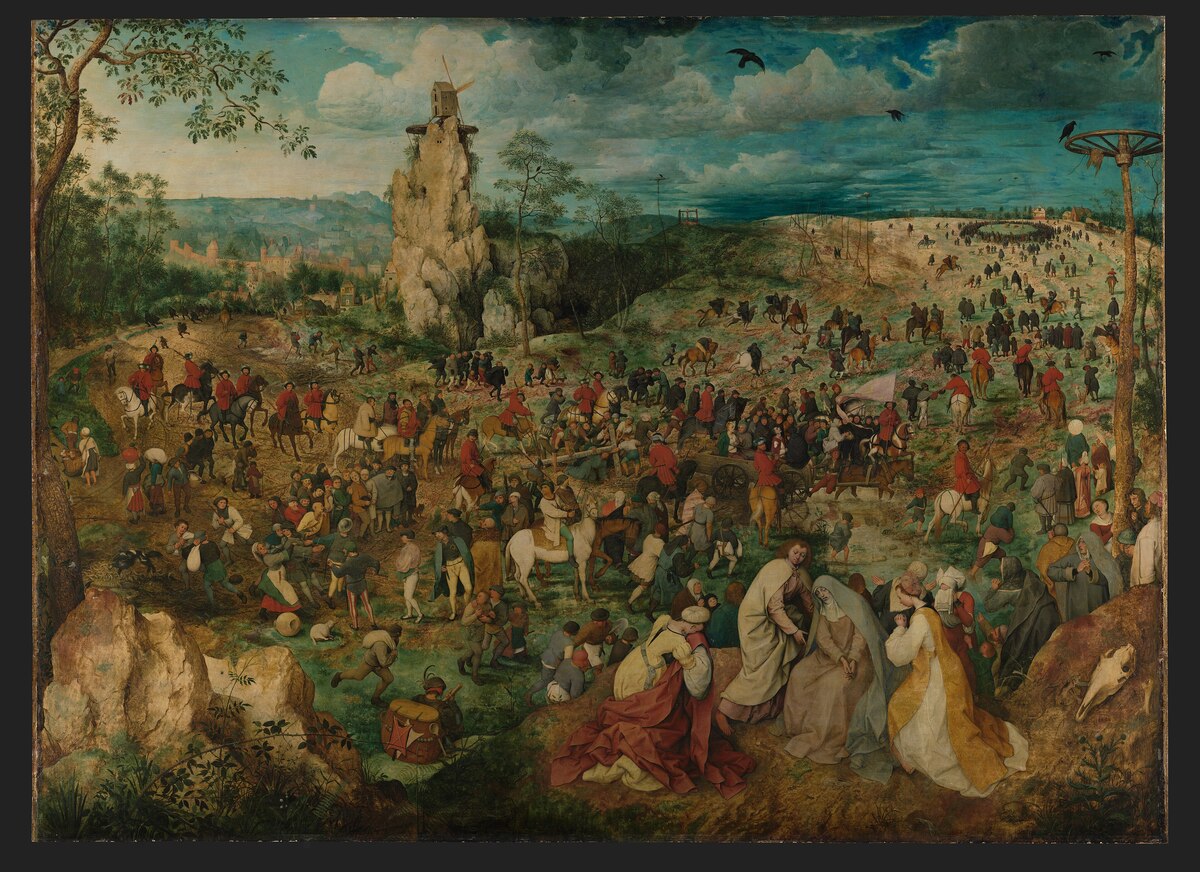
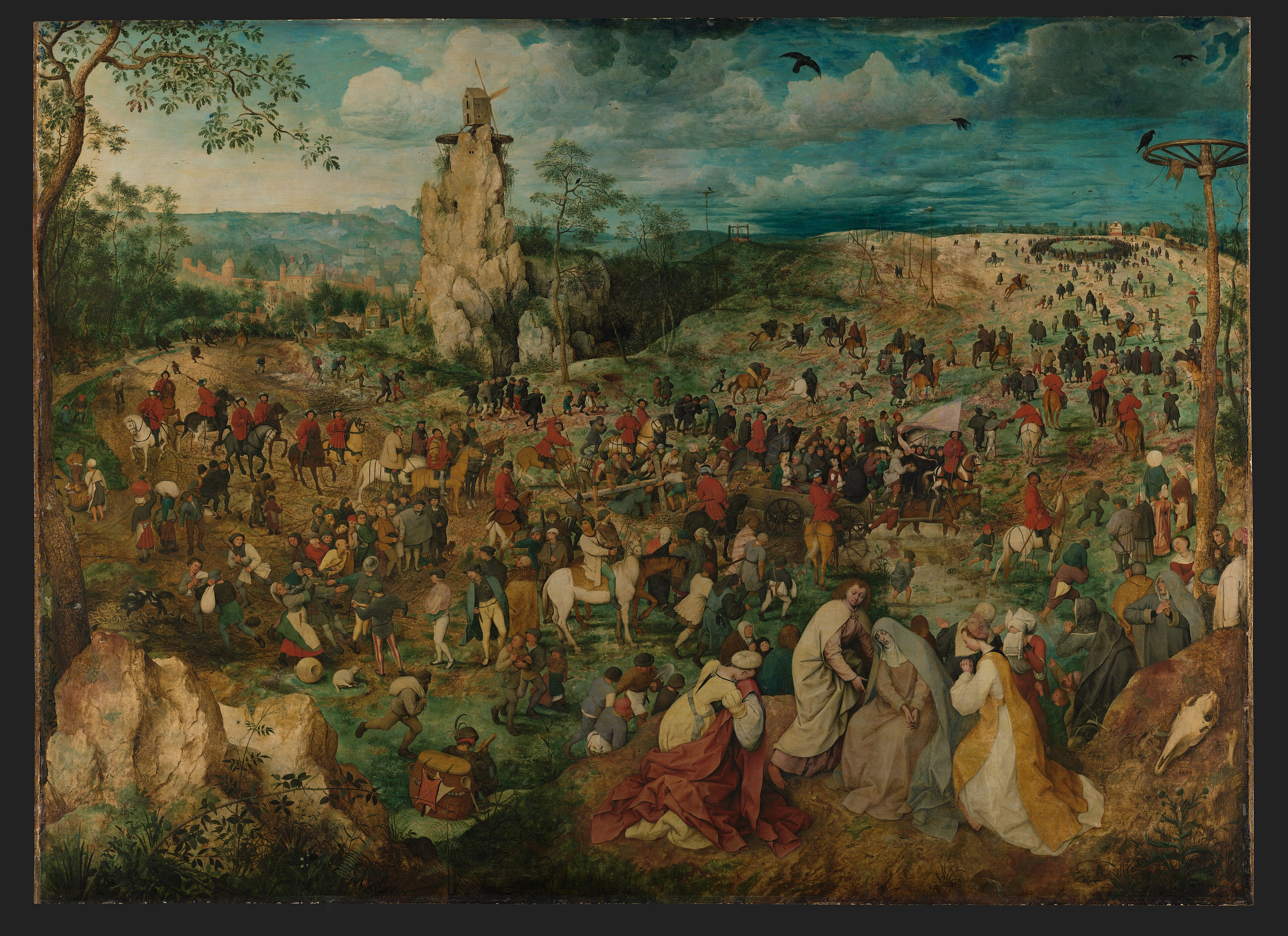
- The painting represents the biblical episode of Christ carrying the cross to Calvary, described by the source as Christ's procession to Calvary. The sacred event is set within a wide, densely populated landscape rather than isolated in the foreground.(Wikimedia Commons: The Procession to Calvary, n.d.)
- Title variants
- The Procession to Calvary; Christ carrying the cross procession to Calvary; Путь на Голгофу (Крестный путь Христа) (Russian caption variant)
- Support
- Oak wood panel
Catalogue identity and subject
The object is catalogued under the title The Procession to Calvary and is attributed to Pieter Brueghel the Elder. Within that title and attribution, the record also classifies the work by type: it is entered as religious art, with the genre designation painting, and its stated subject is Christ carrying the cross in a procession to Calvary, with Jesus Christ listed among the depicted people. Those elements, title, attribution, object type and named subject, are the catalogue facts that anchor every other question asked of the panel, including who made it, when, and how its sacred subject is staged within the picture.(Wikimedia Commons: The Procession to Calvary, n.d., File information summary; Description and Depicted people; Object type and Genre)
The object record dates the painting 1564, and the panel carries an inscription at the bottom right reading BRVEGEL. MD.LXIIII., a signature and date in the same year. The dimensions are given as 124 centimetres high and 170 centimetres wide. Because the inscription supplies both a name and a year, the object date and the signature date are consistent with one another in this record. The date of the painting in 1564 is distinct from the later dates that appear in the catalogue record itself, such as the reference entries and the years attached to subsequent custody, which belong to the documentation of the object rather than to its making.(Wikimedia Commons: The Procession to Calvary, n.d., File information summary; Inscriptions)
The record cites two references for the object: the Kunsthistorisches Museum Wien Bilddatenbank and RKDimages, artwork number 260966. These citations identify the institutional and scholarly reference points against which the object has been documented. They are reference apparatus for the catalogue entry, not part of the painting's physical history, and they are separate from the 1564 object date and the signature date on the panel.(Wikimedia Commons: The Procession to Calvary, n.d., References)
Interpretation
Across these units, the evidence distinguishes several kinds of statement about the object. The title, the attribution to Pieter Brueghel the Elder, the 1564 date, the dimensions of 124 by 170 centimetres, the object type and genre, the named subject and the bottom-right inscription BRVEGEL. MD.LXIIII. are recorded as catalogue facts. The client identification and the custody sequence come from the object history, with the 1566, 1595 and 1781 entries explicitly marked uncertain in the source. The references to the Kunsthistorisches Museum Wien Bilddatenbank and RKDimages artwork number 260966 document where the object has been catalogued. Keeping these categories separate matters because the object date, the signature date and the dates of later custody describe different things: when the painting was made, what it asserts about its own making, and when it changed hands or location.(Wikimedia Commons: The Procession to Calvary, n.d., File information summary; Description and Depicted people; Object type and Genre; Inscriptions; References; Object history and Notes; Object history)
The object and its documentation
The object record identifies the painting as The Procession to Calvary by Pieter Brueghel the Elder, dated 1564, executed in oil on oak wood, measuring 124 centimetres high and 170 centimetres wide, and held by the Kunsthistorisches Museum in Vienna, where it is recorded as current location Gemäldegalerie, room X, under accession number 1025. The record classifies it as religious art with the genre designation painting, and the description states that it shows Christ carrying the cross in a procession to Calvary, listing Jesus Christ among the depicted people. The panel bears a signature and date at the bottom right reading BRVEGEL. MD.LXIIII. The record cites the Kunsthistorisches Museum Wien Bilddatenbank and RKDimages, artwork number 260966, as references for the object.(Wikimedia Commons: The Procession to Calvary, n.d., Artist record)
The artist record gives Pieter Brueghel the Elder as a Flemish painter, drawer and printmaker with dates between 1526 and 1530 to 9 September 1569, working in Antwerp from 1551 to 1563, Italy in 1553, and Brussels from 1563 to 1569. Placed against that itinerary, the 1564 date on the panel falls in the first years after the move to Brussels, so the painting belongs to the period when Brueghel had left the Antwerp workshop world in which he had worked for more than a decade and had settled in the city of the court and the Habsburg administration. The record itself supplies only the chronology of residence, not the reasons for the move or the effect it had on the commission.(Wikimedia Commons: The Procession to Calvary, n.d., Artist record)
Patronage and early custody
The object history names the client as Nicolaas Jongelinck, an Antwerp merchant and patron of Bruegel, with a note stating the client was N. Jonghelinck. This places the commission in an Antwerp mercantile milieu rather than at court, and it associates the panel with a documented patron of the artist. The same record states that in 1566, the year marked as uncertain in the source, the painting passed into the possession of the city of Antwerp, following Nicolaas Jongelinck. The two entries together describe a private commission that very soon afterwards entered civic hands, but the source flags the 1566 date, so the sequence and the terms of that transfer remain only partly documented.(Wikimedia Commons: The Procession to Calvary, n.d., Artist record)
The later ownership record contains gaps the source itself marks as uncertain. It lists the estate of Archduke Ernst in 1595, marked uncertain, and subsequently Rudolf II among the owners. It then records that in 1748 the painting moved from the treasury into the gallery, with 1781 Pressburg marked uncertain, and that it is traceable in the gallery in 1783. Taken together, these entries trace an arc from an Antwerp merchant commission to a Habsburg collection and eventually to an identified place in a gallery, but the uncertain dates and the sparse steps between owners mean the path should be understood as a documented outline rather than a continuous chain of custody.(Wikimedia Commons: The Procession to Calvary, n.d., Artist record)
The artist record gives Pieter Brueghel the Elder as a Flemish painter, drawer and printmaker with dates between 1526 and 1530 to 9 September 1569, working in Antwerp from 1551 to 1563, Italy in 1553, and Brussels from 1563 to 1569.(Wikimedia Commons: The Procession to Calvary, n.d.)
Materials and technique
LinkSupport and medium
The object record identifies the painting as executed in oil on oak wood, a combination that places the panel within the dominant support and medium of sixteenth-century Netherlandish panel painting. The record gives no further account of the oak itself: it does not specify the species of oak, the number or orientation of the boards, the thickness of the panel, the presence of a cradle, parquet or other auxiliary support, or any later intervention on the wood. Nor does it describe the ground, the priming or the number of paint layers. What the evidence establishes is therefore narrow and secure: the medium is oil and the support is oak. Everything beyond that about the physical construction of the panel would have to come from technical examination, and the supplied record contains none.(Wikimedia Commons: The Procession to Calvary, n.d., File information summary; Whole record reviewed)
Where the evidence does allow a material statement to be tied to authorship and date, it is the inscription rather than the paint that carries it. The object record states that the painting bears a signature and date at the bottom right reading BRVEGEL. MD.LXIIII., and the source supports both the title and the attribution to Pieter Brueghel the Elder and the date 1564. The artist record gives Brueghel as a Flemish painter, drawer and printmaker with dates between 1526 and 1530 to 9 September 1569, working in Antwerp from 1551 to 1563, in Italy in 1553, and in Brussels from 1563 to 1569. The panel therefore belongs to the opening of his Brussels years, immediately after the Antwerp period. This is a documented framework for the making of the object in time and place, established from the inscription and the artist record; it is not a description of how the paint was applied.(Wikimedia Commons: The Procession to Calvary, n.d., File information summary; Summary and Source/Photographer)
The object history preserved in the same record is a custody account, and the source itself flags its weak points. It names the client as Nicolaas Jongelinck, an Antwerp merchant and patron of Bruegel, with a note giving the client as N. Jonghelinck. It gives 1566, marked uncertain, for the painting passing into the possession of the city of Antwerp following Nicolaas Jongelinck, then lists the estate of Archduke Ernst in 1595, also marked uncertain, and subsequently Rudolf II among the owners. In 1748 the painting moved from the treasury into the gallery, with 1781 Pressburg marked uncertain, and it is traceable in the gallery in 1783. The accession number recorded for the painting is 1025, and the work belongs to the Kunsthistorisches Museum in Vienna, recorded there as current location Gemäldegalerie, room X. These are provenance and collection facts, not material findings, and the two uncertain dates should be reported as the source reports them rather than resolved.(Wikimedia Commons: The Procession to Calvary, n.d., File information summary)
Documentation, classification and its limits
The record also fixes the subject at the level of documentation and classification rather than interpretation. The description states that the painting shows Christ carrying the cross in a procession to Calvary and lists Jesus Christ among the depicted people; the object is classified as religious art with the genre designation painting. At the same time the record explicitly does not provide a curatorial reading of the composition or its meaning beyond identifying that subject. The consequence for a materials and technique account is real: because no analysis of the panel or paint layers is supplied and no curatorial reading of the composition is supplied, the two registers must be kept apart. What can be said about materials is confined to oil on oak; what can be said about what is shown is confined to the identified subject and the depicted figures; the question of why the sacred event is placed within a broad landscape and crowd is not answered by these units.(Wikimedia Commons: The Procession to Calvary, n.d., File information summary; Whole record reviewed)
Interpretation
Taken together, the evidence supports a deliberately narrow reading of this object's materials and making. It is an oil painting on an oak support, signed and dated by Pieter Brueghel the Elder with the inscription BRVEGEL. MD.LXIIII., produced at the start of his Brussels period for an Antwerp patron, later entering Habsburg custody and now in Vienna. Its high resolution photographic record, derived from the Inside Bruegel project, sustains detailed looking and the crop set labelled for Jerusalem, Jesus, Simon of Cyrene, cherries, a circle, horsemen, a mill and wheels, but that record documents an image of the painting rather than the painting's substance. The most useful thing this archive can state about technique, therefore, is what is documented and what is not: the support and medium are known, the pigments, preparation, layers, tools and any conservation treatment are not recorded here, and the difference between looking closely at a reproduction and examining a panel is the difference between a visual inference and a technical finding.(Wikimedia Commons: The Procession to Calvary, n.d., File information summary; Summary and Source/Photographer; File usage on Commons; Whole record reviewed)
The Reproduction as a Research Instrument
Technical examination
The digital file that anchors this section is not the painting itself but a very high resolution photograph, described in the Commons record as a faithful photographic reproduction of a two-dimensional public domain work, sourced from the Inside Bruegel project. The same record notes that the image is used by a Russian Wikinews article discussing a talk on the gigapixel Bruegel imaging project, which situates the file within a wider programme of very high resolution digitisation rather than treating it as an isolated upload. Because this is a photographic surrogate, the file carries the object record, artist record, collection data, inscriptions, object history and licensing that accompany the painting, and it serves here as a discovery aid and as the carrier of that record. For technical study, the practical consequence is that any observation made from the file is an observation of the reproduction, and the record itself does not supply the condition report or the examination data that would allow the file to stand in for the panel.(Wikimedia Commons: The Procession to Calvary, n.d., Summary and Source/Photographer)
Derived Detail Views and Their Limits
The Commons record lists numerous cropped detail files derived from this image, including detail views labelled for Jerusalem, Jesus, Simon of Cyrene, cherries, a circle, horsemen, a mill and wheels. These crops are a finding about where close study has been directed: they mark out areas of the crowded landscape that someone considered worth isolating and naming, and they show that the high resolution reproduction was used to generate a set of reusable close views rather than a single flat image. What the record does not do is explain those labels or connect them to any account of the painting's composition or meaning, so the crops function as an index of attention rather than as an interpretation. The distinction matters for the archive because a labelled crop can quietly imply a reading it never states, and the only supported claim is that these detail files exist and are derived from this reproduction.(Wikimedia Commons: The Procession to Calvary, n.d., File usage on Commons)
Why the Gap Matters for This Object
Interpretation
The absence of condition and examination data is not a neutral hole for a panel of this date, medium and scale. Oil on oak was a support with its own structural history in sixteenth century Netherlandish practice, and questions of panel joins, paint layer condition and past intervention are precisely the kind that a technical record would normally address; the supplied evidence establishes the medium and the dimensions but stops short of any such account. Read against the rest of the record, this defines the boundary of the present research: the object has a documented support, a documented inscription and a documented custody, but its material biography between creation and the gallery remains undocumented in these units. The working method for this section is accordingly to treat the high resolution reproduction and its derived crops as the only available technical witnesses, to report what they are, and to mark clearly that they are surrogates rather than examinations. Claims about the panel's physical history, its paint layers or its treatment cannot be advanced on this evidence, and any future examination findings would have to be integrated as new units rather than inferred from the photograph.(Wikimedia Commons: The Procession to Calvary, n.d., Whole record reviewed; Summary and Source/Photographer)
Technical examination
The uploaded file of the painting is a very high resolution photograph, described as a faithful photographic reproduction of a two-dimensional public domain work, sourced from the Inside Bruegel project.(Wikimedia Commons: The Procession to Calvary, n.d.)
Condition and conservation
LinkThe condition record and its limits
The section title promises condition and conservation, and the honest starting point is that the supplied evidence does not deliver them. The object record reviewed for The Procession to Calvary, including the file description, the object history, the artist record, the inscription and date, the collection and accession data and the licensing note, does not record the painting's condition, does not record any conservation history, and does not record any technical examination of the oak panel or of the paint layers. This is a gap in this particular excerpt, not a claim that no such examination exists, and it has a direct consequence for how the rest of this account must be read: anything said here about the physical state of the picture at any moment, including the present, would be inference rather than documentation. The same review also found no exhibition history recorded for the painting, so the other usual place where condition and treatment are reported, the loan and display record, is likewise absent from what was supplied. In an accumulating research account, the missing condition record is itself a finding about the evidence base, and it should be flagged before any technical detail is used so that digital detail is not mistaken for physical examination.(Wikimedia Commons: The Procession to Calvary, n.d., Whole record reviewed; File information summary)
Imaging as documentation, not intervention
Interpretation
The consequence for this account is a discipline about what can responsibly be said. The excerpt tells us the subject, the maker, the date, the medium and support, the dimensions, the inscription, the collection and accession number, the references, and the custody history with its acknowledged uncertainties. It does not offer a curatorial reading of the composition or its meaning, and it certainly does not record condition or conservation. A reader who encountered the very high resolution photograph and the detail crops without the surrounding record might reasonably assume that a picture so thoroughly imaged had been correspondingly documented in technical and conservation terms, and the evidence assembled here shows that this assumption is not supported for this excerpt. The most useful scholarly position is therefore to separate three things that are often run together: what has been photographed at high resolution, what has been documented in an object record, and what would belong to an institutional conservation file that is not present among the supplied units. Only the first two are represented here, and neither supplies the dated condition observations, damage descriptions, treatment materials, conservation decisions or environmental measures that the section title anticipates.(Wikimedia Commons: The Procession to Calvary, n.d., Whole record reviewed; File usage on Commons; File information summary)
Provenance and ownership
LinkFrom Antwerp commission to Habsburg collection
The documented custody history of Pieter Brueghel the Elder's The Procession to Calvary begins with a private commission. The object history records the client as Nicolaas Jongelinck, an Antwerp merchant and patron of Bruegel, and a note in the same record gives the client as N. Jonghelinck, so the patron's identity is preserved in two spellings of one name rather than two separate owners. That the commission came from an Antwerp merchant is consistent with the artist's own biography in the supplied record: Brueghel is given as a Flemish painter, drawer and printmaker with dates between 1526 and 1530 and 9 September 1569, working in Antwerp from 1551 to 1563, in Italy in 1553, and in Brussels from 1563 to 1569. The painting is dated 1564, in the year after the artist's move to Brussels, and it is signed and dated at the bottom right with the inscription BRVEGEL. MD.LXIIII. A patron based in Antwerp could therefore have commissioned the panel from an artist who had only recently settled in Brussels, and the object record places the finished work in that Antwerp milieu before any later transfer.(Wikimedia Commons: The Procession to Calvary, n.d., Object history and Notes; Artist record)
The next documented step in the object history is a transfer to civic ownership. The record gives 1566 as the year the painting passed into the possession of the city of Antwerp following Nicolaas Jongelinck, but the year itself is marked uncertain in the source. Because the source flags the date rather than the transfer, the account supports a movement from Jongelinck to the city of Antwerp within that period while leaving the precise year open. The interval between the 1564 date on the panel and the 1566 transfer is short, and nothing in the supplied evidence records a sale, a gift, a pledge or any other mechanism by which the painting left the patron's hands. What the record establishes is the sequence of custody, not the transaction behind it.(Wikimedia Commons: The Procession to Calvary, n.d., Object history; Object history and Notes)
The later history moves the painting out of Antwerp and into a Habsburg context. The object history lists the estate of Archduke Ernst in 1595, again marked uncertain in the source, and subsequently Rudolf II among the owners. The word subsequently places Rudolf II after the Archduke Ernst entry in the record's order, but the evidence supplied does not give a date for Rudolf II's acquisition, nor does it state whether the painting came to him through the estate or by some other route. As with the Antwerp transfer, the source's uncertainty marker attaches to the dated entry, so the 1595 estate reference is reported rather than documented. The account should therefore be read as a chain of custody with flagged dates at two points, not as a fully documented series of transactions.(Wikimedia Commons: The Procession to Calvary, n.d., Object history)
The most fully specified phase of the object history is the eighteenth-century movement within the imperial collections. The record states that in 1748 the painting moved from the treasury into the gallery, that 1781 Pressburg is marked uncertain in the source, and that the painting is traceable in the gallery in 1783. This is a different kind of evidence from the earlier entries: the 1748 move and the 1783 traceable location are given as administrative facts, while the 1781 Pressburg reference carries the source's own uncertainty. The passage from treasury to gallery is particularly consequential for the object's later life, because it corresponds to the transition from a princely storage context to a picture collection organized for viewing, the setting in which the painting is recorded in the present collection. The source consulted here records the painting's current location as Gemäldegalerie, room X, in the Kunsthistorisches Museum in Vienna, with accession number 1025, and it cites the Kunsthistorisches Museum Wien Bilddatenbank and RKDimages, artwork number 260966, as references for the object. The Vienna location and the 1025 accession number are the identifiers by which the object can be traced in the institution's own documentation.(Wikimedia Commons: The Procession to Calvary, n.d., Object history)
What the custody record does and does not establish
The chain of custody should be read alongside what the supplied record does not contain. The object history gives the client, the 1566 Antwerp transfer, the 1595 estate entry, Rudolf II, the 1748 move into the gallery, the uncertain 1781 Pressburg reference and the 1783 gallery trace, but it does not supply a continuous sequence of owners between those points. Unrecorded intervals of this kind are not evidence of a change of ownership; they are gaps in the documentation, and the source marks several of its own entries as uncertain. The same record also does not provide the painting's condition, conservation history or any technical examination of the panel and paint layers, and it does not record any exhibition history for the painting. Those absences matter for provenance because a condition or treatment record could reveal movements, loans or interventions that an ownership list does not. The evidence supplied here supports the sequence of custody and the institutional identifiers, and it leaves the undocumented intervals open rather than filled in.(Wikimedia Commons: The Procession to Calvary, n.d., Object history; Object history and Notes; Whole record reviewed)
Interpretation
Taken together, the supplied evidence allows a qualified synthesis. The painting was commissioned by an Antwerp merchant, Nicolaas Jongelinck, from an artist who had recently moved from Antwerp to Brussels, and it is signed and dated 1564. Its recorded custody then runs, with the source's own uncertainty markers, through the city of Antwerp in 1566, the estate of Archduke Ernst in 1595, Rudolf II, the move from the treasury into the gallery in 1748, an uncertain 1781 Pressburg reference and a gallery location by 1783, ending in the Kunsthistorisches Museum in Vienna under accession number 1025. This sequence describes how a private Antwerp commission entered a Habsburg collection, and it also shows how much of the intervening path is unrecorded. The provenance account is therefore strongest where the record gives dated administrative entries and weakest where the record itself flags doubt or falls silent, and the surviving identifiers, the inscription, the accession number and the RKDimages reference, are what allow the object to be connected across those gaps.(Wikimedia Commons: The Procession to Calvary, n.d., Object history and Notes; Object history)
Provenance timeline
- 1566 (uncertain)
The painting is recorded as passing into the possession of the city of Antwerp following Nicolaas Jongelinck; the source marks the year as uncertain.(Wikimedia Commons: The Procession to Calvary, n.d., Object history)
- 1595 (uncertain)
The estate of Archduke Ernst is listed, with the year marked uncertain in the source, and Rudolf II is subsequently recorded among the owners.(Wikimedia Commons: The Procession to Calvary, n.d., Object history)
- 1748
The painting is recorded as moving from the treasury into the gallery.(Wikimedia Commons: The Procession to Calvary, n.d., Object history)
- 1781 (uncertain)
Pressburg is marked uncertain in the object history.(Wikimedia Commons: The Procession to Calvary, n.d., Object history)
- 1783
The painting is recorded as traceable in the gallery.(Wikimedia Commons: The Procession to Calvary, n.d., Object history)
Exhibition History and Current Display
The supplied excerpt for this painting records no exhibition history at all. The review of the whole record found no list of past displays, no loan history and no exhibition catalogue entries, so any account of where and when the panel has been shown cannot be written from these units. That absence matters for how the object record should be read: it documents a collection location and an accession number, not a display chronology. The record gives the current location as the Gemäldegalerie, room X, within the Kunsthistorisches Museum in Vienna, with accession number 1025. A current room assignment is a statement about where the panel is held and shown now, and it is not the same kind of statement as an exhibition history, which would normally record temporary loans, special displays and dated catalogue appearances. The supplied evidence supports the room and the accession number; it does not support a claim that the painting was included in any particular exhibition.(Wikimedia Commons: The Procession to Calvary, n.d., Whole record reviewed)
The distinction between an exhibition history and a catalogue that discusses an unexhibited object is also relevant to what these units can and cannot show. The supplied record does not provide a curatorial reading of the painting's composition or meaning beyond identifying the subject as Christ carrying the cross to Calvary, and it does not record any exhibition history. A scholarly catalogue entry that interprets such a work could exist, but no such entry is present in the supplied evidence, and the absence of a curatorial reading in the record means the interpretive framing that catalogues usually supply is simply not available here. What the record does supply is the subject identification, the maker, the date and the custody chain, which is a different order of information from the interpretive apparatus of an exhibition catalogue.(Wikimedia Commons: The Procession to Calvary, n.d., Whole record reviewed; Object history)
Documentation, Imaging and Reception
The record notes that the image is used by a Russian Wikinews article discussing a talk on the gigapixel Bruegel imaging project, which places the panel within a modern imaging and public communication context rather than an exhibition context. The references cited for the object are the Kunsthistorisches Museum Wien Bilddatenbank and RKDimages, artwork number 260966. The supplied excerpt does not record any exhibition history for the painting, and it does not record the painting's condition, conservation history or any technical examination of the panel and paint layers. Taken together, the units support a history of documentation, custody and collection location, and they leave the exhibition record and the technical material history as gaps that further research would need to fill from institutional sources.(Wikimedia Commons: The Procession to Calvary, n.d., File usage on other wikis; Whole record reviewed)
Reception and literature
LinkReproduction and the Gigapixel Image
The painting's modern public life is bound up with photographic reproduction. The uploaded file is a very high resolution photograph described as a faithful photographic reproduction of a two-dimensional public domain work, and it is sourced from the Inside Bruegel project. That project name situates the image within an imaging campaign rather than a single amateur snapshot, and the record's licensing note treats the panel as a two-dimensional public domain work, which is the legal condition that permits this kind of derivative circulation. The Commons record further notes that the image is used by a Russian Wikinews article discussing a talk on the gigapixel Bruegel imaging project. That is a modest but concrete instance of reception: the reproduction traveled into news reporting about the technical project that produced it, so the image circulated both as an artwork and as a demonstration of an imaging method. This connects the object's reception to the artist record's identification of Pieter Brueghel the Elder as a Flemish painter, drawer and printmaker, since the gigapixel project addresses a named early modern master rather than an anonymous panel.(Wikimedia Commons: The Procession to Calvary, n.d., File usage on other wikis; Artist record)
The record also lists numerous cropped detail files derived from this image, including detail views labelled for Jerusalem, Jesus, Simon of Cyrene, cherries, a circle, horsemen, a mill and wheels. These crops are evidence of how looking has been organized by users of the image: rather than reproducing the panel only whole, the digital record segments it into named targets that correspond to features a viewer might want to examine at scale. The labels mix sacred narrative, such as Jesus and Simon of Cyrene, with topographic and object categories such as Jerusalem, a mill and wheels, and with the seemingly incidental, such as cherries and a circle. That mixture indicates that the crops were not restricted to devotional subjects; they follow visual curiosity across the whole field. They are a reception artifact in their own right, because they show which parts of the composition later viewers chose to isolate, and they cannot be treated as a complete account of the painting's meaning. The absence in the supplied record of a curatorial reading of the composition or its meaning beyond the subject leaves the interpretation of those details open rather than settled.(Wikimedia Commons: The Procession to Calvary, n.d., File usage on other wikis; Whole record reviewed)
Interpretations and debates
LinkWhat the Record Establishes and Where It Stops
Interpretation
Any interpretation of The Procession to Calvary has to begin from what the supplied record actually establishes and where it stops. The object is attributed to Pieter Brueghel the Elder and dated 1564, executed in oil on oak wood, measuring 124 centimetres high and 170 centimetres wide, and it belongs to the Kunsthistorisches Museum in Vienna, recorded as current location Gemäldegalerie, room X, with accession number 1025. The record classifies the work as religious art with the genre designation painting, and the description states that the painting shows Christ carrying the cross in a procession to Calvary, listing Jesus Christ among the depicted people. Beyond identifying that subject, the supplied excerpt does not provide a curatorial reading of the painting's composition or meaning. The record also does not document the painting's condition, conservation history or any technical examination of the panel and paint layers, and it records no exhibition history. Those absences matter for interpretation because they mark the boundary between what the object record supports and what would require an argument the evidence here does not supply.(Wikimedia Commons: The Procession to Calvary, n.d., Description and whole record reviewed; Artist record; Summary and Source/Photographer; File usage on Commons; File usage on other wikis)
The artist record places Brueghel as a Flemish painter, drawer and printmaker with dates between 1526 and 1530 to 9 September 1569, working in Antwerp from 1551 to 1563, in Italy in 1553, and in Brussels from 1563 to 1569. The 1564 date carried by the panel therefore falls in the first years after the move to Brussels. The object history names the client as Nicolaas Jongelinck, an Antwerp merchant and patron of Bruegel, with a note stating the client was N. Jonghelinck. That combination, an Antwerp patron and a Brussels-based painter at the moment of the signature date, is part of the documented situation of the work; the record does not go on to explain what the patron asked for or how the painting functioned for him. The record cites the Kunsthistorisches Museum Wien Bilddatenbank and RKDimages, artwork number 260966, as references for the object.(Wikimedia Commons: The Procession to Calvary, n.d., Artist record; Description and whole record reviewed)
Inscriptions, Ownership and Its Uncertainties
The panel bears a signature and date at the bottom right reading BRVEGEL. MD.LXIIII., which the object record ties to the 1564 dating of the work. Later ownership is recorded with gaps that the source itself flags. The object history gives 1566 as the year the painting passed into the possession of the city of Antwerp, following Nicolaas Jongelinck, with the year marked as uncertain in the source. It lists the estate of Archduke Ernst in 1595, also marked uncertain, and subsequently Rudolf II among the owners. In 1748 the painting moved from the treasury into the gallery, with 1781 Pressburg marked uncertain, and it is traceable in the gallery in 1783. Read as a sequence, these entries describe a passage from a private Antwerp commission into a Habsburg collection, but the uncertainty markers mean the path cannot be treated as fully documented at every step.(Wikimedia Commons: The Procession to Calvary, n.d., Description and whole record reviewed)
Relationship Between Image, Evidence and Interpretation
Taken together, the evidence supports a claim about pictorial organisation rather than about private intent. The subject is the biblical episode of Christ carrying the cross to Calvary, and the description identifies Jesus Christ among the depicted people, yet the panel measures 124 by 170 centimetres and the record's own detail crops single out not only Jesus and Simon of Cyrene but also cherries, a circle, horsemen, a mill and wheels, a range of motifs spread across the field rather than concentrated on the sacred action. That distribution is consistent with a composition in which the holy event and the surrounding world are held within one continuous scene, and it is the kind of claim the object record and the crop labels can carry. What the record cannot carry is a reading of why the picture is organised that way: the excerpt offers no curatorial interpretation of composition or meaning, and no evidence here about the maker's intentions. The reasonable position is therefore to separate the describable organisation of the panel, supported by the subject identification and the crop labels, from the unsettled question of what that organisation was meant to do.(Wikimedia Commons: The Procession to Calvary, n.d., Description and whole record reviewed; File usage on Commons; Artist record)
Documented values and qualified estimates
LinkThe insurance calculation and its limits
Interpretation
The one monetary figure attached to this section is not a market value but a working insurance estimate generated on 2026-10-17. The calculated range is US$80 million to US$150 million, arrived at by a model applying conservative art-market reasoning for manual insurance review. Because no official institutional insurance figure, documented acquisition price, auction result, or appraised value was supplied, the calculation rests only on attributes that the object record does establish: the high-confidence attribution to Pieter Brueghel the Elder, the date 1564, the medium of oil on oak panel, the large scale of 124 by 170 cm, and the painting's status as a confirmed masterpiece in the Kunsthistorisches Museum, Vienna, Gemäldegalerie, accession 1025. The range is framed as a broad institutional fine-art insurance band rather than a market estimate, and it is deliberately wide precisely because no primary financial data was supplied and because a work of this kind is effectively not replaceable on the open market. The reasoning notes that major authenticated Brueghel the Elder panel paintings are extremely rare, museum-held, and not publicly traded, so any real insurance figure would be set by specialist appraisers working from institutional data, conservation records, and restricted market evidence far beyond the supplied excerpts. The qualification is explicit and should be carried forward with the figure: this is a model-generated working range for manual review only, not an official insurance value, an appraisal, an auction result, or a sale price, and it does not rely on comparable sales or private insurance records. The supplied sources support identification and context, not any monetary figure, and any actual policy limit would require a qualified specialist appraisal together with condition review, provenance verification, and institutional confirmation.(Wikimedia Commons: The Procession to Calvary, n.d.)
The attribution that underpins that calculation is itself documented in the artist record accompanying the object: Pieter Brueghel the Elder is given as a Flemish painter, drawer and printmaker with dates between 1526 and 1530 to 9 September 1569, working in Antwerp from 1551 to 1563, in Italy in 1553, and in Brussels from 1563 to 1569. The object record cites the Kunsthistorisches Museum Wien Bilddatenbank and RKDimages, artwork number 260966, as references, so the identification and the object data are anchored to institutional and research databases rather than to the digital file alone. That distinction matters for any value reasoning: the monetary range is contingent on the attribution being sound, and the attribution here is not an anonymous gallery opinion but one carried by the museum database and the RKD record.(Wikimedia Commons: The Procession to Calvary, n.d.)
The object record and its evidentiary limits
The underlying object record describes a religious painting, genre-designated as a painting, executed in oil on oak wood and measuring 124 centimetres high by 170 centimetres wide, belonging to the Kunsthistorisches Museum in Vienna, where it is recorded as current location Gemäldegalerie, room X, with accession number 1025. The subject is Christ carrying the cross in a procession to Calvary, and the object record lists Jesus Christ among the depicted people. The panel bears a signature and date at the bottom right reading BRVEGEL. MD.LXIIII, which is the primary evidence for the 1564 date and for the artist's name on the object itself. The object history names the client as Nicolaas Jongelinck, an Antwerp merchant and patron of Bruegel, with a note that the client was N. Jonghelinck. The same history gives 1566 as the year the painting passed into the possession of the city of Antwerp following Nicolaas Jongelinck, with the year marked as uncertain in the source, then lists the estate of Archduke Ernst in 1595, also marked uncertain, and subsequently Rudolf II among the owners. It records that in 1748 the painting moved from the treasury into the gallery, that 1781 Pressburg is marked uncertain, and that the work is traceable in the gallery in 1783. Read together, these entries describe a private Antwerp commission that entered civic hands and then a Habsburg collection, but the source itself flags several of the intermediate steps as uncertain, so the custody chain should be reported with those qualifications intact. The supplies do not record the painting's condition, conservation history, or any technical examination of the panel and paint layers, nor any exhibition history, nor a curatorial reading of the composition or meaning beyond identifying the subject. Those absences bound what can responsibly be said about the work's physical state and its institutional presentation.(Wikimedia Commons: The Procession to Calvary, n.d.)
The single supplied source is a Wikimedia Commons file, The Procession to Calvary (Bruegel).jpg, a very high resolution photograph described as a faithful photographic reproduction of a two-dimensional public domain work and sourced from the Inside Bruegel project, derived from that project's imaging. The Commons record lists numerous cropped detail files derived from the image, including detail views labelled for Jerusalem, Jesus, Simon of Cyrene, cherries, a circle, horsemen, a mill and wheels, and notes that the image is used by a Russian Wikinews article discussing a talk on the gigapixel Bruegel imaging project. These crops indicate where close visual study has been directed and function as discovery aids for looking at the panel, but they are not themselves an interpretation of the painting. The annotation supplied with the file states the same thing: it is used here as a discovery aid and as the carrier of the object record, and its descriptions do not override exact institutional evidence. The source is recorded at revision 2 as partially consulted and open access, which is a further reason to treat its object data as a pointer to the museum and RKD records rather than as a substitute for them.(Wikimedia Commons: The Procession to Calvary, n.d.)
Working estimate
Calculated working insurance estimate, not a sale price: Estimated insurance range: US$80M to US$150M Recorded date: Working calculation, generated 2026-10-17. Methodology: Model-generated conservative range for manual insurance review only. Because no official institutional insurance figure, documented acquisition price, auction result, or appraised value was supplied, the range is calculated from the confirmed high-confidence attribution to Pieter Brueghel the Elder, the date 1564, oil on oak panel, the large 124 by 170 cm scale, and the work's status as a confirmed masterpiece in the Kunsthistorisches Museum, Vienna (Gemäldegalerie, accession 1025). The range is expressed as a broad institutional fine-art insurance band rather than a market estimate and is deliberately wide to acknowledge that no primary financial data was supplied and that such a work is effectively not replaceable on the open market. The methodology applies conservative art-market reasoning only: major authenticated Brueghel the Elder panel paintings are extremely rare, museum-held, and not publicly traded, so an insurance figure would be set by specialist appraisers using institutional data, conservation records, and restricted market evidence far beyond the supplied excerpts. Qualification: This is a model-generated working insurance range for manual review only. It is not an official insurance value, appraisal, auction result, or sale price, and it does not rely on comparable sales or private insurance records. The supplied sources support the artwork's identification and context only, not any monetary figure. Actual policy limits require a qualified specialist appraisal, condition review, provenance verification, and institutional confirmation.(Wikimedia Commons: The Procession to Calvary, n.d.)