01
Secondary · About this artwork
Wikimedia Commons: The Hunters in the Snow (n.d.). Wikimedia Commons.
Wikimedia Commons file page providing discovery information and structured data for the painting.
Artwork record / 88 of 331
Artist: Pieter Brueghel the Elder
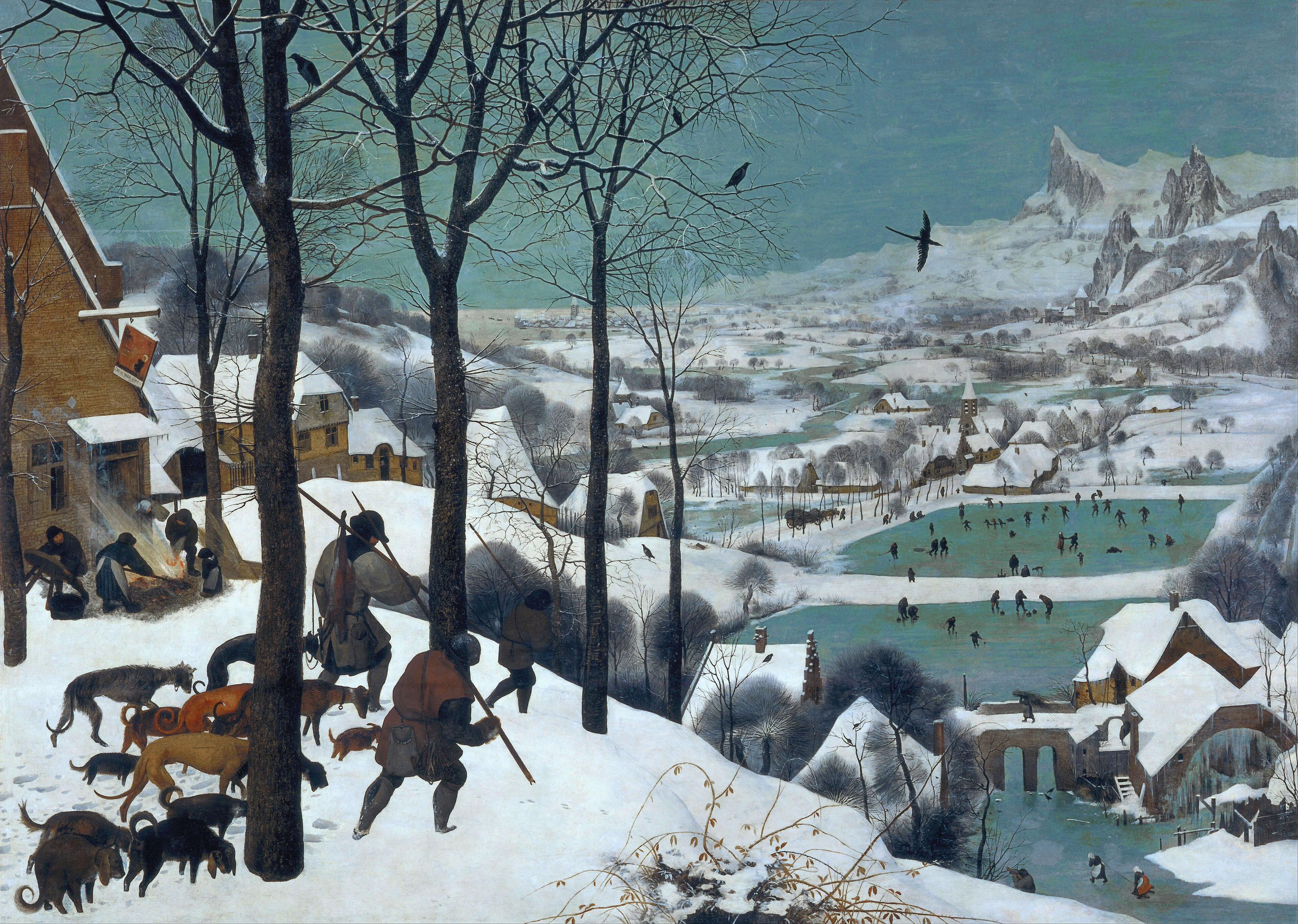
Three hunters and their tired dogs trudge downhill through a snowbound valley, while skaters play below and villagers singe a pig at an inn fire. In this painting of 1565, part of a series of the Labours of the months, Pieter Brueghel the Elder sets a small human figure against a landscape of alpine scale, winter deprivation visibly beside winter pleasure.
Read the story ↓ About the artist ↓ Research and record ↓ Literature and sources ↓ Listen to the article ↓Your browser could not copy automatically. Select the research text below, then copy it.
Open the complete research text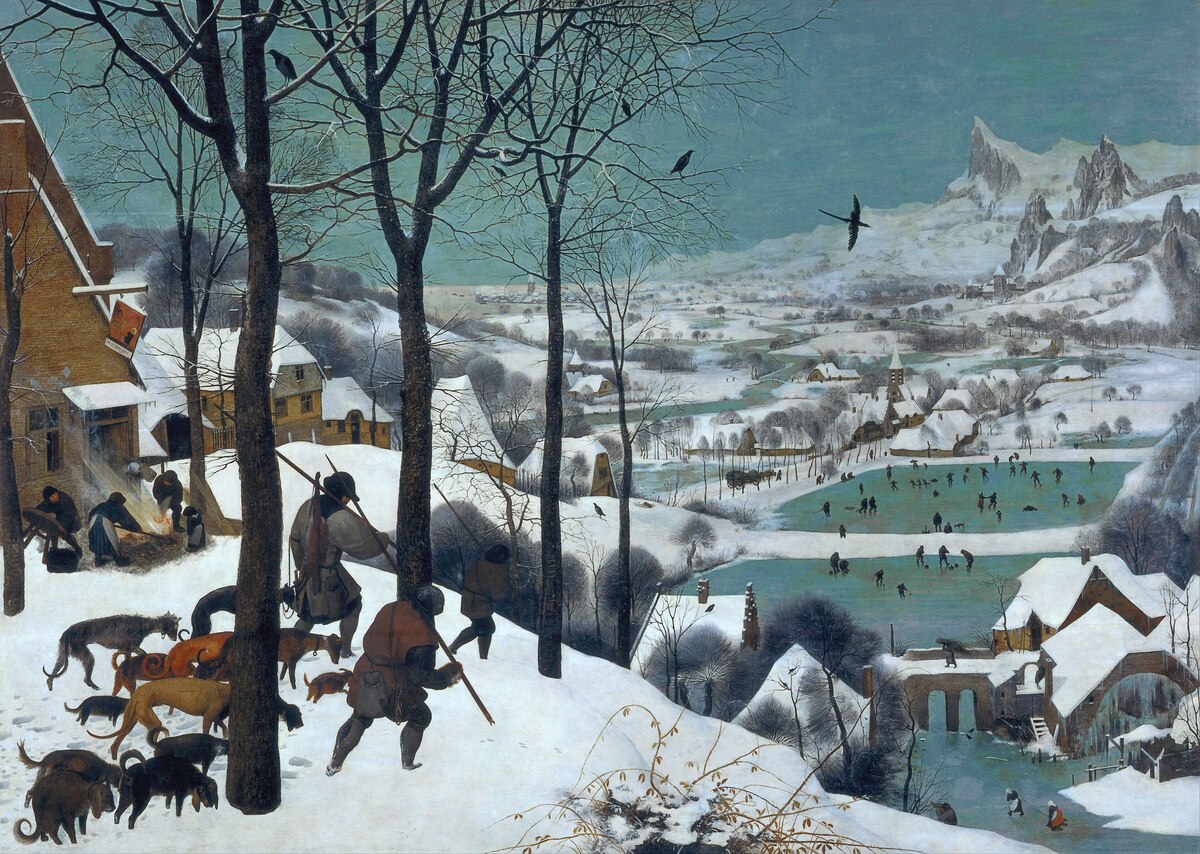
The highest-resolution file we hold, available without payment or an account.3,840 × 2,733 pixels.
Download highest-resolution imageThe needle-like snow-covered mountain range rising at the upper right, the vast alpine backdrop that gives the valley its dizzying depth and reinforces the severity of the winter setting.
The dark, leafless trees at the top of the slope with black crows and magpies perched on the thin branches, and a single bird gliding against the cold green sky, ominous silhouettes that frame the descent of the hunters.
The broad ice-green pond beyond the hill, dotted with tiny villagers skating, spinning tops, playing games and falling, a dense miniature world of winter pleasure that contrasts with the hunters' fatigue.
Your gallery guide
Three hunters and their tired dogs trudge downhill through a snowbound valley, while skaters play below and villagers singe a pig at an inn fire. In this painting of 1565, part of a series of the Labours of the months, Pieter Brueghel the Elder sets a small human figure against a landscape of alpine scale, winter deprivation visibly beside winter pleasure.
Editorial review by Artifact Archive automated publishing
Explore the researchThe story About 4 minutes to read
Three hunters walk downhill through snow, their backs to us, spears over their shoulders. Their heads are bowed, and a thin pack of hunting dogs trails behind them, down toward the valley. This is Pieter Brueghel the Elder's winter landscape of 1565, and the hunters' downward trudge is the first action your eye can follow.
The hunters do not dominate the picture. They occupy a ridge in the lower left, stationed above a much larger valley. Below and beyond them, a broad ice-green pond carries tiny figures skating, spinning tops, playing games and falling. At the left edge, villagers gather around a blazing fire outside a brick inn to singe a pig, its snow-laden roof and crooked hanging sign visible by the flames. The scale of these figures makes the hunters look small, and their descent feel like part of a larger seasonal rhythm.
The painting belongs to a series known as the Labours of the months, Brueghel's cycle tracking the turning year across several canvases. This one is the winter scene, dated 1565, painted in oil on oak wood and signed at the bottom center with the artist's name and the year. It is now part of the collection of the Kunsthistorisches Museum in Vienna.
Framing the top of the slope are dark, leafless trees, with black crows and magpies perched on the thin branches. A single bird glides against the cold green sky. Behind the valley, needle-like snow-covered peaks rise at the upper right, giving the whole scene a steep, dizzying depth.
Put those two scales together and Brueghel's winter becomes a study in contrast, not a single mood. The hunters are weary and the dogs are thin and exhausted, yet the skaters below are absorbed in play. The cold green light and the vast alpine backdrop stretch the landscape far beyond the small figures, so the scene reads as one moment in a season rather than a portrait of any one person.
The painting has a long history of ownership. Its object history names Nicolaas Jongelinck, and records that in 1594 the city of Antwerp gave it to Archduke Ernest. After his estate in 1595 it passed to Rudolf II, and later to the collection of Leopold William.
So the picture works by placing the hunters just above the valley and letting the valley take over. Their downward walk belongs to the winter that the skaters and the pig-singeing villagers are also living through. Brueghel's subject is not the hunt alone, but a whole cold season with its labour, its play and its vast setting held in one view.
Editorial review by Artifact Archive automated publishing.
Historical claims are linked to the records below. Close looking and interpretation are identified in the passage notes.
Portrait unrecorded
About the artist
Died 1569
Pieter Brueghel the Elder was a Flemish painter (1526–1569). Their work is associated with Dutch and Flemish Renaissance painting; Northern Renaissance. Their recorded places of work include Antwerp; Italy; Brussels; Mechelen; Rome.
The research & record
Find catalogue details, historical context, technical research and the literature behind this artwork.
Your browser could not copy automatically. Select the research text below, then copy it.
Open the complete research textThe artwork record
Catalogue information and detailed research, with references that link to the bibliography.
Updated .
The work is catalogued as The Hunters in the Snow by Pieter Brueghel the Elder, a title that fixes both the subject the picture has been known by and the attribution under which it has entered the reference literature. The painting carries the date 1565, and its own inscription, placed at the bottom centre, combines a signature and a date in the form BRVEGEL. M.D.LXV.; the Roman numerals expand to the same year, so the painted inscription and the catalogued date agree rather than the inscription standing as an independent later addition. It is recorded as oil on oak wood, a support whose wood grain and panel construction belong to the same entry as the medium, and its dimensions are given as 1,170 mm in height and 1,620 mm in width, that is about 46.06 by 63.77 inches. The work is a horizontal panel of substantial scale rather than a small cabinet picture, which matters for how a winter landscape with a deep valley and a crowded frozen foreground could be organised on one surface. It is held in the collection of the Kunsthistorisches Museum, Vienna, Austria, under accession number GG_1838, an identifier that ties the physical object to its institutional record. The classification offered alongside the title is two-fold: genre art and winter landscape, which describes both the pictorial category the catalogue assigns and the seasonal subject it names.(Wikimedia Commons: The Hunters in the Snow, n.d., Summary; Date; Dimensions; Accession number; Genre, Description; Inscriptions)
The painting is documented as part of the Labours of the months series, so its identity is not solely that of a single winter scene but of one panel within a cycle tracking the turning year. That series context explains why the description supplied for the object is winter landscape while the genre is given as genre art: the picture presents a season populated by unnamed villagers rather than a portrait or a narrative keyed to a named individual. The account of the picture that accompanies this identification describes what is visually emphasised: tired hunters with hounds, in which three back-turned hunters carrying spears trudge downhill with heads bowed above a straggling pack of thin, exhausted hunting dogs; an inn fire and pig singeing at the left edge, where the brick inn with its snow-laden roof and crooked hanging sign has villagers clustered around a blazing fire to singe a pig; skaters on a frozen pond, the broad ice-green pond beyond the hill dotted with tiny villagers skating, spinning tops, playing games and falling; crows and magpies in bare trees, the dark leafless trees at the top of the slope carrying black crows and magpies on thin branches with a single bird gliding against the cold green sky; and jagged alpine peaks, the needle-like snow-covered mountain range rising at the upper right and giving the valley its dizzying depth.(Wikimedia Commons: The Hunters in the Snow, n.d., Part of; Genre, Description)
The object history recorded for the painting names Nicolaas Jongelinck, then notes that in 1594 it was a gift (Geschenk) of the city of Antwerp to Archduke Ernest, that it entered the estate (Nachlass) of Archduke Ernest in 1595, and that it subsequently passed to Rudolf II and later into the collection of Leopold Wilhelm. This sequence places the panel in a chain of sixteenth- and seventeenth-century ownership that moves from a named individual through a civic gift to Habsburg collections, and the collection of Leopold Wilhelm is the historical layer from which its presence in Vienna descends. The provenance units are the only supplied record of the panel's movement before its modern institutional home, and they establish the object's early circulation as a documented fact of its history rather than a matter inferred from style. Because the same source supplies both the object history and the catalogue data, the provenance and the identity of the panel belong to one record: the accession number GG_1838 is the institutional end-point of a history whose earlier stages are the Jongelinck ownership, the Antwerp gift of 1594 and the transfer to Rudolf II.(Wikimedia Commons: The Hunters in the Snow, n.d., Object history; Accession number)
Interpretation
Several elements of the catalogue entry rest on a single source, a Wikimedia Commons file page that supplies discovery information and structured data for the painting. The source is recorded as open access but only partially consulted, and the image itself is credited there to the Google Art Project, so the published reproductions on which study depends are photographic derivatives rather than the panel. The title, the attribution to Pieter Brueghel the Elder, the date 1565, the oil-on-oak medium, the painter signature and date, the dimensions, the accession number and the object history are all supported by that one record. The genre and description entries and the visual-focus passages also come from it, while the Labours of the months membership and the provenance list are supplied through the related context records attached to the same source page. Because the attribution and the date are documented rather than argued in the supplied evidence, the catalogue identification and the painted inscription stand together: the object is dated 1565, while any dates attached to its catalogue entries, its Wikimedia file page or its institutional record are dates of those documents, not dates of the painting's making.(Wikimedia Commons: The Hunters in the Snow, n.d., Summary; Date; Dimensions; Accession number; Genre, Description; Inscriptions)
The artwork is titled The Hunters in the Snow and is by Pieter Brueghel the Elder.(Wikimedia Commons: The Hunters in the Snow, n.d.)
The painting is dated 1565.(Wikimedia Commons: The Hunters in the Snow, n.d.)
The dimensions are height: 1,170 mm (46.06 in); width: 1,620 mm (63.77 in).(Wikimedia Commons: The Hunters in the Snow, n.d.)
The accession number is GG_1838.(Wikimedia Commons: The Hunters in the Snow, n.d.)
The genre is genre art and the description is winter landscape.(Wikimedia Commons: The Hunters in the Snow, n.d.)
The inscription is a signature and date bottom center: BRVEGEL. M.D.LXV.(Wikimedia Commons: The Hunters in the Snow, n.d.)
Visual observation
The five features recorded in the visual evidence for this winter landscape are not isolated motifs but a sequence of zones read from the lower left upward and outward: three back-turned hunters carrying spears, trudging downhill with heads bowed above a straggling pack of thin, exhausted hunting dogs; the brick inn at the left edge, its roof snow-laden and its hanging sign crooked, where villagers cluster around a blazing fire to singe a pig; a broad ice-green pond beyond the hill, dotted with tiny villagers skating, spinning tops, playing games and falling; dark, leafless trees at the top of the slope with black crows and magpies perched on thin branches and a single bird gliding against the cold green sky; and, at the upper right, a needle-like snow-covered mountain range whose alpine backdrop gives the valley its dizzying depth. Taken together these registered elements establish the painting's characteristic division between a near, downward-moving human action and a far, expansive setting. The habits of the human figures, the animals and the weather are described as what is visually present, not as documents or as an artist's stated intention; the description is a record of what the image shows.(Wikimedia Commons: The Hunters in the Snow, n.d., Vision-derived semantic focus)
The visual focus includes tired hunters with hounds: three back-turned hunters carrying spears, trudging downhill with heads bowed above a straggling pack of thin, exhausted hunting dogs.(Wikimedia Commons: The Hunters in the Snow, n.d.)
The visual focus includes inn fire and pig singeing: at the left edge, the brick inn with its snow-laden roof and crooked hanging sign, where villagers cluster around a blazing fire to singe a pig.(Wikimedia Commons: The Hunters in the Snow, n.d.)
The visual focus includes skaters on the frozen pond: the broad ice-green pond beyond the hill, dotted with tiny villagers skating, spinning tops, playing games and falling.(Wikimedia Commons: The Hunters in the Snow, n.d.)
The visual focus includes crows and magpies in bare trees: dark, leafless trees at the top of the slope with black crows and magpies perched on the thin branches, and a single bird gliding against the cold green sky.(Wikimedia Commons: The Hunters in the Snow, n.d.)
The visual focus includes jagged alpine peaks: the needle-like snow-covered mountain range rising at the upper right, the vast alpine backdrop that gives the valley its dizzying depth.(Wikimedia Commons: The Hunters in the Snow, n.d.)
The painting is identified in the supplied record as part of the Labours of the months series, and its inscriptions and documented physical properties anchor it as a dated work of Pieter Brueghel the Elder: oil on oak wood, measuring 1,170 mm in height and 1,620 mm in width, signed and dated at bottom center with the inscription BRVEGEL. M.D.LXV., which establishes the year 1565. It is now held in the Kunsthistorisches Museum, Vienna, under accession number GG_1838, and its genre is recorded as genre art with the description winter landscape, situating a seasonal, everyday subject within a landscape format. These are the concrete conditions on which any account of the object's creation, patronage and later reception must rest: a securely identified, signed and dated panel of 1565, associated by the source with a multi-painting cycle of the months, executed in a medium and on a support that place it within sixteenth-century Netherlandish panel painting practice.(Wikimedia Commons: The Hunters in the Snow, n.d., Part of)
The painting is part of the Labours of the months series.(Wikimedia Commons: The Hunters in the Snow, n.d.)
The Hunters in the Snow is painted in oil on oak wood, a support and medium recorded in the object's structured documentation. That combination matters for how the winter scene was built and how it has survived: oak panel painting was a dominant support in the Low Countries in the sixteenth century, and the choice of oil as the medium aligns the picture with the period's established workshop practice rather than with any experimental technique. The documented physical facts are limited but firm. The panel measures 1,170 mm in height and 1,620 mm in width, an unusually wide format for a single panel, which supports the panoramic breadth of the valley composition. The painting carries a signature and date at bottom center reading BRVEGEL. M.D.LXV., placing the work in 1565 and identifying Pieter Brueghel the Elder as its maker. These are documented attributes of the object, not visual inferences: the medium, support, dimensions, inscription and date are all established by the cataloguing record. What the documentation does not supply is any account of preparation layers, ground, pigment analysis, underdrawing, brushwork, panel joinery, or condition and treatment history. No technical examination findings are offered for this object, so claims about how the paint was applied, whether the panel was prepared in a particular way, or what pigments were used cannot be made from the evidence at hand.(Wikimedia Commons: The Hunters in the Snow, n.d., Medium)
The inscription at bottom center is part of the object's documented physical record, and its placement and content are worth stating precisely: it bears the artist's name and the year 1565 as a signature and date. The date corroborates the 1565 dating of the painting, and it also anchors the work within the series of the Labours of the months, the cycle in which the documentation places it. That series context is relevant to materials and technique because the picture belongs to a set of compositions of consistent format and subject logic, but the evidence does not describe workshop method, replication practices or any shared preparation across the series. The accession number GG_1838 and the collection of the Kunsthistorisches Museum, Vienna, are documented facts of the object's identity and current location, and they are the framework within which any future technical study of the panel would be reported. Nothing in the supplied evidence records an examination of the inscription's lettering, its medium within the paint layer, or whether it is original to the panel, so the signature is treated here as documented information rather than as a testable claim about the act of signing.(Wikimedia Commons: The Hunters in the Snow, n.d., Medium)
The object history recorded for the painting situates it in a documented chain of owners and transfers: Nicolaas Jongelinck is named, the city of Antwerp gave the work to Archduke Ernest in 1594, it passed through Archduke Ernest's estate in 1595 to Rudolf II, and later entered the collection of Leopold William. This provenance is relevant to materials and technique chiefly as the framework for the object's survival and for any future examination: a panel of this size and date that moved among major collections has a documented institutional history, but the supplied evidence records no condition survey, no restoration campaign, no reframing or transfer, and no intervention at any point in that chain. The evidence also does not state how the painting came to the Kunsthistorisches Museum beyond its current collection and accession number. The provenance therefore should not be stretched into a narrative about the panel's physical state or about any treatment it may have received, because none of that is documented here.(Wikimedia Commons: The Hunters in the Snow, n.d., Medium)
Interpretation
Taken together, the evidence supports a clear division of what is known. Documented: the painting is oil on oak wood, 1,170 by 1,620 mm, dated 1565, signed and dated at bottom center as BRVEGEL. M.D.LXV., part of the Labours of the months series, in the Kunsthistorisches Museum, Vienna, accession GG_1838, genre art and described as a winter landscape, with a provenance running from Nicolaas Jongelinck through the 1594 gift by Antwerp to Archduke Ernest, the 1595 estate of Archduke Ernest, Rudolf II, and the collection of Leopold William. Observed: the hunters and hounds, the inn fire and pig singeing, the skaters on the frozen pond, the crows and magpies in the bare trees, and the jagged alpine peaks. Not supplied: any technical examination, pigment analysis, ground or preparation description, drawing or underdrawing evidence, tool marks, panel construction details, condition report, or treatment history. The interpretive purchase of the documented support and date is that the picture is a large-scale oil-on-oak winter landscape of 1565 whose making can only be described in general period terms until technical evidence is produced; the interpretive caution is that the strong visual impression of cold green light and deep alpine space must not be converted into claims about specific materials or methods that the record does not contain.(Wikimedia Commons: The Hunters in the Snow, n.d., Medium; Vision-derived semantic focus)
The medium is oil on oak wood.(Wikimedia Commons: The Hunters in the Snow, n.d.)
The documented object history of the painting begins with Nicolaas Jongelinck, who is named in the record of ownership. The sequence of later transfers is compressed into a series of dated and undated entries: in 1594 the painting is recorded as a gift from the city of Antwerp to Archduke Ernest (Geschenk der Stadt Antwerpen an Erzherzog Ernst); in 1595 it appears in the estate of Archduke Ernest (Nachlass Erzherzog Ernst); it then passed to Rudolf II; and it is subsequently recorded in the collection of Leopold William (Slg. Leopold Wilhelm). These entries establish a chain of prominent sixteenth- and seventeenth-century owners, moving from a private Antwerp context into Habsburg and later princely collections, but the record as supplied gives no purchase dates, sale prices, agents or intermediate custodians between the named points. The Jongelinck connection and the 1594 Antwerp gift are therefore documented ownership events, while any interval between them is simply unrecorded rather than evidence of an undocumented change of hands.(Wikimedia Commons: The Hunters in the Snow, n.d., Object history)
The object history includes Nicolaas Jongelinck; 1594 Geschenk der Stadt Antwerpen an Erzherzog Ernst; 1595 Nachlass Erzherzog Ernst; Rudolf II.; Slg. Leopold Wilhelm.(Wikimedia Commons: The Hunters in the Snow, n.d.)
The city of Antwerp gave the object to Archduke Ernst, as recorded in its object history.(Wikimedia Commons: The Hunters in the Snow, n.d., Object history)
The object appears in the estate of Archduke Ernst, as recorded in its object history.(Wikimedia Commons: The Hunters in the Snow, n.d., Object history)
The winter landscape attributed to Pieter Bruegel the Elder is today held by the Kunsthistorisches Museum in Vienna, Austria, where it carries the accession number GG_1838. The same institutional record supplies the object's physical description: oil on oak wood, measuring 1,170 mm in height and 1,620 mm in width, signed and dated at bottom center with the inscription BRVEGEL. M.D.LXV. The dating to 1565 and the medium and dimensions are therefore not independent observations but specifications attached to the Vienna object by its cataloguing institution, and they agree with the painting's own inscribed date. The work is classified in the genre category of genre art with the subject description winter landscape, and it is identified as one canvas within the cycle known as the Labours of the months.(Wikimedia Commons: The Hunters in the Snow, n.d., Collection)
The chain of ownership recorded for the picture begins with Nicolaas Jongelinck. In 1594 the city of Antwerp presented the painting as a gift to Archduke Ernest, an event noted in the object history as a Geschenk der Stadt Antwerpen an Erzherzog Ernst. Following the archduke's estate in 1595 the work passed into the possession of Rudolf II, and it is later documented in the collection of Leopold Wilhelm. These transfers matter for the picture's place in a larger history of collecting because they trace the movement of a single winter scene from private or civic hands into the imperial and archducal collections that eventually fed the Vienna holdings. The object history as recorded does not supply the circumstances of the commission from Jongelinck, the terms of the Antwerp gift, or the intervals between the named owners, so the sequence should be read as a list of documented moments rather than a continuous provenance.(Wikimedia Commons: The Hunters in the Snow, n.d., Collection)
The painting belongs to the series known as the Labours of the months, a cycle in which the artist tracked the turning year across several canvases, and this canvas is the winter scene within that sequence. Its stated genre is genre art and its described subject is a winter landscape, so the museum's own classification treats the picture as a scene of seasonal human activity rather than as a mythological or devotional image. The picture's status as a winter panel in a multi-canvas cycle is central to how the remaining evidence about figures and landscape coheres, since the seasonal framework explains why the hunt, the ice games and the village work appear together in one view.(Wikimedia Commons: The Hunters in the Snow, n.d., Collection)
The visual description of the panel records three back-turned hunters carrying spears, trudging downhill with heads bowed above a straggling pack of thin, exhausted hunting dogs. At the left edge stands a brick inn with a snow-laden roof and a crooked hanging sign, where villagers cluster around a blazing fire to singe a pig. Beyond the hill lies a broad ice-green pond dotted with tiny villagers skating, spinning tops, playing games and falling. The scale relationship is explicit in the description: the hunters are small relative to the valley and the figures in it, so the returning hunt occupies a modest portion of the scene while the seasonal activity of the settlement occupies the greater part. The description as recorded reports the condition of the dogs as thin and exhausted and the activity of the villagers as absorbed in play, and it does not attribute a mood to the artist beyond these observable features.(Wikimedia Commons: The Hunters in the Snow, n.d., Collection)
Dark, leafless trees stand at the top of the slope, with black crows and magpies perched on the thin branches and a single bird gliding against the cold green sky. Behind the valley, a needle-like snow-covered mountain range rises at the upper right, described as the vast alpine backdrop that gives the valley its dizzying depth. These elements establish the composition's two registers: a near slope occupied by the hunters, the inn and the bare trees, and a far distance supplied by mountain peaks. Read together with the pond and the pig-singeing villagers, the described scene places a small foreground action within a very large cold setting, which is what allows the panel to read as one moment in a season rather than a portrait of any single figure.(Wikimedia Commons: The Hunters in the Snow, n.d., Collection)
Interpretation
For a history of art and material culture, the picture's importance rests on documented rather than conjectural ground: it is an oil-on-oak winter panel dated 1565, signed at bottom center, functioning as one canvas of the Labours of the months cycle, and it entered the Kunsthistorisches Museum's collection through a documented sequence running from Nicolaas Jongelinck to Archduke Ernest, Rudolf II and Leopold Wilhelm. That combination of a dated cyclic landscape, a signed surface and a traceable passage through sixteenth- and seventeenth-century collections makes the Vienna panel a reference point for how seasonal imagery and landscape painting were collected and classified by later institutions. The interpretation offered here is a qualified synthesis: the evidence establishes the object's date, signature, medium, dimensions, subject category, cycle membership and several ownership transfers, while the aesthetic reading of the scene as a whole season held in one view depends on the described arrangement of small figures within a large landscape, not on documentary statements of the artist's intent, which the evidence does not supply.(Wikimedia Commons: The Hunters in the Snow, n.d., Collection)
The painting is in the collection of the Kunsthistorisches Museum, Vienna, Austria.(Wikimedia Commons: The Hunters in the Snow, n.d.)
Interpretation
The panel commonly known as The Hunters in the Snow is recorded as a work by Pieter Brueghel the Elder, dated 1565, painted in oil on oak wood, and measuring approximately 1,170 mm in height by 1,620 mm in width. Its bottom center inscription, recorded as the signature and date "BRVEGEL. M.D.LXV.", is the primary internal evidence tying the panel to the artist and the year, a point the documentary record treats as high-confidence identification. The same record assigns the painting to the Kunsthistorisches Museum in Vienna under accession number GG_1838 and places it within the Labours of the Months series, classifying it by genre as genre art with a winter landscape description. These are the fixed coordinates on which any further account, whether art historical or financial, depends: a signed, dated, large-format oak panel by a named sixteenth-century artist, held in a named public institution, and belonging to a documented series rather than standing alone.(Wikimedia Commons: The Hunters in the Snow, n.d.)
A record of object history survives alongside the technical description. It names Nicolaas Jongelinck among the painting's owners and states that in 1594 the city of Antwerp presented the work to Archduke Ernest. After the archduke's estate was settled in 1595, it passed to Rudolf II, and it is later recorded in the collection of Leopold William. Read together, these entries trace a movement from private ownership through civic gift to imperial and later collection contexts, and they establish that the panel's movement into Habsburg hands was documented rather than reconstructed. The same source records the signature and date inscription, oil on oak wood as the medium, the dimensions of about 1170 by 1620 mm, the accession number GG_1838, and the current location in Vienna, so provenance and material description rest on the same body of institutional record keeping. No provenance interval beyond these named stages, and no transaction price at any stage, is established by the supplied evidence.(Wikimedia Commons: The Hunters in the Snow, n.d.)
The recorded visual focus of the panel identifies several distinct zones. Three back-turned hunters carrying spears trudge downhill with the heads bowed, above a straggling pack of thin, exhausted hunting dogs. At the left edge stands a brick inn with a snow-laden roof and a crooked hanging sign, where villagers cluster around a blazing fire to singe a pig. Beyond the hill a broad ice-green pond is dotted with tiny villagers skating, spinning tops, playing games and falling. Dark, leafless trees at the top of the slope carry black crows and magpies on thin branches, and a single bird glides against the cold green sky. At the upper right, a needle-like snow-covered mountain range rises, described as the vast alpine backdrop that gives the valley its dizzying depth. These are recorded observations of the picture's content, and they establish the distribution of the narrative action across the panel: the hunters in the foreground, the communal winter activities below, the birds and trees framing the slope, and the alpine range behind. They describe what the object depicts, not why it was painted or what it meant to its first viewers.(Wikimedia Commons: The Hunters in the Snow, n.d.)
The compositional relationship of these zones is itself part of the record. The hunters and their dogs occupy one scale, the skating and pig-singeing villagers another, and the alpine peaks a third, so that the figures at the lower left are visually subordinate to the valley and the mountains beyond them. The fire at the inn gives the left edge a point of warmth and human gathering, while the frozen pond distributes play and mishap across the middle distance, and the birds and bare trees tie the top of the slope to the cold green sky above the range. Because the same record lists the series membership, the winter activities, the hunt, and the landscape within a single description, the panel is documented as a composite scene rather than as a portrait of a single activity. This is a description of what the object shows and how its parts sit relative to one another; it does not by itself establish Bruegel's intentions or the responses of sixteenth-century viewers.(Wikimedia Commons: The Hunters in the Snow, n.d.)
Series membership matters for how the picture is understood. The record states that the painting is part of the Labours of the Months series, and it also records the 1565 date, the oil on oak support, the signature and date bottom center, the dimensions, and accession number GG_1838 at the Kunsthistorisches Museum. The conjunction of these facts means the panel is not an isolated winter scene but one element of a cycle, signed and dated by the artist, held in an identified public collection. The documented provenance, running from Nicolaas Jongelinck and the 1594 gift by the city of Antwerp to Archduke Ernest, through the 1595 estate and Rudolf II to the collection of Leopold William, attaches the work to named owners and historical transfers, which is a different order of evidence from the visual description of the hunters and skaters. The series and provenance record explains why the panel's winter content belongs to a larger programmatic frame, while the accession number and museum location explain the present institutional custody.(Wikimedia Commons: The Hunters in the Snow, n.d.)
A separate documentation of value exists for this painting, and it must be distinguished from the art historical record above. It is described as a calculated working insurance estimate, generated as a working calculation on 2026-10-16, with a working range for manual review of US$80M to US$250M. Its stated methodology is that it was calculated only from the confirmed context in the supplied Wikimedia Commons and institutional record excerpts, and its basis is listed as the high-confidence identification of Pieter Brueghel the Elder, the date 1565, oil on oak wood, the dimensions of about 1170 by 1620 mm, the signature and date inscription, accession number GG_1838, and current location at the Kunsthistorisches Museum in Vienna, together with the work's place in the Labours of the Months series and its documented historic provenance including Nicolaas Jongelinck and later imperial collections. The same documentation states that because no official insurance valuation, public auction result, or private sale price was supplied, the range is a broad, conservative working figure for manual review rather than an appraisal, and that the upper end is intentionally wide to reflect the rarity and institutional importance of a signed, dated panel by this artist while avoiding unsupported precision. It also states that no comparable sales or private insurance records were used or invented.(Wikimedia Commons: The Hunters in the Snow, n.d.)
The qualification attached to this figure is part of the record and limits how it may be used. It is a model-generated working range for manual review only; it is not an official insurance value, not an appraisal, not an auction result, and not a sale price, and it should not be used for binding decisions without examination by a qualified fine-art insurance professional or appraiser. Read against the art historical documentation, the two bodies of record do different work. The institutional and Commons-derived record establishes what the object is, who made it, when, in what material, at what size, with what inscription, under what accession number, in which collection, in which series, and through which owners; the valuation record establishes only a provisional numerical bracket derived from that same descriptive basis, with no market transaction behind it. The relation between them is one of derivation and caution rather than corroboration: the dollar range inherits its factual inputs from the identification of the painting but adds no independent evidence about the painting's history, and its own text states that it should not be treated as a settled or binding value.(Wikimedia Commons: The Hunters in the Snow, n.d.)
Taken together, the supplied units place this winter panel at the intersection of several kinds of documentation. It is a signed and dated oil on oak panel of the 1560s with a recorded inscription, a series affiliation, an imperial and civic provenance, and a modern museum accession, which makes it unusually well anchored in the written record for a sixteenth-century landscape. Its recorded visual content sets a foreground hunt against communal winter activity and a vast alpine distance, so the same object that carries a strong documentary identity also presents an image organized around contrasts of scale, temperature and activity. The valuation documentation shows how such an object can acquire a further, institutional life as a candidate for insurance review, while its explicit qualifications show that this numerical bracket rests on the descriptive record rather than on any documented transaction. The panel therefore matters both as a documented, series-bound work by a named artist and as a demonstration that different records of value, art historical and financial, have to be kept distinct and given only the evidential weight their own statements support.(Wikimedia Commons: The Hunters in the Snow, n.d.)
Working estimate
Calculated working insurance estimate, not a sale price: Working range for manual review: US$80M to US$250M Recorded date: Working calculation, generated 2026-10-16. Methodology: Calculated only from the confirmed context in the supplied Wikimedia Commons and institutional record excerpts. The basis includes high-confidence identification of Pieter Brueghel the Elder, date 1565, oil on oak wood, dimensions of about 1170 by 1620 mm, signature and date inscription, accession number GG_1838, and current location at the Kunsthistorisches Museum in Vienna. The work is part of the Labours of the Months series and has documented historic provenance including Nicolaas Jongelinck and later imperial collections. Because no official insurance valuation, public auction result, or private sale price was supplied, the range is a broad, conservative working figure for manual review rather than an appraisal. The upper end is intentionally wide to reflect the rarity and institutional importance of a signed, dated panel by this artist while avoiding unsupported precision. No comparable sales or private insurance records were used or invented. Qualification: This is a model-generated working range for manual review only. It is not an official insurance value, not an appraisal, not an auction result, and not a sale price. It should not be used for binding decisions without examination by a qualified fine-art insurance professional or appraiser.(Wikimedia Commons: The Hunters in the Snow, n.d.)
Bibliography
References are arranged by author or organisation, with links to the original publications. Where no publication date is recorded, n.d. means no date.
Source notes updated .
No recorded sources match these filters. Reset the filters to see the full bibliography.
Secondary · About this artwork
Wikimedia Commons: The Hunters in the Snow (n.d.). Wikimedia Commons.
Wikimedia Commons file page providing discovery information and structured data for the painting.
Art to live with
A piece of the archive, made yours. Explore The Hunters in the Snow in a size and finish that fits your space.
Choose your edition Combine this painting with your favourites10 × 8 in / 25.4 × 20.3 cm · Standard
10 × 8 in / 25.4 × 20.3 cm · Standard

10 × 8 in / 25.4 × 20.3 cm · Standard

10 × 8 in / 25.4 × 20.3 cm · Standard

10 × 8 in / 25.4 × 20.3 cm · Standard
A gallery paper print with a smooth art-paper surface. Choose a size that suits the painting.
Choose size and finish10 × 8 in / 25.4 × 20.3 cm · Black frame
10 × 8 in / 25.4 × 20.3 cm · Black frame

10 × 8 in / 25.4 × 20.3 cm · Black frame

10 × 8 in / 25.4 × 20.3 cm · Black frame

10 × 8 in / 25.4 × 20.3 cm · Black frame

10 × 8 in / 25.4 × 20.3 cm · Black frame
A ready-to-hang wooden frame with a clear Perspex cover and a semi-gloss printed insert, made in the UK.
Choose size and finish11oz · 2 image repeats
11oz · Standard

11oz · 2 image repeats

11oz · 2 image repeats

11oz · 2 image repeats

11oz · 2 image repeats

11oz · 2 image repeats
An 11oz white ceramic mug with AAA+ ORCA coating and a C-shaped handle. Dishwasher and microwave safe, printed and dispatched in the UK.
Choose size and finish15 × 16.5 in / 38 × 42 cm · Black
15 × 16.5 in / 38 × 42 cm · Black

15 × 16.5 in / 38 × 42 cm · Black

15 × 16.5 in / 38 × 42 cm · Black

15 × 16.5 in / 38 × 42 cm · Black

15 × 16.5 in / 38 × 42 cm · Black

15 × 16.5 in / 38 × 42 cm · Black
A cotton tote with reinforced handles and artwork on the front, printed and dispatched in the UK.
Choose size and finish8.7 × 8.7 in / 22 × 22 cm · Standard
8.7 × 8.7 in / 22 × 22 cm · Standard

8.7 × 8.7 in / 22 × 22 cm · Standard

8.7 × 8.7 in / 22 × 22 cm · Standard
A rectangular PU leather mouse mat with a non-slip base, printed locally for your delivery country.
Choose size and finishA5 · Glossy cover · Lined pages
A5 · Glossy cover · Lined pages

A5 · Glossy cover · Lined pages

A5 · Glossy cover · Lined pages

A5 · Glossy cover · Lined pages

A5 · Glossy cover · Lined pages

A5 · Glossy cover · Lined pages
An A5 notebook with 150 lined pages, a glossy laminated front cover carrying your artwork, black wire-o binding and a white back cover.
Choose size and finishKeep exploring