ArchiveThe Temptation of Christ

Artwork record / 308 of 331

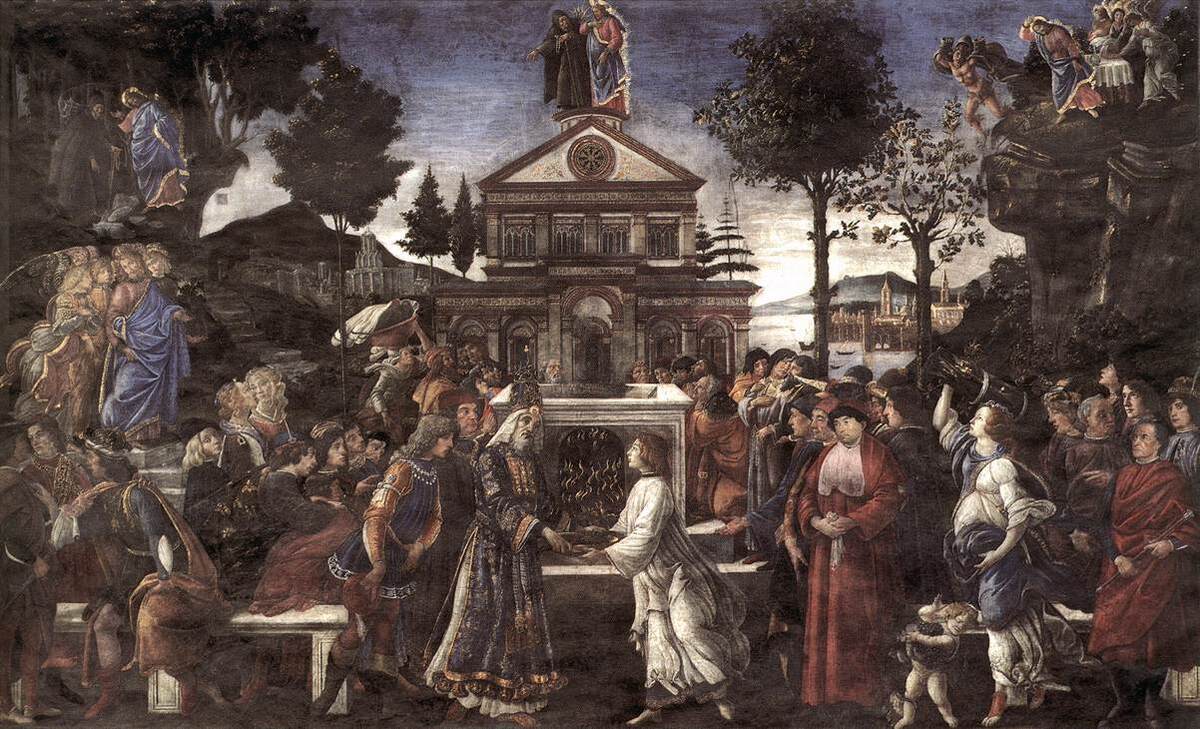
The Temptation of Christ by Sandro Botticelli (between 1473 and 1481)

Artist: Sandro Botticelli

A docent-led reading of Botticelli's Sistine Chapel fresco The Temptation of Christ, moving through the pinnacle episode on the temple roof, the altar ceremony, the ministering angels and the crowd of worshippers to explain how the composition holds the temptations together as one narrative.

Read the story ↓ About the artist ↓ Research and record ↓ Literature and sources ↓ Listen to the article ↓
Article text for AI
Shop this artwork ↓ 1 visit
Datebetween 1473 and 1481CultureItaly PeriodItalian RenaissanceCurrent locationSistine Chapel, Apostolic Palace, Vatican City, Rome, Italy
Listen to the article
100%
The Temptation of Christ by Sandro Botticelli (between 1473 and 1481)
Loading full-resolution artwork…
Scroll to zoom · drag to pan · double-click to focus Pinch to zoom · drag to explore · double-tap to focus FIELD VIEW / 308
Tools & download
Pixel colour Select a pixel with the eyedropper
No pixel selected

Choose the eyedropper, then click or tap the image. Scroll to zoom for finer selection.

Add text

Hand to pan · Select to move text and drawings · Add as many texts as you like · Scroll to zoom

The Temptation of Christ: high-resolution image

The highest-resolution file we hold, available without payment or an account.1,202 × 730 pixels.

Download highest-resolution image

Details to notice

About 3 minutes to read
01

Woman with basket and seated child

In the right-hand crowd a woman in a white bodice and blue skirt carries a loaded basket above her head, with a small child seated at her feet holding a bowl. The everyday offering detail reveals the crowd as worshippers bringing gifts, not mere onlookers.

02

Paired figures on the dark height at left

Small figures on the shadowed rocky outcrop at the upper left, a standing robed figure facing dark-clad companions, one of the temptation episodes set into the landscape and shown at almost miniature scale against the trees.

03

Angels ministering on the mountain

On the rocky height at the upper right, Christ stands among winged angels who tend to him after the temptations. Their clustered gestures and white drapery contrast with the dark cliff and close the narrative on the right edge.

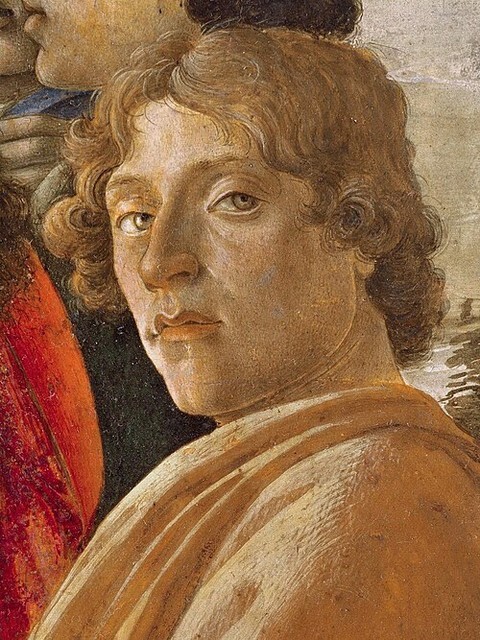
Artist portrait of Sandro Botticelli
Artist portrait Image credit

Sandro Botticelli. Image source · Public domain

About the artist

Sandro Botticelli

Died 1510

Sandro Botticelli was an Italian painter (1445–1510). Their work is associated with Early Renaissance; Florentine School. Their recorded places of work include Florence; Pisa; Rome; Mantua.

Died
1510
Nationality
Italy
Birthplace
Florence
Died in
Florence

The research & record

Study the work.
Follow the evidence.

Find catalogue details, historical context, technical research and the literature behind this artwork.

Article text for AI
Open research text

The artwork record

Research catalogue

Catalogue information and detailed research, with references that link to the bibliography.

Updated .

Identity and catalogue

Link
Title
The Temptation of Christ
Artist or attribution
Sandro Botticelli(Italiamoderna, 2009)
Object date
between 1473 and 1481(Italiamoderna, 2009)
Medium and support
fresco(Italiamoderna, 2009)
Current collection or location
Sistine Chapel, Apostolic Palace, Vatican City, Rome, Italy(Italiamoderna, 2009)
Movement or period
Italian Renaissance
Country or culture
Italy
Depicted subject
A fresco depicting the temptations of Christ, including the pinnacle temptation on the temple roof and related episodes, painted by Sandro Botticelli for the Sistine Chapel between 1473 and 1481.(Italiamoderna, 2009)
Title variants
Temptations of Christ; Three Temptations of Christ(Italiamoderna, 2009)
Dimensions
Unknown
Catalogue Identity

The research file records the work as The Temptation of Christ, attributed to Sandro Botticelli, described as an Italian painter who lived from 1445 to 1510. The attribution and the artist's lifespan belong to the file record, and the phrasing marks the painting as attributed rather than securely documented by the record itself. The same record files the image under the Commons category Three Temptations of Christ by Sandro Botticelli, so the institutional filing of the work sits in tension with the shortest form of the title: the category names a plural subject, the temptations as a sequence, while the file title names a single Temptation. Both forms circulate as the object's recorded identity, and the difference between them is not resolved within the supplied evidence.(Italiamoderna, 2009, Summary, Artist; Category)

The object is titled The Temptation of Christ and is attributed to Sandro Botticelli, an Italian painter who lived from 1445 to 1510.(Italiamoderna, 2009)

The file falls under the Commons category Three Temptations of Christ by Sandro Botticelli.(Italiamoderna, 2009)

Subject and iconography

Link
Subject and composition

Visual observation

The fresco's structured data item names its depicted subject as the Temptations of Christ, so the composition is indexed as a multi-episode narrative rather than a single isolated moment. The evidence supporting that subject designation is the file record's structured data, and the individual episodes described below are set within it. Because the description records several separate encounters across one wall, the title functions as a collective label for the sequence rather than a caption for any one figure group.(Italiamoderna, 2009, Structured data, depicts)

The largest and most legible action in the fresco is the altar exchange, where a bearded high priest in a dark, jewel-embroidered cope extends his hand over an altar grate containing live flames to receive a vessel from a youth robed in white. This moment anchors the whole ceremony scene, and the cope's jewel embroidery distinguishes the priest's vestments within the composition. The description places this exchange at the forefront of the picture's attention, and it is against this dominant foreground action that the other episodes are arranged.(Italiamoderna, 2009, Composition description, high priest and offering)

The temptation that supplies the fresco's title is placed on the central axis, where two small figures stand on the apex of the temple pediment: a dark-clad figure confronting a lighter-robed one. Described as the pinnacle temptation, the confrontation is small in scale yet occupies the compositional center, so the scene identified in the title is rendered as a compact dialogue on a roof rather than a broadly staged encounter. This placement embeds one temptation in the architecture of the temple itself, distinct from the episodes set in the landscape.(Italiamoderna, 2009, Composition description, devil and Christ on the temple roof)

Two further temptation-related episodes occupy the landscape rather than the temple. On the rocky height at the upper right, Christ stands among winged angels who tend to him after the temptations, and their clustered gestures and white drapery contrast with the dark cliff while closing the narrative at the right edge. At the upper left, small figures stand on a shadowed rocky outcrop, a standing robed figure facing dark-clad companions, one of the temptation episodes set into the landscape and shown at almost miniature scale against the trees. The two passages together show how the landscape carries narrative episodes at reduced scale, with the lighter drapery of the angels set against dark rock to mark the close of the sequence.(Italiamoderna, 2009, Composition description, angels ministering on the mountain; Composition description, paired figures on the dark height at left)

The crowd at the right is identified through everyday offering detail: a woman in a white bodice and blue skirt carries a loaded basket above her head, and a small child seated at her feet holds a bowl. These attributes reveal the crowd as worshippers bringing gifts rather than mere onlookers. The evidence supports the identification of the group's role through these objects and actions; the child's seated position, the bowl, and the carried basket are the features that establish the gift-bearing character of the congregation. This offering detail complements the priest's altar exchange, extending the ceremony from the clergy to the assembled laity.(Italiamoderna, 2009, Composition description, woman with basket and seated child)

The depicted subject is the Temptations of Christ, according to the structured data item on the file record.(Italiamoderna, 2009)

In the high priest and offering at the altar, a bearded high priest in a dark, jewel-embroidered cope extends his hand over the altar grate with live flames to receive a vessel from a youth robed in white; this exchange is the largest, most legible gesture in the fresco and anchors the whole ceremony scene.(Italiamoderna, 2009)

On the temple roof, two small figures stand on the apex of the temple pediment: a dark-clad figure confronting a lighter-robed one; this is the pinnacle temptation placed on the central axis of the composition, the moment that gives the fresco its title.(Italiamoderna, 2009)

On the rocky height at the upper right, Christ stands among winged angels who tend to him after the temptations; their clustered gestures and white drapery contrast with the dark cliff and close the narrative on the right edge.(Italiamoderna, 2009)

At the upper left, small figures stand on a shadowed rocky outcrop, a standing robed figure facing dark-clad companions, one of the temptation episodes set into the landscape and shown at almost miniature scale against the trees.(Italiamoderna, 2009)

In the right-hand crowd, a woman in a white bodice and blue skirt carries a loaded basket above her head, with a small child seated at her feet holding a bowl; the everyday offering detail reveals the crowd as worshippers bringing gifts, not mere onlookers.(Italiamoderna, 2009)

Historical context

Link
The object and its institutional setting

The Temptation of Christ is recorded in the file as a fresco attributed to Sandro Botticelli, an Italian painter whose dates are given as 1445 to 1510. The work belongs to the collection of the Sistine Chapel, the chapel of the Apostolic Palace in Vatican City, Rome. The parent institution of that collection is recorded as established between 1473 and 1481, the dates the file associates with the chapel's building period. The same span, 1473 to 1481, is the period the transcript attaches to the making of the fresco, so the object is presented as belonging to the chapel's earliest decorative campaign rather than to a later phase. The medium recorded for the work is fresco, a technique in which pigment is applied to freshly laid lime plaster; the file record supplies no further technical data about plaster, preparation or pigment, and none should be assumed from the label alone.(Italiamoderna, 2009, Summary, Collection, Established; Summary, Work location)

Botticelli's recorded work locations place him in Florence from 1469 to 1481, in Pisa in 1475, in Rome from 1481 to 1482, then in Florence from 1482 to 1490, around Volterra in 1483, in Mantua in 1502, and in Florence from 1503 to 1510. The Roman interval of 1481 and 1482 is the only documented period of residence in the city that would place the painter physically at the Sistine Chapel during the years the file associates with the fresco, and it overlaps the final portion of the chapel's recorded building period. That overlap is a correlation of two separately recorded dates, not a commission document. No contract, payment record or patron's name is present in the supplied evidence, so the identity of whoever engaged Botticelli and the terms on which the work was made remain outside what these units establish. The fresco is securely tied to the chapel by its collection record and to Botticelli by the file's attribution, but neither fact on its own settles the commissioning history.(Italiamoderna, 2009, Summary, Work location; Summary, Collection, Established)

The Sistine Chapel, the parent institution of the work's collection, is recorded as established between 1473 and 1481, the dates the file record associates with the chapel's building period.(Italiamoderna, 2009)

Botticelli's recorded work locations include Florence from 1469 to 1481, Pisa in 1475, Rome from 1481 to 1482, Florence from 1482 to 1490, Volterra around 1483, Mantua in 1502, and Florence from 1503 to 1510.(Italiamoderna, 2009)

Materials and technique

Link
Recorded medium

The file record for this work gives its medium as fresco, entered in the structured data as QS:P186,Q25631150. That single documented field is the foundation of any account of how the object was made: it identifies the painting as a wall painting executed in the fresco technique rather than as an easel picture on wood or canvas, and it aligns the object with the tradition of large-scale monumental decoration for which the fresco method was the standard vehicle in later fifteenth-century Italy. The record does not, however, itemise the support, the number of plaster layers, the pigments, the preparatory drawing, or any restoration history, and the present account therefore cannot describe those specifics without going beyond what the evidence establishes. Fresco as a recorded medium is itself a materially consequential fact: the technique binds the image to a particular wall in a particular building, since a fresco cannot be detached from its support and moved like a panel or a portable canvas. The medium entry and the collection record together explain why this object is understood as an architectural painting rather than a movable artwork, and they set the terms within which its imagery, composition and scale must be read.(Italiamoderna, 2009, Description, Medium)

Visual observation

What the surviving record establishes about the making of this fresco is narrow but firm. The file record names the medium as fresco; it does not name a plasterer, a workshop assistant, a pigment supplier, or a date of execution for the painting itself, nor does it record examination reports, sampling, cross-sections, or conservation treatment. Technical examination and visual inference must therefore be kept apart here. The medium statement is a documented catalogue field attached to the object record. Statements about how the composition was laid out, what the depicted figures do, and how the narrative is organised are instead observations drawn from looking at the image and from the structured description of its subject, and they describe what the picture shows rather than how its materials were prepared. This distinction matters for an accumulating research account: the material record can support a claim that the work is a fresco, while the composition can only support claims about what is represented and how it is arranged.(Italiamoderna, 2009, Description, Medium; Structured data, depicts)

The work belongs to the collection of the Sistine Chapel, part of the Apostolic Palace in Vatican City, Rome, and the file locates that chapel by coordinates at 41 degrees 54 minutes 10.64 seconds north and 12 degrees 27 minutes 15.96 seconds east, with an official website at mv.vatican.va. The chapel's parent institution is recorded as established between 1473 and 1481, the span the file associates with its building period, and it carries authority control numbers including Q2943, LCCN n96096549, NLA 36437812, GND 4104970-6 and BNF 139022841. Within this setting the fresco medium is not incidental: a wall painting of this kind is inseparable from the chapel that houses it, and the building's recorded construction span provides the institutional and chronological frame within which the painting's production is usually situated. The evidence establishes the object's placement and the chapel's dates of establishment; it does not by itself fix the date of the painting's execution.(Italiamoderna, 2009, Description, Medium)

Attribution and documentation

The artist is recorded as Sandro Botticelli, an Italian painter who lived from 1445 to 1510, and his documented working locations include Florence from 1469 to 1481, Pisa in 1475, Rome from 1481 to 1482, Florence from 1482 to 1490, Volterra around 1483, Mantua in 1502, and Florence from 1503 to 1510. The Roman residence in 1481 to 1482 falls within the later part of the 1473 to 1481 span that the record associates with the Sistine Chapel's establishment, so the recorded locations place the painter in Rome during the years in which work on the chapel's decoration is conventionally situated. These are biographical and topographical records, not proof of authorship or of a specific execution date, and they should be weighted as such: they establish where the artist is documented to have been, and that documentation is consistent with the object's Roman setting without independently dating the fresco.(Italiamoderna, 2009, Description, Medium)

The primary source for the material statement and the structured subject data is a digital photograph by the user Italiamoderna, released into the public domain and uploaded on 21 October 2009. The file is 1,202 by 730 pixels and 181 kilobytes, and the credit line records Italiamoderna with the copyright status marked as copyrighted, dedicated to the public domain by copyright holder, under a public domain self-release. The image falls under the Commons category Three Temptations of Christ by Sandro Botticelli. These dimensions, file size, upload date and rights statement are properties of the reproduction, not of the fresco, and they set the limits of what the photographic evidence can show: the record documents the painting's medium and its described composition, but the visible detail and any inference drawn from it depend on this particular digital image and its resolution rather than on direct examination of the wall.(Italiamoderna, 2009, Description, Medium)

Recorded medium

Interpretation

Set in the larger history of material culture, an object that is at once a wall, a recorded subject and a chapel decoration shows why medium and location are not separable facts. The fresco technique commits the image to a plaster support in a building; the building's recorded establishment between 1473 and 1481 and the painter's documented Roman residence in 1481 to 1482 situate that commitment in a specific institutional frame; and the composition, with its central axis, altar ceremony and distributed temptation episodes, was designed for that frame. To describe the work as a fresco is thus also to describe the conditions under which its imagery can be seen and studied, and to acknowledge that the surviving evidence documents the medium, the attribution and the collection, while leaving the preparation, pigments and execution history of the painting to future examination.(Italiamoderna, 2009, Description, Medium; Structured data, depicts)

The medium is fresco, recorded as QS:P186,Q25631150 in the file record.(Italiamoderna, 2009)

Provenance and ownership

Link
The Digital File and Its Uploader

Provenance research on the digital record of The Temptation of Christ begins with the photograph itself rather than with the fresco. The file is a digital photograph by the Wikimedia Commons user Italiamoderna, released into the public domain and uploaded on 21 October 2009. The file history locates that upload at 19:47 on 21 October 2009. The image measures 1,202 by 730 pixels and occupies 181 kilobytes. These figures describe the reproduction and its upload, not the fresco, and should not be mistaken for physical dimensions, condition data or any property of the wall painting in the Sistine Chapel.(Italiamoderna, 2009, File history, 19:47, 21 October 2009)

The file record credits Italiamoderna as the credit line and marks the copyright status as copyrighted, dedicated to the public domain by copyright holder, under a public domain self-release. The credit line, the upload date and the self-release therefore belong to one documented chain of custody for the image file, distinct from the far longer and largely unrecorded history of the fresco on the chapel wall. No earlier or later owner, transfer or sale of the digital file is established by these units, so the interval between the photograph's creation and its 2009 upload remains undocumented rather than proven to involve any change of hands.(Italiamoderna, 2009, Summary, Credit line; Structured data, copyright status)

The file is a digital photograph by the user Italiamoderna, released into the public domain, uploaded on 21 October 2009; the image dimensions are 1,202 by 730 pixels and the file size is 181 kilobytes. These are image and upload properties, not object properties.(Italiamoderna, 2009)

The credit line for the digital file is recorded as Italiamoderna, and the copyright status is marked as copyrighted, dedicated to the public domain by copyright holder, under a public domain self-release.(Italiamoderna, 2009)

Provenance timeline
  1. 1473 to 1481

    The Sistine Chapel, parent institution of the work's collection, is recorded as established within this building period.(Italiamoderna, 2009, Summary, Collection, Established)

  2. 21 October 2009

    A digital photograph of the work by the user Italiamoderna was uploaded, released into the public domain; these are image and upload properties rather than object properties.(Italiamoderna, 2009, File history, 19:47, 21 October 2009)

Collection and display

Link
Institutional Setting

The fresco belongs to the collection of the Sistine Chapel, which the file record places within the Apostolic Palace in Vatican City, Rome, Italy. In the same record the chapel appears as the parent institution of the work's collection, identified by the authority control numbers Q2943, LCCN n96096549, NLA 36437812, GND 4104970-6 and BNF 139022841, and carries coordinates at 41 degrees 54 minutes 10.64 seconds north, 12 degrees 27 minutes 15.96 seconds east together with a link to the official website mv.vatican.va. These are catalogue and locational facts attached to the chapel rather than observations about the painted surface, but they fix the physical and institutional setting in which the work is held and through which it is normally identified.(Italiamoderna, 2009, Summary, Collection; Summary, Collection, Authority file; Summary, Collection, Coordinates and Website)

The evidence units supplied for this section concern collection and display, and within them the only directly documented statements about the object's whereabouts are the collection, parent institution, authority numbers, coordinates and website recorded above. The digital file itself is a separate document: it is a photograph by the user Italiamoderna, released into the public domain, uploaded on 21 October 2009, with image dimensions of 1,202 by 730 pixels and a file size of 181 kilobytes, credited to Italiamoderna and marked as copyrighted but dedicated to the public domain by the copyright holder under a public domain self-release. Those figures describe the image and its upload, not the fresco, and the distinction matters for how the object is studied: the reproduction circulates as a public-domain photograph while the painting remains in the chapel.(Italiamoderna, 2009, Summary, Collection; Summary, Collection, Authority file; Summary, Collection, Coordinates and Website)

The work belongs to the collection of the Sistine Chapel, part of the Apostolic Palace in Vatican City, Rome, Italy.(Italiamoderna, 2009)

The Sistine Chapel parent institution is identified by the authority control numbers Q2943, LCCN n96096549, NLA 36437812, GND 4104970-6 and BNF 139022841 in the file record.(Italiamoderna, 2009)

The file record carries coordinates for the Sistine Chapel at 41 degrees 54 minutes 10.64 seconds north, 12 degrees 27 minutes 15.96 seconds east, and links to the official website mv.vatican.va.(Italiamoderna, 2009)

Documented values and qualified estimates

Link
The working insurance range and its stated limits

Interpretation

The single evidence unit supplied for this section is a model-generated working insurance estimate, and its own framing governs how it can responsibly be used. It records a broad range of US$500 million to US$2 billion, with a recorded date of 16 October 2026, and it describes that date explicitly as a working calculation generated for manual review. The methodology states that the range was derived only from confirmed context already held: Sandro Botticelli of Florence, circa 1445 to 1510, a fresco dated between 1473 and 1481, located in the Sistine Chapel within the Apostolic Palace, Vatican City. No dimensions, no condition data, no object-level Vatican Museums record, and no public auction or sale evidence for the work itself were available to the calculation, and the range is described as intentionally wide and conservative for that reason. The same record qualifies itself in the strongest terms: it is not an official insurance value, not an appraisal, not an auction result and not a sale price; it rests on no comparable sales, no private insurance records and no inspection; and the fresco, as an in-situ wall painting in the Sistine Chapel, is not represented as available for sale. Local review, professional appraisal, condition reporting and object-level documentation are stated as prerequisites before any coverage decision. The figure therefore belongs in this archive as a documented placeholder for institutional or loan-related manual review, not as a market valuation of the object.(Italiamoderna, 2009)

Working estimate

Calculated working insurance estimate, not a sale price: Estimated value: US$500M to US$2B Recorded date: Working calculation, generated 2026-10-16. Methodology: This broad working range is calculated for manual review from the supplied confirmed context only: Sandro Botticelli (Florence, circa 1445 to 1510), a fresco dated between 1473 and 1481, located in the Sistine Chapel, Apostolic Palace, Vatican City. Botticelli is a canonical Italian Renaissance master, and this fresco is one of the documented Sistine Chapel wall paintings he executed in Rome in 1481. Museum-held frescos of this artist, period, medium, and site-specific monumental scale are extremely rarely traded. The range is intentionally wide and conservative, reflecting the absence of dimensions, condition data, an object-level Vatican Museums record, and any public auction or sale evidence for the work itself. Because the fresco is attached to a chapel wall and part of an in-situ cycle, any insurance figure is a working placeholder for institutional or loan-related manual review, not a market valuation. Qualification: This is a model-generated working range for manual review only. It is not an official insurance value, appraisal, auction result, or sale price. It is not based on comparable sales, private insurance records, or an inspection. The artwork is an in-situ fresco in the Sistine Chapel and is not represented as available for sale. Source URLs support context only and do not constitute a public appraisal or valuation record. Local review, professional appraisal, condition reporting, and object-level documentation are required before any coverage decision.(Italiamoderna, 2009)

Bibliography

Sources and further reading

References are arranged by author or organisation, with links to the original publications. Where no publication date is recorded, n.d. means no date.

Source notes updated .

  1. 01

    Secondary · About this artwork

    Wikimedia Commons: The Temptation of Christ. Wikimedia Commons, File:Sandro Botticelli, The Temptation of Christ.jpg. Wikimedia Commons.

    Discovery and reference record for the digital image of Botticelli's fresco The Temptation of Christ in the Sistine Chapel, recording artist, medium, collection and structured data on the depicted subject.

    Language
    English
    Link to reference
    Citation text

Article text and sources · Reading and attribution

An unhandled error has occurred. Reload 🗙