ArchivePrimavera

Artwork record / 239 of 331

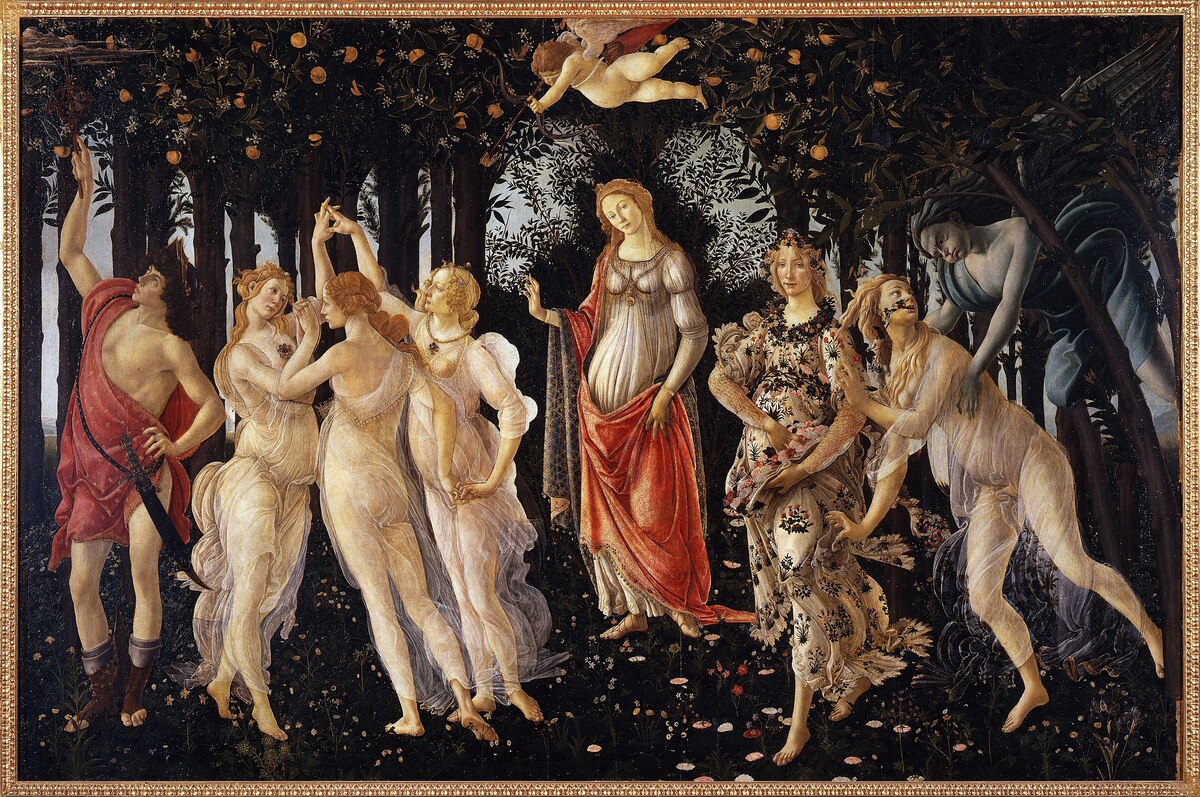
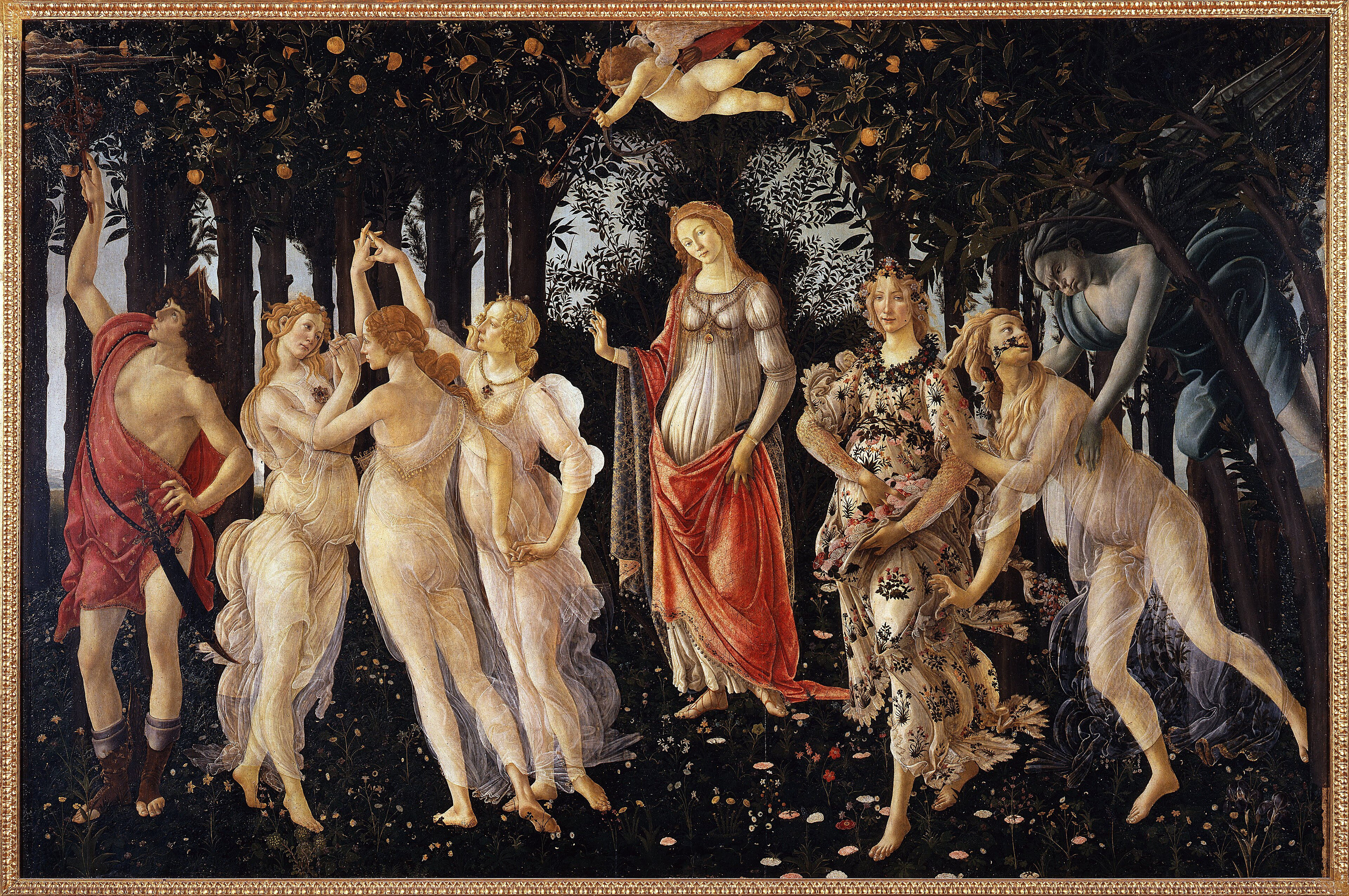
Primavera by Sandro Botticelli (between 1480 and 1485)

Artist: Sandro Botticelli

A docent-led reading of Botticelli's Primavera, a large mythological panel painted in tempera and plaster between 1480 and 1485 and now in the Uffizi Gallery. The account stays close to what the supplied record establishes, naming the classical figures and treating the spring allegory as the organising subject.

Read the story ↓ About the artist ↓ Research and record ↓ Literature and sources ↓ Listen to the article ↓
Article text for AI
Shop this artwork ↓ 0 visits
Datebetween 1480 and 1485CultureItalian PeriodEarly RenaissanceCurrent locationUffizi Gallery, Florence, Italy
Listen to the article
100%
Primavera by Sandro Botticelli (between 1480 and 1485)
Loading full-resolution artwork…
Scroll to zoom · drag to pan · double-click to focus Pinch to zoom · drag to explore · double-tap to focus FIELD VIEW / 239
Tools & download
Pixel colour Select a pixel with the eyedropper
No pixel selected

Choose the eyedropper, then click or tap the image. Scroll to zoom for finer selection.

Add text

Hand to pan · Select to move text and drawings · Add as many texts as you like · Scroll to zoom

Primavera: high-resolution image

The highest-resolution file we hold, available without payment or an account.3,840 × 2,551 pixels.

Download highest-resolution image

Details to notice

About 3 minutes to read
01

Cupid aiming his arrow

The blindfolded winged child hovers above Venus with bow drawn and an arrow aimed downward into the dancing Graces, the small figural detail that makes the garden's allegory of love readable at a glance.

02

Flora scattering roses

A young woman advances in an embroidered gown dense with botanical motifs, a garland of flowers in her hair, gathering roses into a fold of her dress and scattering them across the meadow, the visible end-point of the Zephyrus and Chloris episode.

03

Mercury with caduceus

The leftmost male figure, wearing a red cloak over bare flesh and winged sandals, lifts his caduceus staff toward an overhanging branch, the gesture that frames the composition's western edge and guards the garden.

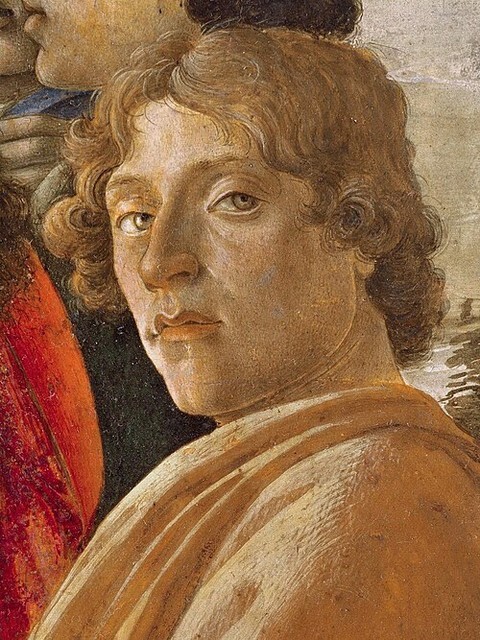
Artist portrait of Sandro Botticelli
Artist portrait Image credit

Sandro Botticelli. Image source · Public domain

About the artist

Sandro Botticelli

Died 1510

Sandro Botticelli was an Italian painter (1445–1510). Their work is associated with Early Renaissance; Florentine School. Their recorded places of work include Florence; Pisa; Rome; Mantua.

Died
1510
Nationality
Italy
Birthplace
Florence
Died in
Florence

The research & record

Study the work.
Follow the evidence.

Find catalogue details, historical context, technical research and the literature behind this artwork.

Article text for AI
Open research text

The artwork record

Research catalogue

Catalogue information and detailed research, with references that link to the bibliography.

Updated .

Identity and catalogue

Link
Artist or attribution
Sandro Botticelli(Wikimedia Commons: Primavera, n.d.)
Object date
between 1480 and 1485(Wikimedia Commons: Primavera, n.d.)
Medium and support
tempera and plaster on panel(Wikimedia Commons: Primavera, n.d.)
Dimensions
height: 207 cm (81.4 in); width: 319 cm (10.4 ft)(Wikimedia Commons: Primavera, n.d.)
Current collection or location
Uffizi Gallery, Florence, Italy(Wikimedia Commons: Primavera, n.d.)
Movement or period
Early Renaissance(Wikimedia Commons: Primavera, n.d.)
Country or culture
Italian
Depicted subject
A mythological painting depicting a group of classical figures in an orange grove: Mercury, the Three Graces, Venus with Cupid, Flora, and Chloris pursued by Zephyrus, representing an allegory of spring.
Title variants
La Primavera; Primavera (Spring); Allegory of Spring
Accession number
8360
Support
panel
Catalogue identity and attribution

The object is catalogued under the title Primavera and attributed to Sandro Botticelli. The supplied record identifies Botticelli as an Italian painter, draftsperson, architectural drafter and fresco painter, born circa 1445 and died on 17 May 1510. Three elements of this identity need to be kept distinct, because they rest on different kinds of statement: the title and the artist attribution are catalogue identifications, the life dates are biographical data about the maker, and the roles listed for him describe the range of his documented practice rather than this single panel. The same record classifies the object as a painting and, by genre, as a mythological painting, which places it among works whose subjects are drawn from classical narrative rather than Christian devotion. It is worth noting how a discovery source of this kind works. The Wikimedia Commons file page supplies identity fields and a subject list, but its own annotation describes it as a discovery and identity source rather than an institutional catalogue record, so the attributions and classifications it carries are reported rather than independently certified by an institutional record. That qualification does not weaken the basic identification, which is consistent across the fields, but it does mean that details of provenance, commission and scholarly debate would have to come from elsewhere.(Wikimedia Commons: Primavera, n.d.)

The record dates the painting between 1480 and 1485, a span of roughly five years. That date describes the making of the object, not any moment within the story the picture relates, and it should not be confused with later catalogue activity such as the assigning of a title or an inventory entry. The uncertainty is built into the range itself rather than being a defect in the report. What the evidence supports is a window of production in the early 1480s, and any more precise dating would require documentation this source does not supply.(Wikimedia Commons: Primavera, n.d.)

What the catalogue supports and what it leaves open

Interpretation

Taken together, the evidence identifies a large tempera and plaster panel on wood, attributed to Sandro Botticelli, made in the early 1480s between 1480 and 1485, catalogued as a mythological painting, depicting Flora, Venus, Cupid, Mercury and Demeter, and held in the Uffizi under accession number 8360. The record stops at these points. It supplies no patron, no programme of reading, and no documented explanation of individual roles within the composition. The gap is not a defect in the object but a limit of the source, and it is the reason the painting's meanings remain a subject of interpretation rather than a matter of settled catalogue fact. What the evidence does establish is enough to fix the work within the Early Renaissance, within Botticelli's series of mythological paintings, and within a history of art in which classical subjects were given monumental panel form.(Wikimedia Commons: Primavera, n.d.)

The artwork is titled Primavera and was created by Sandro Botticelli.(Wikimedia Commons: Primavera, n.d.)

The artist is Sandro Botticelli, born circa 1445 and died 17 May 1510, an Italian painter, draftsperson, architectural drafter and fresco painter.(Wikimedia Commons: Primavera, n.d.)

The painting is dated between 1480 and 1485.(Wikimedia Commons: Primavera, n.d.)

The object type is painting and the genre is mythological painting.(Wikimedia Commons: Primavera, n.d.)

Subject and iconography

Link
The documented composition and its limits

Visual observation

The supplied record identifies the depicted people as Flora, Venus, Cupid, Mercury and Demeter. That list is the full extent of the figure identification the evidence establishes, and it is worth separating that identification from any description of gesture, grouping or narrative order. The record names the figures but does not describe their poses, their spacing or their actions, so an account of who appears in the panel can be drawn directly from the evidence, while an account of what each figure is doing cannot. The object itself is a painting dated between 1480 and 1485, executed in tempera and plaster on panel, with a height of 207 cm (81.4 in) and a width of 319 cm (10.4 ft), held in the Uffizi Gallery, Florence, under accession number 8360. The scale is consequential for the visual evidence: a panel roughly three metres wide and two metres high gives the named figures a broad field to occupy, which is consistent with an assembly of several figures rather than a single concentrated encounter. Because the record supplies identities without gestures, the composition is best described at the level the evidence supports, namely a wide panel presenting a group of named classical figures.(Wikimedia Commons: Primavera, n.d.)

The depicted people include Flora, Venus, Cupid, Mercury and Demeter.(Wikimedia Commons: Primavera, n.d.)

Historical context

Link
Commission, period and genre

The supplied record identifies the object as a mythological painting by Sandro Botticelli, produced within the series of mythological pictures he made in the later fifteenth century. Within that record, the panel is placed in the Early Renaissance, a period the same source brackets between the 1420s and 1500, so the work sits near the end of that span rather than at its beginning. Dating the picture therefore locates it in a late phase of a long period style, not in the formation of the tradition it belongs to. The genre classification is stated twice over: the object is a painting, and more specifically a mythological painting, which distinguishes it from devotional or portrait production of the same decades. That generic label is the strongest contextual claim the evidence carries, because it groups the picture with classical subject matter rather than with Christian narrative.(Wikimedia Commons: Primavera, n.d.)

Botticelli's documented working life is given as 1460 to 1510, with locations that include Florence, Pisa, Rome, Volterra and Mantua. Those places and dates describe a career that ranged beyond a single city, even though the painting itself is associated in the record with the mythological series of his mature period. The five named centres matter for contextual reading because they show the artist moving between different political and ecclesiastical environments; they do not, on their own, establish where any single picture was made or for whom. The record supplies no commission document, no patron name and no payment record for this object, so the creation circumstances remain open. What can be said is that the artist's activity spans roughly half a century and several Italian centres, and that the painting belongs to the part of that career in which mythological subjects were being produced.(Wikimedia Commons: Primavera, n.d.)

Figures and subject

Interpretation

The connection between the named figures and the painting's mythological genre is straightforward in the record: the presence of Flora, Venus, Cupid, Mercury and Demeter is what makes an allegorical spring scene legible as classical subject matter. The panel sits within a series of mythological paintings, which places it in a broader project of picturing antique subjects rather than Christian ones, a project the record treats as characteristic of Botticelli's output. That series context is a claim about artistic production, not about patronage or function. It tells us that this picture was one of several exercises in the same mode, without specifying whether the series was made for one patron, one location or several. The distinction matters because a series can be a stylistic grouping assembled by later scholarship as easily as a documented commission, and the record does not settle which kind of grouping this is.(Wikimedia Commons: Primavera, n.d.)

The painting is part of a series of mythological paintings by Botticelli.(Wikimedia Commons: Primavera, n.d.)

The painting belongs to the Early Renaissance period (1420s to 1500).(Wikimedia Commons: Primavera, n.d.)

Botticelli's work period was 1460 to 1510, with work locations including Florence, Pisa, Rome, Volterra and Mantua.(Wikimedia Commons: Primavera, n.d.)

Materials and technique

Link
The documented support and medium

Technical and catalogue evidence establishes the basic physical constitution of the object. The medium is recorded as tempera and plaster on panel, and the support measures 207 cm in height (81.4 in) and 319 cm in width (10.4 ft). These two facts together describe a large, rigid, wooden support coated and painted in an aqueous medium, rather than a canvas, fresco or other support type. The size matters for any account of making: a panel of roughly two by three metres requires joined and prepared wood, and its scale conditions both how the paint surface was laid down and how the finished object is encountered. The evidence supplied here stops at the material and the dimensions; it does not describe the species of wood, the number of joined members, the preparation layers, or whether the plaster element is a full ground or a more limited application. Those remain open, and the account should not close them by inference.(Wikimedia Commons: Primavera, n.d.)

Documented materials versus visual inference

Visual observation

The evidence distinguishes clearly between what the record documents and what the picture shows. The documented level consists of the medium, the dimensions, the title, the attribution, the date range, the collection and the identified figures. The observational level consists of the depicted people, listed as Flora, Venus, Cupid, Mercury and Demeter. Material analysis as such is not supplied: nothing in these units reports pigment identification, cross-sections, binding-media analysis, infrared imaging or condition treatment. What can be said about materials is therefore bounded by the catalogue-level record of tempera, plaster and panel. Visual description of the scene, including the presence of the orange grove and the arrangement of the figures, belongs to the depiction rather than to the material record, and it should not be converted into claims about pigments or preparation layers.(Wikimedia Commons: Primavera, n.d.)

The identification of the figures as Flora, Venus, Cupid, Mercury and Demeter concerns what is represented, not how the panel was made. It is nonetheless relevant to technique because it indicates a composition assembled from several named classical figures in one scene. A panel of this width can accommodate such an assembly without crowding, which is consistent with the recorded dimensions. The relationship between the figures, their gestures and their roles is not explained in the evidence, and the medium and dimensions units say nothing about them. Material description and subject description therefore run on separate tracks here, and the account keeps them separate.(Wikimedia Commons: Primavera, n.d.)

The medium is tempera and plaster on panel.(Wikimedia Commons: Primavera, n.d.)

The dimensions are height 207 cm (81.4 in) and width 319 cm (10.4 ft).(Wikimedia Commons: Primavera, n.d.)

Collection and display

Link
The Object and Its Institutional Identity

The panel known as Primavera, painted by Sandro Botticelli between 1480 and 1485, belongs to the Uffizi Gallery in Florence, Italy, where it carries accession number 8360. That accession number is the kind of locator that ties the physical object to a specific institutional record, distinguishing the painting from the many reproductions and derivative images that circulate under the same title. The painting is executed in tempera and plaster on panel, a large wooden support measuring 207 cm in height and 319 cm in width. The combination of a plaster ground with tempera on panel is a demanding technique on a surface of this scale, and the dimensions matter for how the object was made and how it is encountered: at more than three metres across, the panel is wider than the reach of a single viewer standing before it, so the composition has to be read in parts as well as in whole. The Uffizi holding establishes that the work is an Italian museum object with a continuous institutional identity, and the accession number gives a precise handle for future catalogue research rather than relying on the title alone.(Wikimedia Commons: Primavera, n.d.)

In the Uffizi record as supplied, the work is classified both as a painting and as a mythological painting, belonging to the Early Renaissance period, which the same source places between the 1420s and 1500. Its subject is summarized as an allegory of spring, and the depicted people are identified as Flora, Venus, Cupid, Mercury and Demeter. The panel is also described as part of a series of mythological paintings by Botticelli, which situates it within a broader project of picturing classical subjects rather than Christian ones during a period when mythological painting was a recognized genre. The artist is Sandro Botticelli, born circa 1445 and dead on 17 May 1510, an Italian painter who also worked as a draftsperson, architectural drafter and fresco painter. His working career is given as running from about 1460 to 1510, with work locations including Florence, Pisa, Rome, Volterra and Mantua. Those working locations do not by themselves document where this particular panel was made, but they establish the geography of Botticelli's practice and the range of centres in which he operated. The combination of a mythological subject with a large panel format also indicates that this was a substantial, intended work rather than a small devotional or private object.(Wikimedia Commons: Primavera, n.d.)

The Wikimedia Commons file page functions as a discovery and identity source rather than an institutional catalogue record, and it is only partially consulted here. That distinction matters for how much weight the record can carry. The page establishes the title, the attribution to Botticelli, the date range of 1480 to 1485, the medium of tempera and plaster on panel, the dimensions, the Uffizi accession number 8360, the list of depicted people, and the classification of the painting as part of a series of mythological works and as an Early Renaissance object of the mythological genre. What it does not provide is a full provenance history, a record of condition and treatment, a record of past exhibitions, or a documented programme of reading for the figures. The date range is a scholarly attribution of the making period rather than a record of a single moment inside the story the panel tells. Anyone building on this account should therefore treat the Commons page as a starting point that the Uffizi's own documentation would need to supplement.(Wikimedia Commons: Primavera, n.d.)

Visual Conventions and Subject

Primavera is a large panel painting made with tempera and plaster. The picture shows a group of classical figures standing and moving through an orange grove, sharing one shallow level space beneath the trees. Each figure is given a distinct action, so the panel reads as a sequence rather than as a single encounter. The figures named in the record are Mercury, Venus, Cupid, Flora and Demeter. Venus stands near the centre, and Cupid appears together with her. The orange grove frames the figures and provides the scene with a setting, so that spring as a subject is carried as much by the grove as by any individual figure. The identities given in the record establish that this is an assembly of classical figures rather than a portrait group, and the allegory of spring is the frame within which those figures appear.(Wikimedia Commons: Primavera, n.d.)

What the Evidence Supports

The record gives the painting's identities and its subject, and then stops. It does not supply a patron, a programme of reading, or a documented explanation of each figure's role, and it does not describe the gestures of the figures in detail. That gap is consequential: the allegory of spring, the presence of Mercury, Venus, Cupid, Flora and Demeter, and the place of the work in Botticelli's mythological series are supported, while a fuller narrative of what each figure means or does is not. The later title Primavera names the season the painting presents and is part of its catalogue identity, not evidence of what every figure signifies. The mythological series matters because it places the work within a sustained practice of picturing classical subjects; it does not by itself explain the scene's internal logic. Reading the panel honestly means holding the allegory of spring as the frame while leaving the finer meanings open, and treating any account of private intent or hidden programme as something the present evidence cannot establish.(Wikimedia Commons: Primavera, n.d.)

The painting is in the collection of the Uffizi Gallery, Florence, Italy, with accession number 8360.(Wikimedia Commons: Primavera, n.d.)

Documented values and qualified estimates

Link
Reasoning about value for an object without comparables

Interpretation

The values recorded for Primavera in this archive are not sale prices or appraisals but working figures generated for a specific internal purpose. The single valuation unit supplied here is a calculated working insurance estimate, an intentionally broad range of US$500 million to US$1 billion, with the calculation recorded as generated on 16 October 2026. Its stated methodology is explicit about its own limits: it is a conservative range produced for manual review, not an appraisal. Nothing in the record documents an auction result, a private sale, a documented acquisition price, or an accessed insurance file. The number therefore belongs to the history of how institutions and researchers provisionally quantify objects that cannot be priced by comparison, rather than to the documented commercial history of the painting itself.(Wikimedia Commons: Primavera, n.d.)

The estimate is derived from the confirmed identity of the work, and that derivation is worth unpacking because it shows how the number was built. The calculation rests on the object being Sandro Botticelli's Primavera, an Early Renaissance painting in tempera and plaster on panel, dated between 1480 and 1485, of very large scale at 207 cm by 319 cm, held at the Uffizi Gallery in Florence, Italy, under accession number 8360. Botticelli is described in the supporting record as one of the most prominent artists of the Italian Renaissance, and Primavera as among the most celebrated mythological paintings in Western art. Those attributes are what make the work effectively unique, and uniqueness is precisely the condition under which the range is described as intentionally wide rather than precise.(Wikimedia Commons: Primavera, n.d.)

The methodology unit states that because no open-market comparables exist for an institutional, world-renowned masterpiece of this stature, a broad insurance-replacement range is used for preliminary review only. It further notes the painting has no recent sale or auction history and is generally considered inalienable or subject to strong cultural-heritage protection in Italy. The qualifications attached to the calculation repeat and sharpen this: it is a model-generated working range for manual review only, and it is not an official insurance value, appraisal, auction result, documented acquisition value, or sale price. The record also states that no comparable sales or private insurance records were accessed or invented, and that any actual insurance amount would require professional appraisal, underwriting, and consideration of institutional, legal, and cultural-heritage factors. These qualifications are part of the evidence rather than a hedge around it: they define what kind of claim the figure is.(Wikimedia Commons: Primavera, n.d.)

What the valuation rests on

The factual content feeding the calculation overlaps closely with the object record supplied for the painting. That context records the title Primavera, attributed to Sandro Botticelli, described as an Italian painter, draftsperson, architectural drafter and fresco painter, born circa 1445 and died 17 May 1510, with a working period from 1460 to 1510 and work locations including Florence, Pisa, Rome, Volterra and Mantua. It records the date range 1480 to 1485, the medium of tempera and plaster on panel, dimensions of height 207 cm (81.4 in) and width 319 cm (10.4 ft), the holding institution as the Uffizi Gallery, Florence, Italy, with accession number 8360, and the object type as painting with the genre mythological painting. It places the work in a series of mythological paintings by Botticelli and in the Early Renaissance, a period the record places between the 1420s and 1500. The value estimate inherits these identifications; it does not establish them independently, and the accompanying note describes the source as a discovery and identity source rather than an institutional catalogue record.(Wikimedia Commons: Primavera, n.d.)

Because the valuation derives entirely from object identification, any uncertainty in that identification propagates into the figure. The one valuation unit and the identity facts come from the same narrow evidence base, and the identity source is explicitly characterized as a discovery and identity source rather than an institutional catalogue record. The calculation also lists the depicted people as Flora, Venus, Cupid, Mercury and Demeter, matching the object record. The presence of mythological figures is relevant to value only indirectly, as part of why the picture is counted among the most celebrated mythological paintings; the record does not argue that subject matter itself sets the range. Reading the number responsibly means treating it as a provisional working estimate attached to a strongly documented object, not as a market measurement of that object.(Wikimedia Commons: Primavera, n.d.)

Working estimate

Calculated working insurance estimate, not a sale price: Estimated value: US$500M to US$1B Recorded date: Working calculation, generated 2026-10-16. Methodology: This is a broad, conservative working range for manual review, not an appraisal. It is derived from the confirmed context that the work is Sandro Botticelli's Primavera, an Early Renaissance tempera and plaster on panel painting dated between 1480 and 1485, of very large scale (207 cm by 319 cm), held at the Uffizi Gallery in Florence, Italy, with accession number 8360. Botticelli is one of the most prominent artists of the Italian Renaissance, and Primavera is among the most celebrated mythological paintings in Western art. For an institutional, world-renowned masterpiece of this stature, no open-market comparables exist; therefore a broad insurance-replacement range is used for preliminary review only. The range is intentionally wide and conservative because the painting is effectively unique, has no recent sale or auction history, and is generally considered inalienable or subject to strong cultural-heritage protection in Italy. Qualification: This is a model-generated working range for manual review only. It is not an official insurance value, appraisal, auction result, documented acquisition value, or sale price. No comparable sales or private insurance records were accessed or invented. Any actual insurance amount would require professional appraisal, underwriting, and consideration of institutional, legal, and cultural-heritage factors.(Wikimedia Commons: Primavera, n.d.)

Bibliography

Sources and further reading

References are arranged by author or organisation, with links to the original publications. Where no publication date is recorded, n.d. means no date.

Source notes updated .

  1. 01

    Secondary · About this artwork

    Wikimedia Commons: Primavera (n.d.). Wikimedia Commons.

    Wikimedia Commons file page for the Google Arts and Culture digital reproduction of Botticelli's Primavera. Serves as a discovery and identity source, not an institutional catalogue record.

    Link to reference
    Citation text

Article text and sources · Reading and attribution

An unhandled error has occurred. Reload 🗙