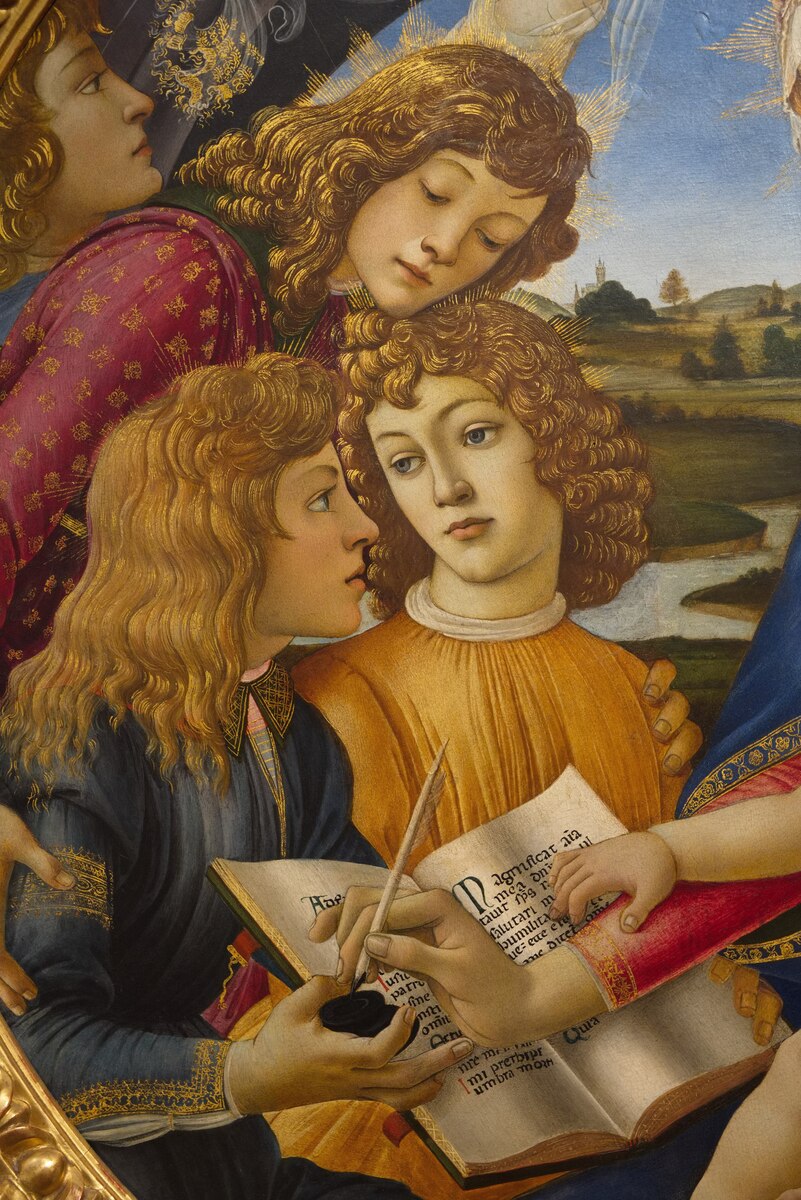
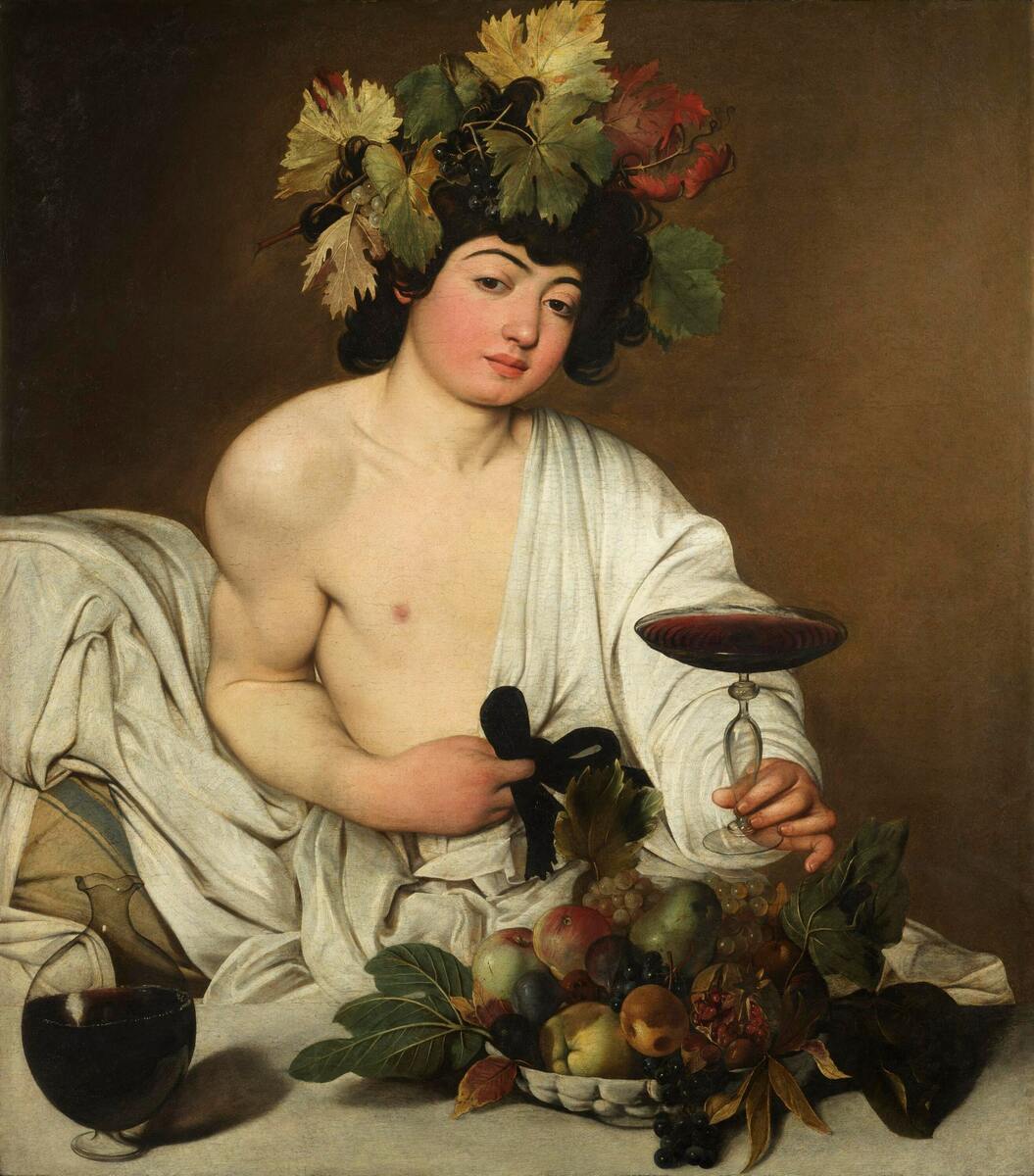
A closer look at the boys gathered at the left of Botticelli's circular devotional painting, made in Florence around 1483. The detail comes from a photograph by Armin Kleiner.
The distant landscape at right with a winding river, rolling green hills, scattered trees, and a small towered building, the earthly vista that opens behind the sacred figures.
02
Angel in patterned magenta robe
The angel at the upper left in profile, wearing a magenta mantle patterned with gold floral motifs, his upturned face and richly ornamented drapery showing Botticelli's craftsmanship on the garment surface.
03
Golden-haired angel above
The upper angel with dense golden curls, gold-ray halo and pink mantle, head tilted down in tender attention toward the group below, providing the vertical tiering of the angelic cluster.
Your gallery guide
Madonna of the Magnificat by Sandro Botticelli (c. 1483)
A closer look at the boys gathered at the left of Botticelli's circular devotional painting, made in Florence around 1483. The detail comes from a photograph by Armin Kleiner.
Editorial review by Artifact Archive automated publishing
This is a detail from Sandro Botticelli's Madonna of the Magnificat, a painting made in Florence around 1483 and now in the Uffizi.
The full picture shows the Virgin Mary with the Christ Child, surrounded by angels. One of those angels writes out the Magnificat, the hymn of praise that gives the painting its name.
What you are seeing here is only part of that larger composition.
The photograph isolates the boys on the left side of the painting.
They lean inward toward the centre of the original panel, where Mary and the child sit. Their heads tilt and their shoulders turn, so the group reads as a small crowd pressing close to a shared focus.
Even in this fragment, the composition points you back toward the mother and child.
The painting is tempera on panel, a method in which pigments are bound in a water-based medium and laid onto a prepared wooden surface.
That technique suits the crisp outlines and clear modelling you see in the faces and hair. The panel itself measures about 115 centimetres across.
The detail was photographed by Armin Kleiner and shared under a Creative Commons licence.
In the complete picture, the writing angel records Mary's song. The boys in this detail are part of the heavenly company that attends her.
Their closeness turns a private devotional image into something shared. The hymn is not only Mary's words; it is written down in the presence of witnesses.
Seeing them gathered like this helps explain why the painting was made: for prayer, and for the retelling of that song.
So the detail is a doorway into the whole. It shows you the attentive crowd around the Virgin, and it points to the moment when the Magnificat is set down.
What survives here is a fragment of a larger act of devotion, made in Florence at the height of the early Renaissance.
The story and its sources
Editorial review by Artifact Archive automated publishing.
Historical claims are linked to the records below. Close looking and interpretation are identified in the passage notes.
Sandro Botticelli was an Italian painter (1445–1510). Their work is associated with Early Renaissance; Florentine School. Their recorded places of work include Florence; Pisa; Rome; Mantua.
The Virgin Mary with the Christ Child and angels, one of whom writes the Magnificat hymn.
Title variants
Madonna of the Magnificat; Madonna del Magnificat
Catalogue identity
The object treated in this section is catalogued as Sandro Botticelli's Madonna of the Magnificat, dated around 1483 and held at the Uffizi in Florence. The attribution to Botticelli, the approximate date and the Florentine repository are the identity anchors carried by the available record; they establish what the archive account is about before any detail of technique, scale or depiction is considered. The medium is tempera, applied to a panel whose width is given as 115 centimetres. Because the unit expressed the measurement as one dimension only, it is retained here as stated rather than resolved into a full height-by-width format. The date should be read as a scholarly approximation belonging to the catalogue, not as an inscribed or otherwise fixed year of execution: the phrase used is circa 1483, and the record offers no internal date, signature or document that would convert that approximation into an exact event. The same applies to the attribution, which the record presents as an identification of the work rather than as a demonstrated chain of documentation.(Armin Kleiner, n.d.)
The artwork is Botticelli's Madonna of the Magnificat, dated c. 1483, held at the Uffizi in Florence.(Armin Kleiner, n.d.)
The photograph reproduced here is not an independent composition but a detail cropped from a larger painting: the boys on the left side of Sandro Botticelli's Madonna of the Magnificat, a work dated around 1483, held at the Uffizi in Florence and painted in tempera on a panel measuring about 115 centimetres. The image was recorded by Armin Kleiner and released under a CC BY-SA 4.0 licence through Wikimedia Commons, so it circulates as an open-access photographic document of a portion of the panel rather than as a reproduction of the whole. Because the crop isolates one group, the evidence it carries is strictly partial: everything visible belongs to a composition whose centre, the Virgin and Child, lies outside the frame, and any reading of the detail's figures has to be referred back to that missing centre.(Armin Kleiner, n.d.)
Within the larger picture, the boys form the left-hand portion of the heavenly company attending the Virgin, and the full composition also includes an angel who writes out the Magnificat, the hymn of praise from which the painting takes its name. Placing the boys on the left therefore positions them as witnesses at the edge of a scene organised around Mary, the Christ Child and the act of writing. The relationship between the written hymn and the surrounding witnesses is what gives the left-hand group its narrative function: the song is not only Mary's utterance but something transcribed in the presence of an attentive company. This is the framework in which the detail's figures should be understood, since the panel's subject matter, not the crop alone, determines what they are doing there.(Armin Kleiner, n.d.)
The photograph is a detail of the boys on the left side of the painting.(Armin Kleiner, n.d.)
The object documented by this evidence is Sandro Botticelli's Madonna of the Magnificat, painted in Florence around 1483 and now held at the Uffizi in Florence. The primary technical record supplied here is brief but specific: the work is executed in tempera, and the panel measures 115 cm. Both details come from the Wikimedia Commons record for a photographic detail of the painting, whose annotation describes it as a detail from Botticelli's Madonna of the Magnificat showing boys on the left. The photograph itself was taken by Armin Kleiner and is licensed under CC BY-SA 4.0, and the source is recorded as open access and only partially consulted. This means that the medium and the panel dimension are transmitted as part of the image record's description of the artwork rather than as the result of a technical examination published in this evidence. Any account of the support, ground, pigments or layer structure beyond the single word "tempera" would have to come from elsewhere. The evidence establishes only that the painting is on panel, is 115 cm in extent, and is described as tempera, and it identifies the view reproduced here as one cropped to the boys on the left.(Armin Kleiner, n.d.)
Tempera on panel: what the record establishes
Interpretation
Tempera is a method in which pigments are bound in a water-based medium and laid onto a prepared wooden surface, and it is the technique that the evidence attaches to this painting. Within the limits of the supplied record, that is the full extent of the making technique documented: no ground layer, gilding, pigment, brush, or workshop procedure is named for this panel, and no conservation report or examination is cited. The medium as recorded does align with the crisp outlines and clear modelling visible in the faces and hair of the detail, but that correspondence is a visual inference from the photograph, not a technical finding established by analysis. The panel measurement of 115 cm is likewise a reported dimension rather than an account of joinery, thickness, or condition. The photographic record was made by Armin Kleiner under a Creative Commons licence, and the Wikimedia Commons source is catalogued as partially consulted and open access, so the technical information available here is the minimum needed to situate the object, not a full materials study.(Armin Kleiner, n.d.)
The photograph reproduced here records a detail of Sandro Botticelli's Madonna of the Magnificat, a tempera painting on panel dated about 1483 and held at the Uffizi in Florence, whose full composition is organised around the Virgin Mary, the Christ Child and a company of angels, one of whom writes out the Magnificat, the hymn of praise that supplies the picture's name. The photograph itself isolates the boys on the left side of the painting, a detail that survives as an image rather than as an independent object: the panel measures approximately 115 centimetres across, and the medium is tempera, in which pigments are bound in a water-based medium and laid onto a prepared wooden surface. The photograph was taken by Armin Kleiner and is licensed under CC BY-SA 4.0, so the image is a licensed modern reproduction of a detail of an earlier painting, and the licence attaches to the photograph rather than to the painting.(Armin Kleiner, n.d.)
The photograph was taken by Armin Kleiner and is licensed under CC BY-SA 4.0.(Armin Kleiner, n.d.)
Insurance valuation as a documented working figure
Interpretation
The only supplied evidence unit for this section is a model-generated working insurance range attached to the Madonna of the Magnificat, the tondo by Sandro Botticelli dated in the evidence to around 1483, executed in tempera on panel and measuring approximately 115 centimetres across, held in the Uffizi in Florence. The calculated figure is stated as a range of US$150M to US$400M, recorded as a working calculation generated on 2026-10-15. The range is described as having been derived only from what the evidence calls the confirmed context: the artist's canonical status, the scale and rarity of the tondo within his autograph oeuvre, and the institutional custody of the work in one of the most prominent public collections. The evidence states explicitly that the range is deliberately wide because no appraisal, comparable sale, or official valuation figure was supplied, and that no public auction or private insurance data was accessed or invented. It also qualifies the figure as a working insurance range for manual review only, not an official insurance value, an appraisal, an auction result, or a sale price, and states that the work is in the permanent collection of the Uffizi and is not presumed to be for sale or privately insurable.(Armin Kleiner, n.d.)
Working estimate
Calculated working insurance estimate, not a sale price: Estimated insurance review range: US$150M to US$400M Recorded date: Working calculation, generated 2026-10-15. Methodology: Broad working insurance range calculated from the confirmed context only: an established Sandro Botticelli (c. 1483) Italian Renaissance tempera on panel of approximately 115 cm, held in the Uffizi, Florence, one of the most prominent public collections. The range is conservatively anchored to the artist's canonical status, the tondo's scale and rarity within his autograph oeuvre, and the institutional custody that would shape any hypothetical insurance discussion. The range is deliberately wide to reflect the absence of any supplied appraisal, comparable sale, or official valuation figure. No public auction or private insurance data was used or invented. Qualification: This is a model-generated working insurance range for manual review only. It is not an official insurance value, an appraisal, an auction result, or a sale price, and it should not be relied upon for binding coverage or financial decisions. No comparable sales, private insurance records, or official valuations were accessed or invented. The artwork is in the permanent collection of the Uffizi, Florence, and is not presumed to be for sale or privately insurable.(Armin Kleiner, n.d.)
Bibliography
Sources and further reading
References are arranged by author or organisation, with links to the original publications. Where no publication date is recorded, n.d. means no date.
Source notes updated .
No recorded sources match these filters. Reset the filters to see the full bibliography.
The recorded title names the artwork itself, Madonna Del Magnificat by Sandro Botticelli, and its author is Studio Beeker. That direct title match makes it the candidate most obviously addressed to this specific painting rather than to the artist's career as a whole. Because no subjects are recorded, relevance rests only on the title's named object.
Advertising supports the archive. These preferences control aggregate page counting, reading activity and ad-delivery diagnostics. They use no visitor tracking cookie.