ArchiveAdoration of the Magi (Zanobi Altar)

Artwork record / 151 of 162

Adoration of the Magi (Zanobi Altar) by Sandro Botticelli (between about 1474 and about 1476)

Artist: Sandro Botticelli

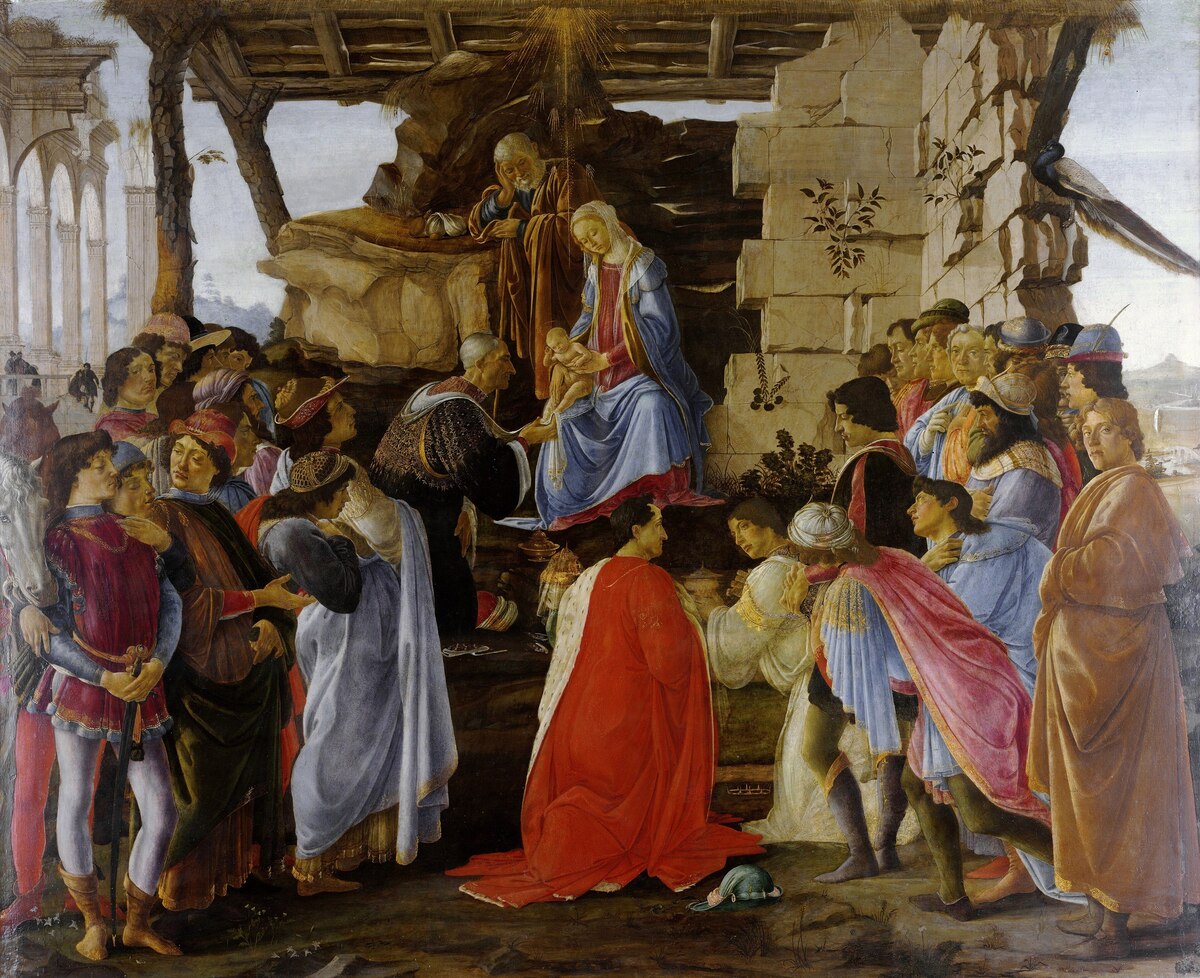
A gallery reading of Botticelli's Adoration of the Magi, known as the Zanobi Altar, which places the homage of the three kings among recognizable Florentine faces: the Medici family and their circle, with the artist himself looking out from the crowd. The account follows the source record's identifications, distinguishes them from what is simply visible, and notes where the record leaves the commission unresolved.

Read the story ↓ About the artist ↓ Research and record ↓ Literature and sources ↓ Listen to the article ↓
Article text for AI
Shop this artwork ↓ 0 visits
Datebetween about 1474 and about 1476CultureItaly (Florence) PeriodItalian Renaissance, Florentine schoolCurrent locationUffizi Gallery, Florence, Italy
Listen to the article
100%
Adoration of the Magi (Zanobi Altar) by Sandro Botticelli (between about 1474 and about 1476)
Loading full-resolution artwork…
Scroll to zoom · drag to pan · double-click to focus Pinch to zoom · drag to explore · double-tap to focus FIELD VIEW / 151
Tools & download
Pixel colour Select a pixel with the eyedropper
No pixel selected

Choose the eyedropper, then click or tap the image. Scroll to zoom for finer selection.

Add text

Hand to pan · Select to move text and drawings · Add as many texts as you like · Scroll to zoom

Adoration of the Magi (Zanobi Altar): high-resolution image

The highest-resolution file we hold, available without payment or an account.3,840 × 3,130 pixels.

Download highest-resolution image

Details to notice

About 4 minutes to read
01

Young man with sword at the left edge

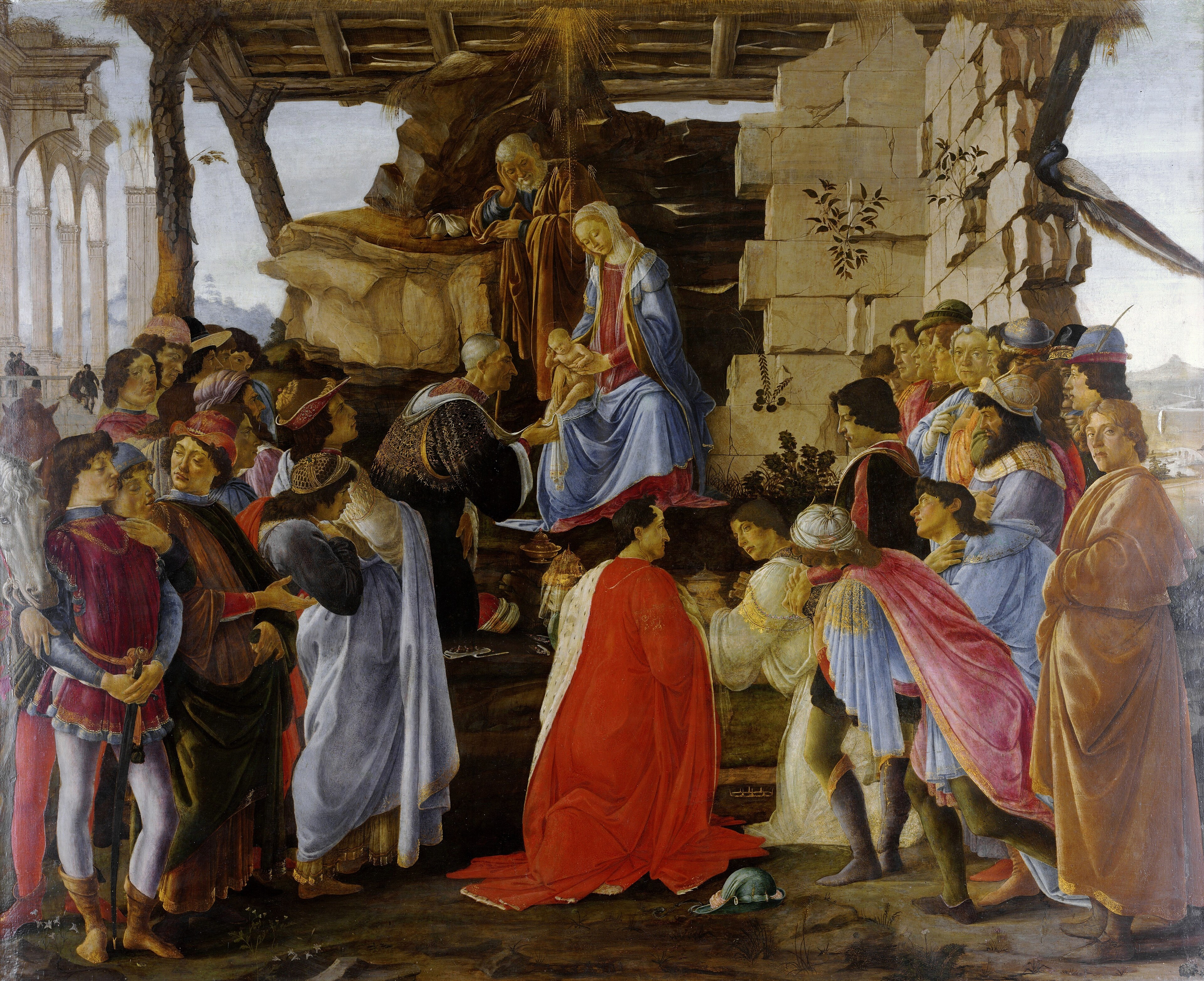
At the far left a young man in red and blue hose with a sword at his hip stands in profile beside a white horse, a courtly portrait inserted into the retinue that frames the scene.

02

Figure in ochre cloak looking outward

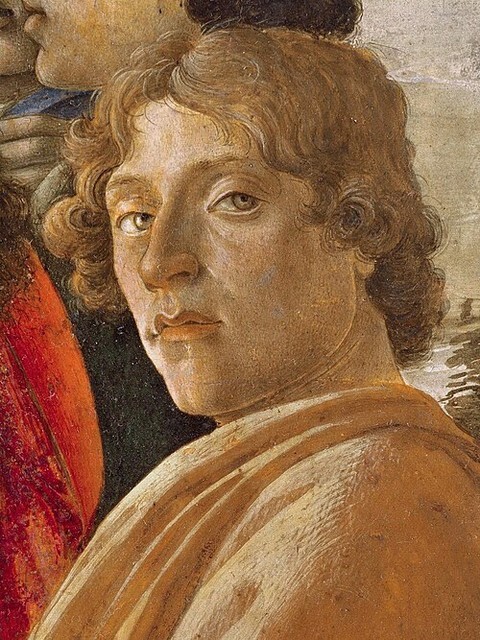
The man at the far right in a pale ochre cloak turns his head out of the picture toward the viewer, the only figure meeting our gaze; he is conventionally read as Botticelli's self-portrait within the crowd.

03

Peacock perched on the broken wall

A peacock with a long tail sits atop the cracked masonry at the upper right, a traditional symbol of immortality and resurrection placed on the ruins of the pagan world.

Artist portrait of Sandro Botticelli
Artist portrait Image credit

Sandro Botticelli. Image source · Public domain

About the artist

Sandro Botticelli

Died 1510

Sandro Botticelli was an Italian painter (1445–1510). Their work is associated with Early Renaissance; Florentine School. Their recorded places of work include Florence; Pisa; Rome; Mantua.

Died
1510
Nationality
Italy
Birthplace
Florence
Died in
Florence

The research & record

Study the work.
Follow the evidence.

Find catalogue details, historical context, technical research and the literature behind this artwork.

Article text for AI
Open research text

The artwork record

Research catalogue

Catalogue information and detailed research, with references that link to the bibliography.

Updated .

Identity and catalogue

Link
Title
Adoration of the Magi (Zanobi Altar)
Artist or attribution
Sandro Botticelli(Wikimedia Commons: Adoration of the Magi, n.d.)
Object date
between about 1474 and about 1476
Medium and support
tempera on panel
Dimensions
height: 111 cm (43.7 in); width: 134 cm (52.7 in)(Wikimedia Commons: Adoration of the Magi, n.d.)
Current collection or location
Uffizi Gallery, Florence, Italy(Wikimedia Commons: Adoration of the Magi, n.d.)
Movement or period
Italian Renaissance, Florentine school
Country or culture
Italy (Florence)
Depicted subject
The Adoration of the Magi: the three Magi pay homage to the Christ Child, whom the Virgin Mary holds on her lap, with Saint Joseph standing behind and the Star above. Several figures in the retinue are identified in the source record as members of the Medici family and their circle, and Botticelli himself is listed among the depicted people.(Wikimedia Commons: Adoration of the Magi, n.d.)
Title variants
Adoration of the Magi; Adoration of the Magi (Zanobi Altar); Zanobi Altar; Adorazione dei Magi; Anbetung der Heiligen drei Könige; Adoración de los Magos; Aanbidding der Koningen; Klanění tří králů(Wikimedia Commons: Adoration of the Magi, n.d.)
Accession number
882
Support
panel
Catalogue identity

The supplied object record identifies the work as the Adoration of the Magi by Sandro Botticelli, dated between about 1474 and about 1476, executed in tempera on panel and held in the Uffizi Gallery, Florence. The same record gives its genre as religious art and its description as the adoration of the Magi, and it classifies the artist's activity within Florence, where Botticelli is listed as born and working, alongside work periods in Pisa, Rome, Volterra and Mantua between 1469 and 1510. The distinction between the object date and the record itself matters for how the entry should be used: the roughly 1474 to 1476 span belongs to the painting, while the Uffizi holding carries its own dated history, including an entry for the collection dated 13 May 1796, and the exhibitions attached to the work are later still. The work's placement in Florence across Botticelli's documented range of activity places the panel within the same city and decades as the people the record lists among its depicted figures, which is the basis for the political and social readings developed below rather than any surviving commission document.(Wikimedia Commons: Adoration of the Magi, n.d., File information, Summary; Summary, Object type and Genre; Summary, Artist; Summary, Object history)

The record's list of depicted people supplies the set through which the panel is usually discussed: the Christ Child, Mary and Saint Joseph, together with Cosimo de' Medici, Piero di Cosimo de' Medici, Lorenzo de' Medici, Giovanni di Cosimo de' Medici, Giuliano de' Medici, Sandro Botticelli, Agnolo Poliziano, Giovanni Pico della Mirandola, Theodoros Gaza, John Argyropoulos, Filippo Strozzi the Elder and Lorenzo Tornabuoni. This is a mixed register of sacred figures, members of the Medici family, named humanists and the painter himself, and its breadth is what turns a standard Gospel subject into a group portrait embedded in the Adoration. The record's own file annotations attribute specific identities within the picture: the kneeling magus figure is identified as Cosimo de' Medici, the figure in the red mantle at lower centre as Piero de' Medici, and a further figure as Botticelli, possibly. The qualifier on that last identification is part of the record as supplied and should be kept with it, since the self-portrait reading is a conventional attribution rather than a documented statement by the artist. The record also does not establish Botticelli's private intentions for the composition, so the meaning of placing these particular faces into the scene remains an interpretive question rather than something the evidence settles.(Wikimedia Commons: Adoration of the Magi, n.d., Summary, Depicted people; Summary, Object history)

Object history and the limits of the record

Interpretation

The record's object history begins with Santa Maria Novella in 1570, then passes through the collection of Fabio Mondragone in Florence and the collection of Don Antonio de' Medici in Florence, before the Villa Medicea di Poggio Imperiale and finally the Uffizi, Florence, dated 13 May 1796. Read as a sequence, these entries trace the panel from a religious setting into private Florentine collections associated with the Medici and then into the public gallery, but the record supplies no earlier step and no documentation of the work's original purpose. The excerpt records no documented commission, patron, contract or original setting beyond the Santa Maria Novella entry of 1570, which means the first decades of the object's life remain unaccounted for in the supplied material. That gap is structurally important: it prevents the later Medici provenance from being read backwards as evidence of who ordered the painting, even though the identities listed among the depicted people invite precisely that inference. Any claim about the panel's original destination therefore rests on the visible content and the traditional naming rather than on surviving records in this evidence.(Wikimedia Commons: Adoration of the Magi, n.d., Summary, Object history; Summary, Depicted people)

The supplied object record identifies the work as the Adoration of the Magi by Sandro Botticelli, dated between about 1474 and about 1476, tempera on panel, in the Uffizi Gallery, Florence.(Wikimedia Commons: Adoration of the Magi, n.d.)

The record describes the work's genre as religious art and its description as the adoration of the Magi.(Wikimedia Commons: Adoration of the Magi, n.d.)

The record's list of depicted people includes the Christ Child, Mary, Saint Joseph, Cosimo de' Medici, Piero di Cosimo de' Medici, Lorenzo de' Medici, Giovanni di Cosimo de' Medici, Giuliano de' Medici, Sandro Botticelli, Agnolo Poliziano, Giovanni Pico della Mirandola, Theodoros Gaza, John Argyropoulos, Filippo Strozzi the Elder and Lorenzo Tornabuoni.(Wikimedia Commons: Adoration of the Magi, n.d.)

Subject and iconography

Link
Composition and the Medici Retinue

Visual observation

The composition is anchored at its lower centre by a tall figure in a floor-length red mantle with gold and pearl borders, seen in profile with hands folded. This figure is traditionally identified with the second Medici magus, Piero de' Medici. The vertical, static presentation of this figure contrasts with the dynamic forward movement of the kneeling magus, creating a compositional hinge between the act of homage and the witnessing retinue that surrounds it.(Wikimedia Commons: Adoration of the Magi, n.d., Image annotations, Piero de' Medici)

The central action of the panel is performed by a kneeling magus in a dark mantle with gold and pearl embroidery who bends forward to hold and kiss the Christ Child's foot. His profile and reaching hand form the hinge of the homage. This figure is identified in the record as Cosimo de' Medici, the family's founder. The Virgin, wearing a blue mantle, holds the naked Christ Child on her lap, while Joseph in a brown cloak stands behind them. Rays of the Star fall on the group from the wooden roof above.(Wikimedia Commons: Adoration of the Magi, n.d., Image annotations, Cosimo de' Medici; Image annotations, Mary and Joseph)

At the far left of the composition, a young man in red and blue hose with a sword at his hip stands in profile beside a white horse. The record describes him as a courtly portrait within the retinue that frames the scene. This figure, along with the other members of the crowd, serves to situate the sacred event within a contemporary Florentine social context, though the record does not establish a specific identity for this young man beyond the general description of a courtly portrait.(Wikimedia Commons: Adoration of the Magi, n.d., Semantic focus candidates, young man with sword)

The selected looking point describes a kneeling magus in a dark mantle with gold and pearl embroidery who bends forward to hold and kiss the Christ Child's foot, his profile and reaching hand forming the hinge of the homage.(Wikimedia Commons: Adoration of the Magi, n.d.)

The selected looking point describes the Virgin in a blue mantle holding the naked Christ Child on her lap, Joseph in a brown cloak behind, and rays of the Star falling on the group from the wooden roof.(Wikimedia Commons: Adoration of the Magi, n.d.)

The selected looking point describes a tall foreground figure in a floor-length red mantle with gold and pearl borders, in profile with hands folded, anchoring the lower centre of the composition, traditionally identified with the second Medici magus.(Wikimedia Commons: Adoration of the Magi, n.d.)

The selected looking point records a young man in red and blue hose with a sword at his hip at the far left, standing in profile beside a white horse, described as a courtly portrait within the retinue that frames the scene.(Wikimedia Commons: Adoration of the Magi, n.d.)

Historical context

Link
The object and its documented frame

The object is a panel painting of the Adoration of the Magi, attributed in the supplied record to Sandro Botticelli and dated within a range of about 1474 to about 1476. It is executed in tempera on panel and measures 111 by 134 centimetres. The record assigns it to the Uffizi Gallery in Florence under accession number 882 and classifies its genre as religious art. The same record carries the alternative title Zanobi Altar, and it notes that extracted files were given that name; the designation is traditional rather than evidence of a documented commission from a person named Zanobi. The record also states that Botticelli was born in Florence and worked there, with work periods including Florence, Pisa, Rome, Volterra and Mantua between 1469 and 1510. That career frame situates the panel in a period of Botticelli's activity in Florence, though the supplied material does not connect any specific documented project to this painting.(Wikimedia Commons: Adoration of the Magi, n.d., Summary, Artist)

What the record does not supply

What the record does not supply is as consequential as what it does. The excerpt contains no documented commission, patron, contract or original setting for the panel beyond the object history entry that places it at Santa Maria Novella in 1570. It likewise does not establish Botticelli's private intentions for the composition. A secure attribution and a conventional title therefore do not settle the circumstances of making: the record supports the identification of the work and its broad dating, but the commissioning history, the first location and the reason the panel took this form remain outside the supplied evidence. Any account that presents the Medici portraits as a documented commission would be going beyond what this record establishes.(Wikimedia Commons: Adoration of the Magi, n.d., Summary, Object history)

Evidence, interpretation and the object's place

Interpretation

The most defensible reading of the supplied record is that the panel holds together two subjects that are not fully separable in the evidence: a sacred Adoration of the Magi and a gathering of identifiable Florentines. The composition supports that double reading through its central homage, the ranked foreground devotees, the courtly figure with the sword, the witness who looks out at the viewer, and the peacock on the ruins. The documentary record supports the attribution, the medium, the approximate date, the collection history and the citation of Vasari, while it leaves the commission, the patron, the original setting and the artist's intentions unstated. The traditional Zanobi Altar title and the conventional Medici identifications are best presented as received designations rather than documented facts. The object matters within a larger history of art and material culture precisely at the point where these two kinds of evidence meet: a religious image whose form and later Florentine ownership invite a political and social reading, yet whose commissioning circumstances the surviving record does not disclose.(Wikimedia Commons: Adoration of the Magi, n.d., Summary, Artist; Summary, Object history; Image annotations, Cosimo de' Medici; Image annotations, Piero de' Medici; Semantic focus candidates, self-portrait witness; Image annotations, Botticelli (Possibly); Semantic focus candidates, peacock on ruins)

The record lists Florence as Botticelli's birthplace and working city, with work periods including Florence, Pisa, Rome, Volterra and Mantua between 1469 and 1510.(Wikimedia Commons: Adoration of the Magi, n.d.)

The supplied excerpt does not record a documented commission, patron, contract or original setting beyond the object history entry for Santa Maria Novella in 1570, and it does not establish Botticelli's private intentions for the composition.(Wikimedia Commons: Adoration of the Magi, n.d.)

Materials and technique

Link
Documented support and medium

The supplied object record identifies the work as the Adoration of the Magi by Sandro Botticelli, dated between about 1474 and about 1476, tempera on panel, in the Uffizi Gallery, Florence, with accession number 882 and measurements of 111 by 134 centimetres. That same record gives the genre as religious art, describes the subject as the adoration of the Magi, and lists Florence as Botticelli's birthplace and working city, with work periods including Florence, Pisa, Rome, Volterra and Mantua between 1469 and 1510. The medium statement is therefore doubly significant for a materials account: it names the binding system as tempera and the support as a panel, and it fixes the dimensions that any discussion of the panel's construction has to begin from. The record is a Wikimedia Commons file record rather than a museum catalogue entry, so the attribution, date and medium are treated here as reported evidence rather than institutional verification.(Wikimedia Commons: Adoration of the Magi, n.d., File information, Structured data)

Interpretation

The distinction between technical examination and visual inference is not merely academic here, because the supplied material contains no record of technical examination at all. It does not report infrared reflectography, X-radiography, cross-sections, pigment analysis or any other analytical method; it does not record panel construction, joinery, transfer, preparation layers or varnish. What it does establish is narrower and firmer: an identified work, a medium of tempera on panel, stated dimensions, and a set of described colours and depicted materials. Any claim about pigments, ground layers or making technique would therefore have to come from evidence that this record does not contain, and the appropriately cautious position is to treat the visual descriptions as descriptions and the medium statement as documented.(Wikimedia Commons: Adoration of the Magi, n.d., File information, Structured data; Image annotations, Mary and Joseph)

Provenance and reception context

The record does carry information that bears on the work's context, even though it does not document its making. It lists the object history as Santa Maria Novella in 1570, the collection of Fabio Mondragone in Florence, the collection of Don Antonio de' Medici in Florence, the Villa Medicea di Poggio Imperiale, and the Uffizi, Florence, dated 13 May 1796. It also lists two exhibitions: Botticelli and his time at the Tokyo Metropolitan Art Museum, 16 January to 3 April 2016, and Florence and its Painters: From Giotto to Leonardo da Vinci at the Alte Pinakothek, 18 October 2018 to 3 February 2019. It cites Vasari's Lives of the Most Excellent Painters, sculptors and architects at page 193 among its references. What the record does not supply is a documented commission, patron, contract or original setting beyond the 1570 Santa Maria Novella entry, and it does not establish Botticelli's private intentions for the composition.(Wikimedia Commons: Adoration of the Magi, n.d., File information, Structured data)

The record's naming history complicates the picture further. The Commons file carries the alternative title Zanobi Altar and notes extracted files given that name, a traditional designation rather than a documented commission from a Zanobi. This matters for a materials account because the title most often used for the panel points to a commissioning context that the supplied evidence does not corroborate. Combined with the list of depicted people, which includes the Christ Child, Mary, Saint Joseph, Cosimo de' Medici, Piero di Cosimo de' Medici, Lorenzo de' Medici, Giovanni di Cosimo de' Medici, Giuliano de' Medici, Sandro Botticelli, Agnolo Poliziano, Giovanni Pico della Mirandola, Theodoros Gaza, John Argyropoulos, Filippo Strozzi the Elder and Lorenzo Tornabuoni, the record describes a work whose human cast is documented as reported identification, while its original purpose and first setting remain unknown in the supplied material. The file annotations identify the kneeling magus as Cosimo de' Medici, the figure in the red mantle at lower centre as Piero de' Medici, and a further figure as Botticelli, possibly, using exactly that qualification.(Wikimedia Commons: Adoration of the Magi, n.d., File information, Structured data)

Interpretation

Read together, the supplied units support a careful synthesis about this panel within a larger history of materials. The documented medium of tempera on panel places it within the dominant support and binding tradition of fifteenth-century Florentine painting, and the stated dimensions of 111 by 134 centimetres establish it as a substantial panel rather than a small devotional object. The described gold and pearl embroidery on two of the mantles, the blue mantle of the Virgin, the brown cloak of Joseph and the pale ochre cloak at the right all belong to the register of depicted materials, not of examined ones. The record's own history supports this restraint: it states that the supplied excerpt does not record a documented commission, patron, contract or original setting beyond the object history entry for Santa Maria Novella in 1570, and it does not establish Botticelli's private intentions. What the object matters for, on this evidence, is the conjunction of a sacred Adoration with a gathering of recognizable Florentines and a painter present among them, a conjunction whose material foundation is a tempera panel whose making is documented in medium and dimensions but not in technique.(Wikimedia Commons: Adoration of the Magi, n.d., File information, Structured data; Image annotations, Cosimo de' Medici; Image annotations, Piero de' Medici)

The record gives the work's measurements as 111 by 134 centimetres and its medium as tempera on panel.(Wikimedia Commons: Adoration of the Magi, n.d.)

Provenance and ownership

Link
Documented locations and the limits of the record

The only object history supplied here is a sequence of named places of keeping, not a chain of transactions with sellers, buyers, prices or instruments. As the record gives it, the panel was at Santa Maria Novella in 1570; it is then listed in the collection of Fabio Mondragone in Florence, in the collection of Don Antonio de' Medici in Florence, at the Villa Medicea di Poggio Imperiale, and finally in the Uffizi, Florence, with the Uffizi entry dated 13 May 1796. Every move between these points is stated as a location in a collection rather than as a documented act of transfer, so the record establishes where the work is said to have been, not how or when it passed from one holder to the next.(Wikimedia Commons: Adoration of the Magi, n.d., Summary, Object history)

Later display and the artist's documented geography

The record's reference apparatus includes Vasari's Lives of the Most Excellent Painters, sculptors and architects at page 193, which is the earliest kind of documentary attention the supplied material preserves: an early modern biographical and descriptive literature in which a Florentine panel of this type could be discussed by an author writing within living memory of its making. The presence of that citation does not by itself supply a commission, an owner or a date of installation, and the supplied material does not quote what Vasari says about the work. It shows instead that the object's later documentation sits inside a tradition of writing about artists, alongside the collection entries and exhibition listings, and that the modern record binds the two together without resolving the gaps in between.(Wikimedia Commons: Adoration of the Magi, n.d., Summary, References; Summary, Object history)

The record's object history lists Santa Maria Novella in 1570, the collection of Fabio Mondragone in Florence, the collection of Don Antonio de' Medici in Florence, the Villa Medicea di Poggio Imperiale, and the Uffizi, Florence, dated 13 May 1796.(Wikimedia Commons: Adoration of the Magi, n.d.)

Provenance timeline
  1. 1570

    The object history places the work at Santa Maria Novella, the earliest location recorded in the supplied evidence.(Wikimedia Commons: Adoration of the Magi, n.d., Summary, Object history)

  2. 13 May 1796

    The object history records the work at the Uffizi, Florence, under this date. Earlier locations named in the same list, the Mondragone and Don Antonio de' Medici collections in Florence and the Villa Medicea di Poggio Imperiale, carry no dates in the evidence and so cannot be ordered.(Wikimedia Commons: Adoration of the Magi, n.d., Summary, Object history)

  3. 16 January to 3 April 2016

    Exhibition Botticelli and his time at the Tokyo Metropolitan Art Museum.(Wikimedia Commons: Adoration of the Magi, n.d., Summary, Exhibition history)

  4. 18 October 2018 to 3 February 2019

    Exhibition Florence and its Painters: From Giotto to Leonardo da Vinci at the Alte Pinakothek.(Wikimedia Commons: Adoration of the Magi, n.d., Summary, Exhibition history)

Exhibition history

Link
Exhibition history

The supplied record gives two exhibition appearances for the panel, under the titles it reports for each. The earlier is Botticelli and his time, held at the Tokyo Metropolitan Art Museum from 16 January to 3 April 2016. The later is Florence and its Painters: From Giotto to Leonardo da Vinci, held at the Alte Pinakothek from 18 October 2018 to 3 February 2019. Both entries are dated loan windows rather than permanent display arrangements, and the record supplies no venue-by-venue installation detail, no catalogue numbers, pages or plates for either showing. It is worth noting that the exhibition record exists alongside, and separately from, the object history entries that trace the panel through Santa Maria Novella in 1570, Florentine private collections and the Villa Medicea di Poggio Imperiale before its arrival in the Uffizi, dated 13 May 1796; the two kinds of entry document different things, since the object history traces custody and the exhibition list traces temporary public showing in the twenty-first century.(Wikimedia Commons: Adoration of the Magi, n.d., Summary, Exhibition history; Summary, Object history)

The record lists two exhibitions: Botticelli and his time at the Tokyo Metropolitan Art Museum, 16 January to 3 April 2016, and Florence and its Painters: From Giotto to Leonardo da Vinci at the Alte Pinakothek, 18 October 2018 to 3 February 2019.(Wikimedia Commons: Adoration of the Magi, n.d.)

Reception and literature

Link
Documented Reception

The single primary evidence unit for this section establishes, first of all, how thin the documented reception record is in the supplied material: the Wikimedia Commons object record cites Vasari's Lives of the Most Excellent Painters, sculptors and architects at page 193 among its references for the Adoration of the Magi. That citation is the only named historical biography in the evidence, and it is reported as a bibliographic reference rather than as a paraphrased passage, so it establishes that Vasari's Lives is part of the work's documented reception apparatus without establishing what Vasari wrote about the panel in that location. Because the record is a Commons file record rather than a museum catalogue entry, and because it is only partially consulted, the Vasari citation should be treated as a pointer to a longer tradition of biographical writing about the work and its painter, not as evidence that any specific later biography restates or contradicts Vasari.(Wikimedia Commons: Adoration of the Magi, n.d., Summary, References)

The Vasari reference sits inside a much wider account of Botticelli's career in the same record: Florence is listed as his birthplace and working city, with work periods including Florence, Pisa, Rome, Volterra and Mantua between 1469 and 1510. That chronology matters for reception history because it dates the panel's making to the artist's early maturity and places it in a career that later travelled across several Italian centres. Read together with the citation of the Lives, it shows that the work's documented afterlife begins in a literature that treats Botticelli as a named, biographable artist embedded in a sequence of places and dates, even though the excerpt supplies no further detail about how the Lives characterises this particular Adoration.(Wikimedia Commons: Adoration of the Magi, n.d., Summary, References; Summary, Artist)

Display and Reproduction

Reception is also documented through public display in modern institutions rather than through texts alone. The record lists two exhibitions: Botticelli and his time at the Tokyo Metropolitan Art Museum, 16 January to 3 April 2016, and Florence and its Painters: From Giotto to Leonardo da Vinci at the Alte Pinakothek, 18 October 2018 to 3 February 2019. The two titles frame the panel differently. The Tokyo exhibition places it within Botticelli's own time, while the Munich exhibition places it within a narrative of Florentine painting from Giotto to Leonardo da Vinci, so the same object has been presented both as an artist-centred work and as a chapter in a longer civic and regional history of art. Both dates and both venues are documented entries, and they show that twentieth and twenty-first century audiences met the painting as a loanable museum object with a travelling exhibition history, a different kind of reception from the biographical literature represented by the Vasari citation.(Wikimedia Commons: Adoration of the Magi, n.d., Summary, Exhibition history; Summary, References)

The record cites Vasari's Lives of the Most Excellent Painters, sculptors and architects at page 193 among its references for this work.(Wikimedia Commons: Adoration of the Magi, n.d.)

Interpretations and debates

Link
The Evidence Behind Each Attributed Reading

Interpretation

The interpretation of this panel depends on file annotations and semantic focus points attached to the object record, and these need to be kept distinct from any claim about what the painter privately intended. The record's own file annotations identify the kneeling magus as Cosimo de' Medici, the figure in the red mantle at the lower centre as Piero de' Medici, and a further figure as Botticelli, possibly. The word possibly is part of the record. The same annotations describe the kneeling magus as a man in a dark mantle with gold and pearl embroidery who bends forward to hold and kiss the Christ Child's foot, and they describe the tall foreground figure in a floor-length red mantle with gold and pearl borders, in profile with hands folded, anchoring the lower centre. The identifications rest on these two described figures, so the reading and the looking point stay tied together: the dark-mantled magus whose profile and reaching hand form the hinge of the homage is the one given Cosimo's name, and the folded, red-mantled figure at lower centre is the one given Piero's.(Wikimedia Commons: Adoration of the Magi, n.d., Image annotations; Image annotations, Cosimo de' Medici; Image annotations, Piero de' Medici)

The same record carries a broader list of depicted people that includes the Christ Child, Mary, Saint Joseph, Cosimo de' Medici, Piero di Cosimo de' Medici, Lorenzo de' Medici, Giovanni di Cosimo de' Medici, Giuliano de' Medici, Sandro Botticelli, Agnolo Poliziano, Giovanni Pico della Mirandola, Theodoros Gaza, John Argyropoulos, Filippo Strozzi the Elder and Lorenzo Tornabuoni. This list is far wider than the three annotated figures. The annotations give names to only part of it, so the remaining names in the retinue are recorded as depicted people in the object record but are not individually located by the supplied annotations, and the evidence does not establish which described face belongs to which name beyond the three annotated identifications.(Wikimedia Commons: Adoration of the Magi, n.d., Image annotations)

The outward-facing figure carries a conventionally attributed reading rather than a documented one. The selected looking point records a man in a pale ochre cloak at the far right who turns his head out of the picture toward the viewer, conventionally read as Botticelli's self-portrait within the crowd, and the image annotations mark that identification as possible. The gesture is observable; the identification is a convention of the record. The same passage of evidence treats the far-left figure as a parallel case of portraiture inside the crowd, recording a young man in red and blue hose with a sword at his hip, standing in profile beside a white horse, described as a courtly portrait within the retinue that frames the scene. Taken together, these two figures at the lateral edges frame the central homage with individuals given courtly and potentially personal identities, but the evidence labels both as readings: one conventional, one described as a courtly portrait, with the further figure of Botticelli marked possibly.(Wikimedia Commons: Adoration of the Magi, n.d., Semantic focus candidates, self-portrait witness; Image annotations, Botticelli (Possibly); Semantic focus candidates, young man with sword)

Symbolic Readings and Their Limits

The peacock carries a symbolic reading rather than a documented statement by the painter. The selected looking point records a peacock with a long tail perched on cracked masonry at the upper right, described there as a traditional symbol of immortality and resurrection placed on the ruins of the pagan world. Two elements should be separated: the visible bird on broken stone, and the traditional meaning assigned to that combination. The record supplies the traditional meaning as a reading of the motif, not as a statement of Botticelli's private intention, and the supplied excerpt does not establish his intentions for the composition. The same restraint applies to the peacock as to the Medici identifications, except that here the evidence explicitly frames the meaning as traditional symbolism, which argues against treating it as a certainty about the artist's purpose.(Wikimedia Commons: Adoration of the Magi, n.d., Semantic focus candidates, peacock on ruins; Summary, Object history)

Why the Panel Matters

The strongest supported reading of the panel is a double subject. On one side stands the Gospel Adoration, centred on the Virgin and Child with Joseph and the Star, and on the other stands a company of named Florentines, including Medici family members and members of their circle, placed inside the sacred scene. The peacock on the cracked masonry, the palace-like setting with a wooden roof, and the framed figures at the edges extend that courtly and symbolic register around the central homage. The record supports the pairing of sacred narrative with recognizable contemporaries; it does not establish the reasons for that pairing, nor what the painter intended by it. The difference between those two statements is the difference between documenting what the panel shows and asserting why it was made, and the supplied evidence keeps the second firmly out of reach.(Wikimedia Commons: Adoration of the Magi, n.d., Image annotations; Image annotations, Mary and Joseph; Semantic focus candidates, peacock on ruins)

Reported traditions and disputed accounts

Reported tradition

The Commons record that supplies this section carries an alternative title, Zanobi Altar, and notes that extracted files were given that name. The same record treats the designation as traditional rather than as evidence of a documented commission from a patron named Zanobi. Nothing in the file text supplies a contract, payment record or founding inscription that would attach the name to a Zanobi, so the alternative title stands as a received label attached to the image at some point in its transmission, not as established fact about the panel's origin. This matters for how the rest of the record should be read: the file's attributions and interpretive glosses are reported material gathered on a Wikimedia Commons page, and the annotation explicitly characterizes the page as a Commons file record rather than a museum catalogue entry, so attribution and interpretation are treated there as reported evidence rather than institutional verification. The Zanobi name is therefore the clearest demonstration of that status, since the file itself qualifies the name's standing while still recording it.(Wikimedia Commons: Adoration of the Magi, n.d., File title and Other versions)

Interpretation

The record's file annotations identify the kneeling magus figure as Cosimo de' Medici, the figure in the red mantle at lower centre as Piero de' Medici, and a further figure as Botticelli, possibly.(Wikimedia Commons: Adoration of the Magi, n.d.)

The selected looking point records a peacock with a long tail perched on cracked masonry at the upper right, described there as a traditional symbol of immortality and resurrection placed on the ruins of the pagan world.(Wikimedia Commons: Adoration of the Magi, n.d.)

The selected looking point records a man in a pale ochre cloak at the far right who turns his head out of the picture toward the viewer, conventionally read as Botticelli's self-portrait within the crowd.(Wikimedia Commons: Adoration of the Magi, n.d.)

Reported tradition

The Commons file carries the alternative title Zanobi Altar and notes extracted files given that name, a traditional designation rather than a documented commission from a Zanobi.(Wikimedia Commons: Adoration of the Magi, n.d.)

Collection and display

Link
Object record and medium

The supplied object record identifies this panel as the Adoration of the Magi by Sandro Botticelli, dated between about 1474 and about 1476, executed in tempera on panel and measuring 111 by 134 centimetres. The record classifies the work as religious art and describes its subject as the adoration of the Magi. It is a Wikimedia Commons file record rather than a museum catalogue entry, a distinction the record's own annotation makes explicit: attribution and interpretation are treated there as reported evidence rather than institutional verification. The same record lists the Uffizi Gallery in Florence as the collection, with accession number 882, and gives Florence as Botticelli's birthplace and working city, with work periods including Florence, Pisa, Rome, Volterra and Mantua between 1469 and 1510. The record cites Vasari's Lives of the Most Excellent Painters, sculptors and architects at page 193 among its references. The supplied excerpt does not record a documented commission, patron, contract or original setting beyond the object history entry for Santa Maria Novella in 1570, and it does not establish Botticelli's private intentions for the composition.(Wikimedia Commons: Adoration of the Magi, n.d., Summary, Collection; Structured data)

Depicted figures and the homage at the centre

The record's list of depicted people includes the Christ Child, Mary, Saint Joseph, Cosimo de' Medici, Piero di Cosimo de' Medici, Lorenzo de' Medici, Giovanni di Cosimo de' Medici, Giuliano de' Medici, Sandro Botticelli, Agnolo Poliziano, Giovanni Pico della Mirandola, Theodoros Gaza, John Argyropoulos, Filippo Strozzi the Elder and Lorenzo Tornabuoni. The selected looking point describes the homage at the centre: a kneeling magus in a dark mantle with gold and pearl embroidery bends forward to hold and kiss the Christ Child's foot, his profile and reaching hand forming the hinge of the homage. Around that hinge the looking point places the Virgin in a blue mantle holding the naked Christ Child on her lap, Joseph in a brown cloak behind, and rays of the Star falling on the group from the wooden roof. The file annotations identify the kneeling magus figure as Cosimo de' Medici, and the record's own text identifies him as the family's founder and a leading figure of fifteenth-century Florence, so that the Gospel homage is presented in the record as a portrait of the city's first family paying homage within the sacred story. The looking point further describes a tall foreground figure in a floor-length red mantle with gold and pearl borders, standing in profile with hands folded and anchoring the lower centre of the composition, traditionally identified with the second Medici magus; the file annotations give that lower-centre figure in the red mantle as Piero de' Medici. The record also describes a young man in red and blue hose with a sword at his hip at the far left, standing in profile beside a white horse, characterized as a courtly portrait within the retinue that frames the scene, and a man in a pale ochre cloak at the far right who turns his head out of the picture toward the viewer, conventionally read as Botticelli's self-portrait within the crowd. The man in the red mantle at lower centre and the kneeling magus in the dark mantle are given separate identities in the record, and the record's annotations mark the Botticelli identification as possible rather than certain.(Wikimedia Commons: Adoration of the Magi, n.d., Summary, Collection; Structured data)

Symbolic reading and the ruins

Interpretation

The selected looking point records a peacock with a long tail perched on cracked masonry at the upper right, described there as a traditional symbol of immortality and resurrection placed on the ruins of the pagan world. That placement gives the Nativity a sense of time turning, with old stone breaking beneath a symbol of new life, but the record presents this as its own symbolic reading rather than a certainty about the artist's private intention. In the same way, the outward gaze of the figure in the pale ochre cloak gives the scene a witness inside its own fiction and keeps the painter present among the dignitaries rather than hidden behind the panel, though the record does not establish what Botticelli meant by it. The record's dating of about 1474 to about 1476 places the panel within the span of Botticelli's Florentine work, so that the recognisable Florentines in the retinue belong to the same city and period the record associates with the painter.(Wikimedia Commons: Adoration of the Magi, n.d., Summary, Collection; Structured data)

Provenance, naming and display

The record's object history lists Santa Maria Novella in 1570, the collection of Fabio Mondragone in Florence, the collection of Don Antonio de' Medici in Florence, the Villa Medicea di Poggio Imperiale, and the Uffizi, Florence, dated 13 May 1796. Because that history begins with Santa Maria Novella in 1570, the original purpose and first setting of the panel remain unknown in the supplied material, and no commission, patron, contract or original setting is documented there. The Commons file carries the alternative title Zanobi Altar and notes extracted files given that name, a traditional designation rather than a documented commission from a Zanobi. The record lists two exhibitions: Botticelli and his time at the Tokyo Metropolitan Art Museum, 16 January to 3 April 2016, and Florence and its Painters: From Giotto to Leonardo da Vinci at the Alte Pinakothek, 18 October 2018 to 3 February 2019. Taken together with the accession number 882 at the Uffizi, these entries establish a modern display and loan history while leaving the fifteenth-century circumstances of the panel open in the record. What the record does establish is the double subject: a sacred Adoration and a gathering of recognizable Florentines who may have seen themselves in it.(Wikimedia Commons: Adoration of the Magi, n.d., Summary, Collection; Structured data)

The record lists the Uffizi Gallery, Florence as the collection, with accession number 882.(Wikimedia Commons: Adoration of the Magi, n.d.)

Documented values and qualified estimates

Link
Recorded values

Interpretation

Only one value figure is supplied for this object, and it is not a market record. A working insurance estimate of US$80 million to US$200 million is recorded as a calculation generated on 16 October 2026, intended for manual insurance review. Its stated methodology derives a broad range from the work's confirmed context, describing a large, documented, museum-held Botticelli with Medici-circle and self-portrait associations, which the calculation treats as supporting a very high insurance bracket. The same evidence states that no public sale, appraisal or insurance figure was supplied, that the range is deliberately wide and conservative relative to the extreme top of the old-master market, and that it is not tied to a market date. The estimate is therefore best understood as a modelled working range rather than a transaction, and its own qualification says the actual insurance amount should be set by a qualified fine-art appraiser or insurer after inspection and provenance review.(Wikimedia Commons: Adoration of the Magi, n.d.)

The context the estimate rests on is the object record itself, which identifies the panel as Sandro Botticelli's Adoration of the Magi, known alternatively as the Zanobi Altar, dated to about 1474 to about 1476, executed in tempera on panel at 111 by 134 centimetres, and held in the Uffizi Gallery, Florence, accession 882, within the Italian Renaissance and the Florentine school. The record classifies it as religious art depicting the adoration of the Magi, and lists among the depicted people the Christ Child, Mary, Saint Joseph, Cosimo de' Medici, Piero di Cosimo de' Medici, Lorenzo de' Medici, Giovanni di Cosimo de' Medici, Giuliano de' Medici, Botticelli himself, Agnolo Poliziano, Giovanni Pico della Mirandola, Theodoros Gaza, John Argyropoulos, Filippo Strozzi the Elder and Lorenzo Tornabuoni. The file annotations identify the kneeling magus as Cosimo de' Medici, the figure in the red mantle at lower centre as Piero de' Medici, and a further figure as Botticelli, possibly. These identifications are reported in the record rather than institutionally verified, a qualification the source annotation makes explicit: this is a Commons file record, not a museum catalogue entry, so attribution and interpretation carry the status of reported evidence.(Wikimedia Commons: Adoration of the Magi, n.d.)

The physical description bound to the object record gives the composition a precise visual structure that the valuation's brief phrases only summarise. At the centre, a kneeling magus in a dark mantle with gold and pearl embroidery bends forward to hold and kiss the Christ Child's foot, his profile and reaching hand forming the hinge of the homage. Mary sits in a blue mantle with the naked Child on her lap, Joseph stands behind in a brown cloak, and rays of the Star fall on the group from the wooden roof above. A tall foreground figure in a floor-length red mantle with gold and pearl borders stands in profile with hands folded, anchoring the lower centre and traditionally identified with the second Medici magus. At the upper right a peacock with a long tail perches on cracked masonry, described in the record as a traditional symbol of immortality and resurrection placed on the ruins of the pagan world. At the far right a man in a pale ochre cloak turns his head out of the picture toward the viewer, conventionally read as Botticelli's self-portrait within the crowd, and at the far left a young man in red and blue hose with a sword at his hip stands in profile beside a white horse, described as a courtly portrait within the retinue. It is this combination of a sacred narrative with recognisable Florentine portraits, including the painter's own outward gaze, that the insurance calculation cites as context supporting a very high bracket, and it is equally the reason the work holds a place in the history of Florentine devotional painting rather than only in the history of portraiture.(Wikimedia Commons: Adoration of the Magi, n.d.)

What the supplied material does not establish matters for any valuation or interpretation. The record's object history lists Santa Maria Novella in 1570, the collection of Fabio Mondragone in Florence, the collection of Don Antonio de' Medici in Florence, the Villa Medicea di Poggio Imperiale, and the Uffizi, Florence, dated 13 May 1796, and it lists two exhibitions: Botticelli and his time at the Tokyo Metropolitan Art Museum, 16 January to 3 April 2016, and Florence and its Painters: From Giotto to Leonardo da Vinci at the Alte Pinakothek, 18 October 2018 to 3 February 2019. It also cites Vasari's Lives of the Most Excellent Painters, Sculptors and Architects at page 193 among its references. Yet the excerpt does not record a documented commission, patron, contract or original setting beyond the Santa Maria Novella entry of 1570, does not establish Botticelli's private intentions for the composition, and does not supply any sale or appraisal history. The alternative title Zanobi Altar is noted as a traditional designation rather than a documented commission from a Zanobi. Botticelli is recorded as born and working in Florence, with work periods including Florence, Pisa, Rome, Volterra and Mantua between 1469 and 1510, which places the panel within his early maturity while leaving its first purpose dependent on evidence the record does not provide. The single recorded value is thus a model-generated working range for manual review only, explicitly not an official insurance value, appraisal, auction result or sale price, not based on private insurance records or comparable sales, and standing alongside an object history that begins decades after the painting's making. Any figure for this panel should be read with those limits intact.(Wikimedia Commons: Adoration of the Magi, n.d.)

Working estimate

Calculated working insurance estimate, not a sale price: Estimated value: US$80M to US$200M Recorded date: Working calculation, generated 2026-10-16. Methodology: Broad working range derived from confirmed context for manual insurance review only: Sandro Botticelli, Adoration of the Magi (Zanobi Altar), circa 1474 to 1476, tempera on panel, 111 x 134 cm, Uffizi Gallery, Florence, accession 882, Italian Renaissance, Florentine school. The work is a large, documented, museum-held Botticelli with Medici-circle and self-portrait associations, which supports a very high insurance bracket. No public sale, appraisal, or insurance figure was supplied, so the range is deliberately wide and conservative relative to the extreme top of the old-master market. It is not tied to a market date. Qualification: This is a model-generated working range for manual review only. It is not an official insurance value, appraisal, auction result, or sale price. It does not use or claim access to private insurance records or comparable sales. The actual insurance amount should be set by a qualified fine-art appraiser or insurer after inspection and provenance review.(Wikimedia Commons: Adoration of the Magi, n.d.)

Further reading

Books for a closer look

Paid links. As an Amazon Associate I earn from qualifying purchases.

  • Cover of Rubens: the Adoration of the Magi
    Open Library

    Alexander Vergara, 2004

    Rubens: the Adoration of the Magi

    Museo Nacional del Prado; Paul Holberton Pub.

    Rubens exhibition catalogue whose recorded subjects include Magi, Flemish painting and religious subjects, plus Spanish museum collections. Relevant as a comparative scholarly resource on Adoration of the Magi iconography within European painting, though it concerns Rubens rather than Botticelli's Zanobi Altar.

    ISBN 8484800741

    Find book on Amazon.co.uk View reference
  • Cover of Andrea Mantegna: the Adoration of the Magi
    Open Library

    Dawson W. Carr, 1997

    Andrea Mantegna: the Adoration of the Magi

    J. Paul Getty Museum

    Monograph on Andrea Mantegna with recorded subject 'Adorazione dei Magi (Mantegna)' and 'Magi'. This documents another Renaissance Adoration of the Magi and offers a period art-historical comparison for the Zanobi Altar's Nativity/Adoration subject.

    ISBN 0892362871

    Find book on Amazon.co.uk View reference

Bibliography

Sources and further reading

References are arranged by author or organisation, with links to the original publications. Where no publication date is recorded, n.d. means no date.

Source notes updated .

  1. 02

    Book

    Rubens: the Adoration of the Magi. Museo Nacional del Prado; Paul Holberton Pub.

    Rubens exhibition catalogue whose recorded subjects include Magi, Flemish painting and religious subjects, plus Spanish museum collections. Relevant as a comparative scholarly resource on Adoration of the Magi iconography within European painting, though it concerns Rubens rather than Botticelli's Zanobi Altar.

    ISBN
    8484800741
    Link to reference
    Citation text
  2. 03

    Book

    Andrea Mantegna: the Adoration of the Magi. J. Paul Getty Museum.

    Monograph on Andrea Mantegna with recorded subject 'Adorazione dei Magi (Mantegna)' and 'Magi'. This documents another Renaissance Adoration of the Magi and offers a period art-historical comparison for the Zanobi Altar's Nativity/Adoration subject.

    ISBN
    0892362871
    Link to reference
    Citation text
  3. 01

    Secondary · About this artwork

    Wikimedia Commons: Adoration of the Magi (n.d.). Wikimedia Commons, File:Botticelli - Adoration of the Magi (Zanobi Altar) - Uffizi.jpg. Wikimedia Commons.

    Discovery and object record supplying the attribution, title variants, date range, medium, dimensions, collection and accession number, depicted people, object history, exhibition history and a reference to Vasari's Lives. A Commons file record rather than a museum catalogue entry, so attribution and interpretation are treated as reported evidence rather than institutional verification.

    Language
    en
    Citation text

Article text and sources · Reading and attribution

An unhandled error has occurred. Reload 🗙