The Quail Shoot
Artist: Francisco Goya · 1775

The Quail Shoot: high-resolution image
The original file is hosted by Wikimedia Commons, available without payment or an account.
Open high-resolution image on Wikimedia CommonsThe complete story
The story About 4 minutes to read
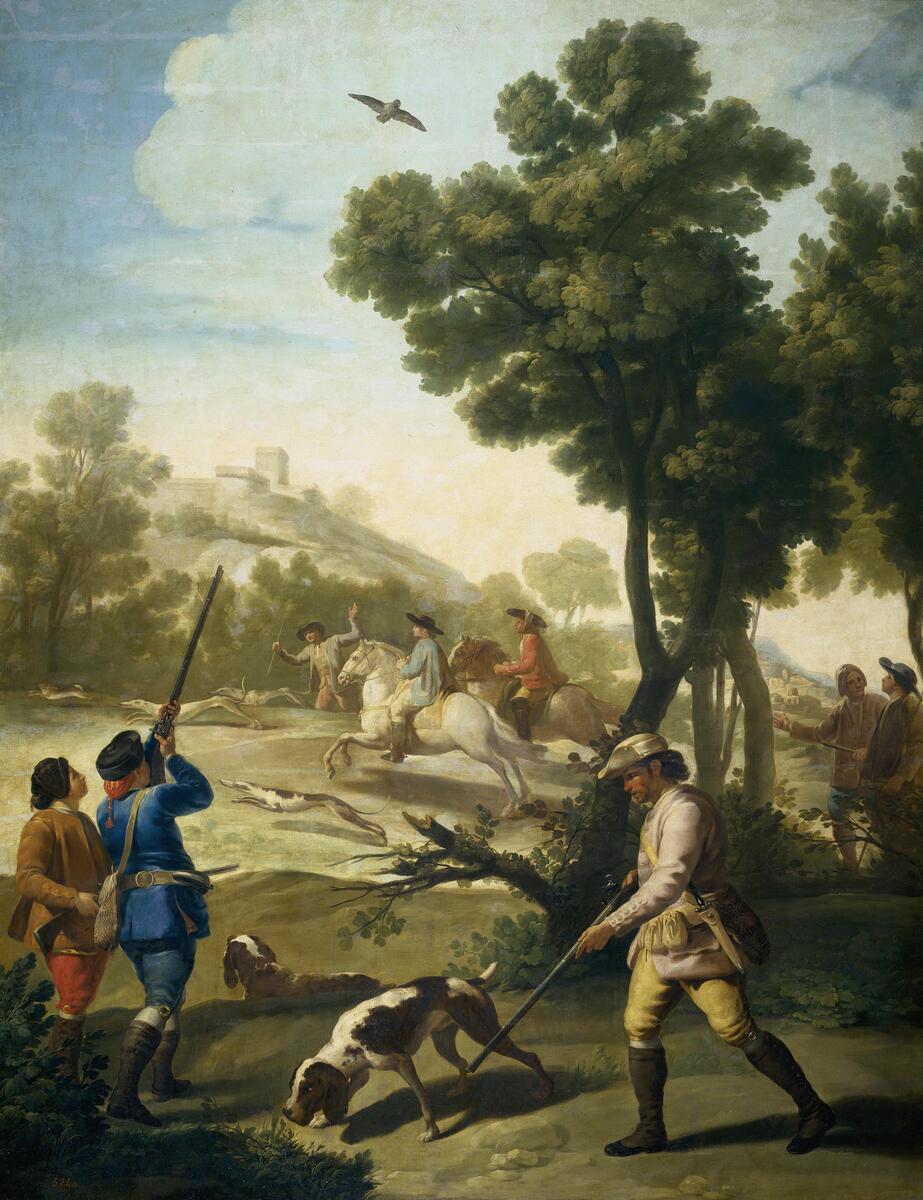
This is Francisco Goya's The Quail Shoot, painted in 1775 and listed among his cartoons for tapestries. A tapestry cartoon is a full-scale painted model from which weavers worked. So the scene before you began not as a finished picture for a wall, but as a design for a woven hanging. The subject is a quail hunt: hunters and dogs close at hand, riders further back in the landscape.
Start with the small bird. A quail hangs in flight against the pale sky. That tiny target is what sets the whole picture moving. Every figure below is oriented toward it in some way.
In the foreground, a hunter in a blue coat raises his long gun toward the bird. His upward gesture gives the action its diagonal. Nearby, a spotted dog lowers its head and follows a scent. Its nose to the ground is the closest, most immediate note of the hunt's animal energy.
To the right, a pale-coated huntsman steps forward with his firearm. His lowered gaze and long stride carry the hunt across the foreground. Deeper in, riders on white and brown horses form a social centre. They connect the working hunters in front to the wider landscape behind.
The work was painted in Spain, and its scale follows from its purpose: a design meant to be translated into woven wall hanging. That helps explain the clear, readable arrangement of figures against open landscape, though the sources supplied here do not describe the commissioning patron or the intended room.
Look again at how the picture is built around that one small bird. The raised gun, the scenting dog and the advancing huntsman each register the target in a different register: aim, instinct and pursuit. That is a reading of the composition, not a record of Goya's stated intent. What the supplied evidence lets me say is that the gestures converge, and the quail gives them their point.
So The Quail Shoot is a hunting scene arranged around a fleeting target, with the human activity below and the riders behind forming one continuous field. Keep your eye on the suspended bird as you leave. Everything else in the painting answers to it.
The story and its sources
Historical claims are linked to the records below. Close looking and interpretation are identified in the passage notes.
- Passage 1Documented historyWikimedia Commons: The Quail Shoot
- Passage 2Close lookingWikimedia Commons: The Quail Shoot
- Passage 3Close lookingWikimedia Commons: The Quail Shoot
- Passage 4Close lookingWikimedia Commons: The Quail Shoot
- Passage 5Documented historyWikimedia Commons: The Quail Shoot
- Passage 6InterpretationWikimedia Commons: The Quail Shoot
- Passage 7InterpretationWikimedia Commons: The Quail Shoot
Details to notice
About 3 minutes to readMounted hunting party
The riders on white and brown horses form the social center of the middle ground, connecting the foreground hunters to the wider landscape.
Advancing huntsman with gun
The pale-coated huntsman steps forward with his firearm, his lowered gaze and long stride continuing the hunt across the right foreground.
Tracking spaniel
The spotted dog lowers its head and follows a scent across the foreground, supplying the close-up animal energy of the hunt.
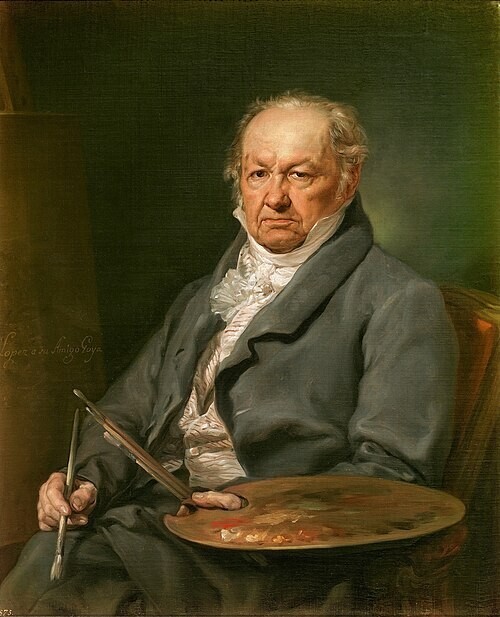
Artist portrait Image credit
Vicente López Portaña. Image source · Public domain
About the artist
Francisco de Goya
30 March 1746 to 16 April 1828
Goya was a Spanish painter and printmaker whose career extended from royal tapestry designs and court portraiture to images of war, repression and unsettling fantasy. Born in Fuendetodos, he trained in Zaragoza and Madrid and became First Painter to Charles IV in 1799. He spent his final years in Bordeaux.
- Born
- 30 March 1746
- Died
- 16 April 1828
- Nationality
- Spanish
- Birthplace
- Fuendetodos, Spain
- Died in
- Bordeaux, France
The research & record
Study the work.
Follow the evidence.
Find catalogue details, historical context, technical research and the literature behind this artwork.
The artwork record
Research catalogue
Catalogue information and detailed research, with references that link to the bibliography.
Updated .
Identity and catalogue
Link- Title
- The Quail Shoot
- Artist or attribution
- Francisco Goya
- Object date
- 1775
- Medium and support
- Oil on canvas
- Dimensions
- 290 cm × 226 cm
- Current collection or location
- Museo del Prado, Madrid, Spain
- Movement or period
- Spanish Enlightenment, tapestry cartoon
- Country or culture
- Spanish
- Depicted subject
- A quail-hunting party, with hunters and dogs in the foreground and riders on horseback in the middle ground, set within a landscape.
- Title variants
- La caza de la codorniz; Partida de caza
- Accession number
- P002857
- Support
- Canvas
Read valuation records and their limitations
Catalogue particulars
The work is catalogued as The Quail Shoot, attributed to Francisco Goya and dated to 1775. The supplied record places its creation in Spain and identifies it as an oil painting on canvas, the medium and support on which the attribution and date rest. Its recorded dimensions are 290 centimetres in height and 226 centimetres in width, an upright format of considerable scale. That scale is consistent with the work's listing among Goya's cartoons for tapestries, the full-scale painted designs made as models from which weavers worked, rather than as a finished picture intended for a wall in its own right.(Wikimedia Commons: The Quail Shoot, n.d., Summary; References and file usage)
The painting belongs to the collection of the Museo del Prado in Madrid, under accession number P002857. The supplied record also cites Pierre Gassier and Juliet Wilson's catalogue as reference number 63 for this painting, and links the work to Fundación Goya en Aragón identifier 6. These identifiers matter for research because they connect the object to two separate reference systems: a standard published catalogue of Goya's works and an institutional finding aid. The Wikimedia Commons page from which this data derives is a discovery aid that cites the Prado object and those catalogue references; it does not replace the institutional catalogue entry itself, and the record is noted as only partially consulted here.(Wikimedia Commons: The Quail Shoot, n.d., Summary)
Interpretation
A distinction worth keeping in view is between the date of the object and the dates attached to its documentation. The 1775 date is the painting's own date as given in the supplied record. The catalogue references by Gassier and Wilson, the Prado accession number and the Fundación Goya en Aragón identifier are later apparatus for locating and describing the work; they postdate the painting and carry no claim about when it was made beyond confirming the attribution the record already states. Nothing in the supplied evidence documents a provenance sequence, a commissioning patron or an intended room, so those elements remain outside what can be asserted here.(Wikimedia Commons: The Quail Shoot, n.d., Summary; References and file usage)
The painting is titled The Quail Shoot and was painted by Francisco Goya in 1775.(Wikimedia Commons: The Quail Shoot, n.d.)
The painting measures 290 centimetres in height and 226 centimetres in width.(Wikimedia Commons: The Quail Shoot, n.d.)
Subject and iconography
LinkRead valuation records and their limitations
Composition and depicted action
Visual observation
The foreground of The Quail Shoot is organized around a hunter in a blue coat who raises his long gun toward a bird in the sky. The upward line of the weapon and arm anchors the diagonal of the action, while a small quail suspended in flight against the pale sky provides the target that motivates the figures' gestures. A spotted dog in the foreground lowers its head to follow a scent, adding close-range animal movement, and to the right a pale-coated huntsman steps forward with his firearm, his lowered gaze and long stride carrying the hunt across the foreground. These four elements establish a sequence of aim, instinct and pursuit that the source record describes as converging on the bird. The description is an observation of depicted figures and their arrangement, not a statement of the painter's intention.(Wikimedia Commons: The Quail Shoot, n.d., Structured data, depicts)
Behind the foreground hunters, riders on white and brown horses form the social centre of the middle ground. The record describes them as connecting the foreground hunters to the wider landscape, so the composition reads as a continuous field from the close action of the gun and dog to the mounted group and the open distance. This layered arrangement of near figures, mounted figures and landscape is a feature of the recorded composition, not an inference about the painting's intended viewing distance or room.(Wikimedia Commons: The Quail Shoot, n.d., Structured data, depicts)
Medium, purpose and context
The work is an oil painting on canvas, and the supplied record lists it among Francisco Goya's cartoons for tapestries, the full-scale designs made as models for woven wall hangings. That designation matters for how the visible scene is understood: the clear, readable arrangement of figures against open landscape is consistent with a design intended to be translated into weaving. The record gives the place of creation as Spain. The supplied evidence does not name a commissioning patron, an intended room, or a specific tapestry workshop, and those gaps should not be filled from the composition alone.(Wikimedia Commons: The Quail Shoot, n.d., Summary; References and file usage; Structured data, depicts)
In the foreground, a hunter in a blue coat raises his long gun toward the bird, anchoring the upward diagonal of the action.(Wikimedia Commons: The Quail Shoot, n.d.)
A small quail is suspended in flight against the pale sky, the target that motivates the hunters' gestures and the dogs' alert movement.(Wikimedia Commons: The Quail Shoot, n.d.)
A spotted dog lowers its head in the foreground and follows a scent, giving the hunt close-up animal energy.(Wikimedia Commons: The Quail Shoot, n.d.)
A pale-coated huntsman steps forward with his firearm, his lowered gaze and long stride continuing the hunt across the right foreground.(Wikimedia Commons: The Quail Shoot, n.d.)
Riders on white and brown horses form the social centre of the middle ground, connecting the foreground hunters to the wider landscape.(Wikimedia Commons: The Quail Shoot, n.d.)
Historical context
LinkRead valuation records and their limitations
The cartoon and its making
The supplied record identifies this work as a tapestry cartoon by Francisco Goya, that is, a full-scale painted model made as a design for a woven wall hanging rather than a finished picture intended for a wall on its own. The same record dates the painting to 1775, describes it as oil on canvas, and gives its dimensions as 290 centimetres in height and 226 centimetres in width. It is also recorded as belonging to the collection of the Museo del Prado in Madrid, with accession number P002857, and its place of creation is given as Spain. Taken together, these particulars place the object at the outset of Goya's work as a designer for the royal tapestry manufactory, and they explain the scale: a cartoon had to match the size of the hanging it would be woven from, so the canvas is large and the composition is built to survive translation into wool. The evidence supplied here establishes the medium, support, dimensions, date, function and current repository; it does not describe the terms of the commission, the payment, or the specific room the hanging was made for.(Wikimedia Commons: The Quail Shoot, n.d., References and file usage; Summary)
Interpretation
Reading the composition as a single field of converging gestures is an interpretation of the visual evidence, not a record of Goya's stated intention. What the evidence does establish is that the quail gives the figures their common point: the raised gun, the scenting dog and the advancing huntsman each register the target in a different way, as aim, instinct and pursuit, while the riders behind place the hunt within a social world rather than presenting it as mere labour. Because the work is a tapestry cartoon, that clarity of arrangement can be connected to its function as a model for weaving, but the sources supplied here do not describe the commissioning patron or the intended room, and the social meaning of the hunting party should therefore be described rather than assumed.(Wikimedia Commons: The Quail Shoot, n.d., Structured data, depicts; References and file usage)
The work is listed among Goya's cartoons for tapestries, the full-scale designs made as models for woven wall hangings.(Wikimedia Commons: The Quail Shoot, n.d.)
The work's place of creation is recorded as Spain.(Wikimedia Commons: The Quail Shoot, n.d.)
Materials and technique
LinkRead valuation records and their limitations
The documentary baseline
The work known as The Quail Shoot is an oil painting on canvas, painted by Francisco Goya in 1775 and recorded in the Wikimedia Commons entry used here. That entry lists it among Goya's cartoons for tapestries, the full-scale designs made as models for woven wall hangings, and it records Spain as the place of creation. The same record gives the dimensions as 290 centimetres in height and 226 centimetres in width. No further support, ground, priming, pigment or medium analysis is supplied with this evidence, so the account below cannot describe the preparatory layers, the binding medium beyond oil, the size or fibre of the canvas, or any later treatment.(Wikimedia Commons: The Quail Shoot, n.d., Summary)
What the supplied record establishes about handling is narrow, but it matters. The oil-on-canvas statement is documentary rather than derived from any visible trace in the reproduction, and the account of the painted surface here belongs to the section on visual evidence. The evidence that the painting was made as a tapestry cartoon is the context for its scale, while the exact relationship between the 290 by 226 centimetre dimensions and that purpose is not specified in the record. Because no supplied unit describes the weaving process, the dyes, the threads or the workshop, nothing can be said here about how the painted design was translated into a hanging.(Wikimedia Commons: The Quail Shoot, n.d., Summary)
The work is an oil painting on canvas.(Wikimedia Commons: The Quail Shoot, n.d.)
Reception and literature
LinkRead valuation records and their limitations
Reference Apparatus and Cataloguing
The reception of this work is documented in the supplied record less through narrative accounts than through the reference apparatus attached to it. The record cites the catalogue by Pierre Gassier and Juliet Wilson as reference number 63 for the painting, and it links the work to Fundación Goya en Aragón identifier 6. These two locators matter because they place the picture within the standard cataloguing infrastructure of Goya studies: the Gassier and Wilson catalogue is the kind of numbered reference by which the painting can be identified and compared across the literature, while the Aragón identifier connects it to the regional Goya documentation project. The supplied evidence does not reproduce the catalogue entry itself, so what can be stated is the fact of the citation and the identifier, not the contents of either entry. Any fuller history of how the picture was described, dated or assessed in those reference works would have to come from those works directly, which are not part of the evidence here.(Wikimedia Commons: The Quail Shoot, n.d., References)
That cataloguing frame cannot be separated from the object's original role, because the role is what earlier viewers would chiefly have been responding to. The work is listed among Goya's cartoons for tapestries, the full-scale painted designs made as models for woven wall hangings, and it was painted in Spain in 1775. The scale recorded for the canvas, 290 centimetres in height and 226 centimetres in width, follows from that function: a cartoon had to be large enough for weavers to work from it at the size of the finished hanging. Understanding the picture as a tapestry design rather than as an independent easel painting changes what counts as its first audience and its first purpose. The supplied evidence does not name the commissioning patron or the intended room, so the reception of the cartoon in its own moment cannot be reconstructed here beyond the general fact of its function as a model for weaving.(Wikimedia Commons: The Quail Shoot, n.d., References and file usage; Summary; References)
The Composition as It Has Been Transmitted
The work's present institutional location is part of its reception history, since it determines who can see it and in what company. The record places the painting in the collection of the Museo del Prado in Madrid, with accession number P002857, and identifies it by the title The Quail Shoot, painted by Francisco Goya in 1775 as an oil on canvas. The Prado accession number is the practical anchor for study and display: it is how the object is requested, photographed and cited, and it situates the cartoon among the museum's holdings of Goya's tapestry designs rather than among isolated hunting pictures. The supplied evidence does not describe the painting's display history, its movements before entering the collection, or the dates of its acquisition, so those stages of reception remain undocumented here. What the evidence does establish is the object's current institutional identity and the reference numbers by which that identity is maintained.(Wikimedia Commons: The Quail Shoot, n.d., References; References and file usage; Summary)
Interpretation
Read together, these documented strands suggest a reception shaped by two different kinds of attention rather than by a single dramatic episode. The cataloguing tradition, represented by the Gassier and Wilson reference and the Fundación Goya en Aragón identifier, treats the painting as a numbered object within Goya's corpus, to be dated, located and compared. The descriptive tradition, represented by the structured observations of the hunters, the scenting dog, the quail and the riders, treats it as a legible image whose interest lies in how the figures converge on a small airborne target. The museum's accession number connects the two, since it is both an administrative fact and the condition under which the image is displayed and reproduced. This synthesis is offered as an interpretation of how the supplied evidence fits together, not as a claim about any individual viewer's response or about the artist's intentions, neither of which the evidence records.(Wikimedia Commons: The Quail Shoot, n.d., References; Structured data, depicts)
The supplied record cites the catalogue by Pierre Gassier and Juliet Wilson as reference number 63 for this painting.(Wikimedia Commons: The Quail Shoot, n.d.)
The supplied record links this work to Fundación Goya en Aragón identifier 6.(Wikimedia Commons: The Quail Shoot, n.d.)
Collection and display
LinkRead valuation records and their limitations
The object and its institutional record
The Quail Shoot is recorded as belonging to the collection of the Museo del Prado in Madrid, where it carries accession number P002857. That number is the object's institutional identity within the Prado's holdings, and it is the reference by which the painting can be traced in the museum's own cataloguing rather than only through the title by which it is commonly known. The same record identifies the work as an oil painting on canvas, gives its dimensions as 290 centimetres in height and 226 centimetres in width, and places its creation in Spain. Taken together, these are the basic physical and administrative facts that anchor any account of the picture: a large vertical canvas, Spanish in origin, now held in Madrid under a specific registration number.(Wikimedia Commons: The Quail Shoot, n.d., Summary)
The wider record supplied for the painting adds the attribution to Francisco Goya and a date of 1775, and classifies the work among Goya's cartoons for tapestries, meaning the full-scale painted designs made as models from which weavers worked. This classification matters for how the object is understood, because a tapestry cartoon was not conceived in the first instance as a finished picture for a wall but as a working design for a woven hanging. The scale recorded for the canvas, 290 by 226 centimetres, is consistent with that function as a full-scale model rather than a small independent composition. The record also cites Pierre Gassier and Juliet Wilson's catalogue as reference number 63 for this painting and links the work to Fundación Goya en Aragón identifier 6, giving the object two further points of scholarly and institutional reference beyond the Prado's own accession number.(Wikimedia Commons: The Quail Shoot, n.d., Summary)
The supplied material does not describe the commissioning patron or the intended room for which the tapestry was destined, and that gap should be stated rather than filled. What the evidence does establish is the chain of identification: a Prado accession number, a place in the Gassier and Wilson catalogue, and a Fundación Goya en Aragón identifier. These are the instruments through which the painting is located in collections and scholarship, and each serves a different purpose, the museum number for the holding institution, the catalogue number for the corpus of Goya's work, and the foundation identifier for the regional documentation of the artist. The record consulted is a Wikimedia Commons file page, described as a discovery aid that cites the Prado object and the catalogue references; it does not replace an institutional catalogue entry and does not itself narrate interpretation. That qualification is worth keeping in view, because the object-specific facts above are relayed through that aid rather than quoted from the museum's own catalogue text.(Wikimedia Commons: The Quail Shoot, n.d., Summary)
Interpretation
Within the history of European material culture, the tapestry cartoon occupies a distinctive position between design and finished work. The evidence supplied for this painting establishes that it belongs to that category and that it was made in 1775, early in Goya's career, but it does not describe the weaving process, the workshop, or the eventual display of the textile. What can be said on the evidence is narrower and firmer: the object now in the Prado under P002857 is an oil on canvas of large vertical format, painted in Spain in 1775, catalogued by Gassier and Wilson as number 63 and by the Fundación Goya en Aragón as number 6, and classified among the cartoons made as models for woven wall hangings. The painting's significance for a larger history of art rests on that documented status as a full-scale preparatory design by Goya, and on its secure place in the reference apparatus through which his work is studied, rather than on any account of patronage or reception that the supplied evidence does not contain.(Wikimedia Commons: The Quail Shoot, n.d., Summary)
The painting belongs to the collection of the Museo del Prado in Madrid, with accession number P002857.(Wikimedia Commons: The Quail Shoot, n.d.)
Documented values and qualified estimates
LinkRead valuation records and their limitations
Recorded values
Interpretation
The supplied record describes The Quail Shoot as an oil painting on canvas by Francisco Goya, dated 1775 and made in Spain. It gives the dimensions as 290 by 226 centimetres and records the work in the collection of the Museo del Prado in Madrid under accession number P002857. The same record lists the painting among Goya's cartoons for tapestries, the full-scale painted models from which weavers worked, and cites Pierre Gassier and Juliet Wilson's catalogue at reference number 63, alongside a Fundación Goya en Aragón identifier of 6. These are the object-specific anchors on which every value question about the picture rests: authorship, date, medium, scale, institution and catalogue position. The surviving evidence does not extend to a commission, a patron, a payment, or an intended room, and the value discussion below therefore has to be read against that thin documentary base rather than in place of it.(Wikimedia Commons: The Quail Shoot, n.d.)
The record's description of the composition is a close-looking account rather than a documentary one. A hunter in a blue coat in the foreground raises his long gun toward a small quail suspended in flight against the pale sky, and that upward gesture anchors the diagonal of the action. A spotted dog nearby lowers its head to follow a scent, while a pale-coated huntsman to the right steps forward with his firearm, his lowered gaze and long stride carrying the hunt across the foreground. Riders on white and brown horses occupy the middle ground as a social centre, connecting the working hunters to the wider landscape. The description does not narrate an interpretation of the picture, and it does not record the artist's intent; it supplies the visible features that any later valuation or interpretation would have to take into account, including the monumentality implied by the recorded dimensions.(Wikimedia Commons: The Quail Shoot, n.d.)
The working range and its basis
The only value figure in the supplied evidence is a working insurance range of US$40 million to US$120 million, recorded as a working calculation generated on 2026-11-16. The recorded methodology states that the range was derived for manual review from the confirmed context: Goya's prominence as an Old Master, the monumentality of the canvas, and the institutional Prado provenance. It describes the figure as a conservative order-of-magnitude estimate anchored to the upper tier of museum-quality Old Master paintings of this scale and importance, with a lower bound reflecting a cautious floor for a securely attributed Goya cartoon and an upper bound reflecting the enhanced value of the tapestry-cartoon group within Goya's oeuvre. The range is stated to be intentionally broad to accommodate uncertainty in attribution, condition and market context. The same record is explicit that no public appraisal, auction result or private insurance figure was supplied, so the range is not anchored to comparable sales, private insurance data, condition reports or provenance verification beyond the supplied excerpt.(Wikimedia Commons: The Quail Shoot, n.d.)
The record attaches a qualification that must travel with the figure: it is a model-generated working range for manual review only, not an official insurance value, appraisal, auction estimate or sale price, and must not be used as any of these. It further states that a qualified fine-art appraiser and insurer should establish any actual insured value. Read alongside the object record, this means the archive can document that a range was calculated and can report the factors the calculation names, but it cannot report an established market or insured value for The Quail Shoot. The gap is itself part of the object's recorded history in this archive: the picture is securely enough placed in the Prado and in the Gassier and Wilson catalogue to support a broad order-of-magnitude working figure, while the evidence supplied here contains nothing that would convert that figure into a transaction, a policy, or a scholarly valuation.(Wikimedia Commons: The Quail Shoot, n.d.)
The valuation factors are worth separating because they rest on different kinds of support. The prominence of Goya as an Old Master and the monumentality of the canvas are general art-historical considerations that the record invokes rather than demonstrates, while the Prado provenance is a documented institutional fact of the object record and the tapestry-cartoon status is likewise documented. The upper bound specifically depends on the place of the cartoon group within Goya's oeuvre, which the object record supports by identifying the work as a tapestry cartoon. The uncertainty the range is designed to absorb is named as attribution, condition and market context, and the supplied evidence contains no condition report or attribution debate to resolve any of those three. The honest reading is therefore that the range expresses the record's confidence in the object's identity and institutional setting, not a measured market position.(Wikimedia Commons: The Quail Shoot, n.d.)
Working estimate
Calculated working insurance estimate, not a sale price: Working insurance range: US$40M to US$120M Recorded date: Working calculation, generated 2026-11-16. Methodology: Broad working range derived for manual review from confirmed context: Francisco Goya, The Quail Shoot, 1775, oil on canvas, 290 x 226 cm, Museo del Prado accession P002857, part of Goya's tapestry-cartoon series. Basis is the exceptional prominence of Goya as an Old Master, the monumentality of the canvas, and the institutional Prado provenance. No public appraisal, auction result, or private insurance figure was supplied, so the range is a conservative order-of-magnitude estimate anchored to the upper tier of museum-quality Old Master paintings of this scale and importance. The lower bound reflects a cautious floor for a securely attributed Goya cartoon; the upper bound reflects the enhanced value of the tapestry-cartoon group within Goya's oeuvre. Range is intentionally broad to accommodate uncertainty in attribution, condition, and market context. Qualification: This is a model-generated working range for manual review only. It is not an official insurance value, appraisal, auction estimate, or sale price, and must not be used as any of these. It is not based on comparable sales, private insurance data, condition reports, or provenance verification beyond the supplied excerpt. A qualified fine-art appraiser and insurer should establish any actual insured value.(Wikimedia Commons: The Quail Shoot, n.d.)
Further reading
Books for a closer look
Paid links. As an Amazon Associate I earn from qualifying purchases.

Open Library Goya
Kodansha International
A Goya catalogue record with subjects including catalogues raisonnés, Museo del Prado, Spanish painting and criticism and interpretation. It is the closest match to a scholarly catalogue that could treat Goya's tapestry cartoons, the category under which The Quail Shoot is documented, and to the Prado collection that holds the work. Its contents are not verified here.
ISBN 0870110837
Bibliography
Sources and further reading
References are arranged by author or organisation, with links to the original publications. Where no publication date is recorded, n.d. means no date.
Source notes updated .
No recorded sources match these filters. Reset the filters to see the full bibliography.
- 02
Book
Goya. Kodansha International.
A Goya catalogue record with subjects including catalogues raisonnés, Museo del Prado, Spanish painting and criticism and interpretation. It is the closest match to a scholarly catalogue that could treat Goya's tapestry cartoons, the category under which The Quail Shoot is documented, and to the Prado collection that holds the work. Its contents are not verified here.
- ISBN
- 0870110837
Citation text
- 03
Book
Francisco Goya - the Paintings. Independently Published.
Catalogued under Goya and titled as a survey of his paintings, which could encompass a 1775 tapestry cartoon such as The Quail Shoot. Relevance rests only on the recorded title and painter; the specific treatment of this hunting composition is not established by the record.
- ISBN
- 9781521566466
Citation text
- 01
Secondary · About this artwork
Wikimedia Commons: The Quail Shoot (n.d.). File:Partida de caza.jpg. Wikimedia Commons.
Wikimedia Commons file page for The Quail Shoot by Francisco Goya. Discovery aid that cites the Museo del Prado object and catalogue references. Its structured data supplies the focus points used for the close-looking passages. It does not replace an institutional catalogue entry and does not narrate interpretation.
- Language
- English
Citation text
Art to live with
Bring this painting
home.
A piece of the archive, made yours. Explore The Quail Shoot in a size and finish that fits your space.
Your text and annotations appear on these editions. Adding to cart saves that design for printing.
Combine this painting with your favourites01 / Find your edition
Made for you
Suggested from your location. Change it if you're sending elsewhere or using a VPN. Prices and delivery are shown in GBP.
19 products
Choose an edition to make it yours
6 × 8 in · Printed cover · 118 lined pages
6 × 8 in · Printed cover · 118 lined pages
6 × 8 in · Printed cover · 118 lined pages
Notebook
GBP 12.03
Delivery GBP 5.35 / Total GBP 17.38
A 6 × 8 inch spiral notebook with 118 ruled pages (59 sheets), a printed front cover, dark grey back cover and metal spiral binding.
Fit and fill keep the painting’s proportions. Stretch changes them.
Move and zoom the painting on your notebook.
Made to order with your design
Made to order
US delivery only
27.9 × 35.6 cm / 11 × 14 in · Standard
27.9 × 35.6 cm / 11 × 14 in · Standard

11 × 14 in / 27.9 × 35.6 cm · Standard

11 × 14 in / 27.9 × 35.6 cm · Standard

11 × 14 in / 27.9 × 35.6 cm · Standard

11 × 14 in / 27.9 × 35.6 cm · Standard

11 × 14 in / 27.9 × 35.6 cm · Standard
Metal art sign
GBP 28.73
Delivery GBP 17.90 / Total GBP 46.63
A printed aluminium sign with rounded corners and mounting holes.
Fit and fill keep the painting’s proportions. Stretch changes them.
Move and zoom the painting on your metal art sign.
Made to order with your design
Printed aluminium · mounting holes included
US delivery only
iPhone 12 Mini ? Glossy ? back view
iPhone 12 Mini · Glossy

iPhone 12 Mini ? Glossy ? back view

iPhone 12 Mini ? Glossy ? back view

iPhone 12 Mini ? Glossy ? back view
Tough phone case
GBP 16.56
Delivery GBP 4.28 / Total GBP 20.84
A two-layer phone case with a printed polycarbonate shell and a shock-absorbing inner liner.
Two layers with a shock-absorbing TPU liner
Case & print details
- Device
- Apple · iPhone 12 Mini
- Material
- Polycarbonate shell with a TPU inner liner
- Artwork
- Outer back and wrapped edges from one template
- Finish
- Glossy
- Version
- Standard version
- Printing
- Dye sublimation
- Print file
- 1,122 × 1,831 px · 95 × 155 mm · PNG · 300 dpi recommended
Rear outline and camera openings follow this variant's Printify template. Case depth and small hardware remain illustrative.
Supplier product detailsFit and fill keep the painting’s proportions. Stretch changes them.
Move and zoom the painting on your tough phone case.
Made to order with your design
Made to order
US delivery only
30.4 × 40.6 cm / 12 × 16 in · Black
30.4 × 40.6 cm / 12 × 16 in · Black

12 × 16 in / 30.4 × 40.6 cm · Black

12 × 16 in / 30.4 × 40.6 cm · Black

12 × 16 in / 30.4 × 40.6 cm · Black

12 × 16 in / 30.4 × 40.6 cm · Black
Framed art print
GBP 53.41
- 1 framed print
- GBP 53.41
- Delivery to United States
- GBP 14.31
- Total
- GBP 67.72
A ready-to-hang wooden frame with a clear Perspex cover and a semi-gloss printed insert.
Delivery is quoted for all selected copies together.
Fit and fill keep the painting’s proportions. Stretch changes them.
Move and zoom the painting on your framed art print.
Made to order with your design
Wooden frame & protective clear front included
US delivery only
38.1 × 40.6 cm / 15 × 16 in · Natural
38.1 × 40.6 cm / 15 × 16 in · Natural

15 × 16 in / 38.1 × 40.6 cm · Natural

15 × 16 in / 38.1 × 40.6 cm · Natural

15 × 16 in / 38.1 × 40.6 cm · Natural

15 × 16 in / 38.1 × 40.6 cm · Natural

15 × 16 in / 38.1 × 40.6 cm · Natural
Canvas tote bag
GBP 14.40
Delivery GBP 4.38 / Total GBP 18.78
A sturdy cotton canvas tote with reinforced handles and artwork on the front panel.
Fit and fill keep the painting’s proportions. Stretch changes them.
Move and zoom the painting on your canvas tote bag.
Made to order with your design
Front print · reinforced cotton handles
US delivery only
22.9 × 20.3 cm / 9 × 8 in · Standard
22.9 × 20.3 cm / 9 × 8 in · Standard

9 × 8 in / 22.9 × 20.3 cm · Standard

9 × 8 in / 22.9 × 20.3 cm · Standard

9 × 8 in / 22.9 × 20.3 cm · Standard

9 × 8 in / 22.9 × 20.3 cm · Standard
Mouse mat
GBP 7.36
Delivery GBP 4.87 / Total GBP 12.23
A rectangular fabric mouse mat with a rubber backing and rounded corners.
Fit and fill keep the painting’s proportions. Stretch changes them.
Move and zoom the painting on your mouse mat.
Made to order with your design
Made to order
US delivery only
See more13 more products
43.2 × 45.7 cm / 17 × 18 in · Artwork
43.2 × 45.7 cm / 17 × 18 in · Artwork

17 × 18 in / 43.2 × 45.7 cm · Artwork

17 × 18 in / 43.2 × 45.7 cm · Artwork

17 × 18 in / 43.2 × 45.7 cm · Artwork
Woven tote bag
GBP 47.33
Delivery GBP 5.94 / Total GBP 53.27
A woven tote with cotton webbing handles and the painting translated into a woven design.
Fit and fill keep the painting’s proportions. Stretch changes them.
Move and zoom the painting on your woven tote bag.
Made to order with your design
Made to order
US delivery only
25.4 × 33 cm / 10 × 13 in · Standard
25.4 × 33 cm / 10 × 13 in · Standard

10 × 13 in / 25.4 × 33 cm · Standard

10 × 13 in / 25.4 × 33 cm · Standard

10 × 13 in / 25.4 × 33 cm · Standard

10 × 13 in / 25.4 × 33 cm · Standard

10 × 13 in / 25.4 × 33 cm · Standard
Matte art print
GBP 12.96
Delivery GBP 7.29 / Total GBP 20.25
An unframed matte poster with archival inks, ready for a frame of your choice.
Fit and fill keep the painting’s proportions. Stretch changes them.
Move and zoom the painting on your matte art print.
Made to order with your design
Unframed · frame it your way
US delivery only
iPhone 12 Mini ? Standard ? back view
iPhone 12 Mini · Standard

iPhone 12 Mini ? Standard ? back view

iPhone 12 Mini ? Standard ? back view

iPhone 12 Mini ? Standard ? back view
Flexible phone case
GBP 15.76
Delivery GBP 4.28 / Total GBP 20.04
A flexible TPU phone case with a frosted finish, a printed back and precise port openings.
Flexible TPU with a frosted, matte finish
Case & print details
- Device
- Apple · iPhone 12 Mini
- Material
- Semi-transparent thermoplastic polyurethane (TPU)
- Artwork
- Back print; rim stays unprinted
- Finish
- Standard
- Version
- Standard version
- Printing
- Dye sublimation
- Print file
- 791 × 1,586 px · 67 × 134.3 mm · PNG · 300 dpi recommended
Rear outline and camera openings follow this variant's Printify template. Case depth and small hardware remain illustrative.
Supplier product detailsFit and fill keep the painting’s proportions. Stretch changes them.
Move and zoom the painting on your flexible phone case.
Made to order with your design
Made to order
S · Standard
S · Standard

S · Standard

S · Standard

S · Standard

S · Standard

S · Standard
Crew socks
GBP 10.78
Delivery GBP 4.49 / Total GBP 15.27
Crew-length polyester and spandex socks with a ribbed cuff, cushioned sole and sublimated artwork.
Fit and fill keep the painting’s proportions. Stretch changes them.
Move and zoom the painting on your crew socks.
Made to order with your design
One pair · design repeated on both socks
US delivery only
12" · Standard
12" · Standard

12" · Standard

12" · Standard

12" · Standard
Laptop sleeve
GBP 26.36
Delivery GBP 4.96 / Total GBP 31.32
A polyester laptop sleeve with a fleece lining, top zip, printed front and black reverse.
Fit and fill keep the painting’s proportions. Stretch changes them.
Move and zoom the painting on your laptop sleeve.
Made to order with your design
Made to order
US delivery only
11oz · 2 image repeats
11oz · White
11oz · 2 image repeats
Mug
GBP 7.42
Delivery GBP 6.23 / Total GBP 13.65
A glossy white ceramic mug with a C-shaped handle, available in 11oz and 15oz sizes.
repeat layout · choose single, double or a repeating pattern in Customise.
Repeat, fit, fill and position your artwork around the mug.
Made to order with your design
Made to order
iPhone 12 Mini ? Standard ? back view
iPhone 12 Mini · Standard

iPhone 12 Mini ? Standard ? back view

iPhone 12 Mini ? Standard ? back view

iPhone 12 Mini ? Standard ? back view

iPhone 12 Mini ? Standard ? back view

iPhone 12 Mini ? Standard ? back view
Biodegradable phone case
GBP 21.19
Delivery GBP 4.28 / Total GBP 25.47
A matte phone case made from plant polymers and bamboo fibre, with the artwork printed on the back.
Flexible plant-polymer shell with a matte finish
Case & print details
- Device
- Apple · iPhone 12 Mini
- Material
- PLA and PBAT polymers with bamboo fibre
- Artwork
- Back print; rim stays unprinted
- Finish
- Standard
- Version
- Standard version
- Printing
- Dye sublimation
- Print file
- 777 × 1,553 px · 65.8 × 131.5 mm · PNG · 300 dpi recommended
Rear outline and camera openings follow this variant's Printify template. Case depth and small hardware remain illustrative.
Supplier product detailsFit and fill keep the painting’s proportions. Stretch changes them.
Move and zoom the painting on your biodegradable phone case.
Made to order with your design
Made to order
27.9 × 35.6 cm / 11 × 14 in · Standard
27.9 × 35.6 cm / 11 × 14 in · Standard

11 × 14 in / 27.9 × 35.6 cm · Standard

11 × 14 in / 27.9 × 35.6 cm · Standard

11 × 14 in / 27.9 × 35.6 cm · Standard
Fine art poster
GBP 20.86
Delivery GBP 7.69 / Total GBP 28.55
A gallery paper print with a smooth art-paper surface. Choose a size that suits the painting.
Fit and fill keep the painting’s proportions. Stretch changes them.
Move and zoom the painting on your fine art poster.
Made to order with your design
Unframed · frame it your way
iPhone 12 Mini ? Standard ? back view
iPhone 12 Mini · Standard

iPhone 12 Mini ? Standard ? back view

iPhone 12 Mini ? Standard ? back view

iPhone 12 Mini ? Standard ? back view
Clear phone case
GBP 15.28
Delivery GBP 4.28 / Total GBP 19.56
A clear phone case with artwork on the back. Leave areas transparent to show the phone underneath.
Clear shell with shock-absorbing TPU sides
Case & print details
- Device
- Apple · iPhone 12 Mini
- Material
- Polycarbonate back and clear TPU sides
- Artwork
- Back print; clear sides stay unprinted
- Finish
- Standard
- Version
- Standard version
- Printing
- Dye sublimation
- Print file
- 732 × 1,527 px · 62 × 129.3 mm · PNG · 300 dpi recommended
Rear outline and camera openings follow this variant's Printify template. Case depth and small hardware remain illustrative.
Supplier product detailsFit and fill keep the painting’s proportions. Stretch changes them.
Move and zoom the painting on your clear phone case.
Made to order with your design
Made to order
15oz · 3 image repeats
15oz · Standard

15oz · 3 image repeats

15oz · 3 image repeats

15oz · 3 image repeats

15oz · 3 image repeats

15oz · 3 image repeats
Travel mug
GBP 32.33
Delivery GBP 5.75 / Total GBP 38.08
A stainless-steel travel mug with a black lid, a tapered base and a printed white exterior.
repeat layout · choose single, double or a repeating pattern in Customise.
Repeat, fit, fill and position your artwork around the mug.
Made to order with your design
Made to order
US delivery only
2.5 × 3.4 cm / 1 × 1.4 in · Glossy
2.5 × 3.4 cm / 1 × 1.4 in · Glossy

1 × 1.4 in / 2.5 × 3.4 cm · Glossy

1 × 1.4 in / 2.5 × 3.4 cm · Glossy

1 × 1.4 in / 2.5 × 3.4 cm · Glossy

1 × 1.4 in / 2.5 × 3.4 cm · Glossy
Photo keyring
GBP 10.30
Delivery GBP 5.45 / Total GBP 15.75
A rectangular zinc-alloy photo keyring with a glossy insert and a swivel split ring.
Fit and fill keep the painting’s proportions. Stretch changes them.
Move and zoom the painting on your photo keyring.
Made to order with your design
Photo insert · zinc frame & swivel ring
US delivery only
iPhone 15 Pro ? Glossy ? back view
iPhone 15 Pro · Glossy

iPhone 15 Pro ? Glossy ? back view

iPhone 15 Pro ? Glossy ? back view

iPhone 15 Pro ? Glossy ? back view

iPhone 15 Pro ? Glossy ? back view

iPhone 15 Pro ? Glossy ? back view
Slim phone case
GBP 16.53
Delivery GBP 5.85 / Total GBP 22.38
A slim printed phone shell with open ports and a lightweight profile.
Slim, lightweight polycarbonate shell
Case & print details
- Device
- Apple · iPhone 15 Pro
- Material
- Polycarbonate
- Artwork
- Outer back and wrapped edges from one template
- Finish
- Glossy
- Version
- Standard version
- Printing
- Dye sublimation
- Print file
- 1,278 × 1,971 px · 108.2 × 166.9 mm · PNG · 300 dpi recommended
Rear outline and camera openings follow this variant's Printify template. Case depth and small hardware remain illustrative.
Supplier product detailsFit and fill keep the painting’s proportions. Stretch changes them.
Move and zoom the painting on your slim phone case.
Made to order with your design
Made to order
US delivery only
36.6 × 30.7 cm / 14.4 × 12.1 in · Standard
36.6 × 30.7 cm / 14.4 × 12.1 in · Standard

14.4 × 12.1 in / 36.6 × 30.7 cm · Standard

14.4 × 12.1 in / 36.6 × 30.7 cm · Standard

14.4 × 12.1 in / 36.6 × 30.7 cm · Standard
Desk mat
GBP 15.17
Delivery GBP 7.21 / Total GBP 22.38
A smooth polyester desk mat with a natural rubber non-slip base and anti-fray edges, available in three sizes.
Fit and fill keep the painting’s proportions. Stretch changes them.
Move and zoom the painting on your desk mat.
Made to order with your design
Made to order
The 30 cm ruler is scaled alongside your selected print. Keep the painting’s proportions with a black background, or stretch it to fill. Frame width, material texture and screen colours are illustrative.
Keep exploring