Asensio Juliá
Artist: Francisco Goya · 1814

Asensio Juliá: high-resolution image
The original file is hosted by Wikimedia Commons, available without payment or an account.
Open high-resolution image on Wikimedia CommonsThe complete story
The story About 2 minutes to read
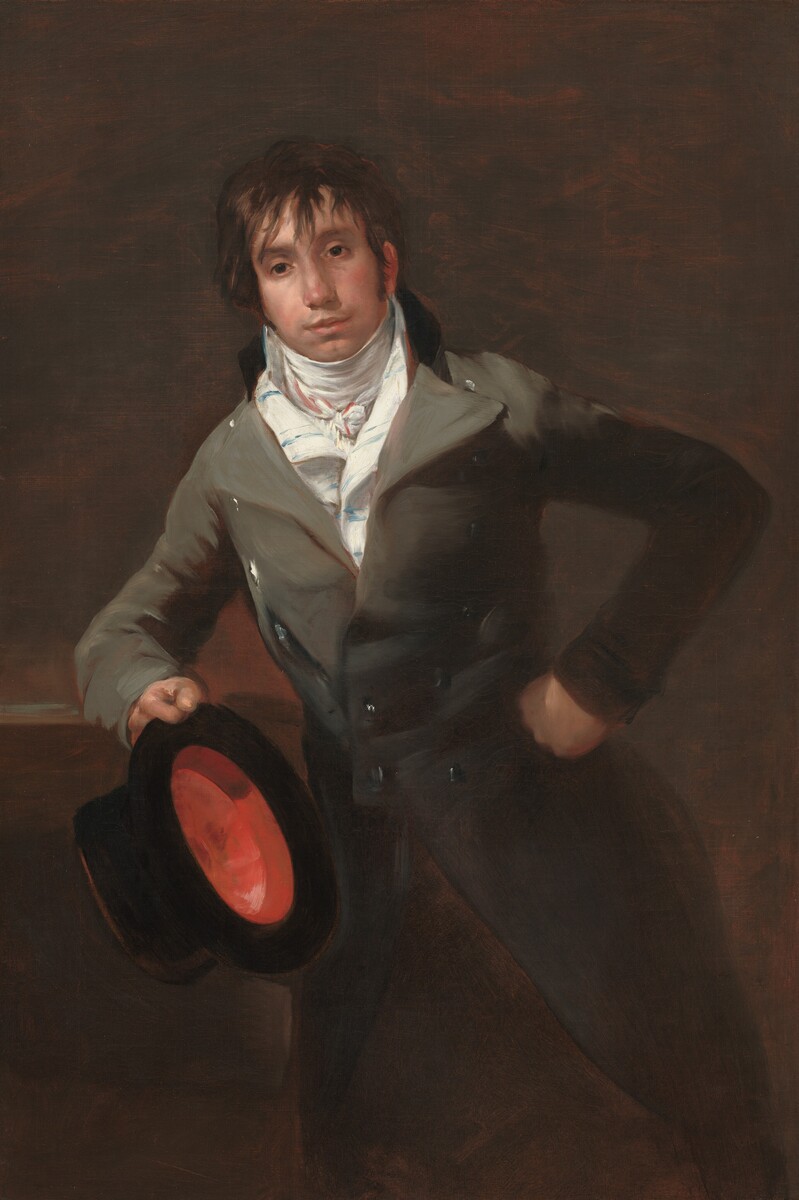
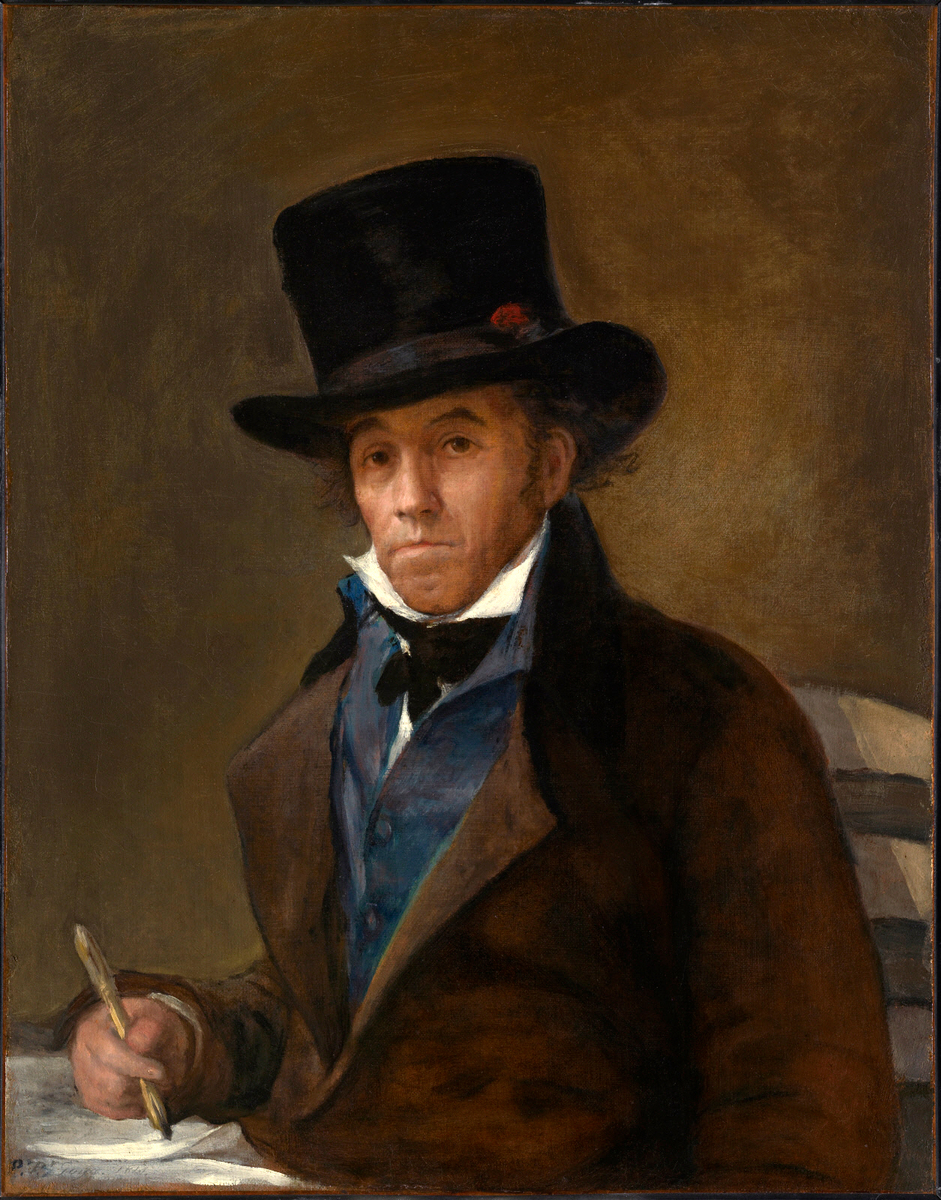
This is a painting titled Asensio Juliá, attributed to Francisco Goya and dated 1814. It portrays Asensio Juliá, a Spanish artist whose identity and role in this portrait are known only from the work's title.
Looking at the painting, you see a figure, presumably Juliá, presented as a subject. The composition and any details of gesture, setting or dress are not described in the available record, so we cannot dwell on them without going beyond the evidence.
Goya painted this work in 1814. At that time, Goya was a established Spanish painter, though the record supplied here does not elaborate on his career or his relationship with Juliá.
The portrait likely served to record Juliá's appearance or status, but any specific interpretation of its meaning or function is not supported by the supplied sources. We can only speculate about why Goya chose to paint him, as no contemporary documents are provided.
Today the painting is held at the Clark Art Institute (accession number 1955.83). Beyond its title, date and artist, the record leaves much unknown, reminding us that not every artwork comes with a full story.
The story and its sources
Historical claims are linked to the records below. Close looking and interpretation are identified in the passage notes.
- Passage 1Documented historyWikimedia Commons: Asensio Juliá
- Passage 2Close looking
- Passage 3Documented historyWikimedia Commons: Asensio Juliá
- Passage 4Interpretation
- Passage 5Documented historyWikimedia Commons: Asensio Juliá
Details to notice
About 2 minutes to readWhite cravat and blue waistcoat
The bright white cravat, dark bow, and blue waistcoat form the central color accent and characterize the sitter's informal but respectable dress.
Red-cockaded top hat
The high black top hat and its small red cockade dominate the silhouette and give the portrait its memorable, less formal character.
Drawing hand and tool
The hand at the lower left holds a slender drawing implement over pale paper, presenting the sitter as a working artist and giving the portrait its narrative key.
Artist portrait Image credit
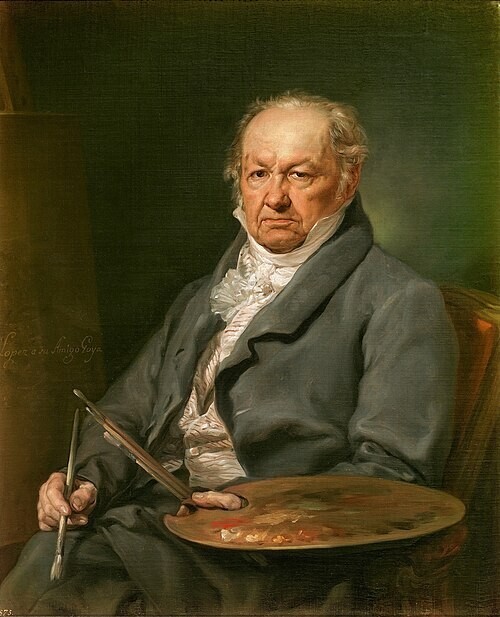
Vicente López Portaña. Image source · Public domain
About the artist
Francisco de Goya
30 March 1746 to 16 April 1828
Goya was a Spanish painter and printmaker whose career extended from royal tapestry designs and court portraiture to images of war, repression and unsettling fantasy. Born in Fuendetodos, he trained in Zaragoza and Madrid and became First Painter to Charles IV in 1799. He spent his final years in Bordeaux.
- Born
- 30 March 1746
- Died
- 16 April 1828
- Nationality
- Spanish
- Birthplace
- Fuendetodos, Spain
- Died in
- Bordeaux, France
The research & record
Study the work.
Follow the evidence.
Find catalogue details, historical context, technical research and the literature behind this artwork.
The artwork record
Research catalogue
Catalogue information and detailed research, with references that link to the bibliography.
Updated .
Identity and catalogue
Link- Title
- Asensio Juliá(Wikimedia Commons: Asensio Juliá, n.d.)
- Artist or attribution
- Francisco Goya
- Object date
- 1814(Wikimedia Commons: Asensio Juliá, n.d.)
- Medium and support
- Painting(Wikimedia Commons: Asensio Juliá, n.d.)
- Current collection or location
- Clark Art Institute(Wikimedia Commons: Asensio Juliá, n.d.)
- Country or culture
- Spanish
- Depicted subject
- A portrait by Francisco Goya of the artist Asensio Juliá, dated 1814, now at the Clark Art Institute.
- Accession number
- 1955.83
- Dimensions
- 73 × 57 cm
- Period
- Unknown
Read valuation records and their limitations
Title, attribution and date
The painting is recorded under the title Asensio Juliá and is attributed to Francisco Goya. The object is a painting, and it carries the date 1814. These are the identifying particulars established by the supplied record: a title naming a person, an attribution rather than an unqualified signature-grade certainty, an object type, and a year. The 1814 date belongs to the work itself as recorded, and is not the date of any later catalogue, file or accession entry.(Wikimedia Commons: Asensio Juliá, n.d., file title and artist field; description field)
Interpretation
The attribution to Goya should be kept as exactly that, an attribution. The record titles the work Asensio Juliá and attributes it to Francisco Goya, which is a different kind of statement from an uncontested authorship. In the same way, the date 1814 is the date recorded for the painting; nothing in the supplied evidence fixes the circumstances of its making, commission or first display, and no provenance sequence or documentary history of ownership accompanies the title, attribution and date. The caution matters for how the object is cited: it is securely identified as a painting called Asensio Juliá, attributed to Goya and dated 1814, and that is the extent of what the record establishes about its identity.(Wikimedia Commons: Asensio Juliá, n.d., file title and artist field; description field)
The named subject
The subject named in the title is a person, Asensio Juliá, but the supplied record gives no further account of him beyond the title itself. Nothing in the evidence describes his appearance, his occupation, his connection to Goya or the occasion for the painting, and the record does not describe the composition, gesture, setting or dress of the figure. The title therefore does the identifying work: it names the sitter, while the evidence stops short of explaining who he was or why he was painted.(Wikimedia Commons: Asensio Juliá, n.d., file title and artist field; description field)
The painting is titled Asensio Juliá and is attributed to Francisco Goya.(Wikimedia Commons: Asensio Juliá, n.d.)
The work is dated 1814.(Wikimedia Commons: Asensio Juliá, n.d.)
The object is a painting.(Wikimedia Commons: Asensio Juliá, n.d.)
Collection and display
LinkRead valuation records and their limitations
Documentation and holding
The painting titled Asensio Juliá is attributed to Francisco Goya and dated 1814, according to the Wikimedia Commons file record from which the present documentation derives. The same record identifies the work as a painting and gives its present location. Any account of the object's collection history therefore rests on a narrow documentary base: the file record supplies the title, attribution, date, object type and current holding, but does not constitute an official museum catalogue entry. That distinction matters for how the following facts should be weighed, since the attribution to Goya and the date of 1814 are reported in that record rather than confirmed here against a catalogue raisonné or the holding institution's own publication.(Wikimedia Commons: Asensio Juliá, n.d., description field)
The painting is held at the Clark Art Institute, with accession number 1955.83. The accession number is the single most concrete piece of collection information available in the supplied evidence, and its form indicates a registration made in the collection during the 1950s, although the evidence does not state the route by which the work entered the institute, the date of acquisition, or any earlier owner. The record does not describe display conditions, gallery location or exhibition history at the Clark, so the work's public visibility at the institute can be noted as a fact of holding without being elaborated into a narrative of display. What the evidence establishes is custodianship and a registered identity within an institutional collection; it does not establish a provenance sequence, and none should be inferred from the accession number alone.(Wikimedia Commons: Asensio Juliá, n.d., description field)
Interpretation
Read together, the attribution to Goya, the date 1814 and the Clark Art Institute accession number 1955.83 frame the object as a named, dated and institutionally held portrait whose documentary footprint in the supplied record is brief. The title identifies the sitter as Asensio Juliá, and the record offers no description of the figure's gesture, setting or dress, so visual analysis of the portrait's composition cannot be carried forward responsibly from this evidence. The relationship between what can be seen in the work and what the record documents is consequently asymmetric: the object itself is a painting of a named individual dated to a specific year, while the archival description confines itself to identification and custody. This is why the collection and display dimension matters here less as a story of successive homes than as a caution about how thin institutional metadata can be even for a work attributed to a major artist.(Wikimedia Commons: Asensio Juliá, n.d., description field)
The painting is held at the Clark Art Institute, with accession number 1955.83.(Wikimedia Commons: Asensio Juliá, n.d.)
Documented values and qualified estimates
LinkRead valuation records and their limitations
The documentary record and its limits
Interpretation
The documentary record for this object is thin and should be described in terms that match its actual source. A Wikimedia Commons file record supplies the basic identifying facts: the work is a painting titled Asensio Juliá, attributed to Francisco Goya, dated 1814, and held at the Clark Art Institute under accession number 1955.83. The Commons annotation accompanying this record states that it is used here only for discovery and is not an official museum catalogue entry. The record names Juliá as the subject, but the evidence does not establish his role, his relationship to Goya, or the circumstances under which the portrait was made. Anyone using this file as the starting point for further research should treat the title, attribution, date and accession as a citation trail to be confirmed against the Clark's own documentation rather than as settled catalogued facts.(Wikimedia Commons: Asensio Juliá, n.d.)
The only value statement in the supplied evidence is explicitly a working calculation and not a valuation of the painting in any professional sense. It records an estimated range of US$15M to US$40M, generated 2026-11-16 and described as a broad working range for manual insurance review only. The methodology states that the range rests on supplied confirmed context, namely that the object is a Goya portrait of 1814 held at the Clark Art Institute under accession 1955.83, and that it reflects Goya's standing as a major Old Master painter, the rarity of 1814 portraits from this period of his career, and the work's long-term museum collection status, which supports an assumed high-value institutional holding. The same methodology states that no dimensions, condition, support, provenance or comparable market transactions were supplied, and that the range is therefore deliberately wide and expressed as a bell-shaped interval around a mid-range institutional-hold assumption without reliance on specific sale results.(Wikimedia Commons: Asensio Juliá, n.d.)
The lower and upper bounds carry different meanings according to the calculation itself. The lower bound is described as allowing for condition or attribution review, and the upper bound as allowing for a fully documented, well-preserved autograph work. The text also states what should precede any underwriting decision: public provenance, exhibition history and conservation records should be gathered first. Its qualification is categorical. It is not an official insurance value, an appraisal, an auction estimate or result, or a sale price; it does not rely on comparable sales, private insurance records or verified museum data; the source URLs provide context only and do not support a public valuation claim; and title, date, attribution, dimensions, condition and accession details should be confirmed directly with the Clark Art Institute and a qualified fine-art appraiser before any coverage or underwriting action.(Wikimedia Commons: Asensio Juliá, n.d.)
Read together, the two accounts establish a useful distinction rather than a contradiction. The Commons record fixes identity, attribution, date, object type and accession, and says nothing about monetary worth. The working calculation accepts those same facts as its inputs and produces a range conditioned on their being correct, while conceding that the features that would most affect an actual valuation, such as dimensions, condition, support, provenance and market comparables, were not available. Any later research should keep these functions separate: the Wikimedia record remains a discovery reference pending verification against the museum, and the 2026 working range remains a manual-review aid that presupposes, but does not verify, the object's identification.(Wikimedia Commons: Asensio Juliá, n.d.)
Working estimate
Calculated working insurance estimate, not a sale price: Estimated value: US$15M to US$40M Recorded date: Working calculation, generated 2026-11-16. Methodology: Broad working range calculated for manual insurance review only, based on the supplied confirmed context: a portrait painting by Francisco Goya, dated 1814, held at the Clark Art Institute (accession 1955.83). The range reflects Goya's standing as a major Old Master painter, the rarity of 1814 portraits from this period of his career, and the work's long-term museum collection status, which supports an assumed high-value institutional holding. No dimensions, condition, support, provenance, or comparable market transactions were supplied, so the range is deliberately wide and conservative, expressed as a bell-shaped interval around a mid-range institutional-hold assumption without reliance on specific sale results. The lower bound allows for condition or attribution review; the upper bound allows for a fully documented, well-preserved autograph work. Public provenance, exhibition history, and conservation records should be gathered before any underwriting decision. Qualification: This is a model-generated working range for manual review only. It is not an official insurance value, an appraisal, an auction estimate or result, or a sale price. It does not rely on comparable sales, private insurance records, or verified museum data. Source URLs provide context only and do not support a public valuation claim. Confirm title, date, attribution, dimensions, condition, and accession details directly with the Clark Art Institute and a qualified fine-art appraiser before any coverage or underwriting action.(Wikimedia Commons: Asensio Juliá, n.d.)
Further reading
Books for a closer look
Paid links. As an Amazon Associate I earn from qualifying purchases.

Open Library Goya
Kodansha International
Goya catalogue with subjects including Catalogues raisonnés, Catalogs, Exhibitions, Romanticism and Spanish Painting. Relevant through the artist, since the artwork is a Goya portrait dated 1814, within his Romantic-period portraiture; no subject data confirms mention of Asensio Juliá.
ISBN 0870110837

Open Library Francisco Goya
Counterpoint
Biographical and critical study of Francisco Goya by Evan S. Connell, with subjects Artists, Biography and Criticism and interpretation. Relevant through the artist of the portrait rather than the sitter, and the record does not document treatment of this 1814 painting.
ISBN 1582433070
Bibliography
Sources and further reading
References are arranged by author or organisation, with links to the original publications. Where no publication date is recorded, n.d. means no date.
Source notes updated .
No recorded sources match these filters. Reset the filters to see the full bibliography.
- 04
Book
Francisco Goya. Counterpoint.
Biographical and critical study of Francisco Goya by Evan S. Connell, with subjects Artists, Biography and Criticism and interpretation. Relevant through the artist of the portrait rather than the sitter, and the record does not document treatment of this 1814 painting.
- ISBN
- 1582433070
Citation text
- 03
Book
Goya. Kodansha International.
Goya catalogue with subjects including Catalogues raisonnés, Catalogs, Exhibitions, Romanticism and Spanish Painting. Relevant through the artist, since the artwork is a Goya portrait dated 1814, within his Romantic-period portraiture; no subject data confirms mention of Asensio Juliá.
- ISBN
- 0870110837
Citation text
- 02
Book
Francisco Goya - the Paintings. Independently Published.
Catalogue record titled 'Francisco Goya - the Paintings', matching the attributed artist Francisco Goya. A painting-focused Goya title is the closest object-level match available for a 1814 portrait, though the record gives no subject details confirming coverage of this specific work.
- ISBN
- 9781521566466
Citation text
- 05
Museum · About this artwork
Citation text
- 01
Secondary · About this artwork
Wikimedia Commons: Asensio Juliá (n.d.). Wikimedia Commons: Asensio Juliá. Wikimedia Commons.
Commons file record used here only for discovery. It supplies the title, artist, date, object type, and Clark Art Institute accession, but is not an official museum catalogue entry.
Citation text
Art to live with
Bring this painting
home.
A piece of the archive, made yours. Explore Asensio Juliá in a size and finish that fits your space.
Your text and annotations appear on these editions. Adding to cart saves that design for printing.
Combine this painting with your favourites01 / Find your edition
Made for you
Suggested from your location. Change it if you're sending elsewhere or using a VPN. Prices and delivery are shown in GBP.
15 products
Choose an edition to make it yours
6 × 8 in · Printed cover · 118 lined pages
6 × 8 in · Printed cover · 118 lined pages
6 × 8 in · Printed cover · 118 lined pages
Notebook
GBP 12.03
Delivery GBP 5.35 / Total GBP 17.38
A 6 × 8 inch spiral notebook with 118 ruled pages (59 sheets), a printed front cover, dark grey back cover and metal spiral binding.
Fit and fill keep the painting’s proportions. Stretch changes them.
Move and zoom the painting on your notebook.
Made to order with your design
Made to order
US delivery only
12.7 × 17.8 cm / 5 × 7 in · Standard
12.7 × 17.8 cm / 5 × 7 in · Standard

5 × 7 in / 12.7 × 17.8 cm · Standard

5 × 7 in / 12.7 × 17.8 cm · Standard

5 × 7 in / 12.7 × 17.8 cm · Standard

5 × 7 in / 12.7 × 17.8 cm · Standard

5 × 7 in / 12.7 × 17.8 cm · Standard
Metal art sign
GBP 19.84
Delivery GBP 17.90 / Total GBP 37.74
A printed aluminium sign with rounded corners and mounting holes.
Fit and fill keep the painting’s proportions. Stretch changes them.
Move and zoom the painting on your metal art sign.
Made to order with your design
Printed aluminium · mounting holes included
US delivery only
iPhone 12 Mini ? Glossy ? back view
iPhone 12 Mini · Glossy

iPhone 12 Mini ? Glossy ? back view

iPhone 12 Mini ? Glossy ? back view

iPhone 12 Mini ? Glossy ? back view
Tough phone case
GBP 16.56
Delivery GBP 4.28 / Total GBP 20.84
A two-layer phone case with a printed polycarbonate shell and a shock-absorbing inner liner.
Two layers with a shock-absorbing TPU liner
Case & print details
- Device
- Apple · iPhone 12 Mini
- Material
- Polycarbonate shell with a TPU inner liner
- Artwork
- Outer back and wrapped edges from one template
- Finish
- Glossy
- Version
- Standard version
- Printing
- Dye sublimation
- Print file
- 1,122 × 1,831 px · 95 × 155 mm · PNG · 300 dpi recommended
Rear outline and camera openings follow this variant's Printify template. Case depth and small hardware remain illustrative.
Supplier product detailsFit and fill keep the painting’s proportions. Stretch changes them.
Move and zoom the painting on your tough phone case.
Made to order with your design
Made to order
US delivery only
20.3 × 25.4 cm / 8 × 10 in · White
20.3 × 25.4 cm / 8 × 10 in · White

8 × 10 in / 20.3 × 25.4 cm · White

8 × 10 in / 20.3 × 25.4 cm · White

8 × 10 in / 20.3 × 25.4 cm · White

8 × 10 in / 20.3 × 25.4 cm · White
Framed art print
GBP 34.51
- 1 framed print
- GBP 34.51
- Delivery to United States
- GBP 9.73
- Total
- GBP 44.24
A ready-to-hang wooden frame with a clear Perspex cover and a semi-gloss printed insert.
Delivery is quoted for all selected copies together.
Fit and fill keep the painting’s proportions. Stretch changes them.
Move and zoom the painting on your framed art print.
Made to order with your design
Wooden frame & protective clear front included
US delivery only
43.2 × 45.7 cm / 17 × 18 in · Artwork
43.2 × 45.7 cm / 17 × 18 in · Artwork

17 × 18 in / 43.2 × 45.7 cm · Artwork

17 × 18 in / 43.2 × 45.7 cm · Artwork

17 × 18 in / 43.2 × 45.7 cm · Artwork
Woven tote bag
GBP 47.33
Delivery GBP 5.94 / Total GBP 53.27
A woven tote with cotton webbing handles and the painting translated into a woven design.
Fit and fill keep the painting’s proportions. Stretch changes them.
Move and zoom the painting on your woven tote bag.
Made to order with your design
Made to order
US delivery only
20.3 × 25.4 cm / 8 × 10 in · Standard
20.3 × 25.4 cm / 8 × 10 in · Standard

8 × 10 in / 20.3 × 25.4 cm · Standard

8 × 10 in / 20.3 × 25.4 cm · Standard

8 × 10 in / 20.3 × 25.4 cm · Standard

8 × 10 in / 20.3 × 25.4 cm · Standard

8 × 10 in / 20.3 × 25.4 cm · Standard
Matte art print
GBP 13.30
Delivery GBP 7.29 / Total GBP 20.59
An unframed matte poster with archival inks, ready for a frame of your choice.
Fit and fill keep the painting’s proportions. Stretch changes them.
Move and zoom the painting on your matte art print.
Made to order with your design
Unframed · frame it your way
US delivery only
See more9 more products
iPhone 12 Mini ? Standard ? back view
iPhone 12 Mini · Standard

iPhone 12 Mini ? Standard ? back view

iPhone 12 Mini ? Standard ? back view

iPhone 12 Mini ? Standard ? back view
Flexible phone case
GBP 15.76
Delivery GBP 4.28 / Total GBP 20.04
A flexible TPU phone case with a frosted finish, a printed back and precise port openings.
Flexible TPU with a frosted, matte finish
Case & print details
- Device
- Apple · iPhone 12 Mini
- Material
- Semi-transparent thermoplastic polyurethane (TPU)
- Artwork
- Back print; rim stays unprinted
- Finish
- Standard
- Version
- Standard version
- Printing
- Dye sublimation
- Print file
- 791 × 1,586 px · 67 × 134.3 mm · PNG · 300 dpi recommended
Rear outline and camera openings follow this variant's Printify template. Case depth and small hardware remain illustrative.
Supplier product detailsFit and fill keep the painting’s proportions. Stretch changes them.
Move and zoom the painting on your flexible phone case.
Made to order with your design
Made to order
S · Standard
S · Standard

S · Standard

S · Standard

S · Standard

S · Standard

S · Standard
Crew socks
GBP 10.78
Delivery GBP 4.49 / Total GBP 15.27
Crew-length polyester and spandex socks with a ribbed cuff, cushioned sole and sublimated artwork.
Fit and fill keep the painting’s proportions. Stretch changes them.
Move and zoom the painting on your crew socks.
Made to order with your design
One pair · design repeated on both socks
US delivery only
12" · Standard
12" · Standard

12" · Standard

12" · Standard

12" · Standard
Laptop sleeve
GBP 26.36
Delivery GBP 4.96 / Total GBP 31.32
A polyester laptop sleeve with a fleece lining, top zip, printed front and black reverse.
Fit and fill keep the painting’s proportions. Stretch changes them.
Move and zoom the painting on your laptop sleeve.
Made to order with your design
Made to order
US delivery only
11oz · 2 image repeats
11oz · White
11oz · 2 image repeats
Mug
GBP 7.42
Delivery GBP 6.23 / Total GBP 13.65
A glossy white ceramic mug with a C-shaped handle, available in 11oz and 15oz sizes.
repeat layout · choose single, double or a repeating pattern in Customise.
Repeat, fit, fill and position your artwork around the mug.
Made to order with your design
Made to order
iPhone 12 Mini ? Standard ? back view
iPhone 12 Mini · Standard

iPhone 12 Mini ? Standard ? back view

iPhone 12 Mini ? Standard ? back view

iPhone 12 Mini ? Standard ? back view

iPhone 12 Mini ? Standard ? back view

iPhone 12 Mini ? Standard ? back view
Biodegradable phone case
GBP 21.19
Delivery GBP 4.28 / Total GBP 25.47
A matte phone case made from plant polymers and bamboo fibre, with the artwork printed on the back.
Flexible plant-polymer shell with a matte finish
Case & print details
- Device
- Apple · iPhone 12 Mini
- Material
- PLA and PBAT polymers with bamboo fibre
- Artwork
- Back print; rim stays unprinted
- Finish
- Standard
- Version
- Standard version
- Printing
- Dye sublimation
- Print file
- 777 × 1,553 px · 65.8 × 131.5 mm · PNG · 300 dpi recommended
Rear outline and camera openings follow this variant's Printify template. Case depth and small hardware remain illustrative.
Supplier product detailsFit and fill keep the painting’s proportions. Stretch changes them.
Move and zoom the painting on your biodegradable phone case.
Made to order with your design
Made to order
iPhone 12 Mini ? Standard ? back view
iPhone 12 Mini · Standard

iPhone 12 Mini ? Standard ? back view

iPhone 12 Mini ? Standard ? back view

iPhone 12 Mini ? Standard ? back view
Clear phone case
GBP 15.28
Delivery GBP 4.28 / Total GBP 19.56
A clear phone case with artwork on the back. Leave areas transparent to show the phone underneath.
Clear shell with shock-absorbing TPU sides
Case & print details
- Device
- Apple · iPhone 12 Mini
- Material
- Polycarbonate back and clear TPU sides
- Artwork
- Back print; clear sides stay unprinted
- Finish
- Standard
- Version
- Standard version
- Printing
- Dye sublimation
- Print file
- 732 × 1,527 px · 62 × 129.3 mm · PNG · 300 dpi recommended
Rear outline and camera openings follow this variant's Printify template. Case depth and small hardware remain illustrative.
Supplier product detailsFit and fill keep the painting’s proportions. Stretch changes them.
Move and zoom the painting on your clear phone case.
Made to order with your design
Made to order
15oz · 3 image repeats
15oz · Standard

15oz · 3 image repeats

15oz · 3 image repeats

15oz · 3 image repeats

15oz · 3 image repeats

15oz · 3 image repeats
Travel mug
GBP 32.33
Delivery GBP 5.75 / Total GBP 38.08
A stainless-steel travel mug with a black lid, a tapered base and a printed white exterior.
repeat layout · choose single, double or a repeating pattern in Customise.
Repeat, fit, fill and position your artwork around the mug.
Made to order with your design
Made to order
US delivery only
2.5 × 3.4 cm / 1 × 1.4 in · Glossy
2.5 × 3.4 cm / 1 × 1.4 in · Glossy

1 × 1.4 in / 2.5 × 3.4 cm · Glossy

1 × 1.4 in / 2.5 × 3.4 cm · Glossy

1 × 1.4 in / 2.5 × 3.4 cm · Glossy

1 × 1.4 in / 2.5 × 3.4 cm · Glossy
Photo keyring
GBP 10.30
Delivery GBP 5.45 / Total GBP 15.75
A rectangular zinc-alloy photo keyring with a glossy insert and a swivel split ring.
Fit and fill keep the painting’s proportions. Stretch changes them.
Move and zoom the painting on your photo keyring.
Made to order with your design
Photo insert · zinc frame & swivel ring
US delivery only
iPhone 15 Pro ? Glossy ? back view
iPhone 15 Pro · Glossy

iPhone 15 Pro ? Glossy ? back view

iPhone 15 Pro ? Glossy ? back view

iPhone 15 Pro ? Glossy ? back view

iPhone 15 Pro ? Glossy ? back view

iPhone 15 Pro ? Glossy ? back view
Slim phone case
GBP 16.53
Delivery GBP 5.85 / Total GBP 22.38
A slim printed phone shell with open ports and a lightweight profile.
Slim, lightweight polycarbonate shell
Case & print details
- Device
- Apple · iPhone 15 Pro
- Material
- Polycarbonate
- Artwork
- Outer back and wrapped edges from one template
- Finish
- Glossy
- Version
- Standard version
- Printing
- Dye sublimation
- Print file
- 1,278 × 1,971 px · 108.2 × 166.9 mm · PNG · 300 dpi recommended
Rear outline and camera openings follow this variant's Printify template. Case depth and small hardware remain illustrative.
Supplier product detailsFit and fill keep the painting’s proportions. Stretch changes them.
Move and zoom the painting on your slim phone case.
Made to order with your design
Made to order
US delivery only
The 30 cm ruler is scaled alongside your selected print. Keep the painting’s proportions with a black background, or stretch it to fill. Frame width, material texture and screen colours are illustrative.
Keep exploring