The Marquesa de Pontejos
Artist: Francisco Goya · c. 1786
The Marquesa de Pontejos: high-resolution image
The highest-resolution file we hold, available without payment or an account.2,462 × 4,096 pixels.
Download highest-resolution imageThe complete story
The story About 4 minutes to read
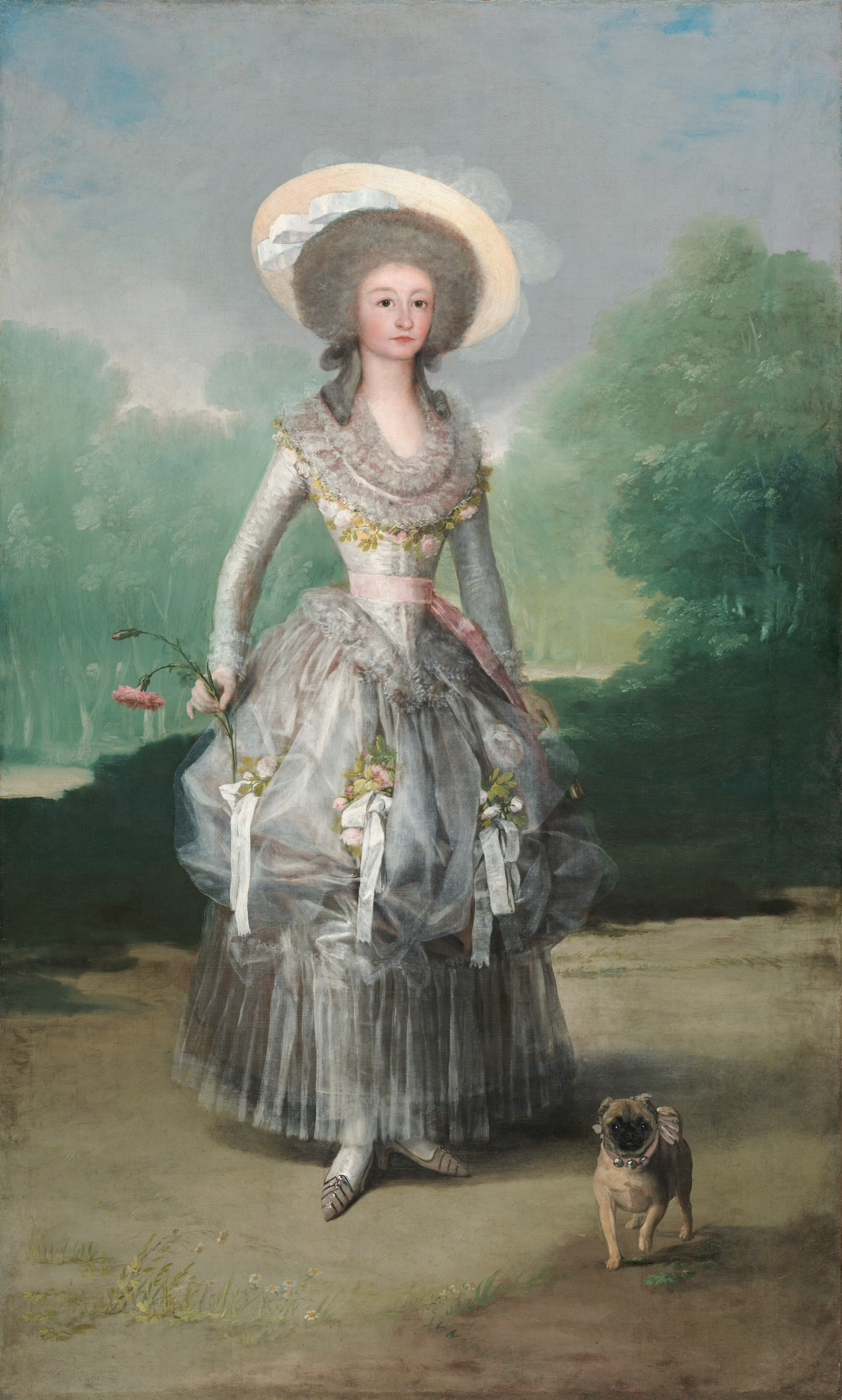
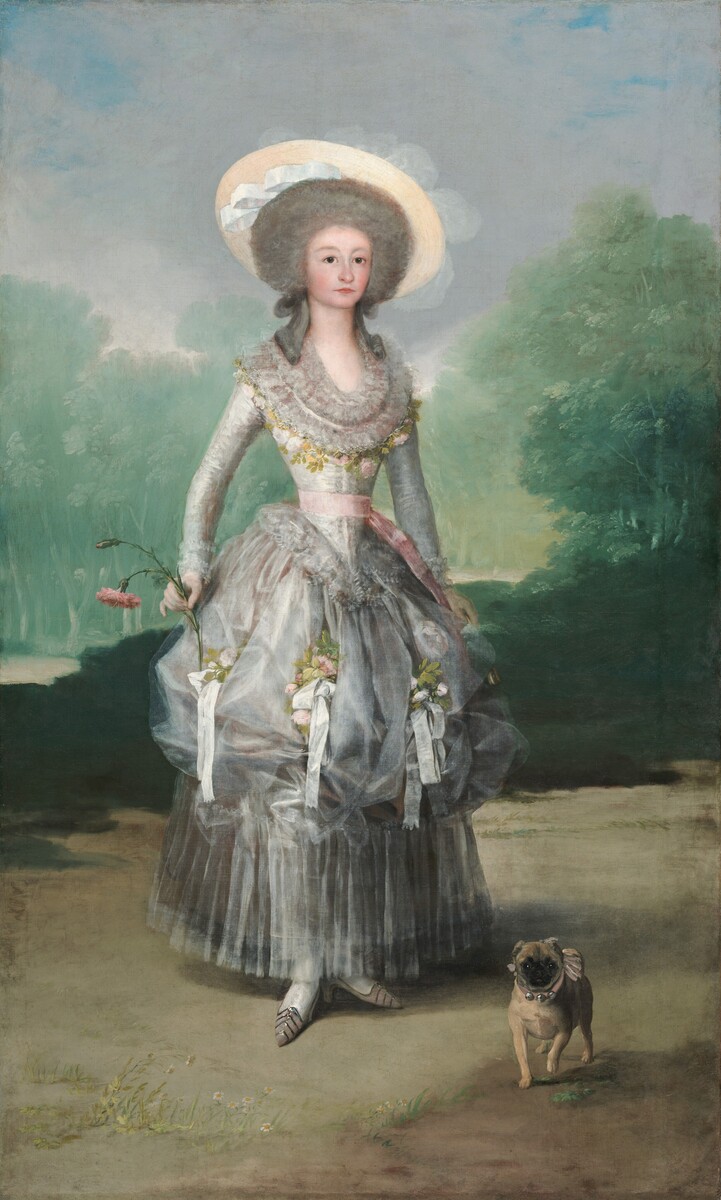
This is Goya's portrait of the Marquesa de Pontejos, painted around 1786. She stands full length in fashionable dress, a broad straw hat tied with a white ribbon on her head. There is no episode here, no scene from a story. Goya presents an aristocratic woman as a poised and fashionable figure, and the painting asks us to read her through how she stands and what she wears.
Look first at her dress. A voluminous translucent overskirt is gathered into bunches of flowers tied with ribbon, so the fabric seems to billow and catch the light around her. That sheer outer layer is the painting's largest area of pale colour. It gives her silhouette weight and movement, and it separates her from the darker ground behind.
In her hand, on the left side of the composition, she holds a slender stem with a pink flower and a bud. It is a small, delicate note against all that pale fabric. Down at the lower right stands a small fawn pug with a dark muzzle and a decorative collar. The dog is close to her feet, at the base of the figure.
The pug adds an informal, affectionate note to what is otherwise a formal portrait. A pet at the feet of a sitter was a familiar way of softening the stiffness of full-length display. That reading comes from how the animal is placed and painted, not from anything the Marquesa is recorded as saying. It is an effect of the picture, and it lightens the tone.
So the portrait works through contrast. The dress and hat declare rank and fashion; the flower and the little dog introduce softness and intimacy. Goya keeps those two registers together in one figure. She remains poised and aristocratic, but she is not remote. The painting gives us grandeur and warmth at the same time.
What stays with you is that balance. A woman of rank, dressed to be seen, holding a flower, with a small dog at her hem. Goya's subject is not an event but a presence, built from fabric, posture and a few chosen details. The portrait presents the Marquesa as fashionable and formal, and quietly human.
The story and its sources
Historical claims are linked to the records below. Close looking and interpretation are identified in the passage notes.
- Passage 1Documented historyThe Marquesa de Pontejos | National Gallery of Art
- Passage 2Close lookingThe Marquesa de Pontejos | National Gallery of Art
- Passage 3Close lookingThe Marquesa de Pontejos | National Gallery of Art
- Passage 4InterpretationThe Marquesa de Pontejos | National Gallery of Art
- Passage 5InterpretationThe Marquesa de Pontejos | National Gallery of Art
- Passage 6InterpretationThe Marquesa de Pontejos | National Gallery of Art
Details to notice
About 3 minutes to readSheer skirt and floral bows
The voluminous translucent overskirt is gathered into ribbon-tied bunches of flowers, showing the delicate brushwork and elaborate fashion that dominate the lower half of the portrait.
Pug at her feet
A small fawn pug with a dark muzzle and decorative collar stands at the lower right, looking outward and adding an informal, affectionate note to the formal portrait.
Pink flower and hand
The marquesa's hand holds a slender stem bearing a pink flower and bud on the left side, an intimate gesture that softens the formal full-length pose.
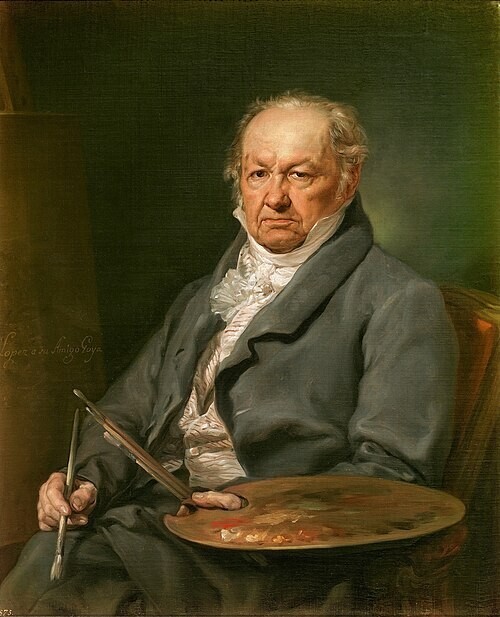
Artist portrait Image credit
Vicente López Portaña. Image source · Public domain
About the artist
Francisco de Goya
30 March 1746 to 16 April 1828
Goya was a Spanish painter and printmaker whose career extended from royal tapestry designs and court portraiture to images of war, repression and unsettling fantasy. Born in Fuendetodos, he trained in Zaragoza and Madrid and became First Painter to Charles IV in 1799. He spent his final years in Bordeaux.
- Born
- 30 March 1746
- Died
- 16 April 1828
- Nationality
- Spanish
- Birthplace
- Fuendetodos, Spain
- Died in
- Bordeaux, France
The research & record
Study the work.
Follow the evidence.
Find catalogue details, historical context, technical research and the literature behind this artwork.
The artwork record
Research catalogue
Catalogue information and detailed research, with references that link to the bibliography.
Updated .
Identity and catalogue
Link- Title
- The Marquesa de Pontejos(The Marquesa de Pontejos | National Gallery of Art, n.d.)
- Artist or attribution
- Francisco Goya
- Object date
- c. 1786(The Marquesa de Pontejos | National Gallery of Art, n.d.)
- Medium and support
- Oil on canvas(The Marquesa de Pontejos | National Gallery of Art, n.d.)
- Dimensions
- Overall: 210.3 x 127 cm (82 13/16 x 50 in.); Framed: 231.8 x 146.4 cm (91 1/4 x 57 5/8 in.)(The Marquesa de Pontejos | National Gallery of Art, n.d.)
- Current collection or location
- National Gallery of Art, Washington, D.C., United States
- Movement or period
- Late 18th-century Spanish portraiture (Goya)
- Country or culture
- Spanish
- Depicted subject
- Full-length portrait of the Marquesa de Pontejos, a Spanish aristocrat, shown standing in fashionable dress with a broad straw hat, holding a slender stem with a pink flower and bud, with a small pug at her feet and a voluminous sheer overskirt tied with floral ribbon bows. Goya presents her as a poised, fashionable figure rather than in a narrative episode.
- Title variants
- The Marquesa de Pontejos
- Attribution qualification
- Attribute to Francisco Goya per the supplied source. The excerpt does not provide further attribution history.
- Accession number
- 1937.1.85(The Marquesa de Pontejos | National Gallery of Art, n.d.)
- Support
- Canvas
Read valuation records and their limitations
Identity and catalogue
The painting is titled 'The Marquesa de Pontejos' and is attributed to Francisco Goya. The attribution is recorded rather than expanded in the supplied evidence, so the name of the artist and the title of the work should be understood as the catalogue identification carried in the source record. The work is dated c. 1786. That circa date is the date of the object, not a date of cataloguing or publication: it belongs to the period of execution proposed for the painting itself, and it is given, like the title and attribution, as recorded information rather than as a determination argued out in the evidence at hand.(The Marquesa de Pontejos | National Gallery of Art, n.d., Wikimedia Commons file record)
The overall dimensions are 210.3 x 127 cm (82 13/16 x 50 in.). The source gives both metric and imperial figures, which is useful for thinking about scale: the height of more than two metres makes this a large full-length portrait rather than a bust or half-length, so the figure is presented at life scale and occupies the canvas from head to hem. Such dimensions are also the kind of measurement a catalogue records for an uncradled canvas or a panel rather than for a reduced copy, though the evidence supplied here does not go on to discuss support, condition, framing or later treatment. Nothing in the supplied evidence describes the canvas weave, stretcher, lining or conservation history, and those should not be assumed.(The Marquesa de Pontejos | National Gallery of Art, n.d., Wikimedia Commons file record)
The painting is in the National Gallery of Art, accession 1937.1.85, Andrew W. Mellon Collection. The accession number and collection name locate the object within an institutional holding that dates from the 1937 founding gift of Andrew W. Mellon, although the evidence does not supply an earlier provenance chain, an acquisition date beyond that founding collection, or any record of intervening owners. The source consulted is a Wikimedia Commons file record that cites National Gallery of Art data rather than the Gallery's own catalogue entry, and the record names the file, artist, date, medium, dimensions, collection and accession. That distinction matters for how firmly each statement here can be held: the catalogue identifiers and the physical description rest on an institutional record transmitted through a Commons file, not on a catalogue raisonné argument or a technical examination report.(The Marquesa de Pontejos | National Gallery of Art, n.d., Wikimedia Commons file record)
The painting is titled 'The Marquesa de Pontejos' and is attributed to Francisco Goya.(The Marquesa de Pontejos | National Gallery of Art, n.d.)
The work is dated c. 1786.(The Marquesa de Pontejos | National Gallery of Art, n.d.)
The overall dimensions are 210.3 x 127 cm (82 13/16 x 50 in.).(The Marquesa de Pontejos | National Gallery of Art, n.d.)
Subject and iconography
LinkRead valuation records and their limitations
The record and its frame
Visual observation
The single supplied record for this work describes it as an oil on canvas showing the Marquesa full length in fashionable dress, with a broad straw hat tied with a white ribbon; the overall dimensions are given as 210.3 x 127 cm (82 13/16 x 50 in.), and the painting is recorded in the National Gallery of Art, Washington, as accession 1937.1.85, Andrew W. Mellon Collection. These are the frame conditions for any reading of the visible evidence: a life-scale, vertically proportioned full-length format, painted in oil, whose large pale passages of fabric had room to register across a canvas over two metres high. The same record dates the work c. 1786 and attributes it to Francisco Goya. The source annotation notes that this is a Wikimedia Commons file record drawing on National Gallery of Art data rather than the museum's own catalogue entry, a qualification worth keeping in view when dates, dimensions or collection details are cited onward.(The Marquesa de Pontejos | National Gallery of Art, n.d., Wikimedia Commons file record)
Composition and chosen details
Within that frame, the composition is organised around the standing figure and a small number of chosen accessories. The Marquesa's outstretched hand, on the left side of the composition, holds a slender stem bearing a pink flower and a bud; at the lower right, close to her feet, stands a small fawn pug with a dark muzzle and a decorative collar. The two details sit at opposite lower corners, one held at hand height and one on the ground, so that the picture's incident is distributed across the field rather than concentrated in an action. Nothing in the record describes a narrative episode: the figure is presented as a poised, fashionable aristocratic presence, and the visible information by which a viewer reads her is posture, dress and these few objects.(The Marquesa de Pontejos | National Gallery of Art, n.d., Wikimedia Commons file record)
Dress, fabric and fashion
The most substantial passage of paint described is the dress. The Marquesa wears a voluminous translucent overskirt gathered into ribbon-tied bunches of flowers, an arrangement in which the sheer outer layer is drawn up at intervals and secured with ribbon and floral bunches rather than falling in a single unbroken fall of cloth. The record identifies this overskirt as the painting's largest area of pale colour, giving weight and movement to the silhouette and separating the figure from the darker ground behind her. Read together with the straw hat and white ribbon, the costume establishes a coordinated fashion: pale, light-catching fabric set against a darker setting, with ribbon recurring as the tying element at both head and skirt. The flower stem in her hand can be seen as continuous with the floral bunches on the dress, so that the held flower repeats a motif already carried by the costume.(The Marquesa de Pontejos | National Gallery of Art, n.d., Wikimedia Commons file record)
Formality and informality
The record draws an explicit contrast of registers: the dress and hat declare rank and fashion, while the flower and the small dog introduce softness and intimacy. The pug is described as adding an informal, affectionate note to an otherwise formal portrait, and the animal's position at the sitter's feet is described as a familiar device for softening the stiffness of full-length display. This is offered as an effect of how the animal is placed and painted, not as evidence of anything the sitter is recorded as saying or intending. The distinction matters: the affectionate note is an inference from visible arrangement and from a recognised convention of pet-at-the-feet portraiture, not a documented statement about the Marquesa's feelings or Goya's brief.(The Marquesa de Pontejos | National Gallery of Art, n.d., Wikimedia Commons file record)
Interpretation
Taken as a whole, the described picture holds grandeur and warmth together in one figure. Rank is carried by full-length display and by the fashionable, light-catching dress and hat; softness is carried by the pink flower and bud and by the pug at the hem. The subject is a presence rather than an event, built from fabric, posture and a few chosen details. Because the supplied evidence is limited to this one record, claims about named visual conventions, earlier or later portraits, or a documented influence on Goya's composition cannot be made here; the pet-at-the-feet device is identified as a familiar convention, but no specific predecessor or successor is established. What the evidence does support is a portrait whose meaning is constructed through the interplay of formal display and small, intimate accessories.(The Marquesa de Pontejos | National Gallery of Art, n.d., Wikimedia Commons file record)
Visual observation
The Marquesa is shown full-length in fashionable dress with a broad straw hat tied with a white ribbon.(The Marquesa de Pontejos | National Gallery of Art, n.d.)
Her hand holds a slender stem bearing a pink flower and bud on the left side of the composition.(The Marquesa de Pontejos | National Gallery of Art, n.d.)
A small fawn pug with a dark muzzle and decorative collar stands at her feet at the lower right.(The Marquesa de Pontejos | National Gallery of Art, n.d.)
The Marquesa wears a voluminous translucent overskirt gathered into ribbon-tied bunches of flowers.(The Marquesa de Pontejos | National Gallery of Art, n.d.)
Materials and technique
LinkRead valuation records and their limitations
Documented support and medium
Visual observation
The painting is recorded as oil on canvas, and that basic material identification is the foundation for any account of how the image was built. The record gives no further technical detail: it does not name a primer or ground, a canvas weave or supplier, a palette of pigments, a varnish, a lining, a cleaning, or any other treatment. What the medium entry establishes, therefore, is the broad class of object, a European oil painting on a fabric support, and not the specific layer structure or condition history that technical examination would supply. Descriptions of sheen, translucency or the modelling of flesh in the picture are visual inferences drawn from the finished surface, not reports of analysed materials, and should be kept distinct from the documented medium.(The Marquesa de Pontejos | National Gallery of Art, n.d., Wikimedia Commons file record)
Because the medium is oil on canvas, the pale, billowing character of the overskirt described in the visual record is an effect achieved within that medium rather than evidence of a separate material. The observation that the Marquesa wears a voluminous translucent overskirt, gathered into ribbon-tied bunches of flowers, describes what the painted surface presents to a viewer. It does not establish which pigments produced the pale passages, whether glazes or scumbles were used to suggest sheer fabric, or how many layers were applied. Those remain questions for examination of the object itself; the evidence supplied here supports the appearance and the medium, and stops short of the technique.(The Marquesa de Pontejos | National Gallery of Art, n.d., Wikimedia Commons file record)
The same distinction applies to the smaller passages of the composition. The slender stem with a pink flower and bud held on the left, the broad straw hat tied with a white ribbon, and the fawn pug with a dark muzzle and decorative collar at the lower right are all recorded as things seen in the painting. They show the range of effects the oil medium was made to carry, from the delicate colour of the flower to the pale ribbon and the dog's coat, but the record does not say how any of these were painted. Reading them as demonstrations of handling, blended passages or layered colour would be an inference from appearance, however reasonable, rather than a documented finding about materials.(The Marquesa de Pontejos | National Gallery of Art, n.d., Wikimedia Commons file record)
The limits of the material record
Interpretation
Within the evidence available, the materials record is thin and largely formal: oil on canvas, with the composition described in visual terms. That combination still matters for the object's place in material culture, because it locates the portrait within the mainstream of later eighteenth-century European portraiture, where oil on canvas was the standard support for ambitious full-length presentation. The record does not permit claims about canvas dimensions, preparatory drawing, underdrawing, or studio practice, and it should not be stretched to do so. The most defensible account is a documented medium and support, alongside a described appearance whose making remains to be established by technical study.(The Marquesa de Pontejos | National Gallery of Art, n.d., Wikimedia Commons file record)
The medium is oil on canvas.(The Marquesa de Pontejos | National Gallery of Art, n.d.)
Provenance and ownership
LinkRead valuation records and their limitations
The Documented Record
The documented ownership history of this portrait, as recorded in the available evidence, is remarkably short: the painting is in the National Gallery of Art under accession number 1937.1.85, as part of the Andrew W. Mellon Collection. The Commons file record that supplies this information is a discovery record drawing on National Gallery of Art data rather than the museum's own catalogue page, and it gives no earlier owner, no dealer, no auction and no intermediate transfer. The accession number itself carries meaning within the museum's numbering system, since the 1937 prefix corresponds to the founding year of the National Gallery of Art, and the Mellon Collection designation identifies the founding benefaction through which the work entered the national collection. Beyond that, the evidence does not establish who held the picture before Mellon, how or when it left Spain, or by what route it reached the United States.(The Marquesa de Pontejos | National Gallery of Art, n.d., Wikimedia Commons file record)
Interpretation
Because the record begins only with the 1937 accession, the long period between the painting's creation around 1786 and its arrival in Washington is an unrecorded interval, not a documented chain of ownership. The evidence supports no claim of continuous descent through the sitter's family, no named sale, and no proven change of hands; to describe any such step would be to invent provenance the sources do not supply. The one thing the record does establish is a change of institutional status: at some point before or during 1937 the work became part of Mellon's collection and then part of the National Gallery's holdings, but the evidence does not specify whether the picture was bought by Mellon, inherited by him, or transferred by some other means. The distinction matters for research, because an unrecorded gap and a documented transfer are different kinds of fact, and only the latter can anchor a chain of title.(The Marquesa de Pontejos | National Gallery of Art, n.d., Wikimedia Commons file record)
The accession identification also fixes the work's title and attribution within the collection record: the painting is titled "The Marquesa de Pontejos" and attributed to Francisco Goya, dated to about 1786, painted in oil on canvas and measuring 210.3 by 127 centimetres, or 82 13/16 by 50 inches. These are catalogue facts attached to the same accession number rather than separate provenance events, but they are what make the object traceable as a specific, singular work rather than a generic Goya portrait. The attribution and the approximate date come from the same Commons record that reports the collection data, and the evidence does not include the museum's own catalogue entry, so the precise wording of the Gallery's attribution and any provenance narrative it may contain remain outside what these sources establish. Anyone pursuing the object's full history would need to consult that catalogue record directly.(The Marquesa de Pontejos | National Gallery of Art, n.d., Wikimedia Commons file record)
Provenance timeline
- 1937
The painting is recorded in the National Gallery of Art, accession 1937.1.85, in the Andrew W. Mellon Collection, the only collection date explicitly stated.(The Marquesa de Pontejos | National Gallery of Art, n.d., Wikimedia Commons file record)
Interpretations and debates
LinkRead valuation records and their limitations
Interpretive Readings and Their Evidential Basis
Interpretation
The interpretive accounts supplied for The Marquesa de Pontejos, attributed to Francisco Goya and dated c. 1786, describe the work as a portrait rather than a narrative painting. The Marquesa is presented as a poised, fashionable aristocratic figure rather than in a narrative episode. That reading depends on the absence of any represented action or story in the record and on the picture's concentration on the sitter's person, her dress and her accessories. It is an interpretation of the portrait's mode, not a claim about a documented commission or about what the sitter herself intended.(The Marquesa de Pontejos | National Gallery of Art, n.d., Wikimedia Commons file record)
The same account identifies the small fawn pug with a dark muzzle and decorative collar, standing at the Marquesa's feet at the lower right, as contributing an informal, affectionate note to the otherwise formal portrait. The reading rests on where the animal is placed and how it is painted, at the base of the figure and close to her feet, rather than on any recorded statement by the sitter or the artist. It should therefore be understood as an effect attributed to the picture, a softening of full-length display, and not as evidence of private sentiment or intent.(The Marquesa de Pontejos | National Gallery of Art, n.d., Wikimedia Commons file record)
These two interpretive claims are grounded in describable features of the composition. The Marquesa appears full length in fashionable dress, with a broad straw hat tied with a white ribbon; her hand holds a slender stem bearing a pink flower and bud on the left side of the composition; a voluminous translucent overskirt is gathered into ribbon-tied bunches of flowers. The poise described in the interpretation is thus visible in posture and attire, while the flower and the dog supply the smaller, softer details that the interpretation reads as counterweights to formal display. The relationship between observation and interpretation is direct: the dress and hat support the attribution of fashion and rank, while the pug and the flower support the attribution of informality and affection.(The Marquesa de Pontejos | National Gallery of Art, n.d., Wikimedia Commons file record)
The limits of further synthesis should be stated plainly. The available record identifies the work, its attribution, date, medium, dimensions and collection, and it describes what is depicted, but it does not record the sitter's own words, the artist's stated intention, a commission document or a contemporary reception. Interpretations of the pug's affectionate effect and of the figure's poise therefore remain readings of the picture's visual rhetoric. They explain how the portrait works on a viewer rather than establishing the maker's private intent, and any larger account of the object's place in the history of aristocratic portraiture would need evidence beyond what these units supply.(The Marquesa de Pontejos | National Gallery of Art, n.d., Wikimedia Commons file record)
The portrait presents the Marquesa as a poised, fashionable aristocratic figure rather than in a narrative episode.(The Marquesa de Pontejos | National Gallery of Art, n.d.)
The pug at her feet adds an informal, affectionate note to the formal portrait.(The Marquesa de Pontejos | National Gallery of Art, n.d.)
Documented values and qualified estimates
LinkRead valuation records and their limitations
The valuation record and its basis
Interpretation
The supplied valuation is a calculated working insurance estimate of US$20M to US$60M, recorded as a working calculation generated on 2026-11-16. Its stated methodology derives a broad range conservatively from context that is itself confirmed: an attributed major late 18th-century Goya oil portrait, approximately 210 by 127 cm overall, in the National Gallery of Art, Washington, D.C., accession 1937.1.85, Andrew W. Mellon Collection. The range is said to reflect the artist's canonical prominence, the scale and full-length format of the portrait, and institutional ownership with documented collection context. No comparable sales, private insurance records or appraisals were consulted, and the figure is deliberately wide to accommodate the unresolved question of whether the work would be treated as an irreplaceable public-collection piece or a private-market asset.(The Marquesa de Pontejos | National Gallery of Art, n.d.)
The document carries an explicit qualification: it is a model-generated working range for manual review only, and is not an official insurance value, appraisal, auction estimate, auction result or sale price. It is not based on comparable sales or on access to private insurance or appraisal records. Actual insurance scheduling for a museum-held work may be governed by institutional policies, loan agreements and specialist appraisal, and the document directs confirmation with a qualified fine-art appraiser and the owning institution before any insurance or financial use. The range should therefore be read as a provisional, methodologically transparent construction that shows how confirmed attribution, scale, format and collection context can be converted into a wide bracket, not as evidence of what the painting would fetch or what insuring it would formally require. Neither this unit nor the descriptive record supplies provenance intervals, sale history, condition reports or treatment records, so no account of the painting's financial or physical history beyond the stated working range can be supported here.(The Marquesa de Pontejos | National Gallery of Art, n.d.)
What the picture records
Those features are why the full-length format and large scale matter beyond measurement: the sheer overskirt, the hat, the flower and the dog are all composed for a tall, life-scale display of rank softened by informality, and that is the kind of presentation the valuation methodology points to when it cites the format alongside the artist's prominence and the institutional setting. The picture's standing in a major public collection is likewise part of the recorded context, since the accession number and the Andrew W. Mellon Collection are the documented collection information the estimate cites. The estimate's own unresolved question, whether the work behaves as an irreplaceable public-collection piece or a private-market asset, is precisely a question about how those two kinds of standing, artistic and institutional, are weighed against one another.(The Marquesa de Pontejos | National Gallery of Art, n.d.)
Working estimate
Calculated working insurance estimate, not a sale price: Estimated value: US$20M to US$60M Recorded date: Working calculation, generated 2026-11-16. Methodology: Broad working range derived conservatively from the confirmed context only: an attributed major late 18th-century Goya oil portrait, approximately 210 x 127 cm overall, held in the National Gallery of Art, Washington, D.C., accession 1937.1.85, Andrew W. Mellon Collection. The range reflects the artist's canonical prominence, the scale and full-length format of the portrait, and institutional ownership with documented collection context. No comparable sales, private insurance records, or appraisals were consulted; the figure is deliberately wide to accommodate the unresolved question of whether the work would be treated as an irreplaceable public-collection piece or a private-market asset. Qualification: This is a model-generated working range for manual review only. It is not an official insurance value, appraisal, auction estimate, auction result, or sale price. It is not based on comparable sales or access to private insurance or appraisal records. Actual insurance scheduling for a museum-held work may be governed by institutional policies, loan agreements, and specialist appraisal. Confirm with a qualified fine-art appraiser and the owning institution before any insurance or financial use.(The Marquesa de Pontejos | National Gallery of Art, n.d.)
Collection and display
LinkRead valuation records and their limitations
The painting is in the National Gallery of Art, accession 1937.1.85, Andrew W. Mellon Collection.(The Marquesa de Pontejos | National Gallery of Art, n.d.)
Further reading
Books for a closer look
Paid links. As an Amazon Associate I earn from qualifying purchases.

Open Library Goya
Kodansha International
A Goya catalogue record with subjects including catalogues raisonnes, Spanish painting, exhibitions and criticism and interpretation. A catalogued survey or raisonne of Goya's work is relevant to establishing context for an attributed Goya portrait, though the record does not identify this painting specifically.
ISBN 0870110837

Open Library Francisco Goya
Counterpoint
Recorded as a biographical and critical study of Goya as artist, including criticism and interpretation. Relevant to Goya's career and portraiture context for The Marquesa de Pontejos, but it is a broad artist study rather than an object-specific treatment of this portrait.
ISBN 1582433070
Bibliography
Sources and further reading
References are arranged by author or organisation, with links to the original publications. Where no publication date is recorded, n.d. means no date.
Source notes updated .
No recorded sources match these filters. Reset the filters to see the full bibliography.
- 04
Book
Francisco Goya. Counterpoint.
Recorded as a biographical and critical study of Goya as artist, including criticism and interpretation. Relevant to Goya's career and portraiture context for The Marquesa de Pontejos, but it is a broad artist study rather than an object-specific treatment of this portrait.
- ISBN
- 1582433070
Citation text
- 03
Book
Goya. Kodansha International.
A Goya catalogue record with subjects including catalogues raisonnes, Spanish painting, exhibitions and criticism and interpretation. A catalogued survey or raisonne of Goya's work is relevant to establishing context for an attributed Goya portrait, though the record does not identify this painting specifically.
- ISBN
- 0870110837
Citation text
- 02
Book
Francisco Goya - the Paintings. Independently Published.
Recorded as a survey of Goya's paintings, which is the medium of The Marquesa de Pontejos (oil on canvas, c. 1786). Its scope on Goya's painted work gives it the closest match to the artwork's medium and artist among the candidates; the record lists no subjects, so it is not a specific study of this portrait.
- ISBN
- 9781521566466
Citation text
- 01
Secondary · About this artwork
The Marquesa de Pontejos | National Gallery of Art (n.d.). Wikimedia Commons file record for 'The Marquesa de Pontejos'. National Gallery of Art.
Discovery record naming the file, artist, date, medium, dimensions, collection and accession. It is a Commons record citing NGA data, not the NGA catalogue page itself.
- Language
- en
Citation text
Art to live with
Bring this painting
home.
A piece of the archive, made yours. Explore The Marquesa de Pontejos in a size and finish that fits your space.
Your text and annotations appear on these editions. Adding to cart saves that design for printing.
Combine this painting with your favourites01 / Find your edition
Made for you
Suggested from your location. Change it if you're sending elsewhere or using a VPN. Prices and delivery are shown in GBP.
19 products
Choose an edition to make it yours
6 × 8 in · Printed cover · 118 lined pages
6 × 8 in · Printed cover · 118 lined pages
6 × 8 in · Printed cover · 118 lined pages
Notebook
GBP 12.03
Delivery GBP 5.35 / Total GBP 17.38
A 6 × 8 inch spiral notebook with 118 ruled pages (59 sheets), a printed front cover, dark grey back cover and metal spiral binding.
Fit and fill keep the painting’s proportions. Stretch changes them.
Move and zoom the painting on your notebook.
Made to order with your design
Made to order
US delivery only
12.7 × 17.8 cm / 5 × 7 in · Standard
12.7 × 17.8 cm / 5 × 7 in · Standard

5 × 7 in / 12.7 × 17.8 cm · Standard

5 × 7 in / 12.7 × 17.8 cm · Standard

5 × 7 in / 12.7 × 17.8 cm · Standard

5 × 7 in / 12.7 × 17.8 cm · Standard

5 × 7 in / 12.7 × 17.8 cm · Standard
Metal art sign
GBP 19.84
Delivery GBP 17.90 / Total GBP 37.74
A printed aluminium sign with rounded corners and mounting holes.
Fit and fill keep the painting’s proportions. Stretch changes them.
Move and zoom the painting on your metal art sign.
Made to order with your design
Printed aluminium · mounting holes included
US delivery only
iPhone 12 Mini ? Glossy ? back view
iPhone 12 Mini · Glossy

iPhone 12 Mini ? Glossy ? back view

iPhone 12 Mini ? Glossy ? back view

iPhone 12 Mini ? Glossy ? back view
Tough phone case
GBP 16.56
Delivery GBP 4.28 / Total GBP 20.84
A two-layer phone case with a printed polycarbonate shell and a shock-absorbing inner liner.
Two layers with a shock-absorbing TPU liner
Case & print details
- Device
- Apple · iPhone 12 Mini
- Material
- Polycarbonate shell with a TPU inner liner
- Artwork
- Outer back and wrapped edges from one template
- Finish
- Glossy
- Version
- Standard version
- Printing
- Dye sublimation
- Print file
- 1,122 × 1,831 px · 95 × 155 mm · PNG · 300 dpi recommended
Rear outline and camera openings follow this variant's Printify template. Case depth and small hardware remain illustrative.
Supplier product detailsFit and fill keep the painting’s proportions. Stretch changes them.
Move and zoom the painting on your tough phone case.
Made to order with your design
Made to order
US delivery only
30.4 × 40.6 cm / 12 × 16 in · Black
30.4 × 40.6 cm / 12 × 16 in · Black

12 × 16 in / 30.4 × 40.6 cm · Black

12 × 16 in / 30.4 × 40.6 cm · Black

12 × 16 in / 30.4 × 40.6 cm · Black

12 × 16 in / 30.4 × 40.6 cm · Black
Framed art print
GBP 53.41
- 1 framed print
- GBP 53.41
- Delivery to United States
- GBP 14.31
- Total
- GBP 67.72
A ready-to-hang wooden frame with a clear Perspex cover and a semi-gloss printed insert.
Delivery is quoted for all selected copies together.
Fit and fill keep the painting’s proportions. Stretch changes them.
Move and zoom the painting on your framed art print.
Made to order with your design
Wooden frame & protective clear front included
US delivery only
38.1 × 40.6 cm / 15 × 16 in · Natural
38.1 × 40.6 cm / 15 × 16 in · Natural

15 × 16 in / 38.1 × 40.6 cm · Natural

15 × 16 in / 38.1 × 40.6 cm · Natural

15 × 16 in / 38.1 × 40.6 cm · Natural

15 × 16 in / 38.1 × 40.6 cm · Natural

15 × 16 in / 38.1 × 40.6 cm · Natural
Canvas tote bag
GBP 14.40
Delivery GBP 4.38 / Total GBP 18.78
A sturdy cotton canvas tote with reinforced handles and artwork on the front panel.
Fit and fill keep the painting’s proportions. Stretch changes them.
Move and zoom the painting on your canvas tote bag.
Made to order with your design
Front print · reinforced cotton handles
US delivery only
22.9 × 20.3 cm / 9 × 8 in · Standard
22.9 × 20.3 cm / 9 × 8 in · Standard

9 × 8 in / 22.9 × 20.3 cm · Standard

9 × 8 in / 22.9 × 20.3 cm · Standard

9 × 8 in / 22.9 × 20.3 cm · Standard

9 × 8 in / 22.9 × 20.3 cm · Standard
Mouse mat
GBP 7.36
Delivery GBP 4.87 / Total GBP 12.23
A rectangular fabric mouse mat with a rubber backing and rounded corners.
Fit and fill keep the painting’s proportions. Stretch changes them.
Move and zoom the painting on your mouse mat.
Made to order with your design
Made to order
US delivery only
See more13 more products
43.2 × 45.7 cm / 17 × 18 in · Artwork
43.2 × 45.7 cm / 17 × 18 in · Artwork

17 × 18 in / 43.2 × 45.7 cm · Artwork

17 × 18 in / 43.2 × 45.7 cm · Artwork

17 × 18 in / 43.2 × 45.7 cm · Artwork
Woven tote bag
GBP 47.33
Delivery GBP 5.94 / Total GBP 53.27
A woven tote with cotton webbing handles and the painting translated into a woven design.
Fit and fill keep the painting’s proportions. Stretch changes them.
Move and zoom the painting on your woven tote bag.
Made to order with your design
Made to order
US delivery only
35.6 × 58.4 cm / 14 × 23 in · Standard
35.6 × 58.4 cm / 14 × 23 in · Standard

14 × 23 in / 35.6 × 58.4 cm · Standard

14 × 23 in / 35.6 × 58.4 cm · Standard

14 × 23 in / 35.6 × 58.4 cm · Standard

14 × 23 in / 35.6 × 58.4 cm · Standard

14 × 23 in / 35.6 × 58.4 cm · Standard
Matte art print
GBP 18.11
Delivery GBP 7.49 / Total GBP 25.60
An unframed matte poster with archival inks, ready for a frame of your choice.
Fit and fill keep the painting’s proportions. Stretch changes them.
Move and zoom the painting on your matte art print.
Made to order with your design
Unframed · frame it your way
US delivery only
iPhone 12 Mini ? Standard ? back view
iPhone 12 Mini · Standard

iPhone 12 Mini ? Standard ? back view

iPhone 12 Mini ? Standard ? back view

iPhone 12 Mini ? Standard ? back view
Flexible phone case
GBP 15.76
Delivery GBP 4.28 / Total GBP 20.04
A flexible TPU phone case with a frosted finish, a printed back and precise port openings.
Flexible TPU with a frosted, matte finish
Case & print details
- Device
- Apple · iPhone 12 Mini
- Material
- Semi-transparent thermoplastic polyurethane (TPU)
- Artwork
- Back print; rim stays unprinted
- Finish
- Standard
- Version
- Standard version
- Printing
- Dye sublimation
- Print file
- 791 × 1,586 px · 67 × 134.3 mm · PNG · 300 dpi recommended
Rear outline and camera openings follow this variant's Printify template. Case depth and small hardware remain illustrative.
Supplier product detailsFit and fill keep the painting’s proportions. Stretch changes them.
Move and zoom the painting on your flexible phone case.
Made to order with your design
Made to order
S · Standard
S · Standard

S · Standard

S · Standard

S · Standard

S · Standard

S · Standard
Crew socks
GBP 10.78
Delivery GBP 4.49 / Total GBP 15.27
Crew-length polyester and spandex socks with a ribbed cuff, cushioned sole and sublimated artwork.
Fit and fill keep the painting’s proportions. Stretch changes them.
Move and zoom the painting on your crew socks.
Made to order with your design
One pair · design repeated on both socks
US delivery only
12" · Standard
12" · Standard

12" · Standard

12" · Standard

12" · Standard
Laptop sleeve
GBP 26.36
Delivery GBP 4.96 / Total GBP 31.32
A polyester laptop sleeve with a fleece lining, top zip, printed front and black reverse.
Fit and fill keep the painting’s proportions. Stretch changes them.
Move and zoom the painting on your laptop sleeve.
Made to order with your design
Made to order
US delivery only
11oz · 2 image repeats
11oz · White
11oz · 2 image repeats
Mug
GBP 7.42
Delivery GBP 6.23 / Total GBP 13.65
A glossy white ceramic mug with a C-shaped handle, available in 11oz and 15oz sizes.
repeat layout · choose single, double or a repeating pattern in Customise.
Repeat, fit, fill and position your artwork around the mug.
Made to order with your design
Made to order
iPhone 12 Mini ? Standard ? back view
iPhone 12 Mini · Standard

iPhone 12 Mini ? Standard ? back view

iPhone 12 Mini ? Standard ? back view

iPhone 12 Mini ? Standard ? back view

iPhone 12 Mini ? Standard ? back view

iPhone 12 Mini ? Standard ? back view
Biodegradable phone case
GBP 21.19
Delivery GBP 4.28 / Total GBP 25.47
A matte phone case made from plant polymers and bamboo fibre, with the artwork printed on the back.
Flexible plant-polymer shell with a matte finish
Case & print details
- Device
- Apple · iPhone 12 Mini
- Material
- PLA and PBAT polymers with bamboo fibre
- Artwork
- Back print; rim stays unprinted
- Finish
- Standard
- Version
- Standard version
- Printing
- Dye sublimation
- Print file
- 777 × 1,553 px · 65.8 × 131.5 mm · PNG · 300 dpi recommended
Rear outline and camera openings follow this variant's Printify template. Case depth and small hardware remain illustrative.
Supplier product detailsFit and fill keep the painting’s proportions. Stretch changes them.
Move and zoom the painting on your biodegradable phone case.
Made to order with your design
Made to order
27.9 × 43.2 cm / 11 × 17 in · Standard
27.9 × 43.2 cm / 11 × 17 in · Standard

11 × 17 in / 27.9 × 43.2 cm · Standard

11 × 17 in / 27.9 × 43.2 cm · Standard

11 × 17 in / 27.9 × 43.2 cm · Standard
Fine art poster
GBP 24.09
Delivery GBP 7.69 / Total GBP 31.78
A gallery paper print with a smooth art-paper surface. Choose a size that suits the painting.
Fit and fill keep the painting’s proportions. Stretch changes them.
Move and zoom the painting on your fine art poster.
Made to order with your design
Unframed · frame it your way
iPhone 12 Mini ? Standard ? back view
iPhone 12 Mini · Standard

iPhone 12 Mini ? Standard ? back view

iPhone 12 Mini ? Standard ? back view

iPhone 12 Mini ? Standard ? back view
Clear phone case
GBP 15.28
Delivery GBP 4.28 / Total GBP 19.56
A clear phone case with artwork on the back. Leave areas transparent to show the phone underneath.
Clear shell with shock-absorbing TPU sides
Case & print details
- Device
- Apple · iPhone 12 Mini
- Material
- Polycarbonate back and clear TPU sides
- Artwork
- Back print; clear sides stay unprinted
- Finish
- Standard
- Version
- Standard version
- Printing
- Dye sublimation
- Print file
- 732 × 1,527 px · 62 × 129.3 mm · PNG · 300 dpi recommended
Rear outline and camera openings follow this variant's Printify template. Case depth and small hardware remain illustrative.
Supplier product detailsFit and fill keep the painting’s proportions. Stretch changes them.
Move and zoom the painting on your clear phone case.
Made to order with your design
Made to order
15oz · 3 image repeats
15oz · Standard

15oz · 3 image repeats

15oz · 3 image repeats

15oz · 3 image repeats

15oz · 3 image repeats

15oz · 3 image repeats
Travel mug
GBP 32.33
Delivery GBP 5.75 / Total GBP 38.08
A stainless-steel travel mug with a black lid, a tapered base and a printed white exterior.
repeat layout · choose single, double or a repeating pattern in Customise.
Repeat, fit, fill and position your artwork around the mug.
Made to order with your design
Made to order
US delivery only
2.5 × 3.4 cm / 1 × 1.4 in · Glossy
2.5 × 3.4 cm / 1 × 1.4 in · Glossy

1 × 1.4 in / 2.5 × 3.4 cm · Glossy

1 × 1.4 in / 2.5 × 3.4 cm · Glossy

1 × 1.4 in / 2.5 × 3.4 cm · Glossy

1 × 1.4 in / 2.5 × 3.4 cm · Glossy
Photo keyring
GBP 10.30
Delivery GBP 5.45 / Total GBP 15.75
A rectangular zinc-alloy photo keyring with a glossy insert and a swivel split ring.
Fit and fill keep the painting’s proportions. Stretch changes them.
Move and zoom the painting on your photo keyring.
Made to order with your design
Photo insert · zinc frame & swivel ring
US delivery only
iPhone 15 Pro ? Glossy ? back view
iPhone 15 Pro · Glossy

iPhone 15 Pro ? Glossy ? back view

iPhone 15 Pro ? Glossy ? back view

iPhone 15 Pro ? Glossy ? back view

iPhone 15 Pro ? Glossy ? back view

iPhone 15 Pro ? Glossy ? back view
Slim phone case
GBP 16.53
Delivery GBP 5.85 / Total GBP 22.38
A slim printed phone shell with open ports and a lightweight profile.
Slim, lightweight polycarbonate shell
Case & print details
- Device
- Apple · iPhone 15 Pro
- Material
- Polycarbonate
- Artwork
- Outer back and wrapped edges from one template
- Finish
- Glossy
- Version
- Standard version
- Printing
- Dye sublimation
- Print file
- 1,278 × 1,971 px · 108.2 × 166.9 mm · PNG · 300 dpi recommended
Rear outline and camera openings follow this variant's Printify template. Case depth and small hardware remain illustrative.
Supplier product detailsFit and fill keep the painting’s proportions. Stretch changes them.
Move and zoom the painting on your slim phone case.
Made to order with your design
Made to order
US delivery only
36.6 × 30.7 cm / 14.4 × 12.1 in · Standard
36.6 × 30.7 cm / 14.4 × 12.1 in · Standard

14.4 × 12.1 in / 36.6 × 30.7 cm · Standard

14.4 × 12.1 in / 36.6 × 30.7 cm · Standard

14.4 × 12.1 in / 36.6 × 30.7 cm · Standard
Desk mat
GBP 15.17
Delivery GBP 7.21 / Total GBP 22.38
A smooth polyester desk mat with a natural rubber non-slip base and anti-fray edges, available in three sizes.
Fit and fill keep the painting’s proportions. Stretch changes them.
Move and zoom the painting on your desk mat.
Made to order with your design
Made to order
The 30 cm ruler is scaled alongside your selected print. Keep the painting’s proportions with a black background, or stretch it to fill. Frame width, material texture and screen colours are illustrative.
Keep exploring