The Forge
Artist: Francisco Goya · circa 1815-1820

The Forge: high-resolution image
The original file is hosted by Wikimedia Commons, available without payment or an account.
Open high-resolution image on Wikimedia CommonsThe complete story
The story About 3 minutes to read
Francisco Goya's The Forge shows three blacksmiths at work around an anvil. It is a genre scene, an image of ordinary working life rather than a historical or religious event. The painting dates from around 1815 to 1820. It is oil on canvas, and in the catalogue record its Spanish title is La fragua.
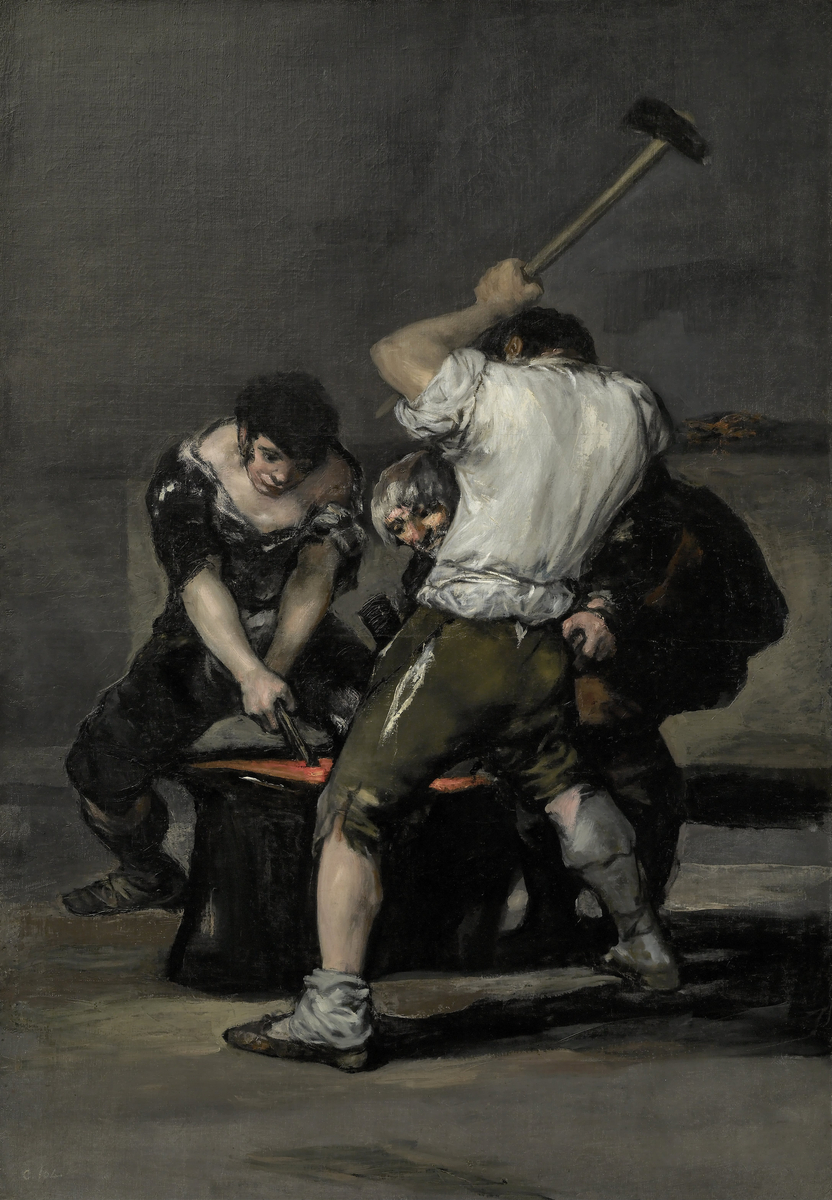
At the right, a standing man swings a long-handled sledgehammer. At the left, another man holds white-hot iron with tongs. Between them, a third head emerges from shadow, watching the work. The action is concentrated on the glowing metal and the anvil, and the three figures fill the dark space.
Goya made this painting late in his life, in the years after Spain's Peninsular War. The supplied record identifies the subject simply as working smiths, without naming any patron or specific event. Because the work is catalogued as genre art, its subject is the labour itself: the hammer, the tongs and the hot iron. It is not an illustration of a named story or a portrait of identifiable people.
The painting's power lies in how it makes that labour visible. The glow of the white-hot iron picks out the hands and faces of the smiths against the dark. The swing of the sledgehammer and the grip of the tongs show a shared rhythm. The third figure in shadow watches between them, so the scene includes both action and attention.
What stays with you is the closeness of the group and the heat of the work. Goya gives no heroic narrative, only the physical fact of making something at the anvil. Because the record is limited, we should not claim more than the painting shows. The Forge is a genre scene of three blacksmiths, and its meaning comes from that shared labour, not from an identified event or symbolic programme in the supplied evidence.
The story and its sources
Historical claims are linked to the records below. Close looking and interpretation are identified in the passage notes.
- Passage 1Documented historyWikimedia Commons: The Forge
- Passage 2Close lookingWikimedia Commons: The Forge
- Passage 3Documented historyWikimedia Commons: The Forge
- Passage 4InterpretationWikimedia Commons: The Forge
- Passage 5InterpretationWikimedia Commons: The Forge
Details to notice
About 2 minutes to readShadowed third smith
A third smith's head and face emerge from shadow between the two main workers, watching the iron closely and deepening the group's shared concentration.
White-hot iron on the anvil
The small glowing iron is the brightest point in the painting and anchors the workers' action. It sits between the tongs and the anvil's dark edge.
Smith holding the iron
The smith at left leans toward the anvil and grips the white-hot iron with tongs. His concentrated face, bare arms, and tool make this the clearest expression of coordinated labor.
Artist portrait Image credit
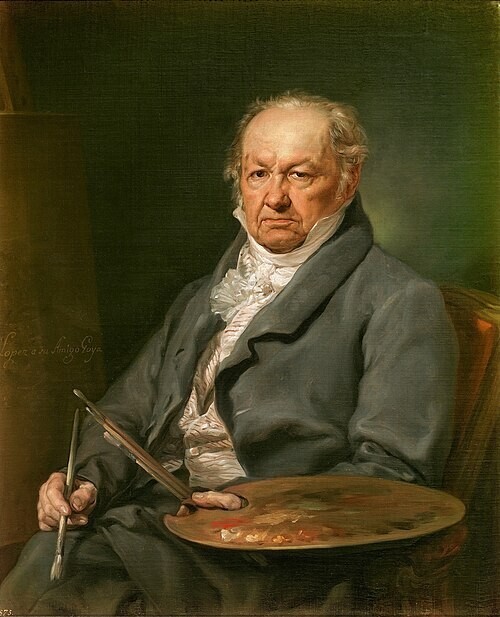
Vicente López Portaña. Image source · Public domain
About the artist
Francisco de Goya
30 March 1746 to 16 April 1828
Goya was a Spanish painter and printmaker whose career extended from royal tapestry designs and court portraiture to images of war, repression and unsettling fantasy. Born in Fuendetodos, he trained in Zaragoza and Madrid and became First Painter to Charles IV in 1799. He spent his final years in Bordeaux.
- Born
- 30 March 1746
- Died
- 16 April 1828
- Nationality
- Spanish
- Birthplace
- Fuendetodos, Spain
- Died in
- Bordeaux, France
The research & record
Study the work.
Follow the evidence.
Find catalogue details, historical context, technical research and the literature behind this artwork.
The artwork record
Research catalogue
Catalogue information and detailed research, with references that link to the bibliography.
Updated .
Identity and catalogue
Link- Title
- The Forge
- Artist or attribution
- Francisco Goya
- Object date
- circa 1815-1820
- Medium and support
- Oil on canvas
- Dimensions
- 181.6 x 125.1 cm
- Current collection or location
- The Frick Collection, New York City(Wikimedia Commons: The Forge, n.d.)
- Movement or period
- Romanticism (attributed broadly)
- Country or culture
- Spanish
- Depicted subject
- Three blacksmiths at work around an anvil: one standing at right swings a long-handled sledgehammer, one at left holds white-hot iron with tongs, and a third head emerges from shadow between them watching the work.
- Title variants
- La fragua
- Accession number
- 1914.1.65
- Support
- Canvas
Read valuation records and their limitations
Catalogue record and attribution
The painting is catalogued as The Forge (La fragua), attributed to Francisco Goya and dated to about 1815 to 1820. It is oil on canvas measuring 181.6 by 125.1 cm. The catalogue assigns it to genre art, defining its subject as a scene of ordinary working life rather than a historical or religious event. The date range belongs to the object's scholarly catalogue entry, not to any documentary record of completion, commission or delivery; the supplied evidence gives no inscription, signature reading or patron that would fix the work to a single year within that span. The Spanish title La fragua and the English The Forge are the recorded title forms, and the attribution to Goya is the catalogue attribution that accompanies the object data.(Wikimedia Commons: The Forge, n.d., File information, Artwork template; Object type, Genre)
The reproduction through which the painting is most widely encountered is a photograph credited to Google Arts and Culture, released as public domain under a Creative Commons Public Domain Mark. That rights status applies to the photographic surrogate, not to the painting as a physical object, and it explains how the image circulates in open-access contexts while the work itself remains a collection object. The catalogue data supplied here do not include the inscription, signature or accession text otherwise typical of a full museum entry, so the identity of the work rests on the title, attribution, medium, dimensions and subject classification given above.(Wikimedia Commons: The Forge, n.d., Permission)
The painting is titled The Forge (La fragua), by Francisco Goya, dated around 1815 to 1820, oil on canvas, 181.6 by 125.1 cm.(Wikimedia Commons: The Forge, n.d.)
The work is catalogued as genre art, a scene of ordinary working life rather than a historical or religious subject.(Wikimedia Commons: The Forge, n.d.)
The photographic reproduction of the painting is public domain under a Creative Commons Public Domain Mark, credited to Google Arts and Culture.(Wikimedia Commons: The Forge, n.d.)
Provenance and ownership
LinkRead valuation records and their limitations
Documented Ownership
The documented ownership of The Forge (La fragua) begins with Javier Goya, the son of the artist, and runs through a sequence of named holders, sales and agents before the painting reached New York. According to the object history recorded in the Frick Collection's catalogue material, the work passed from Javier Goya to purchase in 1836 by Baron Taylor and Adrien Dauzats, acting for the French government, and then to King Louis Philippe of France. This first documented stage thus connects the painting to a royal collection acquired through two named intermediaries, rather than to an unrecorded private holding.(Wikimedia Commons: The Forge, n.d., Object history, Collections)
The next documented transfer came at the Louis Philippe sale, held May 2 to 21, 1853, at Christie's, where the painting was offered as Lot 354 and sold to Henry Labouchere, afterward Lord Taunton. From Labouchere the work passed by inheritance to his grandson E.A.V. Stanley at Quantock Lodge, Bridgewater, Somerset, and then through Agnew. The record therefore distinguishes an 1853 auction purchase from a later family inheritance and from a subsequent passage through the dealer Agnew, without specifying dates for the inheritance or the Agnew transaction.(Wikimedia Commons: The Forge, n.d., Object history, Collections)
The final stage recorded in the supplied history is the twentieth-century acquisition: the painting was bought by Colnaghi and Knoedler in July 1914 and entered the Frick collection in 1914 as accession 1914.1.65, under the Henry Clay Frick Bequest. That accession number and bequest credit line identify the object within the Frick's holdings and are the identifiers a reader would use to locate it in the collection's records.(Wikimedia Commons: The Forge, n.d., Object history, Collections)
Interpretation
Taken together, the three provenance statements form a chain with clearly marked links but also with gaps. The 1836 purchase, the 1853 Christie's sale and the July 1914 purchase from Colnaghi and Knoedler are each dated transactions; the inheritance to E.A.V. Stanley and the passage through Agnew are recorded as events without dates in the supplied evidence. An unrecorded interval between two named holders should not be read as a proven change of ownership during that time, and the catalogue's sequence does not supply the missing dates or any intermediate owners. The account is best used as a framework of documented transfers rather than a continuous record of possession.(Wikimedia Commons: The Forge, n.d., Object history, Collections)
The recorded provenance runs from Javier Goya, son of the artist, to purchase in 1836 by Baron Taylor and Adrien Dauzats for the French government, then King Louis Philippe of France.(Wikimedia Commons: The Forge, n.d.)
At the Louis Philippe sale, held May 2 to 21, 1853, at Christie's, Lot 354, the painting sold to Henry Labouchere, afterward Lord Taunton. It passed by inheritance to his grandson E.A.V. Stanley at Quantock Lodge, Bridgewater, Somerset, then through Agnew.(Wikimedia Commons: The Forge, n.d.)
The painting was bought by Colnaghi and Knoedler in July 1914 and entered the Frick collection, accession 1914.1.65, in 1914 under the Henry Clay Frick Bequest.(Wikimedia Commons: The Forge, n.d.)
Provenance timeline
- 1836
Baron Taylor and Adrien Dauzats purchase the painting for the French government from Javier Goya, son of the artist.(Wikimedia Commons: The Forge, n.d., Object history, Collections)
- May 2 to 21, 1853
At the Louis Philippe sale held at Christie's, Lot 354, the painting sells to Henry Labouchere, afterward Lord Taunton.(Wikimedia Commons: The Forge, n.d., Object history, Collections)
- July 1914
The painting is bought by Colnaghi and Knoedler.(Wikimedia Commons: The Forge, n.d., Object history, Collections)
- 1914
The painting enters the Frick collection, accession 1914.1.65, under the Henry Clay Frick Bequest.(Wikimedia Commons: The Forge, n.d., Object history, Collections)
Collection and display
LinkRead valuation records and their limitations
Present Location and Accession
The Forge, catalogued under its Spanish title La fragua, is held by The Frick Collection in New York City under accession number 1914.1.65, with the credit line Henry Clay Frick Bequest. The collection record lists it as on view in the East Gallery, room 119. These particulars establish the painting's present institutional home and its public accessibility, and they anchor the object in a documented collection rather than in a dispersed or unknown location. Because the Frick record is the source for this information, the account of location and status should be understood as current institutional documentation, subject to change as galleries are reinstalled.(Wikimedia Commons: The Forge, n.d., Collection, Current location, Accession number, Credit line)
Provenance and Transfers
The documented provenance traced in the record begins with Javier Goya, son of the artist. In 1836 the painting was purchased from him by Baron Taylor and Adrien Dauzats on behalf of the French government, after which it passed to King Louis Philippe of France. At the Louis Philippe sale, held May 2 to 21, 1853, at Christie's as Lot 354, the painting sold to Henry Labouchere, afterward Lord Taunton. It then passed by inheritance to his grandson E.A.V. Stanley at Quantock Lodge, Bridgewater, Somerset, and subsequently through the dealer Agnew. In July 1914 it was bought by Colnaghi and Knoedler and entered the Frick collection that same year. This chain is consequential for the object's history: it documents a movement from the artist's family in Spain, through a state purchase in France and a royal collection, into British private hands by sale and inheritance, and finally into the American market and a New York collection on the eve of the First World War. Each transfer is recorded as a discrete transaction or inheritance rather than a continuous narrative, and the record does not supply intervening owners or dates beyond those named.(Wikimedia Commons: The Forge, n.d., Collection, Current location, Accession number, Credit line)
The painting belongs to The Frick Collection in New York City, accession number 1914.1.65, with a credit line of Henry Clay Frick Bequest, and is recorded as on view in the East Gallery (room 119).(Wikimedia Commons: The Forge, n.d.)
Documented values and qualified estimates
LinkRead valuation records and their limitations
Provenance as value evidence
Interpretation
The only valuation figure in the supplied evidence is a calculated working insurance estimate of US$50M to US$150M, recorded as a working calculation generated 2026-11-16. The record states its methodology explicitly: it is a broad, conservative range prepared for manual review, derived only from the confirmed context and the supplied source record. It reflects five factors: Goya's major historical standing as a canonical figure of Spanish and European art; the circa 1815-1820 date range placing the work in his late mature period; oil on canvas at a substantial scale of 181.6 x 125.1 cm; the Frick holding with accession 1914.1.65 and the long, stable museum history implied by the documented provenance from Javier Goya through the French royal collection and the 1853 Louis Philippe sale to Henry Clay Frick in 1914; and the scarcity of comparable Goya oil paintings on the open market, which for an institutional masterpiece would normally be effectively non-market. Because the context is museum-held and no auction, appraisal or insurance data were supplied, the range is intentionally wide and conservative; no comparable sales were invented and no private records were accessed. The figure is not derived from a specific market transaction.(Wikimedia Commons: The Forge, n.d.)
Limits of the valuation
The qualifications attached to that figure are as consequential as the figure itself. The range is described as model-generated and for manual review only; it is not an official insurance value, appraisal, auction estimate, auction result or sale price, and it should not be used to bind coverage or settle any claim. It has not been verified by The Frick Collection, an appraiser or an insurer, and it does not reflect any private insurance schedule or confidential market data. The record further notes that actual insurance values for a museum-held Goya of this significance depend on condition, provenance, exhibition history, replacement-cost considerations and policies specific to the institution, none of which are known in the supplied material. The recommendation is to verify all details against the institution's records and consult a qualified fine art appraiser before relying on any figure.(Wikimedia Commons: The Forge, n.d.)
Read together, the two kinds of evidence work at different levels. The object record establishes what the painting is, where it has been and where it now hangs; the valuation record establishes only an order-of-magnitude starting point built from those same confirmed facts, explicitly excluding the condition, exhibition and insurance-schedule information on which a real appraisal would turn. The wide spread of the range and the insistence that no market transaction underlies it are consistent with the status the provenance describes: a work that moved through named owners and public sale in the nineteenth century but has been institutionally held since 1914. Any account of the painting's worth should therefore distinguish the securely documented history from the provisional, unverified arithmetic, and treat the latter as a prompt for professional review rather than as a finding about the object.(Wikimedia Commons: The Forge, n.d.)
Working estimate
Calculated working insurance estimate, not a sale price: Estimated value: US$50M to US$150M Recorded date: Working calculation, generated 2026-11-16. Methodology: This is a broad, conservative working range prepared for manual review, derived only from the confirmed context and the supplied source record. It reflects: (1) the artist's major historical standing as Francisco Goya, a canonical figure of Spanish and European art; (2) the date range circa 1815-1820, placing the work in his late mature period; (3) oil on canvas at a substantial scale of 181.6 x 125.1 cm; (4) the work being held in The Frick Collection, New York, accession 1914.1.65, with a documented provenance running from Javier Goya through the French royal collection and the 1853 Louis Philippe sale to Henry Clay Frick in 1914, which supports a long, stable museum history; and (5) the scarcity of comparable Goya oil paintings on the open market, which for an institutional masterpiece would normally be effectively non-market. Because the context is museum-held and no auction, appraisal, or insurance data were supplied, the range is intentionally wide and conservative. No comparable sales were invented and no private records were accessed. The figure is not derived from a specific market transaction and should be treated only as an order-of-magnitude starting point for a qualified fine art insurance professional. Qualification: This is a model-generated working range for manual review only. It is not an official insurance value, appraisal, auction estimate, auction result, or sale price, and it should not be used to bind coverage or settle any claim. It has not been verified by The Frick Collection, an appraiser, or an insurer, and it does not reflect any private insurance schedule or confidential market data. Actual insurance values for a museum-held Goya of this significance depend on condition, provenance, exhibition history, replacement-cost considerations, and policies specific to the institution, which are not known here. Verify all details against the institution's records and consult a qualified fine art appraiser before relying on any figure.(Wikimedia Commons: The Forge, n.d.)
Further reading
Books for a closer look
Paid links. As an Amazon Associate I earn from qualifying purchases.

Open Library Goya
Kodansha International
Catalogued under Francisco Goya with subjects including Catalogues raisonnés, Criticism and interpretation, Romanticism, and Human beings in art, this is the strongest available candidate for scholarly study of Goya's paintings, the category to which The Forge belongs as a genre scene of ordinary working life.
ISBN 0870110837
Bibliography
Sources and further reading
References are arranged by author or organisation, with links to the original publications. Where no publication date is recorded, n.d. means no date.
Source notes updated .
No recorded sources match these filters. Reset the filters to see the full bibliography.
- 02
Book
Goya. Kodansha International.
Catalogued under Francisco Goya with subjects including Catalogues raisonnés, Criticism and interpretation, Romanticism, and Human beings in art, this is the strongest available candidate for scholarly study of Goya's paintings, the category to which The Forge belongs as a genre scene of ordinary working life.
- ISBN
- 0870110837
Citation text
- 03
Book
Francisco Goya - the Paintings. Independently Published.
Titled Francisco Goya - the Paintings and attributed to Goya in the catalogue, this record bears directly on the artist's painted work, the medium and maker of The Forge. Its exact contents are not recorded here, so relevance rests on title and artist attribution only.
- ISBN
- 9781521566466
Citation text
- 01
Secondary · About this artwork
Wikimedia Commons: The Forge (n.d.). File:Francisco Goya y Lucientes, de - La fragua - Google Art Project.jpg. Wikimedia Commons.
Wikimedia Commons file record for The Forge, containing object template data, provenance list and Google Arts and Culture image credit, citing The Frick Collection as source.
- Language
- en
Citation text
Art to live with
Bring this painting
home.
A piece of the archive, made yours. Explore The Forge in a size and finish that fits your space.
Your text and annotations appear on these editions. Adding to cart saves that design for printing.
Combine this painting with your favourites01 / Find your edition
Made for you
Suggested from your location. Change it if you're sending elsewhere or using a VPN. Prices and delivery are shown in GBP.
19 products
Choose an edition to make it yours
6 × 8 in · Printed cover · 118 lined pages
6 × 8 in · Printed cover · 118 lined pages
6 × 8 in · Printed cover · 118 lined pages
Notebook
GBP 12.03
Delivery GBP 5.35 / Total GBP 17.38
A 6 × 8 inch spiral notebook with 118 ruled pages (59 sheets), a printed front cover, dark grey back cover and metal spiral binding.
Fit and fill keep the painting’s proportions. Stretch changes them.
Move and zoom the painting on your notebook.
Made to order with your design
Made to order
US delivery only
50.8 × 76.2 cm / 20 × 30 in · Standard
50.8 × 76.2 cm / 20 × 30 in · Standard

20 × 30 in / 50.8 × 76.2 cm · Standard

20 × 30 in / 50.8 × 76.2 cm · Standard

20 × 30 in / 50.8 × 76.2 cm · Standard

20 × 30 in / 50.8 × 76.2 cm · Standard

20 × 30 in / 50.8 × 76.2 cm · Standard
Metal art sign
GBP 64.37
Delivery GBP 20.91 / Total GBP 85.28
A printed aluminium sign with rounded corners and mounting holes.
Fit and fill keep the painting’s proportions. Stretch changes them.
Move and zoom the painting on your metal art sign.
Made to order with your design
Printed aluminium · mounting holes included
US delivery only
iPhone 12 Mini ? Glossy ? back view
iPhone 12 Mini · Glossy

iPhone 12 Mini ? Glossy ? back view

iPhone 12 Mini ? Glossy ? back view

iPhone 12 Mini ? Glossy ? back view
Tough phone case
GBP 16.56
Delivery GBP 4.28 / Total GBP 20.84
A two-layer phone case with a printed polycarbonate shell and a shock-absorbing inner liner.
Two layers with a shock-absorbing TPU liner
Case & print details
- Device
- Apple · iPhone 12 Mini
- Material
- Polycarbonate shell with a TPU inner liner
- Artwork
- Outer back and wrapped edges from one template
- Finish
- Glossy
- Version
- Standard version
- Printing
- Dye sublimation
- Print file
- 1,122 × 1,831 px · 95 × 155 mm · PNG · 300 dpi recommended
Rear outline and camera openings follow this variant's Printify template. Case depth and small hardware remain illustrative.
Supplier product detailsFit and fill keep the painting’s proportions. Stretch changes them.
Move and zoom the painting on your tough phone case.
Made to order with your design
Made to order
US delivery only
30.4 × 40.6 cm / 12 × 16 in · Black
30.4 × 40.6 cm / 12 × 16 in · Black

12 × 16 in / 30.4 × 40.6 cm · Black

12 × 16 in / 30.4 × 40.6 cm · Black

12 × 16 in / 30.4 × 40.6 cm · Black

12 × 16 in / 30.4 × 40.6 cm · Black
Framed art print
GBP 53.41
- 1 framed print
- GBP 53.41
- Delivery to United States
- GBP 14.31
- Total
- GBP 67.72
A ready-to-hang wooden frame with a clear Perspex cover and a semi-gloss printed insert.
Delivery is quoted for all selected copies together.
Fit and fill keep the painting’s proportions. Stretch changes them.
Move and zoom the painting on your framed art print.
Made to order with your design
Wooden frame & protective clear front included
US delivery only
38.1 × 40.6 cm / 15 × 16 in · Natural
38.1 × 40.6 cm / 15 × 16 in · Natural

15 × 16 in / 38.1 × 40.6 cm · Natural

15 × 16 in / 38.1 × 40.6 cm · Natural

15 × 16 in / 38.1 × 40.6 cm · Natural

15 × 16 in / 38.1 × 40.6 cm · Natural

15 × 16 in / 38.1 × 40.6 cm · Natural
Canvas tote bag
GBP 14.40
Delivery GBP 4.38 / Total GBP 18.78
A sturdy cotton canvas tote with reinforced handles and artwork on the front panel.
Fit and fill keep the painting’s proportions. Stretch changes them.
Move and zoom the painting on your canvas tote bag.
Made to order with your design
Front print · reinforced cotton handles
US delivery only
22.9 × 20.3 cm / 9 × 8 in · Standard
22.9 × 20.3 cm / 9 × 8 in · Standard

9 × 8 in / 22.9 × 20.3 cm · Standard

9 × 8 in / 22.9 × 20.3 cm · Standard

9 × 8 in / 22.9 × 20.3 cm · Standard

9 × 8 in / 22.9 × 20.3 cm · Standard
Mouse mat
GBP 7.36
Delivery GBP 4.87 / Total GBP 12.23
A rectangular fabric mouse mat with a rubber backing and rounded corners.
Fit and fill keep the painting’s proportions. Stretch changes them.
Move and zoom the painting on your mouse mat.
Made to order with your design
Made to order
US delivery only
See more13 more products
43.2 × 45.7 cm / 17 × 18 in · Artwork
43.2 × 45.7 cm / 17 × 18 in · Artwork

17 × 18 in / 43.2 × 45.7 cm · Artwork

17 × 18 in / 43.2 × 45.7 cm · Artwork

17 × 18 in / 43.2 × 45.7 cm · Artwork
Woven tote bag
GBP 47.33
Delivery GBP 5.94 / Total GBP 53.27
A woven tote with cotton webbing handles and the painting translated into a woven design.
Fit and fill keep the painting’s proportions. Stretch changes them.
Move and zoom the painting on your woven tote bag.
Made to order with your design
Made to order
US delivery only
27.9 × 40.6 cm / 11 × 16 in · Standard
27.9 × 40.6 cm / 11 × 16 in · Standard

11 × 16 in / 27.9 × 40.6 cm · Standard

11 × 16 in / 27.9 × 40.6 cm · Standard

11 × 16 in / 27.9 × 40.6 cm · Standard

11 × 16 in / 27.9 × 40.6 cm · Standard

11 × 16 in / 27.9 × 40.6 cm · Standard
Matte art print
GBP 12.96
Delivery GBP 7.29 / Total GBP 20.25
An unframed matte poster with archival inks, ready for a frame of your choice.
Fit and fill keep the painting’s proportions. Stretch changes them.
Move and zoom the painting on your matte art print.
Made to order with your design
Unframed · frame it your way
US delivery only
iPhone 12 Mini ? Standard ? back view
iPhone 12 Mini · Standard

iPhone 12 Mini ? Standard ? back view

iPhone 12 Mini ? Standard ? back view

iPhone 12 Mini ? Standard ? back view
Flexible phone case
GBP 15.76
Delivery GBP 4.28 / Total GBP 20.04
A flexible TPU phone case with a frosted finish, a printed back and precise port openings.
Flexible TPU with a frosted, matte finish
Case & print details
- Device
- Apple · iPhone 12 Mini
- Material
- Semi-transparent thermoplastic polyurethane (TPU)
- Artwork
- Back print; rim stays unprinted
- Finish
- Standard
- Version
- Standard version
- Printing
- Dye sublimation
- Print file
- 791 × 1,586 px · 67 × 134.3 mm · PNG · 300 dpi recommended
Rear outline and camera openings follow this variant's Printify template. Case depth and small hardware remain illustrative.
Supplier product detailsFit and fill keep the painting’s proportions. Stretch changes them.
Move and zoom the painting on your flexible phone case.
Made to order with your design
Made to order
S · Standard
S · Standard

S · Standard

S · Standard

S · Standard

S · Standard

S · Standard
Crew socks
GBP 10.78
Delivery GBP 4.49 / Total GBP 15.27
Crew-length polyester and spandex socks with a ribbed cuff, cushioned sole and sublimated artwork.
Fit and fill keep the painting’s proportions. Stretch changes them.
Move and zoom the painting on your crew socks.
Made to order with your design
One pair · design repeated on both socks
US delivery only
12" · Standard
12" · Standard

12" · Standard

12" · Standard

12" · Standard
Laptop sleeve
GBP 26.36
Delivery GBP 4.96 / Total GBP 31.32
A polyester laptop sleeve with a fleece lining, top zip, printed front and black reverse.
Fit and fill keep the painting’s proportions. Stretch changes them.
Move and zoom the painting on your laptop sleeve.
Made to order with your design
Made to order
US delivery only
11oz · 2 image repeats
11oz · White
11oz · 2 image repeats
Mug
GBP 7.42
Delivery GBP 6.23 / Total GBP 13.65
A glossy white ceramic mug with a C-shaped handle, available in 11oz and 15oz sizes.
repeat layout · choose single, double or a repeating pattern in Customise.
Repeat, fit, fill and position your artwork around the mug.
Made to order with your design
Made to order
iPhone 12 Mini ? Standard ? back view
iPhone 12 Mini · Standard

iPhone 12 Mini ? Standard ? back view

iPhone 12 Mini ? Standard ? back view

iPhone 12 Mini ? Standard ? back view

iPhone 12 Mini ? Standard ? back view

iPhone 12 Mini ? Standard ? back view
Biodegradable phone case
GBP 21.19
Delivery GBP 4.28 / Total GBP 25.47
A matte phone case made from plant polymers and bamboo fibre, with the artwork printed on the back.
Flexible plant-polymer shell with a matte finish
Case & print details
- Device
- Apple · iPhone 12 Mini
- Material
- PLA and PBAT polymers with bamboo fibre
- Artwork
- Back print; rim stays unprinted
- Finish
- Standard
- Version
- Standard version
- Printing
- Dye sublimation
- Print file
- 777 × 1,553 px · 65.8 × 131.5 mm · PNG · 300 dpi recommended
Rear outline and camera openings follow this variant's Printify template. Case depth and small hardware remain illustrative.
Supplier product detailsFit and fill keep the painting’s proportions. Stretch changes them.
Move and zoom the painting on your biodegradable phone case.
Made to order with your design
Made to order
20.3 × 30.5 cm / 8 × 12 in · Standard
20.3 × 30.5 cm / 8 × 12 in · Standard

8 × 12 in / 20.3 × 30.5 cm · Standard

8 × 12 in / 20.3 × 30.5 cm · Standard

8 × 12 in / 20.3 × 30.5 cm · Standard
Fine art poster
GBP 13.03
Delivery GBP 7.69 / Total GBP 20.72
A gallery paper print with a smooth art-paper surface. Choose a size that suits the painting.
Fit and fill keep the painting’s proportions. Stretch changes them.
Move and zoom the painting on your fine art poster.
Made to order with your design
Unframed · frame it your way
iPhone 12 Mini ? Standard ? back view
iPhone 12 Mini · Standard

iPhone 12 Mini ? Standard ? back view

iPhone 12 Mini ? Standard ? back view

iPhone 12 Mini ? Standard ? back view
Clear phone case
GBP 15.28
Delivery GBP 4.28 / Total GBP 19.56
A clear phone case with artwork on the back. Leave areas transparent to show the phone underneath.
Clear shell with shock-absorbing TPU sides
Case & print details
- Device
- Apple · iPhone 12 Mini
- Material
- Polycarbonate back and clear TPU sides
- Artwork
- Back print; clear sides stay unprinted
- Finish
- Standard
- Version
- Standard version
- Printing
- Dye sublimation
- Print file
- 732 × 1,527 px · 62 × 129.3 mm · PNG · 300 dpi recommended
Rear outline and camera openings follow this variant's Printify template. Case depth and small hardware remain illustrative.
Supplier product detailsFit and fill keep the painting’s proportions. Stretch changes them.
Move and zoom the painting on your clear phone case.
Made to order with your design
Made to order
15oz · 3 image repeats
15oz · Standard

15oz · 3 image repeats

15oz · 3 image repeats

15oz · 3 image repeats

15oz · 3 image repeats

15oz · 3 image repeats
Travel mug
GBP 32.33
Delivery GBP 5.75 / Total GBP 38.08
A stainless-steel travel mug with a black lid, a tapered base and a printed white exterior.
repeat layout · choose single, double or a repeating pattern in Customise.
Repeat, fit, fill and position your artwork around the mug.
Made to order with your design
Made to order
US delivery only
2.5 × 3.4 cm / 1 × 1.4 in · Glossy
2.5 × 3.4 cm / 1 × 1.4 in · Glossy

1 × 1.4 in / 2.5 × 3.4 cm · Glossy

1 × 1.4 in / 2.5 × 3.4 cm · Glossy

1 × 1.4 in / 2.5 × 3.4 cm · Glossy

1 × 1.4 in / 2.5 × 3.4 cm · Glossy
Photo keyring
GBP 10.30
Delivery GBP 5.45 / Total GBP 15.75
A rectangular zinc-alloy photo keyring with a glossy insert and a swivel split ring.
Fit and fill keep the painting’s proportions. Stretch changes them.
Move and zoom the painting on your photo keyring.
Made to order with your design
Photo insert · zinc frame & swivel ring
US delivery only
iPhone 15 Pro ? Glossy ? back view
iPhone 15 Pro · Glossy

iPhone 15 Pro ? Glossy ? back view

iPhone 15 Pro ? Glossy ? back view

iPhone 15 Pro ? Glossy ? back view

iPhone 15 Pro ? Glossy ? back view

iPhone 15 Pro ? Glossy ? back view
Slim phone case
GBP 16.53
Delivery GBP 5.85 / Total GBP 22.38
A slim printed phone shell with open ports and a lightweight profile.
Slim, lightweight polycarbonate shell
Case & print details
- Device
- Apple · iPhone 15 Pro
- Material
- Polycarbonate
- Artwork
- Outer back and wrapped edges from one template
- Finish
- Glossy
- Version
- Standard version
- Printing
- Dye sublimation
- Print file
- 1,278 × 1,971 px · 108.2 × 166.9 mm · PNG · 300 dpi recommended
Rear outline and camera openings follow this variant's Printify template. Case depth and small hardware remain illustrative.
Supplier product detailsFit and fill keep the painting’s proportions. Stretch changes them.
Move and zoom the painting on your slim phone case.
Made to order with your design
Made to order
US delivery only
36.6 × 30.7 cm / 14.4 × 12.1 in · Standard
36.6 × 30.7 cm / 14.4 × 12.1 in · Standard

14.4 × 12.1 in / 36.6 × 30.7 cm · Standard

14.4 × 12.1 in / 36.6 × 30.7 cm · Standard

14.4 × 12.1 in / 36.6 × 30.7 cm · Standard
Desk mat
GBP 15.17
Delivery GBP 7.21 / Total GBP 22.38
A smooth polyester desk mat with a natural rubber non-slip base and anti-fray edges, available in three sizes.
Fit and fill keep the painting’s proportions. Stretch changes them.
Move and zoom the painting on your desk mat.
Made to order with your design
Made to order
The 30 cm ruler is scaled alongside your selected print. Keep the painting’s proportions with a black background, or stretch it to fill. Frame width, material texture and screen colours are illustrative.
Keep exploring