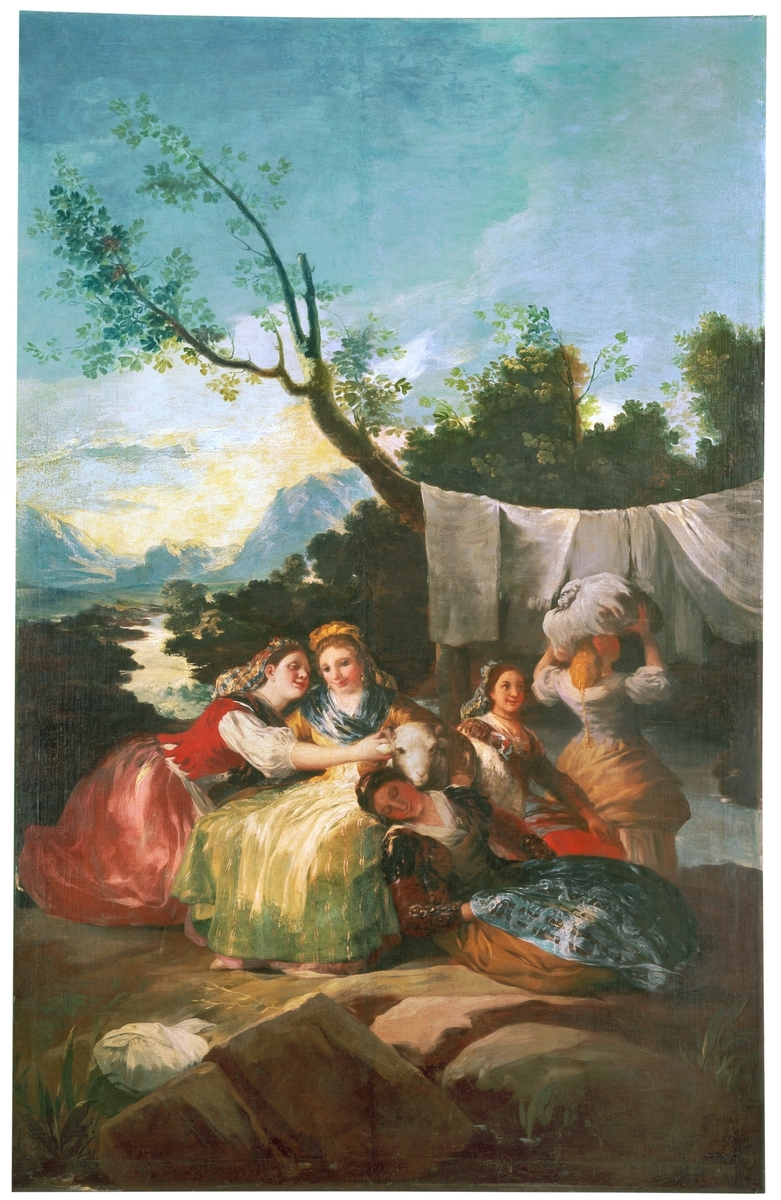
The Flower Girls (Las floreras)
Artist: Francisco de Goya · 1786-1787

The Flower Girls (Las floreras): high-resolution image
The original file is hosted by Wikimedia Commons, available without payment or an account.
Open high-resolution image on Wikimedia CommonsThe complete story
The story About 4 minutes to read
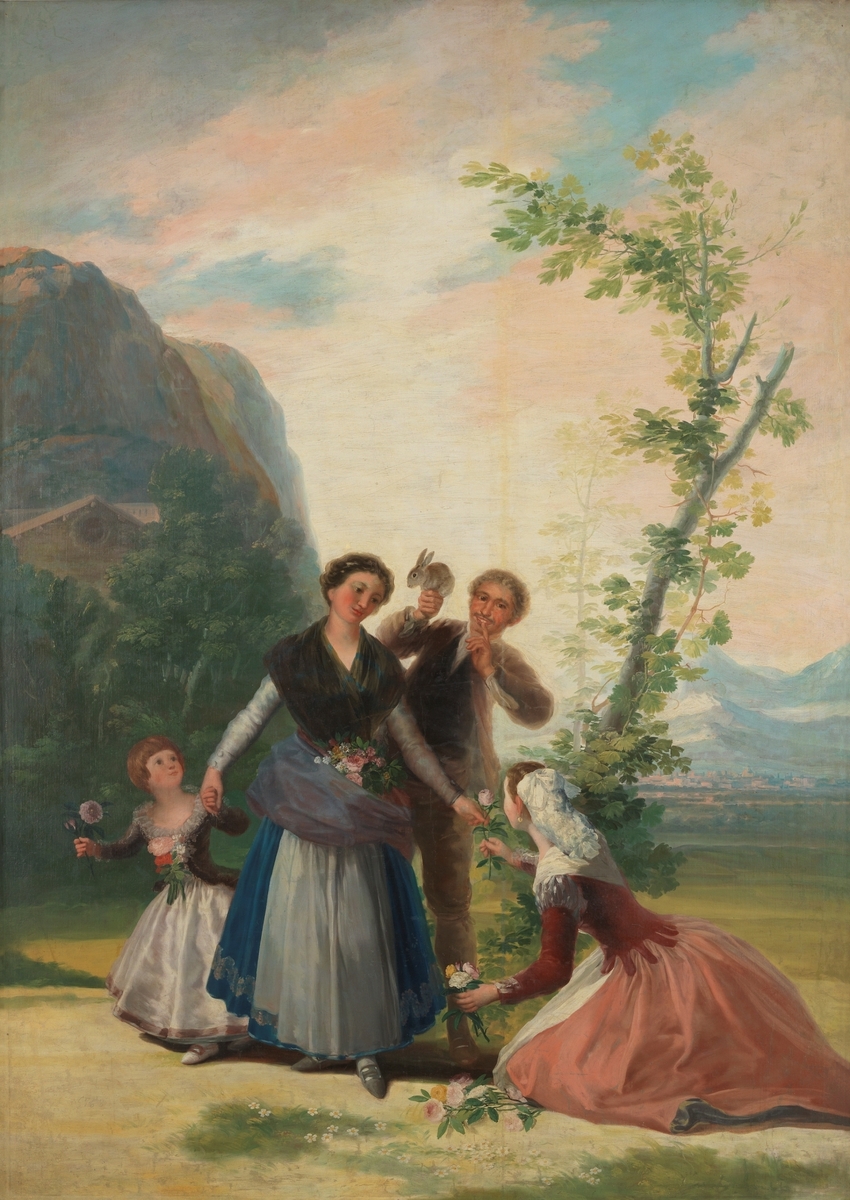
This is Goya's design for a tapestry, not a finished wall hanging. It was painted as a cartoon for a series on the four seasons, meant to decorate the king's conversation room at the palace of El Pardo. The scene shows two women carrying flowers. One sits on the ground with her back to us, while the other leads a young girl by the hand.
Behind the women stands a man holding up a hare. His finger is raised to his lips, asking for silence. He is about to play a practical joke on the standing woman. The figures settle into a clear pyramid shape. That gives the group a steady, balanced outline even though the action is a prank.
The faces carry the mood. Goya worked carefully on them, giving the man a wide grin and the flower girl a daydreaming gaze. That contrast is where the painting breathes. The silent prank and the absorbed springtime gaze sit side by side, and the comedy depends on the woman not seeing what we can see.
The spring subject is built into the composition. Right at the centre, where two diagonal lines cross, sits a flower, and that flower is read as the symbol of spring. The series is why the painting has also been called Spring. Flowers, fresh countryside and the lively colour all belong to that seasonal idea.
The hare adds another layer. Nordström has read the rabbit as a symbol of fertility, and so of spring itself. Tomlinson takes the reading further, linking the flower with the goddess Venus and the girl with youth and the rebirth of spring. These are scholarly interpretations, not inscriptions in the work.
This is the most traditional and Rococo of the works Goya made for El Pardo. Its delicacy, countryside theme, varied colour and natural elements give it a lighter, more decorative character than some of his other cartoons. It was painted between May 1786, shortly after Goya was named royal painter, and the end of 1787.
The finished tapestry was intended for the south wall of the king's conversation room, flanking a door with its pair, The Grape Harvest, or Autumn. That plan changed after Charles the Third died in 1788. The group was spread through rooms at El Escorial instead. So what you see is a design whose intended setting never quite happened.
The story and its sources
Historical claims are linked to the records below. Close looking and interpretation are identified in the passage notes.
- Passage 1Documented historyInstitutional record for The Flower Girls (Las floreras)
- Passage 2Close lookingInstitutional record for The Flower Girls (Las floreras)
- Passage 3InterpretationInstitutional record for The Flower Girls (Las floreras)
- Passage 4InterpretationInstitutional record for The Flower Girls (Las floreras)
- Passage 5InterpretationInstitutional record for The Flower Girls (Las floreras)
- Passage 6InterpretationInstitutional record for The Flower Girls (Las floreras)
- Passage 7Documented historyInstitutional record for The Flower Girls (Las floreras)
Details to notice
About 3 minutes to readMountain and estate
A sheer rock face and a small stone house among trees rise at the left, placing the figures in a dramatic rural setting and opening the composition toward the distant valley.
Child with flowers
At the left, a small child in a pale dress looks upward and holds out a small bunch of flowers, adding a second youthful flower bearer and balancing the kneeling figure.
Kneeling flower girl
A young woman in a pink skirt and white headscarf kneels in the foreground, extending one flower upward while another loose bunch rests near her lap. Her offering connects her directly to the central woman.
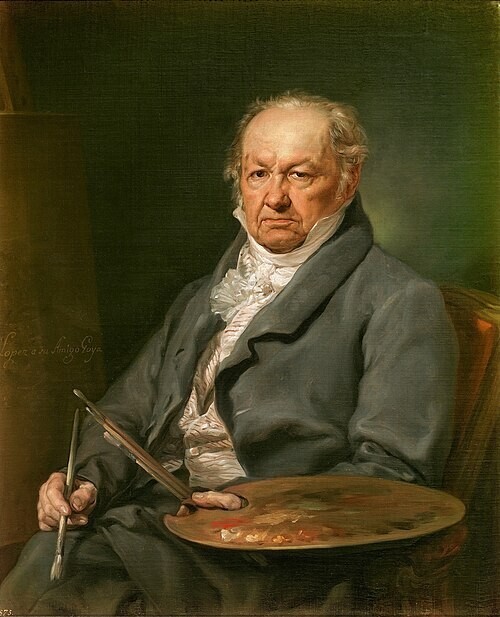
Artist portrait Image credit
Vicente López Portaña. Image source · Public domain
About the artist
Francisco de Goya
30 March 1746 to 16 April 1828
Goya was a Spanish painter and printmaker whose career extended from royal tapestry designs and court portraiture to images of war, repression and unsettling fantasy. Born in Fuendetodos, he trained in Zaragoza and Madrid and became First Painter to Charles IV in 1799. He spent his final years in Bordeaux.
- Born
- 30 March 1746
- Died
- 16 April 1828
- Nationality
- Spanish
- Birthplace
- Fuendetodos, Spain
- Died in
- Bordeaux, France
The research & record
Study the work.
Follow the evidence.
Find catalogue details, historical context, technical research and the literature behind this artwork.
The artwork record
Research catalogue
Catalogue information and detailed research, with references that link to the bibliography.
Updated .
Identity and catalogue
Link- Title
- The Flower Girls (Las floreras)
- Artist or attribution
- Francisco de Goya
- Object date
- 1786-1787
- Medium and support
- Oil on canvas(Fundación Goya en Aragón, n.d.)
- Dimensions
- 277 x 192 cm
- Current collection or location
- Museo Nacional del Prado, Madrid, Spain
- Movement or period
- Rococo, tapestry cartoon
- Country or culture
- Spain
- Depicted subject
- A spring allegory painted as a tapestry cartoon for the king's conversation room at the palace of El Pardo. Two women carry flowers. One sits on the ground with her back to us, while the other leads a young girl by the hand. Behind them a man holds up a hare and raises a finger to his lips, asking for silence before a practical joke on the standing woman.
- Title variants
- Spring (La primavera); Las floreras o La Primavera; The Flower Girls or Spring(Fundación Goya en Aragón, n.d.)
- Attribution qualification
- Documented work by Goya per the Fundación Goya en Aragón record.
- Accession number
- P00793(Fundación Goya en Aragón, n.d.)(Wikimedia Commons: The Flower Girls (Las floreras), n.d.)
- Support
- Canvas
Read valuation records and their limitations
Titles, attribution and physical record
The object is a tapestry cartoon, an oil painting on canvas measuring 277 by 192 centimetres, now held at the Museo Nacional del Prado, Madrid, under inventory number P00793. Its principal catalogue title is The Flower Girls, and the institutional record notes that it has also been known as Spring, since it belongs to the series of cartoons representing the four seasons. The title variants are not rival claims about the subject but two ways of naming the same composition: one derived from the figures and their activity, the other from the seasonal programme of the series to which the canvas belongs.(Fundación Goya en Aragón, n.d., Análisis artístico)
Later documentation and museum record
The institutional record also situates the work in the literature and in exhibition history. It has been catalogued in studies by Desparmet Fitz-Gerald, Sambricio, Nordström, Gassier and Wilson, Gudiol Ricart, Angelis, Camón Aznar, Bozal, Arnaiz, Tomlinson, Luna and López Vázquez. It was shown in Goya. 250 Aniversario at the Museo Nacional del Prado in 1996, catalogue number 35; in Goya y el infante don Luis: el exilio y el reino at the Palacio Real, Madrid, in 2012, catalogue number 48; and in Goya en Madrid. Cartones para tapices 1775-1794 at the Museo Nacional del Prado in 2014. The exhibition entries carry catalogue numbers, whereas the 2014 inclusion is recorded without one in the supplied evidence.(Fundación Goya en Aragón, n.d., Análisis artístico)
The work has also been known as Spring and belongs to the series of cartoons representing the four seasons.(Fundación Goya en Aragón, n.d.)
Subject and iconography
LinkRead valuation records and their limitations
The recorded composition
Visual observation
The institutional record describes a composition built around two women carrying flowers: one sits on the ground with her back turned to the viewer, while the other takes a young girl by the hand. Behind them stands a man holding up a hare, his finger raised to his lips in a gesture for silence, explained in the record as a signal that he is about to play a practical joke on the standing woman. These are recorded observations of the painted surface rather than inscriptions or documents within the work, and the record treats the joke as the narrative situation the gestures establish rather than as a caption the painting supplies. The painting is oil on canvas, 277 by 192 centimetres, held at the Museo Nacional del Prado, Madrid, under inventory number P00793.(Fundación Goya en Aragón, n.d., Análisis artístico; Datos Generales)
The record characterises the group as forming a clear pyramid-shaped composition. Read together with the figures described, the arrangement places the seated woman, the standing woman and child, and the man with the hare into a stable triangular mass, so that the stillness of the outline holds a scene whose content is a prank in progress. The record also notes the care Goya took over the faces to reflect the characters' moods, giving the man a wide grin and the flower girl a daydreaming gaze. That contrast between the grinning prankster and the absorbed woman is an observation about painted expression, and it depends structurally on the man gesturing for silence: the comedy works because the standing woman does not see what the viewer sees.(Fundación Goya en Aragón, n.d., Análisis artístico)
Seasonal iconography and attributed readings
The record identifies the subject as seasonal and notes that the work has also been known as Spring, belonging to the series of cartoons representing the four seasons. Its account of the iconography places a flower right at the centre of the composition, where the two diagonal lines cross, and reads that flower as the symbol of spring. The hare is given a further symbolic layer attributed to Nordström, who states that the rabbit is a symbol of fertility and therefore of spring. Tomlinson is said to extend the springtime reading by associating the flower with the goddess Venus and the girl with youth and the rebirth of spring. These are scholarly interpretations attributed to named authors, not features the painting inscribes; the central flower and the crossing diagonals are recorded as visible arrangement, while the Venus association and the fertility reading are readings layered onto that arrangement.(Fundación Goya en Aragón, n.d., Análisis artístico)
The record's bibliography shows the painting has been catalogued repeatedly in studies by Desparmet Fitz-Gerald, Sambricio, Nordström, Gassier and Wilson, Gudiol Ricart, Angelis, Camón Aznar, Bozal, Arnaiz, Tomlinson, Luna and López Vázquez. The named interpretive readings in the record, Nordström on the hare and Tomlinson on Venus and the girl, thus belong to a substantial catalogue literature rather than to isolated remarks. Because the record attributes those readings without reproducing their arguments, they should be cited as attributed interpretations in that literature and not restated as settled findings about the painting's meaning.(Fundación Goya en Aragón, n.d., Bibliografía; Análisis artístico)
Two women carry flowers. One sits on the ground with her back to us, while the other takes a young girl by the hand.(Fundación Goya en Aragón, n.d.)
Behind the women stands a man holding up a hare, gesturing for silence with his finger over his mouth so as not to spoil the practical joke he is about to play on the woman who is standing.(Fundación Goya en Aragón, n.d.)
The figures form a clear pyramid-shaped composition.(Fundación Goya en Aragón, n.d.)
Historical context
LinkRead valuation records and their limitations
The commission and the room at El Pardo
The Flower Girls is a tapestry cartoon from the series The Four Seasons, designed for the decoration of the king's conversation room in the palace of El Pardo. Within that scheme the cartoon had a specific and paired position: the tapestry woven from it would have hung on the south wall of the king's conversation room at El Pardo, flanking a door together with its counterpart, The Grape Harvest or Autumn. The pairing is the clearest evidence that the series was conceived as an integrated decorative programme rather than a set of independent pictures, with the seasons distributed around the room's openings and walls. The commission therefore belongs to the world of the royal household and its tapestry enterprise, where painted designs were made to be translated into woven hangings for the king's own apartments.(Fundación Goya en Aragón, n.d., Historia; Análisis artístico)
The chronology of the series is fixed by the documentation. The cartoons were painted between May 1786, shortly after Goya was named royal painter, and the end of 1787, so the appointment and the seasonal series are close in time. A carpenter's account from the second half of November 1786 lists stretchers for six pieces: the four seasons together with The Injured Mason and Poor Children at the Well. That account shows the group already physically underway in the workshop by late 1786 and places The Flower Girls within a slightly larger batch of works than the four seasons alone, evidence of how the commission was being handled in practice rather than only how it was later described as a series.(Fundación Goya en Aragón, n.d., Historia)
Scholarship and the object's place in a history of tapestry design
Interpretation
The work has been catalogued in studies by Desparmet Fitz-Gerald, Sambricio, Nordström, Gassier and Wilson, Gudiol Ricart, Angelis, Camón Aznar, Bozal, Arnaiz, Tomlinson, Luna and López Vázquez. That list records the painting's standing in the literature on Goya's cartoons and shows that its status rests on sustained cataloguing rather than on a single account. Taken with the documented commission history, it supports treating The Flower Girls as a case where royal patronage, workshop practice and later art-historical reception can be traced separately: the 1786 carpenter's account and the 1834 inventory establish the object's administrative life, while the scholarly literature establishes how its seasonal allegory and rococo character have been interpreted. The painting matters within a larger history of material culture because it preserves the painted stage of a tapestry project that was planned for a specific royal interior but never installed there, and because its pairing with Autumn and its place among the four seasons show how allegorical series were designed for the architecture of a room.(Fundación Goya en Aragón, n.d., Bibliografía; Historia; Análisis artístico)
The painting is a tapestry cartoon from the series The Four Seasons, made for the decoration of the king's conversation room in the palace of El Pardo.(Fundación Goya en Aragón, n.d.)
The cartoons in this series were painted between May 1786, shortly after Goya was named royal painter, and the end of 1787.(Fundación Goya en Aragón, n.d.)
Owing to the death of Charles III in 1788, this group of works never occupied its originally planned destination and was instead spread between various rooms in the palace of San Lorenzo de El Escorial.(Fundación Goya en Aragón, n.d.)
In the second half of November 1786, the carpenter's account for Goya's stretchers lists six pieces: the four seasons and The Injured Mason and Poor Children at the Well.(Fundación Goya en Aragón, n.d.)
The tapestry would have hung on the south wall of the king's conversation room at El Pardo, flanking a door with its pair, The Grape Harvest or Autumn.(Fundación Goya en Aragón, n.d.)
Materials and technique
LinkRead valuation records and their limitations
Support, medium and scale
The institutional record describes The Flower Girls as oil on canvas, measuring 277 by 192 centimetres, and gives its present location as the Museo Nacional del Prado, Madrid, inventory number P00793. These are the foundational material facts for any technical account of the work: a large-scale painting in an oil medium on a woven canvas support, now in a museum collection. The record does not itemise linen versus other fibre, thread count, ground or priming layers, pigment analysis, stretcher construction or conservation treatment, so the support and medium can be stated with confidence while the finer stratigraphy of the object remains outside the supplied evidence. What the dimensions establish on their own is scale: at nearly two metres wide and almost three metres high, the work belongs to the class of full-size tapestry cartoons rather than to easel painting, and its physical ambition is inseparable from the wall it was designed to occupy.(Fundación Goya en Aragón, n.d., Datos Generales)
The making of the work is framed by the institutional record within a documented campaign. The cartoons in the Four Seasons series were painted between May 1786, shortly after Goya was named royal painter, and the end of 1787, and a carpenter's account from the second half of November 1786 lists six stretchers for Goya: the four seasons together with The Injured Mason and Poor Children at the Well. The stretcher entry is a rare piece of documentary evidence bearing directly on the physical preparation of the canvases, since it attests to carpentry work commissioned in connection with the series at a specific moment within the painting campaign. It also shows that the six compositions were being handled as a coordinated set at the level of their supports, and that the practical furnishing of the canvases ran alongside the painting of them rather than following after.(Fundación Goya en Aragón, n.d., Datos Generales)
Pictorial handling and finish
The record characterises the work's pictorial handling in terms of delicacy, a countryside theme, variety of colours and elements taken from nature, and judges it the most traditional and rococo of the works made for the palace of El Pardo. This is a characterisation of visual effect rather than a technical analysis, and the evidence does not name pigments, binding media beyond the oil medium, brushes or application methods. It should therefore be read as an attributed description of surface qualities: a light, decorative and colour-varied manner suited to a tapestry design. Within that description, the evidence also singles out the faces, noting that Goya took great pains over them to reflect the characters' mood, giving the man a wide grin and the flower girl a daydreaming gaze. This identifies differentiated facial finish as a deliberate concentration of effort within an otherwise decorative composition, even though the record does not describe the brushwork that produced it.(Fundación Goya en Aragón, n.d., Datos Generales)
Interpretation
The seasonal subject is embedded in the design at a specific point: at the centre of the composition, where the two diagonal lines cross, sits a flower read as the symbol of spring. The work has also been known as Spring and belongs to the series of cartoons representing the four seasons. Nordström is credited with reading the rabbit as a symbol of fertility and therefore of spring, while Tomlinson extends the springtime reading by associating the flower with the goddess Venus and the girl with youth and the rebirth of spring. These are attributed scholarly interpretations of iconography rather than documented intentions or inscriptions in the work, and they should be weighed as such. They matter to a material account because they show how the composition's geometry, a crossing point marked by a painted flower, was organised to carry meaning, while the symbolic readings themselves remain interpretive layers built on top of that observed arrangement.(Fundación Goya en Aragón, n.d., Análisis artístico; Datos Generales)
Technical examination and visual inference should be kept distinct for this object. The only statements in the supplied evidence that describe the physical work directly are the identification of oil on canvas, the dimensions of 277 by 192 centimetres, and the November 1786 stretcher account; the characterisation of the work's delicacy and colour and the analysis of its figures are descriptions of appearance attributed to the institutional record. No evidence unit reports ground preparation, underdrawing, pigment sampling or treatment history. The significance of the object within a larger history of European material culture therefore rests on what is documented: a full-scale oil cartoon painted to guide tapestry weaving for a royal interior, executed in a deliberately decorative rococo manner during Goya's early years as royal painter, and surviving as a painting rather than as the woven hanging for which it was designed.(Fundación Goya en Aragón, n.d., Análisis artístico; Datos Generales)
The painting is oil on canvas, measuring 277 by 192 centimetres.(Fundación Goya en Aragón, n.d.)
Provenance and ownership
LinkRead valuation records and their limitations
Royal Collections and the Move to the Prado
The next fixed point in the documented sequence is the inventory of 1834. The cartoon appears in Vicente López's inventory of 1834, made for Ferdinand VII's will. This is a dated, named documentary reference, and it places the work within the Spanish royal collections at the time of the preparation of the king's testamentary arrangements. The evidence does not indicate where the cartoon was kept when it was inventoried in 1834, nor does it describe the terms in which it was listed, so it fixes the work's presence in that royal context without supplying a continuous chain of custody for the period between the dispersal at El Escorial and the compilation of López's inventory.(Fundación Goya en Aragón, n.d., Historia)
The following documented movement took the cartoon from the tapestry workshop to the royal palace in Madrid. Around 1856 or 1857 the cartoon moved from the Royal Tapestry Factory of Santa Bárbara to the Palacio de Oriente in Madrid, remaining in the tapestry basements there until orders of 18 January and 9 February 1870 sent it to the Prado Museum. The approximate date given for the transfer from Santa Bárbara should be weighed as an approximation in the record, and the interval between 1834 and about 1856 or 1857 is an unrecorded one: the evidence does not document ownership or location during those years, and that silence should not be read as a proven change of hands. By contrast, the departure for the Prado is anchored to two precise administrative orders, dated 18 January and 9 February 1870, which frame the transfer as an institutional act rather than a sale or a private transaction.(Fundación Goya en Aragón, n.d., Historia)
What the Record Establishes and Where It Falls Silent
Interpretation
Taken together, the units establish a chain of custodial settings rather than a chain of private owners. The work is recorded in the planned decoration of the El Pardo conversation room, in the dispersed royal spaces at San Lorenzo de El Escorial after 1788, in Vicente López's inventory of 1834, in the Royal Tapestry Factory of Santa Bárbara by the mid 1850s, in the basements of the Palacio de Oriente, and finally at the Prado from 1870. Nothing in the supplied evidence documents a sale, a bequest to a private individual, or an acquisition by purchase at any point in this sequence, and the intervals between the recorded locations are gaps in documentation rather than evidence of undocumented transfers. The 1870 orders are the clearest instance of a dated, deliberately recorded change of custody, and the 1856 or 1857 move from Santa Bárbara is the least precise, being described only as approximate.(Fundación Goya en Aragón, n.d., Historia)
Museum Identity and Public Record
The work's later public life is documented through exhibition and catalogue records and through its current institutional identification. The painting is oil on canvas, measuring 277 by 192 centimetres, and is held at the Museo Nacional del Prado, Madrid, with inventory number P00793, the identifier under which it is tracked after the 1870 transfer. It was shown in Goya. 250 Aniversario at the Museo Nacional del Prado in 1996, catalogue number 35; in Goya y el infante don Luis: el exilio y el reino at the Palacio Real, Madrid, in 2012, catalogue number 48; and in Goya en Madrid. Cartones para tapices 1775-1794 at the Museo Nacional del Prado in 2014. Its scholarly documentation is likewise recorded: the work has been catalogued in studies by Desparmet Fitz-Gerald, Sambricio, Nordström, Gassier and Wilson, Gudiol Ricart, Angelis, Camón Aznar, Bozal, Arnaiz, Tomlinson, Luna and López Vázquez. These exhibition and bibliography entries mark the object's transition from a stored royal cartoon to a published and exhibited museum work, and they supply the publication history through which its provenance has been reconstructed.(Fundación Goya en Aragón, n.d., Exposiciones; Bibliografía; Historia)
The cartoon appears in Vicente López's inventory of 1834, made for Ferdinand VII's will.(Fundación Goya en Aragón, n.d.)
Around 1856 or 1857 the cartoon moved from the Royal Tapestry Factory of Santa Bárbara to the Palacio de Oriente in Madrid, remaining in the tapestry basements until orders of 18 January and 9 February 1870 sent it to the Prado Museum.(Fundación Goya en Aragón, n.d.)
Provenance timeline
- between May 1786 and the end of 1787
The cartoons in this series, including this work, were painted in the period beginning shortly after Goya became royal painter and ending at the close of 1787.(Fundación Goya en Aragón, n.d., Historia)
- second half of November 1786
The carpenter's account for Goya's stretchers lists six pieces, among them the four seasons, which situates this cartoon within that documented group.(Fundación Goya en Aragón, n.d., Historia)
- 1834
The cartoon is recorded in Vicente López's inventory made for the will of Ferdinand VII.(Fundación Goya en Aragón, n.d., Historia)
- around 1856 or 1857
The cartoon moved from the Royal Tapestry Factory of Santa Bárbara to the Palacio de Oriente in Madrid, where it remained in the tapestry basements.(Fundación Goya en Aragón, n.d., Historia)
- 18 January and 9 February 1870
Orders dated to these two days sent the work from the Palacio de Oriente to the Prado Museum.(Fundación Goya en Aragón, n.d., Historia)
- 1996
The work was shown in the exhibition Goya. 250 Aniversario at the Museo Nacional del Prado, catalogue number 35.(Fundación Goya en Aragón, n.d., Exposiciones)
- 2012
The work was included in Goya y el infante don Luis: el exilio y el reino at the Palacio Real, Madrid, catalogue number 48.(Fundación Goya en Aragón, n.d., Exposiciones)
- 2014
The work was included in Goya en Madrid. Cartones para tapices 1775-1794 at the Museo Nacional del Prado.(Fundación Goya en Aragón, n.d., Exposiciones)
Exhibition history
LinkRead valuation records and their limitations
Documented exhibition history
The exhibition record for this cartoon is comparatively compact, and it is worth separating the three documented appearances from the object's much longer institutional life. All three listings derive from the same institutional record, which places the work in a Goya anniversary exhibition, in a Prado exhibition devoted specifically to the tapestry cartoons, and in an exhibition on Goya and the Infante Don Luis. The same record also gives the work's identity as an oil on canvas measuring 277 by 192 centimetres, held at the Museo Nacional del Prado, Madrid, under inventory number P00793. These facts frame the exhibition entries: the object shown was the full-scale painted cartoon, not a woven tapestry.(Fundación Goya en Aragón, n.d., Exposiciones)
The earliest of the three documented showings was Goya. 250 Aniversario, held at the Museo Nacional del Prado in 1996, where the work appeared as catalogue number 35. The number indicates a specific entry in that exhibition's catalogue rather than a general mention, and it gives a locator for any future comparison of the catalogue text with the painting. The 1996 exhibition was a Prado occasion, so it also ties the cartoon's public presentation to the institution that had received it in 1870 by orders of 18 January and 9 February, following its move from the Royal Tapestry Factory of Santa Bárbara to the Palacio de Oriente around 1856 or 1857 and its years in the tapestry basements there.(Fundación Goya en Aragón, n.d., Exposiciones; Historia)
A second Prado showing was Goya en Madrid. Cartones para tapices 1775-1794, held in 2014. The supplied record gives no catalogue number for this entry, and none should be inferred. The title is nonetheless significant for the object's interpretation, because it frames the cartoon within the Madrid tapestry enterprise as a whole, across the years 1775 to 1794, and within the genre of cartones para tapices. That framing matches the documented circumstances of the work's making: the cartoons of its series were painted between May 1786, shortly after Goya was named royal painter, and the end of 1787, for the decoration of the king's conversation room in the palace of El Pardo. The second half of November 1786 carpenter's account for Goya's stretchers lists six pieces, the four seasons together with The Injured Mason and Poor Children at the Well, which places this cartoon among a precisely documented batch of work made for that room.(Fundación Goya en Aragón, n.d., Exposiciones; Historia)
The third documented showing took the work away from the Prado to the Palacio Real in Madrid, for Goya y el infante don Luis: el exilio y el reino in 2012, as catalogue number 48. The exhibition title concerns the Infante Don Luis, his exile and his realm, a subject distinct from the El Pardo tapestry programme, and the supplied evidence does not state what argument the 2012 catalogue made about this particular cartoon. What can be said is that the work was lent to a royal palace venue for an exhibition centred on Goya's patron the Infante Don Luis, and that its catalogue entry carried the number 48. No other venue, date, catalogue number, plate or page for any of the three exhibitions is supplied, and none should be added.(Fundación Goya en Aragón, n.d., Exposiciones)
The work was shown in the exhibition Goya. 250 Aniversario at the Museo Nacional del Prado in 1996, catalogue number 35.(Fundación Goya en Aragón, n.d.)
The work was included in Goya en Madrid. Cartones para tapices 1775-1794 at the Museo Nacional del Prado in 2014.(Fundación Goya en Aragón, n.d.)
The work was included in Goya y el infante don Luis: el exilio y el reino at the Palacio Real, Madrid, in 2012, catalogue number 48.(Fundación Goya en Aragón, n.d.)
Reception and literature
LinkRead valuation records and their limitations
From Commission to Collection
Interpretation
The reason the cartoons did not reach El Pardo was the death of Charles III in 1788. Instead of occupying the conversation room for which the tapestry hangings were designed, the group was spread between various rooms in the palace of San Lorenzo de El Escorial. This dispersal marks the first stage of the work's reception: it ceased to function as part of an intended decorative programme and became a set of pictures housed in a royal residence, removed from the wall arrangement the evidence reconstructs. The distinction matters for interpretation, because the pyramid-shaped composition and the silent prank staged by the man holding up the hare were conceived for a specific architectural position, not for the isolated viewing conditions in which later audiences would see the canvas.(Fundación Goya en Aragón, n.d., Historia; Análisis artístico)
Scholarship and Seasonal Readings
The work has been catalogued in studies by Desparmet Fitz-Gerald, Sambricio, Nordström, Gassier and Wilson, Gudiol Ricart, Angelis, Camón Aznar, Bozal, Arnaiz, Tomlinson, Luna and López Vázquez. This list documents a sustained scholarly literature rather than a single moment of recognition, and it includes the authors whose readings of the imagery are cited elsewhere in the record, Nordström on the hare as a symbol of fertility and so of spring, and Tomlinson extending the springtime reading by associating the flower with the goddess Venus and the girl with youth and the rebirth of spring. Those interpretations are attributed to the named scholars; they are readings of the composition, not inscriptions in or documentation about the object.(Fundación Goya en Aragón, n.d., Bibliografía)
The work has been catalogued in studies by Desparmet Fitz-Gerald, Sambricio, Nordström, Gassier and Wilson, Gudiol Ricart, Angelis, Camón Aznar, Bozal, Arnaiz, Tomlinson, Luna and López Vázquez.(Fundación Goya en Aragón, n.d.)
Interpretations and debates
LinkRead valuation records and their limitations
Programme and Placement
Interpretation
The compositional analysis published with the institutional record locates the spring symbolism in the geometry of the group. The figures form a clear pyramid-shaped composition, and right at the centre of the composition, where the two diagonal lines cross, there sits a flower read as the symbol of spring. This is a reading of design rather than an inscription: the record does not claim that any text in the work names the season. It does explain why the cartoon has also been known as Spring and why it belongs to the series of cartoons representing the four seasons. The central flower and the pyramidal arrangement are thus presented as the visual means by which a seasonal idea is carried by an otherwise genre-like scene of figures carrying flowers.(Fundación Goya en Aragón, n.d., Análisis artístico)
Faces, Gesture and Symbolic Readings
The record's analysis of the faces is an attributed interpretation of Goya's handling rather than a statement of the painter's documented intention: it holds that Goya took great pains over the faces to reflect the characters' mood, giving the man a wide grin and the flower girl a daydreaming gaze. Read alongside the gesture of silence, this mood contrast is what the record treats as the picture's expressive core, the comedy of the impending prank set against the absorbed look of the girl. The claim concerns visible treatment and inferred mood; it does not supply evidence of what Goya privately meant the scene to convey.(Fundación Goya en Aragón, n.d., Análisis artístico)
Two scholarly readings extend the seasonal subject beyond the central flower, and they should be kept distinct from the maker's intent. Nordström states that the rabbit is a symbol of fertility, and therefore of spring. Tomlinson extends the springtime reading by associating the flower with the goddess Venus and the girl with youth and the rebirth of spring. Both are interpretations attributed by the record to named scholars; neither is presented as an inscription or as a documented programme drawn up for the commission. Tomlinson's Venus association in particular moves from the observed flower to a mythological frame that the record reports but does not independently establish.(Fundación Goya en Aragón, n.d., Análisis artístico)
Comparative Character and Literature
Aesthetic characterisations in the record are comparative and institutional. The record judges that the painting's delicacy, countryside theme, variety of colours and elements taken from nature make The Flower Girls the most traditional and rococo of the works made for the palace of El Pardo. That judgement places the cartoon within a hierarchy of Goya's El Pardo output rather than describing it in isolation, and it pairs the light decorative manner with the same rustic subject matter that carries the seasonal reading. How far this traditional and rococo character is a description of style and how far an evaluative ranking is a matter of the record's own framing, which the evidence does not test against the other cartoons in detail.(Fundación Goya en Aragón, n.d., Análisis artístico)
Goya took great pains over the faces to reflect the characters' mood, giving the man a wide grin and the flower girl a daydreaming gaze.(Fundación Goya en Aragón, n.d.)
Its delicacy, countryside theme, variety of colours and elements taken from nature make The Flower Girls the most traditional and rococo of the works made for the palace of El Pardo.(Fundación Goya en Aragón, n.d.)
Right in the centre of the composition, where the two diagonal lines cross, we find a flower, the symbol of spring.(Fundación Goya en Aragón, n.d.)
Nordström states that the rabbit is a symbol of fertility, and therefore of spring.(Fundación Goya en Aragón, n.d.)
Tomlinson extends the springtime reading by associating the flower with the goddess Venus and the girl with youth and the rebirth of spring.(Fundación Goya en Aragón, n.d.)
Collection and display
LinkRead valuation records and their limitations
Object and current holding
The Flower Girls, also known as Las floreras and as Spring, is an oil painting on canvas measuring 277 by 192 centimetres, held today at the Museo Nacional del Prado in Madrid under inventory number P00793. Both the institutional record published by the Fundación Goya en Aragón and the Wikimedia Commons file record give this location and accession number, so the identification of the canvas and its present home is secure across independent reference sources. The Commons record also registers the title variants and the medium and dimensions noted above, confirming that the same physical object is described under its alternative seasonal name and its descriptive name. Within the Prado, then, the work is catalogued as a single object with a stable number, which is what allows its long movement history and its exhibition record to be tracked without ambiguity.(Fundación Goya en Aragón, n.d., Datos Generales)(Wikimedia Commons: The Flower Girls (Las floreras), n.d., Accession number)
Exhibition and scholarly record
Interpretation
The value of The Flower Girls for a larger history of art and material culture lies in what it straddles. It is a royal commission produced within a documented workshop timetable, translated into a woven object, redirected after a king's death, stored in a tapestry factory and in palace basements, inventoried for a royal will, and finally transferred to a national museum. The evidence ties the painted surface to each of these stages without losing the composition itself: the pyramid of figures, the teasing man with the hare, the central flower and the mood-laden faces. Interpreted carefully, the canvas is best read as a working document of a court decorative programme rather than as an independent picture, and its Rococo characterisation by the Foundation belongs to that programme's aesthetic aims at El Pardo. The later iconographic readings of fertility and of Venus extend the seasonal theme, but they remain attributed interpretations. What the combined record establishes is a single object whose meaning changed with every move: design for a wall, abandoned project, stored royal asset, museum painting and repeatedly catalogued subject of study.(Fundación Goya en Aragón, n.d., Datos Generales)(Wikimedia Commons: The Flower Girls (Las floreras), n.d., Accession number)
The work is held at the Museo Nacional del Prado, Madrid, with inventory number P00793.(Fundación Goya en Aragón, n.d.)(Wikimedia Commons: The Flower Girls (Las floreras), n.d.)
Documented values and qualified estimates
LinkRead valuation records and their limitations
A working valuation and its limits
Interpretation
The only valuation document supplied for The Flower Girls is a calculated working insurance estimate dated 16 November 2026, giving a range of US$40M to US$120M. It describes itself as a broad range produced for manual review, not an appraisal, auction result, sale price or official insurance figure, and it states that no comparable sales or private insurance data were used. Its stated inputs are the qualifying facts of the object as recorded elsewhere: a documented Goya listed in the Fundación Goya en Aragón record under accession P00793, painted 1786 to 1787 in oil on canvas, large at 277 by 192 centimetres, signed off as a tapestry cartoon within the royal El Pardo series of the Four Seasons, and held in the permanent collection of the Museo Nacional del Prado. Because the work is not on the market, the estimate is framed by in-situ insurance logic, in which replacement is treated as effectively impossible, and the range is deliberately wide and low-confidence at its boundaries. The document itself warns that it should not support binding coverage or claims without review by a qualified fine-art insurance specialist or appraiser.(Fundación Goya en Aragón, n.d.)(Wikimedia Commons: The Flower Girls (Las floreras), n.d.)
That estimate depends entirely on the documentary identification of the painting, which comes from two records. The Fundación Goya en Aragón records the work as an oil on canvas of 277 by 192 centimetres, held at the Museo Nacional del Prado, Madrid, with inventory number P00793, and connects it to the series of cartoons of the four seasons, the reason the painting has also been known as Spring. The Wikimedia Commons file record corroborates the Prado holding and the inventory number and supplies title variants, medium, dimensions and a Prado source credit. These two records, rather than any sale history, are what the insurance calculation cites as confirmed context; the valuation adds nothing to the object's documented biography and inherits its uncertainties from these sources.(Fundación Goya en Aragón, n.d.)(Wikimedia Commons: The Flower Girls (Las floreras), n.d.)
Commission, series and displacement
The planned setting was never realized as designed. Owing to the death of Charles III in 1788, this group of works never occupied its originally planned destination and was instead spread between various rooms in the palace of San Lorenzo de El Escorial. The cartoon then appears in Vicente López's inventory of 1834, made for Ferdinand VII's will, and around 1856 or 1857 it moved from the Royal Tapestry Factory of Santa Bárbara to the Palacio de Oriente in Madrid, remaining in the tapestry basements until orders of 18 January and 9 February 1870 sent it to the Prado Museum. The record therefore documents a movement from a royal commission that was displaced, through royal inventory and factory storage, into a public museum, which is the condition under which the working insurance estimate treats the painting as permanently held and effectively irreplaceable.(Fundación Goya en Aragón, n.d.)(Wikimedia Commons: The Flower Girls (Las floreras), n.d.)
Style, display and scholarship
The record supplies a display and research history that qualifies how the object has been studied. The work was shown in Goya. 250 Aniversario at the Museo Nacional del Prado in 1996, catalogue number 35; in Goya y el infante don Luis: el exilio y el reino at the Palacio Real, Madrid, in 2012, catalogue number 48; and in Goya en Madrid. Cartones para tapices 1775-1794 at the Museo Nacional del Prado in 2014. It has been catalogued in studies by Desparmet Fitz-Gerald, Sambricio, Nordström, Gassier and Wilson, Gudiol Ricart, Angelis, Camón Aznar, Bozal, Arnaiz, Tomlinson, Luna and López Vázquez, a bibliography in which the interpretive readings of Nordström and Tomlinson take their place alongside cataloguing and survey work. Taken together, the exhibition record and the literature show a painting whose status rests on sustained scholarly attention to its place within Goya's cartoon production, and it is that documented prominence, together with its Prado holding, that the working insurance range cites as its rationale rather than any transaction.(Fundación Goya en Aragón, n.d.)(Wikimedia Commons: The Flower Girls (Las floreras), n.d.)
Working estimate
Calculated working insurance estimate, not a sale price: Estimated value: US$40M to US$120M Recorded date: Working calculation, generated 2026-11-16. Methodology: Broad working insurance range calculated for manual review only, using confirmed context rather than any appraisal or sale record. Factors considered: the work is a documented Goya (Fundación Goya en Aragón record, accession P00793) from 1786-1787, oil on canvas, large scale at 277 x 192 cm, and a signed-off tapestry cartoon within the royal El Pardo series for the Four Seasons, which raises significance. It is held in the permanent collection of the Museo Nacional del Prado and is therefore not on the market, so in-situ insurance logic applies: replacement is effectively impossible, and the range reflects a conservative, wide-order magnitude for a museum-held masterwork of this prominence. No comparable sales or private insurance data were used; the range is deliberately broad and low-confidence at the boundaries to support manual review. Qualification: This is a model-generated working range for manual review only. It is not an official insurance value, appraisal, auction result, or sale price. It does not rely on comparable sales or private insurance records and should not be used for binding coverage or claims without review by a qualified fine-art insurance specialist or appraiser.(Fundación Goya en Aragón, n.d.)(Wikimedia Commons: The Flower Girls (Las floreras), n.d.)
Further reading
Books for a closer look
Paid links. As an Amazon Associate I earn from qualifying purchases.

Open Library Goya
Kodansha International
A Goya catalogue with subjects including catalogues raisonnés, exhibitions and criticism and interpretation, making it the most likely of the Goya candidates to treat a specific work such as the El Pardo tapestry cartoon The Flower Girls.
ISBN 0870110837
Bibliography
Sources and further reading
References are arranged by author or organisation, with links to the original publications. Where no publication date is recorded, n.d. means no date.
Source notes updated .
No recorded sources match these filters. Reset the filters to see the full bibliography.
- 03
Book
Goya. Kodansha International.
A Goya catalogue with subjects including catalogues raisonnés, exhibitions and criticism and interpretation, making it the most likely of the Goya candidates to treat a specific work such as the El Pardo tapestry cartoon The Flower Girls.
- ISBN
- 0870110837
Citation text
- 02
Official · About this artwork
Institutional record for The Flower Girls (Las floreras). The Flower Girls (Las floreras). fundaciongoyaenaragon.es.
Institutional record for this exact painting, covering history, artistic analysis, exhibitions and bibliography.
- Language
- English
Citation text
- 04
Book
Goya: Francisco de Goya y Lucientes. H. N. Abrams.
A Goya monograph by José Gudiol, catalogued under Goya's name. It concerns the artist directly, the documented creator of The Flower Girls, and is a plausible source for discussion of his tapestry cartoons.
- ISBN
- 0810901498
Citation text
- 01
Secondary · About this artwork
Wikimedia Commons: The Flower Girls (Las floreras) (n.d.). File:Las floreras.jpg. Wikimedia Commons.
Wikimedia Commons file record supplying title variants, medium, dimensions, accession number and Prado source credit.
- Language
- English
Citation text
Art to live with
Bring this painting
home.
A piece of the archive, made yours. Explore The Flower Girls (Las floreras) in a size and finish that fits your space.
Your text and annotations appear on these editions. Adding to cart saves that design for printing.
Combine this painting with your favourites01 / Find your edition
Made for you
Suggested from your location. Change it if you're sending elsewhere or using a VPN. Prices and delivery are shown in GBP.
17 products
Choose an edition to make it yours
6 × 8 in · Printed cover · 118 lined pages
6 × 8 in · Printed cover · 118 lined pages
6 × 8 in · Printed cover · 118 lined pages
Notebook
GBP 12.03
Delivery GBP 5.35 / Total GBP 17.38
A 6 × 8 inch spiral notebook with 118 ruled pages (59 sheets), a printed front cover, dark grey back cover and metal spiral binding.
Fit and fill keep the painting’s proportions. Stretch changes them.
Move and zoom the painting on your notebook.
Made to order with your design
Made to order
US delivery only
12.7 × 17.8 cm / 5 × 7 in · Standard
12.7 × 17.8 cm / 5 × 7 in · Standard

5 × 7 in / 12.7 × 17.8 cm · Standard

5 × 7 in / 12.7 × 17.8 cm · Standard

5 × 7 in / 12.7 × 17.8 cm · Standard

5 × 7 in / 12.7 × 17.8 cm · Standard

5 × 7 in / 12.7 × 17.8 cm · Standard
Metal art sign
GBP 19.84
Delivery GBP 17.90 / Total GBP 37.74
A printed aluminium sign with rounded corners and mounting holes.
Fit and fill keep the painting’s proportions. Stretch changes them.
Move and zoom the painting on your metal art sign.
Made to order with your design
Printed aluminium · mounting holes included
US delivery only
iPhone 12 Mini ? Glossy ? back view
iPhone 12 Mini · Glossy

iPhone 12 Mini ? Glossy ? back view

iPhone 12 Mini ? Glossy ? back view

iPhone 12 Mini ? Glossy ? back view
Tough phone case
GBP 16.56
Delivery GBP 4.28 / Total GBP 20.84
A two-layer phone case with a printed polycarbonate shell and a shock-absorbing inner liner.
Two layers with a shock-absorbing TPU liner
Case & print details
- Device
- Apple · iPhone 12 Mini
- Material
- Polycarbonate shell with a TPU inner liner
- Artwork
- Outer back and wrapped edges from one template
- Finish
- Glossy
- Version
- Standard version
- Printing
- Dye sublimation
- Print file
- 1,122 × 1,831 px · 95 × 155 mm · PNG · 300 dpi recommended
Rear outline and camera openings follow this variant's Printify template. Case depth and small hardware remain illustrative.
Supplier product detailsFit and fill keep the painting’s proportions. Stretch changes them.
Move and zoom the painting on your tough phone case.
Made to order with your design
Made to order
US delivery only
20.3 × 25.4 cm / 8 × 10 in · White
20.3 × 25.4 cm / 8 × 10 in · White

8 × 10 in / 20.3 × 25.4 cm · White

8 × 10 in / 20.3 × 25.4 cm · White

8 × 10 in / 20.3 × 25.4 cm · White

8 × 10 in / 20.3 × 25.4 cm · White
Framed art print
GBP 34.51
- 1 framed print
- GBP 34.51
- Delivery to United States
- GBP 9.73
- Total
- GBP 44.24
A ready-to-hang wooden frame with a clear Perspex cover and a semi-gloss printed insert.
Delivery is quoted for all selected copies together.
Fit and fill keep the painting’s proportions. Stretch changes them.
Move and zoom the painting on your framed art print.
Made to order with your design
Wooden frame & protective clear front included
US delivery only
22 × 22 cm / 8.7 × 8.7 in · Standard
22 × 22 cm / 8.7 × 8.7 in · Standard

8.7 × 8.7 in / 22 × 22 cm · Standard

8.7 × 8.7 in / 22 × 22 cm · Standard
Mouse mat
GBP 20.48
Delivery GBP 4.87 / Total GBP 25.35
A rectangular fabric mouse mat with a rubber backing and rounded corners.
Fit and fill keep the painting’s proportions. Stretch changes them.
Move and zoom the painting on your mouse mat.
Made to order with your design
Made to order
43.2 × 45.7 cm / 17 × 18 in · Artwork
43.2 × 45.7 cm / 17 × 18 in · Artwork

17 × 18 in / 43.2 × 45.7 cm · Artwork

17 × 18 in / 43.2 × 45.7 cm · Artwork

17 × 18 in / 43.2 × 45.7 cm · Artwork
Woven tote bag
GBP 47.33
Delivery GBP 5.94 / Total GBP 53.27
A woven tote with cotton webbing handles and the painting translated into a woven design.
Fit and fill keep the painting’s proportions. Stretch changes them.
Move and zoom the painting on your woven tote bag.
Made to order with your design
Made to order
US delivery only
See more11 more products
20.3 × 30.5 cm / 8 × 12 in · Standard
20.3 × 30.5 cm / 8 × 12 in · Standard

8 × 12 in / 20.3 × 30.5 cm · Standard

8 × 12 in / 20.3 × 30.5 cm · Standard

8 × 12 in / 20.3 × 30.5 cm · Standard

8 × 12 in / 20.3 × 30.5 cm · Standard

8 × 12 in / 20.3 × 30.5 cm · Standard
Matte art print
GBP 14.07
Delivery GBP 7.29 / Total GBP 21.36
An unframed matte poster with archival inks, ready for a frame of your choice.
Fit and fill keep the painting’s proportions. Stretch changes them.
Move and zoom the painting on your matte art print.
Made to order with your design
Unframed · frame it your way
US delivery only
iPhone 12 Mini ? Standard ? back view
iPhone 12 Mini · Standard

iPhone 12 Mini ? Standard ? back view

iPhone 12 Mini ? Standard ? back view

iPhone 12 Mini ? Standard ? back view
Flexible phone case
GBP 15.76
Delivery GBP 4.28 / Total GBP 20.04
A flexible TPU phone case with a frosted finish, a printed back and precise port openings.
Flexible TPU with a frosted, matte finish
Case & print details
- Device
- Apple · iPhone 12 Mini
- Material
- Semi-transparent thermoplastic polyurethane (TPU)
- Artwork
- Back print; rim stays unprinted
- Finish
- Standard
- Version
- Standard version
- Printing
- Dye sublimation
- Print file
- 791 × 1,586 px · 67 × 134.3 mm · PNG · 300 dpi recommended
Rear outline and camera openings follow this variant's Printify template. Case depth and small hardware remain illustrative.
Supplier product detailsFit and fill keep the painting’s proportions. Stretch changes them.
Move and zoom the painting on your flexible phone case.
Made to order with your design
Made to order
S · Standard
S · Standard

S · Standard

S · Standard

S · Standard

S · Standard

S · Standard
Crew socks
GBP 10.78
Delivery GBP 4.49 / Total GBP 15.27
Crew-length polyester and spandex socks with a ribbed cuff, cushioned sole and sublimated artwork.
Fit and fill keep the painting’s proportions. Stretch changes them.
Move and zoom the painting on your crew socks.
Made to order with your design
One pair · design repeated on both socks
US delivery only
12" · Standard
12" · Standard

12" · Standard

12" · Standard

12" · Standard
Laptop sleeve
GBP 26.36
Delivery GBP 4.96 / Total GBP 31.32
A polyester laptop sleeve with a fleece lining, top zip, printed front and black reverse.
Fit and fill keep the painting’s proportions. Stretch changes them.
Move and zoom the painting on your laptop sleeve.
Made to order with your design
Made to order
US delivery only
11oz · 2 image repeats
11oz · White
11oz · 2 image repeats
Mug
GBP 7.42
Delivery GBP 6.23 / Total GBP 13.65
A glossy white ceramic mug with a C-shaped handle, available in 11oz and 15oz sizes.
repeat layout · choose single, double or a repeating pattern in Customise.
Repeat, fit, fill and position your artwork around the mug.
Made to order with your design
Made to order
iPhone 12 Mini ? Standard ? back view
iPhone 12 Mini · Standard

iPhone 12 Mini ? Standard ? back view

iPhone 12 Mini ? Standard ? back view

iPhone 12 Mini ? Standard ? back view

iPhone 12 Mini ? Standard ? back view

iPhone 12 Mini ? Standard ? back view
Biodegradable phone case
GBP 21.19
Delivery GBP 4.28 / Total GBP 25.47
A matte phone case made from plant polymers and bamboo fibre, with the artwork printed on the back.
Flexible plant-polymer shell with a matte finish
Case & print details
- Device
- Apple · iPhone 12 Mini
- Material
- PLA and PBAT polymers with bamboo fibre
- Artwork
- Back print; rim stays unprinted
- Finish
- Standard
- Version
- Standard version
- Printing
- Dye sublimation
- Print file
- 777 × 1,553 px · 65.8 × 131.5 mm · PNG · 300 dpi recommended
Rear outline and camera openings follow this variant's Printify template. Case depth and small hardware remain illustrative.
Supplier product detailsFit and fill keep the painting’s proportions. Stretch changes them.
Move and zoom the painting on your biodegradable phone case.
Made to order with your design
Made to order
20.3 × 30.5 cm / 8 × 12 in · Standard
20.3 × 30.5 cm / 8 × 12 in · Standard

8 × 12 in / 20.3 × 30.5 cm · Standard

8 × 12 in / 20.3 × 30.5 cm · Standard

8 × 12 in / 20.3 × 30.5 cm · Standard
Fine art poster
GBP 13.03
Delivery GBP 7.69 / Total GBP 20.72
A gallery paper print with a smooth art-paper surface. Choose a size that suits the painting.
Fit and fill keep the painting’s proportions. Stretch changes them.
Move and zoom the painting on your fine art poster.
Made to order with your design
Unframed · frame it your way
iPhone 12 Mini ? Standard ? back view
iPhone 12 Mini · Standard

iPhone 12 Mini ? Standard ? back view

iPhone 12 Mini ? Standard ? back view

iPhone 12 Mini ? Standard ? back view
Clear phone case
GBP 15.28
Delivery GBP 4.28 / Total GBP 19.56
A clear phone case with artwork on the back. Leave areas transparent to show the phone underneath.
Clear shell with shock-absorbing TPU sides
Case & print details
- Device
- Apple · iPhone 12 Mini
- Material
- Polycarbonate back and clear TPU sides
- Artwork
- Back print; clear sides stay unprinted
- Finish
- Standard
- Version
- Standard version
- Printing
- Dye sublimation
- Print file
- 732 × 1,527 px · 62 × 129.3 mm · PNG · 300 dpi recommended
Rear outline and camera openings follow this variant's Printify template. Case depth and small hardware remain illustrative.
Supplier product detailsFit and fill keep the painting’s proportions. Stretch changes them.
Move and zoom the painting on your clear phone case.
Made to order with your design
Made to order
15oz · 3 image repeats
15oz · Standard

15oz · 3 image repeats

15oz · 3 image repeats

15oz · 3 image repeats

15oz · 3 image repeats

15oz · 3 image repeats
Travel mug
GBP 32.33
Delivery GBP 5.75 / Total GBP 38.08
A stainless-steel travel mug with a black lid, a tapered base and a printed white exterior.
repeat layout · choose single, double or a repeating pattern in Customise.
Repeat, fit, fill and position your artwork around the mug.
Made to order with your design
Made to order
US delivery only
2.5 × 3.4 cm / 1 × 1.4 in · Glossy
2.5 × 3.4 cm / 1 × 1.4 in · Glossy

1 × 1.4 in / 2.5 × 3.4 cm · Glossy

1 × 1.4 in / 2.5 × 3.4 cm · Glossy

1 × 1.4 in / 2.5 × 3.4 cm · Glossy

1 × 1.4 in / 2.5 × 3.4 cm · Glossy
Photo keyring
GBP 10.30
Delivery GBP 5.45 / Total GBP 15.75
A rectangular zinc-alloy photo keyring with a glossy insert and a swivel split ring.
Fit and fill keep the painting’s proportions. Stretch changes them.
Move and zoom the painting on your photo keyring.
Made to order with your design
Photo insert · zinc frame & swivel ring
US delivery only
iPhone 15 Pro ? Glossy ? back view
iPhone 15 Pro · Glossy

iPhone 15 Pro ? Glossy ? back view

iPhone 15 Pro ? Glossy ? back view

iPhone 15 Pro ? Glossy ? back view

iPhone 15 Pro ? Glossy ? back view

iPhone 15 Pro ? Glossy ? back view
Slim phone case
GBP 16.53
Delivery GBP 5.85 / Total GBP 22.38
A slim printed phone shell with open ports and a lightweight profile.
Slim, lightweight polycarbonate shell
Case & print details
- Device
- Apple · iPhone 15 Pro
- Material
- Polycarbonate
- Artwork
- Outer back and wrapped edges from one template
- Finish
- Glossy
- Version
- Standard version
- Printing
- Dye sublimation
- Print file
- 1,278 × 1,971 px · 108.2 × 166.9 mm · PNG · 300 dpi recommended
Rear outline and camera openings follow this variant's Printify template. Case depth and small hardware remain illustrative.
Supplier product detailsFit and fill keep the painting’s proportions. Stretch changes them.
Move and zoom the painting on your slim phone case.
Made to order with your design
Made to order
US delivery only
The 30 cm ruler is scaled alongside your selected print. Keep the painting’s proportions with a black background, or stretch it to fill. Frame width, material texture and screen colours are illustrative.
Keep exploring