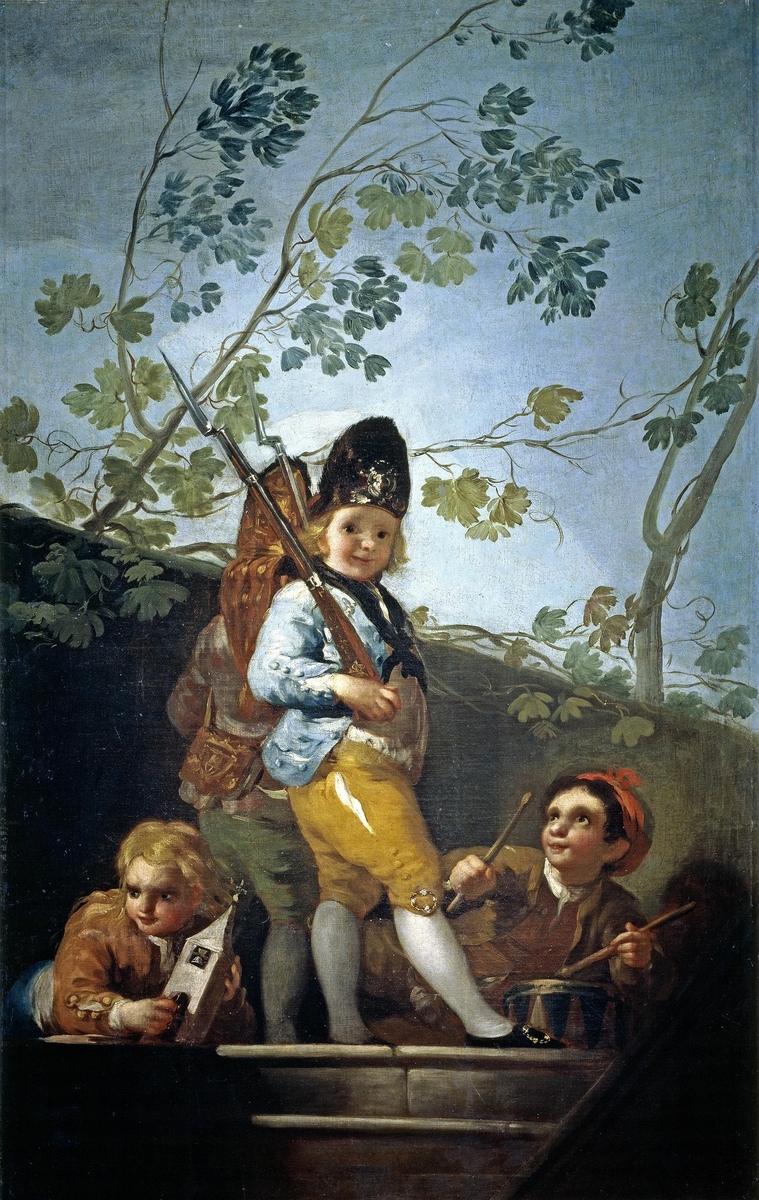
Boys playing soldiers
Artist: Francisco de Goya · 1779

Boys playing soldiers: high-resolution image
The original file is hosted by Wikimedia Commons, available without payment or an account.
Open high-resolution image on Wikimedia CommonsThe complete story
The story About 3 minutes to read
This is Francisco de Goya's Boys playing soldiers, a painting from 1779. It shows a group of boys acting out a military scene. It's a genre picture, meaning it shows ordinary life rather than a story from the Bible or classical myth. Goya made it as a cartoon, a full-size design for a tapestry.
The source record identifies the subject simply as boys playing soldiers, and the title tells us the game. What we see is a group of children absorbed in a make-believe military exercise. Their play is the whole subject of the picture.
A tapestry cartoon is a working design, painted at full scale so weavers could copy it in wool and silk. Goya made a series of these for the Spanish royal tapestry works. This one belongs to that group, the cartones para tapices. Its subject, children at play, fits the light, decorative character of such designs.
The source record does not explain the painting's meaning beyond the title. But the subject itself carries a quiet observation: children imitate the adult world around them. Military play turns war into a game. That gap between innocent play and the seriousness of soldiering is there in the title, even if the source does not spell it out.
So this is a picture about play and imitation, made for a decorative purpose but touching on something larger. The boys are not soldiers; they are practising being soldiers. What stays with you is the ease of their game, and the knowledge that the real thing looks very different.
The story and its sources
Historical claims are linked to the records below. Close looking and interpretation are identified in the passage notes.
- Passage 1Documented historyWikimedia Commons: Boys playing soldiers
- Passage 2Close lookingWikimedia Commons: Boys playing soldiers
- Passage 3Documented historyWikimedia Commons: Boys playing soldiers
- Passage 4InterpretationWikimedia Commons: Boys playing soldiers
- Passage 5InterpretationWikimedia Commons: Boys playing soldiers
Details to notice
About 2 minutes to readWooden platform
The rough wooden ledge beneath the central boy's boot and the drummer serves as both stage and mock battlement, separating the children's game from the dark foreground.
Boy with illustrated book
A blond boy lies prone at lower left, holding a rectangular illustrated book or sheet and glancing outward. The object suggests instructions, pictures, or a game that organizes the children's make-believe.
Drummer boy and drum
The seated boy at lower right looks upward while raising drumsticks over a small drum. His active gesture supplies the scene's rhythm and reinforces the improvised military performance.
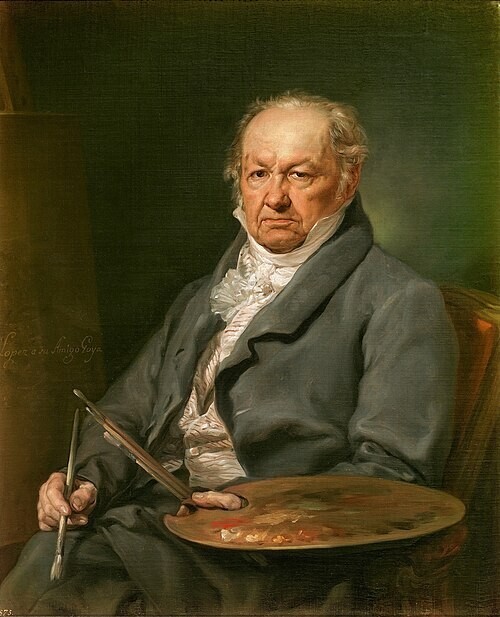
Artist portrait Image credit
Vicente López Portaña. Image source · Public domain
About the artist
Francisco de Goya
30 March 1746 to 16 April 1828
Goya was a Spanish painter and printmaker whose career extended from royal tapestry designs and court portraiture to images of war, repression and unsettling fantasy. Born in Fuendetodos, he trained in Zaragoza and Madrid and became First Painter to Charles IV in 1799. He spent his final years in Bordeaux.
- Born
- 30 March 1746
- Died
- 16 April 1828
- Nationality
- Spanish
- Birthplace
- Fuendetodos, Spain
- Died in
- Bordeaux, France
The research & record
Study the work.
Follow the evidence.
Find catalogue details, historical context, technical research and the literature behind this artwork.
The artwork record
Research catalogue
Catalogue information and detailed research, with references that link to the bibliography.
Updated .
Identity and catalogue
Link- Title
- Boys playing soldiers
- Artist or attribution
- Francisco de Goya
- Object date
- 1779(Wikimedia Commons: Boys playing soldiers, n.d.)
- Medium and support
- oil on canvas(Wikimedia Commons: Boys playing soldiers, n.d.)
- Dimensions
- 146 x 94 cm
- Current collection or location
- Museo del Prado, Madrid, Spain(Wikimedia Commons: Boys playing soldiers, n.d.)
- Movement or period
- Rococo, Classicism, Realist genre (as categorised by the source)
- Country or culture
- Spain
- Depicted subject
- A genre scene of children playing at being soldiers, made in 1779 as a cartoon for a tapestry.
- Title variants
- Muchachos jugando a soldados; Enfants jouant aux soldats; Enfants jogant ai soudats; Nois jugant a soldats; Pojkar som leker soldater; Haurrak soldadu jolasean; Barn leker soldater; Rapazos xugando a soldaos; Rapaces xogando a soldado; Bechgyn yn chwarae milwyr; Мальчики, играющие в солдат; ילדים משחקים בחיילים; ബോയ്സ് പ്ലേയിംഗ് സോളീജേഴ്സ്
- Accession number
- P000783
- Support
- canvas
Read valuation records and their limitations
Catalogue identity
The primary identification of the work is as Boys playing soldiers, a painting by Francisco Goya dated 1779, executed in oil on canvas and measuring 146 by 94 centimetres. That basic catalogue statement establishes the object type, medium, support and scale before any question of interpretation arises. The source gives Spain as the place of creation, which locates the work geographically without specifying a city or a workshop. Because the painting is entered in the record with a high-resolution photographic reproduction drawn from the Museo del Prado's own image service, the visual evidence available for study derives from the holding institution's imaging rather than from an independent photograph.(Wikimedia Commons: Boys playing soldiers, n.d., Summary)
The date is stated as 1779, but the record is not internally resolved on this point. The same source classifies the image among 1778 paintings by Goya while assigning 1779 in its summary, and the discovery record gives a range of 1778 to 1779; the exact-object record does not settle the discrepancy. This matters for catalogue practice because the object date and the later catalogue date are different things: the year of execution, if it can be fixed, belongs to the history of the object, whereas a date range or a filing category reflects the decisions of later cataloguers and image organisers. The evidence here supports only the recognition that the sources disagree, not a resolution of the disagreement.(Wikimedia Commons: Boys playing soldiers, n.d., Summary; Categories)
The work is additionally classified in the record as genre art and, within that, under Rococo, Classicism and Realist genre painting. These labels are not mutually exclusive descriptions of one style but successive or overlapping art-historical categories applied to a single object. The multiple categorisation signals that the painting sits at a point where the light decorative conventions associated with Rococo, the academic gravity associated with Classicism and the observation of ordinary life associated with Realist genre painting can all be invoked. What the record establishes is the classification; what it does not establish is which label the artist or his patrons would have recognised.(Wikimedia Commons: Boys playing soldiers, n.d., Object type and Categories)
Two scholarly reference points anchor the object in the literature. The record cites Pierre Gassier and Juliet Wilson's catalogue of Goya, number 128, and the Fundación Goya en Aragón, ID 31. The presence of a numbered entry in the Gassier and Wilson catalogue and a distinct identifier in the Aragón foundation's listings means the painting has a documented place in the standard cataloguing apparatus for Goya, not merely a museum label. The record also describes the subject as boys playing soldiers, which is the level of subject identification the source itself supplies.(Wikimedia Commons: Boys playing soldiers, n.d., References)
Function and related works
The object is described on the source record as a cartoon for tapestries and is categorised among Goya's cartones para tapices. This functional identification is significant because a tapestry cartoon is a working design painted at full scale for weavers to follow, which explains the scale recorded for the canvas. The record files the work among sketches by the artist, and it also notes a separate file, Niños jugando a soldados (boceto), indicating that a preparatory sketch in the same subject exists. The relationship between this painting and the boceto is established as a subject relationship in the record; the record does not specify the sketch's dimensions, medium or date, and those details should not be assumed.(Wikimedia Commons: Boys playing soldiers, n.d., References and Categories; Categories)
Boys playing soldiers is a painting by Francisco Goya, dated 1779, oil on canvas, measuring 146 by 94 centimetres.(Wikimedia Commons: Boys playing soldiers, n.d.)
The source record categorises the painting as genre art and also under Rococo, Classicism and Realist genre painting.(Wikimedia Commons: Boys playing soldiers, n.d.)
The source record cites Pierre Gassier and Juliet Wilson's catalogue of Goya (number 128) and the Fundación Goya en Aragón (ID 31) as references for this work.(Wikimedia Commons: Boys playing soldiers, n.d.)
The source record files the image among 1778 paintings by Francisco de Goya and among sketches by the artist.(Wikimedia Commons: Boys playing soldiers, n.d.)
Subject and iconography
LinkRead valuation records and their limitations
Subject and function
Visual observation
The source record identifies the depicted subject of Boys playing soldiers simply as boys playing soldiers, and that identification is the extent of the subject interpretation it supplies. The record offers no explanation of the picture's meaning beyond the title, so the game of make-believe soldiering is named rather than interpreted. The same record describes the work as a painting and as a cartoon for tapestries, categorising it among Francisco de Goya's cartones para tapices. Because the subject identification and the functional description come from the same record, the visible boys at play and the decorative working purpose of the canvas have to be held together: the source does not set one against the other, nor does it supply an account of how the children's game was understood by its first audiences.(Wikimedia Commons: Boys playing soldiers, n.d., Description; References and Categories)
The object in its categories
Interpretation
Read together, these evidence units support a limited synthesis. The work is documented as a tapestry cartoon showing boys playing soldiers, created in Spain and reproduced photographically through the Prado's image service, with a related preparatory sketch recorded under the same subject. The record's categories situate it in Goya's cartoon production and in the history of childhood imagery, but the record itself supplies no visual description beyond the title, no named visual conventions, no predecessors or successors, and no technical imaging findings. Interpretations of the children's military play as commentary on adult war belong to the narrated reception of the picture rather than to the source's documented description, and they should be attributed accordingly when they are used.(Wikimedia Commons: Boys playing soldiers, n.d., Description; References and Categories; File usage on Commons; Summary)
Visual observation
The source record identifies the depicted subject as boys playing soldiers.(Wikimedia Commons: Boys playing soldiers, n.d.)
Historical context
LinkRead valuation records and their limitations
Documentary identity and place in the tapestry enterprise
The Wikimedia Commons record for this painting identifies it as a cartoon for tapestries and files it among Goya's cartones para tapices, the full-scale designs made for the Spanish royal tapestry manufactory. The record gives Spain as the place of creation. That designation fixes the object's documentary identity as a working design in the tapestry series rather than as an independent easel picture, although the same record also describes it simply as a painting and supplies a high-resolution photographic reproduction from the Museo del Prado's own image service. The two descriptions are not in conflict: a tapestry cartoon is a painting on canvas that served as a model for weavers, and this record carries both its functional classification and its physical presence as a Prado painting with an inventory number.(Wikimedia Commons: Boys playing soldiers, n.d., References and Categories; Summary)
Visual observation
Beyond genre and medium, the source record classifies the work under 18th-century childhood in painting and under children of Spain in art. Those categories matter for the commissioning context because they place the canvas within a larger pictorial interest in Spanish children, and the record's subject identification as boys playing soldiers tells us the specific childhood activity depicted. The categorical filing does not establish who commissioned the work, for which room or palace it was intended, or what program the series served; the record supplies the classification and the subject, not the circumstances of the commission.(Wikimedia Commons: Boys playing soldiers, n.d., Categories; Description)
The work is described on the source record as a cartoon for tapestries and is categorised among Goya's cartones para tapices.(Wikimedia Commons: Boys playing soldiers, n.d.)
The source gives a place of creation of Spain.(Wikimedia Commons: Boys playing soldiers, n.d.)
The source record files the work under 18th-century childhood in painting and children of Spain in art.(Wikimedia Commons: Boys playing soldiers, n.d.)
Materials and technique
LinkRead valuation records and their limitations
The preparatory sketch
A separate file in the same source record, Niños jugando a soldados (boceto), indicates that a preparatory sketch exists for this same subject. The existence of the boceto is documented as a distinct file associated with the topic, but the record as supplied does not describe that sketch's support, dimensions, medium, palette or degree of finish, and it does not establish how closely the finished cartoon follows it. A preparatory work of this kind would ordinarily be the most direct evidence for how the composition and colour scheme were worked out before the full-scale painting, yet on the present evidence that relationship can only be noted as an open question. The sketch's existence should not be used to claim a particular sequence of drawing and painting stages for the Prado canvas, because no unit records such stages.(Wikimedia Commons: Boys playing soldiers, n.d., File usage on Commons)
The source record also includes a separate file, Niños jugando a soldados (boceto), indicating a preparatory sketch exists in the same subject.(Wikimedia Commons: Boys playing soldiers, n.d.)
Reception and literature
LinkRead valuation records and their limitations
Reproduction and the Museum Image
The documented reception embedded in the source record for this painting is primarily that of reproduction and cataloguing rather than narrative commentary. The source describes the work as a painting and supplies a high-resolution photographic reproduction drawn from the Museo del Prado's own image service, so the most widely circulated modern encounter with the object is through a museum-authorised digital surrogate. The record itself gives no reception history, critical commentary or exhibition narrative beyond this reproductive apparatus; what can be documented is the availability of a high-quality image and the identification of the work as a painting.(Wikimedia Commons: Boys playing soldiers, n.d., Summary)
The source describes the work as a painting and provides a high-resolution photographic reproduction from the Museo del Prado's own image service.(Wikimedia Commons: Boys playing soldiers, n.d.)
Interpretations and debates
LinkRead valuation records and their limitations
The record of the object
Disputed account
The exact-object record for Boys playing soldiers treats nearly every descriptive element as settled: it gives the work as a painting by Francisco de Goya, oil on canvas, measuring 146 by 94 centimetres, held in the collections of the Museo del Prado, Madrid, under inventory number P000783, and listed in the museum's inventory of cartoons for tapestries. The record identifies the depicted subject as boys playing soldiers and gives Spain as the place of creation. It files the work among Goya's cartones para tapices, that is, the full-scale designs made for the royal tapestry works, and it supplies a high-resolution photographic reproduction drawn from the Prado's own image service. These are the stable coordinates of the object as the source presents them. The one element the record does not settle is its date.(Wikimedia Commons: Boys playing soldiers, n.d., Date and Categories)
Disputed dating
The dating of the painting is internally inconsistent in the source, and the exact-object record does not resolve the discrepancy. The source assigns the date 1779, yet it also classifies the image among 1778 paintings by Goya, and its discovery record gives a date range of 1778 to 1779. These are not three independent datings but conflicting statements carried within one file, and the record offers no argument that would let a reader choose among them. Any account of the work that needs a single year must therefore state which claim it is following and acknowledge the others; a bare label of 1779 or of 1778 would overstate what the record establishes. The unresolved date also matters beyond the caption, because Goya's tapestry cartoons were produced in series, and the place of a given cartoon within a series is normally one of the ways such works are ordered. The source's uncertainty leaves that ordering open rather than settled.(Wikimedia Commons: Boys playing soldiers, n.d., Date and Categories)
Classification and related works
The same record classifies the painting in several overlapping ways at once: as genre art, as a cartoon for tapestries, and under the headings Rococo, Classicism and Realist genre painting. It also files the image among sketches by the artist and notes that a separate file exists for a preparatory sketch under the same subject, Niños jugando a soldados (boceto). These classifications are not mutually exclusive descriptions of different objects but layers applied to a single work whose status is genuinely multiple: it is a finished design made for translation into wool and silk, and it is also a painted composition treated by the source as belonging to genre painting and to several stylistic categories. The existence of a related boceto, recorded but not itself examined here, indicates that the composition had a preparatory stage, though the source does not describe that sketch's appearance or its relationship to the final design.(Wikimedia Commons: Boys playing soldiers, n.d., Date and Categories)
Beyond title, medium, dimensions and collection, the source supplies catalogue references: Pierre Gassier and Juliet Wilson's catalogue of Goya, number 128, and the Fundación Goya en Aragón, ID 31. These citations indicate that the painting has an established place in the scholarly cataloguing of Goya's work, even though the record itself does not transmit the content of those catalogue entries. The record's social and historical framing appears in its filing categories as well: it is placed under 18th-century childhood in painting and under children of Spain in art. Those categories are the source's own indexing decisions rather than arguments, but they show how the work is positioned for research: as an image of childhood in a specific national and period setting, and as a tapestry design within a royal manufactory context. What the record does not supply is any interpretation of the subject; the description goes no further than the title's game.(Wikimedia Commons: Boys playing soldiers, n.d., Date and Categories)
What the record establishes and what it leaves open
Interpretation
Read together, the units describe an object whose documentary identity is firm in most respects and unsettled in one. The attribution to Goya, the oil-on-canvas medium, the dimensions, the Prado inventory number P000783, the tapestry-cartoon function, the Spanish place of creation and the cross-references to Gassier and Wilson and to the Fundación Goya en Aragón are all given without qualification. The date alone is reported in incompatible forms within the same source, and the record does not adjudicate between them. The classifications under Rococo, Classicism and Realist genre painting, and the indexing under childhood and under children of Spain, are the source's framings rather than conclusions drawn from the object's own documentation. For the history of material culture, the record establishes what matters most about such a work without needing to settle the year: it is a full-scale painted design made to be woven, preserved in the Prado's cartoons inventory, and copiously reproduced from the museum's own photography. The unresolved date is a caution about the record, not a doubt about the object.(Wikimedia Commons: Boys playing soldiers, n.d., Date and Categories)
Disputed account
The source assigns the date 1779 while also classifying the image under 1778 paintings by Goya, and the discovery record gives a date range of 1778 to 1779; the exact-object record does not resolve this discrepancy.(Wikimedia Commons: Boys playing soldiers, n.d.)
Collection and display
LinkRead valuation records and their limitations
The object and its institutional record
The object catalogued here is Francisco de Goya's Boys playing soldiers, recorded in the collections of the Museo del Prado, Madrid, under inventory number P000783. That single inventory entry carries two overlapping institutional descriptions: the museum's inventory of cartoons for tapestries and, more specifically, the group of works described as cartoons for tapestries (cartones para tapices) by Goya at the Prado. The record thus establishes both a unique object identity and a classification, so the painting can be studied as an individual canvas and as a member of a defined series of designs made for tapestry production. The Wikimedia Commons file record that preserves this information is a discovery source rather than a catalogue raisonné entry; it reproduces the painting through a high-resolution photographic reproduction supplied by the Museo del Prado's own image service and cites Pierre Gassier and Juliet Wilson's catalogue of Goya (number 128) together with the Fundación Goya en Aragón (ID 31) as references for the work.(Wikimedia Commons: Boys playing soldiers, n.d., Summary; Categories)
Interpretation
The classification as a cartoon for tapestries matters because it describes a functional category rather than a purely aesthetic one. A cartoon in this sense is a full-size design from which weavers could work, and the museum's inventory groups this canvas with others by Goya made for that purpose. Placing the painting in that group links its subject to the decorative character of tapestry designs, while the separate inventory designation of the museum's cartoons and the category label cartones para tapices show that the institution treats the object under both a general heading and a named Goya series. Scholarly use of the object therefore depends on holding the individual inventory number, the series membership and the working-design function together, rather than reading the picture as an independent genre painting detached from textile production.(Wikimedia Commons: Boys playing soldiers, n.d., Summary; Categories)
The work belongs to the collections of the Museo del Prado, Madrid, with inventory number P000783, and is listed in the museum's inventory of cartoons for tapestries.(Wikimedia Commons: Boys playing soldiers, n.d.)
The work belongs to the group described as cartoons for tapestries (cartones para tapices) by Goya in the Museo del Prado.(Wikimedia Commons: Boys playing soldiers, n.d.)
Documented values and qualified estimates
LinkRead valuation records and their limitations
Object record and documentary basis
Interpretation
The record for Boys playing soldiers begins with attribution and physical description rather than with value. Francisco de Goya is named as the painter, the work is dated 1779 in the source's principal statement, it is oil on canvas, and it measures 146 by 94 centimetres. The place of creation is given as Spain. These particulars locate the painting within Goya's early Madrid career and give the scale against which any later administrative or financial description of the object has to be read. The Wikimedia Commons file record supplies a high-resolution photographic reproduction drawn from the Museo del Prado's own image service, so the visible object and the documentary object are linked through the museum's imaging rather than through an independent photograph.(Wikimedia Commons: Boys playing soldiers, n.d.)
The same record treats the painting as a tapestry cartoon. It is grouped among Goya's cartones para tapices, described as cartoons for tapestries, and listed in the Museo del Prado's inventory of cartoons for tapestries; the inventory number is P000783 and the collection is that of the Museo del Prado, Madrid. The record categorises the work as genre art and also files it under Rococo, Classicism and Realist genre painting, so the classificatory labels sit alongside one another rather than resolving into a single stylistic slot. The subject is identified as boys playing soldiers, and the image is additionally filed under 18th-century childhood in painting and children of Spain in art, which shows how the record's own metadata frames the picture as much through its subject category as through its author and medium.(Wikimedia Commons: Boys playing soldiers, n.d.)
The source record does not resolve every point it reports. It assigns the date 1779 while also classifying the image among 1778 paintings by Francisco de Goya, and the discovery record gives a date range of 1778 to 1779. The exact-object record leaves this discrepancy standing rather than choosing between the alternatives. The record also files the image among sketches by the artist, and it refers to a separate file, Niños jugando a soldados (boceto), indicating that a preparatory sketch in the same subject exists. These two facts pull in different directions: the painting is presented as a tapestry cartoon at full scale, yet its image is catalogued with sketches, and a distinct boceto file is noted alongside it. Neither the sketch nor its relationship to the finished cartoon is described in the supplied evidence, so the preparatory status of the related object remains to be established from other sources.(Wikimedia Commons: Boys playing soldiers, n.d.)
The record anchors the painting in published scholarship by citing Pierre Gassier and Juliet Wilson's catalogue of Goya, number 128, and the Fundación Goya en Aragón, ID 31, as references for the work. These citations are the record's link between the object and the cataloguing tradition around Goya, and they explain why the file can state a date, medium and dimensions with apparent confidence even where its own date fields disagree. The Wikimedia Commons page is a discovery source for this exact painting, and its annotation notes that it records title, artist, date, medium, dimensions, collection and literature references but does not supply subject interpretation. That limitation matters for any account of what the picture means, because the interpretive weight has to be carried by evidence outside this record rather than by the record itself.(Wikimedia Commons: Boys playing soldiers, n.d.)
The calculated working range
The only value figure in the supplied evidence is a model-generated working insurance estimate: US$8 million to US$40 million, recorded as a working calculation generated on 2026-11-16. Its stated methodology starts from the confirmed context of an autograph 1779 oil on canvas by Goya, 146 by 94 centimetres, one of his tapestry cartoons, held by the Museo del Prado under accession P000783, and applies a conservative high-value tier for a major Old Master painting by Goya of this scale and documented period significance. The band is then widened substantially upward and downward. The record explains the widening as a response to the absence of any public sale, official appraisal or private insurance figure for this work in the supplied excerpts, and it describes the range as an analytical placeholder for manual review only, not a market-derived figure.(Wikimedia Commons: Boys playing soldiers, n.d.)
The qualification attached to the figure is as important as the figure itself. The range is not an official insurance value, appraisal, auction estimate or result, or sale price, and it should not be used to bind coverage. No comparable sales, private insurance records or internal valuation data were consulted. Because the work is in a public museum collection and effectively unlikely to enter commerce, the estimate does not rest on exchange history at all; any real insurance figure would come from the institution or a qualified appraiser. Read within those limits, the number records an inference about category and scale rather than a fact about the object's price.(Wikimedia Commons: Boys playing soldiers, n.d.)
Taken together, the supplied units distinguish carefully between different kinds of statement about the painting. Attribution, medium, dimensions, inventory number and collection are asserted as settled elements of the museum record and the cataloguing literature. The date is asserted but contested within the record itself, between 1779, the 1778 classification and the 1778 to 1779 range. The existence of a preparatory sketch in the same subject is noted without description or comparison. The value range exists only as a dated working calculation with an explicit instruction not to treat it as an appraisal or sale figure. Placing these tiers side by side, rather than collapsing them into a single statement about the object, is what allows the record to be used for research without overstating what any one part of it establishes.(Wikimedia Commons: Boys playing soldiers, n.d.)
Working estimate
Calculated working insurance estimate, not a sale price: Estimated value: US$8M to US$40M Recorded date: Working calculation, generated 2026-11-16. Methodology: Broad working range derived from the confirmed context: an autograph 1779 oil on canvas by Francisco de Goya, 146 x 94 cm, one of his tapestry cartoons, held by the Museo del Prado under accession P000783. The calculation applies a conservative high-value tier appropriate to a major Old Master painting by Goya of this scale and documented period significance, then widens the band substantially upward and downward to reflect that no public sale, official appraisal, or private insurance figure for this work was available in the supplied excerpts. Because the work is in a public museum collection and effectively unlikely to enter commerce, the range is an analytical placeholder for manual review only, not a market-derived figure. Qualification: This is a model-generated working range for manual review only. It is not an official insurance value, appraisal, auction estimate or result, or sale price, and it should not be used to bind coverage. No comparable sales, private insurance records, or internal valuation data were consulted. The work is in the collection of the Museo del Prado, and any real insurance figure would come from the institution or a qualified appraiser.(Wikimedia Commons: Boys playing soldiers, n.d.)
Further reading
Books for a closer look
Paid links. As an Amazon Associate I earn from qualifying purchases.

Open Library Goya
Kodansha International
Catalogue record for a Goya volume whose subjects include catalogues raisonnés, Museo del Prado, Spanish painting, and criticism and interpretation. Directly tied to the artist and to the museum holding this tapestry cartoon, and a catalogue raisonné type study could cover the cartones para tapices, though the record does not confirm this specific work is discussed.
ISBN 0870110837
Bibliography
Sources and further reading
References are arranged by author or organisation, with links to the original publications. Where no publication date is recorded, n.d. means no date.
Source notes updated .
No recorded sources match these filters. Reset the filters to see the full bibliography.
- 02
Book
Goya. Kodansha International.
Catalogue record for a Goya volume whose subjects include catalogues raisonnés, Museo del Prado, Spanish painting, and criticism and interpretation. Directly tied to the artist and to the museum holding this tapestry cartoon, and a catalogue raisonné type study could cover the cartones para tapices, though the record does not confirm this specific work is discussed.
- ISBN
- 0870110837
Citation text
- 03
Book
Goya: Francisco de Goya y Lucientes. H. N. Abrams.
Monograph on Goya by José Gudiol, whose listed subject is Goya, Francisco, 1746-1828. Relevant as an artist-specific scholarly study offering context for Goya's 1770s tapestry cartoons, the category to which Boys playing soldiers belongs, though the record does not name the painting.
- ISBN
- 0810901498
Citation text
- 01
Secondary · About this artwork
Wikimedia Commons: Boys playing soldiers (n.d.). Wikimedia Commons: File:Muchachos jugando a soldados.jpg. Wikimedia Commons.
Wikimedia Commons file record for this exact painting, citing the Museo del Prado's image service and inventory number P000783. Discovery source; it records title, artist, date, medium, dimensions, collection and literature references but does not supply subject interpretation.
- Language
- en
Citation text
Art to live with
Bring this painting
home.
A piece of the archive, made yours. Explore Boys playing soldiers in a size and finish that fits your space.
Your text and annotations appear on these editions. Adding to cart saves that design for printing.
Combine this painting with your favourites01 / Find your edition
Made for you
Suggested from your location. Change it if you're sending elsewhere or using a VPN. Prices and delivery are shown in GBP.
17 products
Choose an edition to make it yours
6 × 8 in · Printed cover · 118 lined pages
6 × 8 in · Printed cover · 118 lined pages
6 × 8 in · Printed cover · 118 lined pages
Notebook
GBP 12.03
Delivery GBP 5.35 / Total GBP 17.38
A 6 × 8 inch spiral notebook with 118 ruled pages (59 sheets), a printed front cover, dark grey back cover and metal spiral binding.
Fit and fill keep the painting’s proportions. Stretch changes them.
Move and zoom the painting on your notebook.
Made to order with your design
Made to order
US delivery only
12.7 × 17.8 cm / 5 × 7 in · Standard
12.7 × 17.8 cm / 5 × 7 in · Standard

5 × 7 in / 12.7 × 17.8 cm · Standard

5 × 7 in / 12.7 × 17.8 cm · Standard

5 × 7 in / 12.7 × 17.8 cm · Standard

5 × 7 in / 12.7 × 17.8 cm · Standard

5 × 7 in / 12.7 × 17.8 cm · Standard
Metal art sign
GBP 19.84
Delivery GBP 17.90 / Total GBP 37.74
A printed aluminium sign with rounded corners and mounting holes.
Fit and fill keep the painting’s proportions. Stretch changes them.
Move and zoom the painting on your metal art sign.
Made to order with your design
Printed aluminium · mounting holes included
US delivery only
iPhone 12 Mini ? Glossy ? back view
iPhone 12 Mini · Glossy

iPhone 12 Mini ? Glossy ? back view

iPhone 12 Mini ? Glossy ? back view

iPhone 12 Mini ? Glossy ? back view
Tough phone case
GBP 16.56
Delivery GBP 4.28 / Total GBP 20.84
A two-layer phone case with a printed polycarbonate shell and a shock-absorbing inner liner.
Two layers with a shock-absorbing TPU liner
Case & print details
- Device
- Apple · iPhone 12 Mini
- Material
- Polycarbonate shell with a TPU inner liner
- Artwork
- Outer back and wrapped edges from one template
- Finish
- Glossy
- Version
- Standard version
- Printing
- Dye sublimation
- Print file
- 1,122 × 1,831 px · 95 × 155 mm · PNG · 300 dpi recommended
Rear outline and camera openings follow this variant's Printify template. Case depth and small hardware remain illustrative.
Supplier product detailsFit and fill keep the painting’s proportions. Stretch changes them.
Move and zoom the painting on your tough phone case.
Made to order with your design
Made to order
US delivery only
20.3 × 25.4 cm / 8 × 10 in · White
20.3 × 25.4 cm / 8 × 10 in · White

8 × 10 in / 20.3 × 25.4 cm · White

8 × 10 in / 20.3 × 25.4 cm · White

8 × 10 in / 20.3 × 25.4 cm · White

8 × 10 in / 20.3 × 25.4 cm · White
Framed art print
GBP 34.51
- 1 framed print
- GBP 34.51
- Delivery to United States
- GBP 9.73
- Total
- GBP 44.24
A ready-to-hang wooden frame with a clear Perspex cover and a semi-gloss printed insert.
Delivery is quoted for all selected copies together.
Fit and fill keep the painting’s proportions. Stretch changes them.
Move and zoom the painting on your framed art print.
Made to order with your design
Wooden frame & protective clear front included
US delivery only
22.9 × 20.3 cm / 9 × 8 in · Standard
22.9 × 20.3 cm / 9 × 8 in · Standard

9 × 8 in / 22.9 × 20.3 cm · Standard

9 × 8 in / 22.9 × 20.3 cm · Standard

9 × 8 in / 22.9 × 20.3 cm · Standard

9 × 8 in / 22.9 × 20.3 cm · Standard
Mouse mat
GBP 7.36
Delivery GBP 4.87 / Total GBP 12.23
A rectangular fabric mouse mat with a rubber backing and rounded corners.
Fit and fill keep the painting’s proportions. Stretch changes them.
Move and zoom the painting on your mouse mat.
Made to order with your design
Made to order
US delivery only
43.2 × 45.7 cm / 17 × 18 in · Artwork
43.2 × 45.7 cm / 17 × 18 in · Artwork

17 × 18 in / 43.2 × 45.7 cm · Artwork

17 × 18 in / 43.2 × 45.7 cm · Artwork

17 × 18 in / 43.2 × 45.7 cm · Artwork
Woven tote bag
GBP 47.33
Delivery GBP 5.94 / Total GBP 53.27
A woven tote with cotton webbing handles and the painting translated into a woven design.
Fit and fill keep the painting’s proportions. Stretch changes them.
Move and zoom the painting on your woven tote bag.
Made to order with your design
Made to order
US delivery only
See more11 more products
20.3 × 30.5 cm / 8 × 12 in · Standard
20.3 × 30.5 cm / 8 × 12 in · Standard

8 × 12 in / 20.3 × 30.5 cm · Standard

8 × 12 in / 20.3 × 30.5 cm · Standard

8 × 12 in / 20.3 × 30.5 cm · Standard

8 × 12 in / 20.3 × 30.5 cm · Standard

8 × 12 in / 20.3 × 30.5 cm · Standard
Matte art print
GBP 14.07
Delivery GBP 7.29 / Total GBP 21.36
An unframed matte poster with archival inks, ready for a frame of your choice.
Fit and fill keep the painting’s proportions. Stretch changes them.
Move and zoom the painting on your matte art print.
Made to order with your design
Unframed · frame it your way
US delivery only
iPhone 12 Mini ? Standard ? back view
iPhone 12 Mini · Standard

iPhone 12 Mini ? Standard ? back view

iPhone 12 Mini ? Standard ? back view

iPhone 12 Mini ? Standard ? back view
Flexible phone case
GBP 15.76
Delivery GBP 4.28 / Total GBP 20.04
A flexible TPU phone case with a frosted finish, a printed back and precise port openings.
Flexible TPU with a frosted, matte finish
Case & print details
- Device
- Apple · iPhone 12 Mini
- Material
- Semi-transparent thermoplastic polyurethane (TPU)
- Artwork
- Back print; rim stays unprinted
- Finish
- Standard
- Version
- Standard version
- Printing
- Dye sublimation
- Print file
- 791 × 1,586 px · 67 × 134.3 mm · PNG · 300 dpi recommended
Rear outline and camera openings follow this variant's Printify template. Case depth and small hardware remain illustrative.
Supplier product detailsFit and fill keep the painting’s proportions. Stretch changes them.
Move and zoom the painting on your flexible phone case.
Made to order with your design
Made to order
S · Standard
S · Standard

S · Standard

S · Standard

S · Standard

S · Standard

S · Standard
Crew socks
GBP 10.78
Delivery GBP 4.49 / Total GBP 15.27
Crew-length polyester and spandex socks with a ribbed cuff, cushioned sole and sublimated artwork.
Fit and fill keep the painting’s proportions. Stretch changes them.
Move and zoom the painting on your crew socks.
Made to order with your design
One pair · design repeated on both socks
US delivery only
12" · Standard
12" · Standard

12" · Standard

12" · Standard

12" · Standard
Laptop sleeve
GBP 26.36
Delivery GBP 4.96 / Total GBP 31.32
A polyester laptop sleeve with a fleece lining, top zip, printed front and black reverse.
Fit and fill keep the painting’s proportions. Stretch changes them.
Move and zoom the painting on your laptop sleeve.
Made to order with your design
Made to order
US delivery only
11oz · 2 image repeats
11oz · White
11oz · 2 image repeats
Mug
GBP 7.42
Delivery GBP 6.23 / Total GBP 13.65
A glossy white ceramic mug with a C-shaped handle, available in 11oz and 15oz sizes.
repeat layout · choose single, double or a repeating pattern in Customise.
Repeat, fit, fill and position your artwork around the mug.
Made to order with your design
Made to order
iPhone 12 Mini ? Standard ? back view
iPhone 12 Mini · Standard

iPhone 12 Mini ? Standard ? back view

iPhone 12 Mini ? Standard ? back view

iPhone 12 Mini ? Standard ? back view

iPhone 12 Mini ? Standard ? back view

iPhone 12 Mini ? Standard ? back view
Biodegradable phone case
GBP 21.19
Delivery GBP 4.28 / Total GBP 25.47
A matte phone case made from plant polymers and bamboo fibre, with the artwork printed on the back.
Flexible plant-polymer shell with a matte finish
Case & print details
- Device
- Apple · iPhone 12 Mini
- Material
- PLA and PBAT polymers with bamboo fibre
- Artwork
- Back print; rim stays unprinted
- Finish
- Standard
- Version
- Standard version
- Printing
- Dye sublimation
- Print file
- 777 × 1,553 px · 65.8 × 131.5 mm · PNG · 300 dpi recommended
Rear outline and camera openings follow this variant's Printify template. Case depth and small hardware remain illustrative.
Supplier product detailsFit and fill keep the painting’s proportions. Stretch changes them.
Move and zoom the painting on your biodegradable phone case.
Made to order with your design
Made to order
20.3 × 30.5 cm / 8 × 12 in · Standard
20.3 × 30.5 cm / 8 × 12 in · Standard

8 × 12 in / 20.3 × 30.5 cm · Standard

8 × 12 in / 20.3 × 30.5 cm · Standard

8 × 12 in / 20.3 × 30.5 cm · Standard
Fine art poster
GBP 13.03
Delivery GBP 7.69 / Total GBP 20.72
A gallery paper print with a smooth art-paper surface. Choose a size that suits the painting.
Fit and fill keep the painting’s proportions. Stretch changes them.
Move and zoom the painting on your fine art poster.
Made to order with your design
Unframed · frame it your way
iPhone 12 Mini ? Standard ? back view
iPhone 12 Mini · Standard

iPhone 12 Mini ? Standard ? back view

iPhone 12 Mini ? Standard ? back view

iPhone 12 Mini ? Standard ? back view
Clear phone case
GBP 15.28
Delivery GBP 4.28 / Total GBP 19.56
A clear phone case with artwork on the back. Leave areas transparent to show the phone underneath.
Clear shell with shock-absorbing TPU sides
Case & print details
- Device
- Apple · iPhone 12 Mini
- Material
- Polycarbonate back and clear TPU sides
- Artwork
- Back print; clear sides stay unprinted
- Finish
- Standard
- Version
- Standard version
- Printing
- Dye sublimation
- Print file
- 732 × 1,527 px · 62 × 129.3 mm · PNG · 300 dpi recommended
Rear outline and camera openings follow this variant's Printify template. Case depth and small hardware remain illustrative.
Supplier product detailsFit and fill keep the painting’s proportions. Stretch changes them.
Move and zoom the painting on your clear phone case.
Made to order with your design
Made to order
15oz · 3 image repeats
15oz · Standard

15oz · 3 image repeats

15oz · 3 image repeats

15oz · 3 image repeats

15oz · 3 image repeats

15oz · 3 image repeats
Travel mug
GBP 32.33
Delivery GBP 5.75 / Total GBP 38.08
A stainless-steel travel mug with a black lid, a tapered base and a printed white exterior.
repeat layout · choose single, double or a repeating pattern in Customise.
Repeat, fit, fill and position your artwork around the mug.
Made to order with your design
Made to order
US delivery only
2.5 × 3.4 cm / 1 × 1.4 in · Glossy
2.5 × 3.4 cm / 1 × 1.4 in · Glossy

1 × 1.4 in / 2.5 × 3.4 cm · Glossy

1 × 1.4 in / 2.5 × 3.4 cm · Glossy

1 × 1.4 in / 2.5 × 3.4 cm · Glossy

1 × 1.4 in / 2.5 × 3.4 cm · Glossy
Photo keyring
GBP 10.30
Delivery GBP 5.45 / Total GBP 15.75
A rectangular zinc-alloy photo keyring with a glossy insert and a swivel split ring.
Fit and fill keep the painting’s proportions. Stretch changes them.
Move and zoom the painting on your photo keyring.
Made to order with your design
Photo insert · zinc frame & swivel ring
US delivery only
iPhone 15 Pro ? Glossy ? back view
iPhone 15 Pro · Glossy

iPhone 15 Pro ? Glossy ? back view

iPhone 15 Pro ? Glossy ? back view

iPhone 15 Pro ? Glossy ? back view

iPhone 15 Pro ? Glossy ? back view

iPhone 15 Pro ? Glossy ? back view
Slim phone case
GBP 16.53
Delivery GBP 5.85 / Total GBP 22.38
A slim printed phone shell with open ports and a lightweight profile.
Slim, lightweight polycarbonate shell
Case & print details
- Device
- Apple · iPhone 15 Pro
- Material
- Polycarbonate
- Artwork
- Outer back and wrapped edges from one template
- Finish
- Glossy
- Version
- Standard version
- Printing
- Dye sublimation
- Print file
- 1,278 × 1,971 px · 108.2 × 166.9 mm · PNG · 300 dpi recommended
Rear outline and camera openings follow this variant's Printify template. Case depth and small hardware remain illustrative.
Supplier product detailsFit and fill keep the painting’s proportions. Stretch changes them.
Move and zoom the painting on your slim phone case.
Made to order with your design
Made to order
US delivery only
The 30 cm ruler is scaled alongside your selected print. Keep the painting’s proportions with a black background, or stretch it to fill. Frame width, material texture and screen colours are illustrative.
Keep exploring