The Death of Sardanapalus
Artist: Eugène Delacroix · 1827

The Death of Sardanapalus: high-resolution image
The original file is hosted by Wikimedia Commons, available without payment or an account.
Open high-resolution image on Wikimedia CommonsThe complete story
The story About 3 minutes to read
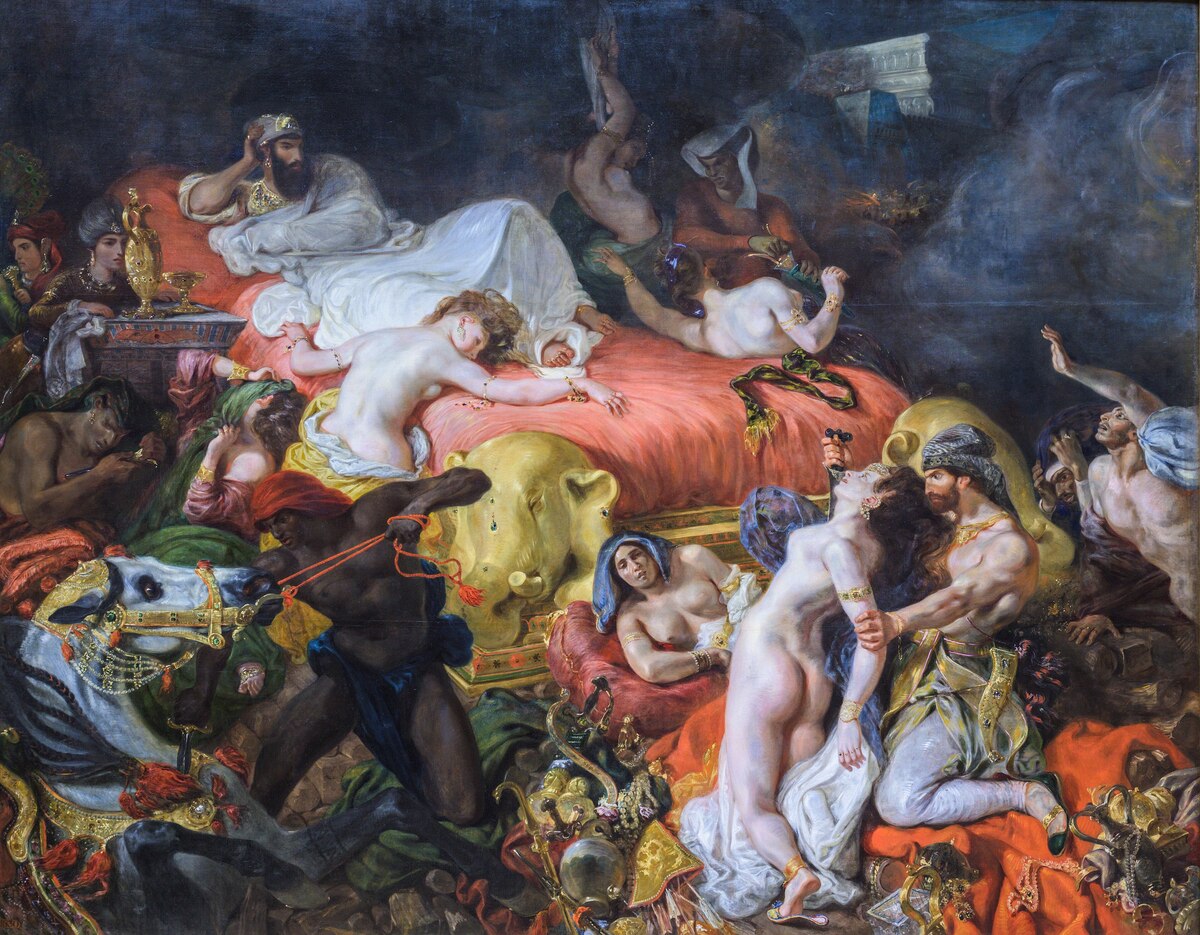
This is Eugène Delacroix's The Death of Sardanapalus, an oil on canvas of 1827. It shows the Assyrian king Sardanapalus at the end of his life, watching from his bed. Around him, his possessions, his horses and his concubines are being destroyed. That is the episode the painting takes up, the legend of the king's final hours.
The king stays in his bed while the destruction happens around him. He does not join in. He watches. That single arrangement carries the scene. The ruler who is about to die is separated from the things and the people being taken from him, and the bed holds him in place while they go.
The destruction has several parts. Possessions, horses and concubines are named among what is being destroyed around the king. So the loss is not only of one thing. It is his whole world of goods, animals and people, all pictured as the scene unfolds around the figure on the bed.
The subject comes from the legend of Sardanapalus, the Assyrian king. The painting presents his final hours. That means the work is a narrative picture. It asks you to read the king and the destruction around him together, as one story about the end of a reign.
What does the arrangement of the king and the destruction tell us? The scene sets stillness against activity. The king remains on the bed while the loss of his possessions and people is carried out around him. That contrast is the heart of the picture. It is not the death itself that we watch but the king's position as everything he owns is taken away.
Delacroix made this painting in 1827, and it is held at the Louvre in Paris. Its subject is a legendary king's final hours. What the picture gives us is that moment as a scene. The king watches from his bed while his possessions, horses and concubines are destroyed.
The story and its sources
Historical claims are linked to the records below. Close looking and interpretation are identified in the passage notes.
- Passage 1Documented historyWikimedia Commons: The Death of Sardanapalus
- Passage 2Close lookingWikimedia Commons: The Death of Sardanapalus
- Passage 3Documented historyWikimedia Commons: The Death of Sardanapalus
- Passage 4Documented historyWikimedia Commons: The Death of Sardanapalus
- Passage 5InterpretationWikimedia Commons: The Death of Sardanapalus
- Passage 6Documented historyWikimedia Commons: The Death of Sardanapalus
Details to notice
About 2 minutes to readConcubine and armed attendant above the bed
A nude concubine twists backward with raised arms as a turbaned attendant in red stands over her, one of the killings taking place behind the king.
Golden elephant-head bed finial
A gilded elephant head with a jeweled eye and curling trunk rises at the foot of the bed, a luxury object that marks the wealth being consumed.
Reclining concubine on the bed
A nude concubine lies prone across the scarlet bed with extended arms and glittering jewelry; her abandoned pose contrasts with the violence around her.

Artist portrait Image credit
Eugène Delacroix. Image source · Public domain
About the artist
Eugène Delacroix
1798 to 13 August 1863
Delacroix was a leading French Romantic painter. Trained by Pierre Guérin, he first exhibited at the Salon in 1822 and drew inspiration from Rubens and English painting. His travels in Spain, Morocco and Algiers in 1832 informed later work, while official commissions occupied much of his mature career.
- Born
- 1798
- Died
- 13 August 1863
- Nationality
- French
- Birthplace
- Charenton-Saint-Maurice, France
- Died in
- Paris, France
The research & record
Study the work.
Follow the evidence.
Find catalogue details, historical context, technical research and the literature behind this artwork.
The artwork record
Research catalogue
Catalogue information and detailed research, with references that link to the bibliography.
Updated .
Identity and catalogue
Link- Title
- The Death of Sardanapalus(Wilfredor, 2024)
- Artist or attribution
- Eugène Delacroix
- Object date
- 1827
- Medium and support
- Oil on canvas
- Current collection or location
- Louvre, Paris(Wilfredor, 2024)
- Movement or period
- Romanticism
- Country or culture
- France
- Depicted subject
- The Assyrian king Sardanapalus watches from his bed while his possessions, horses and concubines are destroyed around him, an episode from the legend of the king's final hours in the source description.(Wilfredor, 2024)
- Dimensions
- Unknown
Read valuation records and their limitations
Catalogue identity
The catalogue record identifies the work as The Death of Sardanapalus, an oil on canvas painting of 1827 by Eugene Delacroix, held at the Louvre in Paris. The medium and support are stated in the record, and the date of 1827 is given as the year of the painting itself. The record also names the collection that holds the work, the Louvre in Paris, and this is the same holding recorded elsewhere in connection with the file. The subject is the final hours of the legendary Assyrian king Sardanapalus, shown while his possessions, horses and concubines are destroyed around him as he watches from his bed. The record is summary in character: it gives title, artist, medium, date, subject and collection, and nothing further about the physical object.(Wilfredor, 2024, Summary, Description)
The date carried in the record, 1827, belongs to the painting and must be separated from the date of the photographic file through which the work is known in this archive. The file is a photograph of Delacroix's painting taken by the uploader, Wilfredor, on 29 January 2024, and released under CC0. The uploader is the photographer, not the artist, so the 2024 date and the CC0 licence attach to the reproduction and not to the 1827 canvas. The file is categorized on Commons under Paintings in the Louvre and Death of Sardanapalus by Eugene Delacroix, which restates in the file's own subject metadata the artist and holding that the written record supplies.(Wilfredor, 2024, Summary, Author, Licensing; Summary, Description)
Several fields that a full catalogue entry would normally carry are absent from the supplied source. The source does not give the painting's dimensions, accession number, support description, inscriptions, provenance history, exhibition history or critical reception. These are gaps in the supplied documentation and they limit what can be asserted here. In particular, no measured size, inventory number, signature or inscribed text, chain of ownership, display record or contemporary commentary should be attributed to the object on the strength of this record. The account that follows is therefore restricted to the identity of the work as the source states it, the subject it depicts and the nature of the photographic file.(Wilfredor, 2024, Whole page; Summary, Description; Summary, Author, Licensing)
The Death of Sardanapalus is an oil on canvas painting of 1827 by Eugene Delacroix, held at the Louvre, Paris.(Wilfredor, 2024)
Subject and iconography
LinkRead valuation records and their limitations
What the visual record describes
Visual observation
The visual record for this painting is unusually thin at the level of firsthand description. The Commons file page summarizes the composition in a single sentence: the image shows the king watching from his bed while his possessions, horses and concubines are destroyed around him. That summary is the only account of the arrangement of figures and objects in the supplied evidence. It establishes the basic structure of the scene, a reclining king set against a field of destruction, but it does not describe how the figures are disposed across the canvas, what gestures or expressions they carry, how the bed is oriented, or how the animals, goods and attendants are distributed. Any fuller reading of the composition has to be built from that single stated relationship between the king and what is being destroyed near him, and from the painting's identity as an oil on canvas of 1827 by Eugène Delacroix held at the Louvre in Paris.(Wilfredor, 2024, Summary, Description)
The evidentiary basis for the section should be stated plainly. The same Commons page is a photograph of the painting taken by the uploader, Wilfredor, on 29 January 2024 and released under CC0; the uploader is the photographer, not the artist. The file is categorized under Paintings in the Louvre and Death of Sardanapalus by Eugene Delacroix. The page supplies the title, artist, medium, date, a subject description and the Louvre collection, but it does not give the painting's dimensions, accession number, support description, inscriptions, provenance history, exhibition history or critical reception. This matters for how the present account is framed: what follows can describe the recorded subject and the established authorship, date, medium and collection, but it cannot responsibly characterize brushwork, palette, scale, surface condition or hanging context, because none of those is documented in the evidence. Observations about the scene are therefore observations of a summary description, not of the object itself, and identifications of figures or episodes should be treated as labels attached by the source rather than as demonstrated visual facts.(Wilfredor, 2024, Summary, Description)
The only explicit visual claim available is relational rather than descriptive of detail. The king is placed at his bed and watches; the destruction of his possessions, horses and concubines happens around him. The source does not say how many figures appear, whether the king is shown seated, propped or supine, how the bed is furnished, whether textiles, vessels, weapons or architectural elements are represented, or what clothing distinguishes the king from those around him. Nor does it record iconographic attributes such as a crown, a cup, a pyre or an inscription that would identify the king or the episode within the image itself. The scene's legibility, on this evidence, rests on the contrast between the stationary figure on the bed and the activity surrounding him, rather than on any described emblem or inscription. Any claim that a particular gesture, costume or furnishing encodes a specific meaning would go beyond what the evidence records.(Wilfredor, 2024, Summary, Description)
Subject and narrative structure
The subject is identified as the legend of Sardanapalus, and the painting is presented as the Assyrian king's final hours. That identification is what makes the work a narrative picture: the viewer is asked to read the king and the destruction around him together as one episode about the end of a reign. The evidence establishes the legendary subject and the narrative framing, but it does not supply the literary source Delacroix used, the ancient authors through whom the Sardanapalus story reached the nineteenth century, or any account by the artist of his intentions. The description also does not explain why the possessions, horses and concubines are being destroyed, nor who is carrying out the destruction. The episode's meaning, within the evidence, is simply the end of a reign figured as the loss of everything the king holds, enacted in his presence while he remains on the bed.(Wilfredor, 2024, Summary, Description)
Limits of the visual and technical evidence
Interpretation
Because the evidence contains no predecessor, successor or comparative work, it does not establish any named visual convention, school, source image or later influence for this painting. Nor does it document technical imaging, conservation treatment or changes in the painting's appearance over time. The photograph of 29 January 2024 is the only recorded act of reproduction, and it is a straightforward capture by a Commons uploader rather than a technical study; nothing in the evidence connects what is seen in that photograph to pentimenti, retouching, varnish or earlier states. The painting's significance in a larger history of art therefore has to be argued from what the evidence does establish: an oil on canvas of 1827 by a named artist, treating a legendary ancient subject as a scene of destruction watched from a bed, and held in the Louvre. Claims about its place in the development of Romantic painting, its relation to earlier treatments of Sardanapalus, or its reception would require sources not present here and should not be inferred from the single descriptive sentence.(Wilfredor, 2024, Summary, Description)
Visual observation
The image depicts the king watching from his bed while his possessions, horses and concubines are destroyed around him.(Wilfredor, 2024)
Condition and conservation
LinkRead valuation records and their limitations
The supplied source does not give the painting's dimensions, accession number, support description, inscriptions, provenance history, exhibition history or critical reception.(Wilfredor, 2024)
Provenance and ownership
LinkRead valuation records and their limitations
The File and the Painting
The provenance record available for this object is not a museum provenance history but a record of a modern photographic file. The supplied Wikimedia Commons source describes a photograph of Eugène Delacroix's painting The Death of Sardanapalus taken by the uploader, Wilfredor, on 29 January 2024 and released under CC0. The same source distinguishes two roles that are easily conflated at the file level: Wilfredor is the photographer of this image, not the artist of the painting. Any account of the file's origins therefore begins in 2024 with the making and licensing of a reproduction, and only then reaches back to the nineteenth-century work it depicts, an oil on canvas of 1827 held at the Louvre in Paris.(Wilfredor, 2024, Summary, Author, Licensing)
The supplied source does not document the painting's owners, transfers, sales or acquisitions at any point. It gives no dimensions, accession number, support description, inscriptions, provenance history, exhibition history or critical reception. In the terms this section requires, the record contains an unrecorded interval rather than a proven change of ownership: the absence of provenance data in the source is not evidence that the painting changed hands, nor that it did not, and the single institutional fact the source does establish, that the work is in the collection of the Louvre, is not accompanied by a date or mode of entry. The Commons file categories, which place the file under Paintings in the Louvre and Death of Sardanapalus by Eugene Delacroix, are organizational labels on the file page rather than acquisition records.(Wilfredor, 2024, Whole page)
The file is a photograph of Delacroix's painting taken by the uploader, Wilfredor, on 29 January 2024, and released under CC0; the uploader is the photographer, not the artist.(Wilfredor, 2024)
Provenance timeline
- 29 January 2024
A photograph of the painting was taken by the uploader Wilfredor, who is the photographer rather than the artist, and released under CC0.(Wilfredor, 2024, Summary, Author, Licensing)
Collection and display
LinkRead valuation records and their limitations
Institutional location
The Death of Sardanapalus by Eugène Delacroix is documented as belonging to the collection of the Louvre in Paris. That single fact of institutional location, reported in the Commons file description, is the only collection information the supplied evidence carries: no accession number, gallery, or installation history is given here. The painting's presence at the Louvre frames the work as part of a national museum collection, but the present source does not document how or when it entered that collection, and it should not be assumed from the bare collection statement.(Wilfredor, 2024, Summary, Description)
The Commons file that supplies the Louvre attribution also files itself under two categories, Paintings in the Louvre and Death of Sardanapalus by Eugene Delacroix. These categories are metadata of the digital photograph rather than independent museum documentation. They are consistent with the stated collection, and they show how the image is indexed for public discovery alongside other Louvre paintings, but they repeat rather than add to the institutional information in the description. The source page itself notes that it does not give dimensions, accession number, support description, inscriptions, provenance, exhibition history, or critical reception. Any account of the painting's material make-up, its movements before the Louvre, or its display and reception therefore stands outside what this file establishes, and further documentation would be needed before such claims could be made.(Wilfredor, 2024, Categories; Summary, Description)
The painting is in the collection of the Louvre, Paris.(Wilfredor, 2024)
The file is categorized on Commons under Paintings in the Louvre and Death of Sardanapalus by Eugene Delacroix.(Wilfredor, 2024)
Documented values and qualified estimates
LinkRead valuation records and their limitations
Interpretation
Eugène Delacroix's The Death of Sardanapalus is an oil on canvas of 1827, held at the Louvre in Paris, according to the Wikimedia Commons file description of the painting. The same description identifies the subject as the Assyrian king Sardanapalus, depicted watching from his bed while his possessions, horses and concubines are destroyed around him, and places the work within the legend of the king's final hours. That description also records the file itself as a photograph of the painting taken by the uploader, Wilfredor, on 29 January 2024 and released under CC0; Wilfredor is the photographer, not the artist, a distinction that matters whenever the image file is cited as evidence for the object. The Commons page categorizes the file under Paintings in the Louvre and Death of Sardanapalus by Eugene Delacroix, but it supplies no dimensions, accession number, support description, inscriptions, provenance history, exhibition history or critical reception, so the surviving documentation establishes subject, medium, date, artist and present collection while leaving the object's physical and institutional particulars undocumented in this source.(Wilfredor, 2024)
The insurance estimate and its limits
A separate, model-generated working insurance estimate recorded on 2026-10-16 places the painting at US$500 million to US$2 billion, a range explicitly described as derived for manual review from the supplied confirmed artwork context and source excerpts. The calculation states its anchors plainly: the confirmed artist as one of the most prominent figures of French Romanticism, the confirmed date of 1827, the oil on canvas medium, the identification of the work as The Death of Sardanapalus, and its documented presence in the Louvre as recorded in the Commons file description. The same calculation notes that no dimensions, accession number, inscriptions, provenance history or official institutional object record were supplied, and that no comparable auction results or private insurance data were accessed. Because the painting appears to be a major museum-held masterpiece with no indication of availability for sale or loan, the range is characterized as intentionally broad and conservative. The qualification is emphatic: the figure is a model-generated working insurance range for manual review only, not an official insurance value, appraisal, auction result or sale price, and it should not be relied upon for any binding insurance, financial, tax or legal purpose. No comparable sales, private insurance records or official museum valuation data were accessed or verified, and the range is said to be subject to revision after professional inspection, provenance research, condition assessment and confirmation against institutional records.(Wilfredor, 2024)
Read together, the two records separate sharply in what they can support. The Commons description establishes artist, title, medium, date, collection and the broad narrative content of the scene, and it is candid about its own gaps. The insurance calculation inherits exactly those anchors and nothing more: it does not add physical data, market comparables or institutional valuation, and it labels its own output as unverified and provisional. Its upper and lower bounds are presented as reflecting the cultural and art-historical significance of a Delacroix masterpiece of this scale and reputation rather than any transaction evidence specific to this canvas. Within the larger history of art and material culture, that asymmetry is itself instructive: the object's standing rests on its identification as a canonical Romantic painting in a national museum collection, while its monetary framing remains a heuristic exercise awaiting conservation, provenance and institutional confirmation. Any later account of the painting's value should therefore cite the recorded range only as a qualified working estimate, and should cite the Commons page only for the facts it actually records.(Wilfredor, 2024)
Working estimate
Calculated working insurance estimate, not a sale price: Estimated value: US$500M to US$2B Recorded date: Working calculation, generated 2026-10-16. Methodology: Broad working insurance range derived for manual review from the supplied confirmed artwork context and source excerpts. The range is anchored to the confirmed artist, Eugene Delacroix, one of the most prominent figures of French Romanticism; the confirmed date of 1827; oil on canvas; identification of the work as The Death of Sardanapalus; and its documented presence in the Louvre, Paris, as recorded in the Commons file description. No dimensions, accession number, inscriptions, provenance history, or official institutional object record were supplied, and no comparable auction results or private insurance data were accessed. Because the artwork appears to be a major museum-held masterpiece with no indication it is available for sale or loan, the range is intentionally broad and conservative for potential fine-art insurance review purposes only. The upper and lower bounds reflect the high cultural and art-historical significance of a Delacroix masterpiece of this scale and reputation while recognizing that no market or appraisal evidence specific to this object was supplied. Qualification: This is a model-generated working insurance range for manual review only. It is not an official insurance value, appraisal, auction result, or sale price, and it should not be relied upon for any binding insurance, financial, tax, or legal purpose. No comparable sales, private insurance records, or official museum valuation data were accessed or verified. The range is based solely on the supplied context and source excerpts and may require revision after professional inspection, provenance research, condition assessment, and confirmation against institutional records.(Wilfredor, 2024)
Further reading
Books for a closer look
Paid links. As an Amazon Associate I earn from qualifying purchases.

Open Library Delacroix: The death of Sardanapalus
Allen Lane
A Delacroix study by Jack J. Spector whose recorded subjects include 'Death of Sardanapalus (Delacroix, Eugène)' and art criticism, making it the only catalogue candidate explicitly indexed to this painting by Delacroix, matching the artwork directly.
ISBN 0713906529

Open Library The journal of Eugène Delacroix
Hacker Art Books
The published journal of Eugène Delacroix, the painting's artist; recorded as diaries and artists' writings by Delacroix, offering primary documentation by the artist connected to the work, though no specific passage about this canvas is claimed.
ISBN 0878172750
Bibliography
Sources and further reading
References are arranged by author or organisation, with links to the original publications. Where no publication date is recorded, n.d. means no date.
Source notes updated .
No recorded sources match these filters. Reset the filters to see the full bibliography.
- 04
Book
The journal of Eugène Delacroix. Hacker Art Books.
The published journal of Eugène Delacroix, the painting's artist; recorded as diaries and artists' writings by Delacroix, offering primary documentation by the artist connected to the work, though no specific passage about this canvas is claimed.
- ISBN
- 0878172750
Citation text
- 02
Book
Delacroix: The death of Sardanapalus. Allen Lane.
A Delacroix study by Jack J. Spector whose recorded subjects include 'Death of Sardanapalus (Delacroix, Eugène)' and art criticism, making it the only catalogue candidate explicitly indexed to this painting by Delacroix, matching the artwork directly.
- ISBN
- 0713906529
Citation text
Shuckford's history is titled as running from the creation to the dissolution of the Assyrian Empire at the death of Sardanapalus, so its recorded scope names the Assyrian king and his fall, the same legend underlying Delacroix's documented subject.
- ISBN
- 9780371904398
Citation text
- 01
Secondary · About this artwork
Wikimedia Commons: The Death of Sardanapalus. File:The Death of Sardanapalus by Eugene Delacroix, Louvre.jpg. Wikimedia Commons.
Wikimedia Commons file page for a CC0 photograph of Delacroix's painting. Supplies title, artist, medium, date, subject description and Louvre collection, but not dimensions, accession number, provenance or museum interpretation.
- Language
- English
Citation text
Art to live with
Bring this painting
home.
A piece of the archive, made yours. Explore The Death of Sardanapalus in a size and finish that fits your space.
Your text and annotations appear on these editions. Adding to cart saves that design for printing.
Combine this painting with your favourites01 / Find your edition
Made for you
Suggested from your location. Change it if you're sending elsewhere or using a VPN. Prices and delivery are shown in GBP.
19 products
Choose an edition to make it yours
6 × 8 in · Printed cover · 118 lined pages
6 × 8 in · Printed cover · 118 lined pages
6 × 8 in · Printed cover · 118 lined pages
Notebook
GBP 11.91
Delivery GBP 5.30 / Total GBP 17.21
A 6 × 8 inch spiral notebook with 118 ruled pages (59 sheets), a printed front cover, dark grey back cover and metal spiral binding.
Fit and fill keep the painting’s proportions. Stretch changes them.
Move and zoom the painting on your notebook.
Made to order with your design
Made to order
US delivery only
35.6 × 27.9 cm / 14 × 11 in · Standard
35.6 × 27.9 cm / 14 × 11 in · Standard

14 × 11 in / 35.6 × 27.9 cm · Standard

14 × 11 in / 35.6 × 27.9 cm · Standard

14 × 11 in / 35.6 × 27.9 cm · Standard

14 × 11 in / 35.6 × 27.9 cm · Standard

14 × 11 in / 35.6 × 27.9 cm · Standard
Metal art sign
GBP 28.43
Delivery GBP 17.71 / Total GBP 46.14
A printed aluminium sign with rounded corners and mounting holes.
Fit and fill keep the painting’s proportions. Stretch changes them.
Move and zoom the painting on your metal art sign.
Made to order with your design
Printed aluminium · mounting holes included
US delivery only
iPhone 12 Mini ? Glossy ? back view
iPhone 12 Mini · Glossy

iPhone 12 Mini ? Glossy ? back view

iPhone 12 Mini ? Glossy ? back view

iPhone 12 Mini ? Glossy ? back view
Tough phone case
GBP 16.40
Delivery GBP 4.25 / Total GBP 20.65
A two-layer phone case with a printed polycarbonate shell and a shock-absorbing inner liner.
Two layers with a shock-absorbing TPU liner
Case & print details
- Device
- Apple · iPhone 12 Mini
- Material
- Polycarbonate shell with a TPU inner liner
- Artwork
- Outer back and wrapped edges from one template
- Finish
- Glossy
- Version
- Standard version
- Printing
- Dye sublimation
- Print file
- 1,122 × 1,831 px · 95 × 155 mm · PNG · 300 dpi recommended
Rear outline and camera openings follow this variant's Printify template. Case depth and small hardware remain illustrative.
Supplier product detailsFit and fill keep the painting’s proportions. Stretch changes them.
Move and zoom the painting on your tough phone case.
Made to order with your design
Made to order
US delivery only
25.4 × 20.3 cm / 10 × 8 in · White
25.4 × 20.3 cm / 10 × 8 in · White

10 × 8 in / 25.4 × 20.3 cm · White

10 × 8 in / 25.4 × 20.3 cm · White

10 × 8 in / 25.4 × 20.3 cm · White

10 × 8 in / 25.4 × 20.3 cm · White
Framed art print
GBP 34.16
- 1 framed print
- GBP 34.16
- Delivery to United States
- GBP 9.64
- Total
- GBP 43.80
A ready-to-hang wooden frame with a clear Perspex cover and a semi-gloss printed insert.
Delivery is quoted for all selected copies together.
Fit and fill keep the painting’s proportions. Stretch changes them.
Move and zoom the painting on your framed art print.
Made to order with your design
Wooden frame & protective clear front included
US delivery only
38.1 × 40.6 cm / 15 × 16 in · Natural
38.1 × 40.6 cm / 15 × 16 in · Natural

15 × 16 in / 38.1 × 40.6 cm · Natural

15 × 16 in / 38.1 × 40.6 cm · Natural

15 × 16 in / 38.1 × 40.6 cm · Natural

15 × 16 in / 38.1 × 40.6 cm · Natural

15 × 16 in / 38.1 × 40.6 cm · Natural
Canvas tote bag
GBP 14.25
Delivery GBP 4.33 / Total GBP 18.58
A sturdy cotton canvas tote with reinforced handles and artwork on the front panel.
Fit and fill keep the painting’s proportions. Stretch changes them.
Move and zoom the painting on your canvas tote bag.
Made to order with your design
Front print · reinforced cotton handles
US delivery only
22.9 × 20.3 cm / 9 × 8 in · Standard
22.9 × 20.3 cm / 9 × 8 in · Standard

9 × 8 in / 22.9 × 20.3 cm · Standard

9 × 8 in / 22.9 × 20.3 cm · Standard

9 × 8 in / 22.9 × 20.3 cm · Standard

9 × 8 in / 22.9 × 20.3 cm · Standard
Mouse mat
GBP 7.29
Delivery GBP 4.82 / Total GBP 12.11
A rectangular fabric mouse mat with a rubber backing and rounded corners.
Fit and fill keep the painting’s proportions. Stretch changes them.
Move and zoom the painting on your mouse mat.
Made to order with your design
Made to order
US delivery only
See more13 more products
43.2 × 45.7 cm / 17 × 18 in · Artwork
43.2 × 45.7 cm / 17 × 18 in · Artwork

17 × 18 in / 43.2 × 45.7 cm · Artwork

17 × 18 in / 43.2 × 45.7 cm · Artwork

17 × 18 in / 43.2 × 45.7 cm · Artwork
Woven tote bag
GBP 46.87
Delivery GBP 5.88 / Total GBP 52.75
A woven tote with cotton webbing handles and the painting translated into a woven design.
Fit and fill keep the painting’s proportions. Stretch changes them.
Move and zoom the painting on your woven tote bag.
Made to order with your design
Made to order
US delivery only
25.4 × 25.4 cm / 10 × 10 in · Standard
25.4 × 25.4 cm / 10 × 10 in · Standard

10 × 10 in / 25.4 × 25.4 cm · Standard

10 × 10 in / 25.4 × 25.4 cm · Standard

10 × 10 in / 25.4 × 25.4 cm · Standard

10 × 10 in / 25.4 × 25.4 cm · Standard

10 × 10 in / 25.4 × 25.4 cm · Standard
Matte art print
GBP 11.31
Delivery GBP 7.22 / Total GBP 18.53
An unframed matte poster with archival inks, ready for a frame of your choice.
Fit and fill keep the painting’s proportions. Stretch changes them.
Move and zoom the painting on your matte art print.
Made to order with your design
Unframed · frame it your way
US delivery only
iPhone 12 Mini ? Standard ? back view
iPhone 12 Mini · Standard

iPhone 12 Mini ? Standard ? back view

iPhone 12 Mini ? Standard ? back view

iPhone 12 Mini ? Standard ? back view
Flexible phone case
GBP 15.62
Delivery GBP 4.25 / Total GBP 19.87
A flexible TPU phone case with a frosted finish, a printed back and precise port openings.
Flexible TPU with a frosted, matte finish
Case & print details
- Device
- Apple · iPhone 12 Mini
- Material
- Semi-transparent thermoplastic polyurethane (TPU)
- Artwork
- Back print; rim stays unprinted
- Finish
- Standard
- Version
- Standard version
- Printing
- Dye sublimation
- Print file
- 791 × 1,586 px · 67 × 134.3 mm · PNG · 300 dpi recommended
Rear outline and camera openings follow this variant's Printify template. Case depth and small hardware remain illustrative.
Supplier product detailsFit and fill keep the painting’s proportions. Stretch changes them.
Move and zoom the painting on your flexible phone case.
Made to order with your design
Made to order
S · Standard
S · Standard

S · Standard

S · Standard

S · Standard

S · Standard

S · Standard
Crew socks
GBP 10.66
Delivery GBP 4.43 / Total GBP 15.09
Crew-length polyester and spandex socks with a ribbed cuff, cushioned sole and sublimated artwork.
Fit and fill keep the painting’s proportions. Stretch changes them.
Move and zoom the painting on your crew socks.
Made to order with your design
One pair · design repeated on both socks
US delivery only
12" · Standard
12" · Standard

12" · Standard

12" · Standard

12" · Standard
Laptop sleeve
GBP 26.12
Delivery GBP 4.92 / Total GBP 31.04
A polyester laptop sleeve with a fleece lining, top zip, printed front and black reverse.
Fit and fill keep the painting’s proportions. Stretch changes them.
Move and zoom the painting on your laptop sleeve.
Made to order with your design
Made to order
US delivery only
11oz · single image
11oz · White
11oz · single image
Mug
GBP 7.36
Delivery GBP 6.17 / Total GBP 13.53
A glossy white ceramic mug with a C-shaped handle, available in 11oz and 15oz sizes.
single layout · choose single, double or a repeating pattern in Customise.
Repeat, fit, fill and position your artwork around the mug.
Made to order with your design
Made to order
iPhone 12 Mini ? Standard ? back view
iPhone 12 Mini · Standard

iPhone 12 Mini ? Standard ? back view

iPhone 12 Mini ? Standard ? back view

iPhone 12 Mini ? Standard ? back view

iPhone 12 Mini ? Standard ? back view

iPhone 12 Mini ? Standard ? back view
Biodegradable phone case
GBP 20.96
Delivery GBP 4.25 / Total GBP 25.21
A matte phone case made from plant polymers and bamboo fibre, with the artwork printed on the back.
Flexible plant-polymer shell with a matte finish
Case & print details
- Device
- Apple · iPhone 12 Mini
- Material
- PLA and PBAT polymers with bamboo fibre
- Artwork
- Back print; rim stays unprinted
- Finish
- Standard
- Version
- Standard version
- Printing
- Dye sublimation
- Print file
- 777 × 1,553 px · 65.8 × 131.5 mm · PNG · 300 dpi recommended
Rear outline and camera openings follow this variant's Printify template. Case depth and small hardware remain illustrative.
Supplier product detailsFit and fill keep the painting’s proportions. Stretch changes them.
Move and zoom the painting on your biodegradable phone case.
Made to order with your design
Made to order
35.6 × 27.9 cm / 14 × 11 in · Standard
35.6 × 27.9 cm / 14 × 11 in · Standard

14 × 11 in / 35.6 × 27.9 cm · Standard

14 × 11 in / 35.6 × 27.9 cm · Standard

14 × 11 in / 35.6 × 27.9 cm · Standard
Fine art poster
GBP 20.66
Delivery GBP 7.61 / Total GBP 28.27
A gallery paper print with a smooth art-paper surface. Choose a size that suits the painting.
Fit and fill keep the painting’s proportions. Stretch changes them.
Move and zoom the painting on your fine art poster.
Made to order with your design
Unframed · frame it your way
iPhone 12 Mini ? Standard ? back view
iPhone 12 Mini · Standard

iPhone 12 Mini ? Standard ? back view

iPhone 12 Mini ? Standard ? back view

iPhone 12 Mini ? Standard ? back view
Clear phone case
GBP 15.11
Delivery GBP 4.25 / Total GBP 19.36
A clear phone case with artwork on the back. Leave areas transparent to show the phone underneath.
Clear shell with shock-absorbing TPU sides
Case & print details
- Device
- Apple · iPhone 12 Mini
- Material
- Polycarbonate back and clear TPU sides
- Artwork
- Back print; clear sides stay unprinted
- Finish
- Standard
- Version
- Standard version
- Printing
- Dye sublimation
- Print file
- 732 × 1,527 px · 62 × 129.3 mm · PNG · 300 dpi recommended
Rear outline and camera openings follow this variant's Printify template. Case depth and small hardware remain illustrative.
Supplier product detailsFit and fill keep the painting’s proportions. Stretch changes them.
Move and zoom the painting on your clear phone case.
Made to order with your design
Made to order
15oz · single image
15oz · Standard

15oz · single image

15oz · single image

15oz · single image

15oz · single image

15oz · single image
Travel mug
GBP 32.00
Delivery GBP 5.68 / Total GBP 37.68
A stainless-steel travel mug with a black lid, a tapered base and a printed white exterior.
single layout · choose single, double or a repeating pattern in Customise.
Repeat, fit, fill and position your artwork around the mug.
Made to order with your design
Made to order
US delivery only
2.5 × 3.4 cm / 1 × 1.4 in · Glossy
2.5 × 3.4 cm / 1 × 1.4 in · Glossy

1 × 1.4 in / 2.5 × 3.4 cm · Glossy

1 × 1.4 in / 2.5 × 3.4 cm · Glossy

1 × 1.4 in / 2.5 × 3.4 cm · Glossy

1 × 1.4 in / 2.5 × 3.4 cm · Glossy
Photo keyring
GBP 10.19
Delivery GBP 5.39 / Total GBP 15.58
A rectangular zinc-alloy photo keyring with a glossy insert and a swivel split ring.
Fit and fill keep the painting’s proportions. Stretch changes them.
Move and zoom the painting on your photo keyring.
Made to order with your design
Photo insert · zinc frame & swivel ring
US delivery only
iPhone 15 Pro ? Glossy ? back view
iPhone 15 Pro · Glossy

iPhone 15 Pro ? Glossy ? back view

iPhone 15 Pro ? Glossy ? back view

iPhone 15 Pro ? Glossy ? back view

iPhone 15 Pro ? Glossy ? back view

iPhone 15 Pro ? Glossy ? back view
Slim phone case
GBP 16.37
Delivery GBP 5.79 / Total GBP 22.16
A slim printed phone shell with open ports and a lightweight profile.
Slim, lightweight polycarbonate shell
Case & print details
- Device
- Apple · iPhone 15 Pro
- Material
- Polycarbonate
- Artwork
- Outer back and wrapped edges from one template
- Finish
- Glossy
- Version
- Standard version
- Printing
- Dye sublimation
- Print file
- 1,278 × 1,971 px · 108.2 × 166.9 mm · PNG · 300 dpi recommended
Rear outline and camera openings follow this variant's Printify template. Case depth and small hardware remain illustrative.
Supplier product detailsFit and fill keep the painting’s proportions. Stretch changes them.
Move and zoom the painting on your slim phone case.
Made to order with your design
Made to order
US delivery only
36.6 × 30.7 cm / 14.4 × 12.1 in · Standard
36.6 × 30.7 cm / 14.4 × 12.1 in · Standard

14.4 × 12.1 in / 36.6 × 30.7 cm · Standard

14.4 × 12.1 in / 36.6 × 30.7 cm · Standard

14.4 × 12.1 in / 36.6 × 30.7 cm · Standard
Desk mat
GBP 15.29
Delivery GBP 7.13 / Total GBP 22.42
A smooth polyester desk mat with a natural rubber non-slip base and anti-fray edges, available in three sizes.
Fit and fill keep the painting’s proportions. Stretch changes them.
Move and zoom the painting on your desk mat.
Made to order with your design
Made to order
The 30 cm ruler is scaled alongside your selected print. Keep the painting’s proportions with a black background, or stretch it to fill. Frame width, material texture and screen colours are illustrative.
Keep exploring