ArchiveThe Dance Class

Artwork record / 13 of 331

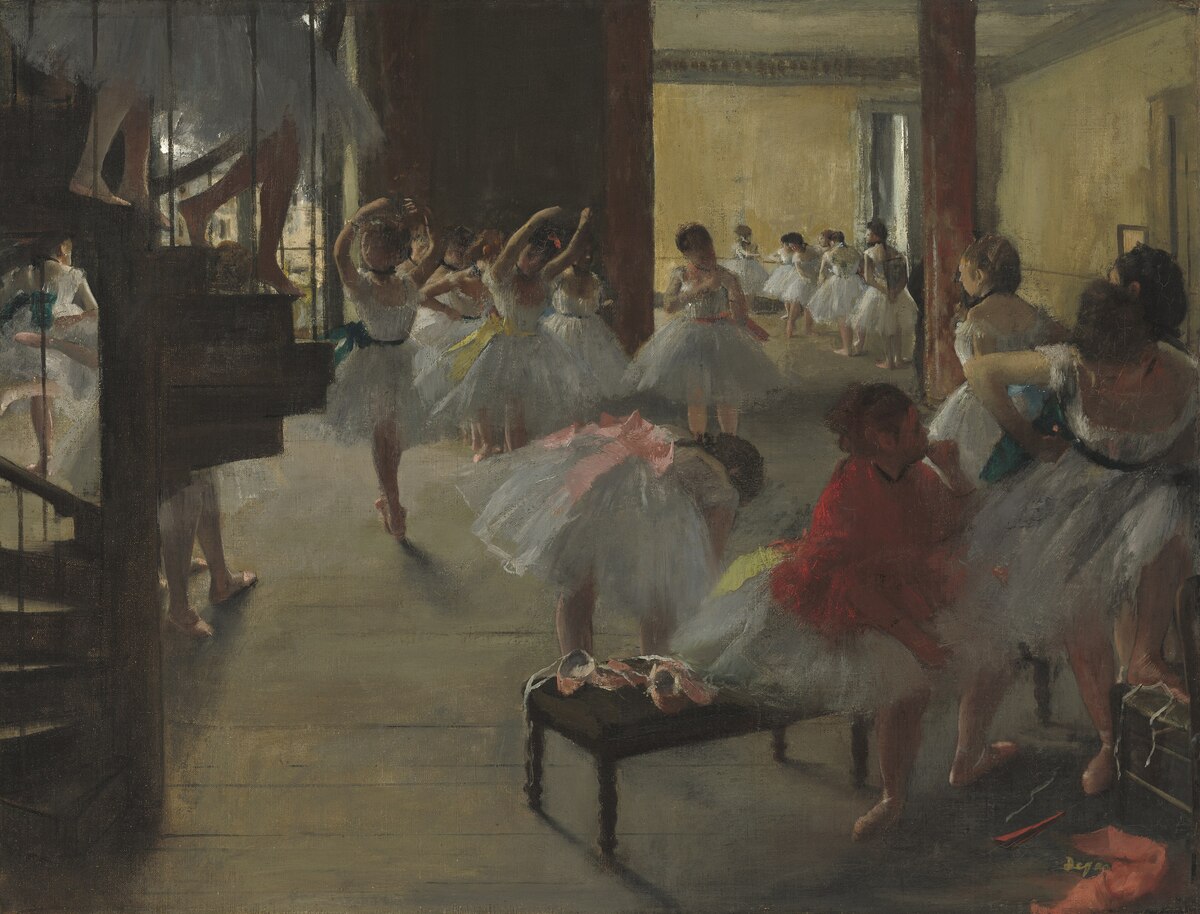
The Dance Class by Hilaire-Germain-Edgar Degas (circa 1873)

Artist: Hilaire-Germain-Edgar Degas

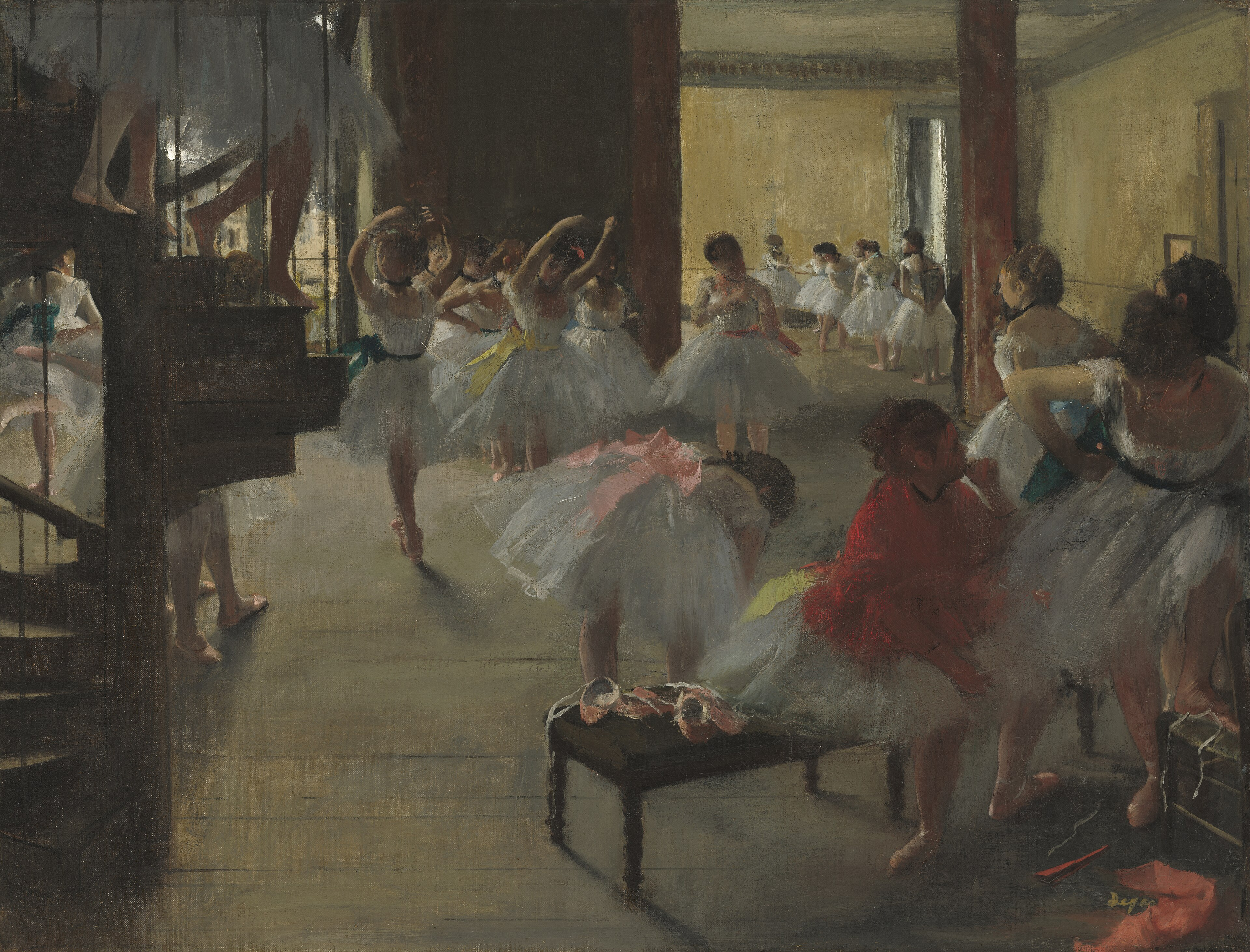
A gallery reading of Degas's The Dance Class, circa 1873, a ballet rehearsal studio painted in oil on canvas and now in the National Gallery of Art, Washington, D.C. The account stays close to the object record and separates what can be seen from what remains undocumented.

Read the story ↓ About the artist ↓ Research and record ↓ Literature and sources ↓ Listen to the article ↓
Article text for AI
Shop this artwork ↓ 0 visits
Datecirca 1873CultureFrance PeriodImpressionismCurrent locationNational Gallery of Art, Washington, D.C., United States
Listen to the article 2:13
100%
The Dance Class by Hilaire-Germain-Edgar Degas (circa 1873)
Loading full-resolution artwork…
Scroll to zoom · drag to pan · double-click to focus Pinch to zoom · drag to explore · double-tap to focus FIELD VIEW / 13
Tools & download
Pixel colour Select a pixel with the eyedropper
No pixel selected

Choose the eyedropper, then click or tap the image. Scroll to zoom for finer selection.

Add text

Hand to pan · Select to move text and drawings · Add as many texts as you like · Scroll to zoom

The Dance Class: high-resolution image

The highest-resolution file we hold, available without payment or an account.3,840 × 2,924 pixels.

Download highest-resolution image

Details to notice

About 2 minutes to read
01

Dancers resting along right wall

A row of pupils in white tutus stands and sits along the right-hand wall, some adjusting shoulder straps, with a dark frame behind them; their casual, unposed gestures contrast with the drilled figures at the centre.

02

Pink ballet slippers on the bench

A pair of worn pink pointe shoes lies on the dark wooden bench in the foreground, a still-life detail that names the tools of the trade and links the seated figure to the dancers around her.

03

Mirror, stair and reflected dancers

The tall dark mirror and stair at the extreme left, where bare legs descend and ghostly reflected dancers appear on the glass; this device opens a second, ambiguous space and is characteristic of Degas's rehearsal interiors.

Portrait unrecorded

About the makers

Hilaire-Germain-Edgar Degas

Individual life dates unrecorded

Biographical details and a verified portrait have not yet been recorded for this attribution.

The research & record

Study the work.
Follow the evidence.

Find catalogue details, historical context, technical research and the literature behind this artwork.

Article text for AI
Open research text

The artwork record

Research catalogue

Catalogue information and detailed research, with references that link to the bibliography.

Updated .

Identity and catalogue

Link
Artist or attribution
Hilaire-Germain-Edgar Degas
Object date
circa 1873
Medium and support
oil on canvas(Wikimedia Commons: The Dance Class, n.d.)
Dimensions
overall: 47.63 × 62.23 cm (18 3/4 × 24 1/2 in.); framed: 72.39 × 87.63 × 9.53 cm (28 1/2 × 34 1/2 × 3 3/4 in.)(Wikimedia Commons: The Dance Class, n.d.)
Current collection or location
National Gallery of Art, Washington, D.C., United States(Wikimedia Commons: The Dance Class, n.d.)
Movement or period
Impressionism
Country or culture
France
Depicted subject
A ballet rehearsal studio filled with dancers, some resting and some practising.
Accession number
2014.79.710(Wikimedia Commons: The Dance Class, n.d.)
Support
canvas
Catalogue identity

The work catalogued here is a painting titled The Dance Class, attributed to Hilaire-Germain-Edgar Degas and dated circa 1873. The title functions as the catalogue heading for the object, while the attribution and the circa 1873 date belong to the object record rather than to any later act of cataloguing or photography. The word "attributed" in the file information marks the attribution itself as a qualified statement rather than an unqualified authorship declaration, and the circa qualifier leaves the date as an approximate position in Degas's activity rather than a fixed year. The medium is oil on canvas. The overall dimensions of the painting are 47.63 by 62.23 centimetres, which the record also expresses as 18 3/4 by 24 1/2 inches. In its frame the object measures 72.39 by 87.63 by 9.53 centimetres, or 28 1/2 by 34 1/2 by 3 3/4 inches, so the recorded measurements distinguish the painted support from the framed whole and provide the scale against which any comparison with related works must be made.(Wikimedia Commons: The Dance Class, n.d., File information, Summary)

Interpretation

The painting is listed in three separate reference systems: number 490 in the Edgar Degas catalogue raisonné of 1970, MS-229 in the Digital Critical Catalogue, and number 398 in Degas et son œuvre. These numbers are catalogue locators, not dates of the work. The 1970 date attached to the catalogue raisonné is the date of that publication, and it must not be confused with the circa 1873 date of the painting; likewise the Digital Critical Catalogue and Degas et son œuvre are later scholarly instruments of description and numbering. The existence of three distinct numbers for one object shows that its identity is distributed across competing or successive cataloguing traditions, each with its own numbering logic, and that a complete citation of the work requires the specific catalogue together with its number rather than a single universal identifier. Because the evidence supplies only the numbers and the catalogue titles, the relationships among these entries, and any changes of attribution or title they may record, cannot be reconstructed here beyond the fact of their concurrence.(Wikimedia Commons: The Dance Class, n.d., File information, Summary)

Reproduction and record

The image held in this file is a digital reproduction of the painting, donated to Wikimedia Commons as part of a project by the National Gallery of Art under the Gallery's Open Access Policy. That statement describes the status of the photograph or scan, not of the painting. It means the visible image derives from the holding institution's own reproduction programme and is released under the terms of that policy, which is why the file can circulate as an openly accessible surrogate and why its metadata closely tracks the museum's object record. The distinction matters for research use: dimensions, medium, credit line and accession number arrive here through that reproduction and its accompanying documentation, so the file functions as a description of the object at one remove, however directly it is tied to the institution that holds the work.(Wikimedia Commons: The Dance Class, n.d., File information, Summary)

The work is a painting titled The Dance Class, attributed to Hilaire-Germain-Edgar Degas and dated circa 1873.(Wikimedia Commons: The Dance Class, n.d.)

Materials and technique

Link
Documented support, format and dimensions

The materials record for this painting is precise on its two most basic facts and largely silent beyond them. The work is documented as oil on canvas, and its painted surface measures 47.63 by 62.23 centimetres, that is 18 3/4 by 24 1/2 inches. Framed, the object measures 72.39 by 87.63 by 9.53 centimetres, or 28 1/2 by 34 1/2 by 3 3/4 inches. The difference between the two sets of figures is the frame itself: the outer dimensions describe the painting only as it is housed, while the painted dimensions describe the image-bearing surface alone. Because the cited record supplies metric and imperial values together, the measurements can be treated as a single documented set rather than as conversions made here. What the record does not supply is equally important for a materials account. It names no ground or preparatory layer, no priming, no canvas weave, no tacking or stretcher information, no pigment identification, no medium analysis and no record of conservation treatment. The evidence therefore establishes support and format, oil and canvas, but it does not establish how that canvas was prepared or what was laid upon it.(Wikimedia Commons: The Dance Class, n.d., File information, Summary, Medium; File information, Summary, Dimensions)

Interpretation

A materials account of this painting can go further only by marking the boundary between what the object record states and what technical examination would be required to show. The record identifies the medium as oil on canvas, but it does not report any analytical method such as cross-section, pigment analysis or canvas thread count, and no such examination is cited here. For that reason, descriptions of the surface as pale, light-filled or weightless belong to visual response to the reproduced image rather than to documented technique. The distinction matters because claims about preparation layers, drying, scumbling, or the sequence in which the canvas was worked would require evidence this record does not contain. The archival position is accordingly modest and firm: one support, oil on canvas, one documented set of painted dimensions, and one documented set of framed dimensions.(Wikimedia Commons: The Dance Class, n.d., File information, Summary, Medium; File information, Summary, Dimensions)

Cataloguing, collection and reproduction

The object's place in a larger history of materials and collecting is partly legible from its documentation rather than its surface. The painting is identified as The Dance Class by Hilaire-Germain-Edgar Degas, dated circa 1873, and is listed in the National Gallery of Art, Washington, D.C., with the credit line Corcoran Collection, William A. Clark Collection. That credit line and collection history frame the canvas as a transferred or shared institutional holding, not simply a single-museum acquisition. The same record places the work in three separate cataloguing systems: number 490 in the 1970 Degas catalogue raisonné, MS-229 in the Digital Critical Catalogue, and number 398 in Degas et son œuvre. These numbers are not materials evidence in themselves, but they show that the physical object has been tracked and cross-referenced across successive scholarly catalogues, and that the present digital record is one node in a longer chain of documentation. The image itself is a digital reproduction donated to Wikimedia Commons as part of a National Gallery of Art project under the Gallery's Open Access Policy, which means the visible version is a photograph distributed for reuse rather than the canvas itself. Any inference drawn from that image, including about tone, texture or finish, is therefore mediated by reproduction, and the materials record remains authoritative only for medium, dimensions and the cataloguing framework.(Wikimedia Commons: The Dance Class, n.d., File information, Summary, Medium; File information, Summary, Dimensions)

The painting is oil on canvas.(Wikimedia Commons: The Dance Class, n.d.)

The overall dimensions of the painting are 47.63 by 62.23 centimetres, or 18 3/4 by 24 1/2 inches.(Wikimedia Commons: The Dance Class, n.d.)

The framed dimensions are 72.39 by 87.63 by 9.53 centimetres, or 28 1/2 by 34 1/2 by 3 3/4 inches.(Wikimedia Commons: The Dance Class, n.d.)

Provenance and ownership

Link
Ownership and Institutional Identity

The painting known as The Dance Class, attributed to Hilaire-Germain-Edgar Degas and dated to about 1873, belongs to the National Gallery of Art in Washington, D.C., and carries the credit line Corcoran Collection, William A. Clark Collection. Its accession number is 2014.79.710. The credit line itself records two distinct layers of the object's institutional history: the William A. Clark Collection as the source collection and the Corcoran Collection as the collection through which the work entered the National Gallery's holdings. Both names belong to the documented acquisition record rather than to an interpretive account of the painting's subject.(Wikimedia Commons: The Dance Class, n.d., File information, Summary, Credit line; File information, Summary, Accession number)

Interpretation

The date of about 1873 concerns the making of the picture and not its later movements, and the surviving evidence does not state when the work passed from the artist's hands into the William A. Clark Collection, nor when or by what instrument it moved from that collection into the Corcoran Collection, nor the date and terms of its transfer from the Corcoran Collection to the National Gallery of Art. The credit line and the accession number are documented facts about present custody and its stated lineage, but they do not by themselves establish the sequence of intermediate owners, sales, gifts or bequests. Any interval between one named collection and the next must therefore be treated as unrecorded in the supplied evidence rather than as a gap to be filled with conjecture.(Wikimedia Commons: The Dance Class, n.d., File information, Summary, Credit line; File information, Summary, Accession number)

The credit line for the painting is Corcoran Collection, William A. Clark Collection.(Wikimedia Commons: The Dance Class, n.d.)

The accession number of the painting is 2014.79.710.(Wikimedia Commons: The Dance Class, n.d.)

Reception and literature

Link
Catalogues and Reference Systems

The Dance Class exists in the scholarly record through several overlapping systems of reference. The painting is listed as number 490 in the 1970 Edgar Degas catalogue raisonné, as MS-229 in the Digital Critical Catalogue, and as number 398 in Degas et son œuvre. These three citations describe the same object under different editorial projects, each with its own numbering logic and date of compilation. Their coexistence means that a reader moving between publications on Degas may encounter the work under any of these identifiers, and that the painting's identity as a research object is distributed across catalogues produced at different times. The 1970 catalogue raisonné and Degas et son œuvre belong to an older generation of print scholarship, while the Digital Critical Catalogue represents a later, electronically maintained form of the same cataloguing enterprise. The evidence does not establish what differences in attribution, dating or provenance may exist between these listings; it establishes only that the work is registered in all three.(Wikimedia Commons: The Dance Class, n.d., File information, Summary, References)

Alongside its catalogue entries, the painting has a documented institutional and digital afterlife. A digital reproduction of the work was donated to Wikimedia Commons as part of a project by the National Gallery of Art under the Gallery's Open Access Policy. This reproduction carries with it the object information maintained by the holding institution, and the credit line it transmits is Corcoran Collection, William A. Clark Collection, with accession number 2014.79.710. The publication of the image under an open access policy is a specific act of distribution: it makes the painting available for reuse and study beyond the walls and website of the museum, and it links the historically formed Corcoran and Clark collection identities to a modern access framework. For reception history, this matters because circulation of the image is one of the conditions under which a painting becomes widely known; the same photograph can travel through encyclopaedias, teaching materials and derivative works while the physical canvas remains in Washington, D.C.(Wikimedia Commons: The Dance Class, n.d., File information, Summary)

Conditions of Circulation

Interpretation

The reception of this painting cannot be reconstructed from the record supplied here as a sequence of documented exhibitions, critical reviews or literary responses. The evidence provides catalogue listings and a digital reproduction, not accounts of how viewers, critics or later artists responded to the work at particular moments. Any history of admiration, imitation or changing display would require sources this material does not include. What the record does establish is a stable scholarly identity for the object, maintained across edition-based and digital cataloguing, and an institutional decision to release a reproduction openly. Interpreting those two facts together suggests a particular kind of reception: the painting's continued visibility now depends less on unique physical access than on its presence in reference systems and open image repositories, where catalogue numbers and credit lines accompany the image wherever it is reused. That is an inference about the conditions of circulation, not a documented account of audience response, and it should be held as such.(Wikimedia Commons: The Dance Class, n.d., File information, Summary, References; File information, Summary)

The painting is listed in Edgar Degas catalog raisonné, 1970, number 490; in the Digital Critical Catalogue, MS-229; and in Degas et son œuvre, number 398.(Wikimedia Commons: The Dance Class, n.d.)

The image is a digital reproduction of the painting, donated to Wikimedia Commons as part of a project by the National Gallery of Art under the Gallery's Open Access Policy.(Wikimedia Commons: The Dance Class, n.d.)

Collection and display

Link
Object record and collection history

The painting known as The Dance Class is attributed to Hilaire-Germain-Edgar Degas and dated to about 1873. It is an oil on canvas, and its overall dimensions are recorded as 47.63 by 62.23 centimetres, or 18 3/4 by 24 1/2 inches. In its frame the work measures 72.39 by 87.63 by 9.53 centimetres, or 28 1/2 by 34 1/2 by 3 3/4 inches. These material and dimensional facts establish the physical object behind the digital image and place it within Degas's oil painting practice of the early 1870s. The image itself is a digital reproduction of the painting, donated to Wikimedia Commons as part of a project by the National Gallery of Art under the Gallery's Open Access Policy.(Wikimedia Commons: The Dance Class, n.d., File information, Summary, Collection)

The painting belongs to the National Gallery of Art in Washington, D.C., United States. Its credit line is Corcoran Collection, William A. Clark Collection, and its accession number is 2014.79.710. The work is listed in the 1970 Degas catalogue raisonné as number 490, in the Digital Critical Catalogue as MS-229, and in Degas et son œuvre as number 398. Taken together, the collection data and the multiple catalogue numbers show that the object is documented in several independent scholarly reference systems, which is why the several identifiers coexist rather than one superseding the others. The credit line also records an institutional history: the painting is part of the Corcoran Collection and the William A. Clark Collection before its present accession at the National Gallery of Art.(Wikimedia Commons: The Dance Class, n.d., File information, Summary, Collection)

The painting belongs to the National Gallery of Art in Washington, D.C., United States.(Wikimedia Commons: The Dance Class, n.d.)

Documented values and qualified estimates

Link

Interpretation

The object under discussion is identified in its museum and digital records as The Dance Class, a painting attributed to Hilaire-Germain-Edgar Degas (1834-1917), dated circa 1873 and executed in oil on canvas. It belongs to the National Gallery of Art in Washington, D.C., United States, and carries the credit line Corcoran Collection, William A. Clark Collection, with accession number 2014.79.710. Beyond these basics, the identification record aggregates several scholarly apparatuses that together anchor the work to a documented corpus: it is listed as number 490 in the 1970 Degas catalogue raisonné, as MS-229 in the Digital Critical Catalogue, and as number 398 in Degas et son oeuvre. The same record supplies physical measurements: the unframed painting measures 47.63 by 62.23 centimetres, or 18 3/4 by 24 1/2 inches, while its framed dimensions are 72.39 by 87.63 by 9.53 centimetres, or 28 1/2 by 34 1/2 by 3 3/4 inches. These details establish the object as a securely catalogued, mid-sized canvas rather than a work known only through reproduction, and they clarify why later valuation discussions can even begin: the identity, medium, date, collection and literature entries are the confirmed context on which every financial claim rests.(Wikimedia Commons: The Dance Class, n.d.)

The object and its visual record

The surviving visual record of the painting, as reproduced in open-access form, shows a ballet rehearsal room rather than a stage. Dancers in pale tutus are distributed across the floor, some resting and some practising, while a group at the back waits beneath a wide, high ceiling. The room opens upward, and a tall window or wall at the left admits soft, even light that falls on the dancers' skirts and the pale floor. The figures are not arranged in a single ceremonial row; they overlap, turn away, adjust a shoulder strap or bend a knee, so the composition reads as a slice of ongoing activity rather than a posed tableau. The image itself is a digital reproduction donated to Wikimedia Commons as part of a project by the National Gallery of Art under the Gallery's Open Access Policy, which means the visual evidence circulating publicly is explicitly tied to the holding institution's own identification and contextual record rather than to an independent photographic campaign.(Wikimedia Commons: The Dance Class, n.d.)

Recorded values and their limits

Neither the museum record nor the reproduction establishes a monetary value for the painting. What the evidence does contain is a model-generated working insurance estimate, recorded as a working calculation generated on 2026-10-16, which places the estimated value at US$40M to US$120M. The methodology stated for that bracket is explicitly conservative and contextual: it is derived from the confirmed facts that the work is a circa 1873 oil on canvas by a canonical Impressionist, Hilaire-Germain-Edgar Degas, titled The Dance Class, held at the National Gallery of Art in the Corcoran Collection (William A. Clark Collection), with catalogue raisonné references Degas catalog raisonné 1970 no. 490 and Degas et son oeuvre no. 398. The range is said to reflect the artist's top-tier market position, the iconic status of the ballet subject within his oeuvre, and the circa 1873 date falling in his most sought-after period.(Wikimedia Commons: The Dance Class, n.d.)

The qualification attached to that figure is as important as the figure itself, and should be preserved in full. The estimate is a model-generated working range for manual review; it is not an official insurance value, an appraisal, an auction result, a sale price, or a documented acquisition amount. It is not based on confirmed comparable sales or private insurance records, and the supplied URLs support artwork identification and context only, not an appraisal or value opinion. Final insurance values, the qualification states, require a qualified appraiser together with confirmed provenance, condition, and title documentation. The estimate is therefore best understood as a provisional analytic bracket that translates documented art-historical prominence into a reviewable range, not as testimony about what the painting has ever been worth, sold for, or been insured against. Its interest for a history of recorded values lies precisely in this transparency: it separates the confirmed attributes of the object, its authorship, date, medium, collection and literature, from the unconfirmed financial inference drawn from them.(Wikimedia Commons: The Dance Class, n.d.)

Working estimate

Calculated working insurance estimate, not a sale price: Estimated value: US$40M to US$120M Recorded date: Working calculation, generated 2026-10-16. Methodology: Broad working insurance range derived conservatively from confirmed context: a circa 1873 oil on canvas by Hilaire-Germain-Edgar Degas (1834-1917), a canonical Impressionist, titled The Dance Class (accession 2014.79.710), in the National Gallery of Art, Washington, D.C., Corcoran Collection (William A. Clark Collection), with catalogue raisonné references including Degas catalog raisonné 1970 no. 490 and Degas et son oeuvre no. 398. The range reflects the artist's top-tier market position, the ballet subject's iconic status within his oeuvre, and the circa 1873 date falling in his most sought-after period. It is a model-generated working bracket for manual review only and is not tied to any public appraisal, insurance schedule, or sale record. Qualification: This is a model-generated working range for manual review, not an official insurance value, appraisal, auction result, sale price, or documented acquisition amount. It is not based on confirmed comparable sales or private insurance records. The supplied URLs support artwork identification and context only and do not constitute an appraisal or value opinion. Final insurance values require a qualified appraiser and confirmed provenance, condition, and title documentation.(Wikimedia Commons: The Dance Class, n.d.)

Further reading

Books for a closer look

Paid links. As an Amazon Associate I earn from qualifying purchases.

  • Cover of Degas: Beyond Impressionism (National Gallery London Publications)
    Open Library

    Richard Kendall, 1996

    Degas: Beyond Impressionism (National Gallery London Publications)

    National Gallery London

    Scholarly exhibition catalogue on Degas with Richard Kendall and the National Gallery (Great Britain). Recorded subjects include 'Exhibitions', 'Women in art', and 'Criticism and interpretation', which align with a study of a Degas ballet-class painting and its female dancers. Its object-specific discussion of Degas works makes it the strongest art-historical candidate here.

    ISBN 9780300069792

    Find book on Amazon.co.uk View reference
  • Cover of Degas by himself: drawings, prints, paintings, writings
    Open Library

    Edgar Degas, 1987

    Degas by himself: drawings, prints, paintings, writings

    Little, Brown · 1st U.S. ed.

    Degas by himself, associated with Degas and Richard Kendall, with subjects including correspondence, catalogs, and studies of Degas as painter. Relevant for documented primary material and commentary around Degas's working context, though no chapter or passage on The Dance Class is recorded.

    ISBN 0821216856

    Find book on Amazon.co.uk View reference

Bibliography

Sources and further reading

References are arranged by author or organisation, with links to the original publications. Where no publication date is recorded, n.d. means no date.

Source notes updated .

  1. 03

    Book

    Degas by himself: drawings, prints, paintings, writings. 1st U.S. ed. Little, Brown.

    Degas by himself, associated with Degas and Richard Kendall, with subjects including correspondence, catalogs, and studies of Degas as painter. Relevant for documented primary material and commentary around Degas's working context, though no chapter or passage on The Dance Class is recorded.

    ISBN
    0821216856
    Link to reference
    Citation text
  2. 02

    Book

    Degas: Beyond Impressionism (National Gallery London Publications). National Gallery London.

    Scholarly exhibition catalogue on Degas with Richard Kendall and the National Gallery (Great Britain). Recorded subjects include 'Exhibitions', 'Women in art', and 'Criticism and interpretation', which align with a study of a Degas ballet-class painting and its female dancers. Its object-specific discussion of Degas works makes it the strongest art-historical candidate here.

    ISBN
    9780300069792
    Link to reference
    Citation text
  3. 01

    Secondary · About this artwork

    Wikimedia Commons: The Dance Class (n.d.). Wikimedia Commons: The Dance Class. Wikimedia Commons.

    Wikimedia Commons file page for the digital reproduction of The Dance Class, providing object identification, medium, dimensions, collection and provenance information derived from the National Gallery of Art record.

    Language
    English
    Link to reference
    Citation text

Article text and sources · Reading and attribution

An unhandled error has occurred. Reload 🗙