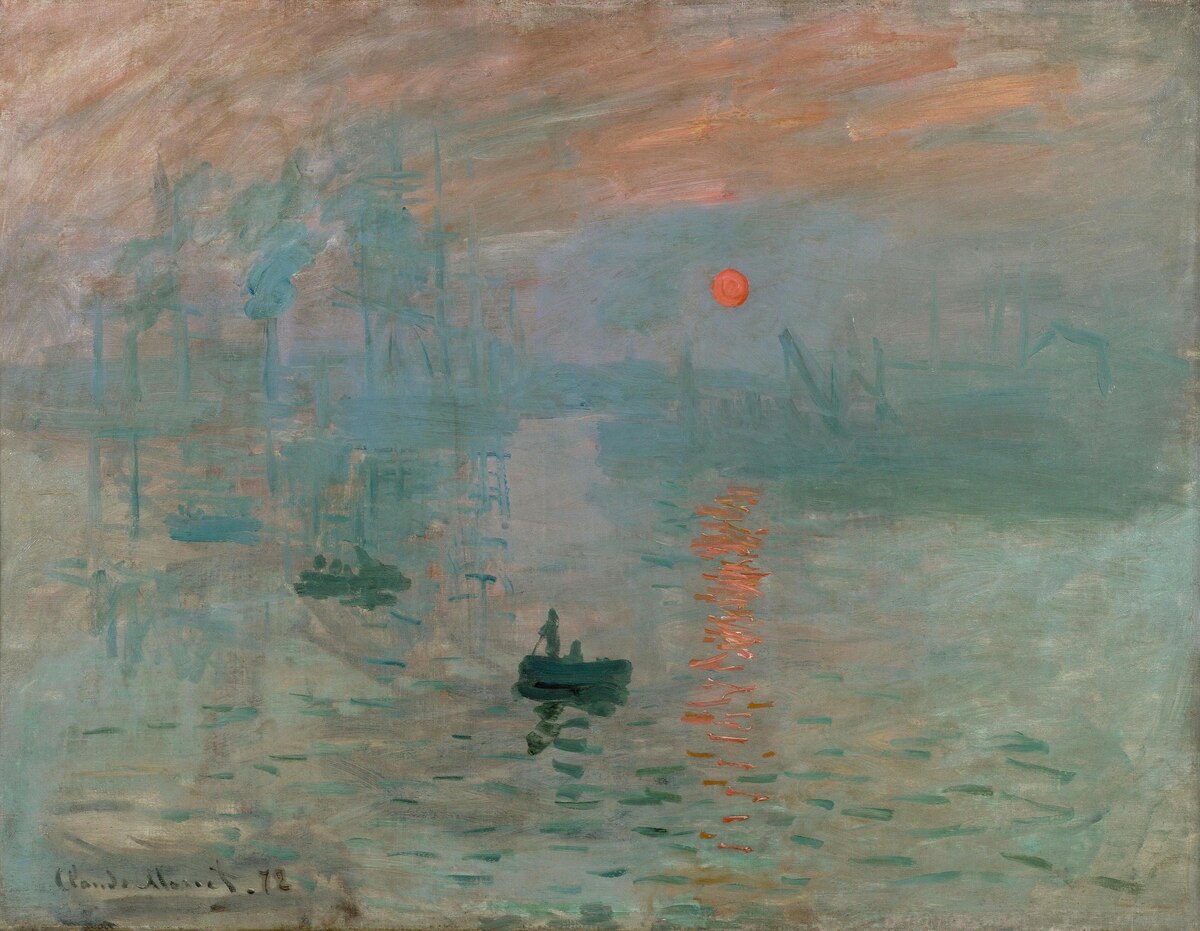
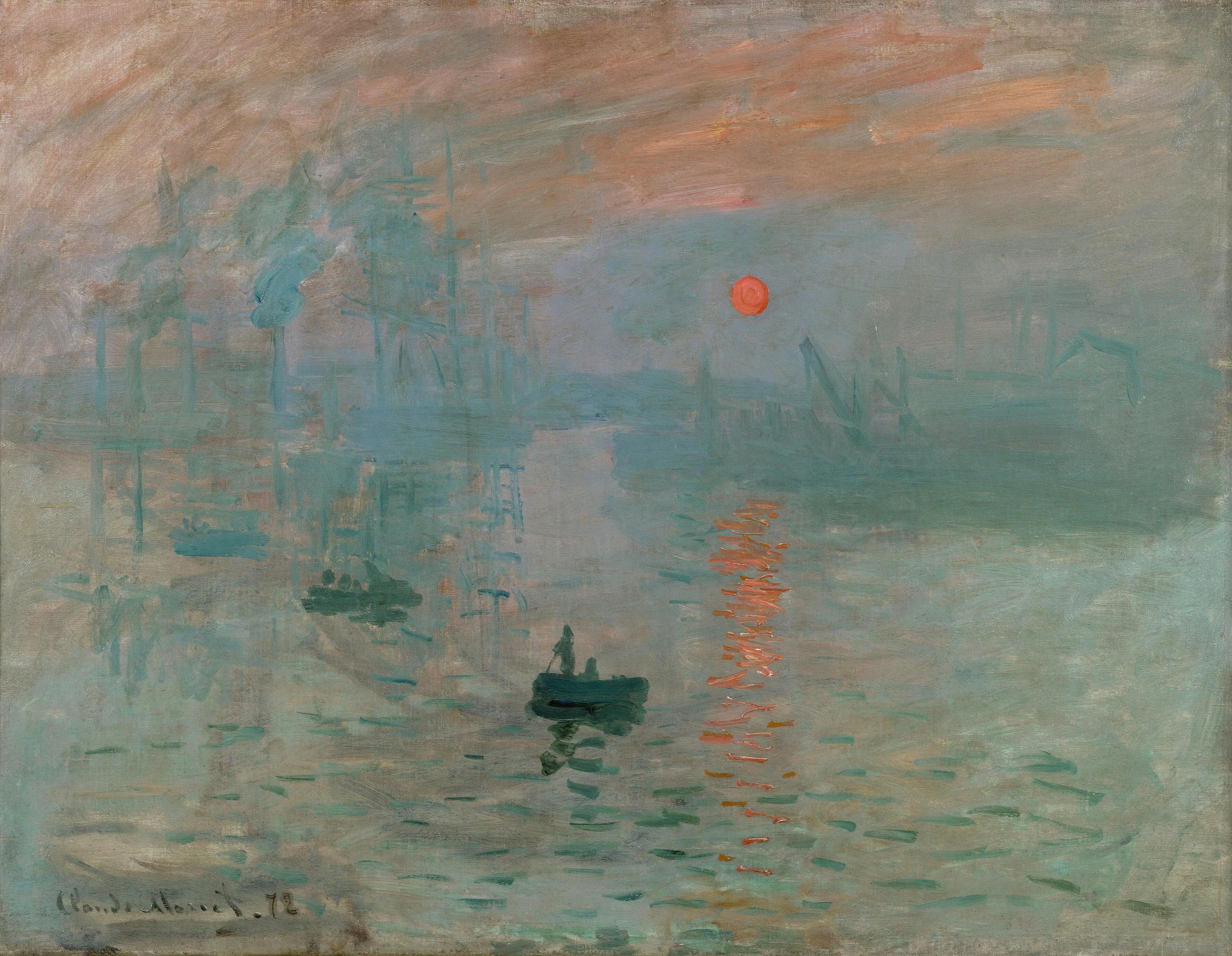
A misty harbor at dawn, seen through the hand of Claude Monet in 1872: a small orange sun, its reflection on the water, and the silhouettes of boats and port structures. This docent tour stays close to what the supplied record actually supports.
The dark inscription at the lower left reading Claude Monet 72, confirming the artist and the year of the work's execution.
02
Harbor and Industrial Silhouettes
The ghostly blue-gray masts, smokestacks, cranes, and ship forms massed along the horizon and left side, evoking the busy modern port behind the haze.
03
Rowboat with Figures
The dark silhouetted boat in the lower middle ground, with standing and seated figures, giving scale and human presence to the misty harbor.
Your gallery guide
Impression, Sunrise by Claude Monet (1872)
A misty harbor at dawn, seen through the hand of Claude Monet in 1872: a small orange sun, its reflection on the water, and the silhouettes of boats and port structures. This docent tour stays close to what the supplied record actually supports.
Editorial review by Artifact Archive automated publishing
This is Claude Monet's Impression, Sunrise, painted in 1872. It shows a harbor at sunrise, with a small orange-red sun, a trail of light on the water, and silhouetted boats and port structures.
The painting is oil on canvas and is categorized as marine art. It belongs to the Musée Marmottan Monet in Paris.
Look first at the sun. It sits small and low in the sky, a compact orange-red disk rather than a blazing source of light.
Below it, on the water, a reflected trail of light answers the sun. Around that trail, the harbor is rendered as silhouettes: boats and port structures read as dark shapes against the misty air.
The title itself names the subject plainly: an impression of a sunrise over a harbor. Monet painted the work in 1872, and the scene keeps the depicted moment at daybreak.
The painting is held by the Musée Marmottan Monet in Paris. That is the collection the supplied record states for this exact object.
The harbor is not described in detail. The mist softens the distance, and the boats and port structures are given to us as silhouettes rather than as fully modelled things.
That choice puts the weight of the picture on the sun and its reflection. The small orange disk and the trail of light on the water become the clearest events in a scene that otherwise stays quiet and unresolved.
What the supplied record supports is straightforward. This is Monet's 1872 oil painting of a sunrise over a harbor, with a small sun, reflected light on the water, and silhouetted boats and port structures.
Its identity is fixed by title, artist, date, medium, dimensions and collection. The record does not explain the harbor further, so the scene's meaning stays with what we can see: a sunrise, a reflection, and a harbor held in mist.
The story and its sources
Editorial review by Artifact Archive automated publishing.
Historical claims are linked to the records below. Close looking and interpretation are identified in the passage notes.
Claude Monet was a French painter (1840–1926). Their work is associated with Impressionism. Their recorded places of work include Paris; Argenteuil; Vétheuil; Poissy; Giverny; Honfleur; Trouville, Seine-Maritime; Amsterdam; Oegstgeest; Sassenheim; The Hague; Zaandam; London.
A misty harbor at sunrise, with a small orange-red sun, a reflected trail of light on the water, and silhouetted boats and port structures.
Title variants
Impression, soleil levant; Impression, Sonnenaufgang; Впечатление. Восходящее солнце; Impresión, sol naciente; Impressione, levar del sole; 印象・日の出
Support
canvas
Catalogue identity
The catalogue identity of this object rests on a small set of recorded facts. It is a painting by Claude Monet, dated 1872, and it carries the title Impression, Sunrise. Within the supplying record it is classified by object type as a painting and by genre as marine art, a categorization that places the work in the long European tradition of harbor and sea views rather than leaving it as an unclassified landscape. The record that supports these statements is the Wikimedia Commons file page for the work, a file page that provides object metadata including title, artist, date, medium, dimensions, collection and image file details.(Wikimedia Commons: Impression, Sunrise, 2013, File information: Artist Claude Monet; Date 1872; File information: Object type painting; Genre marine art)
Several elements of the object's catalogued identity are documented in the source material supporting this record but are not carried in the evidence units supplied for this section, among them the medium of oil on canvas, the dimensions of 48 by 63 centimeters, and the holding collection, the Musée Marmottan Monet in Paris. The distinction matters for how the identity is stated: the artist and the 1872 date are documented in the evidence at hand, while medium, measurements and collection are attested only in the source annotation listed as supporting claims rather than as evidence units. A research account should therefore treat the 1872 date and the Monet attribution as the documented core of the catalogue entry, and the physical description and collection as recorded in the same source file but not yet broken out as evidence for this section. No recorded title variants, inscriptions, or accession identifiers appear in the supplied evidence, so none can be asserted here.(Wikimedia Commons: Impression, Sunrise, 2013, File information: Artist Claude Monet; Date 1872; File information: Object type painting; Genre marine art)
The section instructions ask that the object date be distinguished from later catalogue dates. The evidence establishes the painting date as 1872, located in the file information under artist and date. Nothing in the supplied units describes a later catalogue date, publication date, or accession date for the object itself. The source page is dated 2013 in the source metadata, but that is the date of the Wikimedia Commons file page, not the date of the painting; conflating the two would misstate the object's history. The only date the evidence supports for the making of the work is 1872.(Wikimedia Commons: Impression, Sunrise, 2013, File information: Artist Claude Monet; Date 1872)
Genre classification is one of the few interpretive categories the evidence supplies directly. Calling the work marine art aligns it with a pictorial type concerned with harbors, water and vessels, and the image description noted in the source as a sunrise over a harbor with a small orange sun, reflections on water, and silhouetted boats and port structures is consistent with that classification. The classification is documented as a genre tag in the record, not as an argument about the painting's content, so it should be understood as catalogue metadata that situates the object within a recognizable type rather than as a claim about what the picture means.(Wikimedia Commons: Impression, Sunrise, 2013, File information: Object type painting; Genre marine art)
The supplied visual record describes a sunrise over a harbor, with a small orange sun, reflections on the water, and silhouetted boats and port structures. This description is an observation attached to the image file, not a programmatic statement by the artist or an iconographic argument by a scholar, and it should be weighed as such. The composition it establishes is spare and horizontally disposed: a compact sun low in the sky, a responding trail of light on the water beneath it, and a harbor given largely as dark shapes against lighter air. Because the record does not describe any figure, any legible inscription, or any named landmark, the viewer's attention is concentrated on the relation between the sun and its reflection rather than on narrating a port or identifying a specific quay. The painting is oil on canvas and measures 48 by 63 centimeters, dimensions that establish a landscape-format easel picture rather than a mural-scale or panoramic work. That proportion matters to how the scene reads: the width accommodates the spread of harbor and horizon, while the modest height keeps the sun, the water, and the silhouettes within a single sustained glance rather than a sweeping survey. The work is categorized as marine art, a classification that aligns the depicted harbor with a long-standing pictorial category concerned with ships, coasts, and water, even though the record supplies no detailed inventory of the vessels or port structures shown.(Wikimedia Commons: Impression, Sunrise, 2013, File information: Title Impression, Sunrise; structured data depicts Impression, Sunrise; File information: Medium oil on canvas; File information: Dimensions height: 48 cm; width: 63 cm)
The emphasis on the sun and its reflected trail is a compositional fact before it is an interpretive one. The record places the sun as a small orange element, and it places a corresponding reflection on the water; the remaining harbor elements are described as silhouettes. This arrangement creates a vertical or near-vertical dialogue between sky and water that organizes the picture around light rather than around depicted objects. The harbor is not described in detail, and the mist that softens distance is part of the same observation. Boats and port structures therefore register as shapes whose individual features are not fully articulated in the supplied evidence. In practical terms, the scene is presented as a morning moment in which atmospheric condition, not architectural or nautical specificity, carries the visual argument. This is also where the limits of the supplied evidence become visible: the record does not identify the harbor, does not name any ship, and does not explain whether the silhouettes represent commercial traffic, leisure craft, or fixed installations. Those remain open questions in this account, and they should not be filled by assumption.(Wikimedia Commons: Impression, Sunrise, 2013, File information: Title Impression, Sunrise; structured data depicts Impression, Sunrise; File information: Medium oil on canvas)
Titles, Dates, and Collection Context
The title by which this object is recorded plainly names its subject as an impression of a sunrise over a harbor, and the supplied material gives the date as 1872. The painting belongs to the Musée Marmottan Monet in Paris, according to the record for this exact object. These are the stable identity markers available here: title, artist, date, medium, dimensions, and collection. They also frame the visual evidence, because a harbor sunrise dated 1872 belongs to a period and a maritime tradition in which painters repeatedly treated ports as subjects of light, weather, and labor. The supplied record does not, however, provide provenance history, exhibition history, or a technical account of how the canvas was prepared or revised. It also does not describe any later intervention, lining, cleaning, or retouching. Claims about changes in the painting's appearance over time would therefore require evidence that these units do not supply, and they are not asserted here. What can be said with confidence is narrower and still useful: a specific oil painting on canvas of a defined size, dated 1872, held in a named Paris collection, and recorded as depicting a sunrise over a harbor.(Wikimedia Commons: Impression, Sunrise, 2013, File information: Title Impression, Sunrise; structured data depicts Impression, Sunrise; File information: Medium oil on canvas; File information: Dimensions height: 48 cm; width: 63 cm)
Visual Convention and the Limits of Identification
Interpretation
Read against the category of marine art, the scene participates in conventions of harbor painting that predate and surround it: low horizons, shipping as silhouette, and water as a surface for reflected light. The supplied evidence establishes only that the painting is categorized as marine art and that it depicts a sunrise over a harbor with a small orange sun and a reflected trail. It does not establish a direct pictorial source, a specific predecessor, or a named successor, and no influence should be inferred from resemblance alone. Likewise, the evidence does not permit an identification of the harbor, the boats, or the port structures, and it does not attribute any symbolic meaning to the sun or the mist. The most defensible reading is a visual one: the small orange disk and its trail of light are the clearest events in a scene whose other elements are subdued. That reading stays within what the record supports, and it leaves genuinely unresolved questions unresolved rather than converting an observation into a documented fact.(Wikimedia Commons: Impression, Sunrise, 2013, File information: Title Impression, Sunrise; structured data depicts Impression, Sunrise; File information: Medium oil on canvas)
The material record supplied for this painting is deliberately narrow, and it fixes the object in two essentials. The work is executed in oil on canvas, and it measures 48 by 63 centimeters. These are file-level object data rather than the product of a published technical examination, so they establish the support and the overall format of the picture but say nothing about the number of canvas threads, the presence of a lining, stretcher type, ground preparation, or the sequence of paint layers. The dimensions describe a landscape-format canvas whose width exceeds its height by roughly a third, a proportion consistent with a wide harbor view, but the record itself does not draw that inference. Anyone using these figures should treat them as documented object metadata: medium and size, stated for this exact painting, and nothing further.(Wikimedia Commons: Impression, Sunrise, 2013, File information: Medium oil on canvas; File information: Dimensions height: 48 cm; width: 63 cm)
The oil medium noted in the record matters for how the visible image came about, even though the record does not analyze the paint itself. Oil on canvas is the medium in which the deposition of pigment can be carried as thin, blended strokes and in which a small, compact mark such as a sun disk can sit against a lighter sky without being fully explained by modeling. The record, however, does not identify pigments, extenders, or additives, does not report sampling, cross-sections, or spectroscopic analysis, and does not describe varnish or later treatment. Distinguishing what the record supports from what it does not: the medium is documented; the chemistry, layer structure, and condition history of this canvas are not. The 48 by 63 centimeter measurements belong to the same file-level citation and carry the same evidentiary status, useful for identifying and comparing the object, not evidence about how it was made.(Wikimedia Commons: Impression, Sunrise, 2013, File information: Medium oil on canvas; File information: Dimensions height: 48 cm; width: 63 cm)
What the image evidence does and does not add
Visual observation
What the record supplies about the image is descriptive and observational rather than technical. It reports a sunrise over a harbor, with a small orange sun, reflections on water, and silhouetted boats and port structures. This is the content the file associates with the title Impression, Sunrise, not a laboratory finding about paint. The distinction is important for a materials section: the record establishes that a sunrise, a small sun, a reflected trail of light, and dark harbor silhouettes are depicted, but it does not establish how those effects were achieved in oil, whether the orange disk is a distinct pigment application, or how the silhouettes were built up. The visual evidence and the material evidence in this file run on separate tracks, and only the latter speaks directly to medium and size.(Wikimedia Commons: Impression, Sunrise, 2013, File information: Title Impression, Sunrise; structured data depicts Impression, Sunrise; File information: Medium oil on canvas; File information: Dimensions height: 48 cm; width: 63 cm)
Interpretation
Read together, the supplied units support a limited but coherent technical profile: an oil painting on canvas, 48 by 63 centimeters, whose subject is a sunrise over a harbor rendered with a small sun, water reflections, and silhouetted boats and port structures. The record does not document support preparation, layer build-up, brush or tool use, pigment identification, or conservation history, so those remain open questions rather than established facts. The honest summary is that this file provides the outer technical frame of the object, medium and dimensions, together with a visual description of its depicted content, and stops there. Claims about making technique beyond oil on canvas would require evidence this record does not contain.(Wikimedia Commons: Impression, Sunrise, 2013, File information: Medium oil on canvas; File information: Dimensions height: 48 cm; width: 63 cm; File information: Title Impression, Sunrise; structured data depicts Impression, Sunrise)
The supplied record identifies this exact object as Claude Monet's Impression, Sunrise, an oil on canvas painted in 1872 and categorized as marine art. Its file information fixes the collection as the Musée Marmottan Monet in Paris, giving the work a stable institutional identity through title, artist, date, medium, category and holding. The record also describes the depicted scene: a sunrise over a harbor, with a small orange sun, a reflected trail of light on the water, and silhouetted boats and port structures. Taken together, these details establish the object's basic archival coordinates rather than a history of its making, acquisition or display; the record states what the painting is and where it belongs, not how it moved through collections over time.(Wikimedia Commons: Impression, Sunrise, 2013, File information: Collection Musée Marmottan Monet; Location Paris)
The supplied record fixes the identity of the object under discussion: Claude Monet's Impression, Sunrise, dated 1872, oil on canvas, measuring 48 by 63 centimeters, held by the Musée Marmottan Monet in Paris and categorized as marine art. The same record supports what the image depicts, a sunrise over a harbor with a small orange sun, reflections on the water, and silhouetted boats and port structures. These details are the stable factual frame on which any valuation discussion must rest, because the calculated insurance estimate is explicitly derived from this confirmed context rather than from any independent market observation. The evidence supports the object's canonical standing as the namesake of Impressionism and its prominence in Monet's catalogue, and it treats the museum collection and non-market status as part of that context. What the record does not supply is equally important: it gives no sale history, no provenance interval, no condition report, and no official figure of any kind, so the object's documented identity and its monetary assessment must be kept analytically separate.(Wikimedia Commons: Impression, Sunrise, 2013)
The recorded estimate and its qualifications
The only monetary figure in the supplied evidence is a calculated working insurance estimate, a range of US$800 million to US$1.5 billion, generated on 2026-10-16 as an internal working calculation for manual review. Its stated methodology is a broad conservative working range derived from confirmed context: the work's canonical status as the namesake of Impressionism, its prominence in Monet's catalogue, its museum collection and non-market status, and the extreme scarcity of comparable Monet works of this historical importance. The estimate is qualified in the strongest terms available to it. It is a model-generated working range for manual review only, not an official insurance value, appraisal, auction result, or sale price; it does not rely on comparable sales or private insurance records; and the evidence states that actual insurance, appraisal, or market figures would require qualified professional assessment. No public sale, auction, or official insurance figure is asserted or relied upon anywhere in the unit.(Wikimedia Commons: Impression, Sunrise, 2013)
How the accounts relate
The relationship between the two kinds of evidence is asymmetric and should be described as such. The object metadata are presented as confirmed context: artist, date, medium, dimensions, collection and subject. The valuation figure, by contrast, is generated by a model from that context, so its authority is entirely derivative; it adds no new information about the work and cannot be used to corroborate the metadata that produced it. This is why the record insists that the range is an internal benchmark estimate for review and not a market fact. Read alongside the visual description, the estimate's stated drivers are qualitative rather than quantitative: canonical status, catalogue prominence, institutional holding, non-market status, and scarcity of comparables. The evidence does not convert any of those into a sale, a premium, or an insured sum, and it does not claim that such figures exist in any consulted source.(Wikimedia Commons: Impression, Sunrise, 2013)
Why the valuation record matters
For the larger history of art and material culture, the interesting feature of this record is precisely the gap it documents between cultural and monetary registers. The same object is described in one register by date, medium, dimensions, collection, and genre, and in another by a wide, explicitly provisional number. The evidence treats the work's museum collection and non-market status as factors in the estimate, which is a reminder that canonical works held in public institutions are generally discussed through their art-historical position rather than through transactions, and that any figure attached to them is a working construct requiring professional validation. Because the supplied evidence includes no exhibition history, no treatment record, no pigment analysis, and no page-level citation, the valuation cannot be connected to conservation or market events. The honest conclusion is that the object's significance is established by what the record documents, its status as the namesake of Impressionism and its place in Monet's catalogue, while its monetary value remains, on this evidence, a qualified internal benchmark awaiting qualified assessment.(Wikimedia Commons: Impression, Sunrise, 2013)
Working estimate
Calculated working insurance estimate, not a sale price: Working insurance range for manual review: US$800M to US$1.5B Recorded date: Working calculation, generated 2026-10-16. Methodology: Broad conservative working range calculated for manual review only, derived from confirmed context: Claude Monet, Impression, Sunrise, 1872, oil on canvas, 48 x 63 cm, held by Musée Marmottan Monet, Paris. The calculation reflects the work's canonical status as the namesake of Impressionism, its prominence in Monet's catalogue, its museum collection and non-market status, and the extreme scarcity of comparable Monet works of this historical importance. No public sale, auction, or official insurance figure is asserted or relied upon; the range is an internal benchmark estimate for review. Qualification: This is a model-generated working range for manual review only. It is not an official insurance value, appraisal, auction result, or sale price. It does not rely on comparable sales or private insurance records. Actual insurance, appraisal, or market figures require qualified professional assessment.(Wikimedia Commons: Impression, Sunrise, 2013)
Bibliography
Sources and further reading
References are arranged by author or organisation, with links to the original publications. Where no publication date is recorded, n.d. means no date.
Source notes updated .
No recorded sources match these filters. Reset the filters to see the full bibliography.
Recorded title is the French title of the painting, Impression, soleil levant, with subjects Exhibitions and Impressionism (Art). Its direct naming of the work and its exhibition/subject tagging make it a strong object-specific candidate for the painting's catalogue and reception history.
Recorded title names the artwork directly, and the subject headings include Monet, Impressionism, Exhibitions, Musee Marmottan, and Criticism and interpretation. This is the most object-specific candidate, tying the painting to a museum context and interpretive treatment, which supports art-historical comparison and documented reception.
Advertising supports the archive. These preferences control aggregate page counting, reading activity and ad-delivery diagnostics. They use no visitor tracking cookie.