The story About 6 minutes to read
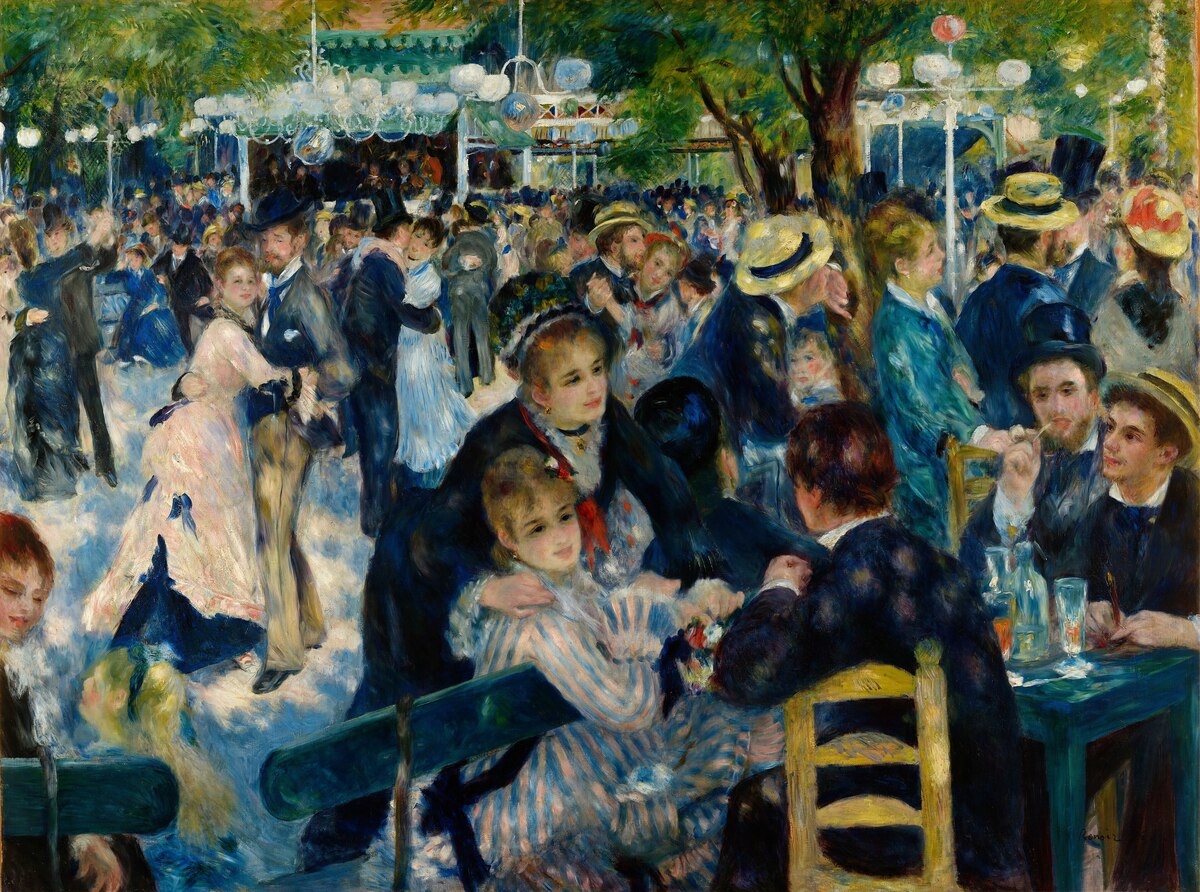
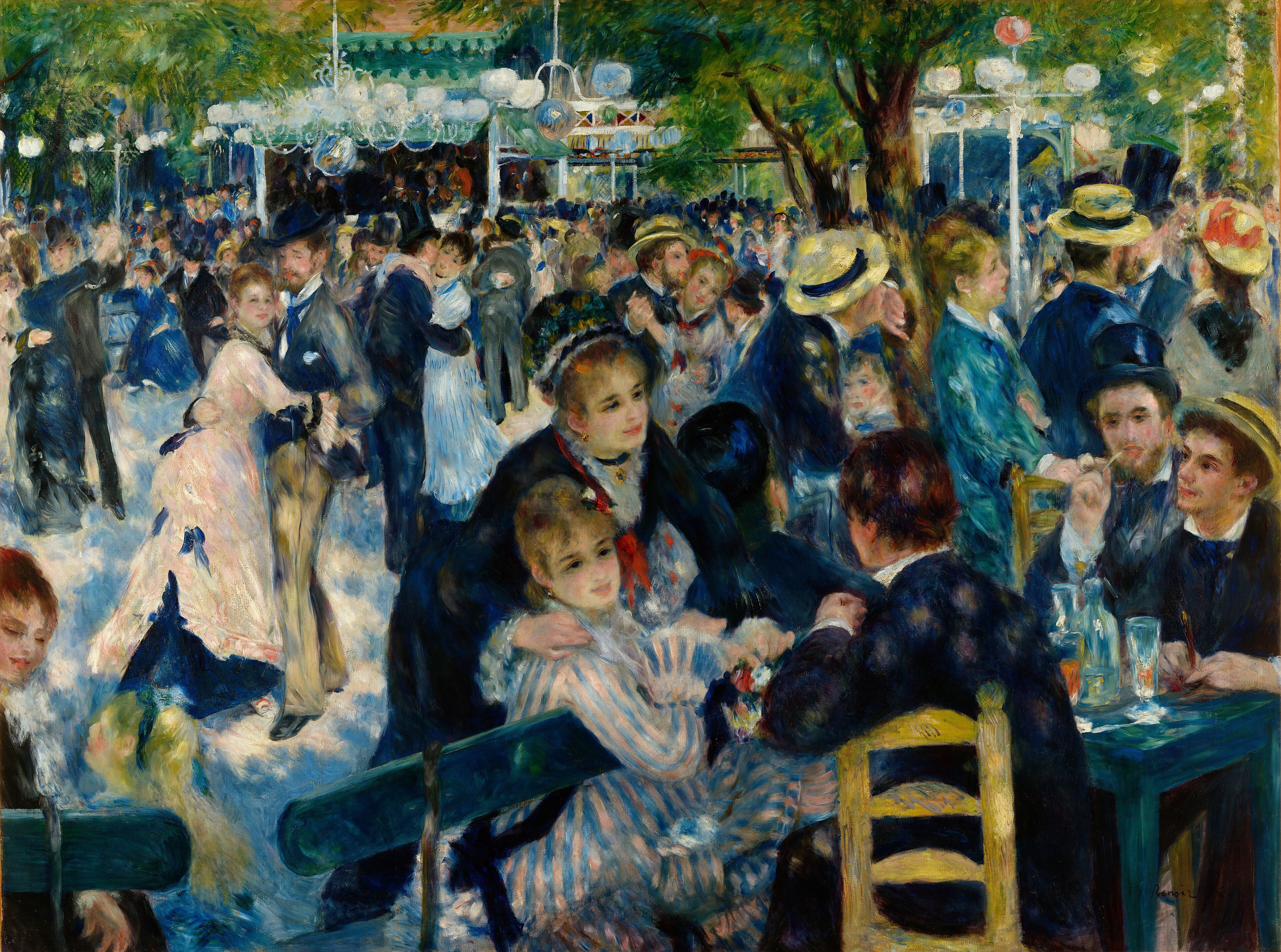
What you're looking at is a Sunday afternoon dance in the garden of the Moulin de la Galette, in Montmartre, Paris. Pierre-Auguste Renoir painted it in 1876.
A crowd has gathered under the trees: couples dancing, people seated on benches, drinkers at a table. This is not a formal ballroom. It's an outdoor pleasure garden, and the painting keeps that informal, crowded energy.
The Moulin de la Galette belonged to Montmartre, the hilltop quarter of Paris, and Renoir shows its garden as a place where different kinds of people share the same afternoon.
Start on the left, where a dancing couple is caught mid-turn. The woman wears a pale pink dress with dark blue trim, her partner a dark blue-grey coat.
Renoir paints them with flickering brushwork. The edges of the figures blur, and that blur is what gives you the speed of the dance. You feel the turn rather than see it frozen.
Toward the lower centre, a girl in a blue-and-white striped dress sits on a wooden bench. Her face turns outward, calm and direct. Against all that movement she holds still, a single presence rather than part of the whirl.
Beside her, a seated woman in a dark dress leans toward the girl. A small hat, a gold necklace and a bright red neck ribbon stand out against the blue shadows.
That lean links the two figures, so the bench becomes one intimate cluster rather than separate sitters. The red ribbon pulls your eye because it is the warmest note in a cool, shaded area.
Over on the right, a green-topped table holds bottles and glasses. A bearded man in a top hat sits with a companion in a straw hat. It is a small still life of leisure, and it balances the dancing on the left.
Above the crowd, a string of white glass globes hangs as outdoor lamps, and an orchestra canopy sits beneath green foliage. These mark the garden setting and explain the light.
That dappled light is one of the painting's main actors. Patches of sun and shade fall across faces, shoulders and tables, so figures dissolve into the crowd and then reappear.
Renoir does not outline everyone clearly. Instead he lets the light and the brushwork do the separating, which is why the scene feels alive rather than posed.
The composition sets up a contrast between movement and stillness. On the left, the dance spins. In the centre foreground, the striped-dress girl and her companion sit quietly. On the right, the drinkers rest.
That contrast is what holds the picture together. Renoir balances the energy of the dance against the calm of the bench and the leisure of the table, so the whole garden reads as one social world.
The dappled light supports that reading by dissolving the crowd. It makes the dance and the seated figures part of the same atmosphere, not separate scenes.
The painting belongs to Impressionism, the movement Renoir worked in, and it is dated 1876, the same year as the dance it shows in the garden.
The Moulin de la Galette was a real place in Montmartre, and the painting keeps that local identity. It shows a Sunday afternoon in that garden, with the orchestra canopy and the lamps as part of the setting.
The record links the canvas to the Musée d'Orsay in Paris, which is where it is associated today. The accession number is RF 2739.
What Renoir gives you is not a portrait of one person but a slice of a shared afternoon. The dancers, the seated girl, the drinkers and the lamps all belong to the same moment.
The painting works because its brushwork and its light treat the whole crowd as one fabric. Movement on the left, stillness in the centre, leisure on the right, all held together under the trees.
So the subject is the dance, but the real achievement is the way the painting makes a crowd feel like a single living scene.