The story About 4 minutes to read
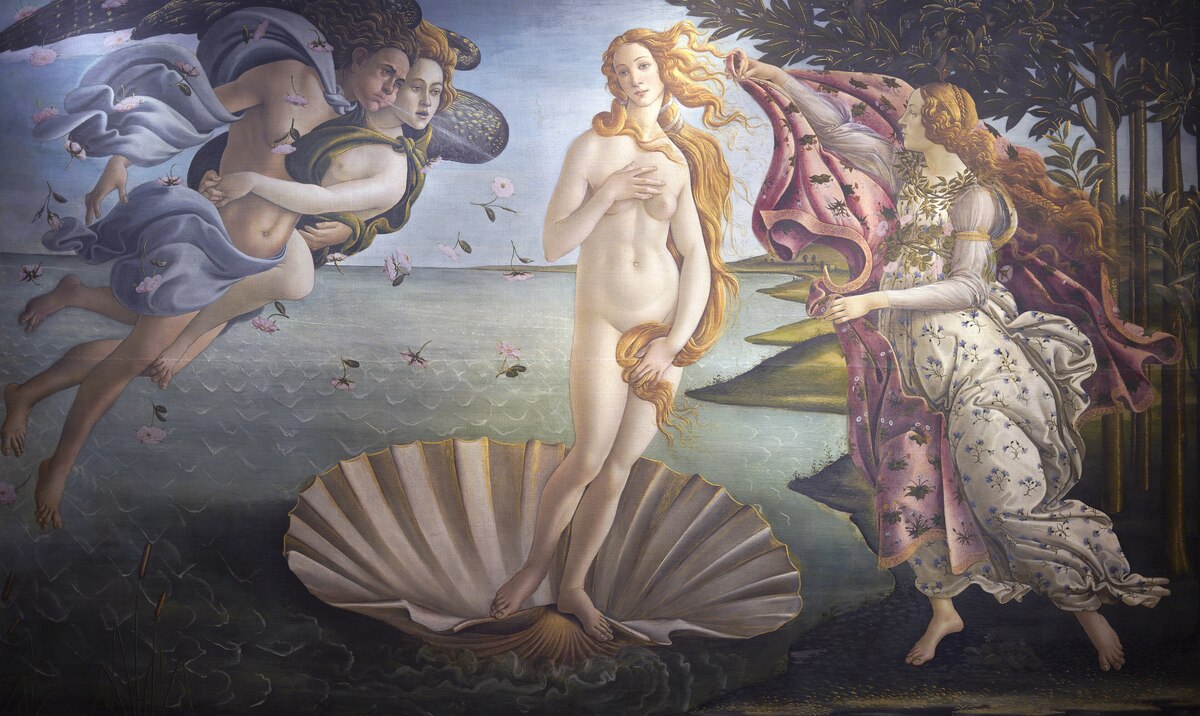
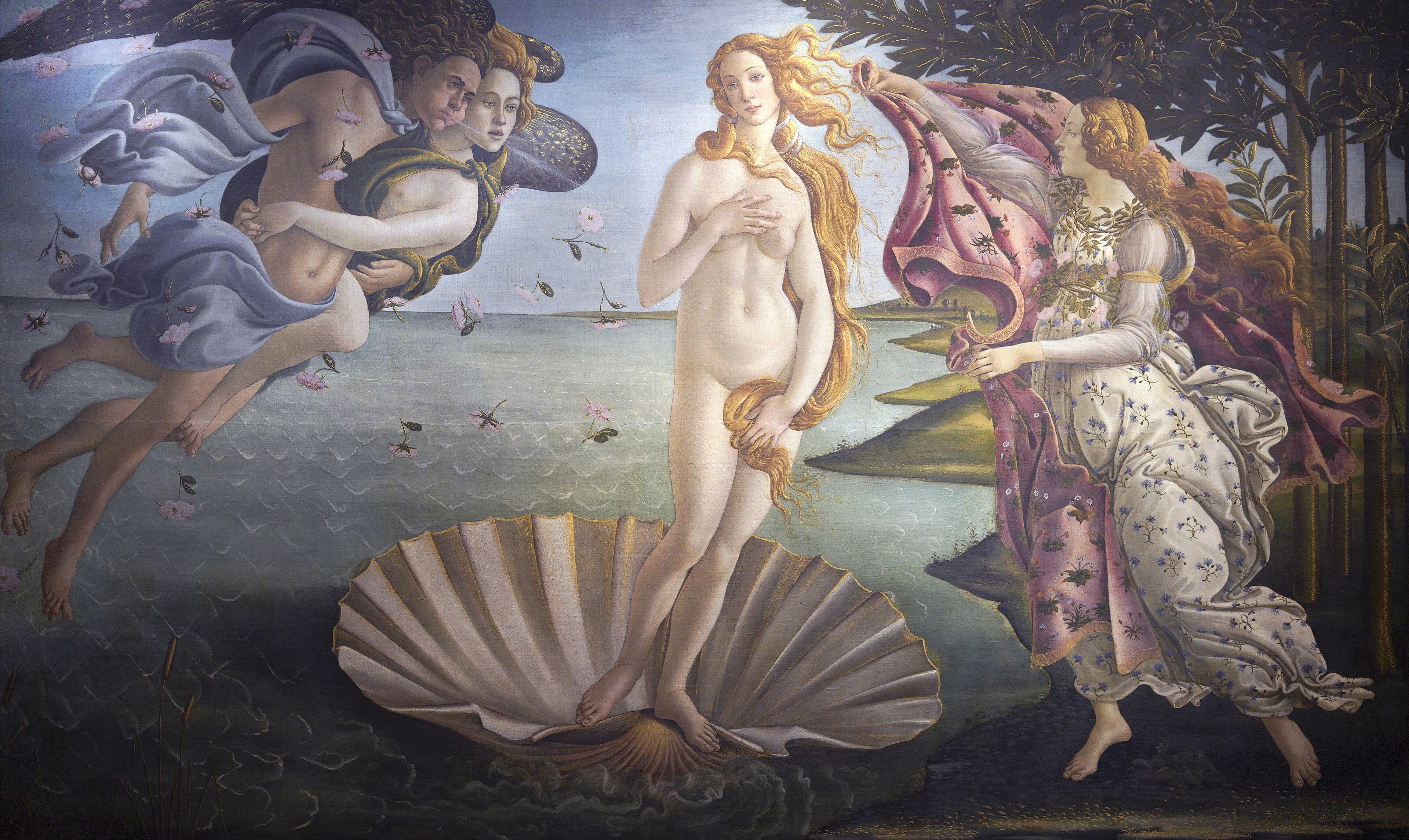
You are looking at a painting known as the Birth of Venus, made by Sandro Botticelli around 1485. Despite that title, the Uffizi's curators point out that it actually shows Venus, the goddess of love and beauty, arriving on land.
She has been born of sea spray and blown to the island of Cyprus by the winds. The composition catches her at the shore, not at the moment of birth.
Venus stands on a giant scallop shell, which the Uffizi describes as pure and perfect as a pearl. Her modest pose, covering her nakedness with long blond hair, is borrowed from classical statues.
Her hair catches the light because it has been gilded. She is met by a young woman, sometimes identified as one of the Graces or as the Hora of spring, who holds out a flower-covered cloak.
Above them, a pair of winds fly in one another's embrace. Roses scattered by the wind remind us of spring.
This is an Early Renaissance picture from Florence, painted in tempera on canvas. The canvas support was widely used in the fifteenth century for decorative works made for noble houses.
The subject, celebrating Venus as a symbol of love and beauty, was perhaps suggested by the poet Agnolo Poliziano. That is an interpretation the Uffizi offers, not a documented certainty.
It is highly probable that a member of the Medici family commissioned the painting. Nothing is written about it before 1550, when Giorgio Vasari describes it at the Medici Villa of Castello.
The orange trees in the background are considered an emblem of the Medici dynasty. The family name resonated with the old name for the orange tree, mala medica.
Botticelli drew on ancient art for this scene. The winds, a pair flying in one another's embrace, are based on a Hellenistic gem owned by Lorenzo the Magnificent.
Venus's gesture of modesty also comes from classical statues. These borrowings place the painting in a Florence that looked back to antiquity for its images of beauty.
The shell, the winds and the flowering cloak are not just decorative. They carry the sense that love and beauty arrive from the sea and are received on land.
The Uffizi reads the subject as a celebration of Venus. The shell, pure as a pearl, and the spring roses reinforce that reading without turning the picture into a simple illustration.
What stays with you is the attention Botticelli gives to arrival. Venus is not born here; she is stepping onto Cyprus, and the whole picture is organised around that moment of being met.
The winds blow, the cloak waits, and the goddess stands on her shell. The painting asks you to see love and beauty as something that comes from elsewhere and is welcomed on shore.