Sky Blue
Artist: Wassily Kandinsky · 1940

Sky Blue: high-resolution image
The original file is hosted by Wikimedia Commons, available without payment or an account.
Open high-resolution image on Wikimedia CommonsThe complete story
The story About 4 minutes to read
Wassily Kandinsky painted Sky Blue in 1940, during his late period, after he had left his native Russia and was living in France. He was a pioneer of abstract art. The painting gives us no scene, no setting and no story. Instead it arranges invented, biomorphic forms, meaning shapes that recall living things, across a blue field.
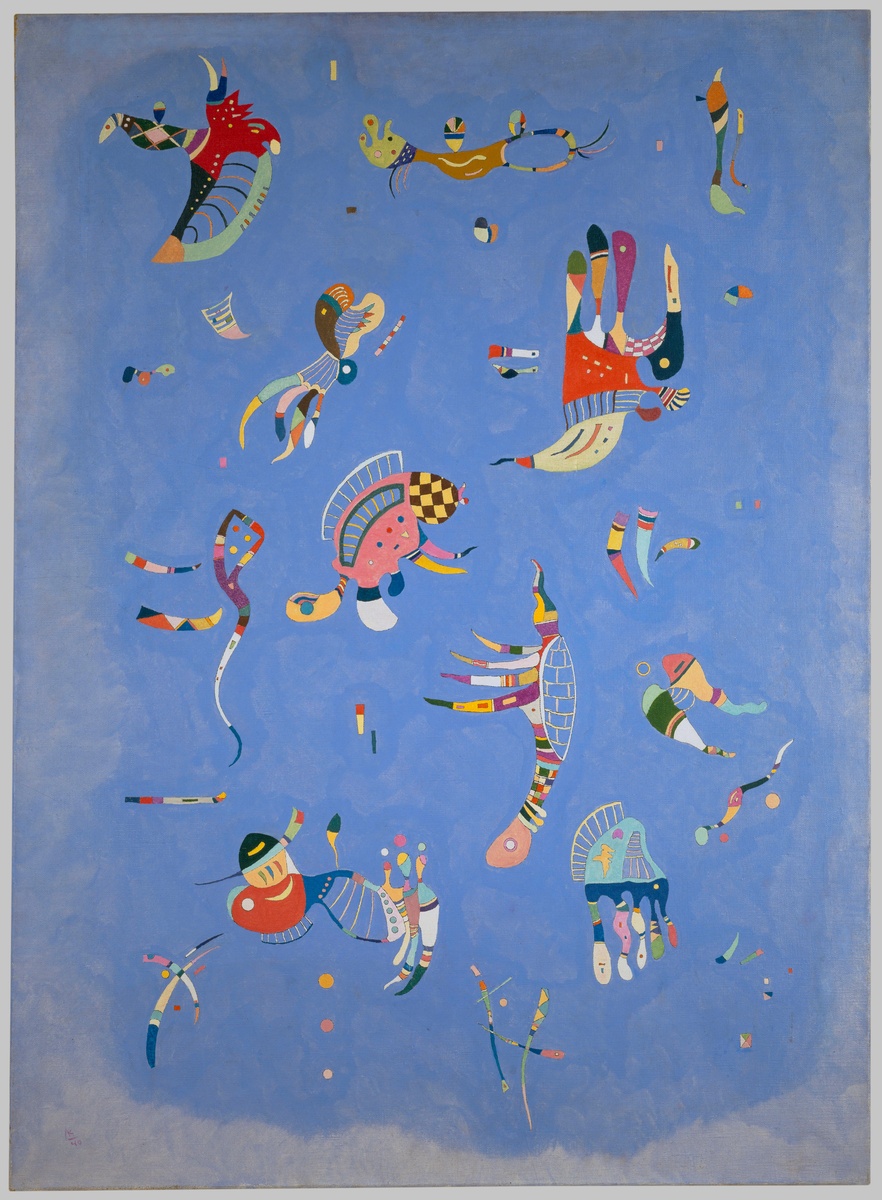
Near the centre sits a rounded pink creature. A black-and-yellow checkered crown rises above it, a fan-like striped wing spreads to one side, and small multicolored appendages extend from its body. It reads almost like a small animal made of pattern and ornament rather than anatomy, which is exactly the kind of invented form this painting trades in.
Around that central figure, other shapes take up the same language. Upper right, a red-orange trapezoid carries tall green, purple, yellow and black appendages and a pale flame-like tail. Upper left, a sweeping crimson crescent has a small checkered head, a striped wing and a curved green tail. Each form is distinct, yet they share a family of stripes, checks and curling extensions.
Lower down, the composition grows stranger and more buoyant. A black-capped red balloon-like body trails a segmented rainbow tail and dangling striped legs across the lower left. Through the lower centre runs a vertical insect-like figure with a white lattice oval wing, a segmented multicolor body and long horizontal feelers. Lower right, a turquoise fan sits on a dark blue body with white dangling legs.
What holds the picture together is the blue field behind all of this. The forms don't stand on a ground or sit in a room. They float, spread across the surface, and meet the blue as though it were open space. That is why the painting feels closer to a world of drifting organisms than to a picture of one.
It's tempting to read these creatures as characters in a story, but the painting doesn't supply one. They are invented organisms, and their relationships are visual rather than narrative. The checkered crown, the striped wing, the rainbow tail: each is a device that lets one shape echo or answer another across the blue.
So Sky Blue asks you to look at how these forms are made and how they hold their places in the field. Pattern, colour and outline do the work that a narrative would do elsewhere. The result is a late Kandinsky in which abstraction becomes a kind of imagined life, playful and precise at once.
The story and its sources
Historical claims are linked to the records below. Close looking and interpretation are identified in the passage notes.
- Passage 1Documented historyWikimedia Commons: Sky Blue
- Passage 2Close lookingWikimedia Commons: Sky Blue
- Passage 3Close lookingWikimedia Commons: Sky Blue
- Passage 4Close lookingWikimedia Commons: Sky Blue
- Passage 5InterpretationWikimedia Commons: Sky Blue
- Passage 6InterpretationWikimedia Commons: Sky Blue
- Passage 7InterpretationWikimedia Commons: Sky Blue
Details to notice
About 3 minutes to readBlue-legged fan creature
A turquoise fan-shaped upper form sits on a dark blue body with white dangling legs, completing the lower-right field of floating organisms.
Lattice-wing insect
A vertical insect-like figure with a white lattice oval wing, segmented multicolor body, and long horizontal feelers runs through the lower center.
Red balloon creature
A black-capped red balloon-like body trails a segmented rainbow tail and dangling striped legs across the lower left, giving weight to the composition's base.
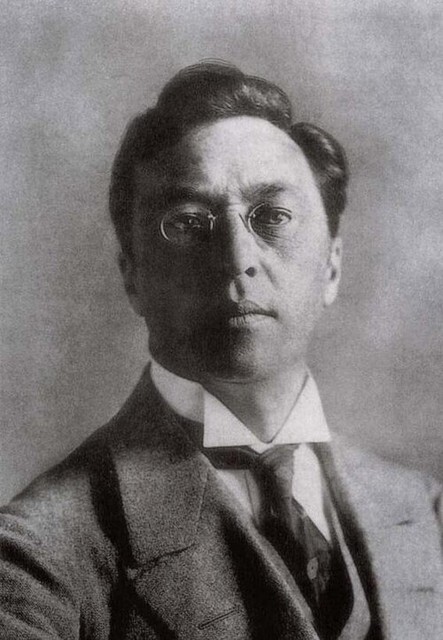
Artist portrait Image credit
未知上傳者. Image source · Public domain
About the artist
Wassily Kandinsky
1866 to 1944
Wassily Kandinsky was an avant-garde painter of Russian origin (1866–1944). Their work is associated with Expressionism; Symbolism; Bauhaus. Their recorded places of work include Paris; Munich; Weimar; Rapallo; The Hague; Russia; Stockholm; Switzerland; Tunis.
- Born
- 1866
- Died
- 1944
- Nationality
- Russian Empire; Russian Soviet Federative Socialist Republic; Soviet Union; France; Germany
- Birthplace
- Moscow
- Died in
- Neuilly-sur-Seine
Biography sources
The research & record
Study the work.
Follow the evidence.
Find catalogue details, historical context, technical research and the literature behind this artwork.
The artwork record
Research catalogue
Catalogue information and detailed research, with references that link to the bibliography.
Updated .
Identity and catalogue
Link- Title
- Sky Blue
- Artist or attribution
- Wassily Kandinsky(Wikimedia Commons: Sky Blue, n.d.)
- Object date
- 1940
- Medium and support
- Oil on canvas(Wikimedia Commons: Sky Blue, n.d.)
- Dimensions
- 100 × 73 cm(Wikimedia Commons: Sky Blue, n.d.)
- Current collection or location
- Musée National d'Art Moderne, Centre Georges Pompidou, Paris, France(Wikimedia Commons: Sky Blue, n.d.)
- Movement or period
- Abstract art (late Kandinsky)
- Country or culture
- Russian-born artist active in France
- Depicted subject
- An abstract composition in which floating biomorphic forms, including checkered and striped creatures, are arranged against a blue field. The work does not depict a narrative but presents a visual world of invented organisms.
- Title variants
- Bleu de ciel
- Accession number
- AM 1976-862
- Support
- canvas
Read valuation records and their limitations
Catalogue identity
The catalogue record identifies the painting as Sky Blue by Wassily Kandinsky, painted in 1940. The artist and date lines of the record establish Wassily Kandinsky as the painter and 1940 as the year of execution. This date is the date of the object, not the date of any catalogue entry or documentation, and the two should not be conflated in the record.(Wikimedia Commons: Sky Blue, n.d., Artist and date lines)
The painting measures 100 by 73 centimetres, a vertical format recorded on the dimensions line of the catalogue. The dimensions describe the support as catalogued and are given here as recorded rather than as independently measured.(Wikimedia Commons: Sky Blue, n.d., Dimensions line)
Wassily Kandinsky painted Sky Blue in 1940.(Wikimedia Commons: Sky Blue, n.d.)
The painting measures 100 by 73 centimetres.(Wikimedia Commons: Sky Blue, n.d.)
Subject and iconography
LinkRead valuation records and their limitations
The painted field and its inhabitants
Visual observation
Sky Blue is an oil painting on canvas made by Wassily Kandinsky in 1940, during his late period, when he was living in France; the Wikimedia Commons record that documents the work describes him as a pioneer of abstract art. That record is the source of the visual descriptions that follow: its vision-derived semantic focus candidate list supplies a set of candidate foci, describing regions of the composition rather than identifying depicted subjects. The list is therefore evidence of how the painted surface can be parsed into salient forms, and it should be read as an observation aid rather than as a catalogue of represented things. No official museum record was supplied, and the source is used only as a discovery aid, so questions of attribution, dating and measurement rest on that single file page rather than on an institutional catalogue.(Wikimedia Commons: Sky Blue, n.d., Medium line; Artist line and date; Vision-derived semantic focus candidate list)
At the centre of the composition sits a pink rounded creature. Above it rises a black-and-yellow checkered crown; a fan-like striped wing spreads to one side; small multicoloured appendages extend from the body. Describing this as a creature is an interpretive convenience drawn from the candidate list itself, which uses the word, not a record of an animal observed or intended. What the observation does establish is the clustering of pattern types: checks, stripes and small projecting forms gathered into a single compact mass. That clustering matters because it concentrates three distinct ornamental devices at the compositional centre, where the eye is most likely to begin, and makes the central form a kind of summary of the picture's visual vocabulary.(Wikimedia Commons: Sky Blue, n.d., Vision-derived semantic focus candidate list)
The surrounding forms are built from the same family of devices while remaining distinct in silhouette. Upper right, a red-orange trapezoidal figure carries tall green, purple, yellow and black appendages and a pale flame-like tail, so that a hard-edged geometric body supports soft, flame-like extremities. Upper left, a sweeping crimson crescent with a small checkered head, a black striped wing and a green curved tail establishes the rhythm on that side. Both repeat the checkered head or crown and the striped wing already seen at the centre, and both end in curling or tapering extensions. The repetition is what allows the separate forms to answer one another across the field; it is a visual relationship, not evidence of narrative connection between them.(Wikimedia Commons: Sky Blue, n.d., Vision-derived semantic focus candidate list)
The lower zone of the composition continues the same language with different emphases. A black-capped red balloon-like body trails a segmented rainbow tail and dangling striped legs across the lower left, introducing a multicoloured segmentation that runs through several hues rather than pairing two. Through the lower centre runs a vertical insect-like figure with a white lattice oval wing, a segmented multicolour body and long horizontal feelers, a markedly more linear and symmetrical construction than the rounded central mass. In the lower right, a turquoise fan-shaped upper form sits on a dark blue body with white dangling legs. Taken together, the six described regions show the painting distributing its forms across the whole blue field rather than grouping them around a single anchor, with dangling legs recurring in the lower half and crowns, wings and feelers recurring above.(Wikimedia Commons: Sky Blue, n.d., Vision-derived semantic focus candidate list)
Interpretation
Because the source is a single partially consulted file page rather than an institutional record with technical imaging or condition documentation, there is no evidence in the supplied units for changes in the painting's appearance, for underdrawing, or for pigment analysis. The descriptions therefore document a present visible state and cannot be used to reconstruct earlier states of the surface. Any future account of how the forms were built up, or of whether the blue field was laid in before or after the individual figures, would require technical evidence that these units do not contain. For now the visual evidence supports a description of arrangement and device, and it stops there.(Wikimedia Commons: Sky Blue, n.d., Vision-derived semantic focus candidate list; Artist line and date)
Visual observation
A pink rounded creature with a black-and-yellow checkered crown, a fan-like striped wing, and small multicolored appendages occupies the centre of the composition.(Wikimedia Commons: Sky Blue, n.d.)
A red-orange trapezoidal figure with tall green, purple, yellow, and black appendages and a pale flame-like tail anchors the upper right.(Wikimedia Commons: Sky Blue, n.d.)
A sweeping crimson crescent with a small checkered head, a black striped wing, and a green curved tail establishes the upper-left rhythm.(Wikimedia Commons: Sky Blue, n.d.)
A black-capped red balloon-like body trails a segmented rainbow tail and dangling striped legs across the lower left.(Wikimedia Commons: Sky Blue, n.d.)
A vertical insect-like figure with a white lattice oval wing, a segmented multicolor body, and long horizontal feelers runs through the lower centre.(Wikimedia Commons: Sky Blue, n.d.)
A turquoise fan-shaped upper form sits on a dark blue body with white dangling legs in the lower right.(Wikimedia Commons: Sky Blue, n.d.)
Historical context
LinkRead valuation records and their limitations
Date and Attribution
Sky Blue is dated to 1940, when Wassily Kandinsky was living in France. Kandinsky is described as a pioneer of abstract art, and the work is placed within his late period. That dating and the artist's location are the barest facts the evidence supplies about the painting's making; it does not record a patron, a commission, a purchase, or the circumstances under which the canvas came to exist. The attribution to Kandinsky and the year 1940 are given together in the source record and are not qualified there, but the file page itself is a discovery aid rather than an official museum record, so the painting's institutional documentation is not directly represented in the evidence.(Wikimedia Commons: Sky Blue, n.d., Artist line and date)
The same source records the object as an oil painting on canvas measuring 100 by 73 centimetres, held in the Musée National d'Art Moderne, Centre Georges Pompidou, Paris, under accession number AM 1976-862. Those details establish a vertical canvas format, the medium, and a modern French public collection as the work's present home. The evidence does not show when or through what route the painting entered that collection, nor does the accession number's year component on its own supply a provenance narrative. The physical description and the collection data sit in the same record as the attribution and date, but they function as separate kinds of fact: one concerns the making of the object, the other its institutional life.(Wikimedia Commons: Sky Blue, n.d., Artist line and date)
Historical Position
Interpretation
The connection between these formal features and the object's historical position rests on the late date and on Kandinsky's standing as a pioneer of abstraction. Because the work is placed in 1940, in France, and in his late period, the invented biomorphic figures can be understood as part of a mature abstract practice rather than an early experiment, and the description's emphasis on invented forms on a blue field fits that placement. This is an interpretive link: the evidence establishes the date, the location and the abstract character separately, and it does not supply a chronology of Kandinsky's stylistic development or a comparison with his earlier work. What can be said responsibly is that a painted canvas of 1940 that arranges non-narrative organic shapes on a blue ground belongs within the history of abstraction as that history is defined by the artist's pioneering role, while the painting's specific place in that history remains a matter for records the evidence does not include.(Wikimedia Commons: Sky Blue, n.d., Artist line and date; Description line; Vision-derived semantic focus candidate list)
Kandinsky was a pioneer of abstract art, and this work belongs to his late period, created in 1940 while he was living in France.(Wikimedia Commons: Sky Blue, n.d.)
Materials and technique
LinkRead valuation records and their limitations
Support and medium
The documented physical description of Sky Blue is concise but decisive for any account of its making: the Wikimedia Commons file page records the work as an oil painting on canvas, associating it with Wassily Kandinsky and a date of 1940. This places the picture within the artist's late period, produced while he was living in France following his departure from Russia. That medium statement is the only material fact supplied by the evidence; it establishes the support and binder at the level of documentation rather than through a published conservation report, so questions of ground preparation, primer, canvas weave, stretcher construction and layer structure remain outside the evidence assembled here. The account below therefore distinguishes carefully between what the source metadata asserts about materials and what the visible surface of the painting allows a viewer to infer, without treating either as a technical analysis the record does not contain.(Wikimedia Commons: Sky Blue, n.d., Medium line)
Sky Blue is an oil painting on canvas.(Wikimedia Commons: Sky Blue, n.d.)
Provenance and ownership
LinkRead valuation records and their limitations
Provenance timeline
- 1940
Kandinsky created this painting in 1940 while living in France, during his late period.(Wikimedia Commons: Sky Blue, n.d., Artist line and date)
Interpretations and debates
LinkRead valuation records and their limitations
The Abstract Mode and Its Limits
Interpretation
The reading of Sky Blue as abstract rather than narrative rests on what the painting shows: it does not depict a scene but arranges invented biomorphic forms on a blue field. That characterisation, supplied in the source description, is a description of the work's mode rather than a claim about what the artist privately meant. It can be tested against the visible forms, which recall living things through rounded bodies, wings, feelers, tails and dangling legs without resolving into identifiable species or a setting. Kandinsky's status as a pioneer of abstract art and the work's date of 1940, made while he was living in France, place this non-narrative arrangement within his late period rather than at the outset of abstraction.(Wikimedia Commons: Sky Blue, n.d., Description line; Artist line and date)
The lower half of the painting continues the same invented language in more buoyant terms. A black-capped red balloon-like body trails a segmented rainbow tail and dangling striped legs across the lower left; a vertical insect-like figure with a white lattice oval wing, a segmented multicolor body and long horizontal feelers runs through the lower centre; and a turquoise fan-shaped upper form sits on a dark blue body with white dangling legs in the lower right. Read together with the central, upper-right and upper-left figures, these forms are distributed across the surface rather than arranged in depth or grouped into an incident. The observation that they float and meet the blue as open space is a reading of compositional effect, and it is consistent with the description of the work as non-narrative: the relationships among the figures are visual rather than dramatic.(Wikimedia Commons: Sky Blue, n.d., Vision-derived semantic focus candidate list; Description line)
The temptation to treat the forms as characters in a story is not supported by the evidence. The source describes invented biomorphic shapes arranged on a blue field and explicitly states that no narrative scene is depicted. Devices such as the checkered crown, the striped wing and the rainbow tail can therefore be understood as formal means by which one shape echoes or answers another, but that is an interpretive synthesis about how the picture coheres, not a record of the maker's intention. The documented facts remain the artist, the 1940 date, the late-period context and the visible inventory of forms; the claim that pattern, colour and outline do the work a narrative would do elsewhere belongs to interpretation and should be attributed as such.(Wikimedia Commons: Sky Blue, n.d., Description line; Artist line and date; Vision-derived semantic focus candidate list)
The painting is abstract and does not depict a narrative scene; instead it arranges invented biomorphic forms on a blue field.(Wikimedia Commons: Sky Blue, n.d.)
Collection and display
LinkRead valuation records and their limitations
Institutional holding
Sky Blue is recorded as held in the Musée National d'Art Moderne, Centre Georges Pompidou, Paris, under accession number AM 1976-862. That single institutional fact is the only collection information supplied here, and it carries more weight than it might first appear. The accession number places the work in a national museum of modern art rather than a private collection or a regional gallery, and the institution's name identifies the French national modern art collection with which the Pompidou is associated. Because the accession number is preserved exactly, the record can be matched against the museum's own files in future research. The evidence supplied does not establish when or how the painting entered the museum, whether by purchase, gift or other transfer, nor does it give a provenance chain before accession. Those gaps should be left open rather than filled by inference. The source is a Wikimedia Commons file page, annotated as a discovery aid rather than an official museum record, so the collection and accession lines are reported here as documented but not yet checked against the museum's catalogue.(Wikimedia Commons: Sky Blue, n.d., Collection and accession lines)
Interpretation
The collection fact is inseparable from the picture's date and place of making. The same source records that Wassily Kandinsky painted Sky Blue in 1940, while he was living in France, and identifies him as a pioneer of abstract art, with the work belonging to his late period. Read together, the museum holding and the 1940 date frame a late work by an artist who had left his native Russia and was working in France at the end of his life. The accession number and the date are the two firm coordinates available: one locates the object now, the other locates its making. Everything between them, including how a 1940 painting came to carry a 1976-series accession number at the national modern art museum, is not supplied and should not be guessed. The juxtaposition is nonetheless historically meaningful, since it situates a late abstract painting by a Russian-born artist working in France within the French national collection of modern art.(Wikimedia Commons: Sky Blue, n.d., Collection and accession lines)
The painting is held in the Musée National d'Art Moderne, Centre Georges Pompidou, Paris, with accession number AM 1976-862.(Wikimedia Commons: Sky Blue, n.d.)
Documented values and qualified estimates
LinkRead valuation records and their limitations
The working valuation
Interpretation
The only monetary figure attached to Sky Blue in the supplied record is a model-generated working insurance estimate of US$8M to US$25M, recorded as a working calculation generated on 2026-10-30. Its stated methodology derives the bracket conservatively from confirmed context alone: a mature 1940 oil on canvas by Wassily Kandinsky, treated as a canonical figure of abstract art, at 100 by 73 cm, held in a major national collection and documented through Wikimedia Commons. Because the work is institutionally held and no official museum valuation, auction result or comparable sale was supplied, the range was deliberately widened rather than refined, with the explicit aim of avoiding unsupported precision. The figure is therefore an order-of-magnitude bracket for manual review, not a number tied to any specific transaction.(Wikimedia Commons: Sky Blue, n.d.)
The qualification attached to the estimate is as consequential as the number itself. The range is not an official insurance value, an appraisal, an auction estimate, an auction result or a sale price; it is stated not to rest on comparable sales or private insurance records, which were not accessed. The source URL that anchors the object's identification is described as supporting identification context only and as not constituting a public valuation, and the record directs that the figure be confirmed with a qualified appraiser and the holding institution before any insurance or financial use. Read alongside the identification data, this means the object's documented standing rests on collection and accession information rather than on market evidence: the painting is recorded as oil on canvas, 1940, 100 by 73 centimetres, in the Musée National d'Art Moderne, Centre Georges Pompidou, Paris, accession AM 1976-862. Until an appraisal or transaction record enters the file, the 2026 bracket should be treated as a placeholder for review rather than as evidence of what the work is worth.(Wikimedia Commons: Sky Blue, n.d.)
What the estimate rests on
Why the bracket could be set at all, and why it had to remain wide, are both explained by the same factors the working calculation cites: the artist's canonical position in abstract art, the work's date of 1940 and its status as a mature late oil, and its location in a major national collection. The identification record supplies the supporting biography and form, describing Kandinsky as a pioneer of abstract art and the painting as belonging to his late period, created in 1940 while he was living in France. It also records that the composition is abstract and does not depict a narrative scene, instead arranging invented biomorphic forms on a blue field. These are the attributes the model weighed as markers of significance; none of them is a price, and the record is explicit that institutional holding and the absence of supplied sales data are precisely what prevented a narrower estimate.(Wikimedia Commons: Sky Blue, n.d.)
For the history of modern art and of museum collections, the useful distinction in this record is between cultural standing and financial valuation. The painting's importance within a history of abstraction is attested through its authorship, date and collection context, while its monetary worth remains, in the supplied evidence, a modeled inference flagged for manual review. Keeping those two registers separate protects the object's documented description, including its biomorphic vocabulary of checkered crowns, striped wings and rainbow tails, from being overshadowed by a provisional number, and it leaves open what a qualified appraisal or institutional statement might later establish.(Wikimedia Commons: Sky Blue, n.d.)
Working estimate
Calculated working insurance estimate, not a sale price: Estimated value: US$8M to US$25M Recorded date: Working calculation, generated 2026-10-30. Methodology: Broad working range derived conservatively from the confirmed context only: a mature 1940 oil on canvas by Wassily Kandinsky, a canonical figure of abstract art, at 100 by 73 cm, held in a major national collection (Musée National d'Art Moderne, Centre Georges Pompidou, accession AM 1976-862) and documented via Wikimedia Commons. Because the work is institutionally held and no official museum valuation, auction result, or comparable sale was supplied, the range was set wide to reflect market significance of late Kandinsky oils while avoiding unsupported precision. Figures are a modeled order-of-magnitude bracket for manual review, not tied to any specific transaction. Qualification: This is a model-generated working range for manual review only. It is not an official insurance value, appraisal, auction estimate, auction result, or sale price. It is not based on comparable sales or private insurance records, which were not accessed. Confirm with a qualified appraiser and the holding institution before any insurance or financial use. The source URL supports identification context only and does not constitute a public valuation.(Wikimedia Commons: Sky Blue, n.d.)
Further reading
Books for a closer look
Paid links. As an Amazon Associate I earn from qualifying purchases.

Open Library Kandinsky: Russian and Bauhaus years, 1915-1933.
Solomon R. Guggenheim Museum
A Kandinsky catalogue whose recorded subjects include Catalogues raisonnés, the Centre Georges Pompidou, and the Musée national d'art moderne, the museum holding Sky Blue (accession AM 1976-862). Its subjects also cover abstract painting and themes and motives, matching the work's non-narrative invented forms.
ISBN 0892070447
Bibliography
Sources and further reading
References are arranged by author or organisation, with links to the original publications. Where no publication date is recorded, n.d. means no date.
Source notes updated .
No recorded sources match these filters. Reset the filters to see the full bibliography.
- 03
Book
Kandinsky: Russian and Bauhaus years, 1915-1933. Solomon R. Guggenheim Museum.
A Kandinsky catalogue whose recorded subjects include Catalogues raisonnés, the Centre Georges Pompidou, and the Musée national d'art moderne, the museum holding Sky Blue (accession AM 1976-862). Its subjects also cover abstract painting and themes and motives, matching the work's non-narrative invented forms.
- ISBN
- 0892070447
Citation text
- 02
Book
Bleu de ciel. Centre Georges Pompidou.
Titled Bleu de ciel and authored by Max-Henri de Larminat together with Wassily Kandinsky. Its recorded subjects include art appreciation and modern art in juvenile literature, which links it to the painting Sky Blue and to Kandinsky's abstract biomorphic imagery by title and artist rather than by accidental name.
- ISBN
- 2858504806
Citation text
- 01
Secondary · About this artwork
Wikimedia Commons: Sky Blue (n.d.). Wikimedia Commons.
Wikimedia Commons file page for the painting, providing title, artist, date, medium, dimensions, collection and accession number. Used as a discovery aid; no official museum record was supplied.
Citation text
Art to live with
Bring this painting
home.
A piece of the archive, made yours. Explore Sky Blue in a size and finish that fits your space.
Your text and annotations appear on these editions. Adding to cart saves that design for printing.
Combine this painting with your favourites01 / Find your edition
Made for you
Suggested from your location. Change it if you're sending elsewhere or using a VPN. Prices and delivery are shown in GBP.
19 products
Choose an edition to make it yours
6 × 8 in · Printed cover · 118 lined pages
6 × 8 in · Printed cover · 118 lined pages
6 × 8 in · Printed cover · 118 lined pages
Notebook
GBP 11.87
Delivery GBP 5.27 / Total GBP 17.14
A 6 × 8 inch spiral notebook with 118 ruled pages (59 sheets), a printed front cover, dark grey back cover and metal spiral binding.
Fit and fill keep the painting’s proportions. Stretch changes them.
Move and zoom the painting on your notebook.
Made to order with your design
Made to order
US delivery only
12.7 × 17.8 cm / 5 × 7 in · Standard
12.7 × 17.8 cm / 5 × 7 in · Standard

5 × 7 in / 12.7 × 17.8 cm · Standard

5 × 7 in / 12.7 × 17.8 cm · Standard

5 × 7 in / 12.7 × 17.8 cm · Standard

5 × 7 in / 12.7 × 17.8 cm · Standard

5 × 7 in / 12.7 × 17.8 cm · Standard
Metal art sign
GBP 19.57
Delivery GBP 17.65 / Total GBP 37.22
A printed aluminium sign with rounded corners and mounting holes.
Fit and fill keep the painting’s proportions. Stretch changes them.
Move and zoom the painting on your metal art sign.
Made to order with your design
Printed aluminium · mounting holes included
US delivery only
iPhone 12 Mini ? Glossy ? back view
iPhone 12 Mini · Glossy

iPhone 12 Mini ? Glossy ? back view

iPhone 12 Mini ? Glossy ? back view

iPhone 12 Mini ? Glossy ? back view
Tough phone case
GBP 16.34
Delivery GBP 4.22 / Total GBP 20.56
A two-layer phone case with a printed polycarbonate shell and a shock-absorbing inner liner.
Two layers with a shock-absorbing TPU liner
Case & print details
- Device
- Apple · iPhone 12 Mini
- Material
- Polycarbonate shell with a TPU inner liner
- Artwork
- Outer back and wrapped edges from one template
- Finish
- Glossy
- Version
- Standard version
- Printing
- Dye sublimation
- Print file
- 1,122 × 1,831 px · 95 × 155 mm · PNG · 300 dpi recommended
Rear outline and camera openings follow this variant's Printify template. Case depth and small hardware remain illustrative.
Supplier product detailsFit and fill keep the painting’s proportions. Stretch changes them.
Move and zoom the painting on your tough phone case.
Made to order with your design
Made to order
US delivery only
30.4 × 40.6 cm / 12 × 16 in · Black
30.4 × 40.6 cm / 12 × 16 in · Black

12 × 16 in / 30.4 × 40.6 cm · Black

12 × 16 in / 30.4 × 40.6 cm · Black

12 × 16 in / 30.4 × 40.6 cm · Black

12 × 16 in / 30.4 × 40.6 cm · Black
Framed art print
GBP 52.67
- 1 framed print
- GBP 52.67
- Delivery to United States
- GBP 14.11
- Total
- GBP 66.78
A ready-to-hang wooden frame with a clear Perspex cover and a semi-gloss printed insert.
Delivery is quoted for all selected copies together.
Fit and fill keep the painting’s proportions. Stretch changes them.
Move and zoom the painting on your framed art print.
Made to order with your design
Wooden frame & protective clear front included
US delivery only
38.1 × 40.6 cm / 15 × 16 in · Natural
38.1 × 40.6 cm / 15 × 16 in · Natural

15 × 16 in / 38.1 × 40.6 cm · Natural

15 × 16 in / 38.1 × 40.6 cm · Natural

15 × 16 in / 38.1 × 40.6 cm · Natural

15 × 16 in / 38.1 × 40.6 cm · Natural

15 × 16 in / 38.1 × 40.6 cm · Natural
Canvas tote bag
GBP 14.20
Delivery GBP 4.32 / Total GBP 18.52
A sturdy cotton canvas tote with reinforced handles and artwork on the front panel.
Fit and fill keep the painting’s proportions. Stretch changes them.
Move and zoom the painting on your canvas tote bag.
Made to order with your design
Front print · reinforced cotton handles
US delivery only
22.9 × 20.3 cm / 9 × 8 in · Standard
22.9 × 20.3 cm / 9 × 8 in · Standard

9 × 8 in / 22.9 × 20.3 cm · Standard

9 × 8 in / 22.9 × 20.3 cm · Standard

9 × 8 in / 22.9 × 20.3 cm · Standard

9 × 8 in / 22.9 × 20.3 cm · Standard
Mouse mat
GBP 7.28
Delivery GBP 4.81 / Total GBP 12.09
A rectangular fabric mouse mat with a rubber backing and rounded corners.
Fit and fill keep the painting’s proportions. Stretch changes them.
Move and zoom the painting on your mouse mat.
Made to order with your design
Made to order
US delivery only
See more13 more products
43.2 × 45.7 cm / 17 × 18 in · Artwork
43.2 × 45.7 cm / 17 × 18 in · Artwork

17 × 18 in / 43.2 × 45.7 cm · Artwork

17 × 18 in / 43.2 × 45.7 cm · Artwork

17 × 18 in / 43.2 × 45.7 cm · Artwork
Woven tote bag
GBP 46.69
Delivery GBP 5.86 / Total GBP 52.55
A woven tote with cotton webbing handles and the painting translated into a woven design.
Fit and fill keep the painting’s proportions. Stretch changes them.
Move and zoom the painting on your woven tote bag.
Made to order with your design
Made to order
US delivery only
55.9 × 76.2 cm / 22 × 30 in · Standard
55.9 × 76.2 cm / 22 × 30 in · Standard

22 × 30 in / 55.9 × 76.2 cm · Standard

22 × 30 in / 55.9 × 76.2 cm · Standard

22 × 30 in / 55.9 × 76.2 cm · Standard

22 × 30 in / 55.9 × 76.2 cm · Standard

22 × 30 in / 55.9 × 76.2 cm · Standard
Matte art print
GBP 19.57
Delivery GBP 7.40 / Total GBP 26.97
An unframed matte poster with archival inks, ready for a frame of your choice.
Fit and fill keep the painting’s proportions. Stretch changes them.
Move and zoom the painting on your matte art print.
Made to order with your design
Unframed · frame it your way
US delivery only
iPhone 12 Mini ? Standard ? back view
iPhone 12 Mini · Standard

iPhone 12 Mini ? Standard ? back view

iPhone 12 Mini ? Standard ? back view

iPhone 12 Mini ? Standard ? back view
Flexible phone case
GBP 15.55
Delivery GBP 4.22 / Total GBP 19.77
A flexible TPU phone case with a frosted finish, a printed back and precise port openings.
Flexible TPU with a frosted, matte finish
Case & print details
- Device
- Apple · iPhone 12 Mini
- Material
- Semi-transparent thermoplastic polyurethane (TPU)
- Artwork
- Back print; rim stays unprinted
- Finish
- Standard
- Version
- Standard version
- Printing
- Dye sublimation
- Print file
- 791 × 1,586 px · 67 × 134.3 mm · PNG · 300 dpi recommended
Rear outline and camera openings follow this variant's Printify template. Case depth and small hardware remain illustrative.
Supplier product detailsFit and fill keep the painting’s proportions. Stretch changes them.
Move and zoom the painting on your flexible phone case.
Made to order with your design
Made to order
S · Standard
S · Standard

S · Standard

S · Standard

S · Standard

S · Standard

S · Standard
Crew socks
GBP 10.63
Delivery GBP 4.42 / Total GBP 15.05
Crew-length polyester and spandex socks with a ribbed cuff, cushioned sole and sublimated artwork.
Fit and fill keep the painting’s proportions. Stretch changes them.
Move and zoom the painting on your crew socks.
Made to order with your design
One pair · design repeated on both socks
US delivery only
12" · Standard
12" · Standard

12" · Standard

12" · Standard

12" · Standard
Laptop sleeve
GBP 26.00
Delivery GBP 4.89 / Total GBP 30.89
A polyester laptop sleeve with a fleece lining, top zip, printed front and black reverse.
Fit and fill keep the painting’s proportions. Stretch changes them.
Move and zoom the painting on your laptop sleeve.
Made to order with your design
Made to order
US delivery only
11oz · 2 image repeats
11oz · White
11oz · 2 image repeats
Mug
GBP 7.32
Delivery GBP 6.14 / Total GBP 13.46
A glossy white ceramic mug with a C-shaped handle, available in 11oz and 15oz sizes.
repeat layout · choose single, double or a repeating pattern in Customise.
Repeat, fit, fill and position your artwork around the mug.
Made to order with your design
Made to order
iPhone 12 Mini ? Standard ? back view
iPhone 12 Mini · Standard

iPhone 12 Mini ? Standard ? back view

iPhone 12 Mini ? Standard ? back view

iPhone 12 Mini ? Standard ? back view

iPhone 12 Mini ? Standard ? back view

iPhone 12 Mini ? Standard ? back view
Biodegradable phone case
GBP 20.89
Delivery GBP 4.22 / Total GBP 25.11
A matte phone case made from plant polymers and bamboo fibre, with the artwork printed on the back.
Flexible plant-polymer shell with a matte finish
Case & print details
- Device
- Apple · iPhone 12 Mini
- Material
- PLA and PBAT polymers with bamboo fibre
- Artwork
- Back print; rim stays unprinted
- Finish
- Standard
- Version
- Standard version
- Printing
- Dye sublimation
- Print file
- 777 × 1,553 px · 65.8 × 131.5 mm · PNG · 300 dpi recommended
Rear outline and camera openings follow this variant's Printify template. Case depth and small hardware remain illustrative.
Supplier product detailsFit and fill keep the painting’s proportions. Stretch changes them.
Move and zoom the painting on your biodegradable phone case.
Made to order with your design
Made to order
30.5 × 40.6 cm / 12 × 16 in · Standard
30.5 × 40.6 cm / 12 × 16 in · Standard

12 × 16 in / 30.5 × 40.6 cm · Standard

12 × 16 in / 30.5 × 40.6 cm · Standard

12 × 16 in / 30.5 × 40.6 cm · Standard
Fine art poster
GBP 17.30
Delivery GBP 7.58 / Total GBP 24.88
A gallery paper print with a smooth art-paper surface. Choose a size that suits the painting.
Fit and fill keep the painting’s proportions. Stretch changes them.
Move and zoom the painting on your fine art poster.
Made to order with your design
Unframed · frame it your way
iPhone 12 Mini ? Standard ? back view
iPhone 12 Mini · Standard

iPhone 12 Mini ? Standard ? back view

iPhone 12 Mini ? Standard ? back view

iPhone 12 Mini ? Standard ? back view
Clear phone case
GBP 15.05
Delivery GBP 4.22 / Total GBP 19.27
A clear phone case with artwork on the back. Leave areas transparent to show the phone underneath.
Clear shell with shock-absorbing TPU sides
Case & print details
- Device
- Apple · iPhone 12 Mini
- Material
- Polycarbonate back and clear TPU sides
- Artwork
- Back print; clear sides stay unprinted
- Finish
- Standard
- Version
- Standard version
- Printing
- Dye sublimation
- Print file
- 732 × 1,527 px · 62 × 129.3 mm · PNG · 300 dpi recommended
Rear outline and camera openings follow this variant's Printify template. Case depth and small hardware remain illustrative.
Supplier product detailsFit and fill keep the painting’s proportions. Stretch changes them.
Move and zoom the painting on your clear phone case.
Made to order with your design
Made to order
15oz · 3 image repeats
15oz · Standard

15oz · 3 image repeats

15oz · 3 image repeats

15oz · 3 image repeats

15oz · 3 image repeats

15oz · 3 image repeats
Travel mug
GBP 31.88
Delivery GBP 5.66 / Total GBP 37.54
A stainless-steel travel mug with a black lid, a tapered base and a printed white exterior.
repeat layout · choose single, double or a repeating pattern in Customise.
Repeat, fit, fill and position your artwork around the mug.
Made to order with your design
Made to order
US delivery only
2.5 × 3.4 cm / 1 × 1.4 in · Glossy
2.5 × 3.4 cm / 1 × 1.4 in · Glossy

1 × 1.4 in / 2.5 × 3.4 cm · Glossy

1 × 1.4 in / 2.5 × 3.4 cm · Glossy

1 × 1.4 in / 2.5 × 3.4 cm · Glossy

1 × 1.4 in / 2.5 × 3.4 cm · Glossy
Photo keyring
GBP 10.16
Delivery GBP 5.37 / Total GBP 15.53
A rectangular zinc-alloy photo keyring with a glossy insert and a swivel split ring.
Fit and fill keep the painting’s proportions. Stretch changes them.
Move and zoom the painting on your photo keyring.
Made to order with your design
Photo insert · zinc frame & swivel ring
US delivery only
iPhone 15 Pro ? Glossy ? back view
iPhone 15 Pro · Glossy

iPhone 15 Pro ? Glossy ? back view

iPhone 15 Pro ? Glossy ? back view

iPhone 15 Pro ? Glossy ? back view

iPhone 15 Pro ? Glossy ? back view

iPhone 15 Pro ? Glossy ? back view
Slim phone case
GBP 16.31
Delivery GBP 5.76 / Total GBP 22.07
A slim printed phone shell with open ports and a lightweight profile.
Slim, lightweight polycarbonate shell
Case & print details
- Device
- Apple · iPhone 15 Pro
- Material
- Polycarbonate
- Artwork
- Outer back and wrapped edges from one template
- Finish
- Glossy
- Version
- Standard version
- Printing
- Dye sublimation
- Print file
- 1,278 × 1,971 px · 108.2 × 166.9 mm · PNG · 300 dpi recommended
Rear outline and camera openings follow this variant's Printify template. Case depth and small hardware remain illustrative.
Supplier product detailsFit and fill keep the painting’s proportions. Stretch changes them.
Move and zoom the painting on your slim phone case.
Made to order with your design
Made to order
US delivery only
36.6 × 30.7 cm / 14.4 × 12.1 in · Standard
36.6 × 30.7 cm / 14.4 × 12.1 in · Standard

14.4 × 12.1 in / 36.6 × 30.7 cm · Standard

14.4 × 12.1 in / 36.6 × 30.7 cm · Standard

14.4 × 12.1 in / 36.6 × 30.7 cm · Standard
Desk mat
GBP 15.23
Delivery GBP 7.11 / Total GBP 22.34
A smooth polyester desk mat with a natural rubber non-slip base and anti-fray edges, available in three sizes.
Fit and fill keep the painting’s proportions. Stretch changes them.
Move and zoom the painting on your desk mat.
Made to order with your design
Made to order
The 30 cm ruler is scaled alongside your selected print. Keep the painting’s proportions with a black background, or stretch it to fill. Frame width, material texture and screen colours are illustrative.
Keep exploring