Shepherd playing a Dulzaina
Artist: Francisco Goya · 1786-1787

Shepherd playing a Dulzaina: high-resolution image
The original file is hosted by Wikimedia Commons, available without payment or an account.
Open high-resolution image on Wikimedia CommonsThe complete story
The story About 3 minutes to read
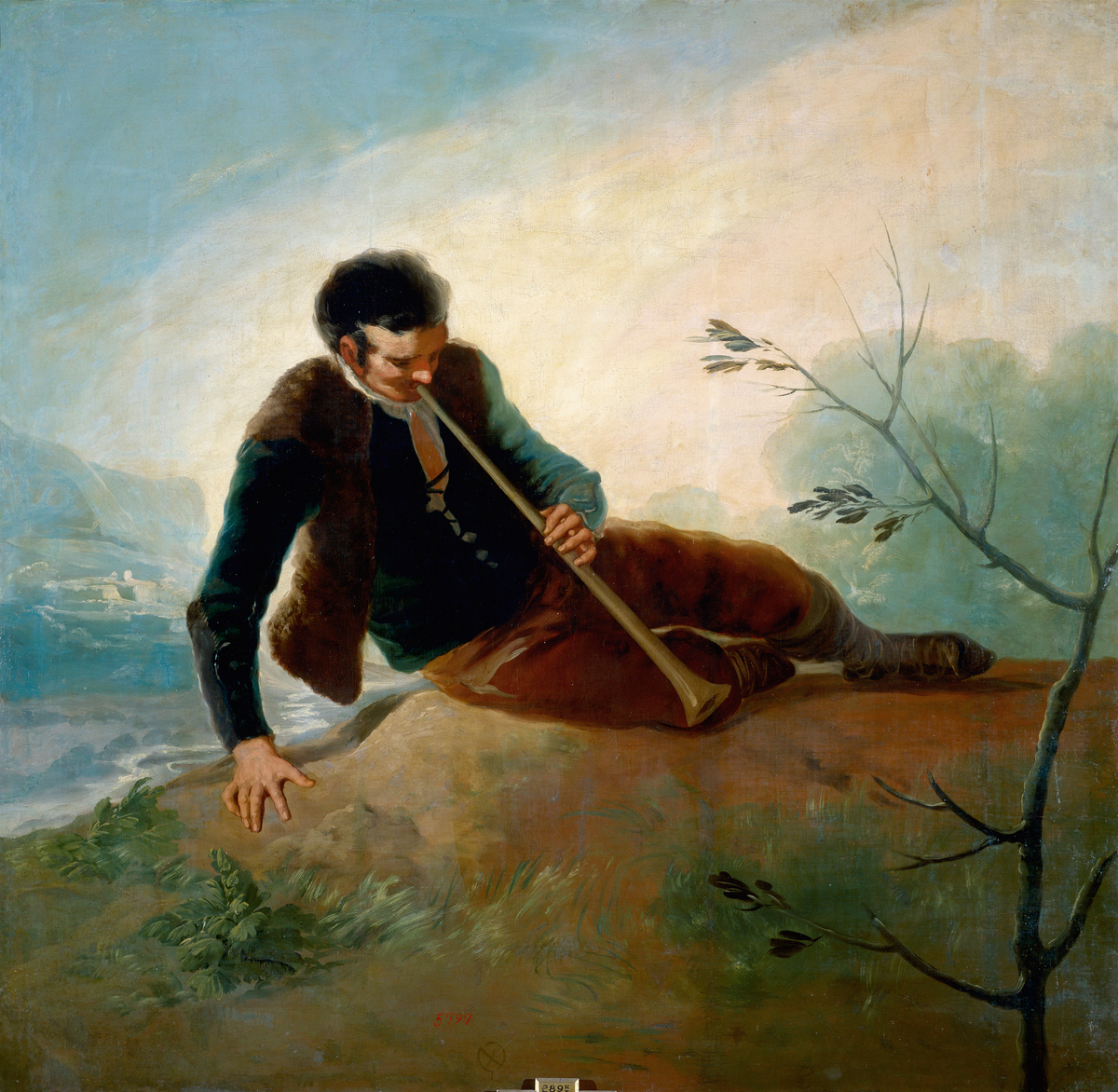
This is Francisco Goya's painting Shepherd playing a Dulzaina, made between 1786 and 1787. A shepherd sits in an open pastoral setting and plays a dulzaina, a long woodwind instrument. The Spanish title is Pastor tocando la dulzaina.
The work is a genre painting, a picture of ordinary rural life rather than a religious or historical scene. It is catalogued among Goya's cartoons for tapestries, designs made for weavers to follow. The supplied record lists it in the Prado's inventory of tapestry cartoons.
The title directs us to the act at the centre of the picture: a shepherd making music. The instrument is identified as a dulzaina, a long woodwind. That single act of playing gives the scene its focus and its name, and it places the figure within a working pastoral world rather than a courtly one.
Goya made this painting in Spain, and it dates to the later 1780s. The supplied record links it to a related subject in the Prado's Goya holdings under the title Summer. That association is recorded as a relationship between works, not as an explanation of this painting's meaning.
The record notes that the painting has been in the Real Patrimonio since 1870. It is catalogued as number 271 in the Goya catalogue by Pierre Gassier and Juliet Wilson. These are points of documented history and scholarship about the object, not clues hidden in the picture itself.
So the painting gives us a shepherd and his music, set in the Spanish countryside, within Goya's work as a designer of tapestry cartoons. The supplied record supports the subject, its genre and its place among the cartoons. It does not offer a fuller reading of the scene beyond that, so the music-making shepherd remains the clearest thing we can say the picture is about.
The story and its sources
Historical claims are linked to the records below. Close looking and interpretation are identified in the passage notes.
- Passage 1Documented historyWikimedia Commons: Shepherd playing a Dulzaina
- Passage 2Documented historyWikimedia Commons: Shepherd playing a Dulzaina
- Passage 3InterpretationWikimedia Commons: Shepherd playing a Dulzaina
- Passage 4Documented historyWikimedia Commons: Shepherd playing a Dulzaina
- Passage 5Documented historyWikimedia Commons: Shepherd playing a Dulzaina
- Passage 6InterpretationWikimedia Commons: Shepherd playing a Dulzaina
Details to notice
About 2 minutes to readBare sapling
The thin, sparsely leaved sapling frames the right side of the composition and reinforces the open pastoral setting around the musician.
Hand on the hillside
The splayed supporting hand presses against the rocky ledge, anchoring the reclining figure and emphasizing his relaxed contact with the land.
Fur-trimmed waistcoat
The thick fur-edged waistcoat, dark jacket, white neckcloth, and brown breeches define the shepherd's rustic costume and social character.
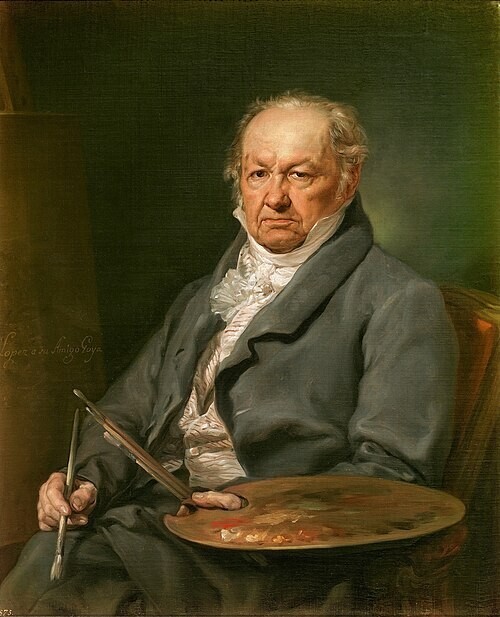
Artist portrait Image credit
Vicente López Portaña. Image source · Public domain
About the artist
Francisco de Goya
30 March 1746 to 16 April 1828
Goya was a Spanish painter and printmaker whose career extended from royal tapestry designs and court portraiture to images of war, repression and unsettling fantasy. Born in Fuendetodos, he trained in Zaragoza and Madrid and became First Painter to Charles IV in 1799. He spent his final years in Bordeaux.
- Born
- 30 March 1746
- Died
- 16 April 1828
- Nationality
- Spanish
- Birthplace
- Fuendetodos, Spain
- Died in
- Bordeaux, France
The research & record
Study the work.
Follow the evidence.
Find catalogue details, historical context, technical research and the literature behind this artwork.
The artwork record
Research catalogue
Catalogue information and detailed research, with references that link to the bibliography.
Updated .
Identity and catalogue
Link- Title
- Shepherd playing a Dulzaina(Wikimedia Commons: Shepherd playing a Dulzaina, n.d.)
- Artist or attribution
- Francisco Goya
- Object date
- 1786-1787(Wikimedia Commons: Shepherd playing a Dulzaina, n.d.)
- Medium and support
- Oil on canvas(Wikimedia Commons: Shepherd playing a Dulzaina, n.d.)
- Dimensions
- 130 × 134 cm(Wikimedia Commons: Shepherd playing a Dulzaina, n.d.)
- Current collection or location
- Museo Nacional del Prado, Madrid, Spain(Wikimedia Commons: Shepherd playing a Dulzaina, n.d.)
- Movement or period
- 18th-century Spanish (tapestry cartoons)(Wikimedia Commons: Shepherd playing a Dulzaina, n.d.)
- Country or culture
- Spain
- Depicted subject
- A shepherd seated in an open pastoral setting plays a long woodwind instrument called a dulzaina.(Wikimedia Commons: Shepherd playing a Dulzaina, n.d.)
- Title variants
- Pastor tocando la dulzaina
- Accession number
- P02895
- Support
- Canvas
Read valuation records and their limitations
Title and attribution
The painting is catalogued under the title "Shepherd playing a Dulzaina," with the Spanish form given as "Pastor tocando la dulzaina," and it is attributed to Francisco Goya. The title and the attribution are the two framing facts of the record, and they are related but distinct: the title identifies the action at the centre of the picture, while the attribution assigns the work to Goya. The subject named in the title is a shepherd playing a dulzaina, described in the record as a long woodwind instrument. Because the record supplies the title in both English and Spanish and identifies the instrument as a woodwind, the musical act in the title is the point from which any fuller account of the picture begins.(Wikimedia Commons: Shepherd playing a Dulzaina, n.d., Summary, Title; Object history; Summary, Title)
Date
The work is dated from 1786 until 1787. That range is the date assigned to the object in the supplied record, and it should be distinguished from the separate dates that attach to the painting's later history, such as its entry into the Real Patrimonio in 1870. The 1786 to 1787 range is the creation date; the 1870 date is a point in the object's institutional history, not a second date for the making of the picture.(Wikimedia Commons: Shepherd playing a Dulzaina, n.d., Summary, Date; Summary, Object history)
The painting is titled 'Shepherd playing a Dulzaina' (Spanish: 'Pastor tocando la dulzaina') and is attributed to Francisco Goya.(Wikimedia Commons: Shepherd playing a Dulzaina, n.d.)
The work is dated from 1786 until 1787.(Wikimedia Commons: Shepherd playing a Dulzaina, n.d.)
The subject is a shepherd playing a dulzaina, a long woodwind instrument.(Wikimedia Commons: Shepherd playing a Dulzaina, n.d.)
Historical context
LinkRead valuation records and their limitations
Subject and historical context
The supplied record identifies this work as a genre painting and catalogues it among Francisco Goya's cartoons for tapestries, designs made for weavers to follow. It further records that the painting was made in Spain. Applied to this object, the category of genre painting means a depiction of ordinary rural life rather than a religious or historical scene, while its inclusion among the tapestry cartoons places it within a specific kind of commissioned design work rather than a free-standing easel picture. The record also documents its physical form as an oil painting on canvas measuring 130 by 134 centimetres, and gives its dates as 1786 to 1787. These are the coordinates within which any account of the object's making and social world must operate. Within the larger history of European material culture, tapestry cartoons occupy an instructive position: they were working designs produced inside a collaborative, institutional process that ended in woven textile, yet they survive as monumental paintings in their own right. This object therefore belongs both to the history of Spanish painting and to the history of tapestry production, and its later status as a Prado picture should not obscure the fact that its original function is recorded as a design for weavers.(Wikimedia Commons: Shepherd playing a Dulzaina, n.d., Summary, Object type; Genre; Categories; Summary, Place of creation)
The work is a genre painting and is catalogued among Goya's cartoons for tapestries.(Wikimedia Commons: Shepherd playing a Dulzaina, n.d.)
The painting was made in Spain.(Wikimedia Commons: Shepherd playing a Dulzaina, n.d.)
Materials and technique
LinkRead valuation records and their limitations
Documented support and format
The supplied record describes the work as an oil painting on canvas measuring 130 by 134 centimetres. These are the only material facts the evidence establishes: a painting executed in oil on a canvas support, very nearly square in format. The record is a Wikimedia Commons reference page rather than the Prado's own catalogue entry, which was not supplied, so the medium and dimensions are reported from that secondary reference record and should be treated as such. The evidence says nothing about canvas weave, thread count, stretcher, ground or preparation layers, priming colour, pigment identification, binders, varnish, lining, or any conservation treatment, and nothing here should be inferred about them.(Wikimedia Commons: Shepherd playing a Dulzaina, n.d., Summary, Medium; Summary, Dimensions)
Interpretation
The evidence available for this section is documentary rather than technical: it establishes medium, support and size, but not how the surface was built up. No cross-sections, pigment analyses, raking-light photographs, X-radiographs or infrared images are recorded in the supplied units. Consequently the account cannot distinguish what examination of the physical object would show from what a viewer infers by eye. The near-square dimensions can be stated as documented fact; anything about how the paint was applied, what colours were used, or whether the composition was worked up in stages would require evidence the record does not contain.(Wikimedia Commons: Shepherd playing a Dulzaina, n.d., Summary, Medium; Summary, Dimensions)
The work is an oil painting on canvas.(Wikimedia Commons: Shepherd playing a Dulzaina, n.d.)
Its dimensions are 130 by 134 centimetres.(Wikimedia Commons: Shepherd playing a Dulzaina, n.d.)
Provenance and ownership
LinkRead valuation records and their limitations
Documented Ownership
The documented ownership history supplied for this painting begins with the Real Patrimonio, the royal patrimony, in which the work is recorded as having been since 1870. The record gives no earlier owner, transfer, sale or acquisition, so the period from the painting's creation in 1786 to 1787 up to 1870 is an unrecorded interval, not a gap that any supplied evidence fills. Treating the 1870 date as a starting point rather than an origin is therefore essential: what is documented is the work's presence in the Real Patrimonio from that year, not the route by which it arrived there. Because the painting is a genre painting catalogued among Goya's cartoons for tapestries, made in Spain, the later royal-patrimonial holding sits within a Spanish institutional context, but the supplied record does not establish any intervening owner or transaction linking the making of the work to that holding.(Wikimedia Commons: Shepherd playing a Dulzaina, n.d., Summary, Object history; Summary, Object type; Genre; Categories; Summary, Place of creation)
Within the current institutional frame, the painting belongs to the collection of the Museo Nacional del Prado in Madrid under accession number P02895 and is listed in room 94. It is separately entered in the Prado's inventory of cartoons for tapestries as number 5797. These are distinct identifiers serving distinct functions: the accession number identifies the object within the museum's collection, while the tapestry-cartoon inventory number situates it in the specific working series to which the catalogue assigns it. The presence of both numbers reflects the object's dual identity as a collected painting and as a design made for weavers to follow. The supplied record does not describe how the work moved from the Real Patrimonio into the Prado's collection, nor does it give a date for that transition, so the relationship between the 1870 royal-patrimonial holding and the present Prado accession is recorded but not narrated.(Wikimedia Commons: Shepherd playing a Dulzaina, n.d., Summary, Object history; Summary, Object type; Genre; Categories)
Scholarly cataloguing provides a further layer of identification. The painting is catalogued as number 271 in the Goya catalogue by Pierre Gassier and Juliet Wilson, a reference point that locates the object within the published corpus of Goya's work rather than within a single museum's records. This catalogue number and the Prado identifiers together allow the object to be traced across different documentary systems: the museum accession record, the tapestry-cartoon inventory, and the scholarly catalogue raisonné. The supplied evidence does not state the date of the Gassier and Wilson publication or the circumstances in which the painting was included, so the catalogue entry should be understood as an established scholarly attribution and numbering rather than as a provenance document in its own right.(Wikimedia Commons: Shepherd playing a Dulzaina, n.d., Summary, Notes; References; Summary, Object history)
Interpretation
Read together, the supplied evidence supports a short but precise provenance statement: creation in Spain in 1786 to 1787; presence in the Real Patrimonio from 1870; and present collection in the Museo Nacional del Prado under accession number P02895, room 94, with tapestry-cartoon inventory number 5797 and Gassier and Wilson catalogue number 271. Everything between the making of the work and 1870 remains undocumented in this record. The distinction matters for research: an unrecorded interval is not evidence of a change of ownership, and the absence of named owners before 1870 should not be read as a hidden or disputed transfer. The object's importance within a larger history of art and material culture rests on its status as a Goya genre painting and tapestry cartoon documented in the Prado and in the standard catalogue, while its earlier ownership history awaits documentation beyond what is supplied here.(Wikimedia Commons: Shepherd playing a Dulzaina, n.d., Summary, Object history; Summary, Object type; Genre; Categories; Summary, Notes; References; Summary, Place of creation)
The painting has been in the Real Patrimonio since 1870.(Wikimedia Commons: Shepherd playing a Dulzaina, n.d.)
Provenance timeline
- since 1870
The painting is recorded as having been in the Real Patrimonio since 1870, an open-ended retention statement rather than a dated transfer event.(Wikimedia Commons: Shepherd playing a Dulzaina, n.d., Summary, Object history)
Reception and literature
LinkRead valuation records and their limitations
Catalogues and the Documentation of Reception
Research access to Shepherd playing a Dulzaina is shaped by the documentary apparatus that has grown around the canvas, not only by the image itself. The painting is catalogued as number 271 in the Goya catalogue by Pierre Gassier and Juliet Wilson, a reference that places it within the standard numbered sequence of the artist's works and gives later scholarship a fixed point of citation. That catalogue position sits alongside the Prado's own inventory of cartoons for tapestries, number 5797, and the museum accession number P02895, with the work listed in room 94. The coexistence of these numbers records successive layers of documentation: a nineteenth-century royal collection, a museum inventory, and a modern catalogue raisonné. Each layer frames the object differently, and each has been used by later writers to identify and locate it. The Gassier and Wilson number in particular signals that the painting has been accepted into the core corpus rather than treated as marginal or disputed.(Wikimedia Commons: Shepherd playing a Dulzaina, n.d., Summary, Notes; References)
Interpretation
The work's later cultural role has been carried substantially through association with the Prado's broader Goya holdings. The supplied record notes that it has been associated with a related subject in the Prado, catalogued under the title Summer (Goya). That association is recorded as a relationship between works, a link between subjects in a shared collection, rather than as an explanation of this painting's meaning; the supplied evidence does not establish what the two works share beyond that recorded relation, and it should not be inflated into a claim about seasonal series, pendants or a programmatic pairing. What the association does establish is that reception of the shepherd has often proceeded through comparison and grouping within the museum's Goya collection, so that the single figure with his instrument is encountered as part of a larger pictorial ensemble rather than in isolation.(Wikimedia Commons: Shepherd playing a Dulzaina, n.d., File usage on other wikis)
The Subject as the Carrier of Meaning
The subject itself has carried much of the work's reception. The title directs attention to the act at the centre of the picture: a shepherd seated in an open pastoral setting, playing a dulzaina, a long woodwind instrument, which gives the scene both its focus and its name in Spanish, Pastor tocando la dulzaina. Read within the history of material culture, the naming matters because it preserves a specific instrument rather than a generic pipe, and it places the figure in a working pastoral world rather than a courtly or mythological one. The supplied record offers no fuller reading of the scene beyond subject, genre and place among the cartoons, and it does not attribute a symbolic or allegorical interpretation to any scholar. Any claim that the music-making carries a programmatic meaning would exceed the evidence; the clearest supported statement is that the picture is about a shepherd and his instrument, presented as ordinary rural life. In reception terms, the instrument has become the painting's identifying feature, the element through which it is titled, catalogued and remembered.(Wikimedia Commons: Shepherd playing a Dulzaina, n.d., Summary, Object type; Genre; Categories; File usage on other wikis)
The painting is catalogued as number 271 in the Goya catalogue by Pierre Gassier and Juliet Wilson.(Wikimedia Commons: Shepherd playing a Dulzaina, n.d.)
Interpretations and debates
LinkRead valuation records and their limitations
Interpretation
The work has been associated with a related subject in the Prado's Goya holdings, catalogued under the title 'Summer' (Goya).(Wikimedia Commons: Shepherd playing a Dulzaina, n.d.)
Collection and display
LinkRead valuation records and their limitations
The painting known in Spanish as Pastor tocando la dulzaina, and in English as Shepherd playing a Dulzaina, is attributed to Francisco Goya and is dated 1786 to 1787. The supplied record describes it as an oil on canvas measuring 130 by 134 centimetres, made in Spain. These technical particulars are the most concrete facts the record offers about the physical object, and they frame everything else that can be said: a near-square canvas painted in oils within a two-year window of Goya's later career. The record also classifies the work as a genre painting and catalogues it among Goya's tapestry cartoons, designs made for weavers to follow. The subject, a shepherd playing a dulzaina, a long woodwind instrument, is the element the title fixes, and it places the picture within ordinary rural life rather than in a religious or historical register.(Wikimedia Commons: Shepherd playing a Dulzaina, n.d., Summary, Collection; Current location)
Collection and display
The institutional history of the canvas is recorded through several overlapping systems of reference, each serving a different purpose. The painting belongs to the collection of the Museo Nacional del Prado in Madrid under accession number P02895, and it is listed in room 94. It is separately entered in the Prado's inventory of cartoons for tapestries as number 5797, and the record also gives its location within the museum's cartones inventory. Two other reference numbers attach to the work from outside the museum's own registration: it has been in the Real Patrimonio since 1870, and it is catalogued as number 271 in the Goya catalogue by Pierre Gassier and Juliet Wilson. Read together, these entries show a single object tracked simultaneously by accession number, by a specialised inventory of tapestry designs, by a royal patrimony holding that dates to 1870, and by the standard reference catalogue of Goya's work. The presence of a cartoons-specific inventory number is the clearest documentary sign that the Prado classifies the painting functionally as a tapestry design, not merely as an independent genre picture, and the Gassier and Wilson entry gives it a fixed place in the published corpus of Goya's work.(Wikimedia Commons: Shepherd playing a Dulzaina, n.d., Summary, Collection; Current location; Summary, References)
Interpretation
The record links the painting to a related subject in the Prado's Goya holdings catalogued under the title Summer. The relationship is recorded as an association between works, not as an interpretation of this canvas's meaning, and the supplied evidence does not explain the basis of the connection. That qualification matters for how the object is understood within the collection: its position among Goya's tapestry designs, and its possible relationship to a seasonal subject, are both documented at the level of catalogue association rather than narrated as biography or intended programme. The record offers no fuller reading of the scene beyond the shepherd's music making, so the act of playing the dulzaina remains the most securely supported account of what the picture depicts.(Wikimedia Commons: Shepherd playing a Dulzaina, n.d., Summary, Collection; Current location)
The painting belongs to the collection of the Museo Nacional del Prado in Madrid, with the accession number P02895, and is listed in room 94.(Wikimedia Commons: Shepherd playing a Dulzaina, n.d.)
The work is entered in the Prado's inventory of cartoons for tapestries, number 5797.(Wikimedia Commons: Shepherd playing a Dulzaina, n.d.)
Documented values and qualified estimates
LinkRead valuation records and their limitations
The object and its record
Interpretation
The object is recorded as a large oil painting on canvas by Francisco Goya, dated 1786 to 1787 and measuring 130 by 134 centimetres. Its Spanish title, Pastor tocando la dulzaina, identifies the subject: a shepherd playing a dulzaina, a long woodwind instrument. The work is classified as a genre painting, a scene of ordinary rural life rather than a religious or historical subject, and it is catalogued among Goya's cartoons for tapestries, the designs made for weavers to follow. The record places it in the collection of the Museo Nacional del Prado in Madrid under accession number P02895, room 94, and in the Prado's inventory of tapestry cartoons as number 5797. It was made in Spain. These attributions and identifications come from a Wikimedia Commons reference page rather than the Prado's own catalogue record, which was not supplied; the page is described as partially consulted, so the institutional catalogue entry behind these details has not been independently checked here.(Wikimedia Commons: Shepherd playing a Dulzaina, n.d.)
Two scholarly locators anchor the painting in the literature and in the museum's own documentation. It is catalogued as number 271 in the Goya catalogue by Pierre Gassier and Juliet Wilson, and it is entered in the Prado's inventory of tapestry cartoons as number 5797. The record also notes that the painting has been in the Real Patrimonio since 1870. These are points of documented history and cataloguing about the object rather than readings of the picture's content. The supplied record further links the work to a related subject in the Prado's Goya holdings catalogued under the title Summer; that association is recorded as a relationship between works, not as an explanation of this painting's meaning.(Wikimedia Commons: Shepherd playing a Dulzaina, n.d.)
Recorded values
A separate kind of value appears in the record: a calculated working insurance estimate of US$40M to US$120M, recorded as a working calculation generated on 2026-11-16. The methodology states that it was produced for manual review using only confirmed context: a large oil on canvas, 130 by 134 cm, by Goya, dated 1786 to 1787, from the eighteenth-century Spanish tapestry-cartoon series, held at the Prado under accession P02895 and Gassier-Wilson 271, with an object history noting transfer to Real Patrimonio in 1870. The wide band is said to reflect the extreme scarcity of museum-held Goya tapestry cartoons on the open market and the absence of any verified comparable sale or public appraisal in the supplied excerpts. The record explicitly states that no auction, sale, or private insurance figure was invented or consulted, and that the range is a conservative model-generated placeholder for a qualified human reviewer to refine.(Wikimedia Commons: Shepherd playing a Dulzaina, n.d.)
That figure carries a heavy qualification and should not be read as a market fact. The record states that it is a model-generated working range for manual review only, not an official insurance value, appraisal, auction estimate, auction result, or sale price, and that it must not be used to bind coverage or settle a claim. It is not based on comparable sales or private insurance records, and a qualified fine-art appraiser and insurer should establish any official value. The range therefore documents how the object's scarcity and museum context were translated into a provisional number for review, not what the painting is worth in any negotiated or insured sense.(Wikimedia Commons: Shepherd playing a Dulzaina, n.d.)
Working estimate
Calculated working insurance estimate, not a sale price: Estimated value: US$40M to US$120M Recorded date: Working calculation, generated 2026-11-16. Methodology: Broad working insurance range calculated for manual review using only the confirmed context: a large oil on canvas (130 x 134 cm) by Francisco Goya, dated 1786 to 1787, from his 18th-century Spanish tapestry-cartoon series, held at the Museo Nacional del Prado (accession P02895, Gassier-Wilson 271), with recorded object history noting transfer to Real Patrimonio in 1870. The wide band reflects the extreme scarcity of museum-held Goya tapestry cartoons on the open market and the absence of any verified comparable sale or public appraisal in the supplied excerpts. No auction, sale, or private insurance figure was invented or consulted; this is a conservative model-generated placeholder for a qualified human reviewer to refine. Qualification: Model-generated working range for manual review only. This is not an official insurance value, appraisal, auction estimate, auction result, or sale price, and it must not be used to bind coverage or settle a claim. It is not based on comparable sales or private insurance records, and a qualified fine-art appraiser and insurer should establish any official value.(Wikimedia Commons: Shepherd playing a Dulzaina, n.d.)
Further reading
Books for a closer look
Paid links. As an Amazon Associate I earn from qualifying purchases.

Open Library Goya
Kodansha International
Recorded as a Goya catalogue covering Prado holdings and Spanish painting; the painting is a Goya tapestry cartoon in the Museo Nacional del Prado, so a Prado-oriented Goya catalogue is the closest object-related match among the candidates.
ISBN 0870110837

Open Library Francisco Goya
Counterpoint
A biographical and critical study of Goya as an artist; relevant for the painter of this 1786 to 1787 pastoral genre scene, but it is a general study rather than an object-specific catalogue entry.
ISBN 1582433070
Bibliography
Sources and further reading
References are arranged by author or organisation, with links to the original publications. Where no publication date is recorded, n.d. means no date.
Source notes updated .
No recorded sources match these filters. Reset the filters to see the full bibliography.
- 04
Book
Francisco Goya. Counterpoint.
A biographical and critical study of Goya as an artist; relevant for the painter of this 1786 to 1787 pastoral genre scene, but it is a general study rather than an object-specific catalogue entry.
- ISBN
- 1582433070
Citation text
- 02
Book
Goya. Kodansha International.
Recorded as a Goya catalogue covering Prado holdings and Spanish painting; the painting is a Goya tapestry cartoon in the Museo Nacional del Prado, so a Prado-oriented Goya catalogue is the closest object-related match among the candidates.
- ISBN
- 0870110837
Citation text
- 03
Book
Francisco Goya - the Paintings. Independently Published.
Titled as a survey of Goya's paintings, which corresponds to the medium of this oil on canvas work, though the catalogue record gives no indication of whether this particular canvas is discussed.
- ISBN
- 9781521566466
Citation text
- 01
Secondary · About this artwork
Wikimedia Commons: Shepherd playing a Dulzaina (n.d.). Wikimedia Commons: File:Pastor tocando la dulzaina.jpg. Wikimedia Commons.
Discovery and reference record for this painting, reproducing Goya attribution, title, date, medium, dimensions, Prado collection, accession number, object history and catalogue references. It is a Wikimedia Commons page, not the Prado's own catalogue record, which was not supplied.
- Language
- en
Citation text
Art to live with
Bring this painting
home.
A piece of the archive, made yours. Explore Shepherd playing a Dulzaina in a size and finish that fits your space.
Your text and annotations appear on these editions. Adding to cart saves that design for printing.
Combine this painting with your favourites01 / Find your edition
Made for you
Suggested from your location. Change it if you're sending elsewhere or using a VPN. Prices and delivery are shown in GBP.
19 products
Choose an edition to make it yours
6 × 8 in · Printed cover · 118 lined pages
6 × 8 in · Printed cover · 118 lined pages
6 × 8 in · Printed cover · 118 lined pages
Notebook
GBP 12.03
Delivery GBP 5.35 / Total GBP 17.38
A 6 × 8 inch spiral notebook with 118 ruled pages (59 sheets), a printed front cover, dark grey back cover and metal spiral binding.
Fit and fill keep the painting’s proportions. Stretch changes them.
Move and zoom the painting on your notebook.
Made to order with your design
Made to order
US delivery only
20.3 × 20.3 cm / 8 × 8 in · Standard
20.3 × 20.3 cm / 8 × 8 in · Standard

8 × 8 in / 20.3 × 20.3 cm · Standard

8 × 8 in / 20.3 × 20.3 cm · Standard

8 × 8 in / 20.3 × 20.3 cm · Standard

8 × 8 in / 20.3 × 20.3 cm · Standard

8 × 8 in / 20.3 × 20.3 cm · Standard
Metal art sign
GBP 22.17
Delivery GBP 17.90 / Total GBP 40.07
A printed aluminium sign with rounded corners and mounting holes.
Fit and fill keep the painting’s proportions. Stretch changes them.
Move and zoom the painting on your metal art sign.
Made to order with your design
Printed aluminium · mounting holes included
US delivery only
iPhone 12 Mini ? Glossy ? back view
iPhone 12 Mini · Glossy

iPhone 12 Mini ? Glossy ? back view

iPhone 12 Mini ? Glossy ? back view

iPhone 12 Mini ? Glossy ? back view
Tough phone case
GBP 16.56
Delivery GBP 4.28 / Total GBP 20.84
A two-layer phone case with a printed polycarbonate shell and a shock-absorbing inner liner.
Two layers with a shock-absorbing TPU liner
Case & print details
- Device
- Apple · iPhone 12 Mini
- Material
- Polycarbonate shell with a TPU inner liner
- Artwork
- Outer back and wrapped edges from one template
- Finish
- Glossy
- Version
- Standard version
- Printing
- Dye sublimation
- Print file
- 1,122 × 1,831 px · 95 × 155 mm · PNG · 300 dpi recommended
Rear outline and camera openings follow this variant's Printify template. Case depth and small hardware remain illustrative.
Supplier product detailsFit and fill keep the painting’s proportions. Stretch changes them.
Move and zoom the painting on your tough phone case.
Made to order with your design
Made to order
US delivery only
25.4 × 20.3 cm / 10 × 8 in · White
25.4 × 20.3 cm / 10 × 8 in · White

10 × 8 in / 25.4 × 20.3 cm · White

10 × 8 in / 25.4 × 20.3 cm · White

10 × 8 in / 25.4 × 20.3 cm · White

10 × 8 in / 25.4 × 20.3 cm · White
Framed art print
GBP 34.51
- 1 framed print
- GBP 34.51
- Delivery to United States
- GBP 9.73
- Total
- GBP 44.24
A ready-to-hang wooden frame with a clear Perspex cover and a semi-gloss printed insert.
Delivery is quoted for all selected copies together.
Fit and fill keep the painting’s proportions. Stretch changes them.
Move and zoom the painting on your framed art print.
Made to order with your design
Wooden frame & protective clear front included
US delivery only
38.1 × 40.6 cm / 15 × 16 in · Natural
38.1 × 40.6 cm / 15 × 16 in · Natural

15 × 16 in / 38.1 × 40.6 cm · Natural

15 × 16 in / 38.1 × 40.6 cm · Natural

15 × 16 in / 38.1 × 40.6 cm · Natural

15 × 16 in / 38.1 × 40.6 cm · Natural

15 × 16 in / 38.1 × 40.6 cm · Natural
Canvas tote bag
GBP 14.40
Delivery GBP 4.38 / Total GBP 18.78
A sturdy cotton canvas tote with reinforced handles and artwork on the front panel.
Fit and fill keep the painting’s proportions. Stretch changes them.
Move and zoom the painting on your canvas tote bag.
Made to order with your design
Front print · reinforced cotton handles
US delivery only
22.9 × 20.3 cm / 9 × 8 in · Standard
22.9 × 20.3 cm / 9 × 8 in · Standard

9 × 8 in / 22.9 × 20.3 cm · Standard

9 × 8 in / 22.9 × 20.3 cm · Standard

9 × 8 in / 22.9 × 20.3 cm · Standard

9 × 8 in / 22.9 × 20.3 cm · Standard
Mouse mat
GBP 7.36
Delivery GBP 4.87 / Total GBP 12.23
A rectangular fabric mouse mat with a rubber backing and rounded corners.
Fit and fill keep the painting’s proportions. Stretch changes them.
Move and zoom the painting on your mouse mat.
Made to order with your design
Made to order
US delivery only
See more13 more products
43.2 × 45.7 cm / 17 × 18 in · Artwork
43.2 × 45.7 cm / 17 × 18 in · Artwork

17 × 18 in / 43.2 × 45.7 cm · Artwork

17 × 18 in / 43.2 × 45.7 cm · Artwork

17 × 18 in / 43.2 × 45.7 cm · Artwork
Woven tote bag
GBP 47.33
Delivery GBP 5.94 / Total GBP 53.27
A woven tote with cotton webbing handles and the painting translated into a woven design.
Fit and fill keep the painting’s proportions. Stretch changes them.
Move and zoom the painting on your woven tote bag.
Made to order with your design
Made to order
US delivery only
25.4 × 25.4 cm / 10 × 10 in · Standard
25.4 × 25.4 cm / 10 × 10 in · Standard

10 × 10 in / 25.4 × 25.4 cm · Standard

10 × 10 in / 25.4 × 25.4 cm · Standard

10 × 10 in / 25.4 × 25.4 cm · Standard

10 × 10 in / 25.4 × 25.4 cm · Standard

10 × 10 in / 25.4 × 25.4 cm · Standard
Matte art print
GBP 11.42
Delivery GBP 7.29 / Total GBP 18.71
An unframed matte poster with archival inks, ready for a frame of your choice.
Fit and fill keep the painting’s proportions. Stretch changes them.
Move and zoom the painting on your matte art print.
Made to order with your design
Unframed · frame it your way
US delivery only
iPhone 12 Mini ? Standard ? back view
iPhone 12 Mini · Standard

iPhone 12 Mini ? Standard ? back view

iPhone 12 Mini ? Standard ? back view

iPhone 12 Mini ? Standard ? back view
Flexible phone case
GBP 15.76
Delivery GBP 4.28 / Total GBP 20.04
A flexible TPU phone case with a frosted finish, a printed back and precise port openings.
Flexible TPU with a frosted, matte finish
Case & print details
- Device
- Apple · iPhone 12 Mini
- Material
- Semi-transparent thermoplastic polyurethane (TPU)
- Artwork
- Back print; rim stays unprinted
- Finish
- Standard
- Version
- Standard version
- Printing
- Dye sublimation
- Print file
- 791 × 1,586 px · 67 × 134.3 mm · PNG · 300 dpi recommended
Rear outline and camera openings follow this variant's Printify template. Case depth and small hardware remain illustrative.
Supplier product detailsFit and fill keep the painting’s proportions. Stretch changes them.
Move and zoom the painting on your flexible phone case.
Made to order with your design
Made to order
S · Standard
S · Standard

S · Standard

S · Standard

S · Standard

S · Standard

S · Standard
Crew socks
GBP 10.78
Delivery GBP 4.49 / Total GBP 15.27
Crew-length polyester and spandex socks with a ribbed cuff, cushioned sole and sublimated artwork.
Fit and fill keep the painting’s proportions. Stretch changes them.
Move and zoom the painting on your crew socks.
Made to order with your design
One pair · design repeated on both socks
US delivery only
12" · Standard
12" · Standard

12" · Standard

12" · Standard

12" · Standard
Laptop sleeve
GBP 26.36
Delivery GBP 4.96 / Total GBP 31.32
A polyester laptop sleeve with a fleece lining, top zip, printed front and black reverse.
Fit and fill keep the painting’s proportions. Stretch changes them.
Move and zoom the painting on your laptop sleeve.
Made to order with your design
Made to order
US delivery only
11oz · single image
11oz · White
11oz · single image
Mug
GBP 7.42
Delivery GBP 6.23 / Total GBP 13.65
A glossy white ceramic mug with a C-shaped handle, available in 11oz and 15oz sizes.
single layout · choose single, double or a repeating pattern in Customise.
Repeat, fit, fill and position your artwork around the mug.
Made to order with your design
Made to order
iPhone 12 Mini ? Standard ? back view
iPhone 12 Mini · Standard

iPhone 12 Mini ? Standard ? back view

iPhone 12 Mini ? Standard ? back view

iPhone 12 Mini ? Standard ? back view

iPhone 12 Mini ? Standard ? back view

iPhone 12 Mini ? Standard ? back view
Biodegradable phone case
GBP 21.19
Delivery GBP 4.28 / Total GBP 25.47
A matte phone case made from plant polymers and bamboo fibre, with the artwork printed on the back.
Flexible plant-polymer shell with a matte finish
Case & print details
- Device
- Apple · iPhone 12 Mini
- Material
- PLA and PBAT polymers with bamboo fibre
- Artwork
- Back print; rim stays unprinted
- Finish
- Standard
- Version
- Standard version
- Printing
- Dye sublimation
- Print file
- 777 × 1,553 px · 65.8 × 131.5 mm · PNG · 300 dpi recommended
Rear outline and camera openings follow this variant's Printify template. Case depth and small hardware remain illustrative.
Supplier product detailsFit and fill keep the painting’s proportions. Stretch changes them.
Move and zoom the painting on your biodegradable phone case.
Made to order with your design
Made to order
40.6 × 40.6 cm / 16 × 16 in · Standard
40.6 × 40.6 cm / 16 × 16 in · Standard

16 × 16 in / 40.6 × 40.6 cm · Standard

16 × 16 in / 40.6 × 40.6 cm · Standard

16 × 16 in / 40.6 × 40.6 cm · Standard
Fine art poster
GBP 18.63
Delivery GBP 7.89 / Total GBP 26.52
A gallery paper print with a smooth art-paper surface. Choose a size that suits the painting.
Fit and fill keep the painting’s proportions. Stretch changes them.
Move and zoom the painting on your fine art poster.
Made to order with your design
Unframed · frame it your way
iPhone 12 Mini ? Standard ? back view
iPhone 12 Mini · Standard

iPhone 12 Mini ? Standard ? back view

iPhone 12 Mini ? Standard ? back view

iPhone 12 Mini ? Standard ? back view
Clear phone case
GBP 15.28
Delivery GBP 4.28 / Total GBP 19.56
A clear phone case with artwork on the back. Leave areas transparent to show the phone underneath.
Clear shell with shock-absorbing TPU sides
Case & print details
- Device
- Apple · iPhone 12 Mini
- Material
- Polycarbonate back and clear TPU sides
- Artwork
- Back print; clear sides stay unprinted
- Finish
- Standard
- Version
- Standard version
- Printing
- Dye sublimation
- Print file
- 732 × 1,527 px · 62 × 129.3 mm · PNG · 300 dpi recommended
Rear outline and camera openings follow this variant's Printify template. Case depth and small hardware remain illustrative.
Supplier product detailsFit and fill keep the painting’s proportions. Stretch changes them.
Move and zoom the painting on your clear phone case.
Made to order with your design
Made to order
15oz · single image
15oz · Standard

15oz · single image

15oz · single image

15oz · single image

15oz · single image

15oz · single image
Travel mug
GBP 32.33
Delivery GBP 5.75 / Total GBP 38.08
A stainless-steel travel mug with a black lid, a tapered base and a printed white exterior.
single layout · choose single, double or a repeating pattern in Customise.
Repeat, fit, fill and position your artwork around the mug.
Made to order with your design
Made to order
US delivery only
2.5 × 3.4 cm / 1 × 1.4 in · Glossy
2.5 × 3.4 cm / 1 × 1.4 in · Glossy

1 × 1.4 in / 2.5 × 3.4 cm · Glossy

1 × 1.4 in / 2.5 × 3.4 cm · Glossy

1 × 1.4 in / 2.5 × 3.4 cm · Glossy

1 × 1.4 in / 2.5 × 3.4 cm · Glossy
Photo keyring
GBP 10.30
Delivery GBP 5.45 / Total GBP 15.75
A rectangular zinc-alloy photo keyring with a glossy insert and a swivel split ring.
Fit and fill keep the painting’s proportions. Stretch changes them.
Move and zoom the painting on your photo keyring.
Made to order with your design
Photo insert · zinc frame & swivel ring
US delivery only
iPhone 15 Pro ? Glossy ? back view
iPhone 15 Pro · Glossy

iPhone 15 Pro ? Glossy ? back view

iPhone 15 Pro ? Glossy ? back view

iPhone 15 Pro ? Glossy ? back view

iPhone 15 Pro ? Glossy ? back view

iPhone 15 Pro ? Glossy ? back view
Slim phone case
GBP 16.53
Delivery GBP 5.85 / Total GBP 22.38
A slim printed phone shell with open ports and a lightweight profile.
Slim, lightweight polycarbonate shell
Case & print details
- Device
- Apple · iPhone 15 Pro
- Material
- Polycarbonate
- Artwork
- Outer back and wrapped edges from one template
- Finish
- Glossy
- Version
- Standard version
- Printing
- Dye sublimation
- Print file
- 1,278 × 1,971 px · 108.2 × 166.9 mm · PNG · 300 dpi recommended
Rear outline and camera openings follow this variant's Printify template. Case depth and small hardware remain illustrative.
Supplier product detailsFit and fill keep the painting’s proportions. Stretch changes them.
Move and zoom the painting on your slim phone case.
Made to order with your design
Made to order
US delivery only
36.6 × 30.7 cm / 14.4 × 12.1 in · Standard
36.6 × 30.7 cm / 14.4 × 12.1 in · Standard

14.4 × 12.1 in / 36.6 × 30.7 cm · Standard

14.4 × 12.1 in / 36.6 × 30.7 cm · Standard

14.4 × 12.1 in / 36.6 × 30.7 cm · Standard
Desk mat
GBP 15.17
Delivery GBP 7.21 / Total GBP 22.38
A smooth polyester desk mat with a natural rubber non-slip base and anti-fray edges, available in three sizes.
Fit and fill keep the painting’s proportions. Stretch changes them.
Move and zoom the painting on your desk mat.
Made to order with your design
Made to order
The 30 cm ruler is scaled alongside your selected print. Keep the painting’s proportions with a black background, or stretch it to fill. Frame width, material texture and screen colours are illustrative.
Keep exploring