Boys picking fruit
Artist: Francisco Goya · 1778

Boys picking fruit: high-resolution image
The original file is hosted by Wikimedia Commons, available without payment or an account.
Open high-resolution image on Wikimedia CommonsThe complete story
The story About 2 minutes to read
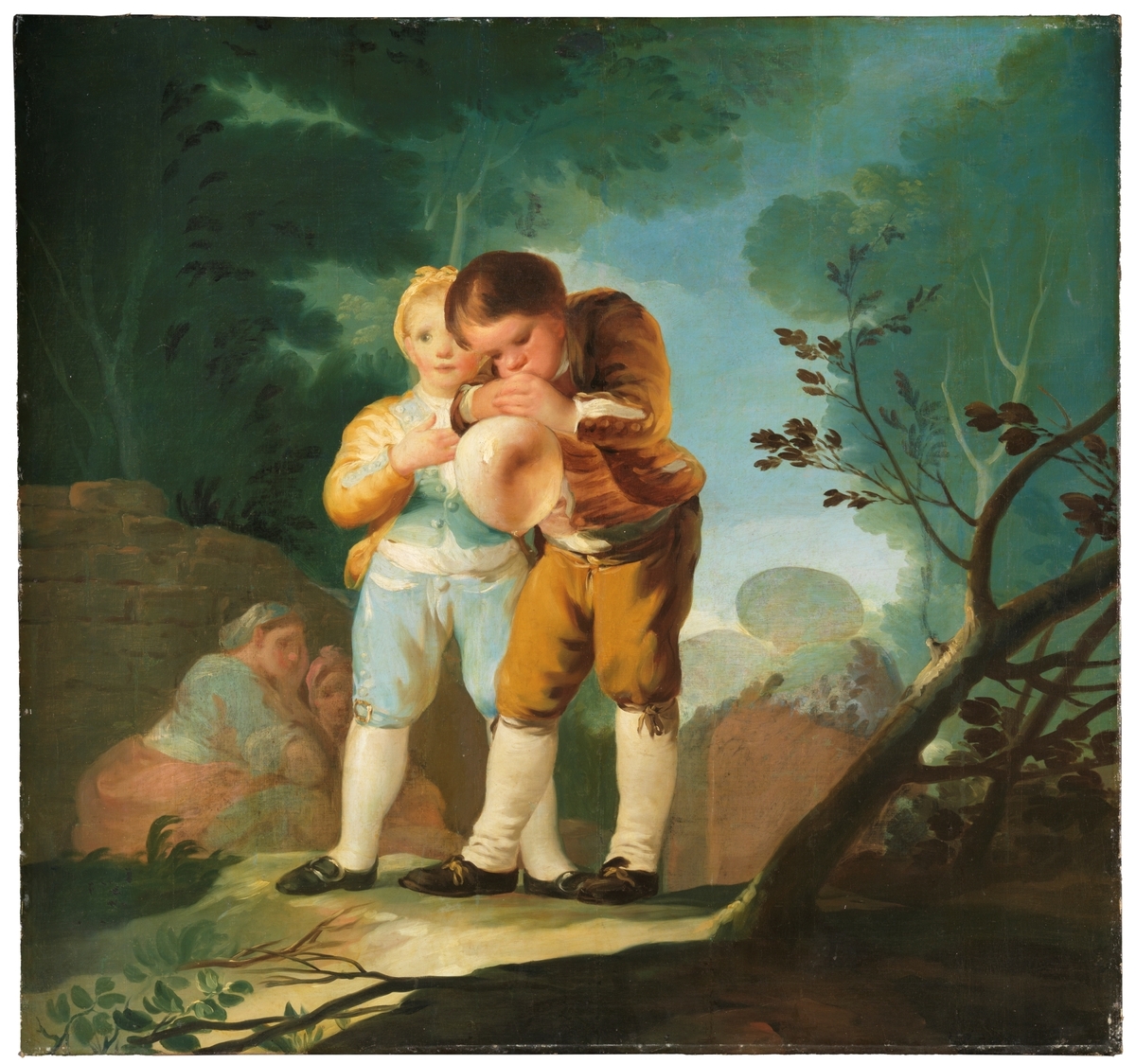
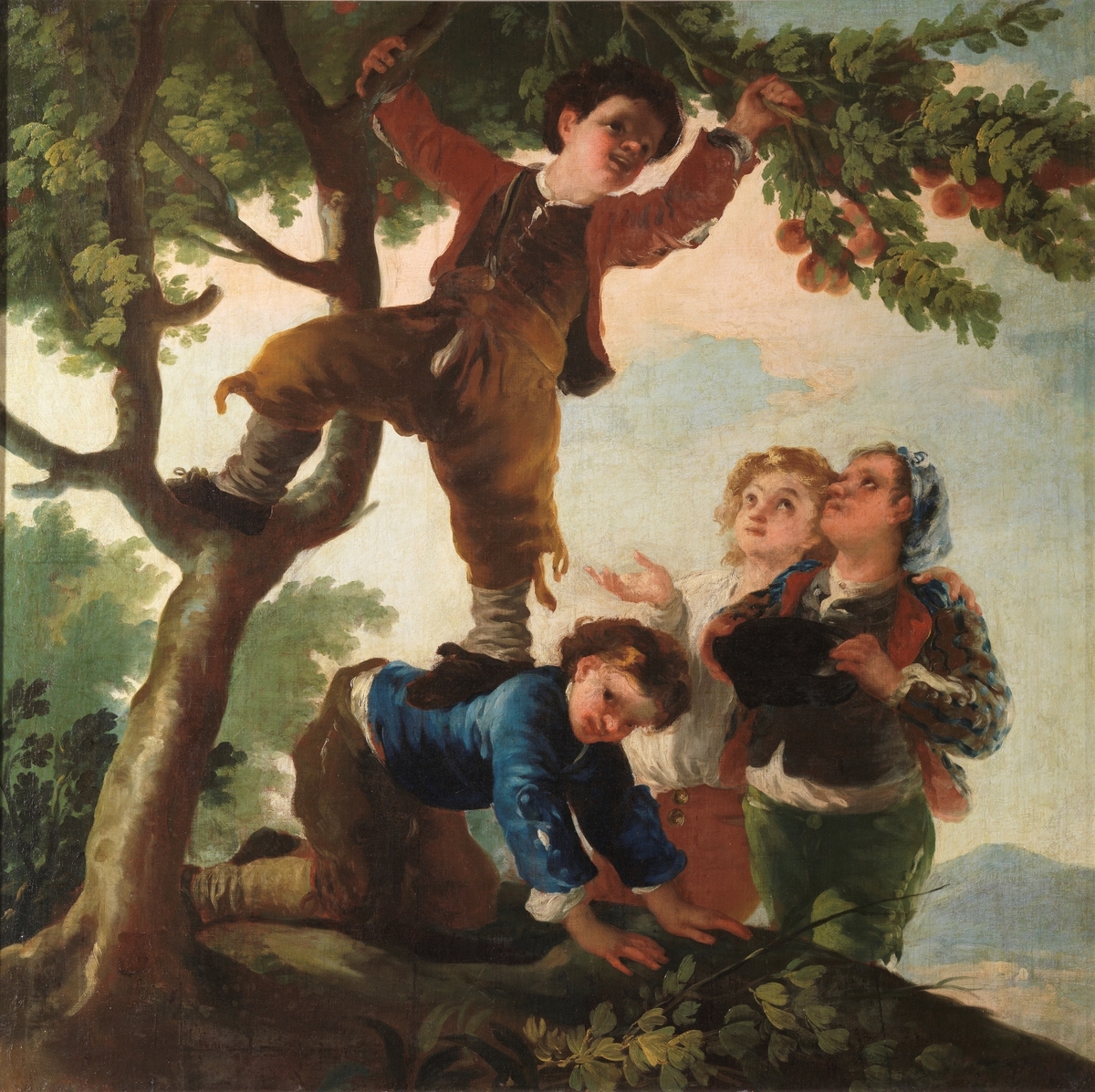
This is Francisco Goya's Boys picking fruit, painted in 1778. It shows children collecting fruit around a tree. One boy reaches up into a fruit-bearing branch. Other children look upward, and a boy crouches in the foreground.
The crouching boy in the foreground turns the group toward us. Above him, the reaching boy carries the action upward into the branch. Between them, the other children look up, so the picture joins a low, near figure to a raised, active one.
The painting is catalogued as a tapestry cartoon, made in Spain in 1778. A cartoon here means a full-scale design painted for weavers to work from. So this is a working picture, conceived as part of a decorative scheme rather than as a finished gallery canvas.
That purpose helps explain what the painting is doing. Children gathering fruit is a modest, everyday subject, suited to a woven wall hanging. We should not read the scene as a portrait of particular children. The supplied record identifies no sitters and offers no symbolic reading.
The painting is best understood through its subject and its job. Goya gives us a small group at work around a tree, arranged from the crouching figure up to the reaching hand. Read that way, the upward looks of the children tie the scene together and carry the eye to the fruit.
The story and its sources
Historical claims are linked to the records below. Close looking and interpretation are identified in the passage notes.
- Passage 1Documented historyWikimedia Commons: Boys picking fruit
- Passage 2Close lookingWikimedia Commons: Boys picking fruit
- Passage 3Documented historyWikimedia Commons: Boys picking fruit
- Passage 4Documented historyWikimedia Commons: Boys picking fruit
- Passage 5InterpretationWikimedia Commons: Boys picking fruit
Details to notice
About 2 minutes to readChild in blue headscarf
The child at the right wears a blue headscarf and clutches a dark hat to the chest while gazing upward with an intent, admiring expression.
Crouching boy in blue
The boy in a blue jacket crouches on hands and knees in the foreground and turns his head over his shoulder toward the viewer, creating a counterpoint to the upward gaze of the others.
Fruit-laden branch
A leafy branch weighted with round red fruit sweeps in from the upper right, and the climber's hand grips it, making the harvest the shared objective.
Artist portrait Image credit
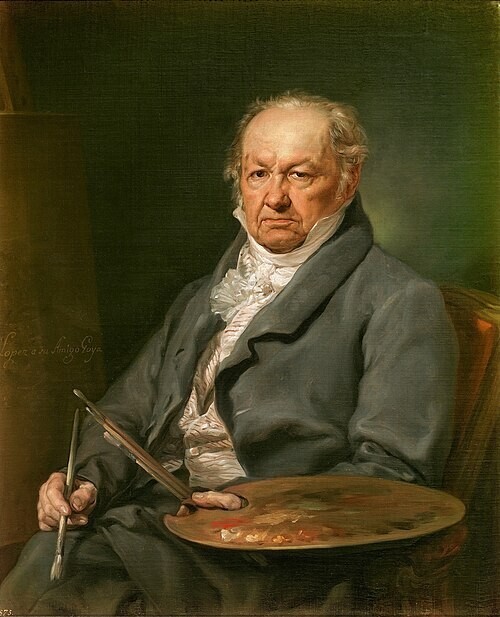
Vicente López Portaña. Image source · Public domain
About the artist
Francisco de Goya
30 March 1746 to 16 April 1828
Goya was a Spanish painter and printmaker whose career extended from royal tapestry designs and court portraiture to images of war, repression and unsettling fantasy. Born in Fuendetodos, he trained in Zaragoza and Madrid and became First Painter to Charles IV in 1799. He spent his final years in Bordeaux.
- Born
- 30 March 1746
- Died
- 16 April 1828
- Nationality
- Spanish
- Birthplace
- Fuendetodos, Spain
- Died in
- Bordeaux, France
The research & record
Study the work.
Follow the evidence.
Find catalogue details, historical context, technical research and the literature behind this artwork.
The artwork record
Research catalogue
Catalogue information and detailed research, with references that link to the bibliography.
Updated .
Identity and catalogue
Link- Title
- Boys picking fruit
- Artist or attribution
- Francisco Goya
- Object date
- 1778
- Medium and support
- oil on canvas
- Dimensions
- 119 × 122 cm
- Current collection or location
- Museo del Prado, Madrid, Spain
- Movement or period
- Rococo / classicist genre painting; tapestry cartoon
- Country or culture
- Spain
- Depicted subject
- Children gather fruit beside a tree: one boy climbs and reaches for the branch while others look up, and a boy crouching in the foreground turns toward the viewer. The painting is a tapestry cartoon made by Goya in 1778.(Wikimedia Commons: Boys picking fruit, n.d.)
- Title variants
- Muchachos cogiendo fruta; Garçons cueillant des fruits; 果実を採る少年たち; Dzieci zrywające owoce; Niños cogiendo fruta
- Accession number
- P000777
- Support
- canvas
Read valuation records and their limitations
Title, attribution and date
The object is recorded under the title Boys picking fruit, with the Spanish title Muchachos cogiendo fruta given alongside it, and it is attributed to Francisco Goya with a date of 1778. The supplied record further classifies the work as a tapestry cartoon (cartón para tapiz) made in Spain in 1778, so that the same year is attached both to the painting and to its function within a cartoon project. This classification is not a separate later label imposed on an unrelated picture: the catalogue entry that gives the title and artist also places the work among the cartoons for tapestries. The object date of 1778 should therefore be kept distinct from the dates of the modern reference works and databases through which the painting is now catalogued, since those tools postdate the work by more than two centuries and describe it rather than date it.(Wikimedia Commons: Boys picking fruit, n.d., Summary; References: Cartoons for tapestries)
The only descriptive passage in the supplied record states that the painting depicts children collecting fruit: a boy reaches into a fruit-bearing branch while other children look upward, and a boy crouches in the foreground. That account is a summary of the subject rather than a symbolic reading, and the record identifies no sitters. Nothing in the evidence supplies dimensions, support, inscriptions or a documented provenance sequence, so those catalogue fields cannot be reconstructed here and should not be inferred from the subject or from the painting's status as a tapestry cartoon.(Wikimedia Commons: Boys picking fruit, n.d., Summary)
Catalogue identifiers
For identification and cross-referencing, the record attaches several standard catalogue identifiers. The work belongs to the Museo del Prado in Madrid under accession number P000777, and it appears in the Prado's online collection under the identifier 08c127fd-defc-4b9b-9067-2c3dfe666f51. It is listed in the Goya catalogue by Pierre Gassier and Juliet Wilson as number 84, and the Fundación Goya en Aragón database identifies it as ID 22. These numbers matter for research because they allow the painting to be traced across the print catalogue and the two institutional databases, but they are locators within modern catalogues, not evidence about when or how the object was made.(Wikimedia Commons: Boys picking fruit, n.d., Summary)
The painting is titled Boys picking fruit (Muchachos cogiendo fruta) and was painted by Francisco Goya in 1778.(Wikimedia Commons: Boys picking fruit, n.d.)
Subject and iconography
LinkRead valuation records and their limitations
The recorded composition
Visual observation
The painted scene is described in the record as children collecting fruit: a boy reaches into a fruit-bearing branch, other children look upward, and a boy crouches in the foreground. The description establishes a division of labour within the group, with one figure actively reaching, several figures directing their gaze upward, and a third position occupied by a crouching figure at the front of the composition. This much is observation rather than identification: the record does not name the children, does not specify the species of tree, and does not give a symbolic reading of the fruit or the gathering. The visual evidence therefore supports a description of a small group at work around a tree and of the upward orientation of attention, but not a claim about who the children are or what the act of picking signifies. That distinction matters because the modest, everyday character of the subject is exactly what the evidence records, while any deeper reading would be an addition beyond it.(Wikimedia Commons: Boys picking fruit, n.d., Title and summary)
Interpretation
The composition can be understood as organised along a vertical axis running from the crouching boy at the front, which grounds the near edge of the picture, up through the other children's upward looks, to the reaching boy and the branch above him. The record's description of the children looking upward is what links the low foreground figure to the raised, active figure and to the fruit itself. The evidence establishes the presence and arrangement of these elements; it does not describe the direction of light, the palette, the setting, or the precise poses beyond reach and crouch. What the composition does establish is a scene that distributes attention upward and inward toward a common object, the fruit-bearing branch, so that the group reads as a coordinated action rather than a set of separate figures.(Wikimedia Commons: Boys picking fruit, n.d., Title and summary)
Support, scale and status
Visual observation
The picture is documented as oil on canvas measuring 119 by 122 centimetres, a nearly square format. The medium and dimensions belong to the material record of the object rather than to the description of its subject, and they condition how the scene is seen: the near-square support frames a compact group rather than a wide landscape or a tall figure study. The evidence does not describe surface condition, previous treatments, or any technical imaging, so no claim can be made here about changes in the painting's appearance over time. What can be said is that the recorded medium and measurements give the visual description a physical basis, and that the compactness of the format is consistent with the tightly grouped arrangement the record describes.(Wikimedia Commons: Boys picking fruit, n.d., Summary; Title and summary)
The painting is catalogued as a tapestry cartoon (cartón para tapiz) made in Spain in 1778. In this context a cartoon is a design painted for weavers to work from, which places the recorded scene within a decorative scheme rather than treating it as a self-contained gallery picture. The subject of children gathering fruit, modest and everyday in character, suits that purpose. The evidence does not specify which tapestry or which room the design served, nor does it describe the weaving itself, so the connection between the painted scene and a finished hanging remains a matter of the work's catalogued status rather than a documented sequence in the supplied units. What the cartoon designation does establish is that the visible composition was conceived as part of a larger decorative programme, which bears directly on how the figures, the tree, and the upward gaze were meant to function.(Wikimedia Commons: Boys picking fruit, n.d., References: Cartoons for tapestries; Title and summary)
The painting depicts children collecting fruit: a boy reaches into a fruit-bearing branch while other children look upward, and a boy crouches in the foreground.(Wikimedia Commons: Boys picking fruit, n.d.)
Historical context
LinkRead valuation records and their limitations
Boys picking fruit is catalogued as a tapestry cartoon, a cartón para tapiz, made in Spain in 1778. The category matters because a cartoon in this context names a design painted at full scale for weavers to work from, so the canvas belongs to a decorative programme rather than to the open market of finished gallery pictures. The catalogue record places its making in Spain and fixes the year, but it does not name the patron, the specific commission, the room or the tapestry series for which the design was intended. Those missing particulars should be kept distinct from the secure identification of the work as a tapestry cartoon of 1778.(Wikimedia Commons: Boys picking fruit, n.d., References: Cartoons for tapestries)
Visual observation
The subject is modest and everyday: children gathering fruit around a tree, with a boy reaching into a fruit-bearing branch while other children look upward and a boy crouches in the foreground. That description is what the record establishes about what is shown. It does not identify sitters, and it offers no symbolic reading, so the scene should not be taken as a portrait of particular children. In a cartoon destined for weaving, such a low-key subject suited a woven wall hanging, and the connection between the everyday theme and the decorative function is the strongest link the evidence supports between the object's purpose and its content.(Wikimedia Commons: Boys picking fruit, n.d., Title and summary; References: Cartoons for tapestries)
The painting is catalogued as a tapestry cartoon (cartón para tapiz) made in Spain in 1778.(Wikimedia Commons: Boys picking fruit, n.d.)
Materials and technique
LinkRead valuation records and their limitations
Support, medium and format
Interpretation
The surviving technical description of Boys picking fruit (Muchachos cogiendo fruta) is brief but exact: it is an oil painting on canvas, and its support measures 119 by 122 centimetres. These are the only material facts the supplied record establishes, and they come from the collection record rather than from any published condition or technical study. The near-square format is worth noting because the work is catalogued as a tapestry cartoon, a full-scale design painted for weavers to work from; a composition intended to be translated into woven wool would normally be planned around the loom widths and the intended position of the hanging. The record does not state whether this canvas was adapted, trimmed or enlarged, so the dimensions should be treated as the present measurement of the support, not as proof of its original state.(Wikimedia Commons: Boys picking fruit, n.d., Summary)
The work is oil on canvas measuring 119 by 122 centimetres.(Wikimedia Commons: Boys picking fruit, n.d.)
Provenance and ownership
LinkRead valuation records and their limitations
Provenance timeline
- 1778
The painting is catalogued as a tapestry cartoon made in Spain, giving the year of its creation.(Wikimedia Commons: Boys picking fruit, n.d., References: Cartoons for tapestries)
Reception and literature
LinkRead valuation records and their limitations
Catalogues and Collection Records
Reception of this painting has been documented chiefly through cataloguing and collection records rather than through accounts of changing display or artistic appropriation. The earliest layer of documentation available here places the work firmly within the scholarly literature on Goya: it appears as number 84 in the Goya catalogue compiled by Pierre Gassier and Juliet Wilson. That catalogue number establishes a fixed reference point against which later inventories and databases can be checked, and it marks the painting as a recognized item in the corpus of Goya's work rather than an attribution resting on a single museum's labels. Because the supplied evidence gives no date for the Gassier and Wilson publication, the catalogue entry can be described only as a scholarly identification of the work, without assigning it a precise moment in the sequence of reception.(Wikimedia Commons: Boys picking fruit, n.d., References: Catalog Goya by Pierre Gassier and Juliet Wilson, 84)
Institutional cataloguing continues that process of identification. The Fundación Goya en Aragón database records the painting under ID 22, and the Museo del Prado online collection records it under the identifier 08c127fd-defc-4b9b-9067-2c3dfe666f51. The two systems use unrelated numbering schemes, which reflects the separate histories of the two bodies that maintain them: one a regional foundation devoted to Goya, the other the museum whose online collection record documents the object's place in its holdings. The accession number P000777, given in the supplied source record, belongs to that same Prado documentation and is the identifier by which the painting is known within the museum's collection. Together these references show the object circulating in at least three overlapping documentary frameworks, each with its own identifier, and they provide the stable locators through which the painting can be traced across catalogues, databases and museum records.(Wikimedia Commons: Boys picking fruit, n.d., References)
These cataloguing records also preserve the painting's documented identity as a tapestry cartoon (cartón para tapiz) made in Spain in 1778. That classification matters for reception because it fixes the object's original function separately from the roles it has since acquired. The cartoon was a full-scale painted design produced as part of a decorative program rather than a gallery canvas, and the Prado's collection documentation records it in those terms. Later scholarly and public attention, including the catalogue entry and the two databases, treats the painting as a work by Goya in its own right; the records do not describe the circumstances in which it moved from that working function into the museum collection, so the transition itself remains undocumented in the supplied evidence and should not be narrated as if it were known.(Wikimedia Commons: Boys picking fruit, n.d., References: Cartoons for tapestries; References: Catalog Goya by Pierre Gassier and Juliet Wilson, 84; References)
Subject and Title
Interpretation
Read together, the evidence describes an object whose reception is attested through identification rather than through a narrated history of admiration, imitation or public event. The Gassier and Wilson catalogue number, the Fundación Goya en Aragón ID and the Museo del Prado online identifier each confirm that the painting is recognized and locatable, but the supplied units do not record exhibitions, reproductions, literary readings or acts of appropriation. Any account of those later stages would exceed what the evidence establishes. What can be said is that the painting's standing rests on its documented status as a 1778 tapestry cartoon by Goya, catalogued in a standard reference work and held in the Prado, and that its title and described subject are the terms in which that standing has been transmitted.(Wikimedia Commons: Boys picking fruit, n.d., References: Catalog Goya by Pierre Gassier and Juliet Wilson, 84; References; References: Cartoons for tapestries; Title and summary)
The work is listed in the Goya catalogue by Pierre Gassier and Juliet Wilson as number 84.(Wikimedia Commons: Boys picking fruit, n.d.)
The work is identified in the Fundación Goya en Aragón database as ID 22 and in the Museo del Prado online collection under ID 08c127fd-defc-4b9b-9067-2c3dfe666f51.(Wikimedia Commons: Boys picking fruit, n.d.)
Collection and display
LinkRead valuation records and their limitations
The object and its record
The painting known as Boys picking fruit (Muchachos cogiendo fruta) is attributed to Francisco Goya and is dated 1778, the year the Wikimedia Commons record gives for its making in Spain. It is an oil on canvas measuring 119 by 122 centimetres, a nearly square format that suits the compact grouping of children around a tree described in the same record: a boy reaches into a fruit-bearing branch, other children look upward, and a boy crouches in the foreground. The subject is thus a small, coordinated action rather than a formal portrait; the supplied record names no sitters and attaches no symbolic reading to the scene. These are the visible, catalogued facts on which any account of the work's place in Goya's production must rest.(Wikimedia Commons: Boys picking fruit, n.d., Summary)
Institutionally the painting belongs to the Museo del Prado, Madrid, under accession number P000777. The Prado's online collection identifies it by the identifier 08c127fd-defc-4b9b-9067-2c3dfe666f51, and the work also appears in the Fundación Goya en Aragón database as ID 22. In the Goya catalogue compiled by Pierre Gassier and Juliet Wilson it is number 84. These separate registrations, the museum accession number, the two database identifiers and the catalogue number, are the handles by which the same canvas is tracked across a museum collection, a regional research database and a scholarly catalogue raisonné; they establish that the object is a single, securely registered work rather than a title attached loosely to an uncertain picture. The Commons record itself is a secondary compilation that cites the Prado and these reference works, so the accession details are reported through it rather than quoted from the museum's own catalogue entry.(Wikimedia Commons: Boys picking fruit, n.d., Summary)
Interpretation
The record classifies the canvas as a tapestry cartoon (cartón para tapiz) made in Spain in 1778. In this context a cartoon is a full-scale painted design from which weavers worked, so the picture was conceived as part of a decorative scheme, as a working design for woven wall hanging, rather than as a finished gallery canvas in the later sense. That function helps explain the choice of subject: children gathering fruit is a modest, everyday theme appropriate to a woven hanging. It also frames how the composition should be read, since the arrangement from the crouching figure in the foreground up to the reaching hand and the upward looks of the children between them serves a design intended to be translated into tapestry. The tapestry-cartoon designation is a cataloguing classification supplied by the record, and the account here treats it as such rather than as an independent technical examination of the canvas.(Wikimedia Commons: Boys picking fruit, n.d., Summary)
The painting belongs to the Museo del Prado, Madrid, accession number P000777.(Wikimedia Commons: Boys picking fruit, n.d.)
Documented values and qualified estimates
LinkRead valuation records and their limitations
The documented object
Interpretation
The object is recorded as Francisco Goya's Boys picking fruit (Muchachos cogiendo fruta), an oil on canvas measuring 119 by 122 centimetres and dated 1778. The Museo del Prado, Madrid, holds it under accession number P000777, and the record catalogues it as a tapestry cartoon (cartón para tapiz) made in Spain in 1778. The same record places the painting in Pierre Gassier and Juliet Wilson's Goya catalogue as number 84, identifies it in the Fundación Goya en Aragón database as ID 22, and gives a Museo del Prado online collection identifier. These locators matter beyond bibliography: they show the work is documented within a canonical catalogue of Goya's oeuvre and within the Prado's own collection apparatus, not merely known from reproduction. The subject is described as children collecting fruit, with a boy reaching into a fruit-bearing branch while other children look upward and a boy crouches in the foreground.(Wikimedia Commons: Boys picking fruit, n.d.)
The description of the Prado accession and the cartoon type gives the work its technical identity. A tapestry cartoon was a full-scale painted design from which weavers worked, so the canvas belongs to the production of Spanish royal tapestry rather than to the finished pictures Goya would later exhibit or sell as independent works. The recorded date of 1778 places it within Goya's first series of tapestry cartoons for the Spanish royal workshops, as stated in the working valuation note, which also emphasises the large scale and the finished cartoon type as factors bearing on the work's standing. The picture therefore sits at an early point in Goya's court career, and its scale and finish are properties of its function as a design for weaving, not incidental features of an easel painting.(Wikimedia Commons: Boys picking fruit, n.d.)
Recorded values and their limits
The most detailed account of value supplied here is explicitly a working calculation, not a record of the art market. It is dated 2026-11-16 and is described as a broad working range calculated for manual review, not derived from any sale, appraisal or insurance record. The range is US$8M to US$25M, and the note states that it excludes any premium for the work ever leaving public ownership. The stated basis is the confirmed identity of the work: an oil on canvas of the recorded dimensions by Goya, dated 1778, from his first series of tapestry cartoons, a documented Prado accession long held in the Museo del Prado. Rarity and importance are inferred from Goya's canonical status, the early date within his court career, the large scale, the finished cartoon type, and the institutional, non-market setting. Because no comparable transactions or public valuations are established in the supplied material, the note sets the range deliberately wide and conservative, anchored to the high end of the international market for major Old Master and early modern paintings of this stature.(Wikimedia Commons: Boys picking fruit, n.d.)
The qualifications attached to that figure are as consequential as the figure itself. The note states that it is a model-generated working insurance range for manual review only, not an official insurance value, not an appraisal, not an auction estimate or result, and not a sale price. No comparable sales, private insurance schedules or museum valuations were consulted or implied, and the artwork is described as held by the Museo del Prado, with no transaction or loan asserted. Any binding figure, the note concludes, must come from a qualified appraiser using physical examination and current market evidence. The supplied material therefore supports a documented collection identity and a provisional, non-binding valuation exercise; it does not support a market price, a provenance history of transactions, or an official insurance schedule.(Wikimedia Commons: Boys picking fruit, n.d.)
Read together, the units separate three kinds of statement that are easily conflated. The catalogue and collection data establish what the object is: Goya's Boys picking fruit, oil on canvas, 119 by 122 centimetres, 1778, a tapestry cartoon, Prado P000777, Gassier and Wilson number 84, Fundación Goya en Aragón ID 22. The valuation note adds an explicitly inferential estimate whose authors mark its basis, its width and its exclusions. The note's own methodology treats the institutional, non-market setting as a reason to exclude any premium for leaving public ownership, which is a statement about how the range was constructed rather than evidence of the work's history. Within a larger history of art and material culture, the work's importance rests on its place in Goya's first series of tapestry cartoons for the Spanish royal workshops and on its long-held public accession, not on any recorded transaction.(Wikimedia Commons: Boys picking fruit, n.d.)
Working estimate
Calculated working insurance estimate, not a sale price: Estimated value: US$8M to US$25M Recorded date: Working calculation, generated 2026-11-16. Methodology: Broad working range calculated for manual review, not derived from any sale, appraisal, or insurance record. Basis: the confirmed work is an oil on canvas of 119 x 122 cm by Francisco Goya, dated 1778, from his first series of tapestry cartoons for the Spanish royal workshops, a documented Prado accession (P000777) long held in the Museo del Prado. Rarity and importance are inferred from the artist's canonical status, the early date within his court career, the large scale, the finished cartoon type, and the institutional, non-market setting. Because no comparable transactions or public valuations are established in the supplied material, the range is set deliberately wide and conservative, anchored to the high end of the international market for major Old Master and early modern paintings of this stature, and excludes any premium for the work ever leaving public ownership. Qualification: This is a model-generated working insurance range for manual review only. It is not an official insurance value, not an appraisal, not an auction estimate or result, and not a sale price. No comparable sales, private insurance schedules, or museum valuations were consulted or implied. The artwork is described as held by the Museo del Prado, and no transaction or loan is asserted. Any binding figure must come from a qualified appraiser using physical examination and current market evidence.(Wikimedia Commons: Boys picking fruit, n.d.)
Further reading
Books for a closer look
Paid links. As an Amazon Associate I earn from qualifying purchases.

Open Library Goya
Kodansha International
Goya catalogue under his own author record, with subjects including catalogues raisonnés, Museo del Prado, Spanish painting, and correspondence. The Prado is the holding institution for Boys picking fruit, and a raisonné-style Goya catalogue is the kind of object-level reference that could document this 1778 tapestry cartoon.
ISBN 0870110837

Open Library Francisco Goya
Counterpoint
Recorded as a Goya study with subjects Criticism and interpretation and Biography by Evan S. Connell, offering art-historical discussion of Goya's career. Relevant through the artist rather than through the specific tapestry cartoon, since the record does not document this painting.
ISBN 1582433070
Bibliography
Sources and further reading
References are arranged by author or organisation, with links to the original publications. Where no publication date is recorded, n.d. means no date.
Source notes updated .
No recorded sources match these filters. Reset the filters to see the full bibliography.
- 04
Book
Francisco Goya. Counterpoint.
Recorded as a Goya study with subjects Criticism and interpretation and Biography by Evan S. Connell, offering art-historical discussion of Goya's career. Relevant through the artist rather than through the specific tapestry cartoon, since the record does not document this painting.
- ISBN
- 1582433070
Citation text
- 02
Book
Goya. Kodansha International.
Goya catalogue under his own author record, with subjects including catalogues raisonnés, Museo del Prado, Spanish painting, and correspondence. The Prado is the holding institution for Boys picking fruit, and a raisonné-style Goya catalogue is the kind of object-level reference that could document this 1778 tapestry cartoon.
- ISBN
- 0870110837
Citation text
- 03
Book
Francisco Goya - the Paintings. Independently Published.
Titled Francisco Goya - the Paintings, closely matching the medium of Boys picking fruit, an oil on canvas. A paintings-focused Goya catalogue is plausibly relevant to a specific painted tapestry cartoon, though the record gives no subjects or contents to confirm inclusion of this work.
- ISBN
- 9781521566466
Citation text
- 01
Secondary · About this artwork
Wikimedia Commons: Boys picking fruit (n.d.). Wikimedia Commons file: Muchachos cogiendo fruta.jpg. Wikimedia Commons.
Wikimedia Commons record citing the Museo del Prado and providing the title, artist, date, medium, dimensions and accession number, together with references to Gassier and Wilson's catalogue and the Fundación Goya en Aragón.
- Language
- English
Citation text
Art to live with
Bring this painting
home.
A piece of the archive, made yours. Explore Boys picking fruit in a size and finish that fits your space.
Your text and annotations appear on these editions. Adding to cart saves that design for printing.
Combine this painting with your favourites01 / Find your edition
Made for you
Suggested from your location. Change it if you're sending elsewhere or using a VPN. Prices and delivery are shown in GBP.
19 products
Choose an edition to make it yours
6 × 8 in · Printed cover · 118 lined pages
6 × 8 in · Printed cover · 118 lined pages
6 × 8 in · Printed cover · 118 lined pages
Notebook
GBP 12.03
Delivery GBP 5.35 / Total GBP 17.38
A 6 × 8 inch spiral notebook with 118 ruled pages (59 sheets), a printed front cover, dark grey back cover and metal spiral binding.
Fit and fill keep the painting’s proportions. Stretch changes them.
Move and zoom the painting on your notebook.
Made to order with your design
Made to order
US delivery only
20.3 × 20.3 cm / 8 × 8 in · Standard
20.3 × 20.3 cm / 8 × 8 in · Standard

8 × 8 in / 20.3 × 20.3 cm · Standard

8 × 8 in / 20.3 × 20.3 cm · Standard

8 × 8 in / 20.3 × 20.3 cm · Standard

8 × 8 in / 20.3 × 20.3 cm · Standard

8 × 8 in / 20.3 × 20.3 cm · Standard
Metal art sign
GBP 22.17
Delivery GBP 17.90 / Total GBP 40.07
A printed aluminium sign with rounded corners and mounting holes.
Fit and fill keep the painting’s proportions. Stretch changes them.
Move and zoom the painting on your metal art sign.
Made to order with your design
Printed aluminium · mounting holes included
US delivery only
iPhone 12 Mini ? Glossy ? back view
iPhone 12 Mini · Glossy

iPhone 12 Mini ? Glossy ? back view

iPhone 12 Mini ? Glossy ? back view

iPhone 12 Mini ? Glossy ? back view
Tough phone case
GBP 16.56
Delivery GBP 4.28 / Total GBP 20.84
A two-layer phone case with a printed polycarbonate shell and a shock-absorbing inner liner.
Two layers with a shock-absorbing TPU liner
Case & print details
- Device
- Apple · iPhone 12 Mini
- Material
- Polycarbonate shell with a TPU inner liner
- Artwork
- Outer back and wrapped edges from one template
- Finish
- Glossy
- Version
- Standard version
- Printing
- Dye sublimation
- Print file
- 1,122 × 1,831 px · 95 × 155 mm · PNG · 300 dpi recommended
Rear outline and camera openings follow this variant's Printify template. Case depth and small hardware remain illustrative.
Supplier product detailsFit and fill keep the painting’s proportions. Stretch changes them.
Move and zoom the painting on your tough phone case.
Made to order with your design
Made to order
US delivery only
25.4 × 20.3 cm / 10 × 8 in · White
25.4 × 20.3 cm / 10 × 8 in · White

10 × 8 in / 25.4 × 20.3 cm · White

10 × 8 in / 25.4 × 20.3 cm · White

10 × 8 in / 25.4 × 20.3 cm · White

10 × 8 in / 25.4 × 20.3 cm · White
Framed art print
GBP 34.51
- 1 framed print
- GBP 34.51
- Delivery to United States
- GBP 9.73
- Total
- GBP 44.24
A ready-to-hang wooden frame with a clear Perspex cover and a semi-gloss printed insert.
Delivery is quoted for all selected copies together.
Fit and fill keep the painting’s proportions. Stretch changes them.
Move and zoom the painting on your framed art print.
Made to order with your design
Wooden frame & protective clear front included
US delivery only
38.1 × 40.6 cm / 15 × 16 in · Natural
38.1 × 40.6 cm / 15 × 16 in · Natural

15 × 16 in / 38.1 × 40.6 cm · Natural

15 × 16 in / 38.1 × 40.6 cm · Natural

15 × 16 in / 38.1 × 40.6 cm · Natural

15 × 16 in / 38.1 × 40.6 cm · Natural

15 × 16 in / 38.1 × 40.6 cm · Natural
Canvas tote bag
GBP 14.40
Delivery GBP 4.38 / Total GBP 18.78
A sturdy cotton canvas tote with reinforced handles and artwork on the front panel.
Fit and fill keep the painting’s proportions. Stretch changes them.
Move and zoom the painting on your canvas tote bag.
Made to order with your design
Front print · reinforced cotton handles
US delivery only
22.9 × 20.3 cm / 9 × 8 in · Standard
22.9 × 20.3 cm / 9 × 8 in · Standard

9 × 8 in / 22.9 × 20.3 cm · Standard

9 × 8 in / 22.9 × 20.3 cm · Standard

9 × 8 in / 22.9 × 20.3 cm · Standard

9 × 8 in / 22.9 × 20.3 cm · Standard
Mouse mat
GBP 7.36
Delivery GBP 4.87 / Total GBP 12.23
A rectangular fabric mouse mat with a rubber backing and rounded corners.
Fit and fill keep the painting’s proportions. Stretch changes them.
Move and zoom the painting on your mouse mat.
Made to order with your design
Made to order
US delivery only
See more13 more products
43.2 × 45.7 cm / 17 × 18 in · Artwork
43.2 × 45.7 cm / 17 × 18 in · Artwork

17 × 18 in / 43.2 × 45.7 cm · Artwork

17 × 18 in / 43.2 × 45.7 cm · Artwork

17 × 18 in / 43.2 × 45.7 cm · Artwork
Woven tote bag
GBP 47.33
Delivery GBP 5.94 / Total GBP 53.27
A woven tote with cotton webbing handles and the painting translated into a woven design.
Fit and fill keep the painting’s proportions. Stretch changes them.
Move and zoom the painting on your woven tote bag.
Made to order with your design
Made to order
US delivery only
25.4 × 25.4 cm / 10 × 10 in · Standard
25.4 × 25.4 cm / 10 × 10 in · Standard

10 × 10 in / 25.4 × 25.4 cm · Standard

10 × 10 in / 25.4 × 25.4 cm · Standard

10 × 10 in / 25.4 × 25.4 cm · Standard

10 × 10 in / 25.4 × 25.4 cm · Standard

10 × 10 in / 25.4 × 25.4 cm · Standard
Matte art print
GBP 11.42
Delivery GBP 7.29 / Total GBP 18.71
An unframed matte poster with archival inks, ready for a frame of your choice.
Fit and fill keep the painting’s proportions. Stretch changes them.
Move and zoom the painting on your matte art print.
Made to order with your design
Unframed · frame it your way
US delivery only
iPhone 12 Mini ? Standard ? back view
iPhone 12 Mini · Standard

iPhone 12 Mini ? Standard ? back view

iPhone 12 Mini ? Standard ? back view

iPhone 12 Mini ? Standard ? back view
Flexible phone case
GBP 15.76
Delivery GBP 4.28 / Total GBP 20.04
A flexible TPU phone case with a frosted finish, a printed back and precise port openings.
Flexible TPU with a frosted, matte finish
Case & print details
- Device
- Apple · iPhone 12 Mini
- Material
- Semi-transparent thermoplastic polyurethane (TPU)
- Artwork
- Back print; rim stays unprinted
- Finish
- Standard
- Version
- Standard version
- Printing
- Dye sublimation
- Print file
- 791 × 1,586 px · 67 × 134.3 mm · PNG · 300 dpi recommended
Rear outline and camera openings follow this variant's Printify template. Case depth and small hardware remain illustrative.
Supplier product detailsFit and fill keep the painting’s proportions. Stretch changes them.
Move and zoom the painting on your flexible phone case.
Made to order with your design
Made to order
S · Standard
S · Standard

S · Standard

S · Standard

S · Standard

S · Standard

S · Standard
Crew socks
GBP 10.78
Delivery GBP 4.49 / Total GBP 15.27
Crew-length polyester and spandex socks with a ribbed cuff, cushioned sole and sublimated artwork.
Fit and fill keep the painting’s proportions. Stretch changes them.
Move and zoom the painting on your crew socks.
Made to order with your design
One pair · design repeated on both socks
US delivery only
12" · Standard
12" · Standard

12" · Standard

12" · Standard

12" · Standard
Laptop sleeve
GBP 26.36
Delivery GBP 4.96 / Total GBP 31.32
A polyester laptop sleeve with a fleece lining, top zip, printed front and black reverse.
Fit and fill keep the painting’s proportions. Stretch changes them.
Move and zoom the painting on your laptop sleeve.
Made to order with your design
Made to order
US delivery only
11oz · single image
11oz · White
11oz · single image
Mug
GBP 7.42
Delivery GBP 6.23 / Total GBP 13.65
A glossy white ceramic mug with a C-shaped handle, available in 11oz and 15oz sizes.
single layout · choose single, double or a repeating pattern in Customise.
Repeat, fit, fill and position your artwork around the mug.
Made to order with your design
Made to order
iPhone 12 Mini ? Standard ? back view
iPhone 12 Mini · Standard

iPhone 12 Mini ? Standard ? back view

iPhone 12 Mini ? Standard ? back view

iPhone 12 Mini ? Standard ? back view

iPhone 12 Mini ? Standard ? back view

iPhone 12 Mini ? Standard ? back view
Biodegradable phone case
GBP 21.19
Delivery GBP 4.28 / Total GBP 25.47
A matte phone case made from plant polymers and bamboo fibre, with the artwork printed on the back.
Flexible plant-polymer shell with a matte finish
Case & print details
- Device
- Apple · iPhone 12 Mini
- Material
- PLA and PBAT polymers with bamboo fibre
- Artwork
- Back print; rim stays unprinted
- Finish
- Standard
- Version
- Standard version
- Printing
- Dye sublimation
- Print file
- 777 × 1,553 px · 65.8 × 131.5 mm · PNG · 300 dpi recommended
Rear outline and camera openings follow this variant's Printify template. Case depth and small hardware remain illustrative.
Supplier product detailsFit and fill keep the painting’s proportions. Stretch changes them.
Move and zoom the painting on your biodegradable phone case.
Made to order with your design
Made to order
27.9 × 22.9 cm / 11 × 9 in · Standard
27.9 × 22.9 cm / 11 × 9 in · Standard

11 × 9 in / 27.9 × 22.9 cm · Standard

11 × 9 in / 27.9 × 22.9 cm · Standard

11 × 9 in / 27.9 × 22.9 cm · Standard
Fine art poster
GBP 17.54
Delivery GBP 7.69 / Total GBP 25.23
A gallery paper print with a smooth art-paper surface. Choose a size that suits the painting.
Fit and fill keep the painting’s proportions. Stretch changes them.
Move and zoom the painting on your fine art poster.
Made to order with your design
Unframed · frame it your way
iPhone 12 Mini ? Standard ? back view
iPhone 12 Mini · Standard

iPhone 12 Mini ? Standard ? back view

iPhone 12 Mini ? Standard ? back view

iPhone 12 Mini ? Standard ? back view
Clear phone case
GBP 15.28
Delivery GBP 4.28 / Total GBP 19.56
A clear phone case with artwork on the back. Leave areas transparent to show the phone underneath.
Clear shell with shock-absorbing TPU sides
Case & print details
- Device
- Apple · iPhone 12 Mini
- Material
- Polycarbonate back and clear TPU sides
- Artwork
- Back print; clear sides stay unprinted
- Finish
- Standard
- Version
- Standard version
- Printing
- Dye sublimation
- Print file
- 732 × 1,527 px · 62 × 129.3 mm · PNG · 300 dpi recommended
Rear outline and camera openings follow this variant's Printify template. Case depth and small hardware remain illustrative.
Supplier product detailsFit and fill keep the painting’s proportions. Stretch changes them.
Move and zoom the painting on your clear phone case.
Made to order with your design
Made to order
15oz · single image
15oz · Standard

15oz · single image

15oz · single image

15oz · single image

15oz · single image

15oz · single image
Travel mug
GBP 32.33
Delivery GBP 5.75 / Total GBP 38.08
A stainless-steel travel mug with a black lid, a tapered base and a printed white exterior.
single layout · choose single, double or a repeating pattern in Customise.
Repeat, fit, fill and position your artwork around the mug.
Made to order with your design
Made to order
US delivery only
2.5 × 3.4 cm / 1 × 1.4 in · Glossy
2.5 × 3.4 cm / 1 × 1.4 in · Glossy

1 × 1.4 in / 2.5 × 3.4 cm · Glossy

1 × 1.4 in / 2.5 × 3.4 cm · Glossy

1 × 1.4 in / 2.5 × 3.4 cm · Glossy

1 × 1.4 in / 2.5 × 3.4 cm · Glossy
Photo keyring
GBP 10.30
Delivery GBP 5.45 / Total GBP 15.75
A rectangular zinc-alloy photo keyring with a glossy insert and a swivel split ring.
Fit and fill keep the painting’s proportions. Stretch changes them.
Move and zoom the painting on your photo keyring.
Made to order with your design
Photo insert · zinc frame & swivel ring
US delivery only
iPhone 15 Pro ? Glossy ? back view
iPhone 15 Pro · Glossy

iPhone 15 Pro ? Glossy ? back view

iPhone 15 Pro ? Glossy ? back view

iPhone 15 Pro ? Glossy ? back view

iPhone 15 Pro ? Glossy ? back view

iPhone 15 Pro ? Glossy ? back view
Slim phone case
GBP 16.53
Delivery GBP 5.85 / Total GBP 22.38
A slim printed phone shell with open ports and a lightweight profile.
Slim, lightweight polycarbonate shell
Case & print details
- Device
- Apple · iPhone 15 Pro
- Material
- Polycarbonate
- Artwork
- Outer back and wrapped edges from one template
- Finish
- Glossy
- Version
- Standard version
- Printing
- Dye sublimation
- Print file
- 1,278 × 1,971 px · 108.2 × 166.9 mm · PNG · 300 dpi recommended
Rear outline and camera openings follow this variant's Printify template. Case depth and small hardware remain illustrative.
Supplier product detailsFit and fill keep the painting’s proportions. Stretch changes them.
Move and zoom the painting on your slim phone case.
Made to order with your design
Made to order
US delivery only
36.6 × 30.7 cm / 14.4 × 12.1 in · Standard
36.6 × 30.7 cm / 14.4 × 12.1 in · Standard

14.4 × 12.1 in / 36.6 × 30.7 cm · Standard

14.4 × 12.1 in / 36.6 × 30.7 cm · Standard

14.4 × 12.1 in / 36.6 × 30.7 cm · Standard
Desk mat
GBP 15.17
Delivery GBP 7.21 / Total GBP 22.38
A smooth polyester desk mat with a natural rubber non-slip base and anti-fray edges, available in three sizes.
Fit and fill keep the painting’s proportions. Stretch changes them.
Move and zoom the painting on your desk mat.
Made to order with your design
Made to order
The 30 cm ruler is scaled alongside your selected print. Keep the painting’s proportions with a black background, or stretch it to fill. Frame width, material texture and screen colours are illustrative.
Keep exploring