Portrait of Adele Bloch-Bauer I
Artist: Gustav Klimt · 1907

Portrait of Adele Bloch-Bauer I: high-resolution image
The original file is hosted by Wikimedia Commons, available without payment or an account.
Open high-resolution image on Wikimedia CommonsThe complete story
The story About 3 minutes to read
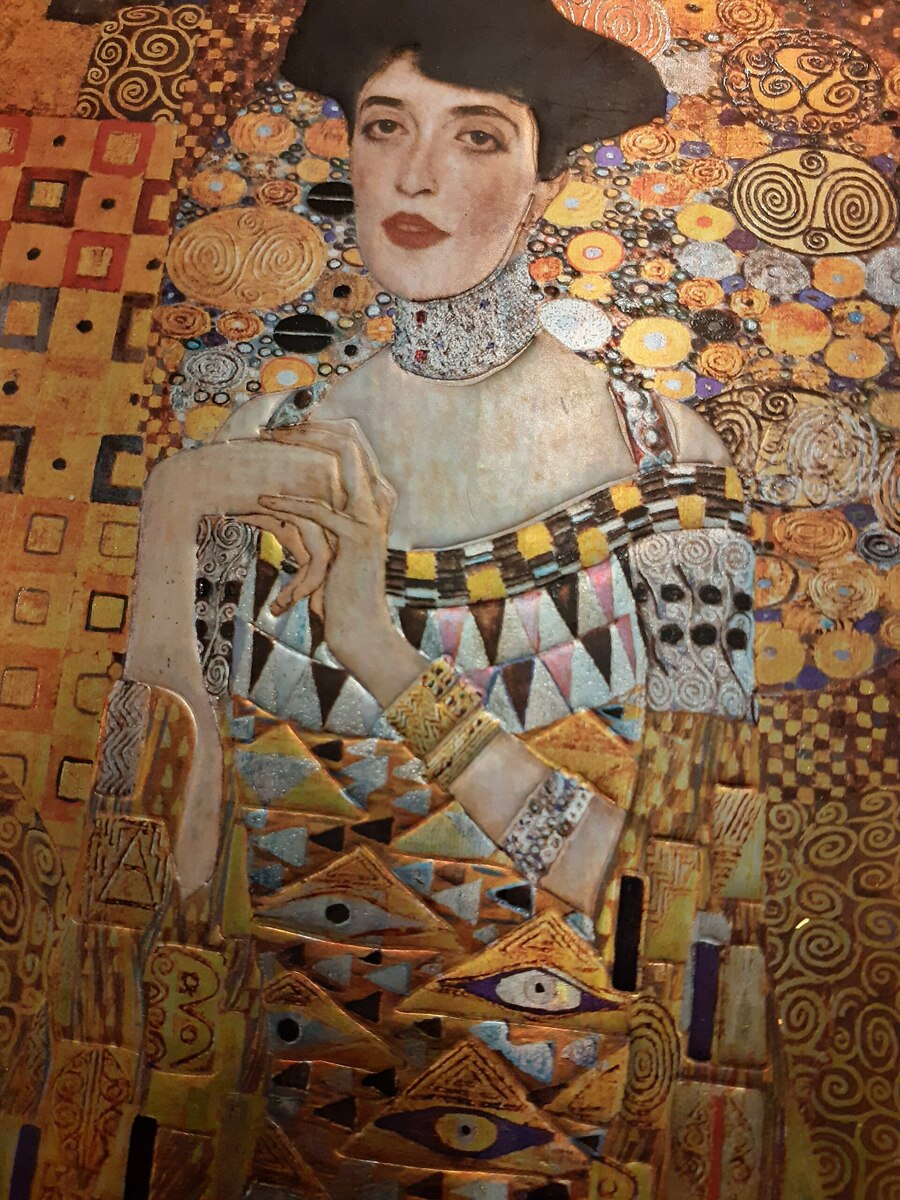
This is Gustav Klimt's Portrait of Adele Bloch-Bauer I, made in 1907. The subject is actually identified in the title. Adele Bloch-Bauer was a Viennese society woman. Klimt painted her in a half-length format. She faces us frontally, with her hands clasped at her breast.
The clasped hands sit near the centre of the canvas. They are the most clearly modelled part of the figure, while much of the surrounding surface is flattened into an even field. This is a portrait, a picture made to represent a specific person. Yet Klimt gives the figure and the background comparable weight, so attention moves between her face, her hands and the gold around her.
The materials matter here. The painting is made with oil, silver and gold on canvas, so the precious metal is physically part of the surface, not just a colour choice. The work belongs to Klimt's Vienna Secession period. That movement is often associated with Art Nouveau.
The painting's later history changes how we encounter it. It stayed with the Bloch-Bauer couple until some point between 1933 and 1941. During that period it was nationalized by the Austrian State, and in 1941 it was purchased by the Moderne Galerie, now the Österreichische Galerie Belvedere.
In 2006 the Belvedere restituted the painting to Maria Altmann, the niece of the Bloch-Bauers. Ronald Lauder then purchased it from her and transferred it to the Neue Galerie in New York City. What you see is a society portrait, and also an object whose custody has been contested and returned.
The story and its sources
Historical claims are linked to the records below. Close looking and interpretation are identified in the passage notes.
- Passage 1Documented historyWikimedia Commons: Portrait of Adele Bloch-Bauer I
- Passage 2Close lookingWikimedia Commons: Portrait of Adele Bloch-Bauer I
- Passage 3Documented historyWikimedia Commons: Portrait of Adele Bloch-Bauer I
- Passage 4Documented historyWikimedia Commons: Portrait of Adele Bloch-Bauer I
- Passage 5Documented historyWikimedia Commons: Portrait of Adele Bloch-Bauer I
Details to notice
About 2 minutes to readGold square motif panel
The left-hand field of gilded squares and rectangles, flat and regular against the swirling rosettes elsewhere, showing how the picture surface is assembled like enamel or mosaic rather than depicted space.
Jewelled choker
The high silver-white collar studded with coloured square gemstones that circles her throat and separates the natural face from the metallic body below.
Egyptian eye motifs on the dress
The lower dress where gold, black and blue triangles carry staring eye shapes, the artist's most overt symbolic ornament and the centre of the garment's hypnotic pattern.
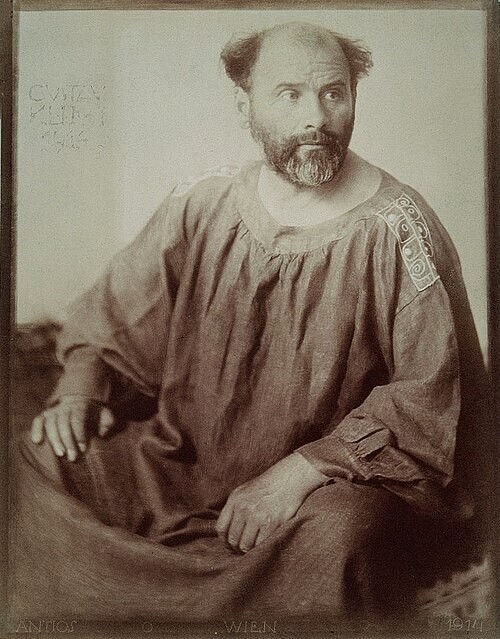
Artist portrait Image credit
Josef Anton Trčka. Image source · Public domain
About the artist
Gustav Klimt
1862 to 1918
Gustav Klimt was an Austrian symbolist painter (1862–1918). Their work is associated with Symbolism; Art Nouveau; Jugendstil. Their recorded places of work include Vienna; Brussels-Capital Region; Florence; Ravenna; Venice; London.
- Born
- 1862
- Died
- 1918
- Nationality
- Austrian Empire; Cisleithania
- Birthplace
- Baumgarten; Vienna
- Died in
- Altes AKH; Vienna; Alsergrund
Biography sources
The research & record
Study the work.
Follow the evidence.
Find catalogue details, historical context, technical research and the literature behind this artwork.
The artwork record
Research catalogue
Catalogue information and detailed research, with references that link to the bibliography.
Updated .
Identity and catalogue
Link- Title
- Portrait of Adele Bloch-Bauer I(Wikimedia Commons: Portrait of Adele Bloch-Bauer I, n.d.)
- Artist or attribution
- Gustav Klimt(Wikimedia Commons: Portrait of Adele Bloch-Bauer I, n.d.)
- Object date
- 1907
- Medium and support
- oil, silver and gold on canvas(Wikimedia Commons: Portrait of Adele Bloch-Bauer I, n.d.)
- Dimensions
- 140 × 140 cm (55.1 × 55.1 in)(Wikimedia Commons: Portrait of Adele Bloch-Bauer I, n.d.)
- Current collection or location
- Neue Galerie, Manhattan, United States(Wikimedia Commons: Portrait of Adele Bloch-Bauer I, n.d.)
- Movement or period
- Vienna Secession / Art Nouveau
- Country or culture
- Austria
- Depicted subject
- A half-length portrait of Adele Bloch-Bauer, a Viennese society woman, depicted frontally against a gold-ground field with her hands clasped at her breast.
- Title variants
- Adele Bloch-Bauer I; Porträt der Adele Bloch-Bauer; Ritratto di Adele Bloch-Bauer; Retrato de Adele Bloch-Bauer; Portret van Adele Bloch-Bauer; Retrat de l'Adele Bloch-Bauer; Retrato de Adele Bloch-Bauer; Adele Bloch-Bauer's Portrait
- Accession number
- 2006.04
- Support
- canvas
Read valuation records and their limitations
Title, attribution and date
The catalogue record identifies the work as Portrait of Adele Bloch-Bauer I, and the depicted person named in that record is Adele Bloch-Bauer herself. The identification is therefore built into the title rather than resting on a separate inscription or label described in the supplied documentation. The same record attributes the painting to Gustav Klimt and dates it to 1907. Because the object date and the catalogue entry are distinct kinds of information, the year 1907 should be understood as the date assigned to the making of the painting, not the date of the Wikimedia Commons record that supplies the title, attribution and date fields.(Wikimedia Commons: Portrait of Adele Bloch-Bauer I, n.d., Title and Depicted people fields; Artist and Date fields)
The Bloch-Bauer name carries a documented later history that runs alongside the catalogue identity of the portrait. The painting belonged to the Bloch-Bauer couple until some point between 1933 and 1941, was nationalized by the Austrian State within that same span, and in 1941 was purchased by the Moderne Galerie, now the Österreichische Galerie Belvedere. In 2006 the Belvedere restituted it to Maria Altmann, the niece of the Bloch-Bauers. These events explain why the object's identity as a portrait and its identity as a restituted object are documented together: the same institutional record that supplies the title and date also supplies the custody history, and any full catalogue entry for the painting must hold both strands at once.(Wikimedia Commons: Portrait of Adele Bloch-Bauer I, n.d., Title and Depicted people fields; Object history)
The painting is titled Portrait of Adele Bloch-Bauer I and depicts Adele Bloch-Bauer.(Wikimedia Commons: Portrait of Adele Bloch-Bauer I, n.d.)
The painting was made by Gustav Klimt in 1907.(Wikimedia Commons: Portrait of Adele Bloch-Bauer I, n.d.)
Subject and iconography
LinkRead valuation records and their limitations
Composition and the scope of the evidence
Visual observation
The object is a portrait, and that genre designation is the essential starting point for reading it: the painting is a representation of a specific person rather than a type or an allegory. The person depicted is identified as Adele Bloch-Bauer, a woman, and the figure is presented in a half-length format with her hands clasped at her breast. These are the recorded features of the composition, and they frame everything else the surface presents. In this account, observation (the half-length framing, the clasped hands) and identification (the named sitter) are kept distinct: the title and the record establish who is represented, while the format and gesture describe how the representation is arranged on the canvas.(Wikimedia Commons: Portrait of Adele Bloch-Bauer I, n.d., Depicted people; Genre: portrait; Genre field)
The square dimensions of the painting are a documented fact, measuring 140 by 140 centimetres, and the square format matters to how the recorded composition reads. A half-length figure with hands clasped at the breast sits within a nearly equal-sided field, so the figure is framed within an area that does not privilege vertical elongation the way conventional portraiture often does. The medium is likewise documented as oil, silver and gold on canvas, which means the metallic material is physically present in the work rather than simulated as colour. The combination of the square support, the half-length figure and the metal-bearing surface describes the object as it is documented, without extrapolating beyond those recorded properties.(Wikimedia Commons: Portrait of Adele Bloch-Bauer I, n.d., Dimensions field; Medium field; Depicted people; Genre: portrait)
Interpretation
The visible arrangement can be described with certainty only at the level the record supports: a woman shown half-length, hands clasped at her breast, in a portrait identified by the sitter's name. The evidence supplied here does not itemise costume, jewellery, furnishings, architectural setting or decorative motifs, and this account does not supply them. That absence is a qualification on the visual evidence rather than a gap to be filled by assumption. What the record does establish is the relation between what is seen and what is identified: the painting functions as a portrait of a named individual, Adele Bloch-Bauer, and the genre designation is inseparable from the depiction of that specific person. Any further reading of clothing, furniture or setting would require evidence not present in these units.(Wikimedia Commons: Portrait of Adele Bloch-Bauer I, n.d., Depicted people; Genre: portrait; Genre field)
Visual observation
The painting depicts Adele Bloch-Bauer, a woman, shown in a half-length format with her hands clasped at her breast.(Wikimedia Commons: Portrait of Adele Bloch-Bauer I, n.d.)
The painting is a portrait, a genre of representation of a specific person.(Wikimedia Commons: Portrait of Adele Bloch-Bauer I, n.d.)
Materials and technique
LinkRead valuation records and their limitations
Documented materials and support
The documented material description of Portrait of Adele Bloch-Bauer I is concise but consequential: the work is oil, silver and gold on canvas. This combination establishes that the picture is a composite object rather than a purely oil painting with gilded color. The oil medium carries the painted passages, while silver and gold are recorded as materials of the work itself, meaning metallic elements belong to its physical construction. The canvas support and the use of more than one medium together define the technical category within which any closer examination of surface, layer structure or metallic application would have to be conducted. The record consulted supplies the medium as a documented field, not as an inference drawn from appearance, so the presence of silver and gold should be treated as established materials rather than as a description of visual effect alone.(Wikimedia Commons: Portrait of Adele Bloch-Bauer I, n.d., Medium field)
The canvas measures 140 by 140 centimetres, a square format. That dimension is documented independently of the medium, and the two facts together describe a large square painting executed in oil with silver and gold on canvas. The square support is worth stating alongside the material record because format and medium jointly condition how the metallic and painted areas relate across the surface: a square field of this size gives the composition an extensive, evenly bounded area within which oil passages and metal-bearing areas are distributed. The evidence supplied establishes the measurement as a recorded dimension rather than a reconstruction from reproduction, and it establishes nothing further about stretcher, tacking margins, ground or panel preparation, which are not documented in the available units.(Wikimedia Commons: Portrait of Adele Bloch-Bauer I, n.d., Dimensions field; Medium field)
What the evidence establishes and what it does not
Visual observation
What the materials record and the visual record establish are distinct kinds of knowledge. The medium field documents oil, silver and gold on canvas; the descriptive record identifies the subject as Adele Bloch-Bauer, a woman shown half-length with her hands clasped at her breast, and classifies the work as a portrait, the genre of representation of a specific person. Nothing in the supplied evidence specifies how the silver and gold were applied, whether as leaf, powder, paint or another preparation, nor which passages of the surface carry which material, nor what ground or priming lies beneath. Those questions remain open in this account. The documented materials should therefore be connected to the visible figure and format only at the level the evidence permits: a portrait of a named sitter, painted in oil with silver and gold on a square canvas of 140 by 140 centimetres, with the distribution and technique of the metallic materials not yet established by the units available.(Wikimedia Commons: Portrait of Adele Bloch-Bauer I, n.d., Medium field; Dimensions field; Depicted people; Genre: portrait; Genre field)
Interpretation
Within a larger history of material culture, the significance of this combination lies in what it makes of the painted surface as a physical object. A portrait executed in oil with silver and gold on canvas places precious metal and paint in the same constructed surface, so the work belongs simultaneously to the history of portraiture of a specific person and to the history of metal-bearing painting materials. The documented square format of 140 by 140 centimetres gives that material construction a defined and substantial field. Because the evidence consulted records materials and dimensions but not layer analysis, pigment identification or treatment history, the object's material importance can be asserted at the level of its documented constitution, while any finer account of how the oil, silver and gold interact across the canvas must await technical examination that the supplied units do not contain.(Wikimedia Commons: Portrait of Adele Bloch-Bauer I, n.d., Medium field; Dimensions field; Genre field)
The painting is oil, silver and gold on canvas.(Wikimedia Commons: Portrait of Adele Bloch-Bauer I, n.d.)
The painting measures 140 by 140 centimetres.(Wikimedia Commons: Portrait of Adele Bloch-Bauer I, n.d.)
Provenance and ownership
LinkRead valuation records and their limitations
From the Bloch-Bauer Collection to the Moderne Galerie
The documented custody of Portrait of Adele Bloch-Bauer I begins with the Bloch-Bauer couple, who are recorded as the painting's owners until some point between 1933 and 1941. The evidence fixes the end of that ownership only within this seven-year window rather than to a precise year, so the household's possession is documented at the start of the interval but the exact moment at which it ceased cannot be stated from the supplied record. During that same 1933 to 1941 span the painting is described as nationalized by the Austrian State, followed in 1941 by its purchase by the Moderne Galerie, the institution now known as the Österreichische Galerie Belvedere. The record therefore presents a sequence from private ownership, through nationalization by the state, to institutional acquisition by the Moderne Galerie. The evidence does not specify the mechanics of the nationalization, the terms of the 1941 purchase, or the names of the individuals involved at each stage, and those gaps should not be filled by inference.(Wikimedia Commons: Portrait of Adele Bloch-Bauer I, n.d., Object history)
Interpretation
The account distinguishes an uncertain interval from a proven change of ownership. The phrase "until between 1933 and 1941" marks the limit of what the evidence establishes: the Bloch-Bauers held the painting at the beginning of that window, and the period of their holding ends somewhere inside it. It does not establish a precise transfer date, nor does it establish what happened between the nationalization and the 1941 purchase by the Moderne Galerie. The 1941 purchase is the one dated transaction in this phase, and it is identified as a purchase by the Moderne Galerie rather than merely as a transfer. Reading the nationalization and the purchase as two consecutive events within the window follows the order given in the record, but the record does not document an unbroken chain of title between them. Because the source is an institutional record consulted partially, these dates should be treated as the source's stated history rather than as an independently verified account of each transaction.(Wikimedia Commons: Portrait of Adele Bloch-Bauer I, n.d., Object history)
Restitution and the Move to New York
In 2006 the painting was restituted by the Österreichische Galerie Belvedere to Maria Altmann, identified in the record as the niece of the Bloch-Bauers. Restitution here is described as an act by the holding institution returning the work to a member of the family from which it had passed into state and institutional hands. After that restitution, Ronald Lauder purchased the painting from Maria Altmann for 135 million dollars, and the work was then transferred to the Neue Galerie in New York City, where it is recorded with the accession number 2006.04. This accession number and the 2006 restitution date align the painting's entry into the Neue Galerie collection with the year of its return to Altmann, and they identify the Neue Galerie as the present institutional custodian in the supplied record.(Wikimedia Commons: Portrait of Adele Bloch-Bauer I, n.d., Object history)
Interpretation
The documented provenance establishes three distinct kinds of custody: family ownership, state and public institutional holding after nationalization and the 1941 purchase, and private ownership under Maria Altmann before the sale to Ronald Lauder and transfer to the Neue Galerie. The recorded sale price of 135 million dollars is stated as the amount Lauder paid Altmann, and the accession number 2006.04 ties the work to its present collection. Together these facts make the painting's history one in which the same object moved between private collections, a nationalized public collection in Austria, and a public collection in the United States. For a history of material culture, the provenance is not incidental to the object: the painting's documented presence in these successive collections, and the 2006 restitution that interrupted its institutional holding in Vienna, are part of what the object is and how it has been valued and contested.(Wikimedia Commons: Portrait of Adele Bloch-Bauer I, n.d., Object history)
The painting belonged to the Bloch-Bauer couple until between 1933 and 1941.(Wikimedia Commons: Portrait of Adele Bloch-Bauer I, n.d.)
The painting was nationalized by the Austrian State between 1933 and 1941.(Wikimedia Commons: Portrait of Adele Bloch-Bauer I, n.d.)
In 1941 the painting was purchased by the Moderne Galerie, now the Österreichische Galerie Belvedere.(Wikimedia Commons: Portrait of Adele Bloch-Bauer I, n.d.)
In 2006 the painting was restituted to Maria Altmann, the niece of the Bloch-Bauers, by the Österreichische Galerie Belvedere.(Wikimedia Commons: Portrait of Adele Bloch-Bauer I, n.d.)
Provenance timeline
- between 1933 and 1941
The painting belonged to the Bloch-Bauer couple until a point dated in the source only as between 1933 and 1941.(Wikimedia Commons: Portrait of Adele Bloch-Bauer I, n.d., Object history)
- between 1933 and 1941
The painting was recorded as nationalized by the Austrian State, with the source fixing the interval only as between 1933 and 1941.(Wikimedia Commons: Portrait of Adele Bloch-Bauer I, n.d., Object history)
- 1941
The painting was purchased by the Moderne Galerie, now the Österreichische Galerie Belvedere.(Wikimedia Commons: Portrait of Adele Bloch-Bauer I, n.d., Object history)
- 2006
Ronald Lauder purchased the painting from Maria Altmann and it was then transferred to the Neue Galerie in New York City; the source groups this with the 2006 restitution and gives no separate date.(Wikimedia Commons: Portrait of Adele Bloch-Bauer I, n.d., Object history)
Collection and display
LinkRead valuation records and their limitations
The object and its holding
The painting known as Portrait of Adele Bloch-Bauer I, made by Gustav Klimt in 1907, is in the collection of the Neue Galerie in Manhattan, United States, where it carries accession number 2006.04. The accession number itself registers the work within an institutional holding formed in the twenty-first century, even though the object was made in 1907 and spent most of the intervening period elsewhere. The painting measures 140 by 140 centimetres, a square format rather than the upright rectangle a half-length portrait might suggest, and it is executed in oil, silver and gold on canvas. The presence of silver and gold in the medium statement means the precious metals are constituent materials of the painted surface rather than merely colours chosen to evoke gold, a distinction the institutional record makes explicit. Its subject is Adele Bloch-Bauer, depicted as a woman in half-length format with her hands clasped at her breast.(Wikimedia Commons: Portrait of Adele Bloch-Bauer I, n.d., Collection and Accession number fields)
The painting is in the collection of the Neue Galerie in Manhattan, United States, with accession number 2006.04.(Wikimedia Commons: Portrait of Adele Bloch-Bauer I, n.d.)
Documented values and qualified estimates
LinkRead valuation records and their limitations
The object and its documented description
The Portrait of Adele Bloch-Bauer I is recorded as a work by Gustav Klimt made in 1907, an oil, silver and gold painting on canvas measuring 140 by 140 centimetres. The supplied institutional record identifies the sitter in the title, Adele Bloch-Bauer, and describes the composition as a half-length portrait of a woman with her hands clasped at her breast. This is a picture made to represent a specific person, so the genre designation of portrait is not incidental to its value: the identity of the sitter is bound into the work's title, its documentary descriptions and, as the later history shows, its legal fortunes. The square format and the use of metal on canvas place the physical object at the centre of any account of what the painting is, before questions of its price or custody arise. In a larger history of material culture, these are not neutral details: gold and silver as painting materials link the object to the early twentieth-century Viennese interest in precious surfaces and to the decorative traditions the work has been associated with in later scholarship.(Wikimedia Commons: Portrait of Adele Bloch-Bauer I, n.d., Object history)
The 2006 sale and its recorded price
The two supplied evidence units agree on the core transaction and differ only in emphasis. One states plainly that Ronald Lauder purchased the painting from Maria Altmann for 135 million dollars, after which it was transferred to the Neue Galerie in New York City. The other records the same purchase price and the same parties, attributes the year 2006 to the transaction, and explicitly qualifies the figure: it is a historical acquisition price, not a current market valuation. That qualification matters for how the figure circulates. The number is a documented fact about a specific exchange between named parties at a specific moment, not a statement about what the painting would fetch today, and the two accounts should be read together rather than as competing claims. The transfer to the Neue Galerie is part of the same account: the purchase and the movement to New York City are presented as successive steps following the sale.(Wikimedia Commons: Portrait of Adele Bloch-Bauer I, n.d., Object history)
Custody, restitution and transfer
The account of the painting's later custody places the sale within a longer sequence. According to the supplied record, the painting stayed with the Bloch-Bauer couple until some point between 1933 and 1941; during that period it was nationalized by the Austrian State, and in 1941 it was purchased by the Moderne Galerie, now the Österreichische Galerie Belvedere. In 2006 the Belvedere restituted the painting to Maria Altmann, the niece of the Bloch-Bauers. Only then did the sale to Lauder occur. The units do not fix a single date for the nationalization within the 1933 to 1941 interval, and that uncertainty should be retained: the record establishes the range and the sequence of events, not a precise date for each step. Read as a chain, the account moves from private ownership, through state control and institutional acquisition, to restitution and then to a new private purchase followed by transfer to a New York museum. Each stage is documented in the same source, and each stage bears on how the object's value, both monetary and cultural, has been understood.(Wikimedia Commons: Portrait of Adele Bloch-Bauer I, n.d.)
What the price does and does not establish
Interpretation
The 135 million dollar figure acquires its significance from its position in this sequence rather than from the number alone. It is the price paid by a named purchaser to a named restituted owner, and the source records it as such alongside the transfer that followed. Because the record itself warns that this is an acquisition price and not a current valuation, the responsible use of the figure is to treat it as evidence of a particular transaction in 2006, tied to the return of the painting to the Bloch-Bauer family. Interpreted in this qualified way, the price and the restitution are two parts of one event in the object's history: the return made the sale possible, and the sale carried the painting from Austrian public custody to a private foundation's museum in Manhattan. The source's framing of these events as a single narrative of provenance supports reading the monetary record as inseparable from the legal and ethical history of the work.(Wikimedia Commons: Portrait of Adele Bloch-Bauer I, n.d.)
Ronald Lauder purchased the painting from Maria Altmann for 135 million dollars, after which it was transferred to the Neue Galerie in New York City.(Wikimedia Commons: Portrait of Adele Bloch-Bauer I, n.d.)
Historical acquisition value: Purchased by Ronald Lauder from Maria Altmann for 135 million dollars. Recorded date: 2006. Methodology: Historical purchase price stated in the object history on the supplied source page. Qualification: This is a historical acquisition price, not a current market valuation.(Wikimedia Commons: Portrait of Adele Bloch-Bauer I, n.d.)
Further reading
Books for a closer look
Paid links. As an Amazon Associate I earn from qualifying purchases.

Open Library Gustav Klimt. Complete Paintings
TASCHEN
Tobias G. Natter's Complete Paintings survey is recorded as a catalogues raisonnes treatment of Klimt's painting. It offers object-level coverage of Klimt's painted oeuvre, the category into which this oil, silver and gold portrait falls, rather than a general biography.
ISBN 9783836527958
Bibliography
Sources and further reading
References are arranged by author or organisation, with links to the original publications. Where no publication date is recorded, n.d. means no date.
Source notes updated .
No recorded sources match these filters. Reset the filters to see the full bibliography.
- 02
The recorded title explicitly names this painting and artist, addressing provenance research (Provenienzforschung) in Austria including the loss history and restitution of Adele Bloch-Bauer I. This directly matches the documented facts of nationalization, Belvedere purchase, and the 2006 restitution to Maria Altmann.
- ISBN
- 9783668659698
Citation text
- 03
Book
Klimt and the women of Vienna's golden age 1900-1918. Prestel.
Exhibition catalogue on Klimt and the women of Vienna's golden age 1900-1918, with recorded subjects including women in art, portraits, and Austrian art. Adele Bloch-Bauer is the documented female portrait subject of this 1907 gold-ground painting, and Ronald S. Lauder is among the listed contributors, tying it to the work's later owner.
- ISBN
- 9783791355825
Citation text
- 04
Book
Gustav Klimt. Complete Paintings. TASCHEN.
Tobias G. Natter's Complete Paintings survey is recorded as a catalogues raisonnes treatment of Klimt's painting. It offers object-level coverage of Klimt's painted oeuvre, the category into which this oil, silver and gold portrait falls, rather than a general biography.
- ISBN
- 9783836527958
Citation text
- 01
Secondary · About this artwork
Wikimedia Commons: Portrait of Adele Bloch-Bauer I (n.d.). Institutional record for Portrait of Adele Bloch-Bauer I. Wikimedia Commons.
Source page supplying object title, artist, date, medium, dimensions, collection, accession number, and provenance summary.
Citation text
Art to live with
Bring this painting
home.
A piece of the archive, made yours. Explore Portrait of Adele Bloch-Bauer I in a size and finish that fits your space.
Your text and annotations appear on these editions. Adding to cart saves that design for printing.
Combine this painting with your favourites01 / Find your edition
Made for you
Suggested from your location. Change it if you're sending elsewhere or using a VPN. Prices and delivery are shown in GBP.
19 products
Choose an edition to make it yours
6 × 8 in · Printed cover · 118 lined pages
6 × 8 in · Printed cover · 118 lined pages
6 × 8 in · Printed cover · 118 lined pages
Notebook
GBP 11.91
Delivery GBP 5.30 / Total GBP 17.21
A 6 × 8 inch spiral notebook with 118 ruled pages (59 sheets), a printed front cover, dark grey back cover and metal spiral binding.
Fit and fill keep the painting’s proportions. Stretch changes them.
Move and zoom the painting on your notebook.
Made to order with your design
Made to order
US delivery only
12.7 × 17.8 cm / 5 × 7 in · Standard
12.7 × 17.8 cm / 5 × 7 in · Standard

5 × 7 in / 12.7 × 17.8 cm · Standard

5 × 7 in / 12.7 × 17.8 cm · Standard

5 × 7 in / 12.7 × 17.8 cm · Standard

5 × 7 in / 12.7 × 17.8 cm · Standard

5 × 7 in / 12.7 × 17.8 cm · Standard
Metal art sign
GBP 19.63
Delivery GBP 17.71 / Total GBP 37.34
A printed aluminium sign with rounded corners and mounting holes.
Fit and fill keep the painting’s proportions. Stretch changes them.
Move and zoom the painting on your metal art sign.
Made to order with your design
Printed aluminium · mounting holes included
US delivery only
iPhone 12 Mini ? Glossy ? back view
iPhone 12 Mini · Glossy

iPhone 12 Mini ? Glossy ? back view

iPhone 12 Mini ? Glossy ? back view

iPhone 12 Mini ? Glossy ? back view
Tough phone case
GBP 16.40
Delivery GBP 4.25 / Total GBP 20.65
A two-layer phone case with a printed polycarbonate shell and a shock-absorbing inner liner.
Two layers with a shock-absorbing TPU liner
Case & print details
- Device
- Apple · iPhone 12 Mini
- Material
- Polycarbonate shell with a TPU inner liner
- Artwork
- Outer back and wrapped edges from one template
- Finish
- Glossy
- Version
- Standard version
- Printing
- Dye sublimation
- Print file
- 1,122 × 1,831 px · 95 × 155 mm · PNG · 300 dpi recommended
Rear outline and camera openings follow this variant's Printify template. Case depth and small hardware remain illustrative.
Supplier product detailsFit and fill keep the painting’s proportions. Stretch changes them.
Move and zoom the painting on your tough phone case.
Made to order with your design
Made to order
US delivery only
30.4 × 40.6 cm / 12 × 16 in · Black
30.4 × 40.6 cm / 12 × 16 in · Black

12 × 16 in / 30.4 × 40.6 cm · Black

12 × 16 in / 30.4 × 40.6 cm · Black

12 × 16 in / 30.4 × 40.6 cm · Black

12 × 16 in / 30.4 × 40.6 cm · Black
Framed art print
GBP 52.87
- 1 framed print
- GBP 52.87
- Delivery to United States
- GBP 14.16
- Total
- GBP 67.03
A ready-to-hang wooden frame with a clear Perspex cover and a semi-gloss printed insert.
Delivery is quoted for all selected copies together.
Fit and fill keep the painting’s proportions. Stretch changes them.
Move and zoom the painting on your framed art print.
Made to order with your design
Wooden frame & protective clear front included
US delivery only
38.1 × 40.6 cm / 15 × 16 in · Natural
38.1 × 40.6 cm / 15 × 16 in · Natural

15 × 16 in / 38.1 × 40.6 cm · Natural

15 × 16 in / 38.1 × 40.6 cm · Natural

15 × 16 in / 38.1 × 40.6 cm · Natural

15 × 16 in / 38.1 × 40.6 cm · Natural

15 × 16 in / 38.1 × 40.6 cm · Natural
Canvas tote bag
GBP 14.25
Delivery GBP 4.33 / Total GBP 18.58
A sturdy cotton canvas tote with reinforced handles and artwork on the front panel.
Fit and fill keep the painting’s proportions. Stretch changes them.
Move and zoom the painting on your canvas tote bag.
Made to order with your design
Front print · reinforced cotton handles
US delivery only
22.9 × 20.3 cm / 9 × 8 in · Standard
22.9 × 20.3 cm / 9 × 8 in · Standard

9 × 8 in / 22.9 × 20.3 cm · Standard

9 × 8 in / 22.9 × 20.3 cm · Standard

9 × 8 in / 22.9 × 20.3 cm · Standard

9 × 8 in / 22.9 × 20.3 cm · Standard
Mouse mat
GBP 7.29
Delivery GBP 4.82 / Total GBP 12.11
A rectangular fabric mouse mat with a rubber backing and rounded corners.
Fit and fill keep the painting’s proportions. Stretch changes them.
Move and zoom the painting on your mouse mat.
Made to order with your design
Made to order
US delivery only
See more13 more products
43.2 × 45.7 cm / 17 × 18 in · Artwork
43.2 × 45.7 cm / 17 × 18 in · Artwork

17 × 18 in / 43.2 × 45.7 cm · Artwork

17 × 18 in / 43.2 × 45.7 cm · Artwork

17 × 18 in / 43.2 × 45.7 cm · Artwork
Woven tote bag
GBP 46.87
Delivery GBP 5.88 / Total GBP 52.75
A woven tote with cotton webbing handles and the painting translated into a woven design.
Fit and fill keep the painting’s proportions. Stretch changes them.
Move and zoom the painting on your woven tote bag.
Made to order with your design
Made to order
US delivery only
30.5 × 40.6 cm / 12 × 16 in · Standard
30.5 × 40.6 cm / 12 × 16 in · Standard

12 × 16 in / 30.5 × 40.6 cm · Standard

12 × 16 in / 30.5 × 40.6 cm · Standard

12 × 16 in / 30.5 × 40.6 cm · Standard

12 × 16 in / 30.5 × 40.6 cm · Standard

12 × 16 in / 30.5 × 40.6 cm · Standard
Matte art print
GBP 15.85
Delivery GBP 7.22 / Total GBP 23.07
An unframed matte poster with archival inks, ready for a frame of your choice.
Fit and fill keep the painting’s proportions. Stretch changes them.
Move and zoom the painting on your matte art print.
Made to order with your design
Unframed · frame it your way
US delivery only
iPhone 12 Mini ? Standard ? back view
iPhone 12 Mini · Standard

iPhone 12 Mini ? Standard ? back view

iPhone 12 Mini ? Standard ? back view

iPhone 12 Mini ? Standard ? back view
Flexible phone case
GBP 15.62
Delivery GBP 4.25 / Total GBP 19.87
A flexible TPU phone case with a frosted finish, a printed back and precise port openings.
Flexible TPU with a frosted, matte finish
Case & print details
- Device
- Apple · iPhone 12 Mini
- Material
- Semi-transparent thermoplastic polyurethane (TPU)
- Artwork
- Back print; rim stays unprinted
- Finish
- Standard
- Version
- Standard version
- Printing
- Dye sublimation
- Print file
- 791 × 1,586 px · 67 × 134.3 mm · PNG · 300 dpi recommended
Rear outline and camera openings follow this variant's Printify template. Case depth and small hardware remain illustrative.
Supplier product detailsFit and fill keep the painting’s proportions. Stretch changes them.
Move and zoom the painting on your flexible phone case.
Made to order with your design
Made to order
S · Standard
S · Standard

S · Standard

S · Standard

S · Standard

S · Standard

S · Standard
Crew socks
GBP 10.66
Delivery GBP 4.43 / Total GBP 15.09
Crew-length polyester and spandex socks with a ribbed cuff, cushioned sole and sublimated artwork.
Fit and fill keep the painting’s proportions. Stretch changes them.
Move and zoom the painting on your crew socks.
Made to order with your design
One pair · design repeated on both socks
US delivery only
12" · Standard
12" · Standard

12" · Standard

12" · Standard

12" · Standard
Laptop sleeve
GBP 26.12
Delivery GBP 4.92 / Total GBP 31.04
A polyester laptop sleeve with a fleece lining, top zip, printed front and black reverse.
Fit and fill keep the painting’s proportions. Stretch changes them.
Move and zoom the painting on your laptop sleeve.
Made to order with your design
Made to order
US delivery only
11oz · 2 image repeats
11oz · White
11oz · 2 image repeats
Mug
GBP 7.36
Delivery GBP 6.17 / Total GBP 13.53
A glossy white ceramic mug with a C-shaped handle, available in 11oz and 15oz sizes.
repeat layout · choose single, double or a repeating pattern in Customise.
Repeat, fit, fill and position your artwork around the mug.
Made to order with your design
Made to order
iPhone 12 Mini ? Standard ? back view
iPhone 12 Mini · Standard

iPhone 12 Mini ? Standard ? back view

iPhone 12 Mini ? Standard ? back view

iPhone 12 Mini ? Standard ? back view

iPhone 12 Mini ? Standard ? back view

iPhone 12 Mini ? Standard ? back view
Biodegradable phone case
GBP 20.96
Delivery GBP 4.25 / Total GBP 25.21
A matte phone case made from plant polymers and bamboo fibre, with the artwork printed on the back.
Flexible plant-polymer shell with a matte finish
Case & print details
- Device
- Apple · iPhone 12 Mini
- Material
- PLA and PBAT polymers with bamboo fibre
- Artwork
- Back print; rim stays unprinted
- Finish
- Standard
- Version
- Standard version
- Printing
- Dye sublimation
- Print file
- 777 × 1,553 px · 65.8 × 131.5 mm · PNG · 300 dpi recommended
Rear outline and camera openings follow this variant's Printify template. Case depth and small hardware remain illustrative.
Supplier product detailsFit and fill keep the painting’s proportions. Stretch changes them.
Move and zoom the painting on your biodegradable phone case.
Made to order with your design
Made to order
30.5 × 40.6 cm / 12 × 16 in · Standard
30.5 × 40.6 cm / 12 × 16 in · Standard

12 × 16 in / 30.5 × 40.6 cm · Standard

12 × 16 in / 30.5 × 40.6 cm · Standard

12 × 16 in / 30.5 × 40.6 cm · Standard
Fine art poster
GBP 17.36
Delivery GBP 7.61 / Total GBP 24.97
A gallery paper print with a smooth art-paper surface. Choose a size that suits the painting.
Fit and fill keep the painting’s proportions. Stretch changes them.
Move and zoom the painting on your fine art poster.
Made to order with your design
Unframed · frame it your way
iPhone 12 Mini ? Standard ? back view
iPhone 12 Mini · Standard

iPhone 12 Mini ? Standard ? back view

iPhone 12 Mini ? Standard ? back view

iPhone 12 Mini ? Standard ? back view
Clear phone case
GBP 15.11
Delivery GBP 4.25 / Total GBP 19.36
A clear phone case with artwork on the back. Leave areas transparent to show the phone underneath.
Clear shell with shock-absorbing TPU sides
Case & print details
- Device
- Apple · iPhone 12 Mini
- Material
- Polycarbonate back and clear TPU sides
- Artwork
- Back print; clear sides stay unprinted
- Finish
- Standard
- Version
- Standard version
- Printing
- Dye sublimation
- Print file
- 732 × 1,527 px · 62 × 129.3 mm · PNG · 300 dpi recommended
Rear outline and camera openings follow this variant's Printify template. Case depth and small hardware remain illustrative.
Supplier product detailsFit and fill keep the painting’s proportions. Stretch changes them.
Move and zoom the painting on your clear phone case.
Made to order with your design
Made to order
15oz · 3 image repeats
15oz · Standard

15oz · 3 image repeats

15oz · 3 image repeats

15oz · 3 image repeats

15oz · 3 image repeats

15oz · 3 image repeats
Travel mug
GBP 32.00
Delivery GBP 5.68 / Total GBP 37.68
A stainless-steel travel mug with a black lid, a tapered base and a printed white exterior.
repeat layout · choose single, double or a repeating pattern in Customise.
Repeat, fit, fill and position your artwork around the mug.
Made to order with your design
Made to order
US delivery only
2.5 × 3.4 cm / 1 × 1.4 in · Glossy
2.5 × 3.4 cm / 1 × 1.4 in · Glossy

1 × 1.4 in / 2.5 × 3.4 cm · Glossy

1 × 1.4 in / 2.5 × 3.4 cm · Glossy

1 × 1.4 in / 2.5 × 3.4 cm · Glossy

1 × 1.4 in / 2.5 × 3.4 cm · Glossy
Photo keyring
GBP 10.19
Delivery GBP 5.39 / Total GBP 15.58
A rectangular zinc-alloy photo keyring with a glossy insert and a swivel split ring.
Fit and fill keep the painting’s proportions. Stretch changes them.
Move and zoom the painting on your photo keyring.
Made to order with your design
Photo insert · zinc frame & swivel ring
US delivery only
iPhone 15 Pro ? Glossy ? back view
iPhone 15 Pro · Glossy

iPhone 15 Pro ? Glossy ? back view

iPhone 15 Pro ? Glossy ? back view

iPhone 15 Pro ? Glossy ? back view

iPhone 15 Pro ? Glossy ? back view

iPhone 15 Pro ? Glossy ? back view
Slim phone case
GBP 16.37
Delivery GBP 5.79 / Total GBP 22.16
A slim printed phone shell with open ports and a lightweight profile.
Slim, lightweight polycarbonate shell
Case & print details
- Device
- Apple · iPhone 15 Pro
- Material
- Polycarbonate
- Artwork
- Outer back and wrapped edges from one template
- Finish
- Glossy
- Version
- Standard version
- Printing
- Dye sublimation
- Print file
- 1,278 × 1,971 px · 108.2 × 166.9 mm · PNG · 300 dpi recommended
Rear outline and camera openings follow this variant's Printify template. Case depth and small hardware remain illustrative.
Supplier product detailsFit and fill keep the painting’s proportions. Stretch changes them.
Move and zoom the painting on your slim phone case.
Made to order with your design
Made to order
US delivery only
36.6 × 30.7 cm / 14.4 × 12.1 in · Standard
36.6 × 30.7 cm / 14.4 × 12.1 in · Standard

14.4 × 12.1 in / 36.6 × 30.7 cm · Standard

14.4 × 12.1 in / 36.6 × 30.7 cm · Standard

14.4 × 12.1 in / 36.6 × 30.7 cm · Standard
Desk mat
GBP 15.29
Delivery GBP 7.13 / Total GBP 22.42
A smooth polyester desk mat with a natural rubber non-slip base and anti-fray edges, available in three sizes.
Fit and fill keep the painting’s proportions. Stretch changes them.
Move and zoom the painting on your desk mat.
Made to order with your design
Made to order
The 30 cm ruler is scaled alongside your selected print. Keep the painting’s proportions with a black background, or stretch it to fill. Frame width, material texture and screen colours are illustrative.
Keep exploring