The story About 5 minutes to read
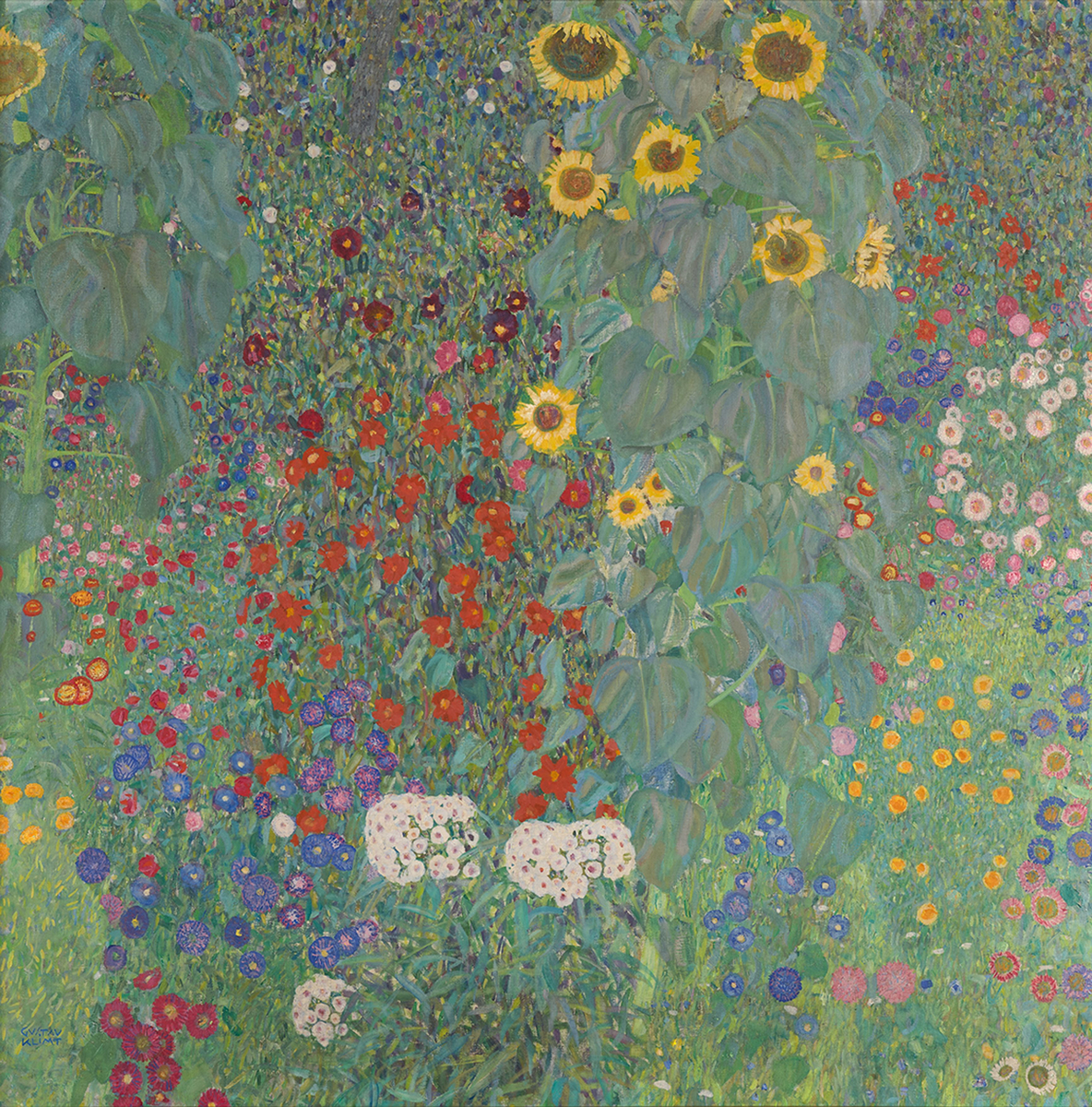
Gustav Klimt painted this farm garden in 1907. The German record also calls it a garden with sunflowers in the country, and it names a brewery garden at Litzlberg am Attersee as the place depicted.
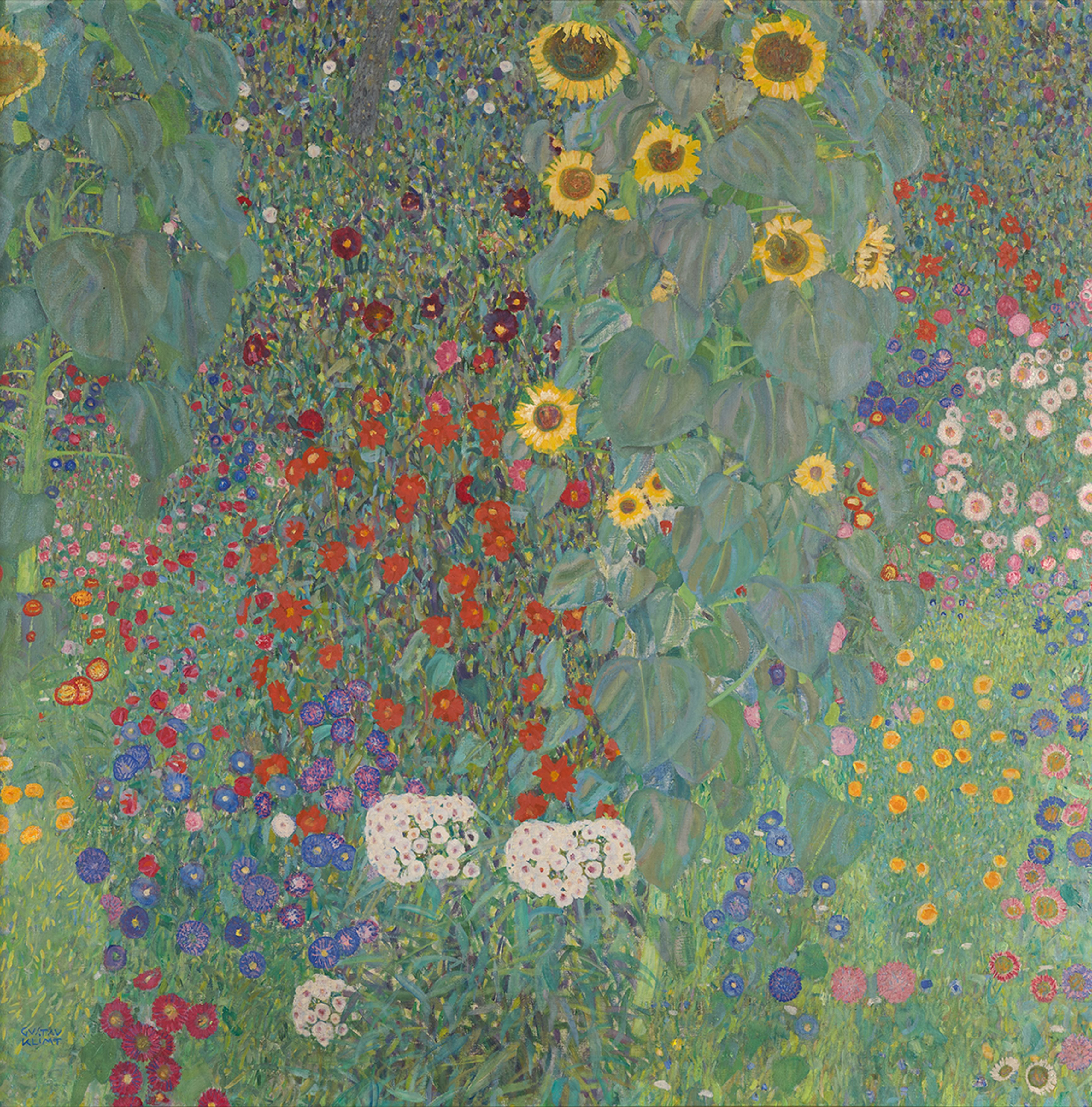
Sunflowers give the picture its name. Around them, the garden is a dense field of blossoms rather than a view with a horizon.
The square format and the close, packed planting make the flowers the subject, not the landscape around them. That is the key to everything that follows.
Look first at how little empty space there is. The canvas fills almost edge to edge with leaves, stems and petals, so the eye has no road, no sky and no distant hill to rest on.
That fullness is the painting's structure. Where a traditional landscape organises space with depth, this one organises it as a surface of overlapping shapes.
The sunflowers rise above the lower flowers, but they do not stand apart. They are woven into the same mass, with the same brushwork.
The record identifies the subject as a brewery garden at Litzlberg am Attersee. This is a working place, not a palace park.
A garden like that is planted for use and for produce. Flowers grow among the crops and the paths, and the result is an untidy abundance rather than a designed display.
The title also appears as 'Garten mit Sonnenblumen auf dem Lande', a garden with sunflowers in the country. That wording keeps the setting rural and plain.
Klimt worked in Vienna and on summer visits to the Austrian countryside. This canvas belongs to a body of garden and landscape pictures he made away from the city.
The focus stays on what is growing. There are no figures, no buildings and no narrative incident in the subject record.
So the painting asks you to look at cultivation itself: flowers, order and abundance, held on a square surface. That is an interpretation of the subject, supported by the title and setting.
In a garden like this, you do not separate the sunflowers from the poppies or the daisies, and the painting follows that experience. The blossoms crowd and overlap.
The square format reinforces it. A square has no top or bottom pull, no broad foreground to walk into, so the garden reads as a continuous pattern.
This is where the picture becomes almost abstract: not because the flowers are unrecognisable, but because the pattern matters as much as the individual plant.
What you take away is a garden at Litzlberg am Attersee, painted by Klimt in 1907 as a square field of flowers. The record gives the place and the date, and the canvas gives the abundance.
The sunflowers name the work, but the whole surface carries it: leaves, petals and stems held together without a horizon.
That is the understanding the painting offers. Not a view of a garden, but the garden itself, seen close enough that it becomes a pattern of colour and growth.