Pilgrimage to the Fountain of San Isidro
Artist: Francisco Goya · between 1819 and 1823

Pilgrimage to the Fountain of San Isidro: high-resolution image
The original file is hosted by Wikimedia Commons, available without payment or an account.
Open high-resolution image on Wikimedia CommonsThe complete story
The story About 4 minutes to read
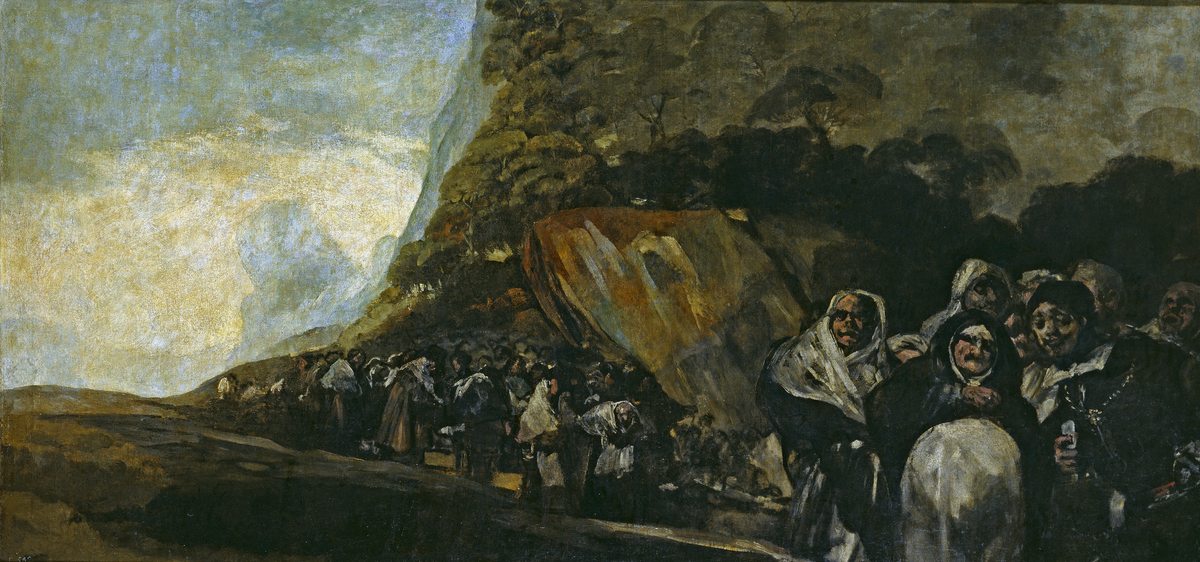
This is Goya's Pilgrimage to the Fountain of San Isidro, painted between 1819 and 1823. It belongs to the series we call the Black Paintings, made for his own house near Madrid. The title places us at a pilgrimage, a public gathering near a fountain dedicated to Saint Isidro.
The record describes the genre as genre art: a scene of everyday or public life, not a religious narrative episode. That distinction matters. You are not looking at a single holy event with a cast of biblical figures. You are looking at a crowd attending a shrine or fountain, a scene of collective movement and gathering.
The work is oil on wall, later transferred to canvas. That support is not incidental: it was made as part of the decoration of Goya's own house, the Quinta del Sordo. The Black Paintings were painted directly onto the walls, so the transfer preserves an image meant for a domestic interior rather than a public gallery.
The alternate title, El Santo Oficio, points to the Holy Office, the Spanish Inquisition. The supplied record does not explain why that title was attached, and it does not describe the figures in enough detail to confirm an inquisitorial scene. So the title is documented, but its precise bearing on the picture's action remains beyond the supplied evidence.
The painting is recorded in the Prado's inventory of new acquisitions begun in 1856, entry 532, and in the Prado catalogue of 1872 to 1907, entry 2166b. Those references show the work entering the museum's documented holdings in the nineteenth century. They tell us about custody and cataloguing, not about the scene's meaning.
What the supplied record leaves open is the crowd's identity and the exact action of the pilgrimage. We can say from the title and genre that this is a public devotional gathering near the Fountain of San Isidro. We cannot say from the supplied evidence who each figure is, or what Goya intended the scene to mean beyond that.
So the painting asks us to read a public ritual through its title and its setting, while the record stops short of a full narrative explanation. The Black Paintings context and the Holy Office alternate title remain documented labels, not keys to every gesture. What we can take away is a scene of collective pilgrimage, made for a private house and later catalogued as part of Goya's late series.
The story and its sources
Historical claims are linked to the records below. Close looking and interpretation are identified in the passage notes.
- Passage 1Documented historyInstitutional record for Pilgrimage to the Fountain of San Isidro
- Passage 2Close lookingInstitutional record for Pilgrimage to the Fountain of San Isidro
- Passage 3Documented historyInstitutional record for Pilgrimage to the Fountain of San Isidro
- Passage 4Documented historyInstitutional record for Pilgrimage to the Fountain of San Isidro
- Passage 5Documented historyInstitutional record for Pilgrimage to the Fountain of San Isidro
- Passage 6InterpretationInstitutional record for Pilgrimage to the Fountain of San Isidro
- Passage 7InterpretationInstitutional record for Pilgrimage to the Fountain of San Isidro
Details to notice
About 3 minutes to readAdvancing pilgrimage
A long line of small, dark-clad pilgrims with pale head coverings winds across the lower slope. Their bowed and clustered silhouettes turn the foreground close-up into a mass public ritual.
Moustached man at right
At the far right, a dark-haired man with heavy sideburns and moustache faces inward, his mouth suggesting speech or song. He presses into the group and heightens its noisy, unsettled character.
White-hooded companion
Beside the central figure, a pilgrim wrapped in a white headscarf and shawl turns toward the crowd. The bright cloth frames a shadowed, downcast face and creates the strongest tonal contrast in the foreground.
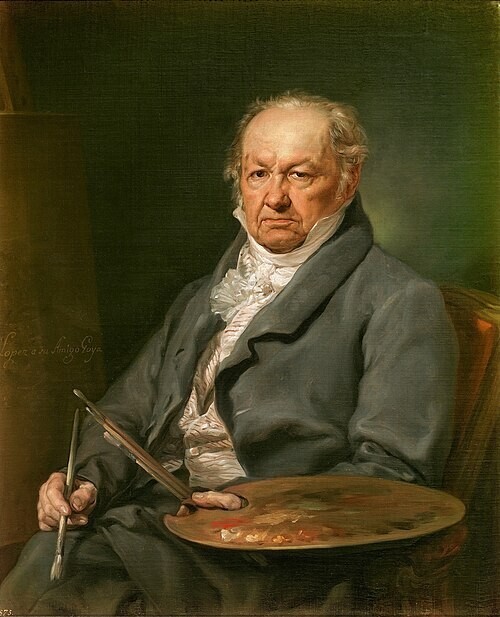
Artist portrait Image credit
Vicente López Portaña. Image source · Public domain
About the artist
Francisco de Goya
30 March 1746 to 16 April 1828
Goya was a Spanish painter and printmaker whose career extended from royal tapestry designs and court portraiture to images of war, repression and unsettling fantasy. Born in Fuendetodos, he trained in Zaragoza and Madrid and became First Painter to Charles IV in 1799. He spent his final years in Bordeaux.
- Born
- 30 March 1746
- Died
- 16 April 1828
- Nationality
- Spanish
- Birthplace
- Fuendetodos, Spain
- Died in
- Bordeaux, France
The research & record
Study the work.
Follow the evidence.
Find catalogue details, historical context, technical research and the literature behind this artwork.
The artwork record
Research catalogue
Catalogue information and detailed research, with references that link to the bibliography.
Updated .
Identity and catalogue
Link- Title
- Pilgrimage to the Fountain of San Isidro(commons.wikimedia.org, n.d.)
- Artist or attribution
- Francisco Goya(commons.wikimedia.org, n.d.)
- Object date
- between 1819 and 1823(commons.wikimedia.org, n.d.)
- Medium and support
- Oil on wall transferred to canvas(commons.wikimedia.org, n.d.)
- Dimensions
- Height 127 cm; width 266 cm (one record also gives 123 x 266 cm)(commons.wikimedia.org, n.d.)
- Current collection or location
- Museo del Prado, Madrid, Spain(commons.wikimedia.org, n.d.)
- Movement or period
- Black Paintings (Pinturas negras)
- Country or culture
- Spain
- Depicted subject
- A genre scene of a pilgrimage procession, also known as El Santo Oficio, showing pilgrims gathered and advancing near the Fountain of San Isidro. Part of Goya's Black Paintings, made between 1819 and 1823 for the Quinta del Sordo.(commons.wikimedia.org, n.d.)
- Title variants
- Peregrinación a la fuente de San Isidro; El Santo Oficio; Paseo del Santo Oficio; Procession du Saint-Office
- Accession number
- P000755
- Support
- Wall transferred to canvas
Read valuation records and their limitations
Titles and attribution
The painting is recorded under the title Pilgrimage to the Fountain of San Isidro, in Spanish Peregrinación a la fuente de San Isidro, and it also carries the alternate title El Santo Oficio. Both names belong to the same documented record, and the record offers no explanation of why the second title was attached or how it relates to the scene's action. The alternate name points toward the Holy Office, the Spanish Inquisition, but the supplied evidence does not describe the figures in enough detail to confirm an inquisitorial subject. The title or titles therefore stand as documented labels rather than as keys to the gestures of the crowd.(commons.wikimedia.org, n.d., Summary, Title)
The work is attributed to Francisco Goya, who lived from 1746 to 1828. The painting is dated between 1819 and 1823, a range that belongs to the object's own chronology and should be kept distinct from the later dates attached to its cataloguing. The earliest of those later dates is the Prado's inventory of new acquisitions begun in 1856, which records the work as entry 532; the Prado catalogue of 1872 to 1907 records it as entry 2166b. Those nineteenth-century references document the work's entry into the museum's holdings and its place in successive catalogues, not the moment of its making.(commons.wikimedia.org, n.d., Summary, Artist; Summary, Date; Summary, References)
The record classifies the painting as genre art, meaning a scene of everyday or public life rather than a religious narrative episode. That classification bears directly on how the title should be read: the subject is not a single holy event with a cast of biblical figures but a public gathering, consistent with a crowd attending a shrine or fountain dedicated to Saint Isidro. The genre designation and the title together establish a scene of collective movement and gathering; they do not by themselves identify individual participants.(commons.wikimedia.org, n.d., Summary, Genre; Summary, Title)
Measurements and record
The painting was made in Spain. The supplied record gives its dimensions in two forms: one line states a height of 127 cm and a width of 266 cm, while another line of the same record states 123 x 266 cm. The width agrees across both statements; the height does not. This is an internal discrepancy within a single record rather than a difference between independent accounts, and the supplied evidence does not resolve which figure is correct. Any measurements quoted for the work should preserve that qualification.(commons.wikimedia.org, n.d., Summary, Place of creation; Summary, Dimensions and Description)
Within an accumulating account of the object, the catalogue data and the absent curatorial explanation are themselves informative. The record states that it offers no curatorial explanation of the scene's action, figures, or meaning, and that its descriptions are limited to title, alternate title, series, genre and catalogue data. Considered alongside the title and genre, this defines what the supplied evidence can sustain: a public devotional gathering near the Fountain of San Isidro, presented as genre rather than religious narrative. What cannot be said is who each figure is or what Goya intended the scene to mean beyond that.(commons.wikimedia.org, n.d., Summary, Title; Summary, Genre)
The painting is titled Pilgrimage to the Fountain of San Isidro, in Spanish Peregrinación a la fuente de San Isidro, and is also called El Santo Oficio.(commons.wikimedia.org, n.d.)
The work is by Francisco Goya, who lived from 1746 to 1828.(commons.wikimedia.org, n.d.)
The painting is dated between 1819 and 1823.(commons.wikimedia.org, n.d.)
The record gives the dimensions as height 127 cm and width 266 cm, while another line of the same record states 123 x 266 cm.(commons.wikimedia.org, n.d.)
The genre of the painting is recorded as genre art, meaning a scene of everyday or public life rather than a religious narrative episode.(commons.wikimedia.org, n.d.)
Historical context
LinkRead valuation records and their limitations
Documented Production and Collection Data
Interpretation
The institutional record for this work identifies it as Pilgrimage to the Fountain of San Isidro, in Spanish Peregrinación a la fuente de San Isidro, and attributes it to Francisco Goya, who lived from 1746 to 1828. The painting is dated between 1819 and 1823 and is recorded as having been made in Spain. It is described as oil on wall transferred to canvas and as part of the group known as Goya's Black Paintings. The record gives its dimensions as height 127 cm and width 266 cm, while another line of the same record states 123 x 266 cm, so the height figure is internally inconsistent and should be quoted with that discrepancy noted. The painting belongs to the Museo del Prado in Madrid under accession number P000755. The genre is recorded as genre art, meaning a scene of everyday or public life rather than a religious narrative episode.(commons.wikimedia.org, n.d., Summary, Place of creation; Summary, Description)
The painting was made in Spain.(commons.wikimedia.org, n.d.)
Materials and technique
LinkRead valuation records and their limitations
The documented support
The institutional record gives the physical constitution of Pilgrimage to the Fountain of San Isidro in a single, consequential formulation: it is oil on wall transferred to canvas, and it is counted among Francisco Goya's Black Paintings. This is not a painting on panel or on an original stretched canvas. The paint was applied in oil to a wall surface, and the image now reaches us on a fabric support because the wall-bound layer was detached and mounted. Any account of its handling, surface and condition has to begin from that two-stage existence, since the material state visible today is the product both of Goya's original application and of a later transfer whose details the supplied record does not describe. The record offers no further description of the wall itself, of any ground or preparation layer, of the transfer method, of lining or consolidation materials, or of pigments, medium additives and tools. Those aspects remain undocumented in the evidence available here.(commons.wikimedia.org, n.d., Summary, Description and Object type)
Interpretation
Because the support was originally a wall, the work belongs materially to a decorative scheme made for a domestic interior rather than to a picture conceived for a frame and a public hanging. The record states the oil-on-wall origin and the transfer to canvas and identifies the work as part of the Black Paintings, but it does not itself name the house, the room or the wall from which the image came, nor does it give a date or an agent for the transfer. What the documented material history establishes is a category difference: a mural-scale image in oil, fixed to architecture, subsequently rendered portable as a canvas. The transfer is therefore part of the object's making as an artifact, not a peripheral conservation footnote, because it changed the physical terms on which the image survives. The precise procedures used and the condition consequences of the transfer cannot be stated from this evidence and are not asserted here.(commons.wikimedia.org, n.d., Summary, Description and Object type)
The record supplies dimensions as height 127 cm and width 266 cm, while another line of the same record states 123 x 266 cm. The two figures agree on the width and differ by four centimeters in height. This is a discrepancy internal to one institutional record, and the supplied evidence does not resolve it or explain whether the variation reflects measurement at different moments, different edges or different conventions of measuring a transferred wall painting. Both readings are retained here rather than silently harmonized. The very wide, low format implied by either figure is a material fact about the object's proportions, and it conditions how the painted surface would have occupied a wall and how it now occupies a canvas. No description of the composition, figure scale or pictorial arrangement accompanies these measurements in the evidence, so the proportions are recorded without being extrapolated into a visual analysis.(commons.wikimedia.org, n.d., Summary, Description and Object type)
Evidence and its limits
The dating of the work to between 1819 and 1823, together with its attribution to Goya, who lived from 1746 to 1828, situates the oil-on-wall execution in the final decade of the artist's life. The record also states that the painting was made in Spain, and it gives the Prado accession number P000755 with the title Pilgrimage to the Fountain of San Isidro, in Spanish Peregrinación a la fuente de San Isidro, also called El Santo Oficio. These are recorded facts of identification, attribution, dating and place, not technical findings from examination of the paint. The evidence does not include any analytical study of the medium, no pigment identification, no cross-section or layer analysis, and no report on the condition of the transferred surface. Statements about what the picture is physically made of therefore rest on the record's materials description alone, and the distinction between that documented description and any visual inference drawn from a reproduction should be kept firm.(commons.wikimedia.org, n.d., Summary, Description and Object type)
The record classifies the painting's genre as genre art, a scene of everyday or public life rather than a religious narrative episode. This classification is a cataloguing decision about the kind of picture, and it sits alongside, rather than replacing, the devotional subject announced by the title and the fountain of San Isidro. The record also notes that its descriptions are limited to title, alternate title, series, genre and catalogue data, and that it offers no curatorial explanation of the scene's action, figures or meaning. The same silence extends to the material account: the record does not describe pigments, brushes, preparatory drawing on the wall, or any intervention during or after the transfer. The alternate title El Santo Oficio is documented, but the record does not explain why that title was attached, and the supplied evidence gives no basis for connecting it to the paint layer or to particular figures.(commons.wikimedia.org, n.d., Summary, Description and Object type)
Two nineteenth-century Prado references are recorded: entry 532 in the inventory of new acquisitions begun in 1856, and entry 2166b in the Prado catalogue of 1872 to 1907. These establish the work's entry into the museum's documented holdings and its continued cataloguing across the later nineteenth and early twentieth centuries. They are records of custody and registration, and they are the documentary context in which the transferred canvas was inventoried as a museum object. They do not document the transfer itself, its date, its method or its materials, and they do not describe conservation treatment. Read together with the materials description, they show a wall painting becoming a catalogued museum canvas, but the evidence records the institutional endpoints of that change rather than the technical steps between them.(commons.wikimedia.org, n.d., Summary, Description and Object type)
Interpretation
For a history of European painting materials, the object is significant precisely because its documented support is unusual and consequential: an oil composition executed on a wall within a domestic decorative series and later carried onto canvas. That sequence places it at a junction between mural painting and easel painting, two traditions with different grounds, different viewing distances and different expectations of permanence. The evidence supplied here establishes the sequence in outline and gives the work's dimensions, date, attribution and museum identity, but it does not permit a reconstruction of Goya's wall preparation, his pigment choices or the transfer technique. The responsible account therefore treats the oil-on-wall-to-canvas formula as a documented material fact of first importance, and leaves the specific craft procedures, and any comparison with other transferred works, as questions the available evidence does not answer.(commons.wikimedia.org, n.d., Summary, Description and Object type)
The work is oil on wall transferred to canvas, part of Goya's Black Paintings.(commons.wikimedia.org, n.d.)
Provenance and ownership
LinkRead valuation records and their limitations
Documented custody and catalogue entries
Pilgrimage to the Fountain of San Isidro is the title under which the Prado holds this work, with the Spanish form Peregrinación a la fuente de San Isidro and the alternate title El Santo Oficio also recorded. Its documented physical history begins in Goya's own lifetime context: the work belongs to the Black Paintings and is dated to 1819 to 1823, and is described as made in Spain. The same record identifies it as oil on wall transferred to canvas and gives its accession number as P000755, fixing the object within the museum's collection by a number that can be traced independently of any narrative description of its subject.(commons.wikimedia.org, n.d., Summary, Place of creation; Summary, References)
The earliest custody evidence supplied is the Prado's inventory of new acquisitions, begun in 1856, where the work appears as entry 532. A second reference places it in the Prado catalogue covering 1872 to 1907, as entry 2166b. Together these establish that the painting was absorbed into the museum's documented holdings during the second half of the nineteenth century and was carried through the institution's published catalogue across the following decades. What these entries record is custody and cataloguing rather than a chain of individual owners: they document where the object was registered and under which number, not who possessed it before that registration. The record supplies no earlier sale, gift, bequest or transfer, so any period before the 1856 inventory remains unrecorded in the evidence rather than proven to be a change of ownership.(commons.wikimedia.org, n.d., Summary, References)
Interpretation
The date of the inventory's commencement matters for how the entry 532 is read. The fact that the reference is to an inventory of new acquisitions begun in 1856 indicates an act of accession into the museum's holdings that was captured by a systematic listing then being started, not merely a mention in passing. The catalogue reference spanning 1872 to 1907, entry 2166b, shows continuity of registration rather than a fresh acquisition, since the same work recurs across successive editions. Read together, the two entries describe a single institutional relationship sustained over roughly half a century of cataloguing, and they distinguish that sustained custody from the earlier, undocumented phase of the painting's existence.(commons.wikimedia.org, n.d., Summary, References)
Limits of the supplied record
The character of the evidence limits what can responsibly be said about the object's passage into the museum. The source is a Wikimedia Commons file page used as a discovery aid, recorded as only partially consulted, and it provides catalogue references without a curatorial essay or a full provenance narrative. No acquisition date beyond the inventory's start, no vendor, donor or intermediary, and no earlier collection are stated. Consequently, the entry numbers should be treated as locators within institutional records rather than as a reconstructed chain of title, and the gap between the painting's creation in 1819 to 1823 and its appearance in the 1856 inventory is an unrecorded interval, not an attested sequence of owners.(commons.wikimedia.org, n.d., Summary, References)
The work is referenced in the Prado's inventory of new acquisitions begun in 1856, entry 532, and in the Prado catalogue of 1872 to 1907, entry 2166b.(commons.wikimedia.org, n.d.)
Provenance timeline
- 1856
The Prado's inventory of new acquisitions, begun in this year, references the work at entry 532, indicating its presence in the museum's holdings by this point.(commons.wikimedia.org, n.d., Summary, References)
- 1872 to 1907
The work appears in the Prado catalogue across this range at entry 2166b, showing continued documented retention in the museum collection.(commons.wikimedia.org, n.d., Summary, References)
Interpretations and debates
LinkRead valuation records and their limitations
What the Record Establishes and What It Leaves Open
Interpretation
The supplied record for Francisco Goya's Pilgrimage to the Fountain of San Isidro, also called El Santo Oficio, is explicit about its own limits: it describes the work through title, alternate title, series, genre and catalogue data, and offers no curatorial explanation of the scene's action, figures or meaning. That absence is itself part of the evidential situation. Any reading of the picture must therefore be built from what the record does establish, and must distinguish that documented framing from the interpretive work of explaining a crowd, a shrine and a title whose bearing on the imagery the record does not settle. The painting was made in Spain, which anchors the work and its subject in a Spanish setting even where the record stops short of narrating what takes place within it.(commons.wikimedia.org, n.d., Summary, Description; Summary, Place of creation)
The supplied record offers no curatorial explanation of the scene's action, figures, or meaning. Its descriptions are limited to title, alternate title, series, genre and catalogue data.(commons.wikimedia.org, n.d.)
Collection and display
LinkRead valuation records and their limitations
Institutional identity and recorded data
The painting known as Pilgrimage to the Fountain of San Isidro, in Spanish Peregrinación a la fuente de San Isidro, is held by the Museo del Prado in Madrid under accession number P000755. The same institutional record supplies the core identification on which any further study of the work depends: the author as Francisco Goya (1746 to 1828), a date between 1819 and 1823, the medium of oil on wall transferred to canvas, and membership in the group conventionally called the Black Paintings. It further records the place of making as Spain and the genre as genre art, that is, a scene of everyday or public life rather than a religious narrative episode. The record also gives dimensions as height 127 cm and width 266 cm, while another line of the same record states 123 x 266 cm, an internal discrepancy that should be carried forward as unresolved rather than silently harmonised. Taken together, these fields establish what the object is, who made it, when, in what material, and where it now resides; they do not by themselves describe the figures or the action depicted.(commons.wikimedia.org, n.d., Summary, Collection and Accession number)
Custody of the work can be traced through two locators in the Prado's own documentation: the inventory of new acquisitions begun in 1856, entry 532, and the Prado catalogue of 1872 to 1907, entry 2166b. These references document the painting's entry into the museum's recorded holdings in the nineteenth century and its continued listing across several decades of cataloguing. What they establish is a history of custody, registration and description within an institution, not a history of the scene's meaning. Read alongside the accession number and the physical data, they show an object whose institutional identity was fixed early and maintained consistently in the museum's records, even while the interpretive literature on the imagery remained a separate question. The record's dates for these entries should be kept distinct from the painting's own dating of 1819 to 1823.(commons.wikimedia.org, n.d., Summary, Collection and Accession number)
Support, transfer and the Black Paintings
The object's material history is unusually layered. It was executed in oil directly on wall and only later transferred to canvas, so the present support is not the original one. Because the image was conceived as wall painting, its original setting was architectural rather than that of a framed picture, and the transfer preserves an image designed for a built interior. The record identifies the work as part of the Black Paintings series and notes the medium as oil on wall transferred to canvas; it also records the work as made in Spain. Any account of the surface, edges or paint layer must therefore reckon with the intervention of transfer, which separates the painted image from the substrate Goya worked on. The record does not describe the condition of the paint layer, the date or method of transfer, or any conservation treatment, and those details should not be supplied from outside the evidence.(commons.wikimedia.org, n.d., Summary, Collection and Accession number)
Titles and the limits of description
Two titles attach to the work in the record: Pilgrimage to the Fountain of San Isidro and the alternate El Santo Oficio, which points to the Holy Office, the Spanish Inquisition. The record offers no explanation of why the alternate title was attached, and it does not describe the figures in enough detail to confirm an inquisitorial scene. The alternate title is therefore documented as a name but not established as a description of the picture's action. This distinction matters for method: a title is evidence of how a work has been named and circulated, not proof of what its figures are doing. The genre designation of genre art, which the record assigns, sits alongside the pilgrimage title as the only explicit characterisation of the subject, and it describes a scene of public or everyday life rather than a religious narrative episode.(commons.wikimedia.org, n.d., Summary, Collection and Accession number)
Interpretation
Within a larger history of art and material culture, the documented facts place the work at a specific intersection. It belongs to Goya's late production of 1819 to 1823, was painted in Spain as wall decoration, and entered the Prado's holdings through nineteenth-century acquisition and cataloguing recorded at entries 532 and 2166b. The genre classification situates it among images of collective public life rather than devotional narrative, while the pilgrimage title locates the pictured gathering at a fountain dedicated to Saint Isidro. The record's silence on the identity of the crowd and on the precise action of the pilgrimage limits what can responsibly be claimed: the evidence supports a public gathering at a named shrine and a documented alternate title invoking the Holy Office, but not a reconstruction of individual roles or of authorial intent beyond those labels. The transfer from wall to canvas is the material fact that most sharply distinguishes this object from a painting made for a frame, and it is the point at which conservation history and the history of the Black Paintings meet.(commons.wikimedia.org, n.d., Summary, Collection and Accession number)
The painting belongs to the Museo del Prado in Madrid, with accession number P000755.(commons.wikimedia.org, n.d.)
Documented values and qualified estimates
LinkRead valuation records and their limitations
The working valuation
Interpretation
The working insurance estimate records a range of US$80M to US$250M, under a recorded date of 2026-11-16 described as a working calculation. Its stated methodology calculates the bracket from the confirmed factors only: Goya's authorship, creation between 1819 and 1823, oil on wall transferred to canvas, the large scale of about 127 by 266 cm with one record giving 123 by 266 cm, membership in the Black Paintings series from the Quinta del Sordo, and current location at the Museo del Prado under P000755. The range is described as deliberately wide and conservative, reflecting the extreme rarity and museum-level importance of a documented Goya Black Painting while accounting for the total absence of comparable market sales, the work's inalienable public collection status, and the lack of any appraisal or official valuation in the supplied material. The record states explicitly that it is intended only as a review bracket for insurance discussion, not a market-derived figure, and that it is model-generated for manual review only, not an official insurance value, appraisal, auction estimate, auction result, documented acquisition price or sale price.(Wikimedia Commons: Pilgrimage to the Fountain of San Isidro, n.d.)(commons.wikimedia.org, n.d.)
The valuation record states that no comparable sales, private insurance records or official valuations were accessed or invented, and that any actual insurance treatment would be set by professional appraisers and institutional risk managers. The documented object record supplies no figure endorsed by the museum or by any appraiser, so the US$80M to US$250M bracket should be treated as an internal working hypothesis for review rather than as a finding about the painting's worth. Its width is itself informative: the absence of market comparables for a wall painting by Goya transferred to canvas, permanently held in a public collection, means that value in the ordinary art-market sense cannot be established from the evidence available. The bracket is best understood as a documented reasoning process that makes its own limits explicit and that depends entirely on the confirmed authorship, date, support, dimensions, series and location facts rather than on any interpretation of what the scene depicts.(Wikimedia Commons: Pilgrimage to the Fountain of San Isidro, n.d.)(commons.wikimedia.org, n.d.)
Working estimate
Calculated working insurance estimate, not a sale price: Estimated value: US$80M to US$250M Recorded date: Working calculation, generated 2026-11-16. Methodology: Broad working range calculated from the confirmed factors only: authorship by Francisco Goya, creation between 1819 and 1823, oil on wall transferred to canvas, large scale of about 127 x 266 cm (one record gives 123 x 266 cm), membership in the Black Paintings series from the Quinta del Sordo, and current location at the Museo del Prado under accession P000755. The range reflects the extreme rarity and museum-level importance of a documented Goya Black Painting while remaining deliberately wide and conservative to account for total absence of comparable market sales, the work's inalienable public collection status, and the lack of any appraisal or official valuation in the supplied material. It is intended only as a review bracket for insurance discussion, not a market-derived figure. Qualification: Model-generated working range for manual review only. This is not an official insurance value, appraisal, auction estimate, auction result, documented acquisition price, or sale price. No comparable sales, private insurance records, or official valuations were accessed or invented. The artwork is held in a public museum collection, and any actual insurance treatment would be set by professional appraisers and institutional risk managers.(Wikimedia Commons: Pilgrimage to the Fountain of San Isidro, n.d.)(commons.wikimedia.org, n.d.)
Further reading
Books for a closer look
Paid links. As an Amazon Associate I earn from qualifying purchases.

Open Library Goya
Kodansha International
A Goya catalogue with subjects including catalogues raisonnes, exhibitions, Museo del Prado and Spanish painting. The artwork is by Goya, belongs to the Museo del Prado (P000755), and is a Spanish painting, so a Goya catalogue tied to the Prado is the most directly relevant type of object-level study among the candidates. Its relevance rests on the Prado and catalogue subjects, not on verified discussion of the Black Paintings.
ISBN 0870110837
Bibliography
Sources and further reading
References are arranged by author or organisation, with links to the original publications. Where no publication date is recorded, n.d. means no date.
Source notes updated .
No recorded sources match these filters. Reset the filters to see the full bibliography.
- 02
Official · About this artwork
Institutional record for Pilgrimage to the Fountain of San Isidro. Wikimedia Commons, File:Peregrinación a la fuente de San Isidro.jpg.
Wikimedia Commons file page used as a discovery aid. It records Goya, the Prado accession, the Black Paintings series and catalogue references, but supplies no curatorial essay on the scene's meaning.
- Language
- English and Spanish
Citation text
- 03
Book
Goya. Kodansha International.
A Goya catalogue with subjects including catalogues raisonnes, exhibitions, Museo del Prado and Spanish painting. The artwork is by Goya, belongs to the Museo del Prado (P000755), and is a Spanish painting, so a Goya catalogue tied to the Prado is the most directly relevant type of object-level study among the candidates. Its relevance rests on the Prado and catalogue subjects, not on verified discussion of the Black Paintings.
- ISBN
- 0870110837
Citation text
- 04
Book
Francisco Goya - the Paintings. Independently Published.
Titled as a volume on Goya's paintings, which matches the medium of the artwork, an oil painting, rather than Goya's prints. Relevance is limited to the recorded title and is not evidence that this painting is discussed inside.
- ISBN
- 9781521566466
Citation text
- 01
Secondary · About this artwork
Wikimedia Commons: Pilgrimage to the Fountain of San Isidro (n.d.). Wikimedia Commons, File:Pilgrimage to the Fountain of San Isidro. Wikimedia Commons.
Wikimedia Commons file page giving the discovery title, Prado accession P000755 and a link to the Prado online gallery record. No Prado curatorial text was supplied.
- Language
- English
Citation text
Art to live with
Bring this painting
home.
A piece of the archive, made yours. Explore Pilgrimage to the Fountain of San Isidro in a size and finish that fits your space.
Your text and annotations appear on these editions. Adding to cart saves that design for printing.
Combine this painting with your favourites01 / Find your edition
Made for you
Suggested from your location. Change it if you're sending elsewhere or using a VPN. Prices and delivery are shown in GBP.
16 products
Choose an edition to make it yours
6 × 8 in · Printed cover · 118 lined pages
6 × 8 in · Printed cover · 118 lined pages
6 × 8 in · Printed cover · 118 lined pages
Notebook
GBP 12.03
Delivery GBP 5.35 / Total GBP 17.38
A 6 × 8 inch spiral notebook with 118 ruled pages (59 sheets), a printed front cover, dark grey back cover and metal spiral binding.
Fit and fill keep the painting’s proportions. Stretch changes them.
Move and zoom the painting on your notebook.
Made to order with your design
Made to order
US delivery only
17.8 × 12.7 cm / 7 × 5 in · Standard
17.8 × 12.7 cm / 7 × 5 in · Standard

7 × 5 in / 17.8 × 12.7 cm · Standard

7 × 5 in / 17.8 × 12.7 cm · Standard

7 × 5 in / 17.8 × 12.7 cm · Standard

7 × 5 in / 17.8 × 12.7 cm · Standard

7 × 5 in / 17.8 × 12.7 cm · Standard
Metal art sign
GBP 19.84
Delivery GBP 17.90 / Total GBP 37.74
A printed aluminium sign with rounded corners and mounting holes.
Fit and fill keep the painting’s proportions. Stretch changes them.
Move and zoom the painting on your metal art sign.
Made to order with your design
Printed aluminium · mounting holes included
US delivery only
iPhone 12 Mini ? Glossy ? back view
iPhone 12 Mini · Glossy

iPhone 12 Mini ? Glossy ? back view

iPhone 12 Mini ? Glossy ? back view

iPhone 12 Mini ? Glossy ? back view
Tough phone case
GBP 16.56
Delivery GBP 4.28 / Total GBP 20.84
A two-layer phone case with a printed polycarbonate shell and a shock-absorbing inner liner.
Two layers with a shock-absorbing TPU liner
Case & print details
- Device
- Apple · iPhone 12 Mini
- Material
- Polycarbonate shell with a TPU inner liner
- Artwork
- Outer back and wrapped edges from one template
- Finish
- Glossy
- Version
- Standard version
- Printing
- Dye sublimation
- Print file
- 1,122 × 1,831 px · 95 × 155 mm · PNG · 300 dpi recommended
Rear outline and camera openings follow this variant's Printify template. Case depth and small hardware remain illustrative.
Supplier product detailsFit and fill keep the painting’s proportions. Stretch changes them.
Move and zoom the painting on your tough phone case.
Made to order with your design
Made to order
US delivery only
25.4 × 20.3 cm / 10 × 8 in · White
25.4 × 20.3 cm / 10 × 8 in · White

10 × 8 in / 25.4 × 20.3 cm · White

10 × 8 in / 25.4 × 20.3 cm · White

10 × 8 in / 25.4 × 20.3 cm · White

10 × 8 in / 25.4 × 20.3 cm · White
Framed art print
GBP 34.51
- 1 framed print
- GBP 34.51
- Delivery to United States
- GBP 9.73
- Total
- GBP 44.24
A ready-to-hang wooden frame with a clear Perspex cover and a semi-gloss printed insert.
Delivery is quoted for all selected copies together.
Fit and fill keep the painting’s proportions. Stretch changes them.
Move and zoom the painting on your framed art print.
Made to order with your design
Wooden frame & protective clear front included
US delivery only
22.9 × 20.3 cm / 9 × 8 in · Standard
22.9 × 20.3 cm / 9 × 8 in · Standard

9 × 8 in / 22.9 × 20.3 cm · Standard

9 × 8 in / 22.9 × 20.3 cm · Standard

9 × 8 in / 22.9 × 20.3 cm · Standard

9 × 8 in / 22.9 × 20.3 cm · Standard
Mouse mat
GBP 7.36
Delivery GBP 4.87 / Total GBP 12.23
A rectangular fabric mouse mat with a rubber backing and rounded corners.
Fit and fill keep the painting’s proportions. Stretch changes them.
Move and zoom the painting on your mouse mat.
Made to order with your design
Made to order
US delivery only
43.2 × 45.7 cm / 17 × 18 in · Artwork
43.2 × 45.7 cm / 17 × 18 in · Artwork

17 × 18 in / 43.2 × 45.7 cm · Artwork

17 × 18 in / 43.2 × 45.7 cm · Artwork

17 × 18 in / 43.2 × 45.7 cm · Artwork
Woven tote bag
GBP 47.33
Delivery GBP 5.94 / Total GBP 53.27
A woven tote with cotton webbing handles and the painting translated into a woven design.
Fit and fill keep the painting’s proportions. Stretch changes them.
Move and zoom the painting on your woven tote bag.
Made to order with your design
Made to order
US delivery only
See more10 more products
iPhone 12 Mini ? Standard ? back view
iPhone 12 Mini · Standard

iPhone 12 Mini ? Standard ? back view

iPhone 12 Mini ? Standard ? back view

iPhone 12 Mini ? Standard ? back view
Flexible phone case
GBP 15.76
Delivery GBP 4.28 / Total GBP 20.04
A flexible TPU phone case with a frosted finish, a printed back and precise port openings.
Flexible TPU with a frosted, matte finish
Case & print details
- Device
- Apple · iPhone 12 Mini
- Material
- Semi-transparent thermoplastic polyurethane (TPU)
- Artwork
- Back print; rim stays unprinted
- Finish
- Standard
- Version
- Standard version
- Printing
- Dye sublimation
- Print file
- 791 × 1,586 px · 67 × 134.3 mm · PNG · 300 dpi recommended
Rear outline and camera openings follow this variant's Printify template. Case depth and small hardware remain illustrative.
Supplier product detailsFit and fill keep the painting’s proportions. Stretch changes them.
Move and zoom the painting on your flexible phone case.
Made to order with your design
Made to order
S · Standard
S · Standard

S · Standard

S · Standard

S · Standard

S · Standard

S · Standard
Crew socks
GBP 10.78
Delivery GBP 4.49 / Total GBP 15.27
Crew-length polyester and spandex socks with a ribbed cuff, cushioned sole and sublimated artwork.
Fit and fill keep the painting’s proportions. Stretch changes them.
Move and zoom the painting on your crew socks.
Made to order with your design
One pair · design repeated on both socks
US delivery only
12" · Standard
12" · Standard

12" · Standard

12" · Standard

12" · Standard
Laptop sleeve
GBP 26.36
Delivery GBP 4.96 / Total GBP 31.32
A polyester laptop sleeve with a fleece lining, top zip, printed front and black reverse.
Fit and fill keep the painting’s proportions. Stretch changes them.
Move and zoom the painting on your laptop sleeve.
Made to order with your design
Made to order
US delivery only
11oz · single image
11oz · White
11oz · single image
Mug
GBP 7.42
Delivery GBP 6.23 / Total GBP 13.65
A glossy white ceramic mug with a C-shaped handle, available in 11oz and 15oz sizes.
single layout · choose single, double or a repeating pattern in Customise.
Repeat, fit, fill and position your artwork around the mug.
Made to order with your design
Made to order
iPhone 12 Mini ? Standard ? back view
iPhone 12 Mini · Standard

iPhone 12 Mini ? Standard ? back view

iPhone 12 Mini ? Standard ? back view

iPhone 12 Mini ? Standard ? back view

iPhone 12 Mini ? Standard ? back view

iPhone 12 Mini ? Standard ? back view
Biodegradable phone case
GBP 21.19
Delivery GBP 4.28 / Total GBP 25.47
A matte phone case made from plant polymers and bamboo fibre, with the artwork printed on the back.
Flexible plant-polymer shell with a matte finish
Case & print details
- Device
- Apple · iPhone 12 Mini
- Material
- PLA and PBAT polymers with bamboo fibre
- Artwork
- Back print; rim stays unprinted
- Finish
- Standard
- Version
- Standard version
- Printing
- Dye sublimation
- Print file
- 777 × 1,553 px · 65.8 × 131.5 mm · PNG · 300 dpi recommended
Rear outline and camera openings follow this variant's Printify template. Case depth and small hardware remain illustrative.
Supplier product detailsFit and fill keep the painting’s proportions. Stretch changes them.
Move and zoom the painting on your biodegradable phone case.
Made to order with your design
Made to order
30.5 × 20.3 cm / 12 × 8 in · Standard
30.5 × 20.3 cm / 12 × 8 in · Standard

12 × 8 in / 30.5 × 20.3 cm · Standard

12 × 8 in / 30.5 × 20.3 cm · Standard

12 × 8 in / 30.5 × 20.3 cm · Standard
Fine art poster
GBP 13.03
Delivery GBP 7.69 / Total GBP 20.72
A gallery paper print with a smooth art-paper surface. Choose a size that suits the painting.
Fit and fill keep the painting’s proportions. Stretch changes them.
Move and zoom the painting on your fine art poster.
Made to order with your design
Unframed · frame it your way
iPhone 12 Mini ? Standard ? back view
iPhone 12 Mini · Standard

iPhone 12 Mini ? Standard ? back view

iPhone 12 Mini ? Standard ? back view

iPhone 12 Mini ? Standard ? back view
Clear phone case
GBP 15.28
Delivery GBP 4.28 / Total GBP 19.56
A clear phone case with artwork on the back. Leave areas transparent to show the phone underneath.
Clear shell with shock-absorbing TPU sides
Case & print details
- Device
- Apple · iPhone 12 Mini
- Material
- Polycarbonate back and clear TPU sides
- Artwork
- Back print; clear sides stay unprinted
- Finish
- Standard
- Version
- Standard version
- Printing
- Dye sublimation
- Print file
- 732 × 1,527 px · 62 × 129.3 mm · PNG · 300 dpi recommended
Rear outline and camera openings follow this variant's Printify template. Case depth and small hardware remain illustrative.
Supplier product detailsFit and fill keep the painting’s proportions. Stretch changes them.
Move and zoom the painting on your clear phone case.
Made to order with your design
Made to order
15oz · single image
15oz · Standard

15oz · single image

15oz · single image

15oz · single image

15oz · single image

15oz · single image
Travel mug
GBP 32.33
Delivery GBP 5.75 / Total GBP 38.08
A stainless-steel travel mug with a black lid, a tapered base and a printed white exterior.
single layout · choose single, double or a repeating pattern in Customise.
Repeat, fit, fill and position your artwork around the mug.
Made to order with your design
Made to order
US delivery only
2.5 × 3.4 cm / 1 × 1.4 in · Glossy
2.5 × 3.4 cm / 1 × 1.4 in · Glossy

1 × 1.4 in / 2.5 × 3.4 cm · Glossy

1 × 1.4 in / 2.5 × 3.4 cm · Glossy

1 × 1.4 in / 2.5 × 3.4 cm · Glossy

1 × 1.4 in / 2.5 × 3.4 cm · Glossy
Photo keyring
GBP 10.30
Delivery GBP 5.45 / Total GBP 15.75
A rectangular zinc-alloy photo keyring with a glossy insert and a swivel split ring.
Fit and fill keep the painting’s proportions. Stretch changes them.
Move and zoom the painting on your photo keyring.
Made to order with your design
Photo insert · zinc frame & swivel ring
US delivery only
iPhone 15 Pro ? Glossy ? back view
iPhone 15 Pro · Glossy

iPhone 15 Pro ? Glossy ? back view

iPhone 15 Pro ? Glossy ? back view

iPhone 15 Pro ? Glossy ? back view

iPhone 15 Pro ? Glossy ? back view

iPhone 15 Pro ? Glossy ? back view
Slim phone case
GBP 16.53
Delivery GBP 5.85 / Total GBP 22.38
A slim printed phone shell with open ports and a lightweight profile.
Slim, lightweight polycarbonate shell
Case & print details
- Device
- Apple · iPhone 15 Pro
- Material
- Polycarbonate
- Artwork
- Outer back and wrapped edges from one template
- Finish
- Glossy
- Version
- Standard version
- Printing
- Dye sublimation
- Print file
- 1,278 × 1,971 px · 108.2 × 166.9 mm · PNG · 300 dpi recommended
Rear outline and camera openings follow this variant's Printify template. Case depth and small hardware remain illustrative.
Supplier product detailsFit and fill keep the painting’s proportions. Stretch changes them.
Move and zoom the painting on your slim phone case.
Made to order with your design
Made to order
US delivery only
The 30 cm ruler is scaled alongside your selected print. Keep the painting’s proportions with a black background, or stretch it to fill. Frame width, material texture and screen colours are illustrative.
Keep exploring