Officer and Laughing Girl
Artist: Johannes Vermeer · c. 1657-1658

Officer and Laughing Girl: high-resolution image
The original file is hosted by Wikimedia Commons, available without payment or an account.
Open high-resolution image on Wikimedia CommonsThe complete story
The story About 3 minutes to read
This is Johannes Vermeer's Officer and Laughing Girl, a painting from around 1657 to 1658. It shows a soldier in a broad black hat and red coat seated with his back to us, leaning toward a young woman. She faces him in a white cap and yellow jacket, smiling openly and holding a raised wine glass. He is called an officer in the title, and his turned back keeps his face from us.
The officer's back fills the near foreground, so we see his hat and shoulders rather than his expression. He leans in, and the woman leans or stands toward him, meeting his approach with a smile. Her raised glass sits between them, a clear sign of a shared, sociable moment. Because his face is hidden, her laugh and the glass carry the emotional weight of the encounter.
The window at the left edge of the canvas is the light source. It brightens the young woman and leaves the officer in shadow, so the painting's light and composition work together. A large framed map covers the rear wall behind the figures. It anchors the interior and, in this reading, comments on the encounter between the two figures.
The officer's turned back creates the painting's central tension: an unseen, addressed face. We are placed on his side of the exchange, looking past him toward the woman who responds. The laughing girl with her wine glass is the emotional counterpoint to that hidden face. Her openness and the raised glass answer his lean, and the scene becomes about the exchange rather than about him alone.
Vermeer builds the whole scene around what we cannot see. The officer's hidden face, the bright window and the map behind them all direct attention to the woman's smile and the glass she raises. What stays with you is that balance: a private, sociable moment made legible through pose, light and one open expression.
The story and its sources
Historical claims are linked to the records below. Close looking and interpretation are identified in the passage notes.
- Passage 1Documented historyWikimedia Commons: Officer and Laughing Girl
- Passage 2Close lookingWikimedia Commons: Officer and Laughing Girl
- Passage 3InterpretationWikimedia Commons: Officer and Laughing Girl
- Passage 4InterpretationWikimedia Commons: Officer and Laughing Girl
- Passage 5InterpretationWikimedia Commons: Officer and Laughing Girl
Details to notice
About 2 minutes to readMuseum wall label
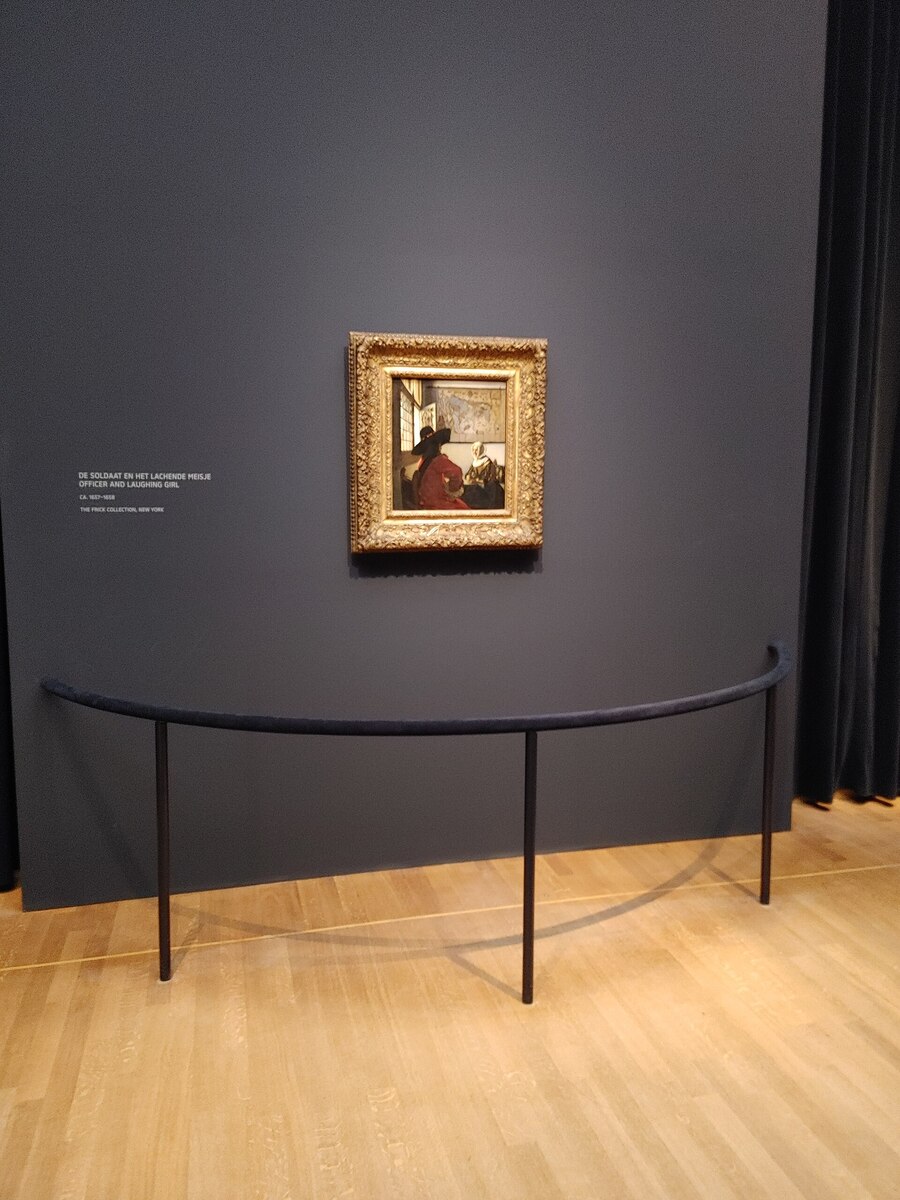
The exhibition label beside the frame giving the Dutch and English title, the date c. 1657-1658 and The Frick Collection, New York, documenting the loan and confirming the identity of the work.
Window at the left
The window at the left edge of the canvas, the raking light source that brightens the girl and throws the officer into silhouette, structuring the whole composition.
Map on the back wall
The large framed map covering the rear wall behind the figures, a signature Vermeer motif that anchors the interior and comments on the encounter.
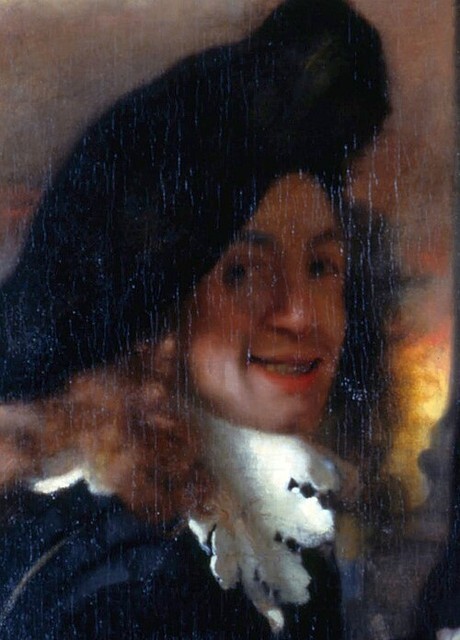
Possible self-portrait Image credit
Johannes Vermeer. Image source · Public domain
About the artist
Johannes Vermeer
1632 to 1675
Vermeer was a Dutch painter who lived and worked in Delft. His small surviving body of work includes religious subjects and domestic interiors shaped by carefully placed objects, architectural space and subtle light. He became a master in Delft's painters' guild in 1653, and his paintings attracted collectors during his lifetime.
- Born
- 1632
- Died
- 1675
- Nationality
- Dutch
- Birthplace
- Delft, Netherlands
- Died in
- Delft, Netherlands
The research & record
Study the work.
Follow the evidence.
Find catalogue details, historical context, technical research and the literature behind this artwork.
The artwork record
Research catalogue
Catalogue information and detailed research, with references that link to the bibliography.
Updated .
Identity and catalogue
Link- Title
- Officer and Laughing Girl(Rlbberlin, 2023)
- Artist or attribution
- Johannes Vermeer
- Object date
- c. 1657-1658
- Medium and support
- Oil on canvas(Rlbberlin, 2023)
- Current collection or location
- The Frick Collection, New York(Rlbberlin, 2023)
- Movement or period
- Dutch Golden Age
- Country or culture
- Dutch
- Depicted subject
- A Dutch officer in a broad hat and red coat sits with his back to the viewer, leaning toward a young woman in a white cap and yellow jacket who faces him, smiling, with a raised wine glass.
- Attribution qualification
- Attribution to Johannes Vermeer is not confirmed by any supplied source.
- Support
- Canvas
- Dimensions
- Unknown
Read valuation records and their limitations
Identity and catalogue
The object in question is a painting titled Officer and Laughing Girl. The supplied discovery record provides this as its catalogue title and nothing in the evidence extends it with alternative title forms, so the title stands here without variants. This section concerns the identity and cataloguing of the painting as established by the available documentation, and it begins with a distinction that is easy to blur: the painting and the photograph through which it is documented here are two different things, with two different makers and two different histories.(Rlbberlin, 2023, File title and summary)
The photograph was uploaded to Wikimedia Commons by the user Rlbberlin, who is identified in the file record as the uploader and copyright holder of the photograph, not as the painter of the artwork. That distinction matters for how the image should be cited and for how claims drawn from it should be weighted. The photograph is a modern documentary record of an older painting; Rlbberlin's authorship attaches to the capture and licensing of the image, while the painting it shows has its own separate authorship that the supplied evidence does not itself name. Anyone using the file record as a source for the painting's creation, therefore, is using it for its visual and contextual testimony, not for an attribution.(Rlbberlin, 2023, Summary)
Dates, display and photographic record
The photograph itself is dated and localised: it was taken on 1 May 2023 in the Netherlands and shows the painting at the Rijksmuseum Amsterdam during the Vermeer Exhibition 2023. The exhibition at the Rijksmuseum Amsterdam provides the setting in which the work was photographed, and the 2023 date belongs to that photographic record and to the display it documents, not to the painting. This is the basic chronology that any catalogue entry must keep straight: an object date, an exhibition context, and the date of a photograph are three separate pieces of information, and the file record supplies only the latter two with any precision.(Rlbberlin, 2023, Summary and file history; Summary)
The discovery object is a painting titled Officer and Laughing Girl.(Rlbberlin, 2023)
The photograph was uploaded by the Wikimedia Commons user Rlbberlin, who is the uploader and copyright holder of the photograph, not the painter of the artwork.(Rlbberlin, 2023)
Subject and iconography
LinkRead valuation records and their limitations
The recorded composition
Visual observation
The painting catalogued as Officer and Laughing Girl presents a two-figure interior in which the principal elements are legible in the supplied photographic record of the work on view. A man identified in the title as an officer, and described as a soldier, wears a broad black hat and a red coat. He is seated with his back toward the viewer and leans toward a young woman. She faces him, wears a white cap and a yellow jacket, and smiles openly. She holds a raised wine glass. Behind the figures a large framed map covers the rear wall, and at the left edge of the canvas a window provides the light that brightens the girl and shadows the officer. These are recorded observations of the composition rather than identifications of sitter, regiment or room, and the evidence does not name the figures, the building or the map's geographic subject.(Rlbberlin, 2023, Discovery semantic focus; Categories)
Pose, address and withheld expression
The arrangement of the two figures establishes the painting's central visual tension. Because the officer is seated with his back to the viewer, his face is withheld, and the encounter is legible chiefly through posture and through the woman's response. He leans in; she faces him with an open smile and a lifted glass, so the sociable exchange is carried by her expression and by the wine glass held between them rather than by his. In this reading the laughing girl with her wine glass is the emotional counterpoint to the officer's hidden face, and the officer's turned back is what creates the tension of an unseen, addressed face. The description should be kept as an account of how the picture is composed, since the evidence records pose and expression but does not document what either figure is thinking or saying.(Rlbberlin, 2023, Discovery semantic focus)
Light, interior and the map
Light and setting are described as working together across the whole composition. The window at the left edge of the canvas is the light source: it brightens the young woman and throws the officer into shadow or silhouette. The rear wall is covered by a large framed map, described in the source as a signature Vermeer motif that anchors the interior and comments on the encounter. Both elements are recorded as features of this painting, and the map in particular is presented as a recurring device within the painter's interiors rather than as a unique invention here. The evidence does not identify the map's subject or establish a documented symbolic programme for it, so its relation to the figures remains a matter of how the composition is read.(Rlbberlin, 2023, Discovery semantic focus)
Interpretation
Taken together, the recorded details support a qualified account of why the picture holds a place in the history of interior painting. The single window at the left, the seated officer seen from behind and the map spanning the rear wall organise the scene so that light, pose and furnishing all direct attention toward the woman's smile and the glass she raises. The evidence describes the map as a signature motif of this painter's interiors and the window as structuring the whole composition, which places the work within a recognizable convention of Dutch domestic scenes rather than isolating it as an anomaly. At the same time, the evidence supplied does not establish dates of execution beyond the label's approximate range, does not identify predecessors or successors by name, and does not document the map's content or any intended meaning. The painting matters here as a closely observed example of how a Dutch interior could be built around withheld expression and controlled light, but the strength of that claim rests on the visible composition and the attributed description, not on technical or documentary evidence about the object's making.(Rlbberlin, 2023, Discovery semantic focus; Categories)
Visual observation
The painting shows a soldier, called an officer in the title, wearing a broad black hat and a red coat.(Rlbberlin, 2023)
The officer is seated with his back to the viewer and leans toward the young woman.(Rlbberlin, 2023)
The young woman wears a white cap and a yellow jacket and smiles openly as she faces the officer.(Rlbberlin, 2023)
The young woman holds a raised wine glass.(Rlbberlin, 2023)
A large framed map covers the rear wall behind the figures.(Rlbberlin, 2023)
A window at the left edge of the canvas is the light source that brightens the girl and shadows the officer.(Rlbberlin, 2023)
Materials and technique
LinkRead valuation records and their limitations
Documented support and medium
The catalogue entry for the object records it as an oil painting on canvas. Beyond this, the supplied evidence does not document a ground layer, a priming, the number or weave of the canvas threads, stretcher or tacking margins, pigment analysis, cross-sections, infrared reflectography, or any conservation treatment; the support is established by the record, while the finer questions of preparation and layer structure remain outside what these units can support.(Rlbberlin, 2023, Categories)
Interpretation
What the evidence does allow is a description of how paint and light are organized in the visible image. A window at the left edge of the canvas is identified as the light source: it brightens the young woman and leaves the officer shadowed. This is an observation about the painted image and its internal illumination, not a technical finding about pigments or modelling, and it should be weighed as such. Read on those terms, the composition is built around a single directional light that falls across the figures and orders their relative prominence, with the smiling woman in white cap and yellow jacket receiving the light and the officer, in broad black hat and red coat, turning his back to the viewer and toward the shadow.(Rlbberlin, 2023, Categories; Discovery semantic focus)
Composition of light and setting
The relationship between what can be seen and what the record establishes is narrower than the spoken account might suggest. The oil-on-canvas medium and the subject matter are documented, and the passage of light from the left, the poses, the glass and the map are observable features of the image. The further interpretive claims, that the window structures the whole composition or that the map acts as a signature motif commenting on the encounter, belong to attributed readings rather than to technical examination. They help explain why the arrangement of figures and setting matters, but they should be kept distinct from the documented medium and from the description of what is visible.(Rlbberlin, 2023, Categories; Discovery semantic focus)
The object is catalogued as an oil painting on canvas.(Rlbberlin, 2023)
Provenance and ownership
LinkRead valuation records and their limitations
Documented Presence in 2023
The provenance documented in the supplied evidence for the Officer and Laughing Girl is confined to a single dated event and a single institutional affiliation, and the account should say so plainly rather than smoothing the gap. The photograph under discussion was taken on 1 May 2023 in the Netherlands and shows the painting at the Rijksmuseum Amsterdam during the Vermeer Exhibition 2023. Those are the facts the record establishes about where and when the object was seen in this instance. They establish a temporary exhibition presence, not a transfer of ownership: a loan for display is not a sale, and nothing in the evidence indicates the painting changed hands at that moment.(Rlbberlin, 2023, Summary and file history; File title)
A separate strand of the record places the painting with The Frick Collection, New York, on the strength of a museum wall label visible in the supplied discovery context. That label also supplied the Dutch and English title and the date c. 1657 to 1658, and it is the source of the object's cataloguing as an oil painting on canvas. The label is an institutional identification of the work and its keeper, not a deed: it does not give an acquisition date, an accession number, a vendor, a price, or any intermediate owner, and the evidence therefore cannot be used to reconstruct a chain of title. What it supports is an association with The Frick Collection at the time the label was made, set against the painting's appearance at the Rijksmuseum in May 2023.(Rlbberlin, 2023, Summary and file history; File title)
Interpretation
The gap between these two points should be described as an unrecorded interval rather than filled with inference. The evidence gives no date by which the Frick association began, no date for when or whether the work left New York for Amsterdam, and no record of return. A reader comparing the two units might reasonably suppose the painting travelled from The Frick Collection to the Vermeer Exhibition 2023, and that supposition is consistent with the evidence, but the supplied units do not state it, and the archive should not promote a plausible sequence into a documented one. Until further records are added, the provenance here consists of an institutional affiliation on an undated label and a photographed public display on 1 May 2023, with everything between them unaccounted for.(Rlbberlin, 2023, Summary and file history; File title)
The term provenance also needs care with respect to the photograph itself, which has its own ownership distinct from the painting's. The image was uploaded by the Wikimedia Commons user Rlbberlin, who is the uploader and copyright holder of the photograph and not the painter of the artwork. The April 2023 date in the file's publication year and the 1 May 2023 capture date belong to that photograph, and the rights attached to it belong to its maker. Recording this separation prevents a common conflation in which the photographer's credit is mistaken for a fact about the painting's history. The painting's documented presence at the Vermeer Exhibition 2023 and its association with The Frick Collection remain the whole of what the evidence establishes about the object's whereabouts and keeping.(Rlbberlin, 2023, Summary and file history; File title)
The photograph was taken on 1 May 2023 in the Netherlands and shows the painting at the Rijksmuseum Amsterdam during the Vermeer Exhibition 2023.(Rlbberlin, 2023)
Provenance timeline
- 1 May 2023
The painting was photographed in the Netherlands while on view at the Rijksmuseum Amsterdam during the Vermeer Exhibition 2023.(Rlbberlin, 2023, Summary and file history)
- 2023
The Vermeer Exhibition 2023 was held at the Rijksmuseum Amsterdam, where the painting was displayed.(Rlbberlin, 2023, File title)
Exhibition history
LinkRead valuation records and their limitations
The Vermeer Exhibition 2023 and Its Photographic Record
The painting Officer and Laughing Girl, catalogued as an oil painting on canvas and dated c. 1657-1658, appeared at the Vermeer Exhibition 2023, held at the Rijksmuseum Amsterdam. The documentation of that display is a photograph taken on 1 May 2023 in the Netherlands, which shows the work on view at the Rijksmuseum during the exhibition. The photograph was uploaded to Wikimedia Commons by the user Rlbberlin, identified as the uploader and copyright holder of the photograph rather than the painter of the artwork; its title names the venue and the exhibition directly, so the image functions both as a record of the painting and as a dated witness to a specific installation moment in the 2023 presentation.(Rlbberlin, 2023, File title; Summary and file history)
Visual Conventions and Composition on Display
Interpretation
Read together, the exhibition evidence and the visual account show why the object carries weight beyond a single viewing. The 2023 Rijksmuseum exhibition placed a painting associated with The Frick Collection before a new public, and the dated photograph and wall label record that encounter at a precise moment and place. The compositional account explains what that public was shown: a scene organized around concealment and response, where pose, light and the map direct attention toward the woman's smile and raised glass. The exhibition history is documented here through the venue, the 2023 date, the photograph's date of 1 May 2023 and the label information; the interpretation of the map and window as motifs and structuring devices belongs to the attributed account rather than to the exhibition record itself.(Rlbberlin, 2023, File title; Summary and file history)
The Vermeer Exhibition 2023 took place at the Rijksmuseum Amsterdam.(Rlbberlin, 2023)
Interpretations and debates
LinkRead valuation records and their limitations
Reading the Visible Arrangement
Interpretation
The most consequential interpretive claim in the supplied account concerns the officer's turned back, which is said to create the painting's central tension of an unseen, addressed face. This is a reading of the composition, not a statement about what the painter intended: because the officer sits with his back to the viewer and leans toward the young woman, the viewer is placed behind him, looking past his hat and shoulders toward a face that the picture withholds. The interpretation attributes the tension to that withheld face rather than to any documented program or inscription. It should therefore be kept distinct from any claim about Vermeer's private purpose, which the evidence does not establish.(Rlbberlin, 2023, Discovery semantic focus)
Set against that withheld face, the laughing girl with her wine glass is described as the emotional counterpoint to the officer's hidden face. The interpretation depends on visible features: she faces the officer, smiles openly, and holds the glass raised between them, so that her expression and gesture carry the sociable weight that his averted face cannot. On this account the picture becomes about the exchange between the two figures rather than about the officer alone. The evidence supports this as an attributed reading of the scene's emotional structure; it does not report a contemporary text, a motto or a document explaining the encounter.(Rlbberlin, 2023, Discovery semantic focus)
Two further elements are given compositional work in the same reading. The large framed map on the back wall is described as a signature Vermeer motif that anchors the interior and comments on the encounter, so the map is treated as more than backdrop: it stabilizes the room and is read as speaking to the relationship between the figures. The window at the left is described as structuring the whole composition by brightening the girl and throwing the officer into silhouette, which links the light source directly to the contrast between the two figures. Both claims are interpretive extensions of observed features, the framed map covering the rear wall and the left-edge window acting as light source, and they should be presented as such rather than as settled facts about the painting's meaning.(Rlbberlin, 2023, Discovery semantic focus)
Taken together, these readings converge on a single explanatory pattern: the officer's hidden face, the bright window and the map behind the figures are all said to direct attention to the woman's smile and the glass she raises, making a private, sociable moment legible through pose, light and one open expression. This synthesis is the writer's qualified interpretation built from the attributed readings and the observed features, and its limits should be stated plainly. The supplied evidence does not include technical analysis of the canvas, pigment or underdrawing, does not record provenance intervals beyond the Frick association reported on the wall label, and does not quote any period source on the painting's subject. What the evidence does establish is the object's identity as an oil on canvas dated c. 1657-1658 in the museum label, its association with The Frick Collection, and its display at the Rijksmuseum during the Vermeer Exhibition 2023, photographed on 1 May 2023. Those documented facts about the object's modern exhibition life sit alongside, and should not be conflated with, the interpretive account of its internal drama.(Rlbberlin, 2023, Discovery semantic focus)
The officer's turned back creates the painting's central tension of an unseen, addressed face.(Rlbberlin, 2023)
The laughing girl with her wine glass serves as the emotional counterpoint to the officer's hidden face.(Rlbberlin, 2023)
The large framed map on the back wall is described as a signature Vermeer motif that anchors the interior and comments on the encounter.(Rlbberlin, 2023)
The window at the left structures the whole composition by brightening the girl and throwing the officer into silhouette.(Rlbberlin, 2023)
Collection and display
LinkRead valuation records and their limitations
The Frick Collection and the wall label
The painting is associated with The Frick Collection, New York, according to a museum wall label visible in the supplied discovery context. That label also gives both the Dutch and the English title and a date of c. 1657-1658, so the collection affiliation, the bilingual titling and the circa dating rest on the same piece of display apparatus rather than on separate archival documents. The object is catalogued as an oil painting on canvas. The wall label is evidence of how the work is presented and identified at The Frick Collection; it does not by itself establish acquisition history, provenance intervals or attribution records, none of which the supplied evidence provides.(Rlbberlin, 2023, Structured data)
A separate record of the work's display comes from a photograph taken on 1 May 2023 in the Netherlands, showing the painting at the Rijksmuseum Amsterdam during the Vermeer Exhibition 2023. The photograph was uploaded to Wikimedia Commons by the user Rlbberlin, who is the uploader and copyright holder of the photograph, not the painter of the artwork. This image documents a loan exhibition setting distinct from the painting's Frick association on the wall label: the label in the discovery context describes the work in its collection framing, while the 2023 photograph records its presence in a temporary exhibition at another institution. The two records together show the painting as a mobile collection object whose identifying texts and display locations can be documented independently of its painted surface.(Rlbberlin, 2023, Structured data)
What the object shows
In the painting as described, a soldier, called an officer in the title, wears a broad black hat and a red coat. He is seated with his back to the viewer and leans toward the young woman. She wears a white cap and a yellow jacket and smiles openly as she faces the officer, and she holds a raised wine glass. A large framed map covers the rear wall behind the figures, and a window at the left edge of the canvas is the light source that brightens the girl and shadows the officer. These are the elements the display and photographic records let a viewer check against the object itself: title, date, medium and collection on one side, and the described composition on the other.(Rlbberlin, 2023, Structured data)
Interpretation
The described composition has been read as organized around the officer's turned back, which creates the painting's central tension of an unseen, addressed face, while the laughing girl with her wine glass serves as the emotional counterpoint to that hidden face. In the same account the large framed map is called a signature Vermeer motif that anchors the interior and comments on the encounter, and the left-hand window is said to structure the whole composition by brightening the girl and throwing the officer into silhouette. These are attributed readings of the painting's devices rather than independent documentation, and they should be weighed as interpretation layered on the observable arrangement of figure, glass, map and light. What the collection evidence firmly establishes is narrower: the title, the c. 1657-1658 date, the oil-on-canvas medium, the Frick association and the 2023 Rijksmuseum display.(Rlbberlin, 2023, Structured data)
The painting is associated with The Frick Collection, New York, according to a museum wall label visible in the supplied discovery context. This label also gives the Dutch and English title and the date c. 1657-1658.(Rlbberlin, 2023)
Documented values and qualified estimates
LinkRead valuation records and their limitations
Recorded values
Interpretation
The recorded values attached to Johannes Vermeer's Officer and Laughing Girl include a calculated working insurance estimate with a working range of US$75M to US$200M, recorded in a working calculation generated on 2026-10-17. The methodology behind this range is explicitly a broad, model generated insurance calculation for manual review, derived from the supplied context that the work is attributed to Vermeer, dated c. 1657-1658, executed in oil on canvas, associated with the Dutch Golden Age, identified as Officer and Laughing Girl, and currently located at The Frick Collection, New York. The calculation applies what it describes as conservative institutional fine art insurance logic for a highly significant Old Master painting by an artist with an extremely limited surviving oeuvre, and it uses a wide band rather than a point estimate so as to reflect attribution, provenance, condition, and market variables. Critically, the same record states that no official institutional appraisal, insurance schedule, auction result, or private valuation record was supplied, and that no comparable sales were used or invented. The figure is therefore a structured working number, not a market fact.(Rlbberlin, 2023)
The qualification attached to this calculation is as significant as the range itself. It states that the range is a model generated working estimate for manual review only, that it is not an official insurance value, not an appraisal, not an auction result, and not a sale price, and that the attribution to Vermeer and the current location were used only as supplied context and were not independently verified by an institutional object record. The record further holds that actual insurance values require professional appraisal, confirmed provenance, condition assessment, clear title, and carrier underwriting. The stated method also names the variables it is adjusting for, namely attribution, provenance, condition, and market variables, but supplies none of the supporting data for those variables. Read as a document, the calculation shows how a value range can be generated from identifying metadata while that metadata remains, by the record's own admission, unverified against an institutional source.(Rlbberlin, 2023)
Working estimate
Calculated working insurance estimate, not a sale price: Working range: US$75M to US$200M Recorded date: Working calculation, generated 2026-10-17. Methodology: This is a broad, model generated insurance calculation range for manual review, derived from the confirmed context that the work is attributed to Johannes Vermeer, dated c. 1657-1658, executed in oil on canvas, associated with the Dutch Golden Age, and identified as Officer and Laughing Girl with a current location at The Frick Collection, New York. The calculation applies conservative institutional fine art insurance logic for a highly significant Old Master painting by an artist with an extremely limited surviving oeuvre, using a wide band rather than a point estimate to reflect attribution, provenance, condition, and market variables. No official institutional appraisal, insurance schedule, auction result, or private valuation record was supplied, and no comparable sales were used or invented. Qualification: This is a model generated working insurance range for manual review only. It is not an official insurance value, not an appraisal, not an auction result, and not a sale price. Attribution to Johannes Vermeer and the current location were used only as supplied context and are not independently verified by an institutional object record. Actual insurance values require professional appraisal, confirmed provenance, condition assessment, clear title, and carrier underwriting.(Rlbberlin, 2023)
Further reading
Books for a closer look
Paid links. As an Amazon Associate I earn from qualifying purchases.

Open Library Vermeer. 1632 - 1675.
Taschen Verlag
A scholarly study of Vermeer's painting with criticism and interpretation of his individual works, matching the artist of Officer and Laughing Girl and its Dutch 17th-century context.
ISBN 9783822863770

Open Library Johannes Vermeer
National Gallery of Art; Royal Cabinet of Paintings Mauritshuis; Yale University Press
Catalogued as a Vermeer exhibition catalogue with catalogue and exhibition subjects, relevant to a painting shown in the 2023 Rijksmuseum Vermeer exhibition documented in the artwork evidence.
ISBN 0300065582

Open Library Johannes Vermeer (1632-1675)
Waanders; Rijksmuseum; W Books; Brand: Waanders Uitgevers
A Vermeer study by Mariet Westermann whose recorded subjects include criticism and interpretation and the Rijksmuseum, connecting to the artist and to the museum venue recorded for this painting.
ISBN 9040088179
Bibliography
Sources and further reading
References are arranged by author or organisation, with links to the original publications. Where no publication date is recorded, n.d. means no date.
Source notes updated .
No recorded sources match these filters. Reset the filters to see the full bibliography.
- 03
Book
Johannes Vermeer. National Gallery of Art; Royal Cabinet of Paintings Mauritshuis; Yale University Press.
Catalogued as a Vermeer exhibition catalogue with catalogue and exhibition subjects, relevant to a painting shown in the 2023 Rijksmuseum Vermeer exhibition documented in the artwork evidence.
- ISBN
- 0300065582
Citation text
- 04
Book
Johannes Vermeer (1632-1675). Waanders; Rijksmuseum; W Books; Brand: Waanders Uitgevers.
A Vermeer study by Mariet Westermann whose recorded subjects include criticism and interpretation and the Rijksmuseum, connecting to the artist and to the museum venue recorded for this painting.
- ISBN
- 9040088179
Citation text
- 02
Book
Vermeer. 1632 - 1675. Taschen Verlag.
A scholarly study of Vermeer's painting with criticism and interpretation of his individual works, matching the artist of Officer and Laughing Girl and its Dutch 17th-century context.
- ISBN
- 9783822863770
Citation text
- 01
Secondary · About this artwork
Wikimedia Commons: Officer and Laughing Girl. File:Rijksmuseum Amsterdam - Vermeer Exhibition 2023 - Officer and Laughing Girl.jpg. Wikimedia Commons.
Wikimedia Commons photograph of the painting on view at the Vermeer Exhibition 2023, Rijksmuseum Amsterdam. Supplies the object title, exhibition context and photograph date. The uploader is the photographer, not the painter.
- Language
- English
Citation text
Art to live with
Bring this painting
home.
A piece of the archive, made yours. Explore Officer and Laughing Girl in a size and finish that fits your space.
Your text and annotations appear on these editions. Adding to cart saves that design for printing.
Combine this painting with your favourites01 / Find your edition
Made for you
Suggested from your location. Change it if you're sending elsewhere or using a VPN. Prices and delivery are shown in GBP.
19 products
Choose an edition to make it yours
6 × 8 in · Printed cover · 118 lined pages
6 × 8 in · Printed cover · 118 lined pages
6 × 8 in · Printed cover · 118 lined pages
Notebook
GBP 11.91
Delivery GBP 5.30 / Total GBP 17.21
A 6 × 8 inch spiral notebook with 118 ruled pages (59 sheets), a printed front cover, dark grey back cover and metal spiral binding.
Fit and fill keep the painting’s proportions. Stretch changes them.
Move and zoom the painting on your notebook.
Made to order with your design
Made to order
US delivery only
12.7 × 17.8 cm / 5 × 7 in · Standard
12.7 × 17.8 cm / 5 × 7 in · Standard

5 × 7 in / 12.7 × 17.8 cm · Standard

5 × 7 in / 12.7 × 17.8 cm · Standard

5 × 7 in / 12.7 × 17.8 cm · Standard

5 × 7 in / 12.7 × 17.8 cm · Standard

5 × 7 in / 12.7 × 17.8 cm · Standard
Metal art sign
GBP 19.63
Delivery GBP 17.71 / Total GBP 37.34
A printed aluminium sign with rounded corners and mounting holes.
Fit and fill keep the painting’s proportions. Stretch changes them.
Move and zoom the painting on your metal art sign.
Made to order with your design
Printed aluminium · mounting holes included
US delivery only
iPhone 12 Mini ? Glossy ? back view
iPhone 12 Mini · Glossy

iPhone 12 Mini ? Glossy ? back view

iPhone 12 Mini ? Glossy ? back view

iPhone 12 Mini ? Glossy ? back view
Tough phone case
GBP 16.40
Delivery GBP 4.25 / Total GBP 20.65
A two-layer phone case with a printed polycarbonate shell and a shock-absorbing inner liner.
Two layers with a shock-absorbing TPU liner
Case & print details
- Device
- Apple · iPhone 12 Mini
- Material
- Polycarbonate shell with a TPU inner liner
- Artwork
- Outer back and wrapped edges from one template
- Finish
- Glossy
- Version
- Standard version
- Printing
- Dye sublimation
- Print file
- 1,122 × 1,831 px · 95 × 155 mm · PNG · 300 dpi recommended
Rear outline and camera openings follow this variant's Printify template. Case depth and small hardware remain illustrative.
Supplier product detailsFit and fill keep the painting’s proportions. Stretch changes them.
Move and zoom the painting on your tough phone case.
Made to order with your design
Made to order
US delivery only
30.4 × 40.6 cm / 12 × 16 in · Black
30.4 × 40.6 cm / 12 × 16 in · Black

12 × 16 in / 30.4 × 40.6 cm · Black

12 × 16 in / 30.4 × 40.6 cm · Black

12 × 16 in / 30.4 × 40.6 cm · Black

12 × 16 in / 30.4 × 40.6 cm · Black
Framed art print
GBP 52.87
- 1 framed print
- GBP 52.87
- Delivery to United States
- GBP 14.16
- Total
- GBP 67.03
A ready-to-hang wooden frame with a clear Perspex cover and a semi-gloss printed insert.
Delivery is quoted for all selected copies together.
Fit and fill keep the painting’s proportions. Stretch changes them.
Move and zoom the painting on your framed art print.
Made to order with your design
Wooden frame & protective clear front included
US delivery only
38.1 × 40.6 cm / 15 × 16 in · Natural
38.1 × 40.6 cm / 15 × 16 in · Natural

15 × 16 in / 38.1 × 40.6 cm · Natural

15 × 16 in / 38.1 × 40.6 cm · Natural

15 × 16 in / 38.1 × 40.6 cm · Natural

15 × 16 in / 38.1 × 40.6 cm · Natural

15 × 16 in / 38.1 × 40.6 cm · Natural
Canvas tote bag
GBP 14.25
Delivery GBP 4.33 / Total GBP 18.58
A sturdy cotton canvas tote with reinforced handles and artwork on the front panel.
Fit and fill keep the painting’s proportions. Stretch changes them.
Move and zoom the painting on your canvas tote bag.
Made to order with your design
Front print · reinforced cotton handles
US delivery only
22.9 × 20.3 cm / 9 × 8 in · Standard
22.9 × 20.3 cm / 9 × 8 in · Standard

9 × 8 in / 22.9 × 20.3 cm · Standard

9 × 8 in / 22.9 × 20.3 cm · Standard

9 × 8 in / 22.9 × 20.3 cm · Standard

9 × 8 in / 22.9 × 20.3 cm · Standard
Mouse mat
GBP 7.29
Delivery GBP 4.82 / Total GBP 12.11
A rectangular fabric mouse mat with a rubber backing and rounded corners.
Fit and fill keep the painting’s proportions. Stretch changes them.
Move and zoom the painting on your mouse mat.
Made to order with your design
Made to order
US delivery only
See more13 more products
43.2 × 45.7 cm / 17 × 18 in · Artwork
43.2 × 45.7 cm / 17 × 18 in · Artwork

17 × 18 in / 43.2 × 45.7 cm · Artwork

17 × 18 in / 43.2 × 45.7 cm · Artwork

17 × 18 in / 43.2 × 45.7 cm · Artwork
Woven tote bag
GBP 46.87
Delivery GBP 5.88 / Total GBP 52.75
A woven tote with cotton webbing handles and the painting translated into a woven design.
Fit and fill keep the painting’s proportions. Stretch changes them.
Move and zoom the painting on your woven tote bag.
Made to order with your design
Made to order
US delivery only
30.5 × 40.6 cm / 12 × 16 in · Standard
30.5 × 40.6 cm / 12 × 16 in · Standard

12 × 16 in / 30.5 × 40.6 cm · Standard

12 × 16 in / 30.5 × 40.6 cm · Standard

12 × 16 in / 30.5 × 40.6 cm · Standard

12 × 16 in / 30.5 × 40.6 cm · Standard

12 × 16 in / 30.5 × 40.6 cm · Standard
Matte art print
GBP 15.85
Delivery GBP 7.22 / Total GBP 23.07
An unframed matte poster with archival inks, ready for a frame of your choice.
Fit and fill keep the painting’s proportions. Stretch changes them.
Move and zoom the painting on your matte art print.
Made to order with your design
Unframed · frame it your way
US delivery only
iPhone 12 Mini ? Standard ? back view
iPhone 12 Mini · Standard

iPhone 12 Mini ? Standard ? back view

iPhone 12 Mini ? Standard ? back view

iPhone 12 Mini ? Standard ? back view
Flexible phone case
GBP 15.62
Delivery GBP 4.25 / Total GBP 19.87
A flexible TPU phone case with a frosted finish, a printed back and precise port openings.
Flexible TPU with a frosted, matte finish
Case & print details
- Device
- Apple · iPhone 12 Mini
- Material
- Semi-transparent thermoplastic polyurethane (TPU)
- Artwork
- Back print; rim stays unprinted
- Finish
- Standard
- Version
- Standard version
- Printing
- Dye sublimation
- Print file
- 791 × 1,586 px · 67 × 134.3 mm · PNG · 300 dpi recommended
Rear outline and camera openings follow this variant's Printify template. Case depth and small hardware remain illustrative.
Supplier product detailsFit and fill keep the painting’s proportions. Stretch changes them.
Move and zoom the painting on your flexible phone case.
Made to order with your design
Made to order
S · Standard
S · Standard

S · Standard

S · Standard

S · Standard

S · Standard

S · Standard
Crew socks
GBP 10.66
Delivery GBP 4.43 / Total GBP 15.09
Crew-length polyester and spandex socks with a ribbed cuff, cushioned sole and sublimated artwork.
Fit and fill keep the painting’s proportions. Stretch changes them.
Move and zoom the painting on your crew socks.
Made to order with your design
One pair · design repeated on both socks
US delivery only
12" · Standard
12" · Standard

12" · Standard

12" · Standard

12" · Standard
Laptop sleeve
GBP 26.12
Delivery GBP 4.92 / Total GBP 31.04
A polyester laptop sleeve with a fleece lining, top zip, printed front and black reverse.
Fit and fill keep the painting’s proportions. Stretch changes them.
Move and zoom the painting on your laptop sleeve.
Made to order with your design
Made to order
US delivery only
11oz · 2 image repeats
11oz · White
11oz · 2 image repeats
Mug
GBP 7.36
Delivery GBP 6.17 / Total GBP 13.53
A glossy white ceramic mug with a C-shaped handle, available in 11oz and 15oz sizes.
repeat layout · choose single, double or a repeating pattern in Customise.
Repeat, fit, fill and position your artwork around the mug.
Made to order with your design
Made to order
iPhone 12 Mini ? Standard ? back view
iPhone 12 Mini · Standard

iPhone 12 Mini ? Standard ? back view

iPhone 12 Mini ? Standard ? back view

iPhone 12 Mini ? Standard ? back view

iPhone 12 Mini ? Standard ? back view

iPhone 12 Mini ? Standard ? back view
Biodegradable phone case
GBP 20.96
Delivery GBP 4.25 / Total GBP 25.21
A matte phone case made from plant polymers and bamboo fibre, with the artwork printed on the back.
Flexible plant-polymer shell with a matte finish
Case & print details
- Device
- Apple · iPhone 12 Mini
- Material
- PLA and PBAT polymers with bamboo fibre
- Artwork
- Back print; rim stays unprinted
- Finish
- Standard
- Version
- Standard version
- Printing
- Dye sublimation
- Print file
- 777 × 1,553 px · 65.8 × 131.5 mm · PNG · 300 dpi recommended
Rear outline and camera openings follow this variant's Printify template. Case depth and small hardware remain illustrative.
Supplier product detailsFit and fill keep the painting’s proportions. Stretch changes them.
Move and zoom the painting on your biodegradable phone case.
Made to order with your design
Made to order
30.5 × 40.6 cm / 12 × 16 in · Standard
30.5 × 40.6 cm / 12 × 16 in · Standard

12 × 16 in / 30.5 × 40.6 cm · Standard

12 × 16 in / 30.5 × 40.6 cm · Standard

12 × 16 in / 30.5 × 40.6 cm · Standard
Fine art poster
GBP 17.36
Delivery GBP 7.61 / Total GBP 24.97
A gallery paper print with a smooth art-paper surface. Choose a size that suits the painting.
Fit and fill keep the painting’s proportions. Stretch changes them.
Move and zoom the painting on your fine art poster.
Made to order with your design
Unframed · frame it your way
iPhone 12 Mini ? Standard ? back view
iPhone 12 Mini · Standard

iPhone 12 Mini ? Standard ? back view

iPhone 12 Mini ? Standard ? back view

iPhone 12 Mini ? Standard ? back view
Clear phone case
GBP 15.11
Delivery GBP 4.25 / Total GBP 19.36
A clear phone case with artwork on the back. Leave areas transparent to show the phone underneath.
Clear shell with shock-absorbing TPU sides
Case & print details
- Device
- Apple · iPhone 12 Mini
- Material
- Polycarbonate back and clear TPU sides
- Artwork
- Back print; clear sides stay unprinted
- Finish
- Standard
- Version
- Standard version
- Printing
- Dye sublimation
- Print file
- 732 × 1,527 px · 62 × 129.3 mm · PNG · 300 dpi recommended
Rear outline and camera openings follow this variant's Printify template. Case depth and small hardware remain illustrative.
Supplier product detailsFit and fill keep the painting’s proportions. Stretch changes them.
Move and zoom the painting on your clear phone case.
Made to order with your design
Made to order
15oz · 3 image repeats
15oz · Standard

15oz · 3 image repeats

15oz · 3 image repeats

15oz · 3 image repeats

15oz · 3 image repeats

15oz · 3 image repeats
Travel mug
GBP 32.00
Delivery GBP 5.68 / Total GBP 37.68
A stainless-steel travel mug with a black lid, a tapered base and a printed white exterior.
repeat layout · choose single, double or a repeating pattern in Customise.
Repeat, fit, fill and position your artwork around the mug.
Made to order with your design
Made to order
US delivery only
2.5 × 3.4 cm / 1 × 1.4 in · Glossy
2.5 × 3.4 cm / 1 × 1.4 in · Glossy

1 × 1.4 in / 2.5 × 3.4 cm · Glossy

1 × 1.4 in / 2.5 × 3.4 cm · Glossy

1 × 1.4 in / 2.5 × 3.4 cm · Glossy

1 × 1.4 in / 2.5 × 3.4 cm · Glossy
Photo keyring
GBP 10.19
Delivery GBP 5.39 / Total GBP 15.58
A rectangular zinc-alloy photo keyring with a glossy insert and a swivel split ring.
Fit and fill keep the painting’s proportions. Stretch changes them.
Move and zoom the painting on your photo keyring.
Made to order with your design
Photo insert · zinc frame & swivel ring
US delivery only
iPhone 15 Pro ? Glossy ? back view
iPhone 15 Pro · Glossy

iPhone 15 Pro ? Glossy ? back view

iPhone 15 Pro ? Glossy ? back view

iPhone 15 Pro ? Glossy ? back view

iPhone 15 Pro ? Glossy ? back view

iPhone 15 Pro ? Glossy ? back view
Slim phone case
GBP 16.37
Delivery GBP 5.79 / Total GBP 22.16
A slim printed phone shell with open ports and a lightweight profile.
Slim, lightweight polycarbonate shell
Case & print details
- Device
- Apple · iPhone 15 Pro
- Material
- Polycarbonate
- Artwork
- Outer back and wrapped edges from one template
- Finish
- Glossy
- Version
- Standard version
- Printing
- Dye sublimation
- Print file
- 1,278 × 1,971 px · 108.2 × 166.9 mm · PNG · 300 dpi recommended
Rear outline and camera openings follow this variant's Printify template. Case depth and small hardware remain illustrative.
Supplier product detailsFit and fill keep the painting’s proportions. Stretch changes them.
Move and zoom the painting on your slim phone case.
Made to order with your design
Made to order
US delivery only
36.6 × 30.7 cm / 14.4 × 12.1 in · Standard
36.6 × 30.7 cm / 14.4 × 12.1 in · Standard

14.4 × 12.1 in / 36.6 × 30.7 cm · Standard

14.4 × 12.1 in / 36.6 × 30.7 cm · Standard

14.4 × 12.1 in / 36.6 × 30.7 cm · Standard
Desk mat
GBP 15.29
Delivery GBP 7.13 / Total GBP 22.42
A smooth polyester desk mat with a natural rubber non-slip base and anti-fray edges, available in three sizes.
Fit and fill keep the painting’s proportions. Stretch changes them.
Move and zoom the painting on your desk mat.
Made to order with your design
Made to order
The 30 cm ruler is scaled alongside your selected print. Keep the painting’s proportions with a black background, or stretch it to fill. Frame width, material texture and screen colours are illustrative.
Keep exploring