Identity and catalogue
Link- Artist or attribution
- Johannes Vermeer
- Object date
- between circa 1657 and circa 1659
- Dimensions
- height: 83 cm (32.6 in); width: 64.5 cm (25.3 in)
- Movement or period
- Dutch Golden Age
- Country or culture
- Dutch
- Title variants
- Brieflesendes Mädchen am offenen Fenster; Brieflezend meisje bij het venster; La Liseuse à la fenêtre; Girl Reading a Letter by an Open Window
- Accession number
- Gal.-Nr. 1336
- Support
- canvas
Catalogue identity and attribution
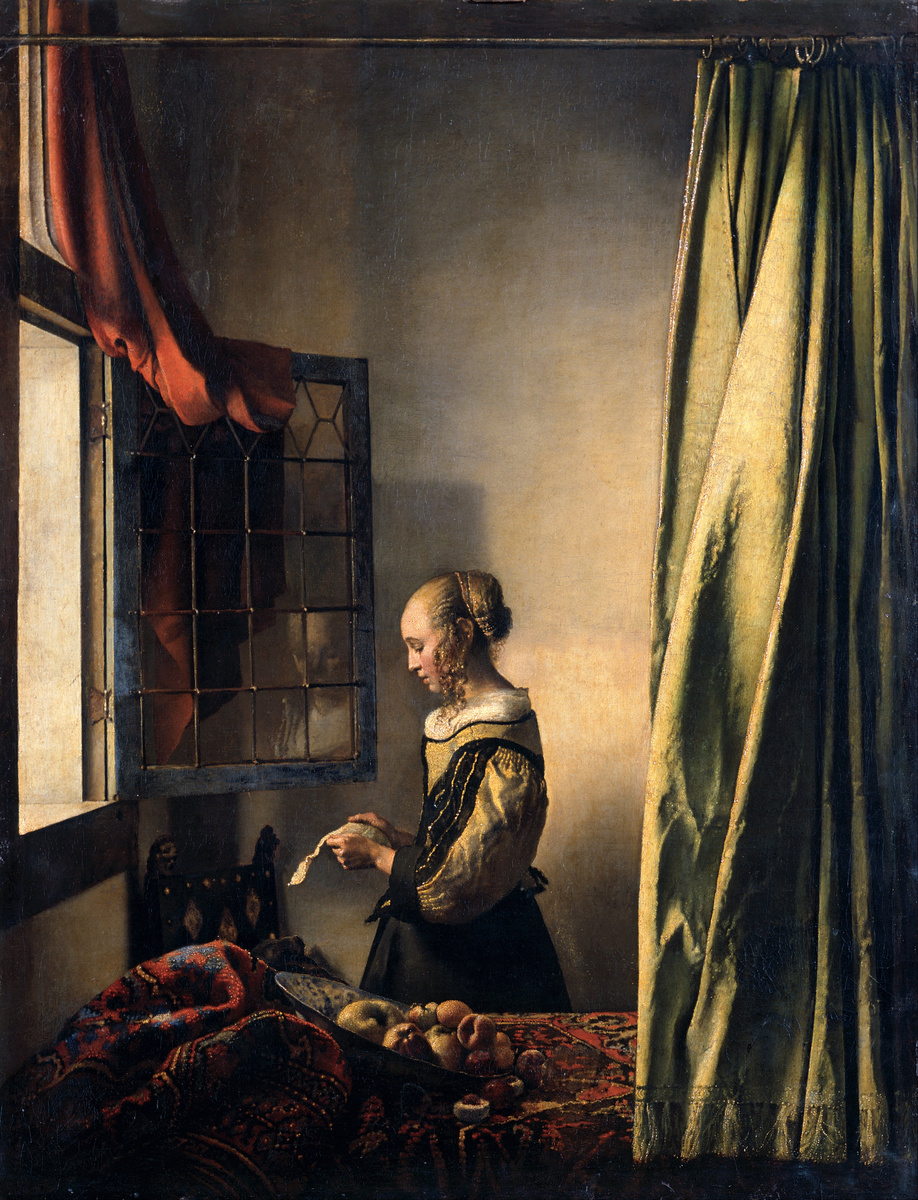
The painting catalogued as Girl Reading a Letter at an Open Window carries an attribution to Johannes Vermeer and a date of circa 1657 to circa 1659. That date belongs to the making of the picture, not to the documents that record it, and the two kinds of dating must be kept apart: the circa 1657 to circa 1659 range is the object date, while numbers such as 34 and 1336 are catalogue positions assigned in much later publications. The work is an oil on canvas measuring 83 cm in height and 64.5 cm in width, and it belongs to the collection of the Staatliche Kunstsammlungen Dresden, Gemäldegalerie Alte Meister, Dresden, Germany, under accession number Gal.-Nr. 1336. In subject it is a genre scene of domestic life, showing a girl reading a letter at an open window rather than a portrait or a history painting.(Wikimedia Commons: Girl Reading a Letter at an Open Window, n.d., Title, Creator, Date fields)
Interpretation
The attribution and the dating rest on catalogue and collection records rather than on the object's own inscriptions, and the evidence supplied records no signature, date or other inscription on the canvas. What the record does establish is the object's movement through cataloguing systems. It appears in the Johannes Vermeer catalogue raisonné of 1908 as number 34, and in the Königlichen Gemäldegalerie zu Dresden catalogue of 1887 as 1336. The 1887 Dresden number and the modern accession Gal.-Nr. 1336 are not the same kind of identifier and should not be conflated: one is a position in a late nineteenth-century gallery catalogue, the other an accession number for the painting in the Dresden collection. The 1908 corpus number shows that by the early twentieth century the picture was already counted within the accepted body of Vermeer's work, while the 1887 gallery number shows it was in Dresden's catalogue two decades earlier. Neither catalogue number tells us when the painting entered the collection, and the evidence supplied does not include that provenance interval.(Wikimedia Commons: Girl Reading a Letter at an Open Window, n.d., Title, Creator, Date fields)
The painted Cupid and the condition record
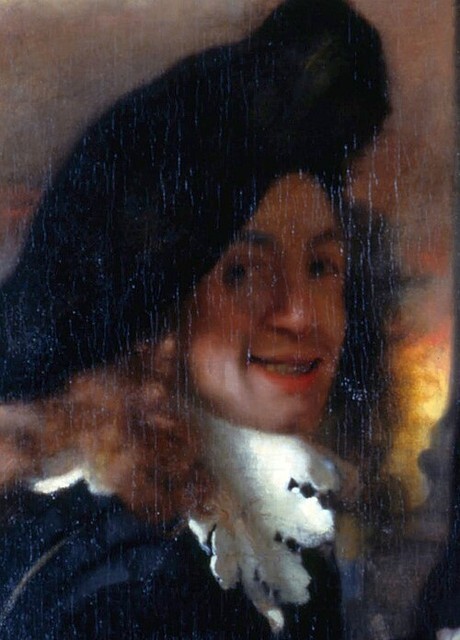
Among the depicted people, the record identifies Cupid, described as a figure on the white wall behind the girl. In the present state of the work that figure is visible: a 2021 caption on the Wikimedia Commons file notes that the painting exists today in a new, real version with the god Cupid on the white wall. That note is recorded as a condition statement about the current state of the work, not as a claim about how the picture looked when it was painted. The distinction matters because the Cupid is at once part of the iconography and part of the object's condition history. What can be seen today includes a visible Cupid on the wall behind the girl; what the historical evidence establishes about earlier states of the surface is limited to the fact that the present version is described as new, with the evidence supplied not recording the treatment, intervention or date of change that produced it. The scene therefore contains more than a letter and a window, and a painted Cupid places the act of reading within a context of love. That reading of the figure's role in the composition is an inference from what the record describes, not a documented statement of the painter's intention.(Wikimedia Commons: Girl Reading a Letter at an Open Window, n.d., Title, Creator, Date fields)
Exhibition and reception record
The picture's later public life is documented through a different kind of record. It was included in the exhibition Vermeer at the Rijksmuseum, held from 10 February 2023 to 4 June 2023. That exhibition date is a reception and display fact and must not be confused with the circa 1657 to circa 1659 creation date or with the 1887 and 1908 catalogue appearances. Taken together, the supplied evidence gives three separate chronological layers for the same canvas: a seventeenth-century moment of making, a late nineteenth- and early twentieth-century moment of cataloguing in Dresden and in the Vermeer literature, and a twenty-first-century moment of exhibition and of the 2021 caption describing the Cupid's present visibility. Each layer supports a different claim, and only the first concerns Vermeer's hand.(Wikimedia Commons: Girl Reading a Letter at an Open Window, n.d., Title, Creator, Date fields)
Subject and iconography
LinkReading the Scene
Visual observation
The object is a genre painting showing a girl reading a letter at an open window, a scene of domestic life rather than a portrait or history painting. The letter is held between both hands, and the open window both admits daylight and opens the interior to a view beyond. On the strength of the supplied record alone, this is what the picture depicts: a single young woman absorbed in reading at the threshold of an open window. Everything else that follows depends on separating what is visible in the composition from what catalogues and captions state about title, maker and date, since those attributions are matters of documentation rather than of looking.(Wikimedia Commons: Girl Reading a Letter at an Open Window, n.d., Object type: painting; Genre: genre art)
Beyond the central figure, the record identifies Cupid among the depicted people and describes that figure as being on the white wall behind the girl. This is stated as a depicted element, so the composition includes a painted image of the god of love within the room's own decoration, not only a letter, a window and a reader. The presence of such a figure changes the scene's iconographic weight: what might otherwise read as an unremarkable household task is placed in a context of love by a motif the artist has chosen to include on the wall. Because the identification of the figure as Cupid comes from the object record rather than from an independent mythological reading, it should be reported as the record's identification while the visual fact of a figure painted on the wall behind the girl remains the observable element.(Wikimedia Commons: Girl Reading a Letter at an Open Window, n.d., Depicted people: Cupid; Captions note)
Condition, Treatment and the Visible Cupid
A 2021 caption on the Wikimedia Commons file records that the painting exists today in a new, real version with the god Cupid on the white wall. Taken together with the depiction of Cupid behind the girl, this caption functions as a condition statement about the current appearance of the work: the Cupid is now part of what the painting visibly shows. The evidence does not describe the conservation intervention itself, so nothing can be said here about who carried it out or by what method. What can be said is that the visible state of the picture and the documentation of that state are closely linked, and that a viewer today sees a wall figure that the caption frames as belonging to the work's present condition.(Wikimedia Commons: Girl Reading a Letter at an Open Window, n.d., Depicted people: Cupid; Captions note; Object type: painting; Genre: genre art)
Catalogues, Attributions and Reception
Interpretation
The title, the attribution to Johannes Vermeer and the dating to between about 1657 and about 1659 are established by the object record and its underlying source claims rather than by anything visible in the painting itself. This matters for how the visual evidence is weighed: the letter, the window, the reading girl and the wall figure are described, while the maker, the date range and the title are documented attributions. The 2023 Rijksmuseum exhibition context places the picture within a body of work associated with that attribution, but the supplied evidence does not establish a specific institutional argument about its date, its relationship to other pictures or its function, so those matters remain open here.(Wikimedia Commons: Girl Reading a Letter at an Open Window, n.d., Object type: painting; Genre: genre art; References field)
Materials and technique
LinkSupport, medium and format
The object is a painting in oil on canvas, 83 cm high by 64.5 cm wide, as recorded in the object record. Those two fields, medium and dimensions, are the only material specifications the supplied evidence states directly, and they establish the physical format of the work: a single canvas support painted in an oil medium, of a size consistent with a domestic interior scene. Nothing in the evidence describes a panel, a transfer, a lining, a stretcher, a mount or a frame, so none of those can be asserted for this object.(Wikimedia Commons: Girl Reading a Letter at an Open Window, n.d., Medium, Dimensions fields)
What the evidence establishes and what it does not
Interpretation
The distinction between what is seen and what is technically established by these units is important here. The record describes the Cupid as located on the white wall behind the girl, which is a description of a figure within the pictorial space; the 2021 caption calls the present state a new, real version with the god on the white wall, which is a condition note about the object today. Neither unit supplies examination data such as cross sections, pigment analysis, infrared imaging or cleaning records, and none of them describes a preparation layer, ground, varnish or overpaint. The most the supplied evidence supports is that the figure of Cupid is present in the painting as now recorded and that the record frames this state as current, with the 2021 annotation as the latest dated statement about it.(Wikimedia Commons: Girl Reading a Letter at an Open Window, n.d., Captions note, 2021; Depicted people: Cupid; Captions note; Medium, Dimensions fields)
Visual observation
For the larger history of materials and making, the canvas format and the interior genre subject place the object within the category of mid seventeenth century Dutch oil painting on canvas, but the supplied evidence does not go beyond the medium, dimensions, depicted subject and condition note. The painting appears in the Johannes Vermeer catalogue raisonné of 1908 as number 34 and in the Königlichen Gemäldegalerie zu Dresden catalogue of 1887 as 1336, and it was included in the exhibition Vermeer at the Rijksmuseum, 10 February 2023 to 4 June 2023. Catalogue and exhibition records of this kind document the object's standing in scholarship and display, not its manufacture; they confirm that the work has been catalogued under those numbers and shown in that exhibition, while the material record of support, size and painted surface remains as stated in the object record and the condition caption.(Wikimedia Commons: Girl Reading a Letter at an Open Window, n.d., Medium, Dimensions fields; Object type: painting; Genre: genre art; Captions note, 2021; Depicted people: Cupid; Captions note)
Condition and conservation
LinkObject, support and record
The object record describes the painting as oil on canvas measuring 83 cm in height and 64.5 cm in width, an identification that grounds any discussion of its physical state: the support and medium constrain what kinds of change, damage and treatment are possible, and the dimensions allow condition observations to be tied to a specific canvas rather than to a generic image. The same record supplies the collection and accession context, placing the work in the Staatliche Kunstsammlungen Dresden, Gemäldegalerie Alte Meister, under accession number Gal.-Nr. 1336, so condition reporting attaches to an inventoried museum object with a documented catalogue history rather than to an unattributed picture. These material and registration facts do not themselves describe damage or intervention, but they establish the physical and administrative frame within which the dated condition note is meaningful.(Wikimedia Commons: Girl Reading a Letter at an Open Window, n.d., Medium, Dimensions fields; Captions note, 2021)
Dated condition note and the Cupid
The most specific condition-related statement in the supplied evidence is a 2021 caption on the Wikimedia Commons file, which notes that the painting exists today in a new, real version with the god Cupid on the white wall. Read carefully, this is a statement about present appearance rather than a technical treatment report: it records that the figure of Cupid is now visible on the wall behind the girl, and it characterizes the current state as a distinct version of the picture. The caption does not, in the evidence provided, name a conservator, date a treatment campaign, describe solvents, varnishes, inpainting or lining, or specify how the change was achieved. It should therefore be treated as a dated observation about the work's current condition, not as an account of method. The object record independently identifies Cupid among the depicted people, described as a figure on the white wall behind the girl, so the figure's presence in the present image and its place in the iconography are both supported, while the process that brought it into view remains outside the evidence.(Wikimedia Commons: Girl Reading a Letter at an Open Window, n.d., Captions note, 2021)
Distinguishing observation from treatment history
Interpretation
The 2021 caption and the general object descriptions must not be collapsed into a single continuous condition history. The caption is attached to the Wikimedia Commons file and describes the painting as it exists today; it does not claim to describe the work as it appeared at earlier moments, and no earlier condition report is supplied that would allow a before-and-after sequence to be documented. Similarly, the iconographic description of Cupid as a depicted figure is an identification of subject matter, not a conservation finding. The evidence supports the presence and visibility of the Cupid in the present state, and it supports the painting's material identity, but it does not establish when or why the figure became visible, nor whether its present appearance matches its original painted form. Any account that treats the visible Cupid as simply the original, untouched composition would go beyond what these units state.(Wikimedia Commons: Girl Reading a Letter at an Open Window, n.d., Captions note, 2021; Medium, Dimensions fields)
Visibility, display and documentation
Condition and reception are intertwined in this object's record. The painting was included in the exhibition Vermeer at the Rijksmuseum, 10 February 2023 to 4 June 2023, which means that the present state of the work, including the visible Cupid noted in the 2021 caption, was the state in which the picture was shown to a large public in that exhibition. The evidence does not state what condition checks, loans requirements or gallery conditions applied to that display, and none should be inferred. What can be said is that the exhibition provides a dated public viewing of the object as it stood after the change recorded in 2021, while the earlier catalogue appearances, as number 34 in the 1908 Johannes Vermeer catalogue raisonné and as 1336 in the 1887 Dresden gallery catalogue, belong to a documentary rather than a condition record. Those catalogue entries confirm the object's long institutional documentation; they do not describe its physical state at those dates.(Wikimedia Commons: Girl Reading a Letter at an Open Window, n.d., Exhibition history field; Captions note, 2021)
Exhibition history
The exhibition record for Girl Reading a Letter at an Open Window places the painting in Vermeer at the Rijksmuseum, held from 10 February 2023 to 4 June 2023. The evidence supplies that title, venue and date range as the object's documented exhibition history, and nothing further about the display itself, so the run of the show and the identity of the host institution are the firm points established here. This 2023 appearance belongs to the modern reception of a painting whose museum life is otherwise documented through catalogue listings rather than through a continuous record of loans, meaning the Amsterdam exhibition stands as the one securely dated public showing in the supplied units.(Wikimedia Commons: Girl Reading a Letter at an Open Window, n.d., Exhibition history field)
Exhibition history and catalogue history are distinct in this evidence and should not be collapsed. The painting appears in the Johannes Vermeer catalogue raisonné of 1908 as number 34, and in the Königlichen Gemäldegalerie zu Dresden catalogue of 1887 as 1336. Those two references document the work's presence in the scholarly and collection literature of the late nineteenth and early twentieth centuries, at a time well before the 2023 Rijksmuseum exhibition, and they show the painting being numbered within a Dresden gallery catalogue system and then within a broader Vermeer catalogue raisonné. The 1887 Dresden listing also connects to the painting's accession identity, since the same object is recorded in the Dresden collection as Gal.-Nr. 1336, so the catalogue number and the accession number align across the supplied records.(Wikimedia Commons: Girl Reading a Letter at an Open Window, n.d., References field; Exhibition history field)
Current state and display
Interpretation
Read together, these units locate the painting within three different registers of documentation. The Rijksmuseum exhibition of 2023 records a modern public showing under a specific title and date range. The 1887 Dresden catalogue and the 1908 Vermeer catalogue raisonné record the object's earlier place in collection and scholarly numbering, with the Dresden number 1336 matching the gallery accession number. The 2021 Commons caption records a state of the work in which the Cupid is present on the white wall. None of these registers substitutes for the others: a catalogue listing is not an exhibition, an accession number is not a catalogue raisonné entry, and a caption note about present condition is not the same as a documented treatment history. Keeping them separate preserves the evidentiary weight of each and shows how the painting's visibility, its institutional identity and its physical state have been recorded at different moments and by different kinds of source.(Wikimedia Commons: Girl Reading a Letter at an Open Window, n.d., Exhibition history field; References field; Captions note, 2021)
Collection and display
LinkObject record and collection identity
The object this section follows is identified in its institutional record as Girl Reading a Letter at an Open Window by Johannes Vermeer, and it is held in the collection of the Staatliche Kunstsammlungen Dresden, Gemäldegalerie Alte Meister, in Dresden, Germany, under accession number Gal.-Nr. 1336. That accession number is the anchor for the object's museum identity and connects the present account to the Dresden gallery catalogues in which the picture has been listed. Because the record preserves both the current holding institution and the number by which the gallery has tracked the work, research on the painting can be pursued through the Dresden collection's own documentation as well as through the wider Vermeer literature. The same record supplies the physical description that underpins any account of the object: it is an oil on canvas measuring 83 cm in height and 64.5 cm in width, and it depicts a girl reading a letter at an open window as a genre scene of domestic life.(Wikimedia Commons: Girl Reading a Letter at an Open Window, n.d., Collection, Current location, Accession number fields)
The Dresden record's description of the scene as a genre scene of domestic life is significant for how the painting has been classified within Vermeer's output, and it is the classification the object record itself advances. A genre scene, as the record uses the term, is a picture of everyday domestic life rather than a portrait or a history painting, so the letter reading is presented as an episode of ordinary household experience rather than as a named individual or a narrated historical subject. The dating carried with the object record places the work in Johannes Vermeer's activity around the middle of the seventeenth century, between circa 1657 and circa 1659. The picture's presence in the Johannes Vermeer catalogue raisonné of 1908 as number 34 shows that this attribution and its place in the painter's catalogue were already established in scholarly reference works by the early twentieth century, while its listing in the Königlichen Gemäldegalerie zu Dresden catalogue of 1887 as 1336 documents that the same object was already numbered in the Dresden gallery's own catalogue more than a decade earlier. Reading these two catalogue appearances together, the object's documentary history runs through at least two separate institutional and scholarly traditions, and the number 1336 recurs in the Dresden catalogue, which is why the accession number Gal.-Nr. 1336 remains the stable identifier for the work today.(Wikimedia Commons: Girl Reading a Letter at an Open Window, n.d., Collection, Current location, Accession number fields)
Depicted subject and the painted Cupid
What the painting shows, according to the object record, extends beyond a girl and a letter. On the white wall behind the girl, the record identifies Cupid among the depicted people, and it describes that figure of the god of love as being on the white wall behind her. The presence of the painted Cupid is therefore part of the picture's subject as recorded, and it places the act of reading in a context of love rather than leaving the letter as an isolated domestic detail. This is a description of depicted content, not an inference about the sitter's feelings or the letter's contents, and the record does not claim to know what the letter says. What it establishes is that the scene as documented contains a visible painted Cupid on the wall, and that this figure is treated as one of the depicted people in the object record's own accounting of the picture.(Wikimedia Commons: Girl Reading a Letter at an Open Window, n.d., Collection, Current location, Accession number fields)
A caption on the Wikimedia Commons file, dated 2021, notes that the painting exists today in a new, real version with the god Cupid on the white wall, and that note is recorded as a condition statement about the current state of the work. The phrasing matters for how the account should be handled: the record treats the visible Cupid as belonging to the present condition of the painting, and the note is a condition statement rather than a claim about the picture's original appearance. Because the evidence supplies this as a caption notation rather than as a conservation report with treatment details, the account should not be expanded beyond what the note says. No cleaning date, no treatment history, no pigment information and no attribution of the intervention to a named restorer are given here, and none should be supplied. What can be said is that the current state of the work includes a visible Cupid on the white wall, and that this visible state is the basis for the identification of Cupid among the depicted people in the object record.(Wikimedia Commons: Girl Reading a Letter at an Open Window, n.d., Collection, Current location, Accession number fields)
Exhibition and catalogues
The painting was included in the exhibition Vermeer at the Rijksmuseum, held from 10 February 2023 to 4 June 2023, according to the object record. This exhibition appearance is the one display event documented in the supplied evidence, and it places the Dresden picture within a modern presentation of Vermeer's work alongside the broader catalogue of the painter's output. The record does not supply the lender, the installation circumstances, the catalogue entry for this specific work or any reception of it at that exhibition, so the exhibition should be described only as an inclusion in that 2023 Rijksmuseum presentation. Similarly, the two catalogue listings supplied by the record, the 1908 catalogue raisonné number 34 and the 1887 Dresden gallery number 1336, establish a documentary trail rather than a display history, and they should be kept distinct from the 2023 exhibition in any account of how the object has circulated publicly.(Wikimedia Commons: Girl Reading a Letter at an Open Window, n.d., Collection, Current location, Accession number fields)
Interpretation
Taken together, the object record's fields allow a connected account of what can be seen and what is documented without collapsing the two. The seen object is an oil on canvas of a stated size in which a girl reads a letter at an open window, with a fruit bowl on a Turkish carpet in the foreground and the girl standing behind that table, holding the letter in both hands, while the open window admits daylight and reveals the setting beyond; the record also identifies Cupid on the white wall behind the girl. The documented object is the same painting under the accession number Gal.-Nr. 1336 in the Dresden Gemäldegalerie Alte Meister, catalogued in Dresden in 1887 and in the Vermeer catalogue raisonné of 1908, and shown at the Rijksmuseum in 2023. The 2021 caption's condition statement connects the two by identifying the visible Cupid with the current real state of the work. Where the evidence is silent, the account must remain silent: no provenance intervals, no restoration history, no materials analysis beyond oil on canvas, and no sitter identification are supplied, and the object's place in the history of domestic genre painting rests here on its documented classification as a genre scene and on its position in Vermeer's catalogued work rather than on claims the record does not make.(Wikimedia Commons: Girl Reading a Letter at an Open Window, n.d., Collection, Current location, Accession number fields)
Documented values and qualified estimates
LinkIdentification and collection record
Interpretation
The object under consideration is recorded under the title Girl Reading a Letter at an Open Window, attributed to Johannes Vermeer and dated circa 1657 to circa 1659. It is described as oil on canvas, approximately 83 cm in height by 64.5 cm in width, and is held in the Gemäldegalerie Alte Meister, Staatliche Kunstsammlungen Dresden, with accession number Gal.-Nr. 1336. The same source characterizes the picture as a genre scene of domestic life rather than a portrait or a history painting, a classification that matters because it places the work within the Dutch tradition of depicting everyday interior conduct rather than narrative or devotional subjects. These identification details also constitute the factual base on which the later working valuation rests, and that valuation explicitly depends on them, since it assumes a museum-quality Dutch Golden Age Vermeer interior with significant art historical prominence and a long institutional collection history.(Wikimedia Commons: Girl Reading a Letter at an Open Window, n.d.)
Recorded values
A working insurance estimate generated 2026-10-16 gives an estimated insurance range of US$400M to US$1B. The methodology states that this is a broad working insurance range generated for manual review from confirmed context only, using the attribution to Johannes Vermeer (1632-1675), the dating circa 1657 to 1659, the medium of oil on canvas, the dimensions of approximately 83 by 64.5 cm, and the Dresden holding with accession Gal.-Nr. 1336. The calculation assumes a museum-quality Dutch Golden Age Vermeer interior with significant art historical prominence and a long institutional collection history, not a recent market transaction. The range is described as intentionally wide and conservative to reflect the rarity of comparable Vermeer works, the absence of public sale data in the supplied excerpts, and the fact that institutional collection status does not by itself provide an insurance valuation. It states that no auction results, private insurance schedules or appraisals were used or invented, and that the number is a screening range only, not tied to any stated policy limit, loan agreement or market event.(Wikimedia Commons: Girl Reading a Letter at an Open Window, n.d.)
The valuation carries an explicit qualification: it is a model-generated working insurance range for manual review only, and it is not an official insurance value, appraisal, auction result, sale price, or statement of market value. The supplied source is said to support artwork identification and context, not a monetary appraisal, and the qualification directs that all values be verified with a qualified fine art appraiser, the holding institution, and the relevant insurance provider before any figure is relied upon. Read alongside the institutional record, this means the provenance, catalogue and exhibition documentation establishes identity, attribution, date, medium, dimensions and collection history, while the monetary figure remains a derivative screening device that has no independent documentary basis in the supplied evidence.(Wikimedia Commons: Girl Reading a Letter at an Open Window, n.d.)
Working estimate
Calculated working insurance estimate, not a sale price: Estimated insurance range: US$400M to US$1B Recorded date: Working calculation, generated 2026-10-16. Methodology: Broad working insurance range generated for manual review from confirmed context only. The artwork is attributed to Johannes Vermeer (1632-1675), dated circa 1657 to 1659, oil on canvas, approximately 83 by 64.5 cm, and held in the Gemäldegalerie Alte Meister, Staatliche Kunstsammlungen Dresden, accession Gal.-Nr. 1336. The calculation assumes a museum-quality Dutch Golden Age Vermeer interior with significant art historical prominence and a long institutional collection history, not a recent market transaction. The range is intentionally wide and conservative to reflect the rarity of comparable Vermeer works, the absence of public sale data in the supplied excerpts, and the fact that institutional collection status does not provide an insurance valuation. No auction results, private insurance schedules, or appraisals were used or invented. This number is a screening range only and is not tied to any stated policy limit, loan agreement, or market event. Qualification: This is a model-generated working insurance range for manual review only. It is not an official insurance value, appraisal, auction result, sale price, or statement of market value. The supplied source supports artwork identification and context, not a monetary appraisal. Verify all values with a qualified fine art appraiser, the holding institution, and the relevant insurance provider before relying on any figure.(Wikimedia Commons: Girl Reading a Letter at an Open Window, n.d.)