Identity and catalogue
Link- Artist or attribution
- Pierre-Auguste Renoir
- Object date
- 1880–1881
- Dimensions
- 51 1/4 x 69 1/8 in.; 130.2 x 175.6 cm
- Movement or period
- Impressionism
- Country or culture
- France
- Depicted subject
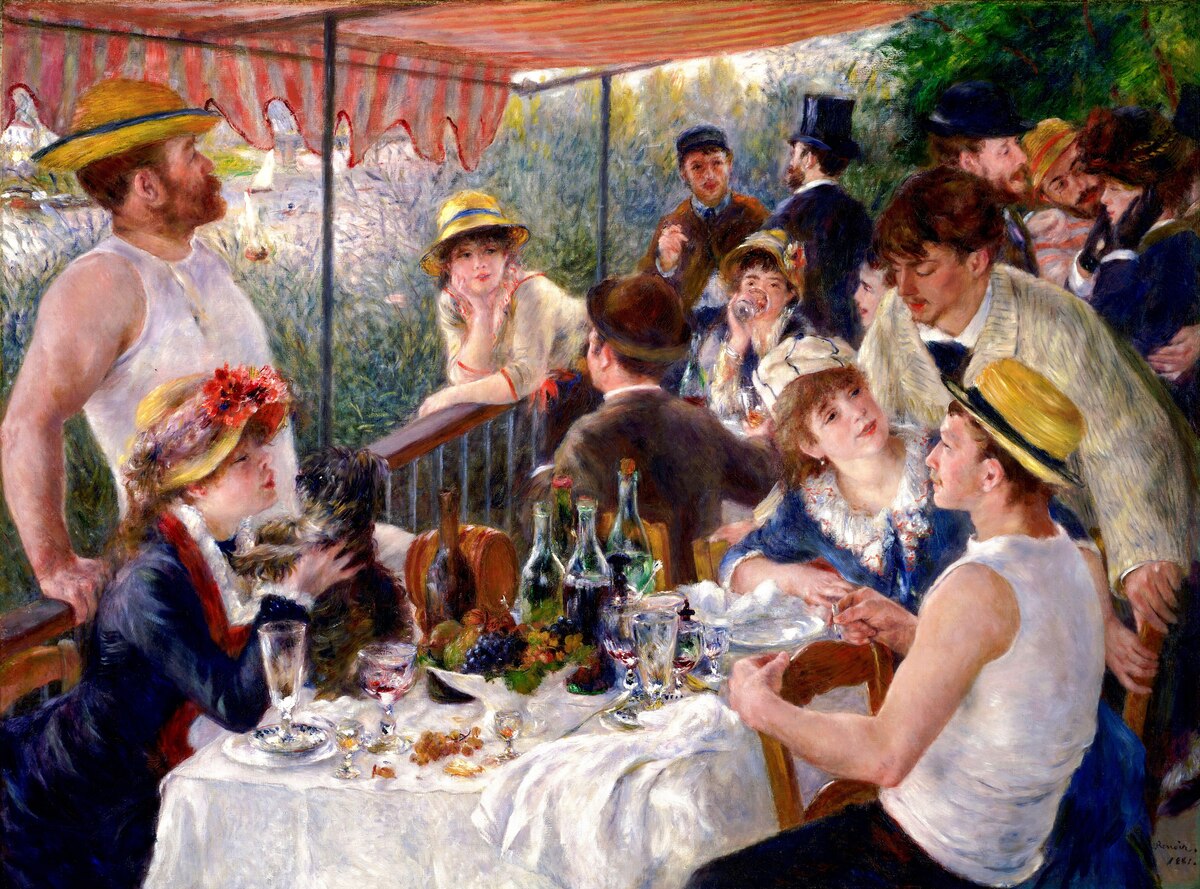
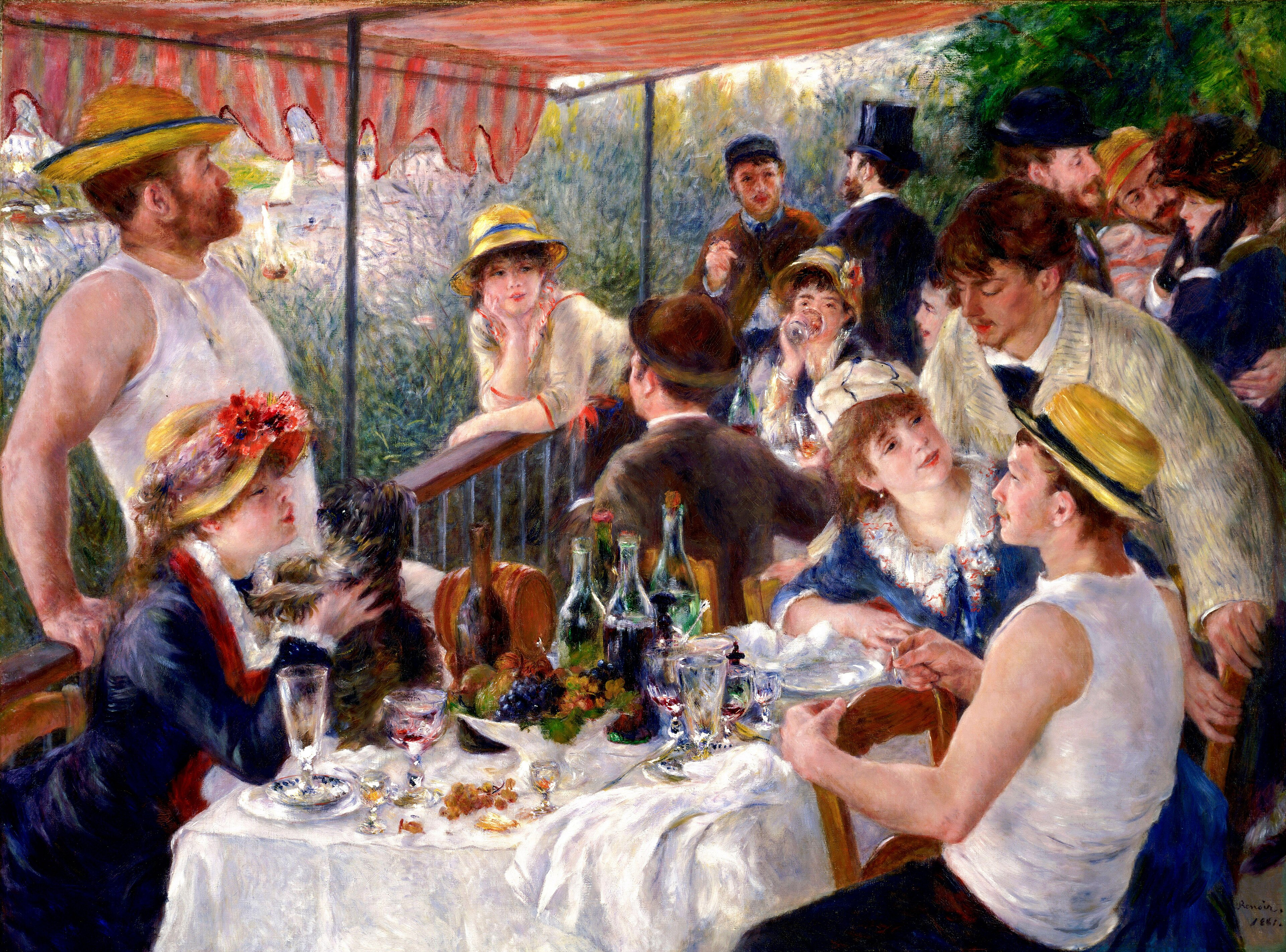
- A group of Renoir's friends gathered on a riverside balcony at the Maison Fournaise restaurant, sharing a leisurely luncheon. Some stand, some lean on the railing, some sit at a table set with wine, fruit and glasses; the scene blends portraiture, still life and landscape into one tightly composed image of modern leisure.(The Phillips Collection, n.d.)
- Title variants
- Le déjeuner des canotiers; Almuerzo de remeros; Das Frühstück der Ruderer; The Luncheon of the Boating Party(commons.wikimedia.org, n.d.)
- Accession number
- 1637
- Support
- canvas
Catalogue identification and title variants
The Phillips Collection catalogues the work as Luncheon of the Boating Party by Pierre-Auguste Renoir, dated between 1880 and 1881. Its object type is painting and its genre is genre art: a scene of contemporary, unheroic life rather than history painting, portraiture or landscape alone. The French title recorded for the same picture is Le déjeuner des canotiers, so the better-known English name is a translation rather than the title under which the work is registered in French. The canvas is signed at the right with the inscription 'Renoir, 1881'. That inscribed year sits at the later edge of the 1880 to 1881 range the museum assigns to the work overall, so the object date and the catalogue date do not coincide exactly: the signature fixes one point within the period of execution, while the institutional range describes the whole campaign of work on the picture.(The Phillips Collection, n.d., Object record)(commons.wikimedia.org, n.d., Inscriptions; Title; Object type)
The same record supplies the physical description of the canvas and its administrative identity. The work is oil on canvas, measuring 51 1/4 x 69 1/8 inches (130.2 x 175.6 cm). It belongs to The Phillips Collection, Washington, D.C., under accession number 1637, and it was acquired in 1923. Within the identifications the catalogue offers, the title, medium, dimensions, accession number and acquisition year are facts of the object record, while the date range and the signature describe when the image was made and marked. The support and measurements establish the scale of the picture: a large horizontal canvas, wider than it is tall. That format is what permits a crowd of near life-size figures to be arranged across one continuous space.(The Phillips Collection, n.d., Object record)(commons.wikimedia.org, n.d., Inscriptions; Title; Object type)
The collection records that most of the models in the painting, all friends of the artist, have been identified. In the right foreground Angèle, one of Renoir's frequent models, turns her head toward the standing Maggiolo, a journalist. The painter Gustave Caillebotte sits backward in his chair and stares across the table at Aline Charigot, Renoir's future wife, who coos at her terrier, and Alphonse Fournaise Jr., son of the restaurant's owner, leans against the balcony's railing surveying the scene. In the centre Baron Raoul Barbier, a former cavalry officer, sits with his back to the viewer, speaking to the woman resting on her elbows on the railing, who is thought to be Alphonsine Fournaise, the daughter of the proprietor. Across the table from Barbier is the actress Ellen Andrée, drinking from a glass; behind her the top-hatted Charles Ephrussi, a banker and editor of the Gazette des beaux-arts, chats with Jules Laforgue, poet, critic and Ephrussi's personal secretary. In the upper right Eugène Pierre Lestringuez, an official in the Ministry of the Interior, laughs with Jeanne Samary, a famous actress of the Comédie Française, while the artist Paul Lhote, a close friend of Renoir's, cocks his head. Alphonsine Fournaise's identity is reported as something thought to be the case, whereas the other sitters are given as named individuals. The social range is unusually wide for a leisure scene of the period: it includes an actress, a banker-editor, a civil servant, several painters, a journalist, the proprietor's son and daughter, and Renoir's future wife.(The Phillips Collection, n.d., Object record)
A second institutional record of the painting converges on the same names from a different angle. Its French title is given there again as Le déjeuner des canotiers, its object type as painting and its genre as genre art, and it is signed at the right 'Renoir, 1881'. The photographed people are listed as identified friends of Renoir including Aline Charigot, Charles Ephrussi, Ellen Andrée, Jeanne Samary and Gustave Caillebotte. That list overlaps the museum's fuller account of the sitters, naming the same individuals the Phillips Collection identifies, but it is not a complete roster of the company depicted. The agreement of two records on the French title, the signature and the identification of friends supports those points as stable catalogue information, while the shorter depicted-people list shows that not every figure is attested by every account.(commons.wikimedia.org, n.d., Depicted people; Title; Object type; Inscriptions)
Interpretation
The painting was included in the 7th Impressionist exhibition at Durand-Ruel & Cie. from 1 March 1882 to 31 March 1882, roughly a year after the year inscribed on the canvas. This exhibition record, like the identity of the sitters as friends of the artist, is part of what the institutional documentation establishes about the work's early public life rather than something the image itself tells a viewer. The object's subsequent place in a public collection in Washington, beginning with its 1923 acquisition, depends on this earlier exhibition history and on the fact that the picture entered the market as a recognised major work of modern French painting. The catalogue information about medium, scale and inscription is what allows the picture to be described and compared consistently across these different moments of its history.(commons.wikimedia.org, n.d., Inscriptions; Title; Object type)
The chain of figures recorded in the catalogue turns the painting into a document of a particular social circle as much as a picture of leisure. Renoir's friends and acquaintances are placed at specific stations across the balcony: Angèle beside the standing journalist Maggiolo at the right; Caillebotte turned backward in his chair toward Aline Charigot and her terrier; Alphonse Fournaise Jr. leaning at the railing; Barbier in the centre with his back to the viewer, addressing the woman thought to be Alphonsine Fournaise; Ellen Andrée drinking across from him; Ephrussi in his top hat in conversation with Laforgue; and in the upper right Lestringuez, Samary and Lhote. These placements are catalogued individually, so the composition can be read as an arrangement of identified people in a known setting rather than an invented crowd. The one qualification the record preserves is that the woman at the railing is only thought to be Alphonsine Fournaise.(The Phillips Collection, n.d., Object record)
Interpretation
The work's move into a permanent collection shapes how it is now catalogued and studied. Duncan Phillips initially intended to form a unit of Renoir's works, but later realised that the Luncheon of the Boating Party was the only major work by the artist that he would need. Shortly after confirming his purchase, he wrote from Paris to his treasurer calling the work 'one of the greatest paintings in the world' and predicting that it would do more good in arousing interest and support for the gallery than the rest of the collection put together. That acquisition, in 1923, is the event that connects the picture's nineteenth-century exhibition history to its twentieth-century identity as a collection-defining object, and it explains why a single picture can be treated in a museum's own account as both a work by Renoir and a foundation of the institution's public role.(The Phillips Collection, n.d., Object record)
The Phillips Collection identifies the work as Luncheon of the Boating Party by Pierre-Auguste Renoir, dated between 1880 and 1881.(The Phillips Collection, n.d.)
In the right foreground, Angèle, one of Renoir's frequent models, turns her head toward the standing Maggiolo, a journalist.(The Phillips Collection, n.d.)
The painter Gustave Caillebotte sits backward in his chair and stares across the table at Aline Charigot, Renoir's future wife, who coos at her terrier.(The Phillips Collection, n.d.)
In the center, Baron Raoul Barbier, a former cavalry officer, is seated with his back to the viewer speaking to the woman resting on her elbows on the railing, who is thought to be Alphonsine Fournaise, the daughter of the proprietor.(The Phillips Collection, n.d.)
Behind Ellen Andrée, the top-hatted Charles Ephrussi, a banker and editor of Gazette des beaux-arts, chats with Jules Laforgue, poet, critic, and Ephrussi's personal secretary.(The Phillips Collection, n.d.)
In the upper right, Eugène Pierre Lestringuez, an official in the Ministry of the Interior, laughs with Jeanne Samary, a famous actress with the Comédie Française, while the artist Paul Lhote, a close friend of Renoir's, cocks his head.(The Phillips Collection, n.d.)
The painting depicts identified friends of Renoir including Aline Charigot, Charles Ephrussi, Ellen Andrée, Jeanne Samary and Gustave Caillebotte.(commons.wikimedia.org, n.d.)
Materials and technique
LinkDocumented Materials and Dimensions
Visual observation
The Phillips Collection records the Luncheon of the Boating Party as an oil on canvas measuring 51 1/4 by 69 1/8 inches, that is 130.2 by 175.6 centimeters. This is the primary documented material fact about the making of the object: the medium is oil paint applied to a canvas support, and the dimensions place it firmly in the category of a large-scale easel painting rather than a modest sketch or study. The measurements, given in both inches and centimeters, are the museum's own object record figures and establish the physical scale against which any discussion of the composition, and of the labor and materials involved, must be measured. Nothing in the supplied evidence specifies the type, weight, weave or preparatory treatment of the canvas, the ground layer, the palette of pigments, the brushes or other tools used, or any varnish or surface coating, so those aspects remain undocumented in this account. The description of the work as a tightly composed painting that unites figure painting, still life and landscape within one image is a curatorial characterization of the composition rather than a statement about its physical construction, and it should not be read as a technical finding. What can be said on the evidence is limited but firm: a single large oil on canvas, whose dimensions are recorded to the quarter inch and to the millimeter.(The Phillips Collection, n.d., Object record)
Technical Examination and Its Limits
Interpretation
The relationship between what is documented and what has been examined is worth stating carefully, because the two are often conflated. The object record, a museum-sourced document, establishes the identification of the work, its medium, its dimensions, its collection history and the identities of most of the models. The 2016 technical analysis is a separate line of evidence, and the supplied material tells us only that it was conducted and that its findings are presented by The Phillips Collection, not what those findings were. Read together, these two strands support a robust account of the painting's material identity, oil on canvas at a recorded size, and of the institution's investment in studying it, without supplying any pigment, ground or layer information. This is a genuine qualification on the record, not a gap to be filled by plausible conjecture. It also has consequences for the larger history of Impressionist technique: the case shows how technical study and object documentation function as distinct evidentiary registers in museum research, and how a canonical painting can be thoroughly documented in its identity and reception while its precise materials remain, in the supplied record, unstated.(The Phillips Collection, n.d., Object record)
Technical examination
A 2016 technical analysis of Luncheon of the Boating Party was conducted and its findings are presented by The Phillips Collection.(The Phillips Collection, n.d.)
Condition and conservation
LinkMaterial baseline and the 2016 technical analysis
The condition history of Luncheon of the Boating Party begins with what the painting is materially: oil on canvas, measuring 51 1/4 by 69 1/8 inches (130.2 by 175.6 cm), a scale that places it among Renoir's ambitious large-format compositions rather than his domestic-scale canvases. The Phillips Collection records the work under accession number 1637, acquired in 1923. These baseline facts about support, medium and dimensions frame every later question of condition, because the painting's size and its oil-on-canvas construction determine how it was handled, hung, travelled and examined over more than a century of institutional life. The object record distinguishes the museum's dating of the work to between 1880 and 1881 from the inscription the painting carries, signed at the right 'Renoir, 1881', a discrepancy in dating conventions that belongs to the documentary record rather than to any physical alteration of the surface.(The Phillips Collection, n.d., Object record)
Technical examination
A 2016 technical analysis of Luncheon of the Boating Party was conducted, and its findings are presented by The Phillips Collection. The evidence establishes the fact and the date of this examination and the institution that presents it, but the supplied units do not itemize which methods were used, what pigments or ground layers were identified, what condition problems were found, or what treatment, if any, followed. The study therefore stands as a documented episode in the painting's recent research history without its detailed results being available here. This matters for how the object is understood: technical analysis of a nineteenth-century canvas typically addresses canvas weave, preparatory layers, pigment identification, earlier restorations and the extent of original paint, which are precisely the questions that determine how much of what a viewer sees corresponds to Renoir's own hand. Until those findings are set out in the evidence, the 2016 analysis should be cited as an examination that took place rather than as a published set of conclusions.(The Phillips Collection, n.d., Object record)
The 2017 to 2018 focused exhibition
The most fully documented recent engagement with the painting's physical and art-historical life is the exhibition 'Renoir and Friends: Luncheon of the Boating Party', held at The Phillips Collection from October 7, 2017 to January 7, 2018. The museum describes it as the first exhibition to focus specifically on this singular masterwork, which is a claim about curatorial attention rather than about the painting's condition. Its timing, arriving in the year following the 2016 technical analysis, places the examination and the focused exhibition in the same period of concentrated institutional study. For a work that entered the collection in 1923 and had been shown in broader collection displays for decades, the 2017 to 2018 exhibition represents a shift toward treating the canvas as an object of dedicated research in its own right, with the technical findings presented alongside its history. The evidence does not record loans, travel, or conservation treatment associated with that exhibition, so no claim about movement or intervention should be inferred from it.(The Phillips Collection, n.d., Object record)
Display context and institutional stakes
Context from the work's display history bears on how the painting has been physically presented and therefore on the conditions under which it has been observed. In December 1923, shortly after its acquisition, the Luncheon of the Boating Party was flanked by Alfred Sisley's Snow at Louveciennes and Banks of the Seine at the Phillips Memorial Gallery. This documented hang places the canvas within a curated ensemble in the year it entered the collection, and it shows that the painting's public life at the Phillips began immediately and in relation to other pictures rather than in isolation. The gallery's founding ambition for the work is recorded in Duncan Phillips's own words: writing from Paris shortly after confirming his purchase, he called it 'one of the greatest paintings in the world' and predicted it would do more good in arousing interest and support for the gallery than the rest of the collection put together. Those statements are about institutional value and public reception, not about the paint layer, but they explain why a single canvas has received the sustained scrutiny that produced the 2016 analysis and the 2017 to 2018 exhibition.(The Phillips Collection, n.d., Object record)
The 2017 to 2018 focused exhibition
The early exhibition record supplies the other end of the object's chronology. The painting was included in the 7th Impressionist exhibition at Durand-Ruel & Cie. from 1 March 1882 to 31 March 1882, which places it in a commercial and critical setting only months after the date inscribed on the canvas. That showing, where the work was received as one of the most famous French paintings of modern times, is the earliest documented public presentation in the supplied evidence and establishes that the canvas was exhibited while still relatively new. Between that 1882 exhibition and the 1923 acquisition, the evidence gives no condition observations, no provenance intervals and no treatment history, and those gaps should remain gaps. The forty-one-year span is part of the record precisely because it is undocumented here.(commons.wikimedia.org, n.d., Exhibition history)(The Phillips Collection, n.d., Object record)
Reception and literature
LinkEarly Acclaim and Exhibition
The earliest documented stage of the painting's public life is its inclusion in the seventh Impressionist exhibition at Durand-Ruel & Cie., held from 1 March 1882 to 31 March 1882, according to the institutional record of the work. At that showing, the painting was hailed as 'one of the most famous French paintings of modern times,' a characterization recorded by The Phillips Collection. This pairing of an 1882 exhibition fact with a later museum description marks the beginning of a reception that would accumulate over more than a century: the work entered public view as a contemporary Impressionist entry, and was already being framed in superlative terms. Both the exhibition history and the acclamation belong to the display and criticism of the early 1880s, before any museum ownership, and they establish that the painting's reputation did not begin with its American acquisition.(commons.wikimedia.org, n.d., Exhibition history)(The Phillips Collection, n.d., Object record)
The Museum Framing of Monumentality
Visual observation
The Phillips Collection's object record advances a distinct reading of the painting, stating that Renoir immortalized his friends to such a degree that the image is 'not anecdotal but monumental.' Within the terms of the evidence, this is an attributed curatorial interpretation rather than a period statement. Its emphasis falls on the elevation of a convivial subject: the museum treats the work as achieving a weight beyond reportage, with the composition and scale of the picture supporting that claim. The same record describes the work as a tightly composed painting that unites figure painting, still life and landscape within one image. Together these statements outline the institutional view that the painting's significance lies in the ambition of its construction, not merely in the identity of the people depicted.(The Phillips Collection, n.d., Object record)
Marjorie Phillips and the Universal Reading
Interpretation
Marjorie Phillips offered an alternative emphasis, writing that 'in the light of time it does not matter much who the figures are. They are every man, all people.' This reading, recorded in the same institutional source as the monumental characterization, shifts attention from the named sitters to the general human situation of leisure. Yet the museum's own record also notes that most of the models in the painting, all friends of the artist, have been identified. The two positions therefore coexist in the documentation: a specific, identifiable social group is pictured, and a viewer may still encounter the scene as broadly representative. The evidence presents both the monumental and the universal readings as interpretations attached to the work, not as mutually exclusive corrections.(The Phillips Collection, n.d., Object record)
Display and Public Esteem
The work's installation at the Phillips Memorial Gallery in December 1923 is documented in specific terms: it was flanked by Alfred Sisley's Snow at Louveciennes and Banks of the Seine. The pairing situates the Renoir within a curated hang of landscape paintings, which shows how the work was presented before its later identity as a singular masterpiece took hold. Over time, the museum record describes the painting as among the most visited, commented upon, and memorable paintings in The Phillips Collection. This later assessment of visitor attention is a statement about the work's standing within one collection. It complements, rather than replaces, the earlier physical description of its placement, and it indicates that the painting's role in the gallery's public life grew after the 1923 hanging.(The Phillips Collection, n.d., Object record)
The Phillips Collection states that Renoir immortalized his friends to such a degree that the image is 'not anecdotal but monumental.'(The Phillips Collection, n.d.)
Marjorie Phillips wrote that 'in the light of time it does not matter much who the figures are. They are every man, all people.'(The Phillips Collection, n.d.)
Collection and display
LinkObject and Collection Record
The Phillips Collection in Washington, D.C. holds Pierre-Auguste Renoir's Luncheon of the Boating Party under accession number 1637, acquired in 1923. The museum's object record dates the work between 1880 and 1881 and describes it as oil on canvas measuring 51 1/4 by 69 1/8 inches (130.2 by 175.6 cm). The picture, which the museum states depicts a group of Renoir's friends sharing a luncheon on a riverside balcony at the Maison Fournaise restaurant, anchors the collection as one of its most visited, commented upon, and memorable paintings.(The Phillips Collection, n.d., Object record)
The Identified Sitters
The Phillips Collection reports that most of the models in the painting, all friends of the artist, have been identified. In the right foreground Angèle, one of Renoir's frequent models, turns her head toward the standing journalist Maggiolo, while the painter Gustave Caillebotte sits backward in his chair and stares across the table at Aline Charigot, Renoir's future wife, who coos at her terrier. Alphonse Fournaise Jr., son of the restaurant's owner, leans against the balcony's railing surveying the scene. In the center Baron Raoul Barbier, a former cavalry officer, is seated with his back to the viewer speaking to the woman resting on her elbows on the railing, who is thought to be Alphonsine Fournaise, the daughter of the proprietor. Across the table from Barbier is the actress Ellen Andrée, drinking from a glass. Behind Ellen Andrée, the top-hatted Charles Ephrussi, a banker and editor of Gazette des beaux-arts, chats with Jules Laforgue, poet, critic, and Ephrussi's personal secretary. In the upper right, Eugène Pierre Lestringuez, an official in the Ministry of the Interior, laughs with Jeanne Samary, a famous actress with the Comédie Française, while the artist Paul Lhote, a close friend of Renoir's, cocks his head.(The Phillips Collection, n.d., Object record)
Interpretive Frameworks
The Phillips Collection describes the work as a tightly composed painting that unites figure painting, still life and landscape within one image. The museum also states that Renoir immortalized his friends to such a degree that the image is "not anecdotal but monumental," a claim about scale and ambition as much as subject: a casual lunch rendered as a large, carefully built composition carrying the weight of history painting. Marjorie Phillips took the opposite emphasis when she wrote that "in the light of time it does not matter much who the figures are. They are every man, all people." The painting thus sustains two readings at once, as a record of specific friends and as a picture of leisure that any viewer can enter. The Phillips Collection notes that the painting was hailed as "one of the most famous French paintings of modern times" when it was first exhibited.(The Phillips Collection, n.d., Object record)
Display and Acquisition History
Shortly after confirming his purchase, Duncan Phillips wrote from Paris to his treasurer calling the work "one of the greatest paintings in the world" and predicting it would do more good in arousing interest and support for the gallery than the rest of the collection put together. Duncan Phillips initially intended to form a unit of Renoir's works, but later realized that the Luncheon of the Boating Party was the only major work by the artist that he would need. In December 1923 the painting was flanked by Alfred Sisley's Snow at Louveciennes and Banks of the Seine at the Phillips Memorial Gallery.(The Phillips Collection, n.d., Object record)
Technical Study and Exhibition
A 2016 technical analysis of Luncheon of the Boating Party was conducted and its findings are presented by The Phillips Collection. An exhibition titled "Renoir and Friends: Luncheon of the Boating Party" was held at The Phillips Collection from October 7, 2017 to January 7, 2018, the first exhibition to focus specifically on this singular masterwork.(The Phillips Collection, n.d., Object record)
Collection and Display
Interpretation
The object record establishes the museum's own dating of 1880 to 1881 while identifying the painting as oil on canvas with precise dimensions, and the same record documents both the accession number and the 1923 acquisition. The identification of most sitters, the attribution of the balustrade group to Alphonsine Fournaise (given with the qualification that she is "thought to be" the proprietor's daughter), and the museum's interpretive language about monumentality all come from this single institutional source, so the account of who is depicted and how the painting should be read rests on The Phillips Collection's curatorial voice rather than on independent corroboration within the supplied evidence. The acquisition narrative is likewise reported through the museum: Duncan Phillips's Paris letter to his treasurer, his initial plan for a group of Renoir works, and the December 1923 hang alongside two Sisleys are documented in the record as episodes in the painting's entry into and display within the Phillips Memorial Gallery. The 2016 technical analysis and the 2017 to 2018 exhibition are the two most recent documented engagements with the work, extending the institutional history from private acquisition in 1923 to public study and monographic display in the twenty-first century.(The Phillips Collection, n.d., Object record)
Documented values and qualified estimates
LinkRecorded value and its status
Interpretation
A working insurance calculation recorded on 2026-10-16 gives an estimated value of US$500M to US$1B, derived from the confirmed artist, title, date, medium, dimensions, signature, collection status, acquisition context and the work's prominence as a major Impressionist picture in a public museum. The basis cited for the range is exactly that body of identification and status information, and the instrument itself states that no public sale, auction, or published appraisal figure is asserted, that the range is a broad order-of-magnitude placeholder for insurance review, and that it is not a precise market-derived figure. Its qualification is explicit: it is a model-generated working range for manual review only, not an official insurance value, appraisal, auction result, or sale price, it does not reflect a current market transaction, and it should not be used to bind coverage without review by a qualified fine-art insurance professional or appraiser. The figure therefore documents an internal working estimate and its stated limits, not a market price the object has ever commanded.(The Phillips Collection, n.d.)(commons.wikimedia.org, n.d.)
Working estimate
Calculated working insurance estimate, not a sale price: Estimated value: US$500M to US$1B Recorded date: Working calculation, generated 2026-10-16. Methodology: Conservative working insurance range calculated for manual review only. Basis: confirmed Pierre-Auguste Renoir, Luncheon of the Boating Party (Le dejeuner des canotiers), oil on canvas, 1880-1881, 51 1/4 x 69 1/8 in. (130.2 x 175.6 cm), signed right Renoir 1881, The Phillips Collection, Washington, D.C., accession number 1637, acquired 1923. The excerpts support the artist, title, date, medium, dimensions, collection status, acquisition context, and prominent status of the work as a major Impressionist picture in a public museum. No public sale, auction, or published appraisal figure is asserted. The range is a broad order-of-magnitude placeholder for insurance review, not a precise market-derived figure. Qualification: This is a model-generated working range for manual review only, not an official insurance value, appraisal, auction result, or sale price. It does not reflect a current market transaction and should not be used to bind coverage without review by a qualified fine-art insurance professional or appraiser.(The Phillips Collection, n.d.)(commons.wikimedia.org, n.d.)