Lied (Chanson)
Artist: Vassily Kandinsky · [1906]

Lied (Chanson): high-resolution image
The original file is hosted by Wikimedia Commons, available without payment or an account.
Open high-resolution image on Wikimedia CommonsThe complete story
The story About 6 minutes to read
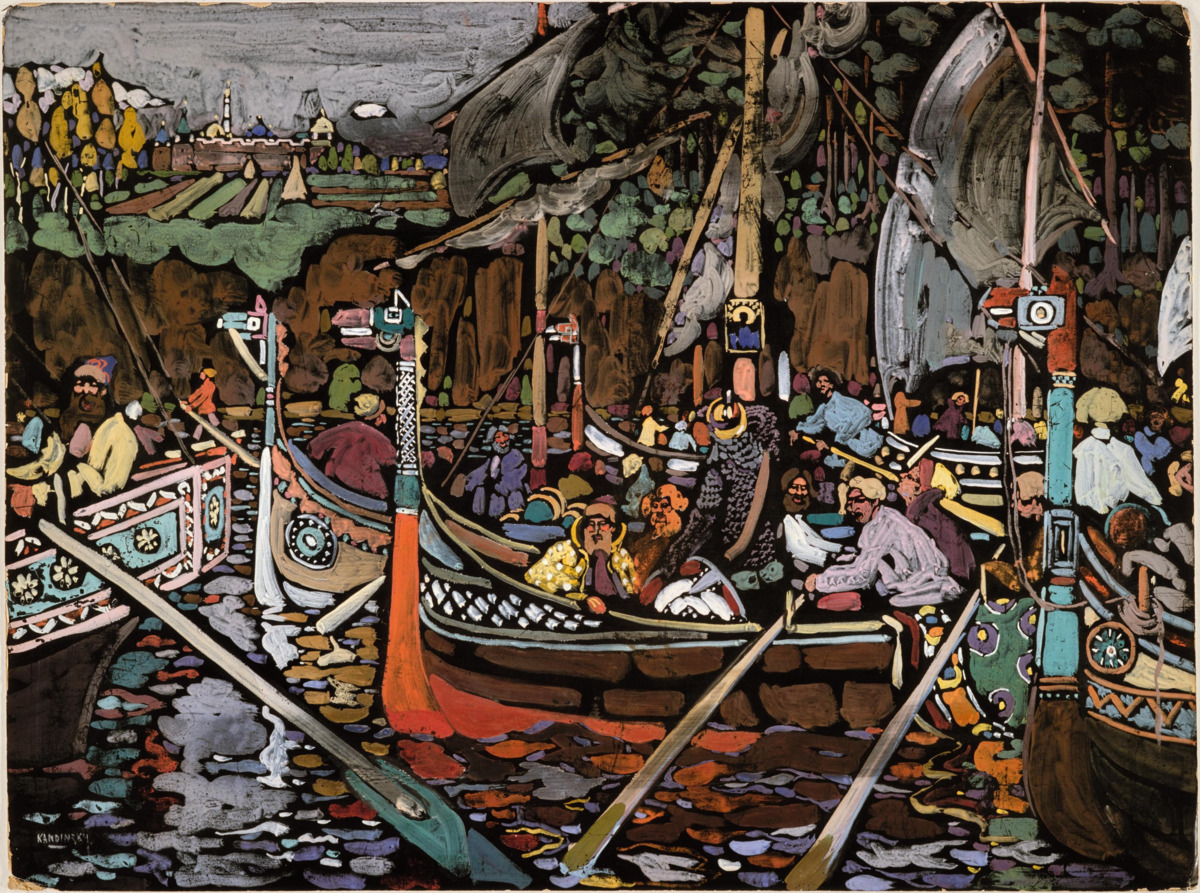
Here Kandinsky paints a scene drawn from Russian folklore. Boatmen appear in legendary dragon ships, the drakkars, on the Volga River. It was made in nineteen oh six, while he was staying in Paris and working at nearby Sèvres. At that moment Russian exoticism had suddenly become fashionable in the French capital. The work is a small tempera on glazed cardboard. But don't let its modest size mislead you. Kandinsky was using a folk subject to make a deliberate claim about Russian art.
Look first at the distant bank. A walled town rises above a wooded slope, with onion domes and white church spires catching the light. Those forms belong to a Russian landscape, not a French one. They tell you where the boatmen are travelling, even though the river itself carries the eye across the foreground. The colour works differently from the way you might expect. Kandinsky places pure colours side by side without mixing them, in a technique the museum compares to printed images.
That unmixed colour is central to how the picture works. The Centre Pompidou's catalogue reads it as a way of provoking enchantment, much as Bilibin and Léon Bakst did in their own Russian imagery. Enchantment here isn't a vague mood. It is a visual strategy. Bright, flat colour sets the legendary ships against the ordinary riverbank and lets the folk tale feel vivid rather than distant. So the picture is doing two things at once. It shows a scene from Russian folklore, and it shows a modern painter choosing a folk technique on purpose.
Kandinsky had been building an art school in Munich between nineteen oh one and nineteen oh three, attached to his group Phalanx. He later travelled through Europe with his student Gabriele Münter and stayed in Paris from nineteen oh six to nineteen oh seven. At Sèvres he painted and engraved essentially a cycle on Little Russian themes. The museum describes that cycle as exalting the folklore of the Russian people. This painting belongs to that moment. It isn't a French landscape with Russian decoration. It is part of a sustained attempt by Kandinsky to place Russian popular art at the centre of his work.
Why would a Russian painter in Paris make folk art his subject? The Centre Pompidou's reading is specific. The Little Russian themes adapt William Morris's Arts and Crafts to the originality of Russian popular art. That adaptation stood against the tsars' westernisation of the country. It also illustrated the rivalry between Saint Petersburg and Moscow. Kandinsky, the museum notes, was a Muscovite at heart. So the dragon ships and the unmixed colours carry a cultural argument. Folk art is not a lesser tradition here. It is a source of national originality, set deliberately against the imperial capital's western taste.
The painting also had a public life in Paris. It was shown at the Salon des Indépendants in nineteen oh seven under the simple title Chanson, with the number twenty six forty five. By nineteen thirteen it had become Chant de la Volga in the Sturm-Album. The museum connects it to Troïka and Das bunte Leben, the larger works with which Kandinsky wanted to draw Parisians' attention to what he was doing. That context matters for how we see the picture. The small tempera wasn't an isolated experiment. It was part of a campaign to introduce a Russian visual language to a French audience.
Come back to those flat, bright colours and the walled town on the bank. They aren't just scenery. They are Kandinsky's way of making Russian folklore feel present and purposeful in Paris. The boatmen on the Volga carry a legend. The painting around them carries an argument about where Russian art should look for its strength. By the time you leave, the small tempera should read as a deliberate act of cultural choice, made in colour as much as in subject.
The story and its sources
Historical claims are linked to the records below. Close looking and interpretation are identified in the passage notes.
- Passage 1Documented historyInstitutional record for Lied (Chanson) Chant de la Volga
- Passage 2Close lookingInstitutional record for Lied (Chanson) Chant de la Volga
- Passage 3InterpretationInstitutional record for Lied (Chanson) Chant de la Volga
- Passage 4Documented historyInstitutional record for Lied (Chanson) Chant de la Volga
- Passage 5InterpretationInstitutional record for Lied (Chanson) Chant de la Volga
- Passage 6Documented historyInstitutional record for Lied (Chanson) Chant de la Volga
- Passage 7InterpretationInstitutional record for Lied (Chanson) Chant de la Volga
Details to notice
About 4 minutes to readTurquoise boat fitting
A tall turquoise boat fitting with geometric painting and a circular medallion rises among passengers at the right edge, displaying the fleet's varied decoration.
Walled town skyline
A distant walled town with onion domes and white church spires rises above the wooded bank, setting the river scene within a Russian landscape.
Floral-painted boat
Pale blue side panels with flower rosettes and carved trim show the handcrafted ornament of the left-hand boat and lead the eye into the foreground.
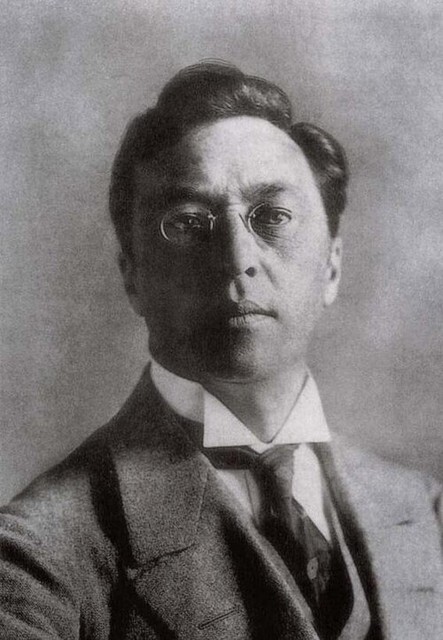
Artist portrait Image credit
未知上傳者. Image source · Public domain
About the artist
Wassily Kandinsky
1866 to 1944
Wassily Kandinsky was an avant-garde painter of Russian origin (1866–1944). Their work is associated with Expressionism; Symbolism; Bauhaus. Their recorded places of work include Paris; Munich; Weimar; Rapallo; The Hague; Russia; Stockholm; Switzerland; Tunis.
- Born
- 1866
- Died
- 1944
- Nationality
- Russian Empire; Russian Soviet Federative Socialist Republic; Soviet Union; France; Germany
- Birthplace
- Moscow
- Died in
- Neuilly-sur-Seine
Biography sources
The research & record
Study the work.
Follow the evidence.
Find catalogue details, historical context, technical research and the literature behind this artwork.
The artwork record
Research catalogue
Catalogue information and detailed research, with references that link to the bibliography.
Updated .
Identity and catalogue
Link- Title
- Lied (Chanson)
- Artist or attribution
- Vassily Kandinsky
- Object date
- [1906]
- Medium and support
- Tempera on glazed cardboard
- Dimensions
- 49 x 66 cm
- Current collection or location
- Centre Pompidou, Musée national d'art moderne, Paris (on view at Palazzo Bonaparte, Rome, as part of "Kandinsky," 15 September 2026 to 14 February 2027)
- Movement or period
- Jugendstil (German Art Nouveau) period; Russian folklore themes
- Country or culture
- Russia (Russian folklore); painted during Kandinsky's stay in Sèvres and Paris
- Depicted subject
- Boatmen appear in legendary dragon ships (drakkars) on the Volga River, a scene drawn from Russian folklore and traditional festival life. The work exalts the folklore of the Russian people through pure, unmixed colours placed side by side.
- Title variants
- Chanson; Chant de la Volga; Lied (Chanson) Chant de la Volga
- Accession number
- AM 81-65-87
- Support
- Glazed cardboard
- Inscriptions
- S.B.G. : KANDINSKY [in white gouache]; S.T.N.R. : Kandinsky, Chanson, N° 117
Read valuation records and their limitations
The catalogue record
The work is a tempera painting on glazed cardboard measuring 49 by 66 centimetres. The support and modest dimensions belong to the object as catalogued and should be kept distinct from the dates attached to its documentation and display. The picture carries two inscriptions: a lower-left inscription KANDINSKY in white gouache, and a top-right inscription Kandinsky, Chanson, N° 117. The painted signature in gouache and the identifying title and number at upper right are thus part of the physical object and are recorded as such in the institutional entry.(Christian Derouet, 2007, Inscriptions)
The recorded title has a history of its own. Under the simple title Chanson and the number 2645, the small tempera was presented at the Salon des Indépendants in 1907, and it became Chant de la Volga in 1913 in the Sturm-Album, where it is reproduced at plate 30. The title used in the present catalogue, Lied (Chanson) Chant de la Volga, carries the German word Lied alongside the French Chanson and the later Chant de la Volga, preserving the successive names under which the work was shown and published rather than settling on a single one. The upper-right inscription naming Chanson and the number 117 belongs to the object's own markings and should not be conflated with the number 2645 recorded for the 1907 Salon presentation.(Christian Derouet, 2007, Inscriptions; Analysis)
Object, evidence and interpretation
Interpretation
Read together, the entries establish a distinction worth keeping in view between what the object visibly is and what the catalogue makes of it. The visible evidence is the tempera on glazed cardboard, its dimensions, its two inscriptions, the boats and dragon ships, and the walled town on the far bank. The historical and technical evidence establishes the 1907 Salon des Indépendants presentation under the title Chanson and number 2645, the 1913 retitling in the Sturm-Album, the 1981 bequest, and the catalogue's account of the Little Russian cycle, the Morris adaptation and the colour method. The catalogue's interpretive claims, including the opposition to the tsars' westernisation, the Saint Petersburg and Moscow rivalry, and the aim of provoking enchantment, are attributed to the museum rather than presented as settled fact. The object matters within a larger history of material culture because a small work on glazed cardboard can carry a programme about national originality, folk sources and modern colour at the same time as it served as an entry point for a Russian visual language in Paris.(Christian Derouet, 2007, Analysis; Acquisition; Inscriptions)
The work carries a lower-left inscription KANDINSKY in white gouache and a top-right inscription Kandinsky, Chanson, N° 117.(Christian Derouet, 2007)
Subject and iconography
LinkRead valuation records and their limitations
The recorded scene
Visual observation
The institutional record describes the picture's subject as boatmen in legendary dragon ships, the drakkars, a scene the record draws from Russian folklore and the Volga River. That description establishes the narrative core of the image. The centre of the composition is occupied by the vessels and their crews, with the river carrying the movement of the scene. The setting is fixed by a second recorded element: a distant walled town with onion domes and white church spires rises above a wooded bank, which the record reads as placing the action within a Russian landscape. The two observations work together. The boats supply the legend, while the town and bank establish where the legend unfolds. The record's wording presents the subject as a scene drawn from folklore, which is a statement about the picture's content, not a claim that a specific written source or named legend has been identified.(Christian Derouet, 2007, Analysis)
Interpretation
Read as a composition, the account divides the image between a foreground of water and shipping and a distance of wooded slope and built forms. The town is described as walled, with onion domes and white spires catching the light above the trees. Because the record does not describe the arrangement of the boats in detail, the spatial relationship between the crews and the distant bank can be stated only in the terms the record supplies. The walled town functions within the account as the marker of place. Its domes and spires identify the landscape as Russian, allowing the Volga subject to be recognised without a caption. This is the record's interpretation of the visible elements, and it is supported by the recorded presence of those forms rather than by any independent identification of the town or church.(Christian Derouet, 2007, Analysis)
Colour as a visual technique
The record connects the unmixed colour to the pursuit of enchantment, naming Bilibin and Léon Bakst as artists who sought a comparable effect by adopting a technique in which pure colours are placed side by side without mixing, as on printed images. This is an attributed comparison. The record establishes that the technique and the enchantment aim are shared, which allows the picture to be understood as participating in a broader Russian visual idiom rather than as an isolated experiment. It does not establish that Kandinsky derived the method from either artist, and no direction of influence is recorded. The link should therefore be treated as a comparison of shared means, not as a documented line of transmission. What the comparison does establish is that the choice of flat, juxtaposed colour was understood by the catalogue author as a deliberate effect rather than a limitation of the medium.(Christian Derouet, 2007, Analysis)
From Chanson to Chant de la Volga
Visual observation
The documentary record traces a change of title. Under the simple title Chanson and the number 2645, the small tempera was presented at the Salon des Indépendants in 1907; by 1913 it had become Chant de la Volga in the Sturm-Album, where it is reproduced at page 30. The record thus establishes both a Paris exhibition appearance in 1907 and a later, differently titled publication in 1913. The inscription N° 117 on the work is recorded separately and should not be conflated with the exhibition number 2645. The shift from the neutral title Chanson to the descriptive Chant de la Volga corresponds to the Volga subject that the record identifies in the composition, but the record does not state who supplied the later title or why the change was made.(Christian Derouet, 2007, Techniques, Dimensions; Analysis)
The Russian argument in the picture
The institutional account places the work within a sustained engagement with Russian popular art. At Sèvres, Kandinsky painted and engraved essentially a cycle on Little Russian themes, which the record describes as exalting the folklore of the Russian people. The record further states that the Little Russian themes adapt William Morris's Arts and Crafts to the originality of Russian popular art, in opposition to the tsars' westernisation of the country, and that they illustrate the rivalry between Saint Petersburg and Moscow. Kandinsky is described as a Muscovite at heart. On this account the dragon ships, the walled town and the unmixed colours carry a cultural argument: folk art is treated as a source of national originality rather than as a lesser tradition. This is the catalogue author's reading, and it is attributed to that record rather than presented as the painter's own recorded statement.(Christian Derouet, 2007, Analysis)
Interpretation
The reading of the picture as a cultural argument depends on connections the record makes between subject, technique and context. The Volga boatmen and the walled town supply Russian content; the side-by-side pure colours supply a technique the record compares to printed images and to Bilibin and Bakst; the Morris adaptation supplies a frame in which Russian popular art is set against imperial westernisation and the rivalry of the two capitals. Taken together, these elements let the picture be described as a deliberate act of cultural choice made in colour as much as in subject. That formulation is an interpretive synthesis of the record's several claims. It should be held as such, since the record does not quote Kandinsky on these points and does not document a programmatic statement attached to this work.(Christian Derouet, 2007, Analysis)
Visual observation
The painting depicts boatmen in legendary dragon ships (drakkars), a scene drawn from Russian folklore and the Volga River.(Christian Derouet, 2007)
The composition includes a distant walled town with onion domes and white church spires rising above a wooded bank, setting the scene within a Russian landscape.(Christian Derouet, 2007)
Historical context
LinkRead valuation records and their limitations
A Russian Subject Made in Paris
The Centre Pompidou's catalogue entry, written by Christian Derouet and published in the collection catalogue of the Musée national d'art moderne, frames this small tempera within a specific moment in Kandinsky's career. According to that account, Kandinsky had established an art school in Munich between 1901 and 1903, attached to his group Phalanx, which organised exhibitions including one devoted to Monet. He then travelled through Europe for several years with his student Gabriele Münter and stayed in Paris from 1906 to 1907. It was in this period, while working at Sèvres, that he painted and engraved what the entry describes as essentially a cycle on Little Russian themes, exalting the folklore of the Russian people. The Sèvres location matters for the circumstances of production, and the cycle as a whole, rather than any single sheet, is the unit of activity the evidence supports.(Christian Derouet, 2007, Analysis)
The entry links the timing of this Russian subject to a wider Parisian appetite. It states that Russian exoticism was suddenly fashionable in Paris with the Russian exhibition organised at the Salon d'automne in 1906. That date places the painting within a rising French interest in Russian art, which the account treats as the circumstantial backdrop to Kandinsky's turn toward folk themes. The observation is about fashion in the capital, not about documented influence on Kandinsky's choices in the painting itself, and should be weighed accordingly.(Christian Derouet, 2007, Analysis)
Colour, Print and the Argument for Folk Art
Interpretation
The cultural reading of those Little Russian themes is more specific still, and should be kept distinct from the technical description. The entry interprets them as adapting William Morris's Arts and Crafts to the originality of Russian popular art, in opposition to the tsars' westernisation of the country, and as illustrating the rivalry between Saint Petersburg and Moscow. It characterises Kandinsky as a Muscovite at heart. This is an interpretive synthesis offered by the catalogue, not a documented statement of Kandinsky's intent in the painting, and it is best read as a scholarly account of what the folk choices meant within Russian cultural politics of the period.(Christian Derouet, 2007, Analysis)
At the time of the German Jugendstil, Kandinsky had created an art school in Munich between 1901 and 1903, attached to his group Phalanx, which organised exhibitions including one devoted to Monet.(Christian Derouet, 2007)
With his student Gabriele Münter, Kandinsky travelled through Europe for several years and stayed in Paris from 1906 to 1907.(Christian Derouet, 2007)
At Sèvres, Kandinsky painted and engraved essentially a cycle on Little Russian themes, exalting the folklore of the Russian people.(Christian Derouet, 2007)
Russian exoticism was suddenly fashionable in Paris with the Russian exhibition organised at the Salon d'automne in 1906.(Christian Derouet, 2007)
Kandinsky was a Muscovite at heart.(Christian Derouet, 2007)
Materials and technique
LinkRead valuation records and their limitations
Support and medium
The Centre Pompidou's record describes Lied (Chanson) as a tempera painting on glazed cardboard, measuring 49 by 66 centimetres. The support and medium are recorded together with the dimensions in the institutional entry, so the description of the ground as glazed cardboard and the use of tempera rest on the museum's documentation rather than on unstated examination results. The record does not describe the preparation of the cardboard, the number of layers, or any tool beyond the paint medium itself, and those details should not be assumed.(Christian Derouet, 2007, Techniques, Dimensions)
Colour handling
Within the catalogue entry, the handling of colour is described as pure colours placed side by side without mixing, a procedure the entry likens to printed images. The same unmixed, juxtaposed colour is said to recur in Scène russe, Dimanche and Vieille Russie, AM 1981-65-83, which places the technique within a group of related works rather than treating it as unique to this painting. The comparison to printed images is the catalogue's formulation, an interpretive account of how the colour operates rather than a technical analysis of pigments or application.(Christian Derouet, 2007, Analysis)
The work is a tempera painting on glazed cardboard measuring 49 by 66 centimetres.(Christian Derouet, 2007)
The colours are pure and placed side by side without mixing, as on images, a technique also used in Scène russe, Dimanche and Vieille Russie, AM 1981-65-83.(Christian Derouet, 2007)
Provenance and ownership
LinkRead valuation records and their limitations
Acquisition and the Bequest of 1981
The documented acquisition history of this tempera on glazed cardboard begins at the end of the artist's line: the painting entered the collection through the bequest of Nina Kandinsky in 1981. That bequest is the single transfer the supplied institutional record establishes, and it places the work within the modern plastic arts collection area at the Centre Pompidou, Musée national d'art moderne. The record as supplied does not itemise intermediate owners between Kandinsky's own possession of the sheet and its arrival through the 1981 bequest, so the period before that transfer must be treated as an unrecorded interval rather than a documented chain of ownership; the bequest establishes how the work came to the museum, not who held it beforehand.(Christian Derouet, 2007, Acquisition)
Two inscriptions on the work itself are independent of the museum's acquisition records and help anchor its earlier life as a circulating object. A lower-left inscription reads KANDINSKY in white gouache, and a top-right inscription reads Kandinsky, Chanson, N° 117. The presence of the title Chanson and a numbered reference on the sheet is consistent with the publicly exhibited and reproduced identity the institutional record describes for the work in the years before it entered the museum, although the record supplied does not state who applied the inscriptions or when.(Christian Derouet, 2007, Acquisition)
The painting was acquired through the bequest of Nina Kandinsky in 1981.(Christian Derouet, 2007)
Provenance timeline
- 1907
The small tempera was shown at the Salon des Indépendants under the title Chanson and the number 2645.(Christian Derouet, 2007, Analysis)
- 1913
The work became known as Chant de la Volga, recorded in the Sturm-Album.(Christian Derouet, 2007, Analysis)
- 1981
The painting was acquired through the bequest of Nina Kandinsky.(Christian Derouet, 2007, Acquisition)
- 15 September 2026 to 14 February 2027
The work is scheduled to be at Palazzo Bonaparte, Rome, as part of the exhibition Kandinsky.(Christian Derouet, 2007, Currently at)
Exhibition history
LinkRead valuation records and their limitations
Exhibition History and Titles
The exhibition record of this small tempera is compact but has two distinct phases. Under the simple title Chanson and the number 2645, the painting was presented at the Salon des Indépendants in 1907. The institutional catalogue entry treats that presentation as part of the work's early public life in Paris, and the same entry notes that the title changed: by 1913 the picture had become Chant de la Volga, a title documented in the Sturm-Album, where it is reproduced as number 30. The shift from a generic musical word to a title naming the river itself is recorded in the catalogue without further explanation, so the renaming can be stated but not accounted for.(Christian Derouet, 2007, Analysis)
Interpretation
The 1907 Salon showing can be read against the larger campaign the Centre Pompidou catalogue attributes to Kandinsky at this moment. The entry relates Chanson to Troïka and Das bunte Leben (La Vie mélangée), the large formats with which Kandinsky wished to draw Parisians' attention to his work. Within that account the small tempera was not a solitary studio experiment but one element in an effort to introduce a Russian visual language to a French audience, and the catalogue's connection between the small work and the large formats is the evidential basis for that framing rather than a claim about how the pictures were hung.(Christian Derouet, 2007, Analysis)
Current Display
Current display is a separate matter from historical exhibition history. The work is currently at Palazzo Bonaparte in Rome as part of the exhibition Kandinsky, running from 15 September 2026 to 14 February 2027. The source records this as present location and display, without describing the selection rationale or the installation, and it should be distinguished from the 1907 Salon entry and from the 1913 Sturm-Album reproduction, which are documented past events of a different kind.(Christian Derouet, 2007, Currently at)
The picture's institutional setting connects its display history to its acquisition. It belongs to the collection area of modern plastic arts (Arts Plastiques - Moderne) at the Centre Pompidou, Musée national d'art moderne, and it entered the collection through the bequest of Nina Kandinsky in 1981. The 1981 bequest therefore frames the object as part of a public national collection, while the Palazzo Bonaparte showing places it before audiences in Rome decades later; the evidence does not establish what was shown or published in the interval between these points.(Christian Derouet, 2007, Acquisition; Currently at)
Under the simple title Chanson and the number 2645, this small tempera was presented at the Salon des Indépendants in 1907 and became Chant de la Volga in 1913 (Sturm-Album, repr. 30).(Christian Derouet, 2007)
The work is currently at Palazzo Bonaparte, Rome, as part of the exhibition Kandinsky, 15 September 2026 to 14 February 2027.(Christian Derouet, 2007)
Reception and literature
LinkRead valuation records and their limitations
Paris Presentation and the Sturm-Album Renaming
Interpretation
Derouet situates Chanson within a larger campaign by relating it to Troïka and Das bunte Leben (La Vie mélangée), the large formats with which Kandinsky wished to draw Parisians' attention to his work. This is an attributed interpretation, not a claim about the artist's private motives, and it places the small tempera in a deliberate effort of self-presentation in the French capital rather than in isolation. The connection matters because it explains why a modestly scaled work on cardboard belongs to the same project as much larger paintings: the reception of the whole enterprise, not size alone, is what the comparison illuminates.(Christian Derouet, 2007, Analysis)
Interpretations and debates
LinkRead valuation records and their limitations
Little Russian Themes and the Arts and Crafts Argument
Interpretation
The Centre Pompidou catalogue reads Lied (Chanson) through the frame of Little Russian themes, which it describes as adapting William Morris's Arts and Crafts to the originality of Russian popular art. In that account the adaptation stood in opposition to the tsars' westernisation of the country and illustrated the rivalry between Saint Petersburg and Moscow, a position consistent with the catalogue's observation that Kandinsky was a Muscovite at heart. The reading is the museum's, not a statement of the painter's private intention, and it gives the folk subject and the unmixed colour a cultural argument rather than a decorative one: popular art as a source of national originality set against the imperial capital's western taste. The same catalogue places the work within a broader practice, noting that at Sèvres Kandinsky painted and engraved essentially a cycle on Little Russian themes, exalting the folklore of the Russian people. This tempera belongs to that cycle rather than standing alone.(Christian Derouet, 2007, Analysis)
A second strand of the catalogue's analysis concerns technique. It describes Kandinsky, like Bilibin or Léon Bakst, as seeking to provoke enchantment by adopting a technique in which pure colours are placed side by side without mixing, as on printed images. Enchantment is thus presented as a visual strategy rather than a vague mood. The observation unit records the same handling, noting that the colours are pure and placed side by side without mixing, as on images, a technique also used in Scène russe, Dimanche and Vieille Russie. The catalogue's comparison therefore has a documentary footing in the picture's own facture and in a group of related works, though the attribution of a deliberate aim to enchant belongs to the institution's reading. What the composition itself establishes is the setting: a distant walled town with onion domes and white church spires rising above a wooded bank, and boatmen in legendary dragon ships, the drakkars, on the Volga, a scene drawn from Russian folklore.(Christian Derouet, 2007, Analysis)
The Little Russian themes adapt William Morris's Arts and Crafts to the originality of Russian popular art, in opposition to the tsars' westernisation of the country, and illustrate the rivalry between Saint Petersburg and Moscow.(Christian Derouet, 2007)
Chanson relates to Troïka and Das bunte Leben (La Vie mélangée), the large formats with which Kandinsky wished to draw Parisians' attention to his work.(Christian Derouet, 2007)
Like Bilibin or Léon Bakst, Kandinsky seeks to provoke enchantment by adopting a technique in which pure colours are placed side by side without mixing, as on printed images.(Christian Derouet, 2007)
Collection and display
LinkRead valuation records and their limitations
Institutional place and acquisition
The Centre Pompidou, Musée national d'art moderne, holds this tempera within its collection area for modern plastic arts (Arts Plastiques - Moderne). That departmental placement is the institutional frame through which the museum's own catalogue account presents the work: not as a decorative curiosity or a folkloric document, but as a modern painting subject to the same collecting, research and display structures as the rest of the modern collection. The object's entry into that collection is documented: it was acquired through the bequest of Nina Kandinsky in 1981, the artist's widow, a route of acquisition that situates the painting within the posthumous formation of the Kandinsky holdings in Paris rather than within an earlier purchase or dealer transaction. The institutional record also fixes the work's current location outside the permanent galleries: it is at Palazzo Bonaparte, Rome, as part of the exhibition Kandinsky running from 15 September 2026 to 14 February 2027, so the object's present display context is a temporary loan exhibition rather than the Musée national d'art moderne itself.(Christian Derouet, 2007, Collection area)
The work belongs to the collection area of modern plastic arts (Arts Plastiques - Moderne) at the Centre Pompidou, Musée national d'art moderne.(Christian Derouet, 2007)
Documented values and qualified estimates
LinkRead valuation records and their limitations
Recorded values
Interpretation
The recorded values attached to the work in this archive are not market facts but a working calculation. The estimated value is given as US$1M to US$6M, recorded as a working calculation generated 2026-10-30. Its stated methodology is a broad working range for manual review only, derived conservatively from confirmed context: an authenticated early Vassily Kandinsky of 1906, tempera on glazed cardboard, 49 x 66 cm, held in the Musée national d'art moderne, Centre Pompidou, acquired via the Nina Kandinsky bequest in 1981 (inventory AM 81-65-87). The factors listed are high-confidence attribution, documented exhibition history (Salon des Indépendants 1907, Sturm-Album 1913), the Jugendstil period with Russian folklore themes, and inclusion in a major touring exhibition. The qualification is explicit: no comparable sales, auction records or private insurance data were consulted or claimed, and the figure is not an official insurance value, appraisal, auction estimate or sale price and must not be used for binding coverage or transaction decisions. Actual insurance values would require professional appraisal and confirmed replacement or market data, and the price date is set by the local system. The range should therefore be read as an internal review device keyed to the documented attribution and exhibition record, not as evidence of what the picture would fetch.(Christian Derouet, 2007)(Wikimedia Commons: Lied (Chanson) Chant de la Volga, n.d.)
Taken together, the documented record and the attributed catalogue reading support an interpretation of the tempera as a deliberate act of cultural choice expressed as much in colour and technique as in subject matter. The boatmen on the Volga carry a legend, while the painting around them, in the museum's account, carries an argument about where Russian art should look for its strength. That synthesis depends on the dated facts established above: the 1906 execution during the Paris and Sèvres period, the Little Russian cycle, the 1907 Salon presentation as Chanson, the 1913 Sturm-Album retitling, and the 1981 bequest that brought the work into the national collection. Where the evidence is silent, as on the circumstances of the Nina Kandinsky bequest beyond its date and the work's whereabouts between 1913 and 1981, this account does not fill the gap, and the values recorded for the object remain working figures for review rather than measures of its standing.(Christian Derouet, 2007)(Wikimedia Commons: Lied (Chanson) Chant de la Volga, n.d.)
Working estimate
Calculated working insurance estimate, not a sale price: Estimated value: US$1M to US$6M Recorded date: Working calculation, generated 2026-10-30. Methodology: Broad working range for manual review only, derived conservatively from confirmed context: an authenticated early Vassily Kandinsky (1906) tempera on glazed cardboard, 49 x 66 cm, held in the Musee national d'art moderne, Centre Pompidou, acquired via the Nina Kandinsky bequest in 1981 (inventory AM 81-65-87). Factors: high confidence attribution, documented exhibition history (Salon des Independants 1907, Sturm-Album 1913), Jugendstil period with Russian folklore themes, and inclusion in a major touring exhibition. The range is a wide indicative insurance-calculation band, not a market result. No comparable sales, auction records, or private insurance data were consulted or claimed. Qualification: Model-generated working range for manual review only. This is not an official insurance value, appraisal, auction estimate, or sale price, and must not be used for binding coverage or transaction decisions. Actual insurance values require professional appraisal and confirmed replacement or market data. Price date is set by the local system.(Christian Derouet, 2007)(Wikimedia Commons: Lied (Chanson) Chant de la Volga, n.d.)
Further reading
Books for a closer look
Paid links. As an Amazon Associate I earn from qualifying purchases.

Open Library Kandinsky: Russian and Bauhaus years, 1915-1933.
Solomon R. Guggenheim Museum
A Kandinsky catalogue with subjects including French and Russian painting, themes and motives, and the Centre Georges Pompidou's collections. The painting is held at the Centre Pompidou and connects to Russian popular art and folklore, so a Kandinsky exhibition catalogue from that institution is the most object-relevant candidate here, though no specific contents about this work are recorded.
ISBN 0892070447

Open Library Vassily Kandinsky
Poligrafa; Polı́grafa; D.A.P./Distributed Art Publishers [distributor]
A Kandinsky volume under the subject 'Criticism and interpretation' by Max Bill and Carola Giedion-Welcker. It is a scholarly study of the artist, relevant to the picture's artist and early Russian period, without any recorded evidence of treatment of this specific painting.
ISBN 9788434312135
Bibliography
Sources and further reading
References are arranged by author or organisation, with links to the original publications. Where no publication date is recorded, n.d. means no date.
Source notes updated .
No recorded sources match these filters. Reset the filters to see the full bibliography.
- 04
Book
Vassily Kandinsky. Poligrafa; Polı́grafa; D.A.P./Distributed Art Publishers [distributor].
A Kandinsky volume under the subject 'Criticism and interpretation' by Max Bill and Carola Giedion-Welcker. It is a scholarly study of the artist, relevant to the picture's artist and early Russian period, without any recorded evidence of treatment of this specific painting.
- ISBN
- 9788434312135
Citation text
- 02
Official · About this artwork
Institutional record for Lied (Chanson) Chant de la Volga. Collection art moderne - La collection du Centre Pompidou, Musée national d'art moderne. www.centrepompidou.fr.
Catalogue entry by Christian Derouet for Lied (Chanson) analysing the work's Little Russian themes, technique and 1907 Salon des Indépendants presentation.
- Language
- French
Citation text
- 03
Book
Kandinsky: Russian and Bauhaus years, 1915-1933. Solomon R. Guggenheim Museum.
A Kandinsky catalogue with subjects including French and Russian painting, themes and motives, and the Centre Georges Pompidou's collections. The painting is held at the Centre Pompidou and connects to Russian popular art and folklore, so a Kandinsky exhibition catalogue from that institution is the most object-relevant candidate here, though no specific contents about this work are recorded.
- ISBN
- 0892070447
Citation text
- 01
Secondary · About this artwork
Wikimedia Commons: Lied (Chanson) Chant de la Volga (n.d.). Wikimedia Commons: Lied (Chanson) Chant de la Volga. Wikimedia Commons.
Discovery record for the painting with title, artist, date and source photographer link to the Centre Pompidou record.
- Language
- English
Citation text
Art to live with
Bring this painting
home.
A piece of the archive, made yours. Explore Lied (Chanson) in a size and finish that fits your space.
Your text and annotations appear on these editions. Adding to cart saves that design for printing.
Combine this painting with your favourites01 / Find your edition
Made for you
Suggested from your location. Change it if you're sending elsewhere or using a VPN. Prices and delivery are shown in GBP.
19 products
Choose an edition to make it yours
6 × 8 in · Printed cover · 118 lined pages
6 × 8 in · Printed cover · 118 lined pages
6 × 8 in · Printed cover · 118 lined pages
Notebook
GBP 11.87
Delivery GBP 5.27 / Total GBP 17.14
A 6 × 8 inch spiral notebook with 118 ruled pages (59 sheets), a printed front cover, dark grey back cover and metal spiral binding.
Fit and fill keep the painting’s proportions. Stretch changes them.
Move and zoom the painting on your notebook.
Made to order with your design
Made to order
US delivery only
17.8 × 12.7 cm / 7 × 5 in · Standard
17.8 × 12.7 cm / 7 × 5 in · Standard

7 × 5 in / 17.8 × 12.7 cm · Standard

7 × 5 in / 17.8 × 12.7 cm · Standard

7 × 5 in / 17.8 × 12.7 cm · Standard

7 × 5 in / 17.8 × 12.7 cm · Standard

7 × 5 in / 17.8 × 12.7 cm · Standard
Metal art sign
GBP 19.57
Delivery GBP 17.65 / Total GBP 37.22
A printed aluminium sign with rounded corners and mounting holes.
Fit and fill keep the painting’s proportions. Stretch changes them.
Move and zoom the painting on your metal art sign.
Made to order with your design
Printed aluminium · mounting holes included
US delivery only
iPhone 12 Mini ? Glossy ? back view
iPhone 12 Mini · Glossy

iPhone 12 Mini ? Glossy ? back view

iPhone 12 Mini ? Glossy ? back view

iPhone 12 Mini ? Glossy ? back view
Tough phone case
GBP 16.34
Delivery GBP 4.22 / Total GBP 20.56
A two-layer phone case with a printed polycarbonate shell and a shock-absorbing inner liner.
Two layers with a shock-absorbing TPU liner
Case & print details
- Device
- Apple · iPhone 12 Mini
- Material
- Polycarbonate shell with a TPU inner liner
- Artwork
- Outer back and wrapped edges from one template
- Finish
- Glossy
- Version
- Standard version
- Printing
- Dye sublimation
- Print file
- 1,122 × 1,831 px · 95 × 155 mm · PNG · 300 dpi recommended
Rear outline and camera openings follow this variant's Printify template. Case depth and small hardware remain illustrative.
Supplier product detailsFit and fill keep the painting’s proportions. Stretch changes them.
Move and zoom the painting on your tough phone case.
Made to order with your design
Made to order
US delivery only
40.6 × 30.4 cm / 16 × 12 in · Black
40.6 × 30.4 cm / 16 × 12 in · Black

16 × 12 in / 40.6 × 30.4 cm · Black

16 × 12 in / 40.6 × 30.4 cm · Black

16 × 12 in / 40.6 × 30.4 cm · Black

16 × 12 in / 40.6 × 30.4 cm · Black
Framed art print
GBP 53.10
- 1 framed print
- GBP 53.10
- Delivery to United States
- GBP 14.11
- Total
- GBP 67.21
A ready-to-hang wooden frame with a clear Perspex cover and a semi-gloss printed insert.
Delivery is quoted for all selected copies together.
Fit and fill keep the painting’s proportions. Stretch changes them.
Move and zoom the painting on your framed art print.
Made to order with your design
Wooden frame & protective clear front included
US delivery only
38.1 × 40.6 cm / 15 × 16 in · Natural
38.1 × 40.6 cm / 15 × 16 in · Natural

15 × 16 in / 38.1 × 40.6 cm · Natural

15 × 16 in / 38.1 × 40.6 cm · Natural

15 × 16 in / 38.1 × 40.6 cm · Natural

15 × 16 in / 38.1 × 40.6 cm · Natural

15 × 16 in / 38.1 × 40.6 cm · Natural
Canvas tote bag
GBP 14.20
Delivery GBP 4.32 / Total GBP 18.52
A sturdy cotton canvas tote with reinforced handles and artwork on the front panel.
Fit and fill keep the painting’s proportions. Stretch changes them.
Move and zoom the painting on your canvas tote bag.
Made to order with your design
Front print · reinforced cotton handles
US delivery only
22.9 × 20.3 cm / 9 × 8 in · Standard
22.9 × 20.3 cm / 9 × 8 in · Standard

9 × 8 in / 22.9 × 20.3 cm · Standard

9 × 8 in / 22.9 × 20.3 cm · Standard

9 × 8 in / 22.9 × 20.3 cm · Standard

9 × 8 in / 22.9 × 20.3 cm · Standard
Mouse mat
GBP 7.28
Delivery GBP 4.81 / Total GBP 12.09
A rectangular fabric mouse mat with a rubber backing and rounded corners.
Fit and fill keep the painting’s proportions. Stretch changes them.
Move and zoom the painting on your mouse mat.
Made to order with your design
Made to order
US delivery only
See more13 more products
43.2 × 45.7 cm / 17 × 18 in · Artwork
43.2 × 45.7 cm / 17 × 18 in · Artwork

17 × 18 in / 43.2 × 45.7 cm · Artwork

17 × 18 in / 43.2 × 45.7 cm · Artwork

17 × 18 in / 43.2 × 45.7 cm · Artwork
Woven tote bag
GBP 46.69
Delivery GBP 5.86 / Total GBP 52.55
A woven tote with cotton webbing handles and the painting translated into a woven design.
Fit and fill keep the painting’s proportions. Stretch changes them.
Move and zoom the painting on your woven tote bag.
Made to order with your design
Made to order
US delivery only
25.4 × 25.4 cm / 10 × 10 in · Standard
25.4 × 25.4 cm / 10 × 10 in · Standard

10 × 10 in / 25.4 × 25.4 cm · Standard

10 × 10 in / 25.4 × 25.4 cm · Standard

10 × 10 in / 25.4 × 25.4 cm · Standard

10 × 10 in / 25.4 × 25.4 cm · Standard

10 × 10 in / 25.4 × 25.4 cm · Standard
Matte art print
GBP 11.27
Delivery GBP 7.19 / Total GBP 18.46
An unframed matte poster with archival inks, ready for a frame of your choice.
Fit and fill keep the painting’s proportions. Stretch changes them.
Move and zoom the painting on your matte art print.
Made to order with your design
Unframed · frame it your way
US delivery only
iPhone 12 Mini ? Standard ? back view
iPhone 12 Mini · Standard

iPhone 12 Mini ? Standard ? back view

iPhone 12 Mini ? Standard ? back view

iPhone 12 Mini ? Standard ? back view
Flexible phone case
GBP 15.55
Delivery GBP 4.22 / Total GBP 19.77
A flexible TPU phone case with a frosted finish, a printed back and precise port openings.
Flexible TPU with a frosted, matte finish
Case & print details
- Device
- Apple · iPhone 12 Mini
- Material
- Semi-transparent thermoplastic polyurethane (TPU)
- Artwork
- Back print; rim stays unprinted
- Finish
- Standard
- Version
- Standard version
- Printing
- Dye sublimation
- Print file
- 791 × 1,586 px · 67 × 134.3 mm · PNG · 300 dpi recommended
Rear outline and camera openings follow this variant's Printify template. Case depth and small hardware remain illustrative.
Supplier product detailsFit and fill keep the painting’s proportions. Stretch changes them.
Move and zoom the painting on your flexible phone case.
Made to order with your design
Made to order
S · Standard
S · Standard

S · Standard

S · Standard

S · Standard

S · Standard

S · Standard
Crew socks
GBP 10.63
Delivery GBP 4.42 / Total GBP 15.05
Crew-length polyester and spandex socks with a ribbed cuff, cushioned sole and sublimated artwork.
Fit and fill keep the painting’s proportions. Stretch changes them.
Move and zoom the painting on your crew socks.
Made to order with your design
One pair · design repeated on both socks
US delivery only
12" · Standard
12" · Standard

12" · Standard

12" · Standard

12" · Standard
Laptop sleeve
GBP 26.00
Delivery GBP 4.89 / Total GBP 30.89
A polyester laptop sleeve with a fleece lining, top zip, printed front and black reverse.
Fit and fill keep the painting’s proportions. Stretch changes them.
Move and zoom the painting on your laptop sleeve.
Made to order with your design
Made to order
US delivery only
11oz · single image
11oz · White
11oz · single image
Mug
GBP 7.32
Delivery GBP 6.14 / Total GBP 13.46
A glossy white ceramic mug with a C-shaped handle, available in 11oz and 15oz sizes.
single layout · choose single, double or a repeating pattern in Customise.
Repeat, fit, fill and position your artwork around the mug.
Made to order with your design
Made to order
iPhone 12 Mini ? Standard ? back view
iPhone 12 Mini · Standard

iPhone 12 Mini ? Standard ? back view

iPhone 12 Mini ? Standard ? back view

iPhone 12 Mini ? Standard ? back view

iPhone 12 Mini ? Standard ? back view

iPhone 12 Mini ? Standard ? back view
Biodegradable phone case
GBP 20.89
Delivery GBP 4.22 / Total GBP 25.11
A matte phone case made from plant polymers and bamboo fibre, with the artwork printed on the back.
Flexible plant-polymer shell with a matte finish
Case & print details
- Device
- Apple · iPhone 12 Mini
- Material
- PLA and PBAT polymers with bamboo fibre
- Artwork
- Back print; rim stays unprinted
- Finish
- Standard
- Version
- Standard version
- Printing
- Dye sublimation
- Print file
- 777 × 1,553 px · 65.8 × 131.5 mm · PNG · 300 dpi recommended
Rear outline and camera openings follow this variant's Printify template. Case depth and small hardware remain illustrative.
Supplier product detailsFit and fill keep the painting’s proportions. Stretch changes them.
Move and zoom the painting on your biodegradable phone case.
Made to order with your design
Made to order
40.6 × 30.5 cm / 16 × 12 in · Standard
40.6 × 30.5 cm / 16 × 12 in · Standard

16 × 12 in / 40.6 × 30.5 cm · Standard

16 × 12 in / 40.6 × 30.5 cm · Standard

16 × 12 in / 40.6 × 30.5 cm · Standard
Fine art poster
GBP 17.30
Delivery GBP 7.58 / Total GBP 24.88
A gallery paper print with a smooth art-paper surface. Choose a size that suits the painting.
Fit and fill keep the painting’s proportions. Stretch changes them.
Move and zoom the painting on your fine art poster.
Made to order with your design
Unframed · frame it your way
iPhone 12 Mini ? Standard ? back view
iPhone 12 Mini · Standard

iPhone 12 Mini ? Standard ? back view

iPhone 12 Mini ? Standard ? back view

iPhone 12 Mini ? Standard ? back view
Clear phone case
GBP 15.05
Delivery GBP 4.22 / Total GBP 19.27
A clear phone case with artwork on the back. Leave areas transparent to show the phone underneath.
Clear shell with shock-absorbing TPU sides
Case & print details
- Device
- Apple · iPhone 12 Mini
- Material
- Polycarbonate back and clear TPU sides
- Artwork
- Back print; clear sides stay unprinted
- Finish
- Standard
- Version
- Standard version
- Printing
- Dye sublimation
- Print file
- 732 × 1,527 px · 62 × 129.3 mm · PNG · 300 dpi recommended
Rear outline and camera openings follow this variant's Printify template. Case depth and small hardware remain illustrative.
Supplier product detailsFit and fill keep the painting’s proportions. Stretch changes them.
Move and zoom the painting on your clear phone case.
Made to order with your design
Made to order
15oz · single image
15oz · Standard

15oz · single image

15oz · single image

15oz · single image

15oz · single image

15oz · single image
Travel mug
GBP 31.88
Delivery GBP 5.66 / Total GBP 37.54
A stainless-steel travel mug with a black lid, a tapered base and a printed white exterior.
single layout · choose single, double or a repeating pattern in Customise.
Repeat, fit, fill and position your artwork around the mug.
Made to order with your design
Made to order
US delivery only
2.5 × 3.4 cm / 1 × 1.4 in · Glossy
2.5 × 3.4 cm / 1 × 1.4 in · Glossy

1 × 1.4 in / 2.5 × 3.4 cm · Glossy

1 × 1.4 in / 2.5 × 3.4 cm · Glossy

1 × 1.4 in / 2.5 × 3.4 cm · Glossy

1 × 1.4 in / 2.5 × 3.4 cm · Glossy
Photo keyring
GBP 10.16
Delivery GBP 5.37 / Total GBP 15.53
A rectangular zinc-alloy photo keyring with a glossy insert and a swivel split ring.
Fit and fill keep the painting’s proportions. Stretch changes them.
Move and zoom the painting on your photo keyring.
Made to order with your design
Photo insert · zinc frame & swivel ring
US delivery only
iPhone 15 Pro ? Glossy ? back view
iPhone 15 Pro · Glossy

iPhone 15 Pro ? Glossy ? back view

iPhone 15 Pro ? Glossy ? back view

iPhone 15 Pro ? Glossy ? back view

iPhone 15 Pro ? Glossy ? back view

iPhone 15 Pro ? Glossy ? back view
Slim phone case
GBP 16.31
Delivery GBP 5.76 / Total GBP 22.07
A slim printed phone shell with open ports and a lightweight profile.
Slim, lightweight polycarbonate shell
Case & print details
- Device
- Apple · iPhone 15 Pro
- Material
- Polycarbonate
- Artwork
- Outer back and wrapped edges from one template
- Finish
- Glossy
- Version
- Standard version
- Printing
- Dye sublimation
- Print file
- 1,278 × 1,971 px · 108.2 × 166.9 mm · PNG · 300 dpi recommended
Rear outline and camera openings follow this variant's Printify template. Case depth and small hardware remain illustrative.
Supplier product detailsFit and fill keep the painting’s proportions. Stretch changes them.
Move and zoom the painting on your slim phone case.
Made to order with your design
Made to order
US delivery only
36.6 × 30.7 cm / 14.4 × 12.1 in · Standard
36.6 × 30.7 cm / 14.4 × 12.1 in · Standard

14.4 × 12.1 in / 36.6 × 30.7 cm · Standard

14.4 × 12.1 in / 36.6 × 30.7 cm · Standard

14.4 × 12.1 in / 36.6 × 30.7 cm · Standard
Desk mat
GBP 15.23
Delivery GBP 7.11 / Total GBP 22.34
A smooth polyester desk mat with a natural rubber non-slip base and anti-fray edges, available in three sizes.
Fit and fill keep the painting’s proportions. Stretch changes them.
Move and zoom the painting on your desk mat.
Made to order with your design
Made to order
The 30 cm ruler is scaled alongside your selected print. Keep the painting’s proportions with a black background, or stretch it to fill. Frame width, material texture and screen colours are illustrative.
Keep exploring