Composition
Artist: Vassily Kandinsky · 1944
Composition: high-resolution image
The highest-resolution file we hold, available without payment or an account.5,493 × 7,210 pixels.
Download highest-resolution imageThe complete story
The story About 3 minutes to read
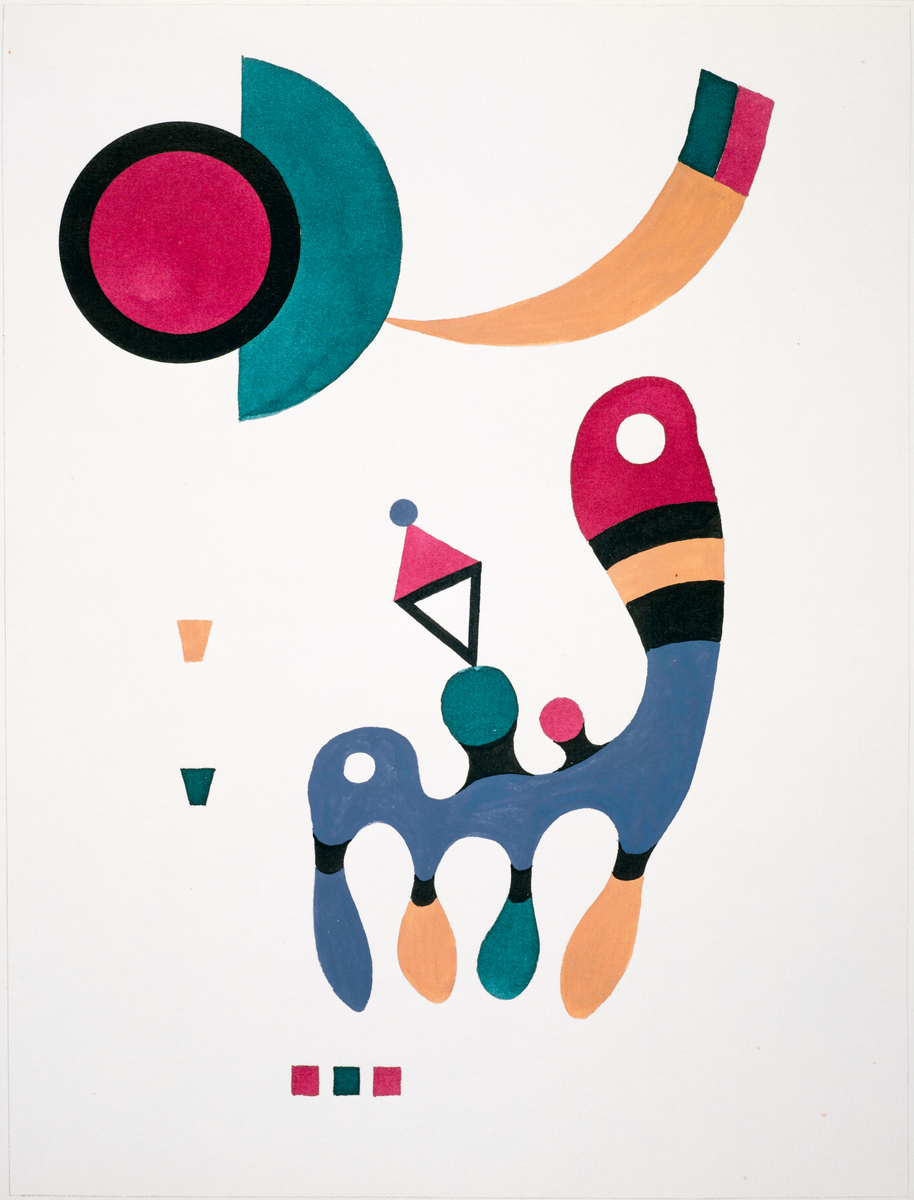
This is Composition, made by Vassily Kandinsky in 1944. The subject is abstract, not a scene or a person. Geometric and organic forms meet on a small sheet of paper, with no depicted narrative subject. The Centre Pompidou classifies the work as abstract art.
The composition combines geometric and organic forms. A striped red head-like form opens through a circular aperture, and a blue arched body carries teardrop pendants. A ringed red disc sits against a teal half-disc, an ochre ribbon curves nearby, and a triangular marker holds a blue dot. These shapes are the visual evidence of the work, not disguised objects from a story.
This sheet is an original stencil gouache. Gouache au pochoir means gouache applied through a stencil, so each colour area was printed by hand rather than painted freely. The image is a hors-commerce copy of the publication 11 tableaux et 7 poemes, issued in Amsterdam by Editions Duwaer in 1945. It is numbered V/XXX and contains an original stencil.
Kandinsky made this in 1944, the year he died. The publication followed in 1945, so the book and the print belong to a later moment than the image's making. Keeping those dates distinct helps. The work is not a casual sketch but a designed plate for a limited edition, and the stencil process gives its flat colour shapes a clean, shared edge.
The work's meaning sits in how its forms relate, not in a hidden narrative. A red head-like shape, a blue arched body, discs and ribbons are held together by shape and colour alone. Kandinsky's abstract language asks you to read those relationships as a composition, and the stencil process is what lets that language reach paper as clean, repeatable colour.
The story and its sources
Historical claims are linked to the records below. Close looking and interpretation are identified in the passage notes.
- Passage 1Close lookingInstitutional record for Composition (1944)Institutional record for Composition (1944)
- Passage 2Close lookingWikimedia Commons: Composition (1944)Institutional record for Composition (1944)Institutional record for Composition (1944)
- Passage 3Documented historyInstitutional record for Composition (1944)Institutional record for Composition (1944)
- Passage 4Documented historyInstitutional record for Composition (1944)Institutional record for Composition (1944)
- Passage 5InterpretationWikimedia Commons: Composition (1944)Institutional record for Composition (1944)Institutional record for Composition (1944)
Details to notice
About 2 minutes to readTriangular marker with blue dot
A black-outlined maroon triangle topped by a small blue dot is positioned between the upper motifs and the blue body like a pivot or small hat.
Ochre curved ribbon
A long beige-ochre arc sweeps from the center toward the upper-right corner, ending in small teal and red rectangular caps. It creates the composition's main diagonal and balances the lower figure.
Ringed red disc and teal half-disc
A maroon disc enclosed by a thick black ring is set against a large flat teal half-disc at the upper left. This cluster establishes the composition's dominant circular counterweight.
Artist portrait Image credit
未知上傳者. Image source · Public domain
About the artist
Wassily Kandinsky
1866 to 1944
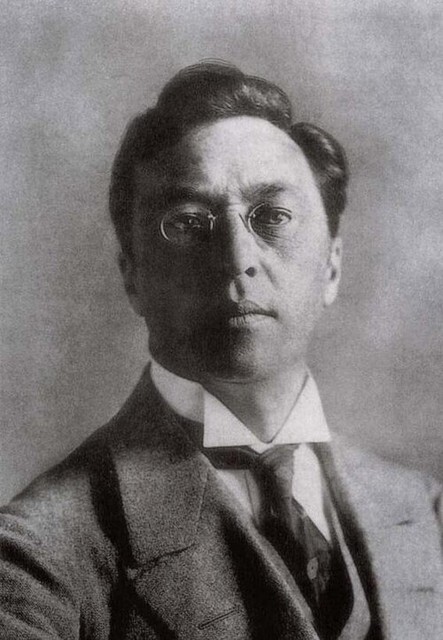
Wassily Kandinsky was an avant-garde painter of Russian origin (1866–1944). Their work is associated with Expressionism; Symbolism; Bauhaus. Their recorded places of work include Paris; Munich; Weimar; Rapallo; The Hague; Russia; Stockholm; Switzerland; Tunis.
- Born
- 1866
- Died
- 1944
- Nationality
- Russian Empire; Russian Soviet Federative Socialist Republic; Soviet Union; France; Germany
- Birthplace
- Moscow
- Died in
- Neuilly-sur-Seine
Biography sources
The research & record
Study the work.
Follow the evidence.
Find catalogue details, historical context, technical research and the literature behind this artwork.
The artwork record
Research catalogue
Catalogue information and detailed research, with references that link to the bibliography.
Updated .
Identity and catalogue
Link- Title
- Composition(Bernard, 2016)
- Artist or attribution
- Vassily Kandinsky(Bernard, 2016)
- Object date
- 1944
- Medium and support
- Gouache au pochoir on paper(Bernard, 2016)
- Dimensions
- 27 x 20.5 cm (image); book dimensions 28 x 35.5 cm(Bernard, 2016)
- Current collection or location
- Musée National d'Art Moderne, Centre Pompidou, Paris(Bernard, 2016)(Musée national d'art moderne, n.d.)
- Movement or period
- Abstract art
- Country or culture
- France (artist of Russian origin, French nationality from 1939)
- Depicted subject
- An abstract composition of geometric and organic forms, made as an original stencil gouache for the deluxe publication '11 tableaux et 7 poèmes' (Amsterdam, Editions Duwaer, 1945).
- Title variants
- Composition (1944)
- Accession number
- AM 81-65-754
- Support
- paper
- Inscriptions
- Legende : Composition 1944
Read valuation records and their limitations
Titles, attribution and dates
The Centre Pompidou records the work under the title Composition, attributed to Vassily Kandinsky and dated 1944. The same catalogue entry gives the artist's life dates as 1866, born in the Russian Empire, and 1944, died in France, so the making of this sheet falls in the final year of his life. That conjunction of dates is a catalogue fact about the object and its maker, not an inference drawn from the image itself; nothing in the supplied record assigns the sheet to a particular month or season of 1944, and the death date should not be read as evidence that the work was finished late in the year.(Bernard, 2016, Main title and creation date; Artist field; Description)(Musée national d'art moderne, n.d., Description)
A second date belongs to a different event. The publication that carries this image, 11 tableaux et 7 poèmes, was issued in Amsterdam by Editions Duwaer in 1945, the year after the artist's death. The institutional description identifies the present sheet as a hors-commerce copy of that publication, numbered V/XXX and containing an original stencil. The 1944 date therefore attaches to the making of the composition, while 1945 attaches to the edition in which this impression circulated. The cataloguing keeps the two moments apart, and they should stay apart in any account of the object: the image precedes the book that delivers it, and the hors-commerce designation and Roman-numeral limitation describe the copy's place within the edition rather than the date of the design.(Bernard, 2016, Description; Main title and creation date)(Musée national d'art moderne, n.d., Description)
Medium, support and scale
The medium is recorded as gouache au pochoir on paper, gouache applied through a stencil. Physically the object is small: the image measures 27 by 20.5 centimeters, while the book containing it measures 28 by 35.5 centimeters. Those figures distinguish the printed image area from the volume that holds it, and they establish that the composition was conceived at a modest scale consistent with a plate in a limited-edition publication. The stencil method, as the record describes it, is the technique by which the gouache reached the paper, and the medium statement should be cited in those terms rather than expanded into claims about individual color areas or the number of passes used.(Bernard, 2016, Dimensions; Description)(Musée national d'art moderne, n.d., Description)
Catalogues and reproduction
Interpretation
Read together, these records describe a single object with several overlapping identities: a 1944 composition by Kandinsky, a stencil plate within a 1945 Amsterdam publication, a numbered hors-commerce copy, and a museum drawing held since 1981. The dates and numbers do different work. The 1944 date concerns authorship and design; the 1945 date concerns the edition; the Roman numeral V/XXX concerns this copy's position in the print run; the inventory number concerns the museum's custody; and the Roethel number concerns the work's place in the catalogue of Kandinsky's graphic output. Keeping these registers separate is what allows the sheet to be described precisely, and it is also what makes it useful for a larger history of the printed multiple: a late work by a major abstract painter, issued as a limited-edition plate and preserved as a museum object with a documented posthumous provenance.(Bernard, 2016, Main title and creation date; Description; Acquisition)(Musée national d'art moderne, n.d., Description; Legs de Nina Kandinsky, 1981)
The work is titled Composition, made by Vassily Kandinsky in 1944.(Bernard, 2016)
The artist is Vassily Kandinsky, born in 1866 in the Russian Empire and died in 1944 in France.(Bernard, 2016)
The image measures 27 by 20.5 centimeters; the book containing it measures 28 by 35.5 centimeters.(Bernard, 2016)
Subject and iconography
LinkRead valuation records and their limitations
The abstract composition and its described forms
Visual observation
The Centre Pompidou record describes Composition as abstract, combining geometric and organic forms, and classifies it as abstract art using those forms without a depicted narrative subject. That institutional classification and the keyword sets attached to the record in both of its online versions provide the frame within which the individual shapes on the small sheet should be read. The description is a characterisation of the work's mode rather than a key to hidden subjects, and the record does not assert any depicted scene or figure. What follows is therefore an account of visible forms and of the terms the cataloguing institution uses for them, not an iconographic decoding.(Bernard, 2016, Subject keywords; Description)(Musée national d'art moderne, n.d., Mots clés iconographiques; Description)
The visible elements of the composition can be enumerated as the image record presents them. A striped red form with a head-like character opens through a circular aperture; a blue arched body carries teardrop pendants; a ringed red disc sits against a teal half-disc; an ochre curved ribbon runs nearby; and a triangular marker holds a blue dot. The vocabulary is deliberately descriptive: "head-like" and "body" describe resemblance in shape, and the record does not identify these forms as persons, portraits or objects from a narrative. The terms record what a viewer can point to on the sheet, while the institutional classification of the whole as abstract art establishes that such resemblance is not to be treated as depiction.(Wikimedia Commons, n.d., Image)(Bernard, 2016, Subject keywords)(Musée national d'art moderne, n.d., Mots clés iconographiques)
Interpretation
Reading these forms together, the sheet sets opposed kinds of shape against one another. The striped red head-like form with its circular aperture and the blue arched body with pendants belong to the organic, curved side of the description; the ringed red disc against a teal half-disc and the triangular marker with a blue dot belong to the geometric side. Curved ribbon and arched body are held in the same field as discs and a triangle, and the record's phrase "combining geometric forms and organic forms" is the catalogue's own summary of that relationship. This is a qualified reading of the described elements rather than an attributed iconographic programme: the evidence supports the observation that curved and angular, open and closed shapes are set in relation, not a claim about what any shape symbolises.(Bernard, 2016, Subject keywords)(Musée national d'art moderne, n.d., Mots clés iconographiques)(Wikimedia Commons, n.d., Image)
Visual observation
The composition is abstract, combining geometric forms and organic forms.(Bernard, 2016)(Musée national d'art moderne, n.d.)
Visible in the composition are a striped red head-like form with a circular aperture, a blue arched body with teardrop pendants, a ringed red disc against a teal half-disc, an ochre curved ribbon, and a triangular marker with a blue dot.(Wikimedia Commons, n.d.)
Historical context
LinkRead valuation records and their limitations
The object and its documented creation
Interpretation
The object is a gouache au pochoir on paper titled Composition, made by Vassily Kandinsky in 1944, and it is now held in the Cabinet d'art graphique of the Musée National d'Art Moderne, Centre Pompidou, Paris, under inventory number AM 81-65-754. The institutional records give the image as 27 by 20.5 centimeters; the book in which this copy belongs measures 28 by 35.5 centimeters, so the sheet was designed to sit within a larger publication format. Kandinsky, born in 1866 in the Russian Empire, died in 1944 in France, the same year assigned to the work. The Centre Pompidou classifies it as abstract art combining geometric and organic forms without a depicted narrative subject.(Bernard, 2016, Description; Subject keywords; Genre and subject)(Musée national d'art moderne, n.d., Description; Mots clés iconographiques)
The sheet is not a stand-alone print but a hors-commerce copy of the publication 11 tableaux et 7 poèmes, issued in Amsterdam by Editions Duwaer in 1945. This copy is numbered V/XXX and is described as containing an original stencil. Two dates therefore need to be kept distinct: the 1944 creation of the image and the 1945 appearance of the book, so that the plate belongs to a designed, limited-edition publishing project rather than to casual sketching. The medium description, gouache au pochoir, establishes the method: gouache applied through a stencil, so that each colour area was formed as a printed shape rather than freely brushed. The evidence documents the publication and the numbered, non-commercial status of this copy; it does not record the press run of the edition, the exact number of plates printed from this design, or the circumstances under which Kandinsky supplied the design to the publisher, and those points remain outside what these records establish.(Bernard, 2016, Description)(Musée national d'art moderne, n.d., Description)
Provenance and cataloguing
The work also appears in colour on p. 245 of the exhibition catalogue Kandinsky. 1933-1944. Les années parisiennes (Musée de Grenoble, 2016-2017), although the institutional record states that it was not exhibited in that show. Reproduction in a catalogue without display is a meaningful distinction: it shows the sheet circulating as an illustrative reference for Kandinsky's Paris years while remaining outside the exhibition's installed selection. The evidence establishes the reproduction and the non-exhibition; it does not explain the selection decision, and no motive should be inferred for the inclusion of the image in the catalogue alone.(Bernard, 2016, Acquisition; Bibliography; Description)(Musée national d'art moderne, n.d., Legs de Nina Kandinsky, 1981; Description)
Interpretation
Read together, the units describe an object whose importance lies at the intersection of late graphic production and the collecting history of Kandinsky's estate. The hors-commerce numbering V/XXX, the 1945 Amsterdam imprint and the 1944 date establish a late work conceived for a deluxe publication; the 1981 bequest and the 1970 Roethel catalogue establish its passage into institutional and scholarly custody; and the 2016-2017 catalogue reproduction shows its continuing use as a reference point for the artist's Paris period, even where it was not hung. This layered record, rather than any single document, is what makes the sheet useful for the study of the pochoir as a medium of abstract art in the mid-twentieth century. The evidence is silent on the artist's intentions regarding the individual motifs, on the size of the edition beyond this copy's numbering, and on the ownership history between publication and bequest; those absences should be stated rather than resolved by conjecture.(Bernard, 2016, Description; Acquisition; Bibliography; Genre and subject)(Musée national d'art moderne, n.d., Description; Legs de Nina Kandinsky, 1981)(Wikimedia Commons, n.d., Image)
This is a hors-commerce copy of the publication '11 tableaux et 7 poèmes' (Amsterdam, Editions Duwaer, 1945), numbered V/XXX, containing an original stencil.(Bernard, 2016)(Musée national d'art moderne, n.d.)
Materials and technique
LinkRead valuation records and their limitations
Medium and support
The Centre Pompidou record identifies the medium of this sheet as gouache au pochoir on paper, that is, gouache applied through a stencil rather than brushed freely onto the support. This classification is a cataloguing statement by the holding institution, not a description of a visible brush impression, and it establishes the basic material equation for the object: a paper support, a gouache medium, and a stencil as the means of transferring colour. The same account explains that the sheet is a hors-commerce copy of the publication 11 tableaux et 7 poèmes, issued in Amsterdam by Editions Duwaer in 1945, and that it contains an original stencil and is numbered V/XXX. The making of the image and its appearance in a limited-edition publication are therefore linked through the stencil process itself, which is at once a picture-making technique and a means of producing a numbered edition.(Bernard, 2016, Techniques)
Reading form and technique together
Interpretation
The visible composition and the documentary medium complement one another, though they should not be conflated. The institutional record describes the composition as abstract, combining geometric and organic forms, and classifies it as abstract art using geometric and organic forms without a depicted narrative subject. A visual description of the image identifies a striped red head-like form with a circular aperture, a blue arched body with teardrop pendants, a ringed red disc against a teal half-disc, an ochre curved ribbon, and a triangular marker with a blue dot. These are observations of the image, while the gouache au pochoir medium is a documented catalogue fact; the observation that colour areas read as flat and share clean edges follows from the stencil account but is not itself recorded as a technical finding in the evidence. What the two kinds of statement jointly establish is an object whose abstract vocabulary of discs, arcs, ribbons and markers was realised through a reproductive stencil technique rather than through free painting.(Bernard, 2016, Subject keywords; Techniques)(Musée national d'art moderne, n.d., Mots clés iconographiques)(Wikimedia Commons, n.d., Image)
The medium is gouache au pochoir on paper, meaning gouache applied through a stencil.(Bernard, 2016)
Provenance and ownership
LinkRead valuation records and their limitations
Identity and Custody of the Object
Composition carries the inventory number AM 81-65-754 and is held in the Cabinet d'art graphique of the Musée National d'Art Moderne, Centre Pompidou, Paris. Both institutional records consulted for this account identify the work as a gouache au pochoir on paper, that is, gouache applied through a stencil, made by Vassily Kandinsky in 1944, the year of the artist's death; the Centre Pompidou records give the artist's life dates as 1866, in the Russian Empire, to 1944, in France. The image measures 27 by 20.5 centimeters, while the book containing it measures 28 by 35.5 centimeters, so the sheet is a plate within a larger publication object rather than a free-standing picture. The composition is described as abstract, combining geometric and organic forms without a depicted narrative subject. These physical and descriptive facts frame every question of provenance that follows: the object that changed hands was not a painting but a printed plate inside a limited-edition book.(Bernard, 2016, Acquisition; Description)(Musée national d'art moderne, n.d., Legs de Nina Kandinsky, 1981; Description)
The documented provenance of this specific copy has a single recorded transfer. The work entered the collection through the bequest of Nina Kandinsky in 1981, a transfer attested by both the Centre Pompidou collection record and its published institutional entry, which cites the bequest directly. That event is the terminus of the documented chain and is stated without reference to any earlier owner, sale, dealer or acquisition by Nina Kandinsky herself. The sources accordingly establish one dated, institutionally registered change of custody and leave the period before 1981 unrecorded: an unrecorded interval is not evidence of a proven change of ownership, and nothing in the supplied records permits the reconstruction of intervening hands. The inventory number AM 81-65-754, with its 1981 segment, is consistent with registration in the year of the bequest, though the sources present the number as an identifier rather than as an explanation of the acquisition process.(Bernard, 2016, Acquisition)(Musée national d'art moderne, n.d., Legs de Nina Kandinsky, 1981)
Provenance here must be understood together with the object's status as a publication. This is a hors-commerce copy of 11 tableaux et 7 poèmes, published in Amsterdam by Editions Duwaer in 1945, numbered V/XXX and containing an original stencil. Because the image was made in 1944 but the book appeared in 1945, the object's existence as a numbered plate belongs to a moment after Kandinsky's death; the edition, not the artist alone, is the immediate context in which this sheet was produced and circulated. The distinction matters for provenance because the documented history of this copy begins only with Nina Kandinsky's bequest, and the sources do not state how the hors-commerce copy passed from the 1945 publication into her hands. The publication details establish what the object is and when it was issued; they do not fill the gap in its ownership record.(Bernard, 2016, Acquisition; Description)(Musée national d'art moderne, n.d., Legs de Nina Kandinsky, 1981; Description)
The work's scholarly footprint can be traced through cataloguing and reproduction, which record its place in the literature without documenting transfers of ownership. It is catalogued in Roethel, Kandinsky. Das graphische Werk (Cologne, DuMont Schauberg, 1970), cat. no. IV 2, p. 413, and reproduced there as no. 73, p. 485, placing it within the systematic record of Kandinsky's graphic work compiled before the 1981 bequest. It also appears reproduced in colour at p. 245 of the exhibition catalogue Kandinsky. 1933-1944. Les années parisiennes (Musée de Grenoble, 2016-2017), though the sources state it was not exhibited there. Neither publication is presented as evidence of ownership; both are evidence of recognition and documentation, and the distinction between being catalogued or reproduced and being shown or held should be preserved when the object's history is summarized.(Bernard, 2016, Acquisition; Bibliography)(Musée national d'art moderne, n.d., Legs de Nina Kandinsky, 1981)
The work entered the collection through the bequest of Nina Kandinsky in 1981.(Bernard, 2016)(Musée national d'art moderne, n.d.)
Provenance timeline
- 1945
Publication of the portfolio 11 tableaux et 7 poèmes by Editions Duwaer in Amsterdam, of which this work is a hors-commerce copy numbered V/XXX containing an original stencil.(Bernard, 2016, Description)(Musée national d'art moderne, n.d., Description)
- 1981
The work entered the public collection through the bequest of Nina Kandinsky.(Bernard, 2016, Acquisition)(Musée national d'art moderne, n.d., Legs de Nina Kandinsky, 1981)
- 2016-2017
The work was reproduced in colour in the exhibition catalogue Kandinsky. 1933-1944. Les années parisiennes at the Musée de Grenoble, though it was not exhibited.(Bernard, 2016, Bibliography)
Exhibition history
LinkRead valuation records and their limitations
The Grenoble Catalogue and the Limits of the Exhibition Record
The exhibition record for Composition is thin but precise, and it is defined by a distinction that is easy to collapse: the work appears in an exhibition catalogue without having been shown in the exhibition the catalogue documents. The catalogue Kandinsky. 1933-1944. Les années parisiennes, published for the Musée de Grenoble in 2016-2017, reproduces the work in colour at page 245. The same record states that the work was not exhibited in that presentation. The page reference therefore locates a colour plate, not a display position, and the volume's presence in the object's bibliography attests to the work's place in the scholarship of Kandinsky's Paris years rather than to a loan history. The published catalogue is credited with Sophie Bernard as director, carries the ISBN 978-2-7572-1190-8, and appeared in French; the evidence does not record a venue beyond the Musée de Grenoble nor dates finer than the 2016-2017 span.(Bernard, 2016, Bibliography)
What the object is materially conditions how it can be shown and why its exhibition footprint is slight. According to the Centre Pompidou's institutional records, the sheet measures 27 by 20.5 centimetres while the book that contains it measures 28 by 35.5 centimetres; it is a copy hors commerce of 11 tableaux et 7 poèmes, issued in Amsterdam by Editions Duwaer in 1945, numbered V/XXX and containing an original stencil. The technique is gouache au pochoir, gouache applied through a stencil. The image dates to 1944, the year of Kandinsky's death, while the publication belongs to 1945, so the print and its host volume represent a moment after the making of the image. A plate conceived as part of a limited-edition livre d'artiste, held with an original stencil rather than as a single independent sheet, is the kind of object for which catalogue reproduction is often the principal form of public visibility; the Centre Pompidou record identifies the holding as the Cabinet d'art graphique of the Musée National d'Art Moderne, with inventory number AM 81-65-754.(Bernard, 2016, Acquisition; Bibliography)(Musée national d'art moderne, n.d., Legs de Nina Kandinsky, 1981)
The work's entry into public custody is documented independently of its display: it came to the collection through the bequest of Nina Kandinsky in 1981. This provenance is separate from the 1945 Amsterdam publication of the portfolio and from the 1944 date of the image, and it should not be read back into the exhibition account as though it were a showing. The distinction matters because the same institutional records that establish the bequest also supply the physical description of the sheet, its edition status and its inventory number; a reader consulting the exhibition history should keep the bequest, the manufacture of the image, the printing of the book and the catalogue reproduction as four distinct events. Nothing in the supplied evidence records a solo or group exhibition in which this specific copy was hung.(Bernard, 2016, Acquisition; Bibliography)(Musée national d'art moderne, n.d., Legs de Nina Kandinsky, 1981)
Documentation Beyond Display
For the catalogue raisonné of the graphic work, the object is recorded in Roethel, Kandinsky. Das graphische Werk, published in Cologne by DuMont Schauberg in 1970, as cat. no. IV 2, page 413, with a reproduction as no. 73, page 485. This is a scholarly catalogue entry rather than an exhibition record, and it confirms that the stencil was already treated as part of Kandinsky's printed oeuvre more than a decade before the 1981 bequest brought this copy into the Musée National d'Art Moderne. Read together with the 2016-2017 Grenoble catalogue, the bibliography shows a continuous documentary life for the work in print that is not paralleled, in the supplied evidence, by any record of physical display.(Bernard, 2016, Bibliography)
Interpretation
The Centre Pompidou classifies the composition as abstract, combining geometric and organic forms without a depicted narrative subject. That classification is a curatorial description of what the sheet shows, and it is the basis on which the work enters the histories of abstraction to which the Paris years catalogue belongs. In the context of exhibition and documentation, the point is not merely iconographic: a small stencil plate, editioned within a wartime livre d'artiste and catalogued by Roethel, reproduced in a twenty-first-century exhibition catalogue but not hung in it, and finally bequeathed by the artist's widow, sits at the intersection of print scholarship, the artist's late Paris production and institutional collecting. Its importance to material culture lies in that convergence, and the evidence supports it while leaving the details of any display history unrecorded.(Bernard, 2016, Acquisition; Bibliography)(Musée national d'art moderne, n.d., Legs de Nina Kandinsky, 1981)
The work is reproduced in colour (p. 245) in the exhibition catalogue Kandinsky. 1933-1944. Les années parisiennes (Musée de Grenoble, 2016-2017), though not exhibited.(Bernard, 2016)
Reception and literature
LinkRead valuation records and their limitations
From the Portfolio to the Cabinet d'art graphique
The reception of this Composition (1944) has to be reconstructed from catalogues, collection records and a later exhibition publication, and each of those instruments records a different kind of attention. The work is a hors-commerce copy of the publication 11 tableaux et 7 poèmes, issued in Amsterdam by Editions Duwaer in 1945, numbered V/XXX and containing an original stencil; the image itself is gouache applied through a stencil, gouache au pochoir, and measures 27 by 20.5 centimeters, while the book it belongs to measures 28 by 35.5 centimeters. That double identity, a designed plate inside a limited edition and a separately catalogued sheet in the Cabinet d'art graphique of the Musée National d'Art Moderne, Centre Pompidou, under inventory number AM 81-65-754, is the frame within which all later descriptions, bibliographic citations and reproductions of the work operate. Its arrival in the national collection came only through the bequest of Nina Kandinsky in 1981, so the work's public institutional life is later than its making and publication.(Bernard, 2016, Description; Acquisition; Bibliography)(Musée national d'art moderne, n.d., Description; Legs de Nina Kandinsky, 1981)
Bibliography and the Graphic Work
The first substantial layer of reception is bibliographic, and it is shaped by Roethel's catalogue of Kandinsky's graphic work: Kandinsky. Das graphische Werk, published in Cologne by DuMont Schauberg in 1970, records the sheet as catalogue number IV 2, p. 413, with a reproduction at no. 73, p. 485. That placement is consequential for how the object has been understood, because it treats the stencil as part of the printed and graphic oeuvre rather than as an isolated drawing, and it fixes a reference point against which later publications cite the work. The Centre Pompidou's own record reproduces this catalogue information alongside its description, so the standard reference and the collection's account reinforce one another. Sophie Bernard's 2016 publication shows a second, more recent layer of cataloguing: the exhibition catalogue Kandinsky. 1933-1944. Les années parisiennes, held at the Musée de Grenoble in 2016-2017, reproduces the work in colour at p. 245 although the sheet was not exhibited there. Reproduction without display is a distinct form of reception, one that circulates a work's image and places it within a narrative of the artist's Paris years while keeping the object itself off the wall.(Bernard, 2016, Bibliography)
Accumulated Meanings
Interpretation
Taken together, these stages show a work whose fame is cumulative rather than dramatic. The 1945 publication gave the stencil a place within a limited-edition portfolio; Roethel's 1970 catalogue fixed its status within Kandinsky's graphic oeuvre; the 1981 bequest brought the sheet into a national collection, where it received an inventory number and an abstract classification; and the 2016-2017 Grenoble catalogue reproduced it in colour in a study of the Paris years even though it was not shown. None of these stages erases the earlier ones, and the sheet's original function as a plate in a book has not been replaced by its later role as a museum object so much as supplemented by it. The evidence does not supply a history of critical interpretation, imitation or artistic appropriation, and it would be a mistake to infer one; what it does document is a steady bibliographic and institutional attention that has kept the work visible through reproduction and cataloguing.(Bernard, 2016, Description; Bibliography; Acquisition; Subject keywords)(Musée national d'art moderne, n.d., Description; Legs de Nina Kandinsky, 1981; Mots clés iconographiques)
The work is catalogued in Roethel, Kandinsky. Das graphische Werk (Cologne, DuMont Schauberg, 1970), cat. no. IV 2, p. 413, reproduced no. 73, p. 485.(Bernard, 2016)
Interpretations and debates
LinkRead valuation records and their limitations
Attributed Readings and Their Limits
Interpretation
The Centre Pompidou describes Composition as abstract art, built from geometric forms and organic forms, and expressly without a depicted narrative subject. This is a classification attached to the object by the holding institution, and it should be kept distinct from any statement about what Kandinsky privately intended when he made the plate. The institutional reading establishes how the work is framed within the collection: its interest is carried by the arrangement of forms rather than by reference to a scene or a person. That framing also sets the terms in which the visible elements can be discussed, as compositional components whose relationships matter rather than as disguised actors in a story.(Bernard, 2016, Genre and subject)
The institutional catalogue description of the composition as abstract, combining geometric and organic forms, is corroborated by the image record and by the collection database's subject keywords. The same abstract character is described independently in the museum's two records and in the visual documentation, so the general description of the composition is not the product of a single cataloguing pass. What this agreement establishes is a shared description of the object's formal language; it does not establish a narrative reading that the sources deliberately decline to supply.(Bernard, 2016, Subject keywords; Genre and subject)(Musée national d'art moderne, n.d., Mots clés iconographiques)
The object is a hors-commerce copy of the publication 11 tableaux et 7 poèmes, issued in Amsterdam by Editions Duwaer in 1945, numbered V/XXX and containing an original stencil; both the institutional record and the collection database give this publication context, and the database separately records the same numbering and edition details. The medium is gouache au pochoir on paper, that is, gouache applied through a stencil. The image measures 27 by 20.5 centimeters and the book containing it measures 28 by 35.5 centimeters. The work is held in the Cabinet d'art graphique of the Musée National d'Art Moderne, Centre Pompidou, Paris, under inventory number AM 81-65-754, and it entered the collection through the bequest of Nina Kandinsky in 1981. These documented particulars situate the sheet within a limited edition rather than treating it as an isolated drawing, and they give the stencil its place as the technique through which the plate's colour areas reached paper.(Bernard, 2016, Description; Subject keywords; Genre and subject)(Musée national d'art moderne, n.d., Description; Mots clés iconographiques)
The Centre Pompidou classifies the work as abstract art, using geometric and organic forms without a depicted narrative subject.(Bernard, 2016)
Collection and display
LinkRead valuation records and their limitations
Museum record and provenance
The work is held in the Cabinet d'art graphique of the Musée National d'Art Moderne, Centre Pompidou, Paris, under inventory number AM 81-65-754. Both institutional records consulted for this object agree on this location and number, so the sheet is documented as part of a graphic-arts cabinet rather than a painting collection, a distinction that matters for how it is stored, handled and studied. The same records state that it entered the collection through the bequest of Nina Kandinsky in 1981, which links the sheet's museum history to the artist's widow and to the posthumous transfer of Kandinsky's estate into French public collections. Because the inventory number and the bequest are given in two independent records from the same institution, they are the firmest facts in this account; other details, such as medium, publication and catalogue references, rest on the combined institutional and catalogue sources described below.(Bernard, 2016, Collection area and inventory no.)(Musée national d'art moderne, n.d., Inv.)
The work is held in the Cabinet d'art graphique of the Musée National d'Art Moderne, Centre Pompidou, Paris, with inventory number AM 81-65-754.(Bernard, 2016)(Musée national d'art moderne, n.d.)
Documented values and qualified estimates
LinkRead valuation records and their limitations
Recorded values
Interpretation
The object's recorded value derives from a documented institutional identity rather than from a transaction. The working insurance estimate runs from US$400K to US$1.5M, a conservative range derived only from confirmed context: a 1944 Vassily Kandinsky gouache au pochoir on paper with an image of 27 by 20.5 cm, an original stencil made for the deluxe hors-commerce publication 11 tableaux et 7 poèmes (Amsterdam, Editions Duwaer, 1945), numbered V/XXX, held at the Musée National d'Art Moderne, Centre Pompidou, inventory AM 81-65-754, from the Nina Kandinsky bequest of 1981, and documented in Roethel's Kandinsky graphic-work catalogue as cat. no. IV 2. The range is stated to reflect the artist's prominence, the work's late date and small scale, its status as a multiple-related stencil print in a museum graphic-arts collection rather than a unique oil, and the strength of its provenance and catalogue documentation.(Bernard, 2016)(Musée national d'art moderne, n.d.)(Wikimedia Commons, n.d.)
The qualification attached to that range is as consequential as the range itself. The figure is described as a model-generated working insurance range for manual review only, not an official insurance value, appraisal, auction result, or sale price. It was not prepared by a qualified appraiser and does not reflect inspection of the physical object, condition, authenticity, title, or current market comparables, and no comparable sales, private insurance records, or public appraisals were consulted, which is why the figure is intentionally wide and bracketed. The stated remedy is confirmation with a qualified fine-art appraiser and the collecting institution before any insurance or financial use.(Bernard, 2016)(Musée national d'art moderne, n.d.)(Wikimedia Commons, n.d.)
What the range can and cannot measure follows from what the sources establish about the work. The institutional records fix the title Composition, the maker Vassily Kandinsky (born 1866 in the Russian Empire, died 1944 in France), the medium of gouache au pochoir on paper, meaning gouache applied through a stencil, the image dimensions of 27 by 20.5 cm, and the book dimensions of 28 by 35.5 cm. They also fix the holding in the Cabinet d'art graphique of the Musée National d'Art Moderne, Centre Pompidou, Paris, under inventory number AM 81-65-754, entry through the Nina Kandinsky bequest of 1981, and the work's place as a hors-commerce copy of '11 tableaux et 7 poèmes' (Amsterdam, Editions Duwaer, 1945), numbered V/XXX and containing an original stencil. That combination of documented multiple, museum graphic-arts collection and strong provenance is exactly what the valuation reasoning cites, while the absence of condition inspection or comparables is what it excludes.(Bernard, 2016)(Musée national d'art moderne, n.d.)(Wikimedia Commons, n.d.)
Working estimate
Calculated working insurance estimate, not a sale price: Estimated value: US$400K to US$1.5M Recorded date: Working calculation, generated 2026-10-30. Methodology: Conservative working range derived from confirmed context only: a 1944 Vassily Kandinsky gouache au pochoir on paper (27 x 20.5 cm image), an original stencil made for the deluxe hors-commerce publication 11 tableaux et 7 poemes (Amsterdam, Editions Duwaer, 1945), numbered V/XXX, held at the Musee National d'Art Moderne, Centre Pompidou (inventory AM 81-65-754), from the Nina Kandinsky bequest of 1981, and documented in Roethel's Kandinsky graphic-work catalogue (cat. no. IV 2). The range reflects the artist's prominence, the work's late date and small scale, its status as a multiple-related stencil print in a museum graphic-arts collection rather than a unique oil, and the strong provenance and catalogue documentation. No comparable sales, private insurance records, or public appraisals were consulted, so the figure is intentionally wide and bracketed for manual review. Qualification: This is a model-generated working insurance range for manual review only. It is not an official insurance value, appraisal, auction result, or sale price. It was not prepared by a qualified appraiser and does not reflect inspection of the physical object, condition, authenticity, title, or current market comparables. No public appraisal or private insurance data was used. Confirm all figures with a qualified fine-art appraiser and the collecting institution before any insurance or financial use.(Bernard, 2016)(Musée national d'art moderne, n.d.)(Wikimedia Commons, n.d.)
Further reading
Books for a closer look
Paid links. As an Amazon Associate I earn from qualifying purchases.

Open Library Kandinsky compositions
Museum of Modern Art; Distributed by Harry N. Abrams, Inc.
Recorded as 'Kandinsky compositions', with a Kandinsky exhibition subject and an individual-artist focus. It directly matches the artist and the work's title type, Composition, and is the most object-specific Kandinsky candidate available. The catalogue entry gives no chapter details, so its treatment of this 1944 stencil cannot be verified.
ISBN 0810961423

Open Library Kandinsky: Russian and Bauhaus years, 1915-1933.
Solomon R. Guggenheim Museum
Catalogued as a Kandinsky volume with subjects including abstract painting, prints, catalogues raisonnes, and Centre Georges Pompidou and Musee national d'art moderne collections, which aligns with the work's repository, its abstract classification, and its stencil print medium. Listed among related catalogues rather than as a monograph on the 1945 Duwaer portfolio.
ISBN 0892070447

Open Library Vassily Kandinsky
Poligrafa; Polı́grafa; D.A.P./Distributed Art Publishers [distributor]
A Kandinsky criticism and interpretation title by Max Bill and Carola Giedion-Welcker, relevant to the artist and his late abstract work. It is a general critical study, not documented as treating '11 tableaux et 7 poemes' or this specific gouache au pochoir.
ISBN 9788434312135
Bibliography
Sources and further reading
References are arranged by author or organisation, with links to the original publications. Where no publication date is recorded, n.d. means no date.
Source notes updated .
No recorded sources match these filters. Reset the filters to see the full bibliography.
- 02
Official · Background reading
Institutional record for Composition (1944). Kandinsky. 1933-1944. Les années parisiennes, pp. 245. www.centrepompidou.fr.
Exhibition catalogue (Musée de Grenoble, 2016-2017) reproducing the work in colour.
- Language
- French
- ISBN
- 978-2-7572-1190-8
Citation text
- 06
Book
Vassily Kandinsky. Poligrafa; Polı́grafa; D.A.P./Distributed Art Publishers [distributor].
A Kandinsky criticism and interpretation title by Max Bill and Carola Giedion-Welcker, relevant to the artist and his late abstract work. It is a general critical study, not documented as treating '11 tableaux et 7 poemes' or this specific gouache au pochoir.
- ISBN
- 9788434312135
Citation text
- 04
Book
Kandinsky compositions. Museum of Modern Art; Distributed by Harry N. Abrams, Inc.
Recorded as 'Kandinsky compositions', with a Kandinsky exhibition subject and an individual-artist focus. It directly matches the artist and the work's title type, Composition, and is the most object-specific Kandinsky candidate available. The catalogue entry gives no chapter details, so its treatment of this 1944 stencil cannot be verified.
- ISBN
- 0810961423
Citation text
- 03
Official · About this artwork
Institutional record for Composition (1944). Vassily KANDINSKY, Composition. collection.centrepompidou.fr.
Collection database record with supplementary details on the publication, provenance and keywords.
- Language
- French
Citation text
- 05
Book
Kandinsky: Russian and Bauhaus years, 1915-1933. Solomon R. Guggenheim Museum.
Catalogued as a Kandinsky volume with subjects including abstract painting, prints, catalogues raisonnes, and Centre Georges Pompidou and Musee national d'art moderne collections, which aligns with the work's repository, its abstract classification, and its stencil print medium. Listed among related catalogues rather than as a monograph on the 1945 Duwaer portfolio.
- ISBN
- 0892070447
Citation text
- 01
Secondary · About this artwork
Wikimedia Commons: Composition (1944). Kandinsky, Wassily - Composition, 1944, GAC.jpg.
Discovery image record from Google Arts & Culture; not used as an authority for catalogue data.
- Language
- English
Citation text
Art to live with
Bring this painting
home.
A piece of the archive, made yours. Explore Composition in a size and finish that fits your space.
Your text and annotations appear on these editions. Adding to cart saves that design for printing.
Combine this painting with your favouritesThis product is not available in your country. Choose another delivery country to see available editions.
01 / Find your edition
Made for you
Suggested from your location. Change it if you're sending elsewhere or using a VPN. Prices and delivery are shown in GBP.
0 products
Choose an edition to make it yours
The 30 cm ruler is scaled alongside your selected print. Keep the painting’s proportions with a black background, or stretch it to fill. Frame width, material texture and screen colours are illustrative.
Keep exploring