Impression V (Parc)
Artist: Vassily Kandinsky · 12 March 1911

Impression V (Parc): high-resolution image
The original file is hosted by Wikimedia Commons, available without payment or an account.
Open high-resolution image on Wikimedia CommonsThe complete story
The story About 3 minutes to read
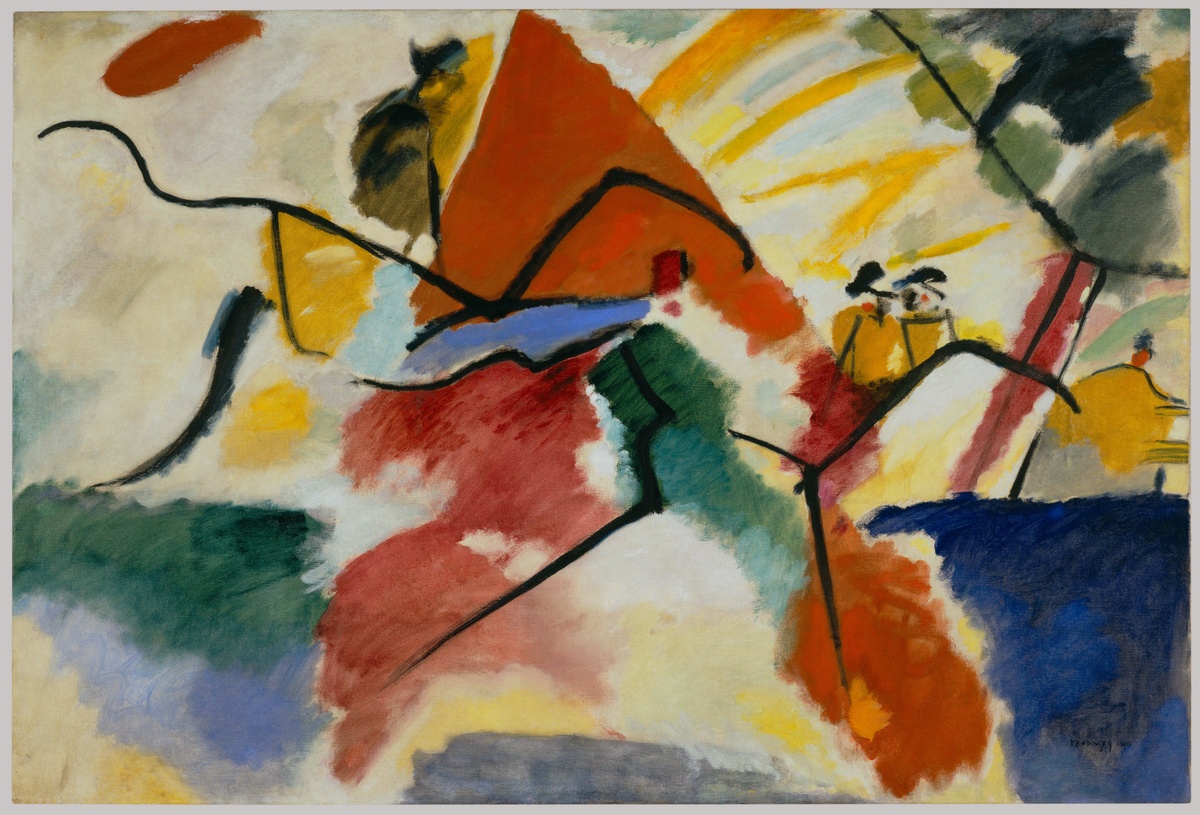
Kandinsky painted this work on 12 March 1911, and he later grouped it among six 1911 canvases he called Impressions. In his essay Du Spirituel dans l'art, he explained that these works were still inspired by external nature and let some concrete elements show through. So this is not pure abstraction. It began with something seen, and two horsemen with their mount are still legible, reduced to black lines.
Those black-line horsemen are superimposed on a monumental red triangle. The Centre Pompidou describes the triangle as having symbolic meaning, though the record does not spell out a single fixed interpretation. What we can see is that the riders are drawn rather than modelled, and the triangle dominates the field of colour behind them. The figure is present, but it has been simplified until it reads as a sign.
The painting belongs to the moment when Kandinsky was pushing form and colour away from describing the visible world. The Centre Pompidou states that in this work form and colour move away from any descriptive function and instead convey rhythms and cadences. That is the shift to notice. Colour is no longer asked to tell you what a thing looks like. It is asked to carry tempo and pulse.
Kandinsky exhibited the painting at the Salon des Indépendants in Paris in 1911, the year he made it. That places it in public view at the same moment his ideas about non-descriptive colour were taking shape. The title Impression is telling. It claims a connection to something seen, while the image itself loosens that connection almost to breaking point.
So the work holds two things at once. The horsemen and the red triangle keep the painting anchored to a subject, while the free play of colour and rhythm pulls it toward abstraction. That tension is the painting's real subject. Kandinsky is not asking you to read a scene literally. He is asking you to feel how line and colour can carry movement and cadence, even when the figures have almost dissolved into signs.
The story and its sources
Historical claims are linked to the records below. Close looking and interpretation are identified in the passage notes.
- Passage 1Documented historyInstitutional record for Impression V
- Passage 2InterpretationInstitutional record for Impression V
- Passage 3Documented historyInstitutional record for Impression V
- Passage 4Documented historyInstitutional record for Impression V
- Passage 5InterpretationInstitutional record for Impression V
Details to notice
About 2 minutes to readBlue horizon band
A vivid blue horizontal band cuts beneath the red mass, creating the painting's key warm-cool color contrast and separating the upper scene from the ground.
Yellow rays
A fan of yellow and pale strokes radiates behind the red mass, evoking sunlight and the luminous atmosphere of the park.
Sweeping black line
A long black calligraphic line arcs from the left edge into the colored center, acting as the structural gesture that binds the abstract forms.
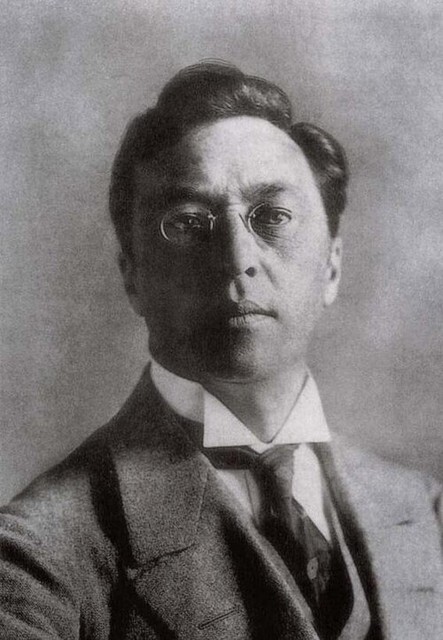
Artist portrait Image credit
未知上傳者. Image source · Public domain
About the artist
Wassily Kandinsky
1866 to 1944
Wassily Kandinsky was an avant-garde painter of Russian origin (1866–1944). Their work is associated with Expressionism; Symbolism; Bauhaus. Their recorded places of work include Paris; Munich; Weimar; Rapallo; The Hague; Russia; Stockholm; Switzerland; Tunis.
- Born
- 1866
- Died
- 1944
- Nationality
- Russian Empire; Russian Soviet Federative Socialist Republic; Soviet Union; France; Germany
- Birthplace
- Moscow
- Died in
- Neuilly-sur-Seine
Biography sources
The research & record
Study the work.
Follow the evidence.
Find catalogue details, historical context, technical research and the literature behind this artwork.
The artwork record
Research catalogue
Catalogue information and detailed research, with references that link to the bibliography.
Updated .
Identity and catalogue
Link- Title
- Impression V (Parc)
- Artist or attribution
- Vassily Kandinsky
- Object date
- 12 March 1911
- Medium and support
- Oil on canvas
- Dimensions
- 106 x 157.5 cm
- Current collection or location
- Musée national d'art moderne, Centre Pompidou, Paris (record notes a loan to Palazzo Bonaparte, Rome, 15 September 2026 to 14 February 2027)
- Movement or period
- Der Blaue Reiter
- Country or culture
- Russia / France (artist of Russian birth, French nationality from 1939)
- Depicted subject
- Still inspired by external nature, the painting shows two horsemen and their mount reduced to black lines, superimposed on a monumental red triangle with symbolic meaning, as form and colour move away from descriptive function toward rhythm and cadence.
- Title variants
- Impression V; Impression V (Park)
- Accession number
- AM 1976-851
- Support
- Canvas
- Inscriptions
- S.D.B.DR. : KANDINSKY 1911.
Read valuation records and their limitations
Catalogue identity
The institutional record catalogues the work as Impression V (Parc), attributed to Vassily Kandinsky and dated 12 March 1911. The same record gives the support and medium as oil on canvas and the dimensions as 106 by 157.5 centimetres. The painting carries an inscription at the lower right, 'KANDINSKY 1911', which combines the artist's name with the year 1911. This inscribed year and the recorded day of execution belong to the object's own date; they are distinct from the later catalogue and database activity through which the work is now documented. The account below therefore keeps the 1911 making of the painting separate from the twentieth- and twenty-first-century institutional dates that surround its acquisition, display and loan.(www.centrepompidou.fr, n.d., Informations détaillées; Inscriptions)
The title word 'Parc' and the title structure 'Impression V' connect the canvas to a series of works that Kandinsky himself later framed. In his essay Du Spirituel dans l'art of 1912, Kandinsky called six of his 1911 paintings Impressions, and he described these as still inspired by external nature, allowing some concrete elements to show through. The essay thus provides the artist's own retrospective grouping of the 1911 canvases, one year after the date inscribed on this painting. The catalogue title preserves that grouping while the parenthetical 'Parc' points to the external nature from which the Impression was drawn.(www.centrepompidou.fr, n.d., Premier paragraphe; Informations détaillées; Inscriptions)
Acquisition and current location
Ownership of the canvas is documented as a donation by Nina Kandinsky in 1976, the year in which the work entered the collection. The painting is held in the Musée national d'art moderne, Centre Pompidou, under inventory number AM 1976-851; the inventory prefix and year match the 1976 donation. This accession information belongs to the object's later institutional history and should not be conflated with the 1911 date of execution or with the 1912 essay in which Kandinsky described the Impressions. The record also notes an ongoing or recent loan of the painting to Palazzo Bonaparte, Rome, scheduled from 15 September 2026 to 14 February 2027, a further institutional date attached to the work's movements rather than to its creation.(www.centrepompidou.fr, n.d., Acquisition; Informations détaillées; Inscriptions; Premier paragraphe)(collection.centrepompidou.fr, n.d.)
The work is titled Impression V (Parc), made by Vassily Kandinsky on 12 March 1911, oil on canvas, 106 x 157.5 cm.(www.centrepompidou.fr, n.d.)
The painting bears the inscription 'KANDINSKY 1911' at the lower right.(www.centrepompidou.fr, n.d.)
Historical context
LinkRead valuation records and their limitations
The documented object
The institutional record identifies the painting as Impression V (Parc), made by Vassily Kandinsky on 12 March 1911 in oil on canvas and measuring 106 by 157.5 cm. It is held in the Musée national d'art moderne, Centre Pompidou, under inventory number AM 1976-851, and the canvas bears the inscription 'KANDINSKY 1911' at the lower right. The presence of that dated signature, together with the precise day recorded for execution, gives the research account a fixed point from which the work's place in Kandinsky's development of 1911 can be discussed. The collection database classifies the subject under the iconographic keyword cavalier and associates the painting with the movement keyword Der Blaue Reiter, indicating how the holding institution situates the horsemen motif and the work's movement affiliation within its cataloguing system.(www.centrepompidou.fr, n.d., Premier paragraphe; Acquisition)(collection.centrepompidou.fr, n.d.)
Interpretation
The Centre Pompidou describes the picture as showing two horsemen and their mount reduced to black lines and superimposed on a monumental red triangle that carries symbolic meaning. The record does not specify a single fixed meaning for the triangle, so the symbolic character of the form should be treated as the institution's characterization rather than as a decoded programme. What the evidence does support is a marked difference in handling: the riders are drawn rather than modelled, while the triangle dominates the field of colour behind them. The figure remains present but is simplified until it functions as a sign, which is the formal condition against which any account of the painting's subject must be measured.(www.centrepompidou.fr, n.d., Premier paragraphe)
The artist's later account
Kandinsky's own later essay, Du Spirituel dans l'art of 1912, is the key document for the title. There he called six of his 1911 paintings Impressions and explained that these works were still inspired by external nature and allowed some concrete elements to show through. This is a retrospective statement by the artist, published a year after the canvas was made, and it frames the work as a record of an external impression rather than as pure abstraction. The concrete elements that remain legible, namely the black-line horsemen and their mount, are exactly the kind of residue that this account predicts, which makes the essay and the visible image mutually explanatory without requiring the essay to be read as a programme written in advance of the painting.(www.centrepompidou.fr, n.d., Premier paragraphe)
Public exhibition and the meaning of the title
The year of creation also placed the painting in public view. The artist exhibited the work at the Salon des Indépendants in Paris in 1911, the same year it was made. That exhibition history matters for the section's social context because it establishes that the canvas was shown publicly at the moment Kandinsky's ideas about non-descriptive colour were taking shape, rather than remaining a private studio object. The title Impression, claimed in the same period, holds the painting to a connection with something seen while the image itself loosens that connection, and the juxtaposition of a legible subject with free colour is the tension the later essay and the institutional description both address.(www.centrepompidou.fr, n.d., Premier paragraphe)
Interpretation
The Centre Pompidou's interpretation states that in this work form and colour move away from any descriptive function and convey rhythms and cadences. This is an attributed institutional reading, not a statement by the artist in the supplied evidence, and it should be weighed as such. It nonetheless aligns with the visible reduction of the horsemen to line and with Kandinsky's own 1912 remark that the Impressions let concrete elements show through: the descriptive burden is contracted to a few sign-like forms while colour is asked to carry tempo and pulse. The value of the object for a larger history of art lies in this double state, anchored to a subject by the horsemen and the red triangle and pulled toward abstraction by the free play of colour and rhythm.(www.centrepompidou.fr, n.d., Premier paragraphe)
The painting's later history in the museum is documented separately from its creation. It entered the collection through a donation by Nina Kandinsky in 1976, the event recorded alongside the inventory number AM 1976-851. This provenance belongs to a phase of institutional reception far removed from the 1911 Salon des Indépendants showing, and the two dates should not be conflated: the 1911 exhibition records the work's first public appearance, while the 1976 donation records how the canvas reached the Musée national d'art moderne. The Centre Pompidou record also lists an ongoing or recent loan to Palazzo Bonaparte, Rome, from 15 September 2026 to 14 February 2027, indicating that the object continues to circulate for exhibition in the present.(www.centrepompidou.fr, n.d., Acquisition; Premier paragraphe)(collection.centrepompidou.fr, n.d.)
In his essay Du Spirituel dans l'art (1912), Kandinsky called six of his 1911 paintings Impressions; these were still inspired by external nature and let some concrete elements show through.(www.centrepompidou.fr, n.d.)
Provenance and ownership
LinkRead valuation records and their limitations
The Documented Chain
The documented provenance of Impression V (Parc) consists of a single recorded transfer and one later movement. The painting is held in the Musée national d'art moderne, Centre Pompidou, under inventory number AM 1976-851, and it entered that collection through a donation by Nina Kandinsky in 1976. Both the object record and the collection database give the same inventory number and the same 1976 Nina Kandinsky donation, so the acquisition is attested twice across the museum's published documentation rather than resting on a single notice. The inventory prefix, which repeats the year 1976, aligns the registration of the work with the year of the gift.(www.centrepompidou.fr, n.d., Acquisition)(collection.centrepompidou.fr, n.d.)
The evidence supplies no earlier owner, sale, dealer, estate transfer or intermediate location between the painting's making and the 1976 donation. The work is dated by the museum to 12 March 1911, and the object bears the inscription KANDINSKY 1911 at the lower right, but neither the inscription nor the date functions as a provenance record. The gap between 1911 and 1976 should be described as an unrecorded interval, not as an unbroken line of possession. That distinction matters for how the object is used as evidence: the museum documents the donor and the year of entry, and it does not, in the supplied record, document the hands the painting passed through beforehand.(www.centrepompidou.fr, n.d., Acquisition)(collection.centrepompidou.fr, n.d.)
Display and Custody
One public appearance of the work is documented within the artist's own lifetime. The artist exhibited the painting at the Salon des Indépendants in Paris in the year of its creation, 1911. This is an exhibition datum rather than an ownership datum, but it situates the canvas in a Parisian public context at the moment of its making and shows that the work left the studio for display. The museum record also lists an ongoing or recent loan to Palazzo Bonaparte, Rome, from 15 September 2026 to 14 February 2027. That loan is a temporary movement of a national-collection object and does not alter ownership, which remains with the Musée national d'art moderne.(www.centrepompidou.fr, n.d., Deuxième paragraphe; Acquisition)(collection.centrepompidou.fr, n.d.)
Interpretation
The bequest context sharpens why the 1976 gift bears weight in the literature on this canvas. Nina Kandinsky's donation is the mechanism by which the painting passed from private hands into a public national collection, and the inventory number records that transition in institutional terms. The collection database classifies the work with the iconographic keyword cavalier and the movement keyword Der Blaue Reiter, so the same records that establish the acquisition also place the object within the categories by which the museum interprets its subject and its art-historical setting. Provenance and classification are therefore documented together: the entry into the collection is the point at which the work received the identifier and the descriptive terms under which it is now studied.(www.centrepompidou.fr, n.d., Acquisition)(collection.centrepompidou.fr, n.d.)
The painting entered the collection through a donation by Nina Kandinsky in 1976.(www.centrepompidou.fr, n.d.)(collection.centrepompidou.fr, n.d.)
Provenance timeline
- 1976
The painting enters the Musée national d'art moderne collection through a donation by Nina Kandinsky.(www.centrepompidou.fr, n.d., Acquisition)(collection.centrepompidou.fr, n.d.)
Exhibition history
LinkRead valuation records and their limitations
Exhibition history and the Salon des Indépendants
The exhibition history recorded for Impression V (Parc) is a single, precisely dated event: the artist exhibited the work at the Salon des Indépendants in Paris in the year of its creation, 1911. The institutional record links this appearance directly to the painting's date of 12 March 1911, so the public showing belongs to the same year in which the canvas was made rather than to a later retrospective or commemorative occasion. Two details of this claim deserve emphasis. First, the venue is the Société des Artistes Indépendants in Paris, a submission-based salon whose character is not described in the consulted evidence; only the venue and year are documented here. Second, the record treats the exhibiting party as the artist himself. No further Paris display of the painting is asserted in the consulted units, and no other venue or year of exhibition is documented for it.(www.centrepompidou.fr, n.d., Deuxième paragraphe)
This early exhibition belongs to the object's documented life rather than to a separate reception tradition. The same institutional source that dates the painting to 12 March 1911 and describes its oil-on-canvas medium and dimensions is the source for the 1911 Paris showing, so the exhibition is embedded in the same object-level record that fixes the work's identity. The record also states that the painting bears the inscription 'KANDINSKY 1911' at the lower right, and that Kandinsky himself later grouped six of his 1911 paintings under the term Impressions in his essay Du Spirituel dans l'art (1912). The 1911 Salon showing therefore precedes the 1912 essay that retrospectively names and frames the group to which the work belongs.(www.centrepompidou.fr, n.d., Deuxième paragraphe)
Exhibition history must be kept distinct from the painting's present whereabouts on the one hand and its acquisition history on the other. The work is held in the Musée national d'art moderne, Centre Pompidou, under inventory number AM 1976-851, and it entered the collection through a donation by Nina Kandinsky in 1976. That 1976 donation date is an acquisition event, not an exhibition, and the evidence does not connect the Salon des Indépendants appearance to the donation in any causal or documentary way. Similarly, the Centre Pompidou record lists an ongoing or recent loan to Palazzo Bonaparte, Rome, for 15 September 2026 to 14 February 2027. This is a listed loan destination and date range in the institutional record; the evidence does not characterise it as the painting's permanent display location, nor does it call the Rome presentation an exhibition in the sense of the 1911 Salon.(www.centrepompidou.fr, n.d., Deuxième paragraphe; Acquisition)(collection.centrepompidou.fr, n.d.)
The distinction the evidence most clearly enforces is between the 1911 Paris showing, the 1976 donation, and the 2026 to 2027 Rome loan: three different kinds of event recorded in the same institutional source. A scholarly account of the painting's public life should not collapse them. The Salon appearance documents the work as visible to a Paris audience in the year of execution. The donation documents a change of ownership into a public collection. The Rome loan documents a scheduled or recent movement of the object in the present institutional record. Only the first is an exhibition in the sense the evidence attaches to that word, and none of the three is asserted to have been accompanied by a catalogue entry, plate or page number in the consulted units.(www.centrepompidou.fr, n.d., Deuxième paragraphe; Acquisition)(collection.centrepompidou.fr, n.d.)
Interpretation
Because the Salon des Indépendants showing is documented for 1911 while the term Impression is attached to the work through Kandinsky's 1912 essay and the later grouping of six 1911 canvases, the exhibition history bears directly on how the painting's title and interpretive frame are dated. The evidence allows the statement that the painting was on public view in Paris before the essay that names its group appeared. It does not establish what title the work carried at the Salon, whether it was catalogued under Impression V (Parc), or how it was received there. Those remain unestablished in the supplied evidence and should not be inferred from the later nomenclature.(www.centrepompidou.fr, n.d., Deuxième paragraphe)
The artist exhibited the work at the Salon des Indépendants in Paris in the year of its creation.(www.centrepompidou.fr, n.d.)
Interpretations and debates
LinkRead valuation records and their limitations
The Institutional Reading: Rhythm and Cadence
Interpretation
The Centre Pompidou's record for Impression V (Parc) reads the painting as a work in which form and colour move away from any descriptive function and instead convey rhythms and cadences. In that account, colour is no longer asked to describe how a thing looks; it is asked to carry tempo and pulse, and line is likewise loosened from depiction. The formulation is an institutional interpretation, not a documented statement of what Kandinsky intended at the moment of painting, and it should be weighed as such. It nonetheless names the terms on which the picture is now understood: rhythm, cadence and non-descriptive form rather than legible subject matter.(www.centrepompidou.fr, n.d., Premier paragraphe)
That reading does not rest on total absence of subject. The same record describes the two horsemen and their mount as reduced to black lines and superimposed on a monumental red triangle that it calls symbolic in meaning. The triangle's symbolism is asserted rather than specified: the source does not fix a single interpretation of it. What the record establishes is a compositional hierarchy in which a drawn, linear figure sits over a dominating colour form. The figure survives as a sign rather than a modelled body, which is why the painting can be described both as retaining a subject and as pressing form and colour toward non-description.(www.centrepompidou.fr, n.d., Premier paragraphe)
Limits of Interpretation
Read together, the evidence supports a qualified synthesis rather than a single verdict. The Centre Pompidou's account of rhythm and cadence and its account of the black-line horsemen over a symbolic red triangle describe two aspects of one operation: a subject that has been simplified until it functions as a sign, and a colour field asked to carry movement and pulse. The surviving figures and the dominating triangle keep the painting anchored to a subject, while the treatment of colour and line pulls it toward abstraction. This tension is best treated as the picture's interpretive centre of gravity, but it is a synthesis built from an attributed institutional reading and the artist's later grouping, not a recovery of the maker's private intent. The record does not supply that intent, and no claim about it should be inferred from the symbolism of the triangle.(www.centrepompidou.fr, n.d., Premier paragraphe)
The Centre Pompidou states that form and colour now move away from any descriptive function and convey rhythms and cadences.(www.centrepompidou.fr, n.d.)
The two horsemen and their mount are reduced to black lines and are superimposed on a monumental red triangle with symbolic meaning.(www.centrepompidou.fr, n.d.)
Collection and display
LinkRead valuation records and their limitations
The institutional record
The painting now known as Impression V (Parc) is held in the Musée national d'art moderne, Centre Pompidou, under inventory number AM 1976-851. Two of the Centre Pompidou's own records confirm this inventory number and collection location, so the identification rests on institutional documentation rather than on the painting's inscription or on external attribution. The institutional record also supplies the object's basic technical description: Vassily Kandinsky, Impression V (Parc), 12 March 1911, oil on canvas, 106 by 157.5 centimetres. The painting bears the inscription 'KANDINSKY 1911' at the lower right, which agrees with the date recorded by the museum but is not itself the source of the dating. The title's parenthetical 'Parc' locates the originating motif in a park setting, a point worth holding alongside the museum's account of the work's relation to external nature, discussed below.(collection.centrepompidou.fr, n.d., Inv. : AM 1976-851)(www.centrepompidou.fr, n.d., Actuellement à Palazzo Bonaparte)
The painting entered the Musée national d'art moderne through a donation by Nina Kandinsky in 1976, the same year encoded in the inventory number AM 1976-851. Both Centre Pompidou records consulted here state this acquisition route, which means the work's presence in the national collection is a matter of documented donation history rather than uncertain or gradual accumulation. The museum's iconographic keyword for the work is 'cavalier', and its movement keyword is 'Der Blaue Reiter', links that connect the painted horsemen to the artist's wider circle and to the vocabulary the collection uses to classify the canvas within early twentieth-century German modernism. These classification terms are the museum's, not the artist's own labels, and they describe the work's subject and affiliation rather than certifying any particular reading of the composition.(collection.centrepompidou.fr, n.d., Inv. : AM 1976-851)(www.centrepompidou.fr, n.d., Actuellement à Palazzo Bonaparte)
According to the Centre Pompidou record for this work, the painting was exhibited by the artist at the Salon des Indépendants in Paris in 1911, the year of its creation. That exhibition history places the canvas before a Parisian public while the ideas about non-descriptive colour that the museum associates with the period were still taking shape, and it also situates a work connected to the Blaue Reiter milieu within French exhibition conditions. The same record lists an ongoing or recent loan to Palazzo Bonaparte in Rome, provisionally dated 15 September 2026 to 14 February 2027. Because this is a scheduled or current loan, the painting's physical location is not necessarily the Paris collection named by the two records; anyone tracking the object should treat the Rome dates as the more recent movement of the work and the Paris inventory number as its permanent institutional identity. Both facts come from the same institution's public record, so they describe the museum's own accounting of where the painting is and to whom it belongs.(collection.centrepompidou.fr, n.d., Inv. : AM 1976-851)(www.centrepompidou.fr, n.d., Actuellement à Palazzo Bonaparte)
The Centre Pompidou states that in this work form and colour move away from any descriptive function and instead convey rhythms and cadences. This is the museum's formulation, and it is careful: it does not claim that the painting is fully abstract, only that form and colour have been released from the task of describing. The same institutional account links the painting to Kandinsky's essay Du Spirituel dans l'art of 1912, in which he called six of his 1911 paintings Impressions, and it explains that these works were still inspired by external nature and let some concrete elements show through. Read together, the museum's aesthetic claim and its historical claim are compatible: the canvas belongs to a moment of deliberate loosening, not to a clean break with the visible world. The essay, published a year after the painting and evidently written in relation to works of that year, is cited here as the artist's later grouping of the canvases under one term, as the record presents it, rather than as a statement composed when Impression V was made.(collection.centrepompidou.fr, n.d., Inv. : AM 1976-851)(www.centrepompidou.fr, n.d.)
The Centre Pompidou record describes the two horsemen and their mount as reduced to black lines and superimposed on a monumental red triangle that it calls symbolic. The record does not fix a single interpretation of the triangle, and its wording should not be taken to supply one. What the combination establishes is a divided pictorial structure: the riders are drawn in line rather than modelled in volume, while the triangle dominates the field of colour behind them. The museum's iconographic keyword 'cavalier' and its movement keyword 'Der Blaue Reiter' both attach to this legible equestrian element rather than to the colour field alone, which is consistent with the record's claim that concrete elements survive the move away from description. The account therefore treats the horsemen as signs rendered in line while preserving the museum's caution about what the triangle means.(collection.centrepompidou.fr, n.d., Inv. : AM 1976-851)(www.centrepompidou.fr, n.d., Actuellement à Palazzo Bonaparte)
What the record supports
Interpretation
Taken as a whole, the documented information supports a description of this painting as the product of a specific date, a specific medium, a known donation and a public exhibition in the year of its making, while leaving the interpretation of its symbolic triangle open at the level of the institution's own wording. The institutional records establish what the work is, where it has belonged, how it was acquired and where it has recently travelled, and they attribute to the artist a later conceptual grouping of 1911 canvases as Impressions still inspired by external nature. The importance of the object within a larger history of art lies in the tension these records describe rather than in any claim of firstness: legible equestrian figures and a monumental triangle hold the work to a subject, while form and colour are said to convey rhythms and cadences rather than to describe. Interpretive claims about tempo, pulse or feeling of the kind the spoken account offered are not part of the museum's documentation and should be treated as reception or commentary rather than as recorded facts about the artist's method.(collection.centrepompidou.fr, n.d., Inv. : AM 1976-851)(www.centrepompidou.fr, n.d., Actuellement à Palazzo Bonaparte)
The work is held in the Musée national d'art moderne, Centre Pompidou, with inventory number AM 1976-851.(collection.centrepompidou.fr, n.d.)(www.centrepompidou.fr, n.d.)
The Centre Pompidou record lists an ongoing or recent loan to Palazzo Bonaparte, Rome, 15 September 2026 to 14 February 2027.(www.centrepompidou.fr, n.d.)
Documented values and qualified estimates
LinkRead valuation records and their limitations
Acquisition and record
The institutional record for Impression V (Parc) identifies the work as an oil on canvas measuring 106 by 157.5 cm, painted by Vassily Kandinsky on 12 March 1911, and held in the Musée national d'art moderne, Centre Pompidou, under inventory number AM 1976-851. The same record notes the inscription 'KANDINSKY 1911' at the lower right of the painting. These details establish the object's physical form and its place in a public collection, and they provide the fixed points against which the account of its recorded value must be read.(www.centrepompidou.fr, n.d.)
The acquisition history recorded by the Centre Pompidou states that the painting entered the collection through a donation by Nina Kandinsky in 1976. The acquisition record associated with this object gives the same year and donor, and it specifies the character of the transaction precisely: it is a donation, and no price is provided. The record carries an explicit qualification that this is an acquisition note rather than a market valuation or an insurance figure. The distinction matters because a donation entry documents transfer of ownership and the identity of the donor, not the monetary worth of the work. Any statement about the painting's value after its entry into the collection would rest on evidence other than this record, and none is supplied here.(www.centrepompidou.fr, n.d.)
Interpretation
The date and the identity of the donor connect the acquisition record to the larger documentary context of the work. Nina Kandinsky's donation is recorded for 1976, the same year in which the object received the inventory number AM 1976-851, so the accession is internally consistent: an object whose inventory number begins with the year of donation and whose record names the donor and year. Within the evidence available here, that consistency is the strongest support for the acquisition account, and the absence of a price should be treated as a deliberate feature of the record, not as an omission to be supplied from outside. The painting's later loan to Palazzo Bonaparte, Rome, from 15 September 2026 to 14 February 2027, is recorded in the same institutional source; it shows the work in continued circulation as a public collection object, but it is not a valuation and does not report any figures.(www.centrepompidou.fr, n.d.)
Historical acquisition value: Donation from Nina Kandinsky, 1976 Recorded date: 1976. Methodology: Acquisition records note a donation by Nina Kandinsky in 1976; no price is provided. Qualification: This is an acquisition note, not a market valuation or insurance figure.(www.centrepompidou.fr, n.d.)
Further reading
Books for a closer look
Paid links. As an Amazon Associate I earn from qualifying purchases.

Open Library Kandinsky: Russian and Bauhaus years, 1915-1933.
Solomon R. Guggenheim Museum
Catalogue record lists Kandinsky as author with subjects including Catalogs, Exhibition, Centre Georges Pompidou, Musée national d'art moderne (Paris), Themes motives, Criticism and interpretation, and Catalogues raisonnés. This is the only candidate whose recorded subjects connect directly to the artist, the holding institution of Impression V (Parc), and object-level catalogue scholarship, making it the strongest match for studying this painting.
ISBN 0892070447

Open Library Vassily Kandinsky
Poligrafa; Polı́grafa; D.A.P./Distributed Art Publishers [distributor]
Recorded under the title Vassily Kandinsky by Max Bill and Carola Giedion-Welcker, with the subject Criticism and interpretation. Relevance rests on the named artist and on interpretive art-historical writing rather than on any inferred treatment of Impression V (Parc), which the catalogue record does not document.
ISBN 9788434312135
Bibliography
Sources and further reading
References are arranged by author or organisation, with links to the original publications. Where no publication date is recorded, n.d. means no date.
Source notes updated .
No recorded sources match these filters. Reset the filters to see the full bibliography.
- 05
Book
Vassily Kandinsky. Poligrafa; Polı́grafa; D.A.P./Distributed Art Publishers [distributor].
Recorded under the title Vassily Kandinsky by Max Bill and Carola Giedion-Welcker, with the subject Criticism and interpretation. Relevance rests on the named artist and on interpretive art-historical writing rather than on any inferred treatment of Impression V (Parc), which the catalogue record does not document.
- ISBN
- 9788434312135
Citation text
- 03
Official · About this artwork
Official Centre Pompidou collection database record; confirms inventory number, iconographic keyword cavalier, movement keyword Der Blaue Reiter, and exhibition history.
- Language
- fr
Citation text
- 06
Book
Vassily Kandinsky: teaching at the Bauhaus. Bauhaus-Archiv Museum für Gestaltung.
Catalogue record identifies Magdalena Droste as author with a Kandinsky title and subjects including Exhibitions, Bauhaus, and Bauhaus-Archiv, Museum für Gestaltung. Relevant to Kandinsky scholarship and his pedagogical and Bauhaus context, though nothing in the record ties it specifically to Impression V (Parc) or its 1911 horsemen and red triangle.
- ISBN
- 9783922613510
Citation text
- 04
Book
Kandinsky: Russian and Bauhaus years, 1915-1933. Solomon R. Guggenheim Museum.
Catalogue record lists Kandinsky as author with subjects including Catalogs, Exhibition, Centre Georges Pompidou, Musée national d'art moderne (Paris), Themes motives, Criticism and interpretation, and Catalogues raisonnés. This is the only candidate whose recorded subjects connect directly to the artist, the holding institution of Impression V (Parc), and object-level catalogue scholarship, making it the strongest match for studying this painting.
- ISBN
- 0892070447
Citation text
- 01
Secondary · About this artwork
Wikimedia Commons: Impression V (n.d.). Wikimedia Commons.
Wikimedia Commons discovery record; used as fallback only for confirming the object identity already established by the museum records.
- Language
- en
Citation text
- 02
Official · About this artwork
Official Centre Pompidou object record for the exact painting; establishes title, date, medium, dimensions, acquisition, inscription, exhibition, interpretation and loan status.
- Language
- fr
Citation text
Art to live with
Bring this painting
home.
A piece of the archive, made yours. Explore Impression V (Parc) in a size and finish that fits your space.
Your text and annotations appear on these editions. Adding to cart saves that design for printing.
Combine this painting with your favourites01 / Find your edition
Made for you
Suggested from your location. Change it if you're sending elsewhere or using a VPN. Prices and delivery are shown in GBP.
1 product
Choose an edition to make it yours
iPhone 12 Mini ? Glossy ? back view
iPhone 12 Mini · Glossy

iPhone 12 Mini ? Glossy ? back view

iPhone 12 Mini ? Glossy ? back view

iPhone 12 Mini ? Glossy ? back view
Tough phone case
GBP 16.34
Delivery GBP 4.22 / Total GBP 20.56
A two-layer phone case with a printed polycarbonate shell and a shock-absorbing inner liner.
Two layers with a shock-absorbing TPU liner
Case & print details
- Device
- Apple · iPhone 12 Mini
- Material
- Polycarbonate shell with a TPU inner liner
- Artwork
- Outer back and wrapped edges from one template
- Finish
- Glossy
- Version
- Standard version
- Printing
- Dye sublimation
- Print file
- 1,122 × 1,831 px · 95 × 155 mm · PNG · 300 dpi recommended
Rear outline and camera openings follow this variant's Printify template. Case depth and small hardware remain illustrative.
Supplier product detailsFit and fill keep the painting’s proportions. Stretch changes them.
Move and zoom the painting on your tough phone case.
Made to order with your design
Made to order
US delivery only
The 30 cm ruler is scaled alongside your selected print. Keep the painting’s proportions with a black background, or stretch it to fill. Frame width, material texture and screen colours are illustrative.
Keep exploring